Showing posts with label Referendum. Show all posts

Referendum maths

Referendums are strange things. Today, there was a referendum in Hungary in which the vote was 95% in favour of the proposition presented, but the turnout was only 45%. I don't want to comment on the issue, but simply on the numbers, because it's a good illustration of how the outcome can be manipulated.

Clearly what happened was that those in favour of the proposition turned out to vote, but those against it stayed at home. Because of that, the referendum technically failed because the turnout was less than 50%. But the Hungarian Government won't let that stand in their way.

And why should they? Let's imagine a situation in which those against the proposition had been urged to go out and vote instead of stay at home. The turnout would then have been higher that 50%, and the proposition would have technically passed. That's because it is very unusal for everyone to go out and vote in any referendum or election.

I think we'd regard 85% as an exceptionally high turnout in a western democracy. A 95% majority on a 45% turnout represents 42.75% of the electorate. If the turnout had been 85% (indicating tht 15% were undecided about how to vote, or didn't care about the issue one way or the other) that would leave those opposed to the motion at 42.25% of the electorate, leaving them in a minority.

-

Why do these numbers matter? Because I reckon we are likely to see almost exactly the same result in the upcoming referendum on Catalan independence.

After several monhs of uncertainty, it now appears that the referendum on Catalan independence is back on track. Only this week, President Carles Puigdemont said, "There will either be a referendum, or there will be a referendum."

When that referendum is held, those who are against independence will not turn out and vote No. They will say that the referendum is illegal and use that as a pretext to encourage people not to vote. At a guess, just as with this Hungarian referendum, some 95% of those who do vote in the Catalan independence referendum will vote Yes, but the turnout will probably be below 50%. The Spanish nationalists will say that this means only 42.75% want independence, hoping that people will believe that 57.25% don't. But that won't be true. It will be to conflate two different groups: those that don't want independence and those who can't decide or don't care about the issue one way or the other.

It's one of the fundamental flaws with referendums. Sometimes it's possible to manipulate them by encouraging non-participation rather than by getting people out to vote.

Bookmark and Share

That was the day that was

As a record of a very special day yesterday, I thought I'd post what people had to say about it on the three evening news programmes.


Bookmark and Share

Some let me make you of the leaders' speeches

I'm sure the news reports will only show some short clips, so here are this afternoon's speeches in full.


The title would have been especially appropriate if Lee Waters had been speaking ... or if the referendum had been held last October.

But I have no idea where the idea of us now being "full and equal partners in the UK" comes from. We are still very far from having the same areas of responsibility devolved to Wales as are devolved to either Scotland or Northern Ireland.

This is the message we must now send clearly from the loud hill of Wales.


Bookmark and Share

Wales Wins

I've toyed with so many titles and themes for this post, as there are lots of things to say about this referendum, the campaigns, and the eventual result. But those things can wait.

What matters most is that we in Wales have shown ourselves, and the rest of the world, that we have the self-confidence and maturity to make decisions for ourselves. It's just one step, but a significant one. It makes me proud of how far we've come as a nation, and confident about how much further we will go.

It is Wales that has won today. Let's celebrate that, first and foremost.

Bookmark and Share

Drinking in the Last Chance Saloon

There's still time to get out and vote before the polling booths close ... and then to reward yourself with a pint in your local hostelry.


Bookmark and Share

Feeling guilty?

Admit it. You were going to get up early and vote before you went to work. You promised yourself that you would, but you didn't quite make it. I understand. Mornings are like that.

But never mind, the polling stations are going to stay open until 10pm ... so you've still got the chance to be part of the Yes vote today. Take it.

That guilty feeling that's been gnawing away inside you all day will just disappear, I promise. And tomorrow night you'll be able to celebrate with a clear conscience and proudly say you were part of it.


And if you can persuade a few others to vote as well, we'll have an even bigger celebration.

Bookmark and Share

Set your alarms early

When each new dawn breaks I'm more likely to be thinking about going to bed rather than struggling to get out of it; but whatever the time we usually set our alarms at, I'd urge everyone to make it fifteen minutes earlier just for tomorrow. It's a special day.


Use five minutes for a more leisurely cup of tea or coffee, then use the other ten to take a small detour to the polling station on the way to work, or wherever else tomorrow morning takes you. This referendum vote may not be the biggest step forward we'll take, but it's a step we need to take now and one which all the polls show we are ready for. And even though there are very good reasons for taking this one step whether we go any further or not—reasons which I've written about on many occasions before—I want to make it clear that I see this as just the next step towards an independent Wales. I think those who share this view need to say it loudly and clearly before tomorrow's referendum rather than after it.

Others campaigning for a Yes vote might well have different reasons for doing so. Some will want to take this step and a few steps further. Some will want to take this step but not move any further. Perhaps some might look for guarantees that devolution will not go any further, but there aren't any guarantees. In a democracy, things will change when enough of us want them to change and are prepared to vote for parties that will implement those changes.

As soon as this vote is won—as I am sure it will be—I will be focusing on what comes next. Some of the more obvious things are devolution of the justice system, police and prisons in the same way as these are currently devolved to Scotland and Northern Ireland; the ability to set rates of taxation as Scotland can do now with income tax and will soon be able to do with other taxes, and as Northern Ireland is set to be able to do with corporation tax; the control of our coastline and our marine resources; and the ability to set our own energy policy and our own priorities for transport and other infrastructure, rather than rely on the priorities of a government that can only ever have a 5% interest in Wales and a 95% interest in the rest of our island.

-

So I, for one, am not going to try and make out that I only want to go so far, afraid that people might not share my vision for where the devolution journey should end and might vote No because of it. Why? Because there is absolutely nothing for people to be afraid of. We're not on some slippery slope; instead the task at hand is for us to clear the way for the next step, consolidate the ground to give us a firm foothold, and then take it and each subsequent step forward together, with our eyes wide open, because we are convinced that they are the right steps for us to take as a nation.

If I and the others who share this view cannot convince others in Wales then we cannot move forward together, and I wouldn't want us to. But if the last decade has shown us anything, it's that we can convince others: just look at the way we have changed the minds of parties like the Welsh Tories, who were once vehemently against any form of devolution; and of Welsh Labour, who only a few years ago were reluctant about or openly opposed to taking the step we will take tomorrow ... at least until well after the current generation of Labour politicians had retired. We are on the right side of this argument, so we need to have the confidence to keep taking it forward rather than think that having crossed one small hurdle we should take a breather and let things settle down for a few years.

Put simply, we cannot afford to stay either where we are now, or where we will be after the results of the referendum are announced on Friday. For, as if anyone hadn't noticed, Wales is in a bad position economically and our communities and society as a whole are under tremendous strain because of it. Plenty of the hard choices we have made are right, especially those things that are built on our values as a nation, but which sadly are no longer shared by our neighbours. Yet plenty of what we have been doing is wrong. We need the courage to say so and the self-confidence to build the better Wales we want on the foundation of what is important to us.

The vote tomorrow will be a mark of that self-confidence. Be part of it.

Bookmark and Share

Polls, polls, polls ... and a missing poll

Following Monday's YouGov poll for Y Byd ar Bedwar, which showed a two-to-one margin in favour of a Yes vote in the referendum on Thursday, it's interesting and reassuring to see the same two-to-one margin reflected in the rmg:Clarity poll for the Western Mail today.

Voters to deliver a big Yes says poll on more powers

The campaign for lawmaking powers for the National Assembly receives a further boost today as an exclusive new poll for the Western Mail shows Yes voters outnumbering their No counterparts by two to one.

The poll shows 49% of voters favour a Yes vote, 22% a No vote and 28% are still undecided.

Western Mail, 2 March 2011

Although this might seem a little different from Monday's YouGov poll, which I commented on here, the results are in fact almost identical. The 67% to 33% headline figure in that poll was weighted on likelihood to vote as well as, obviously, excluding the don't knows and won't votes. But comparing like with like, the detailed figures show a margin of 49% to 26% in favour of a Yes, with 16% don't knows and 9% won't votes.

The Western Mail also mentions that a YouGov poll will be published today by ITV Wales. I don't know if that will simply be the same data as shown on Y Byd ar Bedwar, since that programme is produced by ITV.

-

However as someone who has been convinced that we would get a Yes vote in this referendum for months, if not years, I was actually much more interested in a couple of other questions asked in the Western Mail's poll:

Rmg:Clarity also asked voters a number of other questions which will not be on the ballot paper tomorrow in order to get a clearer picture of the thirst for further devolution in Wales.

Asked whether they would like to see the Assembly gain responsibility for the police and the criminal justice system, voters responded with 57% saying yes, 26% no and with 17% unsure.

Asked whether they would like to see the power to raise and lower taxes devolved to Cardiff Bay, 54% said yes, 34% no and 12% were unsure.

I've made no secret of the fact that I see this referendum as just one step on the way to us making more and more of the decisions that affect Wales in Wales, and our eventual independence. If anything, I see the requirement for this referendum as just a delaying tactic to get us tied up in one issue to the exclusion of any progress on the others. And although it is undoubtedly a major achievement for us to have got this referendum, we should bear in mind that the One Wales Agreement between Plaid Cymru and Labour also included a commitment to consider devolving the criminal justice system to Wales and the establishment of a single administration of justice in Wales. Very little progress has been made on that.

So this poll should act as a timely reminder that there is widespread support for devolving police and the justice system to Wales. In fact there is even greater public support for this than the support we have for primary lawmaking powers.

In my opinion, it's not difficult to see why. How we make laws that affect Wales is important, but it is a largely technical issue which is not easy for people to understand. However devolution of the police and justice system is something much easier to understand and see direct benefits from. These areas have been devolved to Northern Ireland in circumstances which were much more contentious and difficult than the issue could ever be in Wales, so it is hardly unreasonable for us to ask why both Northern Ireland and Scotland should have this responsibility, but Wales should not. I only hope the results of this poll will focus our minds as our political parties put together their manifestos for the Assembly elections in May.

-

Finally, one very noticeable and disappointing absence has been the BBC's annual St David's Day poll commissioned from ICM. Over the past few years it has given us one of the more reliable pictures of political opinion in Wales, because it tends to ask the same questions using the same methodology. Indeed it was the only regular political poll in Wales until YouGov set up its Welsh panel and ITV began commissioning monthly polls from them. I've seen no announcement about it or explaination from the BBC, which is more disappointing still. But the BBC operates on rather peculiar principles, and it might just be that they are reticent to publish a political poll so close to a major vote. If so, I hope that they still go ahead with it, but publish the results later. It should surely be part of the BBC's commitment to Wales.


Update - 2:10 2 March 2011

I've now been told that the BBC's annual St David's day poll will be published on Friday, and that YouGov have asked other questions to which I guess we'll see the answers on Wales Tonight. Both very welcome pieces of news. Thanks.

Bookmark and Share

YouGov Poll for Y Byd ar Bedwar - Updated

There was an interesting set of figures on last night's Y Byd ar Bedwar from a poll conducted by YouGov for ITV Cymru. These are the three sections:


Performance of the Assembly

It's done a good job ... 46%
It's done a bad job ... 17%
It's been neither good nor bad ... 27%
 

Referendum voting intention

Yes ... 67%
No ... 33%
 

Best governance model for Wales

No Assembly ... 17%
Assembly with current powers ... 13%
Assembly with greater powers ... 35%
Assembly with law-making and tax-setting powers ... 11%
Full independence ... 6%

The complete results aren't yet available on the YouGov site, but I'll provide a link when they are. The Western Mail has a lot more detail here.

-

These figures don't come as any surprise to me. I had reckoned the referendum vote would be 65% to 35% in favour of primary lawmaking powers. The question will be over the turnout, which I think will be between 35% and 40% ... but the bigger the turnout, the larger the Yes margin will be.

But the other figures are no surprise either. On the whole, people in Wales are happy with the Assembly, and very few would want to go back to the old days of a Secretary of State for Wales from the party that happened to be in power at Westminster making all the decisions that are now made by the elected Welsh government.

The reason we're being presented with a different picture in the media discussions and debates is because the people who want a No are, for the most part, in the small minority who are unhappy with the Assembly itself and what has done. But balance means that both sides are being presented as equal, even though that's very far from being the case in reality.

-

The No campaign never amounted to much, but is now crumbling. We are seeing people who have appeared in television as representatives of True Wales urging people to abstain.

Paul Matthews  ABSTAIN ON THURSDAY! Let's deprive this "referendum" of any legitimacy - by securing an abysmal turnout - then start the campaign to ABOLISH THE ASSEMBLY on Friday!

I am opposed to the existence of the assembly. No ifs no buts. THE ONLY HONEST THING FOR ME TO DO IS ABSTAIN, in the absence of an "abolish the assembly" box on the ballot. I am not going to PRETEND I want to keep the status quo! ABSTAIN ON THURSDAY!

True Wales Supporters Club on Facebook

The only reason for this tactic is that they know they will lose, but want the turnout to be as low as possible in order to claim that those who didn't vote were in fact against the Assembly getting primary law-making powers. That was one of the reasons behind them not wanting to register as the official No Campaign, although the more immediate reason is that their support base is so small that they could not possibly afford to print the million or so leaflets that would then have been delivered for free.

I only hope that by exposing these charlatans in the No campaign for what they are, we encourage more people to vote on Thursday. A clear majority of us want a Yes vote, but we each have to get out and put pencil to ballot paper rather than stay at home and assume that all the other people who want a Yes vote will make the extra votes unnecessary.


Update - 10:40 2 March 2011

The full results are now on the YouGov site, here. It's particularly interesting to see that the 67% to 33% headline figure is weighted on likelihood to vote as well as, obviously, excluding the don't knows and won't votes.

In order to compare like with like, the best figures are those which show a margin of 49% to 26% in favour of a Yes, with 16% don't knows and 9% won't votes.


Update - 02:15 4 March 2011

I've just noticed that Paul Matthews has tried to cover his tracks by deleting the message he left on Facebook. But unfortunately for him, I made this archive copy of the page as it appeared on 1 March.

Bookmark and Share

Say Goodbye to Schedule 5

Anyone who can work Schedule 5 of the Goverment of Wales Act 2006 into a song deserves to have a wider audience:


Well done, Geraint. But moving to Schedule 7 still won't allow us to make any laws that affect building societies ;-)

Bookmark and Share

Another Poster to Print

Here's a new poster from Yes for Wales:


Either click the image or click here to download the hi-res pdf version.

Bookmark and Share

The BNP wants us to vote No

As if the systematic lies and deliberate misrepresentations of True Wales were not enough – and they weren't enough for Len Gibbs, who decided he needed to set up his own site to add a few more of his own – the BNP has today come out in favour of a No vote on 3 March.

Those of you with strong stomachs can read about it here:

     British National Party in Wales Calls for No Vote in Welsh Assembly Referendum

In it, we will see that our National Assembly is really an "EU regional parliament" that has been imposed on us as part of our "subservience to an unelected European state" ... and that the referendum is not about us getting primary lawmaking powers, but in fact "to give greater powers to the EU".

But what I find most fascinating is that the BNP wholeheartedly agree with True Wales on one thing. They claim they want people to vote No not because they are against devolution, but because they want to give Wales something better instead. Of course they do.

Now we know that the people of Wales don't have the abilities needed for full lawmaking powers, and that Welsh people who haven't moved out of Wales are not the most innovative and creative ... this must be true because True Wales have said so. But I'm not really convinced. It seems to me that True Wales and the BNP in Wales are showing an extraordinary ability to come up with innovative and creative lies.

Bookmark and Share

If you don't trust politicians, trust GPs

One of the features of the Yes for Wales campaign has been its decision to use people form all walks of life, rather than just politicians, to explain why we need to get out and vote Yes on 3 March. The reasons for that are quite understandable: people's level of trust in politicians is probably only marginally above our trust in estate agents ... although this survey shows that we do trust our AMs more than we trust our MPs.
     
But one group we are much more likely to trust is our GPs. So with only a week to go before the big day, it's good and very timely to see this endorsement of a Yes vote from Dr Andrew Dearden, chair of the Welsh Council of the BMA.

“For me, the question is about the most efficient and effective way for the Assembly to function.

“At the moment we have a half-way house. If we want to do something we can either do it or we have to got to Parliament in London and ask their permission.

“This question is different to whether you agree to having an Assembly. I would not want people to vote as to whether they want an Assembly. Since we have got one, it’s about how effective you would like it to run.”

Dr Dearden said that in his experience there have been many positive things that had come from devolution for the healthcare profession.

He said: “We keep asking ourselves how has the health of the people of Wales improved, but the health of the people is down to many factors that are not controlled by the Assembly.

“But there have been some very good things that the Assembly has done. They are leading the world on autism and they were the first nation to introduce the smoking ban.

“They are also looking into the transplant process and the issue of presumed consent.

“They have kept free accommodation for junior doctors when they come out of university, which is sensible for the economy as it will increase recruitment in Wales. It’s not a utopia, but they have kept things out that have been going on across the border."

South Wales Echo, 23 February 2011

He strikes quite a welcome note of realism. Getting some of the same primary lawmaking powers that Scotland and Northern Ireland already have is not going to transform Wales into a utopia. And it is true that many of the decisions any future Welsh Government will make on the health service will be about how wisely we allocate resources, not on what laws we can make.

But for some policy areas, making laws can make a very real difference.

Dr Dearden mentions the smoking ban—which we in Wales could have introduced much earlier without the present cumbersome system—and the issue of presumed consent for organ transplants. I could add to that by mentioning the new legislation on mental health, which I looked at in detail here.

The issue of presumed consent for organ transplants is a good illustration of an area where a majority in Wales want to change the system, but which the government in Westminster is refusing to let us do. As things stand they have an absolute veto, because the Assembly cannot legislate in any new area without permission from Westminster. But we can change that by voting Yes next Thursday.
     

Bookmark and Share

Two More Videos

Ioan Gruffudd and Cynog Dafis give us their reasons for voting Yes on 3 March:


The originals are from the Ie dros Gymru and Our Assembly pages on YouTube.

Bookmark and Share

Rachel Banner lies in order to protect herself

It's all too easy to make fun of someone like Len Gibbs, he's simply out of his depth. Yet that's what happened yesterday when the Western Mail ran this story about the claim he made on his website that:

“The recently published international PERA report found that for the second time running, of 64 wealthy nations, Welsh children came bottom for reading, maths and science.”

The real facts about the PISA report are in the article. But right at the bottom of it we can see Rachel Banner's response on behalf of True Wales. Her actual words were:

Rachel Banner said: “The comments made by Len Gibbs were not made on behalf of True Wales.”

She was obviously trying to distance herself from Len Gibbs, and for prefectly understandable reasons, but I don't know who she thought she was trying to fool. She was telling a barefaced lie, for True Wales had in fact made exactly the same claim on its own website a few weeks ago:

True Wales awards the Welsh Assembly and the Welsh Assembly Government a second wooden spoon for failing our children. In the latest report on educational standards in sixty-four wealthy nations, the children of Wales have, for the second time in a row, come bottom of the league for reading, science and mathematics.

True Wales, Why say No

And just in case Rachel Banner or anyone else in True Wales has thoughts about trying to hide the evidence, she shouldn't bother. An archive copy of it is here, and this is a screenshot from the page:


It's amazing and rather pathetic to see Rachel Banner put the knife into her former colleague in this way, because the hapless Len Gibbs was simply repeating a lie that True Wales had already told. But why go to so much trouble? What's the point of trying to salvage your own credibility by distancing yourself from one lie when there are so many other lies on the True Wales website?

Bookmark and Share

Scrutiny ... or a Veto?

Alongside the many spurious issues that have been raised in the referendum campaign so far, there is one issue that is actually very relevant to the subject at hand: that of scrutiny. We hear the frequently repeated claim that the UK Parliament at Westminster has a role in scrutinizing legislation proposed by the Assembly, and the further claim that this is a good thing.

So in this post I'd like to look in a little more detail at how the current system works, and I think the best way of doing this is to take one example: the Mental Health LCO and the subsequent Mental Health Measure which finally became law in December last year. I've chosen this for two reasons:

•  first, it's short and easy to understand
•  second, it is not politically contentious because it was not introduced by the Welsh Government, but by a Tory AM, although it did have cross-party support.

-

An LCO is a Legislative Competence Order, a means by which the Assembly is allowed to pass laws in a particular area. The process was laid out in the Government of Wales Act 2006 and came into effect following the Assembly elections of May 2007. This progress of this particular LCO is set out in detail on this page of the Assembly's website:

Provision of mental health services

The National Assembly for Wales (Legislative Competence) (Health and Health Services and Social Welfare) Order 2010 (formerly known as the National Assembly for Wales (Legislative Competence) (No.6) Order 2008 (Relating to Provision of Mental Health Services)

Proposed by Jonathan Morgan AM. The Order confers further legislative competence on the National Assembly for Wales, in the field of Health and Health services (field 9, Part 1, Schedule 5 to the 2006 Act). The Order enables the National Assembly for Wales to pass Assembly Measures providing mentally disordered persons with a right to assessment by the health service in Wales, duties on the health service to provide treatment, and a right to independent mental health advocacy.

The Order became the first to be introduced by an individual backbench Assembly Member to receive Royal approval.

Assembly:

Westminster:

As we can see, the process is long and very complicated. And I'm sure people will be relieved that I'm not going to go through every stage in detail (anyone who wants to do that can simply click the links) but I do want us to look at the LCO as it was first proposed. In a nutshell, it allowed the National Assembly for Wales to pass Measures to give mentally disordered persons a right to assessment by the health service in Wales, to lay duties on the health service to provide treatment, and to give individuals the right to independent mental health advocacy.

In fact the actual LCO request itself was not very much more complicated than that. The legal wording (i.e. what was to be added to Field 9 of Schedule 5 of the GoWA 2006) would allow the Assembly to legislate on:

Provision for and in connection with –
     (a)  the assessment by the health service in Wales of persons who are
     or may be mentally disordered persons;
     (b)  duties on the health service in Wales to provide treatment for
     mentally disordered persons;
     (c)  independent mental health advocacy for persons who are or may be
     mentally disordered persons.

This matter does not include assessment of, treatment or advocacy for persons detained, liable to be detained or liable to recall under the Mental Health Act 1983 (or any statutory modification or re-enactment thereof).

The principle should be, and indeed was, simple and straightforward. Health is a devolved matter, but in order for any government to provide an effective health service it is sometimes necessary to pass laws to give people rights within that service. As things stand, the Welsh Government has responsibility for running the health service, but does not have the corresponding power to make laws about the way it works. They have to ask permission each and every time they want to make laws in a new area.

     

Now how long do we think it would take for the Assembly to get permission from Westminster to make laws in this area? In fact it took a whole two years. The proposed LCO was laid before Parliament in February 2008, and the final LCO came into effect in February 2010. The final version is here, and the matters to be added to Schedule 5 were:

Assessment of mental health and treatment of mental disorder.

This matter does not include any of the following—

     (a)  subjecting patients to—
          (i)  compulsory attendance at any place for the purposes of assessment
          or treatment,
          (ii)  compulsory supervision, or
          (iii)  guardianship;
     (b)  consent to assessment or treatment;
     (c)  restraint;
     (d)  detention.

For the purposes of this matter, “treatment of mental disorder” means treatment to alleviate, or prevent a worsening of, a mental disorder or one or more of its symptoms or manifestations; and it includes (but is not limited to) nursing, psychological intervention, habilitation, rehabilitation and care.”.

and

Social care services connected to mental health.

This matter does not include the independent mental capacity advocacy services established by Part 1 of the Mental Capacity Act 2005.”.

Although the words are arranged in a different way, and although the final LCO includes matters under separate headings relating to the fields of health and social welfare, they say almost exactly the same thing as the original did. So why on earth did it take all of two years for the LCO to pass through Westminster?


But—and this is the important point—the LCO that was granted after those two years was not a new law, but only permission to make new laws about the assessment and treatment of those with mental health problems. The process of making the new law was much more complicated, because it had to do with the details and practicalities of how the services were to be provided, and the matter of rights and safeguards for people who are in an obviously vulnerable position because of mental health problems.

We can follow the progress of this legislation on this page. The proposed Measure was introduced in March 2010 and, like all Assembly legislation, has to go through detailed scrutiny procedures in four separate stages.

To get an idea of how much work was involved, we need only look at the final version of the Measure as passed by the Assembly in November 2010, which is here. As we can see, it has 6 Parts, 56 Sections, and 2 Schedules, and to read the detail rather than just the headings, we can click "Opening Options" on the left, then "Open Whole Measure".

-

True Wales want to inflate the importance of Westminster's scrutiny of an LCO that was only a few short paragraphs of generalities, not realizing (or at least not being prepared to acknowledge) that scrutiny means dealing with and understanding the details and ramifications of any proposed legislation. Westminster had absolutely nothing to do with the scrutiny of the actual legislation itself, that is something that Assembly members from all parties had to do ... in just the same way as it is done in the Scottish Parliament and Northern Ireland Assembly. We in Wales are no less capable of doing this than the people of Scotland and Northern Ireland are.


In closing, I would like to make a more general point about what scrutiny is. It is a process by which representatives from all points on the political spectrum examine a proposed piece of legislation in detail. They do this to make the proposed legislation better than it might otherwise be: by closing loopholes, avoiding conflicts with other legislation, and clarifying any potential confusion about how that legislation might work in practice.

But if we look at how things work at Westminster, it is open to the government of the day (as most legislation is proposed by government) to use the majority it has to ignore the recommendations of any scrutiny committee, and even to ignore the will of the House of Lords. If necessary, it can use the Parliament Act to force the Lords to vote in favour of the legislation it wants to put through. This is entirely right, because representative democracy should mean that the final say rests with those who have been elected by the people who will be affected by that legislation.

-

But the LCO process is something entirely different. Even though our National Assembly might have the necessary majority of AMs to pass a law that affects only Wales, the LCO process gives one person—the Secretary of State for Wales—an absolute power to refuse to lay it before Parliament. Then, even if they do lay it before Parliament, Parliament in turn has the power to refuse to grant it. This is not scrutiny, it is a veto.

We ourselves, through the AMs we elect to the Assembly, should have the right to make laws in areas that are already devolved to Wales, without requiring permission from the government of the day at Westminster. For that government might, as it does now, have an entirely different political complexion from the Welsh Government, and therefore be inclined to veto our request not on the grounds of constitutional principle, but simply because they don't agree with the policies we wish to pursue, even in areas which are meant to be devolved to Wales.

But we have it in our own hands to remove this veto ... by voting Yes on 3 March.

Bookmark and Share

Two Videos

Here are two simple, direct and effective videos urging us to vote Yes on 3 March:


For more, go the Ie dros Gymru and Our Assembly pages on YouTube.

And spread the word by embedding them on your blog or website, sending a link to your friends by email, or using the share button below.

Bookmark and Share

True Wales ... Well and Truly Baffled

Poor Rachel Banner and the half-dozen or so other Labour party members of True Wales have described themselves as "baffled":

Labour members of True Wales are baffled that Ed Miliband is playing into the hands of the separatists, blithely unaware of the consequences for the most vulnerable in Wales. On his visit to a meeting of a select band of Labour Party ‘Yes for Wales’ supporters, he reiterated his support for giving the Assembly even greater power.

True Wales, Latest news

It's amazing how out of touch they are with the party they belong to, for not only Ed Miliband, but every single one of the candidates in the Labour leadership contest last year was in favour of a Yes vote, as I wrote in this post last July:

All five say Yes

It is interesting to see that all five would-be leaders of the Labour Party have said they are in favour of a Yes vote in the referendum on primary lawmaking powers for the Senedd.


     'Ie i fwy o bwerau' medd pump
     Labour leader hopefuls back extra Welsh Assembly powers

As recently as last year this was still a burning "issue" on which the Labour Party were split. But now everything has changed. I wonder what someone like Paul Murphy—who is used to joust with Don Touhig for the dubious prize of being the MP most against any further devolution to Wales—makes of that? He supports Ed Miliband, and Ed Miliband wants a Yes.

What of many of the rest who were at best lukewarm about it? They all support a candidate who wants Wales to have primary lawmaking powers. So will they now fall into line? I think even those who will do it through gritted teeth are hardly the sort who would put their head above the parapet on the issue.

The simple fact is that the Welsh public want a Senedd with primary lawmaking powers ... by a margin that is widening all the time, and currently stands at almost two-to-one in favour of a Yes. Now that it is clear that the tide is moving in only one direction, what Labour MP would want to stand against it?

Syniadau, 5 July 2010

And it was refreshing to see that, unlike some Welsh Labour MPs, Ed Miliband supports a Yes vote for the right reasons:

He used a question and answer session with Labour supporters at the Wales Millennium Centre in Cardiff to say he did not think the current way in which Welsh laws are made "makes sense".

Mr Miliband said: "I'm for a Yes vote because the idea that Carwyn and other ministers in the Welsh Assembly Government have to come back to London for order-making powers when they want to change things in a devolved area doesn't make sense.

"When it's legislation that is only affecting Wales, it should be made in Wales ... and that's why I'm supportive of a Yes vote in the referendum."

BBC, 12 February 2011

Bookmark and Share

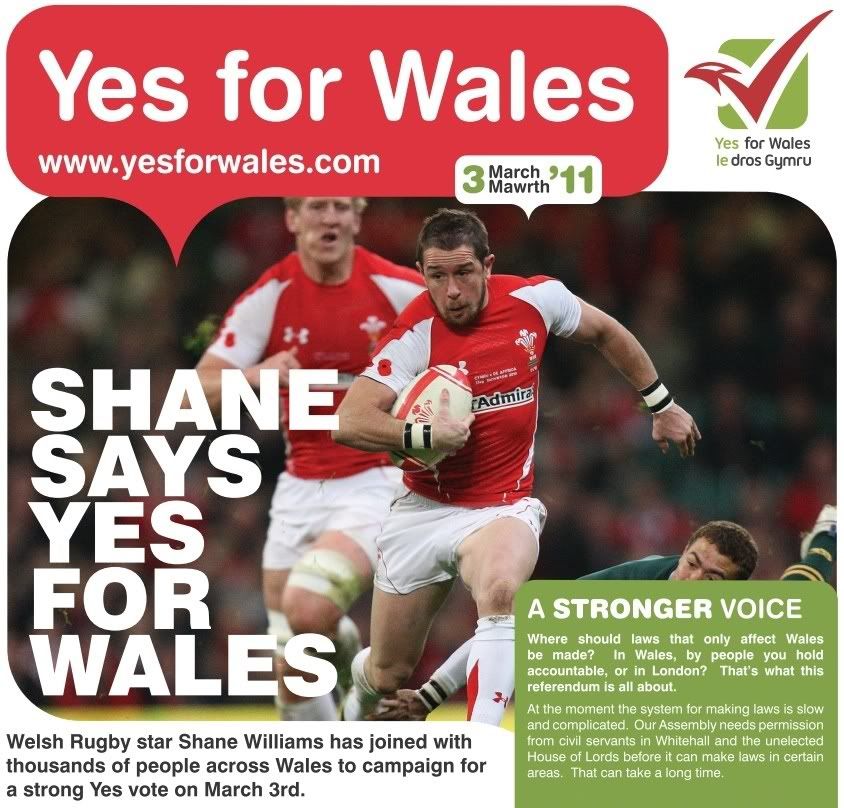
Well done, Shane

 
... and thanks for a couple of tries today, too ;-)

Bookmark and Share

Labour try to divide the Yes vote

What do the recent announcements by Peter Hain, Paul Murphy and now Hywel Francis have in common?

Each one of them is deliberately misrepresenting what this referendum is about and, instead of concentrating on the issue at hand, trying to turn the referendum into the first part of Labour's campaign for the Assembly elections in May.

•  Peter Hain's claim was that voting Yes would transform the Welsh economy. But voting Yes will do no such thing, because the lawmaking powers we will get when we vote Yes specifically will not give Wales any fiscal or economic powers.

•  Paul Murphy claimed that voting Yes had nothing to do with the procedural intricacies of lawmaking in Wales. But the referendum is only about the way the Assembly will be able to make laws and nothing else.

•  Now we have Hywel Francis claiming that voting Yes will deliver a blow against the cuts being imposed by the ConDem government in Westminster. But voting Yes will not save us from a single penny of the cuts that have been made by them, nor the deeper cuts that are going to be made by them over the next few years.

So what would explain their actions? At one level it's very simple: they have decided that people in Wales simply aren't capable of understanding the issue at hand, and are therefore trying to make out that the referendum is about something they think people in Wales will understand. That doesn't say much about their respect for people in Wales, and it makes what they are trying to do no different from what True Wales have been trying to do when they claim that this referendum is about increased taxes, more politicians, or the "slippery slope to independence".

But there's more to it than that. It is clear that each of them is using this referendum as an opportunity to attack the Tories, but both Paul Murphy and Hywel Francis have now introduced a rather sinister sub-text. Paul Murphy criticized the Yes campaign because, as an all-party group, it had what he called "the problem" of not being able to attack the Tories in the way he would like; and Hywel Francis claimed that the Yes campaign was:

making it more difficult to mobilise a full-blooded anti-Tory campaign

So it's hard to avoid the conclusion that they are putting two fingers up at the careful work of the Yes for Wales campaign.


Now these three men are certainly being unscrupulous, but they are not stupid. They are quite sincere in wanting a Yes vote now, even though the only reason they've changed their minds is because they realized Labour was going to lose power at Westminster. They thought things were fine ... so long as they were in government there.

So would they put a Yes vote in danger by undermining the Yes for Wales campaign in this way? I don't think so. I think they have calculated that the margin in favour of a Yes vote—at least 20% in nearly all the polls—is such that they can afford to undermine cross party support for a Yes vote. So they reckon it probably won't matter if they alienate Tory and LibDem supporters so much that they vote No or, more likely, stay at home ... so long as they get a few Labour supporters who would otherwise stay at home out to vote.

As I see it, they realize that although a good many of their supporters do understand what this referendum is about, and will vote on the issue at hand, there are others who simply don't understand and who therefore see no point in voting in the referendum. They want to persuade these people that the referendum is, to all intents and purposes, just another party political election in which Labour is on one side and the Tories on the other. By getting people to vote Yes for Labour's reasons they hope that the referendum campaign will trundle on and seamlessly morph into Labour's campaign for the Assembly elections in May.


The big question is how the rest of us should react to this tactic. I think we shouldn't ... or at least not yet. In the immortal words of Huw Lewis, we should "Let Labour be Labour." We simply need to point out what they're doing and why they're doing it, but should not let ourselves be distracted from explaining why it is important for us to be able to make laws in those areas that are already devolved to Wales. If we stick to the job at hand, we will not alienate those from other parties who support a Yes vote.

Nor, I suggest, should we in Plaid react with anger to the sort of personal attacks that Labour have just made on Ieuan Wyn Jones. It's all part of the same strategy, in all probability orchestrated by the same elements in the Labour Party at Westminster. They want to turn what should be the campaign for a Yes vote in March into the early skirmishes of the campaign for the Assembly elections in May.

We can afford to wait a few weeks. Right now we need to keep fighting an inclusive, uniting campaign for a Yes vote; for the sake of Wales, and for the sake of people of all political persuasions in Wales. But after that—though maybe allowing a day or two for the hangover from the celebration party on 4 March to wear off—we can turn our attention to campaigning for the Assembly elections ... and do it with a clear conscience.

Bookmark and Share