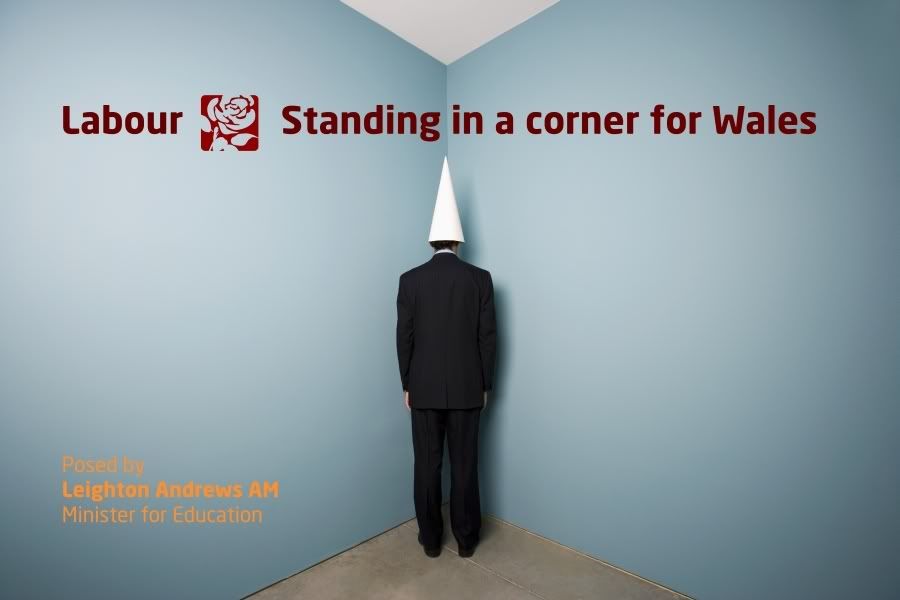
It was either great timing or an even greater stroke of luck that Leighton Andrews' should announce the consultation on revising the statutory procedures for schools reorganization at the same time as news broke that Ysgol Capel Iwan would have to remain open for up to a year, even though it has no pupils.
It's all to easy to put two and two together and conclude that we must speed things up in order to prevent future fiascos of this sort. But I think we'd be shooting at the wrong target.
The situation at Capel Iwan is a fiasco, but it is not too serious a fiasco. It's easy to throw a figure like £110,000 into the air, but the reality is that the staff concerned are not going to be paid to do nothing; they will be given notice or deployed elsewhere. And even if the school had been formally shut down, the building would still be there; empty, needing security, and as likely or unlikely to find a new use as it is now. Yes, it is an embarrassment to Sir Gâr, who had not addressed the problem of a school where the numbers had halved from around 30 in 2006/7 and 2007/8 to 16 in 2008/9 and 13 in 2009/10. But the irony is that if the Council had made a proposal to close the school, it might well have galvanized the local community into a protest campaign and action to save it. That might have encouraged new parents to send their children there, and that might have kept it going for longer. Perhaps lack of publicity allowed this school to die a "natural death".
-
School closures of this type are inevitable. By any objective measure the number of surplus spaces in schools has to be addressed, and this means that some schools will have to close. In a good number of cases, given the demographic trends, the situation is so black-and-white that it is tempting to think that the statutory procedures can be made more simple. But we must be very wary of using these black-and-white cases as a justification for curtailing all statutory procedures. The tail must not be allowed to wag the dog.
The consultation document that Leighton Andrews has produced is very simple. It merely proposes that the statutory objection and response periods be halved, and that they must not be made in school holidays.
Objections to statutory proposals for school organisation
In my opinion this is far too simplistic a "solution" to a rather more complicated problem.
-
The main principle at stake is that people must have adequate time to consider and respond to reorganization proposals. It seems obvious to me that reducing the objection period from two months to one month is, in some cases, not going to allow enough time for this to happen properly. Firstly the documentation is not always available at the start of the period, and secondly it still doesn't give enough time for the local community to set up meetings to discuss the proposals.
We need to be aware that there might be two very different scenarios under which changes are proposed. In all cases the local authority will have already put proposals out for preliminary consultation, in many cases with a number of different options in a genuine desire to engage with the community to find a way forward. In such cases I believe that the statutory process could be refined, because the resulting formal proposal will hardly be news to the community concerned. However, there is another scenario in which a local authority could come up with a markedly different proposal, perhaps because of the unacceptability of a first proposal that did not properly consider the range of options. So although cutting the statutory period might well be reasonable in the first case, it would not be reasonable in the second.
The better solution must surely be for the statutory period to be cut only when there has been sufficient previous consultation on a number of options beforehand, and where the chosen proposal is substantially similar to one of the options. This will mean giving the earlier consultation some statutory status. Publishing it with this status would be necessary to prevent a very cursory proposal being passed off as a proper consultation.
-
When it comes to a local authority's response time, I would have no objection to this being cut from a month to two weeks. In most instances it is a foregone conclusion that there will be at least one objection to any proposal, and only one objection is all that is currently necessary before the decision is referred to the Welsh Government. So the local authority becomes not much more than a "sorting office". There's no issue of principle at stake, just paperwork.
But Leighton Andrews' proposal misses the wider point. The bigger problem that needs to be addressed is that it only takes one objection for the matter to be referred to the Welsh Government. To my mind, this is a ridiculously low threshold that we urgently need to revise. I realize that there is a political "power play" in operation here. This proposal has come from the WG, and the changes it proposes will simply put more pressure on local authorities without imposing any commensurate improvement in response at a national level. Leighton Andrews has also made no secret of the fact that he wants to take education out of the hands of the 22 local authorities and put it into the hands of a smaller number of regional education authorities instead. In this "power play" it is hardly surprising that his proposal makes no attempt to change the unequal balance of power between local and national government. It is also worth pointing out that if such regional education authorities are formed, they would need to have a corresponding degree of democratic accountability. Local authorities have the great virtue of being directly elected.
I believe that we should set higher thresholds for the number of objections necessary before a decision is passed to national government. I think we also need to make a distinction between objections from local people and organizations, and those of others from outside. I wouldn't want to be dogmatic about the figure, but it has struck me as odd that some proposals attract many thousands of objections when the numbers who would be affected by the proposal can only be in the hundreds. I'd suggest that it should take a minimum of 25% of those in the catchment areas (i.e. the immediate catchment area and the surrounding catchments which children would move into or from) and for the number of such objections to be greater than the number of endorsements, before the matter can be referred to national government. Of course that wouldn't stop others from outside the area making objections or endorsements, or having them considered in the same way as local objections.
But I have a degree of misapprehension about even that. For in principle I think that these decisions should be made locally rather than nationally. Perhaps a good analogy would be with the planning process: that the decision would normally be made locally, but that the minister concerned would be able to "call in" certain proposals in certain defined circumstances. I think that the role of national government should be to set targets and lay down procedures to be followed ... and in addition to this they will also exercise a large degree of influence by means of funding. These tools should be quite sufficient in themselves without passing the power to make almost every decision to a minister in the WG.
-
There is one other aspect in which the current decision-making process is fundamentally flawed. In some cases the decision will either be to do what is proposed, or not to do it. But in other cases there will be a number of different options, each of which will have its pros and cons, but with not much to choose between them.
What happens at present is that a local authority will, if it conducts a preliminary consultation, have put a number of options forward for consideration. But it will then only be able to put forward one statutory proposal ... though hopefully the one chosen will reflect local opinion better than the others. If the proposal is referred to the Welsh Government (no matter whether we establish a new threshold or not, or whether the proposal is "called in" under the alternative arrangement) the minister is currently only able to rule on that one proposal. S/he must either accept or reject it, and if s/he rejects it everything has to start over from square one, even though it might be obvious that a solution needs to be found urgently.
I would like to see a situation in which the local authority presents a range of options in the first consultation. The LA would then choose its favoured proposal for the second consultation, but could include alternatives. If the threshold for objections was not reached, the LA would proceed with its favoured proposal. But if it was reached, the minister would then have the option of either approving it, or rejecting it in favour of one of the alternative proposals, or rejecting all of the proposals. If Leighton Andrews really is concerned about speeding up the current statutory processes, this flexibility would do much more to achieve that aim than merely cutting out a few weeks, but not changing the current arrangements in any other way.
To put it in blunter terms, there is often more than one way to skin a cat.
What is wrong with the current system is not the time it takes, but that it lacks any degree of flexibility. What is the point of saving six weeks, but then losing a whole year or more by having to go back to square one? Also, as almost all reorganization proposals can only be implemented at the start of the school year, how can saving six weeks make any real difference anyway? Leighton Andrews is just tinkering at the edges rather than dealing with the real problem. I would therefore urge people to reject his proposal as it stands, and to press for a more ambitious overhaul of the system that would result in:
• the formal recognition of preliminary consultations
• a higher threshold before the decision is referred to the Welsh Government, or a "calling in" system
• the inclusion of alternatives which the minister could approve if s/he rejected the main proposal
We have until 5 November to respond. Details of how to do so are here.