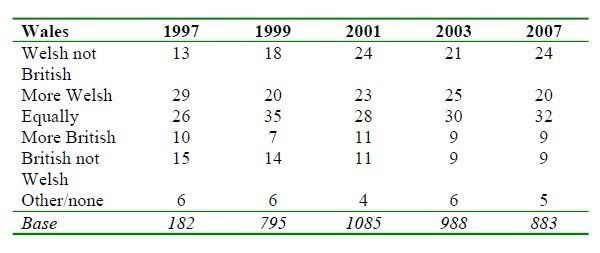
When the 2011 census figures on national identity for Wales and England were released last year they showed that people in both countries overwhelmingly rejected the idea that Britain was a nation. The equivalent figures for Scotland are among those that have just been released today, and they show almost exactly the same thing.
To demonstrate this, I have updated the table I included in this post to include the figures for Scotland. Although the wording of the questions is slightly different, it is important to notice that these are specific questions about national identity rather than identity in a more general sense.
How would you describe your national identity?
Tick all that apply ...In Wales:
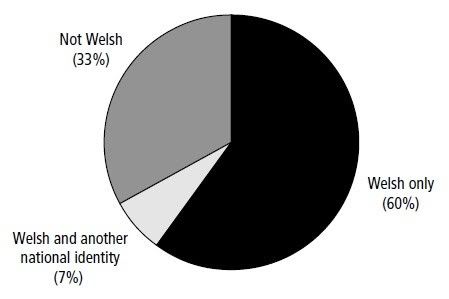
Welsh only ... 57.5%
Welsh and British only ... 7.1%
Welsh and any other(s) ... 1.2%
Welsh in any form ... 65.9%
Not Welsh ... 34.1%British only ... 16.9%
British and any other(s) ... 9.4%
British in any form ... 26.3%
Not British ... 73.7%English only ... 11.2%
English and British only ... 1.5%
English and any other(s) ... 1.1%
English in any form ... 13.8%
Not English ... 86.2%In England:
English only ... 60.4%
English and British only ... 9.1%
English and any other(s) ... 0.7%
English in any form ... 70.1%
Not English ... 29.9%British only ... 19.2%
British and any other(s) ... 10.1%
British in any form ... 29.3%
Not British ... 70.7%Welsh only ... 0.6%
Welsh and British only ... 0.1%
Welsh and any other(s) ... 0.1%
Welsh in any form ... 0.8%
Not Welsh ... 99.2%What do you feel is your national identity?
Tick ALL that apply ...In Scotland:
Scottish only ... 62.4%
Scottish and British only ... 18.3%
Scottish and any other(s) ... 1.9%
Scottish in any form ... 82.6%
Not Scottish ... 17.4%British only ... 8.4%
British and any other(s) ... between 8.4% and 10.7% *
British in any form ... between 26.7% and 29.0% *
Not British ... between 71.0% and 73.3% *English only ... 2.3%
* The dataset for Scotland has been released in a less detailed form, making it impossible to distinguish between those who describe their national identity as, for example, Welsh only and those who describe it as Welsh and British. However these groupings only account for 2.3% in total and therefore don't affect the overall picture by very much.
Census 2011, Table KS202EW
Scottish Census 2011, Release 2A, Table 6
In each country the figure who describe their national identity as British in any way, shape or form is less than 30%. There is hardly any difference between the three countries. The figure is lowest in Wales at 26.3% and highest in England at 29.3%. This is an emphatic rejection of the idea of Britain as a nation across the whole of this island.
Instead, a large majority of people in all three countries think of their national identity as being Welsh, English or Scottish only. Again the figures are remarkably similar: highest in Wales at 69.2% (57.5% Welsh only, 11.2% English only, 0.5% Scottish only) and lowest in England at 61.8% (60.4% English only, 0.6% Welsh only, 0.8% Scottish only).
In both cases Scotland sits neatly in the middle. However there is one significant difference: the percentage in Scotland who regard their national identity as Scottish and British is very much higher (18.3%) than the equivalent figure in either Wales (7.1% Welsh and British) or England (9.1% English and British). And, correspondingly, the figure for those who regard their national identity as British only is very much lower in Scotland (8.4%) than it is in either Wales (16.9%) or England (19.2%).
I don't fully understand the reason for this, and I'd value people's thoughts about why opinion in Scotland should be so different.
-
In closing, I think I should repeat the point I touched on before. These census questions are specifically about national identity, not about identity in a more general sense. Most people in Denmark would feel Scandinavian and be happy to identify themselves as Scandinavian ... but would never describe their nationality as Scandinavian. Most people in the Netherlands would feel European and be happy to identify themselves as European ... but would never describe their nationality as European.
In the same way, it is perfectly possible for people to feel British without considering their nationality to be British. There's nothing wrong with the idea of Britain; it is perfectly reasonable to describe the geographical, historical, cultural and social identity we have in common as British.
But it is wrong to describe Britain as a nation, and even more wrong to describe Britain as "one nation". The census evidence shows that the people who live on this island overwhelmingly reject the idea of Britain as a nation. Instead, the vast majority of us see our national identity as Welsh, English or Scottish only.