Showing posts with label Labour. Show all posts

I'm voting Labour tomorrow

It probably won't surprise anyone that I would never vote for the Tories or for UKIP, but I have seriously considered the others. Under a preferential voting system, my first preference would go to the Greens; Plaid and Labour would vie for second and third depending on the particular circumstances of the election and the quality of the local candidates; and the LibDems would come fourth, although at present their policy of holding a second referendum on Europe (even if for the wrong reason) makes them a rather more attractive proposition than they would usually be.

-

At present, Wales is part of the UK. At a UK level Plaid Cymru are all but irrelevant. Even if Wales elected 40 Plaid Cymru MPs it would probably not make any difference in a House of Commons that has 650 members.

Plaid Cymru have developed two particular conceits which annoy the hell out of me: that they are the only party that speaks for Wales and that they are the only party that represents Welsh interests. Plaid Cymru will only ever be able to claim that it "speaks for Wales" when more people in Wales vote for them than for any other party. If you want to use that sort of language, the party that "speaks for Wales" is, and has been for generations, Labour. Plaid needs to do the hard work of winning more votes before it can make that claim. Additionally, no party can claim that it uniquely represents Welsh interests. What is in our national interest is a matter of political opinion, and election campaigns are all about presenting different political positions and persuading voters about the merits of each. Even parties like UKIP and the Tories stand in Wales because they believe that their policies are in the best interests of Wales and, even though we might not like it, a good number of our fellow countrymen and women vote for them ... and are no less Welsh because of it. For me, Plaid Cymru's current leadership has given up on trying to persuade people about the merits of their policies, and instead started to go down the very dangerous road of suggesting that some parties (and by implication the people who vote for them) are anti-Welsh.

My advice to Plaid is to give up on this approach and concentrate instead on how and why their vision of what they want Wales to become, and their particular policies for getting there, are better for Wales than those of other parties in Wales.

Plaid's manifesto for this election was cringeworthy. Time and time again they promised to deliver on things which they couldn't possibly deliver .... even if Plaid were to win every single seat in Wales.

In contrast, Labour are a far more realistic choice at a UK level. For the first time in several decades, Labour have put forward a manifesto which will move the UK more to the left. Under Jeremy Corbyn, there is a glimmer of hope that the UK might become a significantly better place in which to live. That's good while we're part of the UK and good if the UK breaks up, because the people of England will always be our neighbours.

-

I want Wales to be independent for two reasons. The first is that Wales is a nation, and we deserve to stand on our own two feet as a nation, side by side with all the other nations of the world. However I realize that this is a sentimental view, perhaps more a matter of the heart than the head.

But the second reason I want Wales to be independent is that I do not like the political direction that the UK seems determined to travel in. The UK, and specifically the welfare state and public ownership of key sectors of the economy, that our parents and grandparents built after the second world war was something to be proud of. I benefited from it enormously. But over the past few decades it has been, and still is being, systematically dismantled. A Labour-led government under Corbyn, McDonnell and their colleagues offers the hope that this will be stopped, and perhaps even reversed. In my opinion that is worth voting for, although I half fear that it's already too late.

Will Labour deliver if elected? Who knows? I don't think any government achieves everything it sets out to achieve, but it might succeed in changing some things for the better and pointing the UK in a different direction of travel. Perhaps I'm being sentimental in this too.

-

Being more hard-headed, it is still unlikely that Labour will win tomorrow. To form a government they will probably need a supply and confidence arrangement with the SNP. Perhaps all that voting Labour will achieve is to give the Tories a couple of dozen fewer seats, which hopefully will force the Tories to take their foot off the accelerator so that the car crash which is Brexit will be a little softer.

However, I'm sure of this: if the Tories do form the next Westminster government, it will be a catalyst that helps bring about a united Ireland and an independent Scotland more quickly than would otherwise be the case. If I were more Machiavellian, I might encourage people to vote Tory for that very reason. But it would be like voting to leave the EU knowing that Brexit would make a united Ireland and an independent Scotland more likely. I can't in all conscience do something bad in order to bring about something good. No, I want to be able to argue for an independent Wales as the only way left for us to be part of a society which values public ownership and control of key sectors, rather than ever-increasing privatization and marketization of things that should be held by us all for the common good.

This election might well be the last chance the UK has to reverse its ever-rightward direction of travel and the inevitable self-destruction it will bring. For that reason I will be voting Labour tomorrow. I want to be able to say that I tried.

Bookmark and Share

Labour and the devolution of policing to Wales

As there seems to be some doubt over whether the devolution of policing to Wales is, or is not, Labour Party policy, I thought I would look more carefully at the subject.

Labour is a party that puts great store on its manifesto commitments. Being cynical, this is because there are often very different policy proposals within Labour, and because there are sometimes conflicts between what conference decides and what Labour leaders want. So the current definitive guide to what Labour's policy is on any issue relating to Wales is Labour's Welsh manifesto 2015, which is here.

These are the relevant quotes from it:

Foreword
We will strengthen devolution once again, guaranteeing fair funding for Wales, as well as powers over policing, energy, transport and elections.

Page 13
We will help make communities safer, by protecting and strengthening neighbourhood policing and will devolve to the Welsh Government the powers to shape the priorities and the governance structures for policing in Wales.

Page 52
We will devolve powers over policing so that Welsh Ministers can devise an all-Wales policing plan to ensure it reflects Welsh priorities.

Page 62
The Welsh Government has long demonstrated that locally made and locally accountable decision making is both more legitimate and effective. So we will give more powers to the Welsh Government, legislating early in the next Parliament to devolve to Wales powers outlined in the cross party Silk Commission, including on policing and elections, energy and transport.

This is not an absolutely unequivocal commitment to "devolve policing", but better interpreted as a commitment to devolve some powers over policing ... specifically so that Welsh ministers "can devise an all-Wales policing plan" and set up appropriate "governance structures for policing in Wales".

-

Some of us might well be concerned that this does not go far enough, and would like to see policing devolved in its entirety. That is a simple thing to say, but things are more complicated than that. The quote from page 62 of the manifesto commits Labour "to devolve to Wales powers outlined in the cross-party Silk Commission, including on policing ..." so it is worth looking to see what the Second Silk Report says. These are its precise recommendations on the subject:

Recommendation
R.24 On policing, we recommend:

a. policing and related areas of community safety and crime prevention should be devolved;

b. existing levels of cross-border police cooperation should be maintained;

c. powers in respect of arrest, interrogation and charging of suspects, and the general powers of constables, should not be devolved unless and until criminal law is devolved;

d. the National Crime Agency should not be devolved;

e. police pay should be devolved, but police pensions should not be devolved; and

f. the two Governments should agree charging systems and terms of service provision for the Police College, Independent Police Complaints Commission, HM Inspectorate of Constabulary and common services such as the Police National Computer system.

Second Silk Commission Report, Page 111

So it seems clear to me that Carwyn Jones is perfectly correct to say, as he did today in response to Andy Burnham, that Labour's policy is to devolve policing ... to the extent recommended by the Silk Commission.

-

To understand where the boundaries of what is and what is not devolved lie, this quote from David Hanson, Labour's shadow police minister in 2013, is useful:

"... but there are some really complex issues around this in relation to serious organised crime, counter terrorism, the legal system, justice, probation, which need to be examined in very great detail before such a major step would even be considered to be taken. It isn't just a simple matter of devolving policing to Wales because counter terrorism, serious organised crime, cross-border issues, much of the crime in my part of Wales derives from people who live in England."

Mr Hanson stressed that he was not arguing against the idea: "I'm just saying there are many challenges to this."

BBC, 19 February 2013

Remember that his contribution was made before Labour's policy was settled in the 2015 manifesto. Nonetheless, his points are valid, but easily answered. With regard to policing, things like serious organised crime, counter terrorism and border control would be handled on a UK-wide basis though the National Crime Agency, a body that was set up later that same year. This is how things already work in the Six Counties and (to a large extent) Scotland, and therefore explains why Silk II specifically recommended the NCA should not be devolved.

Bookmark and Share

Sweet stuff ... and nonsense

It was nice to see Geraint Davies, the Labour MP for Swansea West, come out in favour of a tax on sugary drinks in this tweet today:

The reaction was for a number of Plaid Cymru supporters to say that this was Plaid's policy, put forward in our conference in October 2013. But, as I noted at the time in a comment on this post, it was not Plaid that came up with the idea. The policy had been put forward by Sustain, on behalf of over 60 organizations, in January 2013 in a document entitled, A Children's Future Fund: How food duties could provide the money to protect children’s health and the world they grow up in, and Plaid seem to have lifted the policy from them.

People can download the document by clicking the image.


Of course there's nothing wrong with a political party lifting ideas from organizations like this ... although the details will need to be refined. In principle, I think it's a good policy for public health reasons, and therefore one that deserves to be implemented. Even though I'd like the kudos of Wales doing it first, it doesn't really matter whether it's enacted across the UK (or whatever's left of it) by a government at Westminster, or across Wales by a government at Cardiff Bay.

Nor do I really care exactly how the money raised by such a tax is used. Wales does have a shortage of doctors compared with other countries, so Plaid's proposal to hypothecate it to employ a thousand more doctors is fine; but using it to "subsidize healthy foods" might work too.

So let's try and put our tribalism to one side and see if we, Plaid Cymru and Labour, can make it work. The Assembly already has the power to do this as a levy (in the same way as for single-use bags) so we could easily get it through before May 2016 if we put our minds to it without waiting for the Wales Act; but there's no chance of it even being considered in Westminster before May 2015.

Bookmark and Share

Relief

The overwhelming feeling, both for me and for most people who support Plaid Cymru, after the announcement of the European Parliament election result will be relief that Jill Evans managed to hold on to her seat.

Plaid lost a lot of their support and were in a fairly miserable fourth place. In the end Jill's seat was saved by Labour's failure ... and by UKIP's success.

-

In the Welsh Political Barometer in February and YouGov poll in April, Labour were at 39% (details here) and in last week's Wales Political Barometer they were at 33% (details here). These percentages would easily have given Labour two seats. But in the end, Labour only managed to get 28.15% of the vote. This fall in support for Labour, and this alone, enabled Jill to squeeze in with 15.26%. If Labour had managed to get 30.6% of the vote, they would have won the fourth Welsh seat by getting more than twice Plaid's vote.

-

Looking back at the campaign, Labour did themselves no favours by not really contesting these elections. They kept a low profile, not really engaging in the fight in any meaningful way; probably thinking that this election didn't really matter and keeping their resources safe for fighting the 2015 Westminster election instead. So they've only got themselves to blame for not getting two Welsh seats.

The second factor was that UKIP did much better than even I imagined they would do. They were never in any danger of not winning a seat in Wales, but they probably picked up enough votes from people in Wales who would otherwise vote Labour to keep Labour below the magic 30.6% that would have squeezed Plaid out. Mark Hutchings tweeted it right: UKIP saved Plaid's bacon.

So Plaid owes UKIP a rather large thank you. Quite ironic really, as Plaid's main tactic in this election had been to single out UKIP for attack.

Bookmark and Share

The Collapse of the Centralist Left

Before it becomes old news, I'd like to draw attention to the latest political opinion poll in Catalunya, as published in El Periódico last week.

The most notable thing about it is the remarkable surge of support for ERC, the Catalan Republican Left, the only party in Catalunya to have consistently supported independence. They are Plaid Cymru's sister party in the EFA Group in the European Parliament.


•  ERC - Esquerra Republicana de Catalunya ... left, Catalan
•  CiU - Convergència i Unió ... centre-right, Catalan
•  PSC - Partit dels Socialistes de Catalunya ... centre-left, Spanish
•  ICV - Iniciativa per Catalunya Verds ... eco-socialist, Catalan
•  PP - Partido Popular ... right, Spanish
•  Cs - Ciutadans ... left, Spanish
•  CUP - Candidatura d'Unitat Popular ... left, Catalan

The result of the election in November 2012 is shown in the inner ring, and my thoughts on that result are here. In the negotiations after the election, CiU had wanted to form a coalition with ERC, but in the end formed a minority government without support from any other party. They were able to do this because there is no way that a right wing, anti-independence party like the PP would ever see eye-to-eye with left wing, pro-independence parties like ERC and CUP, and would never vote the same way on any issue. Therefore the PP's 19 votes are effectively cancelled by 19 of the votes from ERC and CUP deputies, and with 38 votes effectively "paired" CiU can just about govern on their own.

ERC did, however, commit themselves to not vote against CiU on no-confidence issues that could bring down the government and force an early election, provided that sufficient progress was made on moving towards independence. This seems to be happening, and there will almost certainly be a referendum on independence in 2014.

-

In one sense, the swing away from CiU shown in this poll is only to be expected. Having to preside over a programme of austerity (forced in the sense that the Spanish government has required the Autonomous Communities cut their deficit much more stringently than central government has had to do, but not forced in the sense that CiU are a right-of-centre party that would make those sorts of cuts anyway) is hardly likely to make any government popular. So the swing from right to left is no great surprise.

What is interesting is that the swing has not benefited the pro-Spanish PSC, which had always been the largest party of the left until last year's election. The swing has instead gone primarily to ERC who have all but doubled their support and are now the largest party, but with ICV and the Cs also making gains. In other words, it has gone to parties which have unequivocal views on the matter of self-determination. The lion's share has gone to the pro-independence and pro-right-to-decide parties, ERC and ICV, but some has gone to the unequivocally pro-Spanish, anti-independence Cs. The PSC has been squeezed out because it has tried to sit on the fence. It has tried to be pro-Spanish to the Spanish and pro-Catalan to the Catalans, but it can't have it both ways.

-

I think there are lessons to be learned from this, and from what happened in the election in Euskadi. In both countries support for the major Spanish left-of-centre party (PSC in Catalunya and PSE-EE in Euskadi, but both are no more than local branches of the centralist PSOE) has collapsed, with the majority of their support switching to nationalist left-of-centre parties instead.

What is happening in Spain is also happening in the UK. The Labour Party, even though it tries to market itself as having Welsh and Scottish versions, is essentially monolithic. It will always gear itself to policies tailored to win support in the UK as a whole ... and this, of course, means England, because about 85% of the UK's population lives in England. By definition, this means that the Labour Party cannot stand up for the interests of Wales and Scotland on matters where our national interests differ from those of England. It can't have it both ways, and once this simple fact becomes clear to the electorate, voting patterns that have been ingrained for decades will suddenly shift from the centralist left to the nationalist left.

It has happened in Scotland with the SNP. It has happened in Euskadi with EH Bildu. It has now happened in Catalunya with ERC ... and exactly the same will happen in Wales with Plaid Cymru.

Bookmark and Share

Push, Push

As someone who believes in universal benefits paid for by progressive taxation—even when parties that used to know better are turning their backs on the principle—I was impressed to learn that Finland gives every expectant mother, rich or poor, a free box filled with essentials for their new-born baby.


And it doubles as a cot. Handy.


But that's not the best bit. The Finnish government also publishes a helpful booklet called Having Children in Finland


As we can see from the cover, it is pushed out by the Ministry of Labour. How very appropriate.

Bookmark and Share

N is for National, National means Wales

In my last post, I commented on Owen Smith's speech to the Labour conference at Llandudno last weekend, particularly his repeated emphasis on the idea of Britain (or the UK, for he used both interchangeably) as "one nation". I noted that this was very different from what he had said at the Labour Conference in Manchester last October, for all the emphasis in his speech then was on "the nations of Britain" as opposed to Britain as "one nation".

These two different positions effectively delineate the long-standing fault line in the Labour Party in Wales between those who want Wales to take increasing responsibility for its own affairs and those who are more sceptical about, if not exactly hostile to, the devolution settlement moving forward. This difference became very apparent recently not only in the reported "roasting" that Carwyn Jones received from Labour MPs for making a submission to the Silk Commission without first having consulted the wider party, but also in the contrast between Owen Smith's and Carwyn Jones' speeches last weekend.

The difference between those speeches has been widely commented on already, but I thought that this part of the speech from Mark Drakeford provided the clearest and most forceful rebuttal of the idea of Britain as "one nation":


The point of me writing this is not to try and magnify the rift, nor to take political advantage from it. It is to try and persuade people within the Labour Party that it is far more appropriate to see Britain as a collection of nations that share much in common rather than as "one nation". It is not a matter of party politics or ideology. It simply reflects the way that most people on this island see themselves, as the census results show all too clearly.

Bookmark and Share

Rewriting history: Owen Smith's "one nation"

After the highs of the SNP Conference in Inverness, I've just undertaken the rather more dour task of watching the recorded coverage of the Labour Party Conference in Llandudno.

One thing that struck me was the inordinate number of times Owen Smith talked of "one nation" in his speech. He spoke of Britain or the UK as "one nation" no less than eight times, and also used the term "wider British nation". In contrast, he didn't refer to Wales as a "nation" at all. This was picked up by Vaughan Roderick and Karl Roberts immediately afterwards, with Vaughan describing the speech this way:

VR: If you like, it was Owen Smith explaining what he meant when he came up with the term "one nation" and gave it to Ed Miliband.

KR: Yes. I'm not sure if everybody is aware, but it was coined by Owen Smith, wasn't it?

VR: That's right, yes.


Ed Miliband used the term "one nation" as the major plank of his speech at the main Labour Party Conference in Manchester last autumn (here). It was, for Labour, a new term. It had previously been associated with the Tories, and the Tories were none too happy with Labour for stealing their clothes.

But how likely is it that Owen Smith coined the term and gave it to Ed Miliband?

To my mind it is so unlikely as to be impossible. As evidence of this, we simply need to look at what Owen Smith said at the very same conference last year. His speech was published in full in the Western Mail, and these are some of the relevant quotes from it:

The coalition tactic of divide and rule is clear not just in their approach to the nations of the UK – but to its people too.

And we remain a meeting place for British people of different faiths and nations, ages and wages.

Choices designed to respect devolution – but also to unite the people and the nations of Britain.

And we believe that the majority of the British people – in all our nations and regions – believe that too.

So let's unite the nations and people of Britain behind Ed Miliband.

Wales Online, 2 October 2012

So back in October last year—at the very time when he is supposed to have given Ed Miliband the idea of Britain as "one nation"—it is quite obvious that Owen Smith was thinking in terms of the "nations of Britain" rather than of Britain as "one nation".

As I said before in this comment when the national identity results of the census came out, what Ed Miliband had said about "one nation" trampled roughshod over what Owen Smith had said in his speech ... not to mention, of course, trampling roughshod over the way people in the nations of Britain see themselves. The vast majority of people in this island see our nationality as being Welsh, English or Scottish. Less than 30% of us see our nationality as British in any form, and that figure includes the very small percentage (less than 10%) who see their nationality as "Welsh and British" or "English and British".

I'm not sure where Vaughan and Karl got their story from, although I think it probably came from Owen Smith himself judging from what he said later in the programme. It seems obvious to me that they were being fed a lie. My guess is that it is another attempt at rewriting history, designed to paper over an obvious and embarrassing difference between him and his leader.

Bookmark and Share

Rewriting History

Owen Smith's father is a professor of history, and Owen himself should have some knowledge of the subject as his degree was in history and French. But sadly, he seems to have consigned it all to the dustbin and moved into the business of rewriting it instead.

On Thursday he told David Williamson of the Western Mail that,

"The Labour party championed the cause of devolution for over a century, and we delivered it for Wales and Scotland ... "

Wales Online, 21 March 2013

Who is he trying to fool? If you champion something, you would have taken steps to implement it when you were in a position to do so.

Did the Labour Party implement devolution when Ramsey Macdonald became Prime Minister in 1924 or in 1929? No. Did Clement Attlee's government implement it in 1945? No, and it refused to even contemplate having a Welsh Secretary and Welsh Office although Scotland had had both since 1885.

That wasn't rectified until Harold Wilson came to power in 1964. But if this counts as "delivering devolution" then Owen Smith would have to give the credit for delivering it to Scotland to Gladstone, rather than a Labour Party that didn't even exist at the time.

It was only when Gwynfor Evans won Carmarthen for Plaid in 1966 and Winnie Ewing won Hamilton for the SNP in 1967 that Labour began to take devolution seriously. Their response was to set up the Crowther/Kilbrandon Commission, which finally reported in 1973. Labour would have much preferred to leave devolution in the long grass, but the Wilson government of 1974 and Callaghan government of 1976 could only survive with support from other parties, and pressing forward with devolution to Scotland and Wales was part of the price for Plaid Cymru and SNP support. However process was sabotaged by Labour MPs at every step along the way, and the Wales and Scotland Acts of 1978 bore very little resemblance to what Kilbrandon had recommended. It was therefore hardly surprising that they didn't receive enough support in the referendums of 1979.

There was obviously no chance of Labour embracing devolution while Neil Kinnock was leader of the Labour Party (not that it matters, because there was no chance of Labour being elected while he was leader) and therefore it was only when John Smith became leader in 1992 that devolution for Wales and Scotland can be said to have become mainstream Labour policy.

Bookmark and Share

Owen Smith's absurdity

On The Wales Report last night Owen Smith said that the Welsh government should not have power to vary the rate of income tax,

" ... because we don't have the relative tax base in order to provide Wales with the volume of money that our needs requires."


This is an absurd line of argument. If not having enough of a tax base to provide you with "the volume of money that your needs require" was a valid reason not to have any major tax-setting powers, then the United Kingdom government should not have the power to set a rate of income tax either, or have any other macro-economic powers.

The "volume" of money it raises from taxation fell short of the money it needs to meet its spending needs by a massive £14bn in August alone. This is from a ConDem coalition government whose primary aim was to cut the UK's deficit, not increase it ... but the deficit would be even higher under Labour, because their main line of argument is that they would not cut it by as much.

And over the years, the tax base of the UK has been so inadequate to meet its spending needs that its national debt surpassed £1,000bn at the beginning of this year ... and it's getting bigger all the time.

-

What he went on to say in the interview was equally ridiculous. Immediately following the section I quoted above, he said that our low relative tax base was "why we've had Barnett".

No it isn't. The Barnett Formula merely ensures that any decisions which the UK government makes on spending in England require a proportionate amount to be given to Wales, Scotland and Northern Ireland as well. It has nothing whatsoever to do with the relative tax base of Wales, Scotland or Northern Ireland being inadequate. In fact Scotland's tax base is more healthy than the tax base of the UK as a whole; yet the Barnett Formula treats Scotland far more generously than it treats Wales.

-

Owen really hasn't thought things through. It's obvious that he doesn't want Wales to have any major tax-varying powers, and equally obvious that he and others in the Labour Party in Wales will therefore put all sorts of bogus arguments and unnecessary obstacles in our path to stop us getting them. But how else is Wales going to get the tools we need to do something to improve the state of our economy?

It seems that Labour see Wales as no more than a child. It's as if they see the money the Welsh government gets as pocket money given to us by Westminster, and the limit of their ambition is to let us supplement it with control of a few minor taxes ... the equivalent of doing a paper round. Big deal. Wales needs a government that is eager to take at least some responsibility for our economic performance. We won't make any real progress until we start to take this responsibility for ourselves.

Bookmark and Share

Labour's "core beliefs" ... the local picture

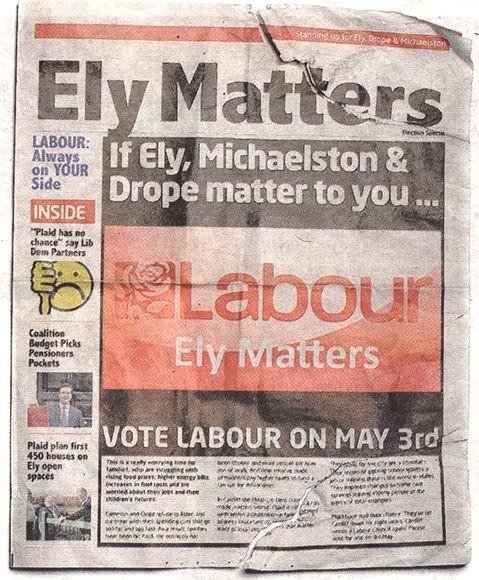
It was impossible not to smile at Labour's embarrassment about the election leaflets they intended to distribute in Ely which included this claim:

“I’m a graduate looking for a job but thanks to Plaid I can’t apply for most jobs in Wales because you need to speak Welsh.”

Wales Online, 14 April 2011

It's all very well for one of Labour's spokesmen to claim that this "clearly ran contrary to Welsh Labour’s policy position and core beliefs". Half of it might be true, but the other half certainly isn't.

-

Yes, let's be clear that Labour's policy position as a party is not anti-Welsh. In the past supporting the Welsh language was definitely a minority position within the party; but at a national level this has now changed, particularly because Labour decided not to make the language a political football in the National Assembly. That was a very welcome and sensible decision.

But what of Labour's "core beliefs"? To me, a "core belief" is a value held by every member and activist within a party – or at least by the vast majority of them. So we need to ask these questions:

     • who thought it was a good idea to include this quote in an election leaflet?
     • who gave the go ahead to include it?
     • who designed the leaflet?
     • who approved the leaflet for printing and publication?

It doesn't really matter who the particular individuals are, but it will surely be obvious to everyone that if just one person in that chain of decision-making actually did think that not being anti-Welsh language was a "core belief" of the Labour party this leaflet could never have been produced. As Oscar Wilde would have said: one mistake may be regarded as a misfortune, two looks like carelessness ... but four in a row?

-

All too often there is a huge discrepancy between what the Labour party is and does at national level and what the Labour party is and does at a local level. In too many parts of Wales, the local Labour party has members, activists and indeed councillors who regard Welsh as something to be opposed. This episode has again shown that Cardiff is one of those places ... but then so is Sir Gâr, Wrecsam, Blaenau Gwent, Caerffili and maybe half a dozen more councils across Wales.

So although Carwyn Jones or someone else at a national level in the Labour party might get round to apologizing for this leaflet and telling us that Labour are not really that sort of party, we need to remember that we are facing local elections in a few weeks' time, not national ones.


At local level, Labour is very much uglier.

Bookmark and Share

Carwyn rips up Labour's manifesto

Towards the end of First Minister's questions on Tuesday there was this exchange between Carwyn Jones and Leanne Wood, which I want to thank Naturiaethwr for drawing to my attention:


Leanne Wood: What discussions has the First Minister had recently with the UK Government on the natural resources of Wales?

First Minister: I attended the joint ministerial committee last month, where I repeated my call for the people of Wales to control renewable energy projects up to 100 MW.

Leanne Wood: Thank you for clarifying that, First Minister. Can you confirm that you only asked for energy projects up to 100 MW and that you did not ask for anything more? If you can confirm that, can you explain to us why your ambition for Wales is so limited?

First Minister: Because it's in renewable energy that we have the greatest potential in projects up to 100 MW. I suspect that that question is based on nuclear ...

Leanne Wood: No, not at all. It is nothing to do ...

First Minister: We fully support Wylfa B as a development for the people of Anglesey. I do not know whether your party does or not. We certainly want to ensure that, when it comes to renewable energy, the people of Wales have proper control over their resources.

Poor Carwyn was wrong on two counts. First, he claimed that the greatest renewable energy potential was in projects up to 100 MW. It isn't ... not by a very long way.

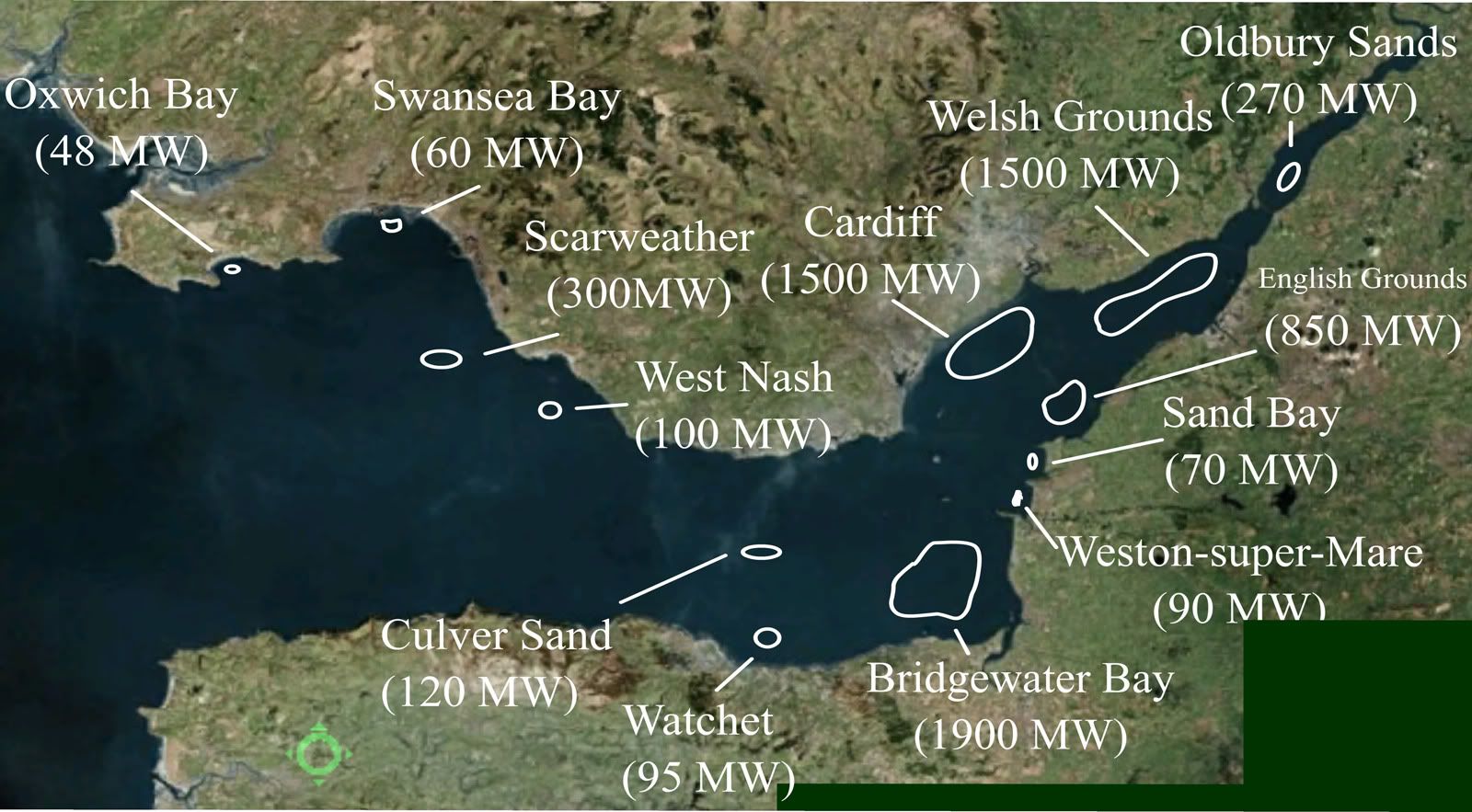
In terms of offshore wind, the size of the large projects in Rounds 2 and 3 completely dwarfs all the other windfarms in Wales put together. Gwynt y Môr, currently under construction, is 576 MW. The Atlantic Array in the Bristol Channel is 1,500 MW with about a third of this in Welsh waters. The Irish Sea Zone windfarms will probably have an installed capacity of 3,715 MW in Welsh waters, as I described in this post. At present, the total installed capacity of onshore windfarms, every one of which is below 100 MW, is about 377 MW. Even if we add the Round 1 offshore windfarms of North Hoyle at 60 MW and Rhyl Flats at 90 MW, there is still nine times more potential in larger schemes than in smaller ones of 100 MW or less.

In terms of energy from tidal lagoons—our other big potential source of renewable energy—the WS Atkins study for Tidal Electric identified six sites on the Welsh side of the Bristol Channel. The three larger ones totalled 3,300 MW, and the three that were 100 MW or less totalled 208 MW.


So there is fifteen times more potential in larger schemes than smaller ones of 100 MW or less. Carwyn really didn't have the first clue what he was talking about. He's looking at the small things, but completely missing the big picture.

-

But his second mistake was worse. For some reason he got in into his head that Leanne was asking him specifically about nuclear power. She wasn't, but that didn't stop him displaying his ignorance about Plaid Cymru's policy on nuclear energy in Wales.

Perhaps we can forgive him that, for there are one or two mavericks in Plaid who have tried hard to confuse people by misrepresenting what our policy is. But there really is no excuse for him not knowing what his own stated policy on nuclear energy is. Labour's manifesto for the Assembly election in May last year says:

The Assembly Government's Low Carbon Energy Statement sets out how we intend to maximise energy savings and energy efficiency, making the majority of the energy production we need in Wales from low carbon sources.

Welsh Labour Manifesto, 2011

And in that document it says:

Our approach to nuclear power in Wales is ... we remain of the view that the high level of interest in exploiting the huge potential for renewable energy reduces the need for other, more hazardous, forms of low carbon energy and obviates the need for new nuclear power stations.

Low Carbon Energy Statement, March 2010

Every one of Labour's AMs was elected on the basis of a manifesto pledge that Wales had no need for nuclear power. So what was Carwyn playing at by claiming that "we fully support Wylfa B as a development for the people of Anglesey"?

Is he just showing us how ignorant he is of his own party's manifesto? Has his government's policy position changed ... and was this done with the consent or even knowledge of his fellow Labour AMs? Or has the Labour party now got itself a maverick leader who's decided that what he thinks party policy should be on this issue is more important than the manifesto he and his fellow AMs were actually elected on?

Bookmark and Share

Labour: absolutely wrong, absolutely immoral

Carwyn Jones came out with an amazing attack on the performance of his own party when they were in power at Westminster on Dragon's Eye last Thursday:


He was, if he'd stopped to think before openning his mouth, talking just as much about the fact that in 2007 the Labour government in Westminster had introduced regional pay scales in the Department for Constitutional Affairs before it became the Ministry of Justice. This is a taste of the outcry that greeted the proposal:

     Welsh civil servants pay crisis
     Union condemns court 'pay divide'

Yet despite all the protests, Labour went ahead and implemented the plan in August 2007. The quality isn't very good, but this is a map showing how it works.


It would be laughable if it weren't so tragic. I'm sure that Carwyn Jones had completely forgotten about what his own party had done less than five years ago, for it would be hard to imagine him making such a gaffe if he had been. He just gave the unthinking, standard knee-jerk reaction that any Labour politician gives to a proposal that comes from the Tories in Westminster, completely unaware of the double standards involved.

But he has got it half right: the actions of Westminster governments are the problem, it's just that the colour of the government is irrelevant; for either way—whether under Labour before or the Tories and LibDems now—Wales loses out. Standing up for Wales doesn't just mean standing up to what the Tories are now proposing, it must also mean standing up to what Labour not only proposed, but actually implemented.

-

So yes, let's welcome the fact that Carwyn is at last prepared to consider the Welsh Government taking responsibility for negotiating and setting the terms and conditions for the public sector in Wales:

Welsh government 'could take over' public sector pay

The Welsh government might look at whether it can take responsibility for the pay and conditions of public sector workers, says First Minister Carwyn Jones.

Chancellor George Osborne has announced a review into regional pay adjustments for the public sector. Mr Jones said it could result in people in Wales being paid less to do the same work as people in south-east England.

"That's not acceptable," he said. "Ultimately we may have to look at taking over pay and conditions here in Wales. It's not as easy as it sounds. There are real issues in terms of how that's done. But if we're forced into that situation, better that than have people's pay cut by the UK government in London."

Regional pay was "code for cutting pay in Wales", he said.

BBC, 30 November 2011

But why leave it until "ultimately"? Isn't the writing on the wall clear enough? The Tories will do it, and will justify it by pointing to the fact that they are only doing what Labour did. Carwyn is just showing the same old passivity that has become his hallmark. Wake up, smell the coffee, and start pressing for public sector pay and conditions to be devolved to Wales now.

Bookmark and Share

What sort of kittens?

I've just listened to Eluned Morgan delivering the first Patrick Hannan Lecture.


Towards the end she told the story of a child who, when asked what sort of new-born kittens he had in his box, said they were "anti-independence kittens". A week later she took a friend to see these special kittens and was told by the same child that they were "pro-independence kittens". "Hang on," she said, "last week you told me they were anti-independence kittens. What's changed?" The child said, "Their eyes are open now."

OK, she didn't tell it quite like that. But it was interesting to hear her take on how Labour in Wales made the journey from being an anti-devolution to a pro-devolution party.

Yes, Labour have come a long way in the past thirty years ... but they still haven't quite got the picture.

Bookmark and Share

Still time to get that amendment in, Carwyn

As a result of Peter Hain's performance in front of the cameras over the last few days, Change of Personnel today asked a question about who is seen to be leading, or at least speaking for, the Labour Party in Wales.

But despite the accolades it got me wondering, if you didn’t know any better and let’s face it most people who watched across the UK and further afield wouldn’t, you’d believe from last week that Peter Hain was Wales’s First Minister and leader of the Welsh Government, not simply the Shadow Secretary of State for Wales.

He managed to totally out think and outmanoeuvre Carwyn Jones (admittedly not a particularly difficult task) who was there and met with families but remained in the background as Peter with help from his advisers took the lead on every front from the start of the unfolding tragedy. Everything from talking with the families, appearing with the police at press conferences and updating the gathered media to launching the appeal for families - would Alex Salmond, Peter Robinson or Martin McGuiness have allowed their respective Shadow Secretaries of State to take the lead in such circumstances in Scotland or Northern Ireland? I sincerely doubt it.

So why is Carwyn Jones, who is after all supposed to be the man elected as Wales’s First Minister, so willing to let Peter Hain do it in Wales? Is what’s best for the Labour Party still more important than doing his job and leading the country, especially during such a dreadful tragedy?

Change of Personnel, 19 September 2011

I don't particularly want to concentrate in this post on the tragedy that has unfolded over the last few days. That is something that rightly puts politics into the shade. I thoroughly dislike the idea of any politician taking more of the media spotlight than the police, the rescue teams and people speaking on behalf of the families. So although I think Peter Hain should have said very much less than he did, I would apply that to any politician. I saw Carwyn Jones, Bethan Jenkins and Gwenda Thomas interviewed about what happened, as well as some local councillors (there may have been others that I missed) and I think their shorter contributions were much more appropriate than those made by Mr Hain, who even when he wasn't speaking seemed to take inordinate trouble to be seen in the background.

Yet the question about who is seen to be leading the Labour Party in Wales is important, even though overshadowed by the tragedy at the Gleision Colliery.

-

First, we need to realize that Carwyn Jones is only the leader of the Labour group in the National Assembly, and is First Minister because of that. There is no Welsh Labour Party; there is just one Labour Party with Ed Miliband as its leader. Peter Hain and Carwyn Jones have to fight between themselves about which one of them is the most prominent Labour politician in Wales, with the right to speak for Labour in Wales.

Carwyn Jones is disadvantaged not only by his own lack of drive and ambition (something Peter Hain could never be accused of) but by the fact that the Labour Party itself regards what is decided by Labour in Westminster as more important than what is decided by Labour in Cardiff Bay. A good example of this was that the Labour manifesto for the Assembly election in 2011 was opposed to nuclear power, but a week before the election a Labour spokesman said that the party's definitive position on the issue was in fact in their Westminster manifesto of 2010, which supported nuclear power on Ynys Môn. As John Dixon noted, the clear message was that whatever the party in Wales thinks is irrelevant if it clashes with what the party in Westminster wants.

-

At present the arrangement in Scotland is exactly the same as it is in Wales; but they are now set to change it, as reported here only a week ago:

Scottish Labour breaks free of Miliband

Labour has announced plans to create a new Scottish leader and a beefed-up party north of the Border to fight back against electoral dominance by the SNP. The radical reforms, to be made following the crushing loss to the SNP in May's Holyrood elections, will lead to the loosening of ties with the UK Labour movement with UK leader Ed Miliband no longer in charge of party fortunes in Scotland.

The results of a review into the Labour trouncing at the polls were made public yesterday and were billed as the biggest shake-up of the party in Scotland for 90 years. They come a week after calls for the Scottish Conservative Party to be transformed and mean that the two leading UK parties are now undergoing changes that could bring a weakening of their bonds with Scotland. Further reforms to Scottish Labour will see local party associations, which are currently drawn on Westminster seats, being scrapped and reformed along Holyrood's boundaries in a move designed to shift the party's focus to Edinburgh and away from Westminster.

The moves were agreed by the party's ruling Scottish Executive committee yesterday, but they still have to be ratified by the UK Labour Party at its conference next month. The reforms were signed off in Glasgow after the three-month review led by MSP Sarah Boyack and MP Jim Murphy. They said that while the party had delivered devolution, it had failed to follow the same principles itself.

"This is about turning the Scottish Labour Party into Scotland's Labour Party. Today, we are completing the devolution of the Scottish Labour Party," Murphy said. "From now on, whatever is devolved to the Scottish Parliament will be devolved to the Scottish Labour Party."

Boyack said: "Labour devolved Scotland when we set up the Scottish Parliament in 1999, and we are proud of that. Labour used that Scottish Parliament to deliver important reforms for Scotland, but we didn't reform ourselves. Now we need to make devolution a reality within our party too."

Scotland on Sunday, 11 September 2011

As it happens, the Labour Party conference is next week rather than next month, but it seems fairly clear that the plan for the Labour Party in Scotland to be separately constituted, able to make its own policy in the areas devolved to Scotland, and with one clear elected leader, is going to be approved.

Therefore the obvious question is why this should happen for the Labour Party in Scotland but not for the Labour Party in Wales. The areas devolved to Wales might differ from the areas devolved to Scotland, but the principle should surely be the same.

Now, I can well imagine that someone in Labour might say that there now needs to be a separate Scottish Labour Party in response to their poor showing in the election in May ... but that nothing needs to change in Wales because Labour are doing perfectly well as they are. Why fix something that isn't broken? But my answer is that this change actually has nothing to do with Labour's poor performance in Scotland. The idea was in fact a key plank of Ed Miliband's campaign to become leader of the Labour Party back in June 2010:

Miliband says Scots Labour must make own policy

Labour leadership contender Ed Miliband says the party has to embrace differences north and south of the Border.

On a campaigning visit to Holyrood yesterday to meet MSPs he backed the idea of the Scottish Parliament going its own way from Westminster on legislation, and of the party in Scotland having complete control over policy.

"The policies in Scotland for Scottish Labour should be decided in Scotland – that should not be controversial," he said. "Under my leadership we would lighten up about difference.

"The whole nature of the devolution settlement is accepting that within a United Kingdom we can learn from each other and there will be particular policies and ideas which would be appropriate to Scotland and that Scotland should be able to pursue."

The Herald, 1 July 2010

Remember that this was said at a time when Labour were miles ahead in the opinion polls in Scotland, and when nearly everyone expected them to form the next Scottish Government. So the issue actually has nothing to do with Labour having lost heavily to the SNP; the principle would have applied even if Labour had managed to form a government in Scotland, and therefore applies just as much to Wales, even though Labour have been able to form a government here.

-

Now of course I have no way of knowing what the agenda for Labour's party conference will be, though it's a safe bet that this subject will be on it somewhere. But will the motion only talk about a separately constituted Scottish Labour Party ... or will fairness and consistency demand that Wales is treated in the same way as Scotland?

If you were ever serious about standing up for Wales, it's not too late to get that amendment in, Carwyn.

Bookmark and Share

A Senior Labour Source

It appears that a "senior Labour source" has told Martin Shipton that there's something abnormal about a person who uses both Welsh and English.

     Labour slate 'Welsh only' AM for using English in Assembly business

What the story doesn't make clear is that this source is very senior indeed ... 65 million years old.

Bookmark and Share

Trainspotting

When Carwyn Jones was younger, every boy wanted to be a train driver when they grew up. Saving their pocket money for a platform ticket, they would spend many an afternoon marvelling at the power of the locomotives and the skill of the men who drove them.


But some people never had the drive to realize their ambition. So while the governments of Scotland and Northern Ireland are now driving the locomotive of change in these islands, an older Carwyn Jones and his friends in the Welsh Labour party seem quite happy to be left on the platform watching the train pull away.


Bookmark and Share

Looking Back at Blaenau Gwent

Rather like watching a documentary on dinosaurs, two lumbering beasts clashed horns. One was the Labour Party, moribund from years of being unchallenged at a local level. The other was the Labour Party, shorn of all the values and ideals that made it what it was, with a bright shiny new leader determined to remould it to reflect the moral values of the new age ... or in other words, Thatcherism.

In most places the fight was over before it had begun. Labour's new values prevailed; for in order to become electable, the Labour Party had no choice but to adopt the values of middle England, and Labour MPs either changed their values to suit or were replaced by candidates with those new values. But in some remote valleys where Labour votes were weighed rather than counted, the hierarchy of the old beasts still held sway. Peter Law would not stand aside in favour of a candidate parachuted in from middle England. He stood as an independent, won, and Peoples Voice was born.

In terms of policies and ideas, People's Voice didn't have many. Those who were elected—Peter and then Trish Law, and Dai Davies—were probably just "more Labour than Labour" and were elected more for their hearts being in the right place than for having any distinctive policy platform. For me, the one good idea that stood out was a proposal to make public transport free ... it was lifted from the Scottish Socialist Party, but no less good an idea for that.

-

Meanwhile the bright shiny Labour Party simply carried on regardless; even though the shiny bits got tarnished and rusty, some bits fell off and had to be replaced, and the well oiled machine ended up looking like a collection of spare parts with only a trace of anything human remaining. How could one AM or one MP hold out for long? They didn't, and on Thursday next week the assimilation of Blaenau Gwent into the collective will finally be complete. Resistance was futile.


Apparently Labour are going to change things in Blaenau Gwent so that any future displays of independent thinking will be crushed before they get a chance to develop. They've started with the name; it is now going to be known as the Blaenau Organized Regime, Gwent. They strongly deny that the BORG will become one of the greatest threats mankind will ever face.

Bookmark and Share

Labour's Failure on Child Poverty

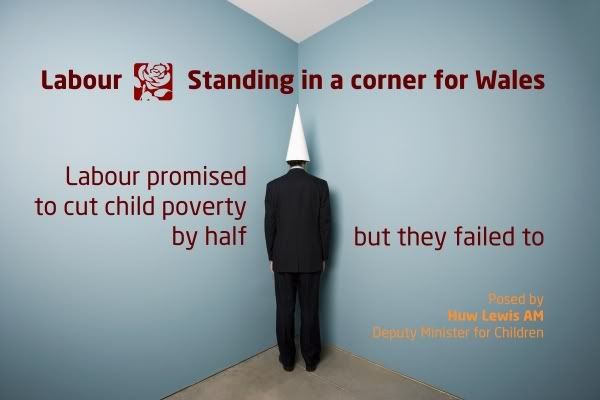
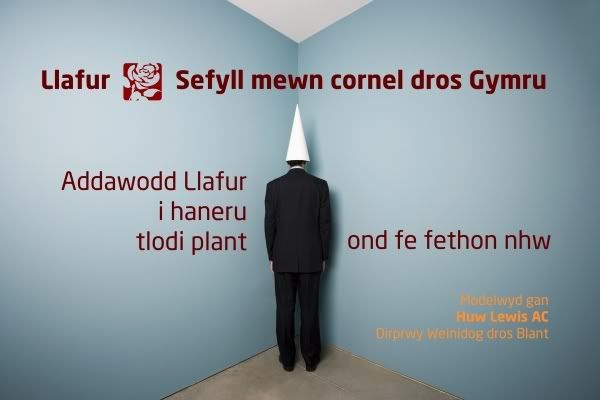
I'm pleased to announce that Huw Lewis has stepped onto centre stage to pose for the next poster in the campaign to highlight just how well Labour has been "standing up for Wales".


Postcard | Hi-res image | PDF

Cerdyn post | Delwedd safon uwch | PDF

By any standard, the failure to cut child poverty levels has been the worst of all Labour's failures. A party that used to pride itself on standing up for those who are less well off conveniently managed to forget all those values when in power. Instead it pandered to the rich, allowed (in fact encouraged) its new friends in big business and the financial institutions to become even more filthy rich, and hoped against hope that some of this money would somehow trickle down to the less well off in our communities.

But their blind trust in the free market economy—and of course they made it more free by not adequately regulating the financial institutions—not only failed to make an impact on child poverty before the credit crash, but brought us all to the brink of ruin when the results of that failure to regulate hit home.

-

So why is Huw Lewis in the spotlight for this? Dear old Screwloose is a good example of someone whose heart is probably in the right place. There are all sorts of things we can do to alleviate the worst effects of poverty for children in Wales. But the bottom line is that poverty is a matter of money. It is a question of how we as a society create wealth and how we distribute that wealth fairly.

Labour have done nothing for Wales in that respect. Relative to the rest of the UK Wales is progressively getting even poorer, and no amount of spending money on special programmes or placing new responsibilities on local authorities and other bodies is going to do any more than make a small dent in the problem. To make a real difference we must also take the levers that control the Welsh economy into our own hands.

But Welsh Labour are absolutely terrified of taking any sort of responsibility for things like taxation and the benefits system in Wales. This is all the more surprising because having an Assembly with taxation powers has consistently been the most popular model of governance in the annual St David's day poll [see here], and because 60% of people in Wales think that the Welsh Government should have control over the benefits system, with only 23% thinking it should remain in the hands of the UK government [see here].

-

There's only one conclusion we can draw from this: Labour are great at spending money on programmes, but are absolutely clueless when it comes to turning Wales into a more prosperous country. It is only by taking the levers of the economy into our own hands that we will have any hope of putting an end to child poverty in Wales.

Bookmark and Share

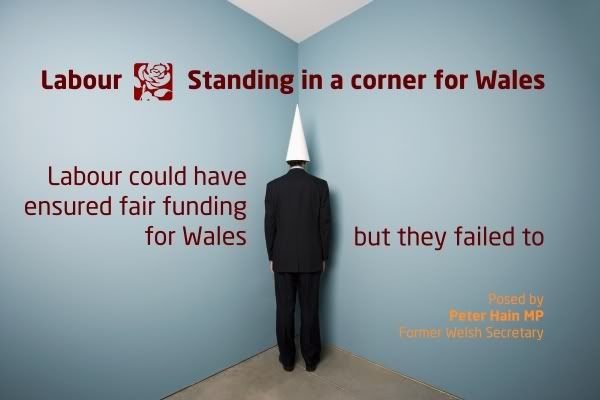
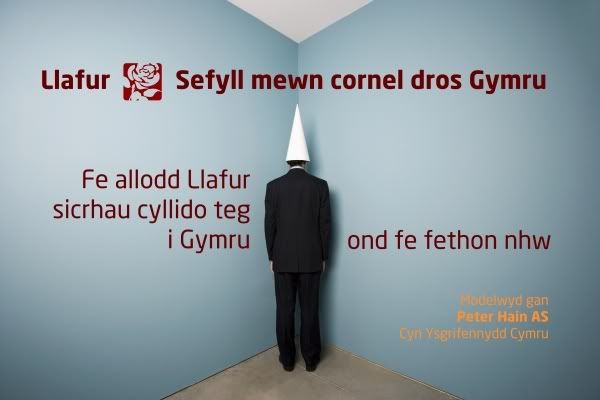
Peter Hain poses for the camera

Apparently Peter Hain was furious that Leighton Andrews was the first Labour politician to feature in the new poster campaign highlighting Labour's performance during their time in government.

Peter is of course a very important person, and all the frantic emails and phone messages from him and his staff couldn't be ignored. So we are delighted to announce that he was able to take some valuable time away from his personal tanning parlour and step into the studio for the latest poster in the series.

Demand is running high, but you can download a postcard size image to put on your blog or website and email to your friends, or a high resolution image or pdf to print out and display.


Postcard | Hi-res image | PDF

Cerdyn post | Delwedd safon uwch | PDF

I'm sure that many other prominent Labour politicians will want to have their moment in the spotlight too. So please get in touch to book an appointment.

Bookmark and Share