Showing posts with label Minimum wage. Show all posts

Recalculating the Living Wage

I very much welcome the increase in the minimum wage to £7.20 an hour announced by George Osborne in his budget a few weeks ago, and that it would be set to rise to over £9 an hour by 2020. On the face of it, this 2020 figure would probably be in line with the Living Wage as calculated by the Living Wage Foundation.

When first introduced in 2011 the Living Wage was £7.20, and since then has risen by 25p in 2012 and by 20p in both 2013 and 2014 to now stand at £7.85. If that same annual increase were maintained for the next six years, then it would indeed be just over £9 an hour by 2020. Although, to be more precise, the Low Pay Commission (who recommend the minimum wage rate to the government) have been asked to ensure that the minimum wage reaches at least 60% of median earnings by 2020 ... which will probably be more than £9 an hour.

As a target sum, this would comfortably beat Labour's manifesto promise of £8 an hour by 2020, and be equal to what Plaid Cymru and the SNP had proposed. The LibDems didn't make any commitment. Only the Greens proposed something better: that the minimum wage would rise to £10 an hour by 2020.

-

The problem, as everybody realizes, is that the Tory increase in the minimum wage is going to be offset by cuts in tax credits. In some cases families will be worse off, although not in every case. There is a good article on this here by the Social Market Foundation. They assume that 60% of the median wage will result in a minimum wage of £9.35 an hour, and on that basis this is the worst case graphic from it:


But it is better for others, as this graphic shows:


The question I asked myself was to what extent the proper Living Wage, as calculated on behalf of the Living Wage Foundation, would need to be adjusted to take account of the fact that tax credits would now be cut. But in doing this I discovered something which surprised me, which I think most people will be unaware of, and which is the main reason for me writing this post.

-

The way that the Living Wage is calculated is set out in detail in this document. When the calculation was first made in 2011 the £7.20 rate it set was accurate, but the increases in the Living Wage since then have been limited by a formula which states that it should not increase by more than 2% above any rise in average earnings.

The effect of applying this cap is quite startling. This is from the conclusion at the end of the 2014 calculation:

Based on the above calculations, the ‘reference’ level of the Living Wage, reflecting actual minimum living costs, is £9.20 in 2014, but the applied Living Wage, resulting from the capped increase, is £7.85.

The difference is a huge £1.35 an hour.

I suppose I can understand the rationale behind the cap. The aim of the LWF is to get employers to become accredited Living Wage Employers; and in order to make a long-term commitment, it was helpful for there to be some method of cushioning large increases. Back in 2011 it was probably reasonable to assume that wages would rise following the worse ravages of the recession caused by the 2008 financial crisis, but wages haven't gone up by very much at all. So it's proved to be a false assumption. Whatever good intentions lay behind imposing this cap, the end result is that the current Living Wage of £7.85 is now way below what it should be in order to meet actual minimum living costs. Instead of rising by about 65p or 70p each year, the Living Wage has only risen by 20p or 25p each year.

Now consider what will happen over the next five years. It seems pretty obvious that the calculated Living Wage is going to rise further. In part this will be because of the effect of reductions in tax credits, but on top of that there will be the usual cost of living increases. What is currently calculated at £9.20 will certainly be over £10 an hour and probably closer to £11 an hour by 2020.

-

The definition of the Living Wage, as taken from calculation document, is "the wage that produces enough income after taxes, benefits and tax credits to cover [a family's] expenses." So it is clear that the next calculation of the Living Wage will need to take the reduction in tax credits into account. This will be a major change, and therefore will provide a perfect opportunity to reset the calculation without the cap imposed in previous years.

I'm sure this will result in a large rise which will make some accredited Living Wage employers think twice. But I think it's a bullet that needs to be bitten. If the Living Wage doesn't actually reflect what minimum income is needed to cover expenses, it is meaningless.

Bookmark and Share

Child Poverty ... what can Wales do about it?

Thanks to Valleys Mam, I downloaded Victoria Winckler's research paper for the Joseph Rowntree Foundation on child poverty in Wales.

     What is needed to end child poverty in Wales?

It's a very good piece of work. And as it's only eight pages long, I really would urge people to read it. It says nearly everything I could think of saying about the subject—and a great deal more that I hadn't thought of—far better than I could say it.

-

If I wanted to add anything, it would be that better public transport is one factor that would help (by no means at the top of the list, but on it somewhere). It is mentioned in the paper, though only once. The big things are getting more people into work and improved childcare.

In London, for example, there has been a scheme for those on Income Support to get half price travel on buses and trams. That was introduced by Ken Livingstone but, more surprisingly, Boris Johnson has extended that scheme to include those on Job Seekers Allowance and the new Employment and Support Allowance. The reason is this:

[The scheme] is designed to help people back to work by making it easier to travel to interviews, and access libraries, job centres, and other amenities.

Mayor of London Press Release, 2 April 2009

We sometimes forget that London has a few devolved powers. So if they can do it, why shouldn't we? It's worth noting that this concession can continue for up to six months after the person gets work. I like that, because it might make all the difference to someone's ability to take a job. There is always some uncertainty in the first few months about how things might work out in a new job.

And I would also add the need to better enforce the minimum wage, as there are many examples of employers flouting the rules, and too few enforcement officers in Wales.

-

I'd like to widen this discussion. Doing away with child poverty is one thing that must surely unite all of us, no matter what political views we hold. It is shameful, and we must do something about it.

So I'd like to invite people to suggest what we could do in Wales to improve our particular situation. If we are serious about devolving more powers to our Assembly, we are not going to do it simply by arguing in general terms. We need to be able to give specific examples of how the political power to do things differently in Wales will make things better.

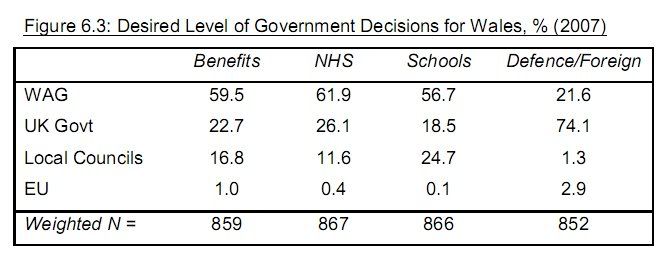
I'll start with this. A couple of months ago, I was surprised (although very pleasantly surprised) to read that a 2007 survey had found that a large majority of people in Wales think that the Welsh government should be the body that makes decisions about the benefits system in Wales. I mentioned it on the Syniadau Forums.

Survey respondents were asked about which level of government "ought to make most of the important decisions for Wales" for four key policy areas: Welfare Benefits, the National Health Service, Schools, and Defence and Foreign Affairs. Results are presented in Figure 6.3 below. These show not only clear majority public support for the devolved level of government to have control over areas where they already make many decisions—on schooling and healthcare—but also a similar level of public endorsement for those powers to extend to an area like welfare benefits. The latter is striking, as it is a policy area that currently remains very much reserved to Westminster.

Source

The reply format in a blog is fairly limited, especially in terms of formatting and the ability to include images, etc. So if anyone wants to reply in more depth, you are welcome to respond on a new thread I've opened on the Syniadau Forums.

Bookmark and Share

The minimum wage ... what will the Tories do?

In my post last night I was angry enough at the fact that the minimum wage was only going to be increased by 7p. But I was even more angry when I read of a Bill introduced in the Commons to allow workers to "opt out" of receiving the the minimum wage. It is due to receive its second reading this Friday.

Christopher Chope calls for minimum wage opt-out

Of course this particular bill is going to fail. But it does raise the question of what the Tories intend to do when they win the next UK general election. Tories don't introduce such bills for fun, they do it because they want to test out the water to help frame the policies they will adopt when they are in power.

It would be very bad for their image if they abolished the minimum wage completely, and they could easily not increase it allowing its relative value to fall over the years. But they obviously want to see if they can go further.

The idea of an "opt out" is deviously clever. It allows them to spin it along the lines of "widening choice" or "increasing employment opportunities to help aid recovery". So the language they use is that of freedom and rights. This is how Christopher Chope began his speech:

I beg to move,

That leave be given to bring in a Bill to introduce more freedom, flexibility and opportunity for those seeking employment in the public and private sectors.

Two months ago we were celebrating the 60th anniversary of the universal declaration of human rights. Article 23.1 states:

“Everyone has the right to work, to free choice of employment, to just and favourable conditions of work and to protection against unemployment.”

Article 6 of the international covenant on economic, social and cultural rights, to which the United Kingdom is a party, states:

“The State Parties to the present Covenant recognise the right to work which includes the right of everyone to the opportunity to gain his living by work, which he freely chooses or accepts, and will take appropriate steps to safeguard this right.”

It may come as a shock to many Members of this House to know that, currently, many people are not given the rights to work enshrined in those important United Nations articles.

But, after all the fine idealism, the bottom line is this:


This must be a comedy routine. I can't believe that anybody could really believe this, and I can only admire the consumate professionalism of someone able to deliver this sort of speech with a straight face.

Yet ConservativeHome said:

He made a very persuasive speech, and it should be noted that no-one rose to speak against it ...

So, pound to a penny, I reckon that this concept of an "opt out" along these lines will become a reality when the Tories are elected. Of course I could say that this is a reason not to vote Tory ... but that would be superfluous. It wouldn't matter if no-one in Wales voted Tory, there would still be a Tory government in Westminster, because more people in England vote for the Conservatives than for any other party (that was true even in the 2005 election, by the way).

So I'll say this instead: If we in Wales think that a minimum wage is an important tool to help reduce poverty and create a fairer, more equal and more inclusive society, we need to make sure that we have the ability to legislate on the matter through the National Assembly.

In particular I'd say this to Labour, because they can do something to help protect the minimum wage in Wales now, while they are still in power at Westminster.

But will they ... ?

Bookmark and Share

The minimum wage rises ... by all of 7p

First, credit where it's due. In my opinion introducing the minimum wage was one of the better things Labour did. If we want to move people out of poverty (something that we are singularly failing to do) this is one of the best tools by which to do it, not least because it should act to make being in work more attractive than being on benefits.

But only 7p? It works out at about 1.2%, but that is pretty derisory. To put this year's rise into perspective the minimum wage rose by 17p in 2007, and by 21p in 2008. Even in these difficult economic times the government should have insisted on it being more. What would another 10p add to the wage bill of someone working a 35 hour week? Only £3.50 ... plus a little more for employer's NI.

To put that into the prespective of this week's big scandal, would that really bump up the price of having your moat cleared, or the Wisteria on your chimney removed?

The only silver lining is that the rate will apply to those 21 and over, as opposed to the current 22 or over, from 2010. But for the life of me I can't see why it shouldn't apply to everyone over 18.

-

And, while on the subject, it's also worth noting that the minimum wage is not very well enforced. There have only been a handful of prosecutions in the UK as a whole. Yet in Wales there were nearly 800 instances of firms not paying it and all the signs point to the situation actually being far worse than that. In 2005-6 the rate of non-compliance in investigated cases was a huge 32%. Wales had just 8 investigators, all based in Cardiff.

For references to the figures, look at this post I made in the Wales Online forum last year.

Leanne Wood has also raised the issue here, here and here on her blog.

Bookmark and Share