Showing posts with label Peter Hain. Show all posts

Devolving National Insurance and VAT to Wales

On Thursday, there was a lengthy debate in the Commons about the Silk Commission. While waiting for some paint to dry, I caught up with it on Democracy Live, and thought that people would like to see this short exchange from it:


Here we can see Huw Irranca-Davies and Peter Hain making a strong case for varying the rates of two different taxes because it would have a significant and positive impact on jobs in Wales.

But look at the context in which they are doing it. They have to ask the Tories and LibDems in the UK government to do it, because they are in opposition and therefore can't do it themselves. And the UK government will of course refuse, because they have their own ideas of what is good for the economy of the UK as a whole, and aren't going to change those ideas because people in Wales think differently.

Yet why should it be this way? If these tax changes are good for the economy and job prospects in Wales, why shouldn't the Welsh government have the power to do in Wales what the UK government refuses to do in the remainder of the UK?

-

Now of course it might just be that Labour are proposing this because they are in opposition, because it makes a good sound bite, and because they know full well that the UK government won't do it. That's the luxury of not being in power.

But let's assume that they are in fact being sincere, and genuinely believe that these tax changes would benefit the Welsh economy in these difficult times. We'd have to do the sums, of course: working out how much revenue will be lost because of these tax cuts; but balancing this against fewer people out of work, and fewer building firms with not enough work on their books to keep them going ... but if the calculation was positive, why shouldn't we be able to go ahead and do it?

That's what devolution of taxation powers to Wales would mean for Wales. Instead of pleading with the Tories in Westminster to do something for Wales, and then blaming them for not doing it, we would be taking some responsibility for ourselves.

-

It's ironic. Here was a debate in which Welsh Labour MPs queued up to say how much they were reticent about—or completely hostile to—the Silk Commission looking into taxation powers for Wales, suggesting that it was all a sinister Tory plot. But in it, they inadvertently gave us a perfect example of how useful these powers would be to provide more jobs and boost the Welsh economy.

Bookmark and Share

The Clown Prince of Comedy Maths

It was reassuring to read in this story in today's Western Mail that Peter Hain has lost none of his blind tribalism. If the Tories support anything it must be wrong, whatever Labour supports must be right ... and if anyone has any better ideas they must be ignored.

The idea in question is that the Welsh Government should become responsible not only for how much it spends, but also for how that money is raised. Mr Hain is against this because public expenditure in Wales is greater than the money collected in Wales through taxation. That's not in question. But the figures he uses to justify his position are. He says:

The Holtham commission calculated that approximately £17.1bn of tax revenue is raised in Wales every year. Total public spending in Wales is around £33.5bn – almost twice the amount raised.

This latest demonstration of the Peter Principle starts by saying something that is true, but then twists it into a barefaced lie. £17.1bn is the total of revenues raised in Wales by UK-wide taxes for 2007-08. This is broken down in Table 4.1 of the Holtham Commission's Final Report, on page 40.

However this figure doesn't include money raised from local taxes, in particular council tax and non-domestic rates. It's not easy to calculate these figures exactly because NDR are put into a common pot for "Englandandwales" and supplemented by the Treasury before being redistributed, but Alan Trench calculated it at just over £1.9bn in this post on Devolution Matters.

The Holtham Report didn't put a precise figure on this, but does put it at approximately that level, for the very next paragraph says this:

In aggregate, total identifiable expenditure in Wales in 2007-08 was £25 billion, around £6 billion more than tax receipts. This is commonplace given Wales’s relatively high needs. Out of the devolved countries and the nine English regions, only London and the East and South East of England have fiscal surpluses.

So where does Peter Hain get his figure of "around £33.5bn" from? He doesn't say. But I can say that, at the very least, he is not comparing like with like. If he relies on Holtham for the first of his figures, he must surely also rely on Holtham for the second. But not satisfied with a six billion difference, he expects us to believe his figure of more than sixteen billion. Any clown that can get his sums wrong by several billion pounds fully deserves all the laughter he gets.

-

I don't think Peter really intends us to take him seriously. He wants to get his name into the papers, and the more outrageous his claims the better. That's just his personal style, and it suits his personal agenda. He knows full well that a few die-hards will now quote this supposed £16.4bn fiscal deficit as if it were the gospel truth ... at least until someone comes up with an even more outrageous figure that they can latch onto.

-

But there's a much more fundamental point at stake. After claiming that we only raise about half the total amount spent on us, Peter says that:

We shouldn't be ashamed or embarrassed by that. Wales' needs are greater than most other parts of UK.

No. We should be ashamed of it. We should rightly set out to address any fiscal deficit that we cannot support. The real question is how on earth we can be expected to do this without having our hands on the same enonomic levers that other governments have at their disposal.

Taxation is a tool by which we can take control of our own economy and steer it in the right direction. Every government adjusts the levels of a whole range of taxes to make their own economies more successful and to give them a competitive advantage over their neighbours. Each country has different strengths, different human and natural resources, and a different sense of what is important. Until we in Wales are able to use taxation as a tool to play to our own unique strengths, we will always be at a disadvantage.

Peter Hain and his Labour party clearly have no desire to see Wales fight for its own prosperity in this way. Put bluntly, their only solution is for us to resign ourselves to always being dependent on England; but to sugar it by saying that we shouldn't be "ashamed" or "embarrassed" enough to get off our backsides and do something about it. Nothing can or will change until we start taking responsibility for both the income and expenditure sides of the economic equation.

Bookmark and Share

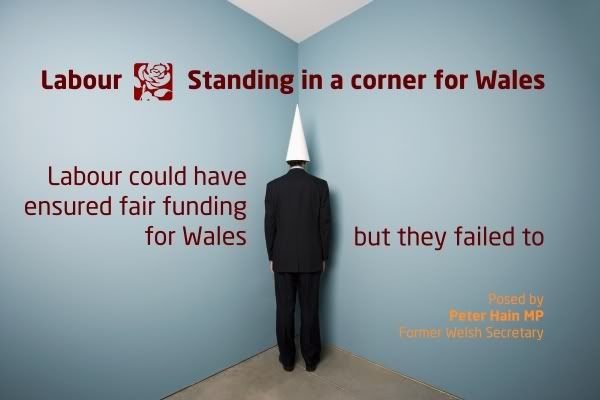
Peter Hain poses for the camera

Apparently Peter Hain was furious that Leighton Andrews was the first Labour politician to feature in the new poster campaign highlighting Labour's performance during their time in government.

Peter is of course a very important person, and all the frantic emails and phone messages from him and his staff couldn't be ignored. So we are delighted to announce that he was able to take some valuable time away from his personal tanning parlour and step into the studio for the latest poster in the series.

Demand is running high, but you can download a postcard size image to put on your blog or website and email to your friends, or a high resolution image or pdf to print out and display.


Postcard | Hi-res image | PDF

Cerdyn post | Delwedd safon uwch | PDF

I'm sure that many other prominent Labour politicians will want to have their moment in the spotlight too. So please get in touch to book an appointment.

Bookmark and Share

Hain's £68bn White Elephant

Peter Hain's grip on reality has never been too firm. A red mist descends, he goes into attack mode, his mouth disengages from his brain ... and he comes out with things that make him look ever more ridiculous.

He must have had a particularly bad weekend, for today he came out with the announcement that the "cuts imposed by the Tories" on three projects amounted to £16,900 for every man, woman and child in Wales. He came to this conclusion by adding together the supposed value of three projects: £34.4bn for the Lavernock-Brean barrage, £14bn for the St Tathan defence academy and £2.3bn for Ynys Môn as an Energy Island.

     ‘Scrapping projects has cost each of us £17,000’

Sure enough, this adds up to £50.7bn, which divided by 3 million is £16,900. Let's ignore the fact that Labour could have implemented all these projects when they were in power in Westminster if they wanted to; others have picked up on that one. Let's ignore the fact that were not fighting another election on what politicians in Westminster do or don't do; this election is about electing AMs who will not be able to do a thing about the level of block grant the Welsh Government gets from Westminster. Let's ignore the fact that if this barrage could be built by private finance, as he claims, it cannot at the same time be a cut from Westminster.

To me, the more obvious question is to ask why he considers the barrage to be an entirely Welsh scheme? Surely it would be half English? It doesn't look as if his grasp of figures has improved since he left the young Liberals, who seem to make a point of ensuring that their activists are unable to do simple maths.

Yet maybe, just maybe, Peter Hain might have more financial acumen than we give him credit for. Perhaps he's saying that the Welsh half of the barrage will cost £34.4bn, making the total cost something more like £68.8bn. It will certainly be up at that level if we start talking about putting transport links on top of it.

Bookmark and Share

Labour try to divide the Yes vote

What do the recent announcements by Peter Hain, Paul Murphy and now Hywel Francis have in common?

Each one of them is deliberately misrepresenting what this referendum is about and, instead of concentrating on the issue at hand, trying to turn the referendum into the first part of Labour's campaign for the Assembly elections in May.

•  Peter Hain's claim was that voting Yes would transform the Welsh economy. But voting Yes will do no such thing, because the lawmaking powers we will get when we vote Yes specifically will not give Wales any fiscal or economic powers.

•  Paul Murphy claimed that voting Yes had nothing to do with the procedural intricacies of lawmaking in Wales. But the referendum is only about the way the Assembly will be able to make laws and nothing else.

•  Now we have Hywel Francis claiming that voting Yes will deliver a blow against the cuts being imposed by the ConDem government in Westminster. But voting Yes will not save us from a single penny of the cuts that have been made by them, nor the deeper cuts that are going to be made by them over the next few years.

So what would explain their actions? At one level it's very simple: they have decided that people in Wales simply aren't capable of understanding the issue at hand, and are therefore trying to make out that the referendum is about something they think people in Wales will understand. That doesn't say much about their respect for people in Wales, and it makes what they are trying to do no different from what True Wales have been trying to do when they claim that this referendum is about increased taxes, more politicians, or the "slippery slope to independence".

But there's more to it than that. It is clear that each of them is using this referendum as an opportunity to attack the Tories, but both Paul Murphy and Hywel Francis have now introduced a rather sinister sub-text. Paul Murphy criticized the Yes campaign because, as an all-party group, it had what he called "the problem" of not being able to attack the Tories in the way he would like; and Hywel Francis claimed that the Yes campaign was:

making it more difficult to mobilise a full-blooded anti-Tory campaign

So it's hard to avoid the conclusion that they are putting two fingers up at the careful work of the Yes for Wales campaign.


Now these three men are certainly being unscrupulous, but they are not stupid. They are quite sincere in wanting a Yes vote now, even though the only reason they've changed their minds is because they realized Labour was going to lose power at Westminster. They thought things were fine ... so long as they were in government there.

So would they put a Yes vote in danger by undermining the Yes for Wales campaign in this way? I don't think so. I think they have calculated that the margin in favour of a Yes vote—at least 20% in nearly all the polls—is such that they can afford to undermine cross party support for a Yes vote. So they reckon it probably won't matter if they alienate Tory and LibDem supporters so much that they vote No or, more likely, stay at home ... so long as they get a few Labour supporters who would otherwise stay at home out to vote.

As I see it, they realize that although a good many of their supporters do understand what this referendum is about, and will vote on the issue at hand, there are others who simply don't understand and who therefore see no point in voting in the referendum. They want to persuade these people that the referendum is, to all intents and purposes, just another party political election in which Labour is on one side and the Tories on the other. By getting people to vote Yes for Labour's reasons they hope that the referendum campaign will trundle on and seamlessly morph into Labour's campaign for the Assembly elections in May.


The big question is how the rest of us should react to this tactic. I think we shouldn't ... or at least not yet. In the immortal words of Huw Lewis, we should "Let Labour be Labour." We simply need to point out what they're doing and why they're doing it, but should not let ourselves be distracted from explaining why it is important for us to be able to make laws in those areas that are already devolved to Wales. If we stick to the job at hand, we will not alienate those from other parties who support a Yes vote.

Nor, I suggest, should we in Plaid react with anger to the sort of personal attacks that Labour have just made on Ieuan Wyn Jones. It's all part of the same strategy, in all probability orchestrated by the same elements in the Labour Party at Westminster. They want to turn what should be the campaign for a Yes vote in March into the early skirmishes of the campaign for the Assembly elections in May.

We can afford to wait a few weeks. Right now we need to keep fighting an inclusive, uniting campaign for a Yes vote; for the sake of Wales, and for the sake of people of all political persuasions in Wales. But after that—though maybe allowing a day or two for the hangover from the celebration party on 4 March to wear off—we can turn our attention to campaigning for the Assembly elections ... and do it with a clear conscience.

Bookmark and Share

Stating the Obvious

I'm not sure Peter Hain is doing his own party much good by saying that the referendum on primary lawmaking powers is being held now because Plaid Cymru insisted on it; but if he wants to put his foot in it, he's welcome:

     Plaid Cymru 'insistence' behind poll date, says Hain

Of course we insisted on it. It was our main "red line" issue when we negotiated the One Wales Agreement with Labour in 2007.

Some in Labour will have had their doubts about whether that part of One Wales would be delivered, but were sensible enough keep quiet while the All Wales Convention did its work. This gave them time to come round. Others—most notably Peter Hain himself—repeatedly tried to break the agreement, saying that the vote should not be held for many years to come, and that it would be lost if Labour stuck to their commitment.

But wiser heads in his party (yes, I'm happy to acknowledge that Labour has some ... though being wiser than Peter Hain is hardly setting the bar very high) prevailed, and in the end Labour came to realize that Plaid had been absolutely right to insist that the referendum was held before the next Assembly election. It would have been better to hold it last October, but next month is good too.

This only goes to show that Welsh Labour are very much more principled than Peter Hain wanted them to be ... or could ever hope to be himself.

Bookmark and Share

Bucketman and the Welsh Economy

One of Plan Flynn's most memorable lines was to compare Peter Hain with Odo in Deep Space Nine, a shape-shifter who, as he put it:

... liquefies at the end of each day and sleeps in a bucket to emerge in another chosen shape the following morning.

As we know, Peter Hain was the one responsible for taking the recommendations of the Richard Commission and giving us a watered down dog's breakfast called the Government of Wales Act 2006. By failing to implement what it recommended, we were instead landed with the tortuous LCO process by which the Assembly can—but only if the incumbent Secretary of State and Westminster allow us to—make laws in those devolved areas in which Welsh Ministers already have executive responsibility. This is the process that we will finally do away with when we vote Yes on 3 March.

He was also the person who said that this legislation would last for a generation, that he didn't want to see a referendum for many years, and that it could not be won before then ... even though the opinion polls were clearly showing the opposite. But then, when it became clear even to him that Labour was going to lose power in Westminster, he shape-shifted into a man who realized that the Assembly needed all the powers it could get to protect us from the worst effects of the public services cuts and privatization agenda of the ConDem government in Westminster.


But rather than being contrite after being shown to be so out of touch, Peter Hain has now emerged from his bucket to claim that this was all his idea from the beginning. And if we read this piece in the Western Mail yesterday, he does look like he is in favour of more powers for the Assembly ... until, that is, we look more closely. For in the same way as his fictional equivalent couldn't quite manage to get the shape of his ears right, the Odo-ous Mr Hain hasn't quite managed to shape-shift himself into a convincing pro-devolutionist.

A “YES” vote in the referendum on more powers for the National Assembly would give AMs the opportunity to “think big” and transform the economy of Wales, according to Shadow Welsh Secretary Peter Hain.

“I think there’s an opportunity now if we get a Yes vote in the referendum – and I don’t take that for granted at all – now for the Assembly to really lift its game and for everybody in Cardiff Bay and at Cathays Park to start really thinking big, and think about the big issues to transform the Welsh economy and make us world class, which we are certainly not.

Western Mail, 22 January 2011

We need to ask ourselves one simple question: In what way will voting Yes enable the next Welsh Government to "transform the Welsh economy"? The Assembly does not, and has never had, control over the levers of our economy. These are still firmly in the hands of the UK government at Westminster. It was for this very reason that Tory AM Alun Cairns decided to leave his seat in the Assembly and stand for election as an MP. Look at what he said in March last year when asked if he was doing the right thing:


Absolutely right. My greatest interest is the economy and business and that's where the powers lie for economy and business really, where I'd like to be able to make a contribution to the constituency.

... When you look at the economy and business and in terms of overcoming deprivation, child poverty and those sorts of issues, it is Westminster that has most of the levers and that's really what can make the biggest influence and difference to the Vale of Glamorgan and other constituencies.

Just about the only lever on the economy the Welsh government has is the ability to set the multiplier for non-domestic rates. But even this is not a matter of devolution, but of centralization. For local authorities had the ability to set this before Westminster took central control. And in the case of Wales it only has a marginal effect anyway because the money goes to the Treasury in Whitehall before being redistributed back to Wales.

We need to be clear that what is devolved to Wales is not the economy, but economic development. In essence, the Welsh government can spend some of the money it receives in the annual block grant as grants or loans to encourage businesses to locate in Wales, and fund schemes like ProAct and ReAct. These are of course useful, but only marginally effect the economy. To create a climate in which business as a whole, rather than just a few selected companies, can flourish we would need to have wider control over things like rates of business and personal taxation, national insurance, VAT and monetary policy.


So when Peter Hain shoots his mouth off and claims that voting Yes will "transform the Welsh economy", I have to wonder which side he's batting for. He's doing just the same thing as True Wales: ignoring what this referendum is actually about and claiming that it is about other things instead. Now whatever else Peter Hain is, he is certainly a shrewd political operator. It might indeed be reasonable for him to assume that the eyes of ordinary people in Wales will start to glaze over at the technicalities of what this referendum is about, so that in order to get people excited enough to get out and vote the thing needs to be sexed-up into something more interesting. Certainly people are more concerned about the economy because it affects fundamentally important issues like jobs and the level of public services.

But it's a mistake to do it; not only because it's dishonest, but because rash promises that you have no means to fulfil have a habit of coming back to bite you. Labour have form on this, after all, the previous ten-year plan was that Wales would improve its GVA figures relative to the UK as a whole ... but instead the gap has widened. Why? Because there was no mechanism by which the Welsh Government could pursue different economic policies from the remainder of the UK. We had a few limited powers which we could target at a few companies or sectors, but no power to make an across-the-board difference. Nor will this referendum give us those powers.

-

The only grain of truth linking a Yes vote to the ability to improve our economic performance is that the ConDem government in Westminster has made it clear that they will not consider the issues raised in the Holtham Report—either fair funding or devolution of some taxation powers—unless we vote Yes. But even a commitment to "consider" the Holtham report is no guarantee that Wales will get what it recommended. We might get yet another watered-down dog's breakfast instead of the real thing.

Bookmark and Share

Right to Cry

I don't know whether to laugh or cry at this story in the Guardian:

'Right-to-buy' council house policy reviewed to appease Lib Dems

Exclusive: Key Margaret Thatcher policy could be ended by coalition looking for ways to increase available housing stock

Guardian, 16 September 2010

It looks like the ConDem coalition might be about to put an end to Right to Buy in order to increase the stock available for the increasing numbers on housing waiting lists. And of course, if it ever came to a vote in the Commons, most Labour MPs would be fighting among themselves to be the first into the lobby to vote to abolish it.

So what do we have? We have the LibDems in favour of abolition; the Tories probably prepared to give it up, because they don't want to spend a penny more on new housing than they have to; English Labour MPs keen to hammer one more nail into the undead effigy of Margaret Thatcher ...

... and Welsh Labour MPs?

Ah yes, Welsh Labour MPs. They were the ones that managed to hold up the Housing LCO for a whole three years to make sure that we couldn't even suspend Right to Buy in Wales, let alone get rid of it.

They thought they'd managed to pull it off, too: by leaving it all until it was too late to get it through Westminster in the normal course of business—even though they had a large majority, and could have passed it without trouble if they'd wanted to—in an attempt to point the finger of blame at the Tories for not including it in the wash up. Little did they know that the Tories would not only back down on the LCO ... but they'd think about scrapping the whole policy.

Poor Peter Hain, he must be in tears. He does his very best to stop us in Wales getting the powers to do things better ... but then even the Tories show themselves to be less enthusiastic about the Right to Buy than he and his colleagues in Welsh Labour had been. I look forward to him explaining that the abolition of Right to Buy in both England and Wales is what the Labour Party had really wanted all along. There won't be a dry eye in the House.

-

I can't wait for March. By finally getting over the obstacle to a proper Parliament that Peter Hain has so carefully constructed, we will be able to move on from his dog's breakfast of a Government of Wales Act 2006 to a new Act. One that will give us the same sort of Parliament that Scotland has had from the beginning.

Bookmark and Share

Home is where the heart is

In the final Scottish leaders debate tonight, Jim Murphy justified flipping his home on his parliamentary expenses on the grounds that, as Secretary of State for Scotland, he had to spend more time in Scotland than Westminster. So London is where he has his second home.

That sounds reasonable.


But our Secretary of State for Wales works on quite different principles. His main home is in London, and he claims his allowances on his second home in Wales.

Home is where the heart is, and home is certainly what you fight for. Perhaps this explains why Hain has been so bad at fighting for Wales' fair share of money from Westminster ... and why the Secretaries of State for Scotland have been so much more successful in fighting for their own country at the cabinet table. Labour have been responsible for systematically short-changing us while they have been in power in Westminster. Our share of public spending relative to England has dropped from 125% to 113% over the past thirteen years.

Don't give Peter Hain and the rest of the Labour leadership in Westminster a chance to keep on doing more of the same. Wales needs MPs that will put Wales first.

Bookmark and Share

A liability matched only by his ability to lie

Peter Hain did one of the things he does best in the Welsh Leaders debate on ITV last night: repeating the same lie over and over again in the belief that repeating it will make it true. The subject was replacing the Barnett Formula with a fairer way of funding Wales, using the sort of needs-based criteria by which departments allocate funding to the regions of England.

A wiser person might have thought twice before opening his mouth, especially when each of the other parties agree that the current system is unfair and needs to be replaced. But not Peter Hain. No, he wants us to believe that he has already sorted out the problem and secured fair funding for Wales.


Hain has secured no such thing. His vanity has got the better of him yet again. He can't bring himself to say that he tried to do this, but failed. So he must instead make out that his failure to do it was in fact a success.

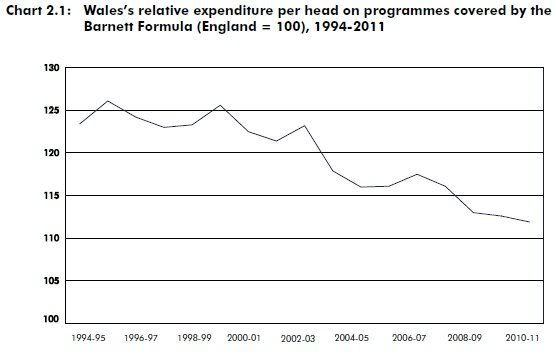
Peter Hain's problem is that he has no idea how to fight for Wales at the Cabinet table. The Treasury have been able to run rings around him and, as a direct result, Wales has got far less of an increase in public spending than either Scotland or England. This graph, from the Holtham Commission's first report, shows just how much Wales' share of spending has declined relative the amount of money Labour has spent in England in the thirteen years they have been in power at Westminster.


Peter Hain did respond to this by going to the Treasury to ask for Wales to be fairly treated. But the Treasury ran rings around him again. In the debate he claimed that he had negotiated "a detailed reform of the Barnett Formula". But he's deluding himself and trying to mislead the rest of us. This is the final agreement in its entirety. It includes absolutely no figures or detail at all:

The Government welcomes many aspects of the Holtham report, which it continues to study in detail.

The new arrangements are as follows:

•  the Government agrees that the Barnett formula could lead to convergence to an extent that would be regarded as unacceptable although further convergence is not currently expected in the coming years;

•  the Government will make a full assessment of the extent of convergence with consideration of Wales' position relative to other parts of the United Kingdom as part of each spending review; and

•  following this assessment the Government would be prepared to take action if appropriate to ensure Wales is not disproportionately disadvantaged.

Wales Office, 26 November 2009

All of us can clearly see that this is only an agreement that the Treasury will assess the situation in future. Consider the three things I highlighted:

Regarded as unacceptable
To whom? The Treasury and the Wales Office obviously both regard it as acceptable for Wales' share of spending relative to England to have dropped from 125% to 113% in the thirteen years Labour have been in power. So at what point would it become "unacceptable"? So far as most people in Wales are concerned, it was surely unacceptable for there to have been any fall at all. So far as Plaid are concerned, the point of unacceptability has already been reached, because Holtham has confirmed that the absolute bottom line correction figure that should be applied to the existing Barnett Formula is 114%.

If appropriate
But why the "if"? If Peter Hain had won a firm agreement from the Treasury, there would be no "if" about it. This agreement leaves the matter entirely at the discretion of the Treasury. What if the Treasury thought there were circumstances that made it inappropriate to treat Wales as a special case ... for example, because public borrowing is out of hand and they think the UK can therefore not afford it?

Disproportionately disadvantaged
We can all see that Peter Hain conveniently misquotes this part of the agreement. This is not the same as the "disadvantaged" he now keeps quoting. Wales has already been systematically disadvantaged over the last 13 years. This agreement would allow that to continue, and could easily be taken to mean only that the Treasury would do something if the rate at which we have been disadvantaged over the past 13 years—about 1% per year relative to England—were to accelerate to more than 1% a year.

-

In other words the agreement does not deliver what Peter Hain claims it delivers. But he simply appears too stupid to understand that. He very obviously doesn't know enough about the subject to understand that the Treasury has made a fool out of him. This is most clearly illustrated by the fact that the Welsh Labour Manifesto makes the ridiculous claim that the Barnett Formula is already based on need ... it is simply not true.

Peter Hain is a liability to Wales. He has already cost Wales huge amounts of money, money that we would have secured if we had someone who knew how to fight Wales' corner. But the rest of Wales' Labour MPs aren't much better. They could have kicked up a fuss about it, but instead they just kept schtum; in part cowed by the Treasury, in part in the hope that the subject would be too complicated for the average person to understand.

-

Finally, it is encouraging that both the Tories and the LibDems want the Barnett Formula to be replaced with a "fair" needs-based formula. That's all well and good, but what does "fair" actually mean to them? Neither of them will say.

It is only Plaid that has put a figure on it, based on what the Holtham Commission has recommended. We are the only party that is prepared to put hard numbers against the shortfall ... 300 million reasons to vote Plaid.


I've written about the Holtham Commission and its report in a number of posts on Syniadau. Please click here to bring them up.

Bookmark and Share

Llanelli

A week or so back, BlogMenai posted a copy of a letter sent out to every voter in Llanelli by the sitting Labour MP. I've nothing against Nia Griffith as a person, but what was said in her name was something else again:

You understand that Assembly funding and, to a large extent County Council funding, depend on Westminster, and only a Labour Government can deliver for Llanelli.

Liam Byrne MP, Alistair Darling's right-hand man, has agreed that we need to revise the Barnett funding formula to deliver a better deal for Wales. But only a Labour Government in Westminster can actually deliver that money for Wales.

... I'm counting on you to help me get the best deal for the people of the Llanelli constituency.

So let's have a look at those claims in a little more detail. Let's look at what the Labour Government in Westminster has actually delivered for Wales in their thirteen years in power.


This is a chart showing how spending in Wales relative to the remainder of the UK has fallen, taken from the Holtham Commission's report on finance and funding for Wales. We can see that Wales is now much worse off compared with the other countries of the UK than it was when Labour came to power. So Labour's claim to be the only party that can actually deliver money for Wales is nothing other than a barefaced lie. Precisely the opposite is true.

What has happened is this: Labour have spent a lot of money on the UK as a whole, and a lot of that money has been spent in Wales. The problem for us is that Labour were increasing their spending more per head in England and Scotland than they were doing in Wales. Yet Labour expect us to be grateful to them because we have received half a share, rather than a fair share. They rely on the fact that people in Wales won't look beyond the immediate horizon to see the bigger picture.


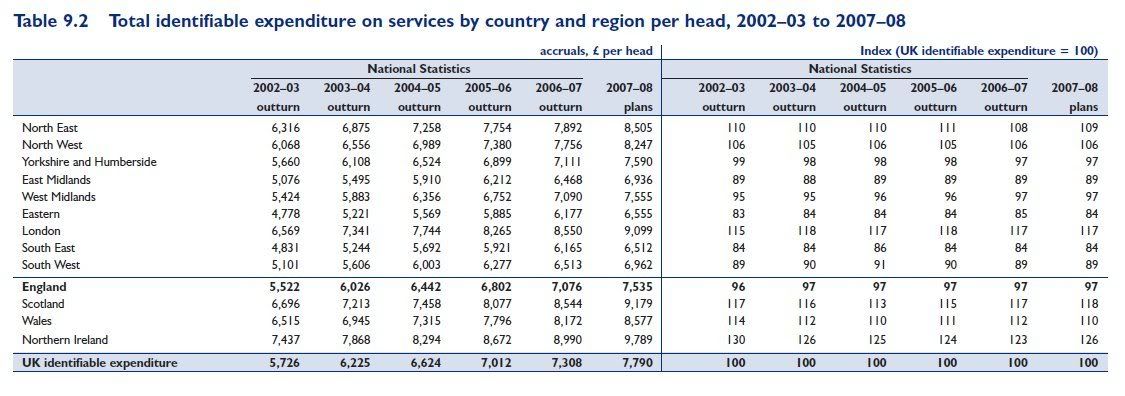
As we can see from this table, the PESA figures show that over the past six years relative spending (the UK as a whole is 100) in Wales has gone down from 114 in 2002-03 to 110 in 2007-08. But for the same period relative spending in Scotland has in fact gone up from 117 to 118, and in England from 96 to 97.

So why has this happened? It is simply because Labour Secretaries of State for Wales have not taken the same care to fight for Wales as their counterparts in Scotland, or the departmental Secretaries for England.

-

But the real scandal is that Labour won't do anything to change this unfair situation. Why do you think the letter mentions Liam Byrne rather than his boss Alistair Darling on one hand, or Peter Hain on the other? Simple, it's because Alistair Darling has refused to make any commitment to change things ... and that Peter Hain, rather than fight for Wales, prefers to take this snub and spin it into something else.

Back in November last year, the Wales Office—headed by none other than Peter Hain, never reluctant to bathe himself in the orange glow of self-praise—proudly proclaimed:

     Hain secures fairer funding agreement for Wales

But it was nothing of the sort. Hain was lying through his teeth. All he got was from the Treasury was the non-committal statement that everything to do with funding for Wales was essentially all right, that it always has been, and that nothing is going to change ... but that they might look at it in future if things get worse.

Gerald Holtham himself said that Labour were acting like "silly billies" for not doing anything to change the system while they could. If he wasn't on television I think he might well have used the sort of language I used when I looked at the Wales Office statement in detail in this post:

     Silly billies ... or yet more silly buggers?

So instead of actually fighting to "actually deliver that money for Wales" Labour meekly gave up the fight without winning any commitment from the Treasury other than to "look at it".

So why the hell should anyone in Llanelli actually vote Labour? In the thirteen years that Labour has been in power their track record has been precisely the opposite of what they claim.

-

And as for Nia Griffith herself? Yes, she probably does care about her constituents, I don't doubt that. But the real question is whether she has been able to make any difference for them in Westminster. Like so many Labour MPs, she's fine at standing up for things like keeping post offices open when she's in the constituency, but in Westminster she will do what the Labour whips tell her to do ... and vote to close them.

That's just one example of why what it says in her letter about a Labour MP being able to make a difference is so pathetic. Most Welsh Labour MPs are just lobby fodder to vote through what the Labour government in Westminster decides.

-

But Llanelli has a far better choice than to vote for Nia Griffith. Llanelli is going to be a contest between Plaid Cymru and Labour and I can guarantee that Plaid's Myfanwy Davies will stand up and fight for Llanelli and for Wales, rather than meekly turn into lobby fodder for the issues that matter to middle England.


It's a big ask, but she can do it. Labour's share of the vote in the 2005 election was 46.9% with Plaid at 26.5%. So it would take a straight swing of just over 10% for us to win. But that's quite close enough to mean that many of those who voted LibDem and Tory (12.9% and 13.7% respectively) will turn to Plaid simply in order to break Labour's hold on the seat.

Only by voting for Myfanwy will people in Llanelli be able to get rid of a Labour Party that does precisely the opposite of what it claims to do for Wales, and a candidate who isn't strong enough to stand up for her constituents when the Labour whips in Westminster tell her to do the opposite of what she told them she would do.

Bookmark and Share

Still playing politics with the Housing LCO

The pre-election antics of Peter Hain would be amusing if they were not so pathetic, or if the issue wasn't so important to Wales.

Although it doesn't give me much satisfaction, what I said about the Housing LCO in this post in February has proved to be accurate. Following the vote in the Assembly, Peter Hain had little choice but to lay the LCO before Parliament. But since then, the Labour Government has done nothing to prioritize it in order to get it through Parliament in the normal course of business, therefore it now looks inevitable that it will be included in the wash up negotiations, as reported by Tomos Livingstone in today's Western Mail:

     Which party will blink first over new housing powers?

As I said back in February, the Tories had sent the strongest signal that they would not agree to pass the LCO and David Jones simply repeated that position again yesterday ... although he did hold out the compromise that the Tories would allow the LCO through as part of the washing up process if the clauses on the right to buy and traveller sites were removed. It goes without saying that I disagree with the Tories' policy position on these two issues, but they have been quite consistent in their opposition. The problem has been that Labour were so pig-headed that they chose to ignore those warning signs.

And so now we get to the stand-off.

Peter Hain wants to portray the situation as one in which the Tories are being two-faced. But, as is so often true, that description fits himself and his government much better. For if, as he claims

"This is an absolutely critical piece of legislation to tackle homelessness and to deal with the housing shortage, to make sure the key housing problems in Wales are comprehensively tackled. It's backed by all the principal housing organisations in Wales."

... then why has he and his government spent the past two years obstructing it? He's just trying to be cute. If Labour wanted the LCO to be passed, Labour would have used the majority they have in Westminster to vote it through. So the only logical conclusion is that Peter Hain does not want it to be passed. But rather than stand up and oppose it in an honest and straightforward way, he prefers to twist things in order to try and make it appear as if the Tories are the ones to blame instead.

-

I don't quite know how things will pan out in the next few weeks. The wash up is a period of horse trading between, as Alex Salmond put it this week, Tweedledum and Tweedledee. It is possible that the Tories will let the LCO through as it stands but, if they do that, it will be because they get their way on another matter that they consider to be of greater importance to them than anything to do with Wales. That would of course be great for us, and it would be exquisite to see Peter Hain and Wayne David saying through gritted teeth that this is what they wanted all along. Who knows, if David Cameron were really smart, he could spin it as an example of the Tories respecting Wales so much that he over-rode the wishes of his three MPs in Wales in favour of the democratic wishes of the majority of people in Wales.

However I think it more likely that Peter Hain will concede the two clauses in order to allow the LCO through in some form. After all, if the LCO is dumped now, it will simply come before the new Secretary of State for Wales after the election ... and will just go round the same roundabout once or twice more. Despite what Peter Hain says now, his track record clearly shows that he doesn't want the Assembly to have the power to suspend the right to buy, so if he concedes that to the Tories now he ends up with exactly what he always wanted. But with the added luxury of being able to point a finger of blame at the Tories ... which, given his inability to see anything except through the lens of Labour-vs-Tory tribalism, probably matters more to him and his career than anything to do with what is right for Wales.

Unfortunately for him, this election offers Wales a greater choice of options than Labour's Tweedle Dumb and the Tories' Tweedle Twee.

Bookmark and Share

Peter Hain's Swansong

All political careers have to come to an end, and I have to say that I even felt a touch of sympathy for Peter Hain as he was taunted in his final performance as Secretary of State for Wales in the Commons yesterday.

     Hain refuses to name the date for a referendum

Poor man. He put himself in an impossible position by being two-faced about devolution. He so wanted to be seen as a strong advocate of devolution in Wales. He claimed that it wasn't him who was holding back the move to primary lawmaking powers of the same sort (though still not to the same extent) as the Scottish Parliament has had for the past decade ... no, for him it was always the people of Wales who were holding things back because we wouldn't vote Yes in the referendum.

But poll after poll has shown that the people of Wales will vote Yes in the referendum.

Peter Hain couldn't live with that. I believe his support for further devolution was just posturing. He realized he couldn't stop it happening, so the only course left was to put obstacles in the way in order to slow it down. He then convinced himself that the convoluted dog's breakfast that he had devised would last for a generation. Some politicians can adapt to change, but he simply couldn't bring himself to admit that he'd misread the situation so badly.

-

But Labour took pity on him and allowed him to save face. The rest of the party eventually came to realize that it was in their own best interests to have the referendum; but by delaying the vote by a couple of weeks, and then forgetting to actually send him the letter, Cobweb Jones made sure that Peter Hain wouldn't be put in the awkward position of having to do anything about it at all. He could just let it gather dust in his intray ... which is where it will now stay until a new Tory Secretary of State for Wales sits behind his old desk at Tŷ Gwydyr. Not that I think she (or he, for the Tories might just get enough seats in Wales to be able to have a Secretary of State who has been elected by people in Wales, I suspect Jonathan Evans will be in line for it) will act very quickly ... but it would be too embarrassing for the Tories to break all their election promises. In fact, they will delight in being able to say that they delivered something for Wales, for I don't think Wales will get much else from them.

And that, of course, will be Peter Hain's final humiliation. By his logic, Labour should take all the credit for delivering devolution – but by that same logic, it will be the Tories that now give Wales a Senedd that can make laws without having to ask for Westminster's permission. How ironic. Peter Hain is the one that keeps saying "it's either Labour or the Tories" ... and he's now scored a spectacular own goal for the Tories!

-

Never mind, Peter. I hate to have to tell you this, but devolution was never about either Labour or the Tories. It's been about people in Wales, from all parties and none, believing that we in Wales should make most of the decisions that affect our lives in Wales through our own National Assembly.

Bookmark and Share

Plaid Cymru - Plaid Cameron?

I've managed to catch up with the BBC's coverage of the Labour Party conference held over the weekend. It was an unpleasant job, but someone had to do it. I was rather amused to find that one of their new slogans was "Plaid Cymru - Plaid Cameron".

As I mentioned in this post on Saturday, for a party that claims the Westminster election is a straight choice between them and the Tories, Labour do seem to be rather more concerned about Plaid Cymru than they want to admit. Welsh Ramblings picked up on the same theme when commenting on Wayne David's pre-conference article on Wales Home.

So what is this new set of double standards that seems to have pervaded the Labour Party? Peter Hain has been pressing his "It's us or the Tories" mantra for some time. So things must be getting desperate if he now needs to appeal to Plaid and LibDem voters to help Labour out, mustn't they?

-

The simple fact is that the Tories are going to be the largest party in the Commons after the next election. There is no real doubt about that. It is not just a matter of percentages and swings compared to the last election. One of the major things that will make a difference is that the Boundaries Commission has redrawn a number of constituencies, particularly in England, and this will help remove one of the most outrageous anomalies of the 2005 election; namely that the Tories got more votes in England than Labour did, but Labour still got 92 more English seats than the Tories.

So if the Tories won most of the English vote even in 2005, of course they're going to do even better this time round. Labour are fooling themselves by letting themselves think they'll form the next government at Westminster.

-

Will it be nice to be ruled by the Tories? Of course it won't. We know that they will use the current financial crisis as a pretext for public spending cuts, and we know that they will do nothing to shift the burden of taxation from the poor to the rich.

But what makes anyone think that Labour will do anything different? Just take two examples of Labour's taxation policy during the time they have been in office. First, when the Tories said they would reduce inheritance tax, Labour's response was to reduce inheritance tax too because Gordon Brown was terrified he would lose the votes of middle England. Second, in order to try and prove he had been a great Chancellor, Gordon Brown's final flourish was to abolish the 10p starter rate of income tax in order to make better off people even better off. When he realized this was a mistake, instead of reinstating it he decided instead to reduce every standard rate tax payer's bill, which he chose to do by borrowing the money to pay for it. Thus we remain in the scandalous position of the burden of taxation being higher for the poor than it is for the rich. That's what Labour are really like.

-

Now I accept that the Tories won't do as well in Wales as they will in England. But that doesn't mean that Labour have Wales' interests at heart. One simple graph from the Holtham Commsiion's report shows what they think of public spending in Wales:


This shows that when the Labour Party came to power, relative spending in Wales was at about 125% of that in England. But the differential has halved in those thirteen years. Meanwhile in Scotland, which also had higher spending levels, the relative percentage did not fall in the same way. In fact in the last six years it went up, as I mentioned here.

It doesn't take any genius to figure out why. Labour need to keep Scotland sweet because of the threat from the SNP ... but they reckoned they could get away with systematically short-changing Wales because they thought the people of Wales would always vote for them.

-

The only difference between the Tories and Labour is that we all know what the Tories are like. They may be ******** but at least they're honest about the cuts they'll make. Labour are blatant hypocrites, because they say they'll protect Wales, but their track record proves that they'll do the exact opposite.

-

So is a vote for Plaid a vote for Cameron? Although the Tories will win more seats than Labour, it's highly unlikely that they'll get an overall majority. So what difference will it make if the Tories are opposed by Labour MPs or LibDem or Plaid MPs? In arithmetical terms it will make no difference at all.

But it will make a difference in terms of Wales' best interests. Unlike Labour, Plaid MPs will fight for Wales because getting the best deal for Wales is our only priority. Labour and LibDem MPs will always have a potential conflict of interest between what is best for the UK and what is best for Wales. If we need an example of that, just look at the hypocrisy of Labour MPs in Wales who campaigned for local services such as Post Offices in order to make headlines in the local media, but who then voted in Westminster to close them. They had no backbone. The party whips would not tolerate dissent, and these Welsh Labour MPs just did what they were told rather than stand up for their constituents.

-

Labour have long ceased to be a radical party or a party of the left. Blair reinvented Labour so that it was indistinguishable from the Tories, and Gordon Brown just carried on where he left off.

Peter Hain likes to kid himself that Labour still have a place in progressive politics. That is not only an inappropriate way to think about what the Labour Party has now become, but singularly offensive coming from a man who used the bogus Progress Peter Forum as a vehicle to conceal funds intended only for his own political advancement.

Hain, every bit as much as the party he speaks for, insults all of us who do want to see progressive politics.

Bookmark and Share

The Grey Cobweb

Believe it or not, I did draft a post congratulating Carwyn Jones on managing to get a slot on the Andrew Marr show on Sunday, and for his rather good toolbox illustration. In the end I thought it was too un-newsworthy, though I did finish it off by saying the question I would have asked is whether he had sent the letter off to Peter Hain.

As we've learned today, he hasn't.

Which says just about all we need to know about Carwyn Jones and why he got his reputation for being so dozy. He's so laid back he might as well be horizontal. I had thought he'd dyed his hair grey in order to follow in Rhodri Morgan's footsteps. Now I realize it's just a cobweb.


Beneath the grey cobweb, there's precious little decisive activity in the grey cells. Nick Bourne was right. Peter Hain is, in the shadows, still very firmly in control of Welsh Labour. It looks like we'll have to wait some time before we get to the N of the Bang.

Just remember that David Cameron has only said he will not stand in the way of the Referendum Order, and that he will give his MPs a free vote. Nobody in Labour will be able to say that they weren't warned when his MPs either vote it down or impose new conditions. Peter Hain will be laughing. He might just get what he wanted all along ... to scupper the referendum for the next ten years.

Bookmark and Share

Hain's delusion explained

After Tuesday's events I watched Peter Hain's performance in the Senedd yesterday with great interest, and I have to say I was relatively impressed. I'm not going to call it a U-turn, because a lot of what he had to say is not very different from what he has always said. But the one big—and crucial—difference is that he is now no longer saying that the referendum will be lost if held on or before May 2011. That is very welcome and makes all the difference.

He said a lot of things (after all, this was meant to be a debate on the Queen's speech, not the referendum) and he said similar things in different ways in answer to different people. But I would précis what he said as:

If the Assembly decides to vote for a referendum, I will not stand in the way. I will lay it before Parliament without taking 120 days to do it. When the referendum comes I will vote Yes and I will actively support the Yes campaign. But be warned, the result might well be a lot tighter than you think.

That is quite reasonable. Now of course it won't stop Peter Hain spending the next few weeks doing all he can behind the scenes to convince Labour AMs not to vote for the referendum. But it does mark the end to his one man campaign of outspoken public opposition to a referendum. Or at least I hope it does. This new, more reasonable attitude might just be a short lived reaction to yesterday's fiasco.

-

There was, however, one constant element in what he said yesterday which demonstrates just how different things are between Westminster and Cardiff. I don't mean his aggressive, confrontational tone, which was quite out of place in the Senedd (... though Mark Isherwood sank to the bait!) I'm talking about his constantly repeated "It's-either-us-or-the-Tories" mantra, something which is so deeply ingrained that it can probably be called an obsession. It simply isn't true that voting LibDem is a vote for the Tories, or that voting Plaid is a vote for the Tories ... and that's why he was laughed at when he said it.

Another refrain is that "Labour delivered devolution". Well yes, but that's a bit like giving a midwife all the credit for delivering a baby rather than the mother for going through the ordeal. Surely the point is that the people of Wales wanted devolution and voted for it. In fact if Labour had proposed a better devolution settlement, they wouldn't have had to keep trying to put it right bit by bit over the last few years ... but let's leave that to one side.

Labour's blind spot seems to be that devolution is an issue that depends entirely on them. If others want to tag along, that's OK, but Labour must call all the shots. As a result Hain brings with him all his "It's-either-us-or-the-Tories" baggage ... and he is therefore particularly dismissive of the contribution that Tory supporters will make to winning the referendum.

Two quotes demonstrate this perfectly. He talked of:

... the vast majority of Tory voters who are implacably opposed to further powers

and later said that Nick Bourne

... is not able to deliver his own Conservative voters. They'll all go in for a No vote.

The man is deluding himself. He simply can't see past his own tribalism ... but the bigger problem is that he expects everyone else in Labour to see things in the same way.

-

To try and cut through this and analyse the problem more objectively I need to make a distinction. There are two very different issues. The first is what the political parties think about a referendum, the second is the way their supporters will vote in a referendum.

Peter Hain can say with some justification that it is almost entirely up to Labour politicians whether we get a referendum. We need the votes of Labour AMs to get a two-thirds majority in the Senedd, and the votes of Labour MPs to get the referendum through Westminster. But he is completely wrong to think that ordinary voters will vote along party lines.

Ian Titherington beat me to it with the figures in this post. So let me put those figures in a different way.

-

Firstly I'm going to use the YouGov/Aber poll, which found a 42% - 37% margin in favour of a Yes to "full" lawmaking powers.

YouGov/Aber Poll
Westminster voting intentions

Lab ... 34% ... split 44% - 41%
Con ... 31% ... split 32% - 53%
Plaid ... 15% ... split 80% - 9%
LD ... 12% ... split 38% - 44%

This gives Yes percentages of:

Lab ... 44% of 34% = 15.0%
Con ... 32% of 31% = 9.2%
Plaid ... 80% of 15% = 12.0%
LD ... 38% of 12% = 4.6%

Now let's repeat that same calculation using the YouGov/ITV poll which found a 51% - 30% margin in favour of a Yes to "increased" lawmaking powers.

YouGov/ITV Poll
Westminster voting intentions

Lab ... 34% ... split 57% - 27%
Con ... 31% ... split 41% - 47%
Plaid ... 14% ... split 93% - 7%
LD ... 14% ... split 48% - 26%

This gives Yes percentages of:

Lab ... 57% of 34% = 19.4%
Con ... 41% of 31% = 12.7%
Plaid ... 93% of 14% = 13.2%
LD ... 48% of 14% = 6.7%

Now, I want to emphasize that the second sets of figures may look like a precise calculation, but this isn't strictly true because there are factors (such as don't knows and weighting) that it's not easy to work backwards from. They can, however, be taken as a rough indication that a very good number of Tory supporters will vote Yes. In fact there will be roughly twice as many Yes votes from Tory supporters as Yes votes from LibDem supporters.

This clearly shows that the Yes campaign simply cannot afford to sideline the Tories. We need those Tory votes and the Yes campaign must include them.

-

Now let's do another calculation, but this time with Assembly voting intentions:

YouGov/Aber Poll
Assembly voting intentions (FPTP)

Lab ... 32% ... split 43% - 40%
Con ... 25% ... split 33% - 54%
Plaid ... 24% ... split 74% - 13%
LD ... 12% ... split 36% - 44%

This gives Yes percentages of:

Lab ... 43% of 32% = 13.8%
Con ... 33% of 25% = 8.3%
Plaid ... 74% of 24% = 17.7%
LD ... 36% of 12% = 4.3%

Again the same "health warnings" apply, but this shows that Yes votes from Plaid supporters (for the Assembly) will quite comfortably outnumber Yes votes from Labour supporters.

Please understand that the purpose of doing this is not to set one party against another, it is simply an attempt to demonstrate that although getting a referendum depends almost entirely on Labour politicians, winning the referendum is not anywhere near as dependent on Labour supporters. It won't be about those who vote Labour, nor even about those who don't vote Tory. It has to be about Yes campaigners from all parties working together.

-

That's why Peter Hain's "us and them" attitude—and in particular the strange idea that no (or hardly any) Tories will vote Yes in a referendum—is completely crazy. I would even go so far as to suggest that his previous statements about the referendum being lost if held before 2011 can only be explained (if a delusion can ever be explained) by him not properly taking the Yes votes from non-Labour supporters into account.

Bookmark and Share

Huw Irranca-Davies

I want to comment on a speech that Huw Irranca-Davies made last night about the referendum on primary lawmaking powers, at least in so far as it was reported in today's Western Mail:

I don’t think we can have just a sterile passage of time where we entirely park the results of the Convention. This is why the Labour Party will be expected to take a lead in describing the process that needs to be taken forward.

The most essential part of that process is finding a plan to engage with the wider public in Wales and ask their views on these issues, not to launch into some sort of Yes campaign solely driven by the political elite.

Labour must lead on powers referendum - Western Mail, 19 November 2009

Huw is a Labour MP who I have some time for, and I believe I can understand the concerns he expressed about what Labour's response to Sir Emyr's report should be. There is no doubt in my mind that Labour need to reach a common position in the next few weeks, and then come out firmly on one side of the fence or the other.

What concerns me is the phrase "finding a plan to engage with the wider public in Wales and ask their views on these issues". It concerns me because that seems to be a very good description of what the All Wales Convention has spent the last year-and-a-half doing.

-

That is how most people will understand his speech, yet I wonder if that is what he in fact means. From my perspective, the publication of the AWC's report has already set out the case for a referendum in clear and decisive terms. But the way that referendum campaign is now fought is another matter entirely. This is what we need to concentrate our minds on.

Daran Hill wrote what I thought was an excellent piece about it yesterday. This is an extract of what he said:

... there remains a degree of disconnect between the Assembly and the population of Wales – who also happen to be the Welsh electorate.

This should worry everyone who supports more powers for the Assembly. Because in as much as yesterday’s report from the All Wales Convention provides a solid evidence base on which to build, it also illustrates the huge knowledge gap that still exists. The worry – and it is the same worry as in 1997 – is that, come a referendum, lack of knowledge will lead too many people into the camp of resisting change. When in doubt, stay at home or stay with what you know – or don’t know, actually.

When we move to referendum, which looks and feels increasingly like Autumn 2010, our actions and strategy need to reflect what has gone before.

Beware the entitlement to rule - WalesHome, 18 November 2009

As National Organizer of the 1997 Yes Campaign, Daran probably has a better idea than anybody about what will we need to do in order to win this referendum. For even though lots of people have talked about it, we do not yet have any sort of Yes Campaign for this referendum.

We must not fall into the trap of thinking that we have to wait for public opinion to come round, nor that we should fight the referendum only when we know that the outcome is a foregone conclusion. We have to make the case for a Yes vote.

This is not something that can be done by another few years of consultation. Consultations are neutral, but the time for neutrality has passed. It is now time to unashamedly move on.

-

Now of course this will involve engagement with the public, as Huw I-D rightly said. We need to know exactly what people think and why they think it. The most fundamental part of trying to persude or convince anybody to vote Yes is to listen to them, to understand them and to and respect them. Without that, we do not have a hope of convincing them.

We know, from what the GfK NOP Social Research Report tells us, that a very substantial part of the public have a basic understanding of the issues involved, and that more people will vote Yes than vote No, by a margin of some 10%. But those same surveys reveal that a very significant number do not understand the issues. Here is an extract from their report:

The research demonstrated that there was a poor understanding of a number of the terms surrounding the debate on increased powers. Critically, the term ‘full law-making powers’ was not well understood.

• Findings from the second wave of quantitative research suggested that understanding of the concept of ‘full law-making powers’ has not increased since Wave 1. The majority of respondents recognised that full law-making powers mean that the Assembly “will have more powers in certain areas of Welsh life such as health, education, housing and tourism” (80% in Wave 1, 81% in Wave 2);

• Confusion was evident over whether the Assembly “will have law-making powers in all areas of Welsh life”, 48% of respondents in Wave 1 and 49% in Wave 2 incorrectly thought this was true;

• Three in ten respondents incorrectly thought it was true that the Assembly “will be able to change the basic rate of income tax” (30% in Wave 1, 28% in Wave 2);

• A quarter of respondents seemed to equate full law-making powers with independence. Twenty six per cent of respondents in both waves incorrectly believed it was true that “Wales will be independent of the UK”.

The qualitative research also shed light on the effects of poor understanding of ‘full law-making powers’, which was frequently misinterpreted as meaning that the Assembly would be able to make decisions in all areas of Welsh life. This could result in an impression that the debate on increasing law-making powers was one of independence, a less popular option. In this sense, poor understanding hindered the debate on increased powers.

Executive Summary
Full Social Research Report

To repeat:

     28% think that voting Yes will give the Assembly tax setting powers
     26% think that voting Yes equates with independence

Personally, I can't blame people for this "misunderstanding" of what "full lawmaking powers" means. It was always the wrong way of putting it, and this goes a long way to explain why the final poll showed a margin of 47% to 37% in favour, but that when YouGov asked the question in terms of "increased" rather than "full" powers this week for ITV Wales the margin was 51% to 31% in favour.

-

What is now different is that it's no longer up to the AWC, or any similar neutral body, to present the options. The AWC have taken things as far as they can. It is now up to us, as non-neutrals, to present our respective cases either to vote Yes or to keep things the way they are. As these polls show, the way we present our arguments when we set up the Yes Campaign will make all the difference. The ball is in our court.

There is no room for politicians to play some sort of role as an "honest broker" as another Huw, Huw Lewis, said yesterday. An honest broker is by definition on neither side of the argument ... and anyway, who would trust any politician who set himself up as being "neutral" on this issue? Not least someone who hopes to become the leader of his party.

To make a case, you have to take sides. Any politician in Wales who claims that he hasn't got an opinion one way or the other simply cannot be taken seriously. Like Peter Hain, to pretend to be in favour of the Assembly getting primary lawmaking powers in those areas for which it already has devolved responsibility, yet to qualify it by always saying " ... but only in a few more years" is not going to fool anyone.

Bookmark and Share

Two sides to the Tories, two reasons to make a decision now

Well, it's finally happened. The Tories have got off the fence and said what they think about the referendum:


There are two sides to this story: what's been going on within the Tory party itself, and what the right response to it should be.

John Osmond has provided us with one of the best insights into what has been going on behind the scenes in the Tory party in this post on the IWA blog. It is worth reading. Seriously, please click the link and read it before you read the rest of this post.

    The battle for Cameron's nose

Essentially Lord Roberts' report on the position that the Tories should adopt on devolution provoked very mixed reaction in the Tory ranks. So much so that the Tories refused to publish it at all. On one side there are the Tories that have come round to embrace devolution and who want it not so much to go further, but want to tidy up the mess that we currently have under the GoWA 2006 so that our Assembly has the ability to pass laws on those matters for which it already has administrative responsibility. That's all the referendum is going to do. The most unequivocal of these—in the blogosphere, at least—has been Glyn Davies, though his view is probably shared by the majority of Tory AMs, including Nick Bourne as leader. On the other side are the Tory MPs. The most ferocious anti-devolutionist is of course David TC Davies, but David Jones probably runs him close.

Each side has been trying to bend Cameron, who couldn't really be bothered either way, to their point of view. The antis' position was to put things off. They wanted a commitment that a referendum wouldn't be held in the first term of a new Tory government. This in itself speaks volumes: it can only mean that the antis feel sure they will lose. Public opinion has been moving in only one direction over the past two years or so. If there was the slightest chance of the vote being lost they'd have wanted the referendum as soon as possible, while things were still in the balance. As that point has now been passed, the only thing left is to hold the inevitable off for as long as possible ... which, strangely enough, is exactly what Peter Hain wants too.

The pros wanted Cameron to adopt a compromise position: instead of five years' delay they wanted to get it down to two. That actually wouldn't have done much good, since the Tories would be in mid-term and therefore at their most unpopular.


That's how things look from the Tory side, but what are the rest of us to make of it? I'm bound to say that one thing Peter Hain said in the ITV interview was quite right. In fact, he seems to have been quoting directly from what I've written in this blog! What on earth is any promise from Cameron actually worth? Circumstances are bound to change, and it won't be too difficult for him to use any change in circumstance as a pretext for changing his mind. "Events, dear boy, events" ... as old Etonians have been known to say.

As the interviews show, Cameron couldn't give a fig one way or the other. But one thing is going to change: the Tories currently only have three MPs in Wales, after May 2010 they may well have ten ... and what's the betting that the majority of those ten will be as against a shift of legislative power from the Westminster to which they've just been elected as some of the current crop of Labour MPs are? Three MPs can be ignored as cranks, it's rather harder to ignore ten, especially if they're only sitting a few yards from you in the Commons. So Cameron's position could easily shift ... especially if he sees an electoral advantage in it.


Another factor is simple pride. Most Labour politicians in Wales will very loudly claim that they were the party that gave us devolution ... although Peter Hain does seem very much more fond of using the word "I". So Hain is as grumpy as hell about what Cameron has said. This is how he put it to the Western Mail:

If Cameron’s true intentions were indeed for the best interests of devolution in Wales, he should have waited to consider the widely-anticipated recommendations of Emyr Jones Parry [Chair of the All Wales Convention] due to be published in less than two weeks.

This is no more than a Cameron headline-grabbing stunt.

Western Mail, 6 November 2009

Odd, isn't it? He thinks that Cameron should have waited until after the AWC had reported. But has that stopped him taking every opportunity he could get his hands on to pump out his own opinion, so as to try and undermine what Sir Emyr's report will say? Once again, Hain's own hypocrisy on this issue has become so "up close and personal" that he can't see the wood for the trees.

But let's use this. The very last thing in the world that Hain wants is for the Tories to able to say that they delivered legislative devolution to Wales ... that they were the ones that took the dog's breakfast of the current LCO system and let us move on to something more simple, more straightforward and more easy to understand. And not only that, but something that is less wasteful and therefore less expensive because it will mean that two different sets of politicians will not be able to spend years covering exactly the same ground on every single area of new legislation.

So, since people like Hain are impervious to even the most basis concepts of democracy—namely that it is not for any party to "give us" the right to make laws about things that concern Wales alone—let's pander to his ego. If he so wants to be remembered as the person who "gave us" devolution, then he still has the chance to do so in the few months he has left as Secretary of State for Wales.

-

Of course, if any Labour MPs prefer not to think about it in terms of Labour's largesse towards the people of Wales, they just have to think about it in terms of whether the Tories can be trusted. Either way, the answer is the same. Do it now, while you still can.

Bookmark and Share

Accept it with good grace, Peter

In Emyr Jones Parry's interview on Sunday (the video is this post) he put in a sentence which I thought was very gracious at the time, but that I now realize had a far greater significance. He said it had been:

a very considerable political achievement to get that Act

He was talking about the Government of Wales Act 2006 and of its architect, Peter Hain.

Now I have made no secret of the fact that I question Peter Hain's sincerity about his commitment to devolution. I think he got the Act through by telling MPs it meant one thing and by telling AMs that it meant something else. The result was an LCO process that was inadequately defined, so that its practicalities had to be worked out "on the fly".

Nonetheless, given that Labour's Welsh MPs and AMs were so divided at the time, the fact that any Act was passed at all is somewhat of an achievement. Whatever else Peter Hain is, he is a consummate political operator ... and guile sometimes has a part to play in getting results.

-

This morning, Betsan Powys blogged about Peter Hain giving a lecture next Thursday in which he, as his press release says:

... as a passionate devolutionist ... presents the case for the incremental devolution of powers to the Assembly and argues the current devolution settlement is working well. The process enabling the Assembly to take on more and more law making powers delivers much more than under the old system, and is being continually reviewed and improved. He warns against a holding a referendum on full law making powers prematurely.

Perhaps it would be cruel for me to say that the reason why the LCO process has had to be "continually reviewed and improved" is because it was a dog's breakfast from the beginning ... and that if it's capable of being moved in one direction, it is equally possible for the Tories to "review and improve" the process so that it suits them instead. So I said something a little gentler in my comment.

But, thanks to this post from A Change of Personnel, a clearer picture is beginning to emerge. Slugger O'Toole interviewed Peter Hain yesterday, and I've taken the liberty of embedding the part of the interview where he talks about Wales:


It is inconceivable that Peter Hain doesn't have a very good idea of what Sir Emyr's report will recommend. Nor does it take much to realize that Peter Hain doesn't like what it will recommend, and that it will recommend it so decisively ... which is obviously why he wants to pre-empt the issue by speaking out now.

He claims that there is no consensus about primary lawmaking powers in Wales. But this is not about "consensus". There is consensus about very few things in politics. On most issues there is considerable divergence of opinion, and that is healthy and right in a democracy. Many people in Wales are still against devolution and always will be. Many people do not want the status quo to change. But many, many more people do. To me, it is quite clear which way we will vote when we get the opportunity to do so ... the only question was when Labour politicians would let us have that vote.

Nobody is claiming that the Yes vote in the referendum is going to be 95%. We know from the last poll on the issue that 52% were in favour to 39% against with don't knows at 9%. And should 52% not seem like a lot, it might be worth reminding him that he last held his seat in Neath with, as it so happens, 52% of the vote. However Sir Emyr said on Sunday that the latest poll conducted over the summer shows "a clear trend" in public opinion, which can only mean that the margin is continuing to increase.

-

So it is rather touching that Peter Hain should express such concern that the referendum might just, conceivably, be lost. And perhaps he really does want to keep putting off the referendum for that reason. In a democracy it's possible to loose any vote, just as it's possible for Labour to win the Westminster election in May. Possible, yes ... but not at all likely.

Peter, it's not your job to do our worrying for us. We know that you wanted your Act to last for a generation, but very few things in politics are that long-lasting. Stop trying to block the way. Have the good grace to accept the praise you deserve for the GoWA 2006 ... but also accept that most people in Wales are now ready for things to move on.

Bookmark and Share

Progress Politicians Forum

As she mentioned in her blog today, Betsan Powys has found out that Carwyn4Labour.com and Edwina4Labour.com have both been registered in the last few days.

She wonders if this signals the start of campaigns for the Labour leadership in Wales, as when Peter Hain registered Hain4Labour in his attempt to become deputy leader of the party in Westminster.

Well, of course it does. But I would suggest that if Betsan wants to know who's really serious about getting the post, she or one of her researchers should look for a shadowy think-tank called the Progress Carwyn/Huw/Edwina/Jane Forum, and check how much money has been channelled through it.

The Progress Peter Forum was a good example of the way a Labour politician will try to progress a political career ... and look where he ended up!

Bookmark and Share