Showing posts with label Electoral reform. Show all posts

Musings on a Sunday lunchtime

On a lazy Sunday lunchtime, I was rather taken by something that Lee Waters wrote on his Amanwy blog today:

I'm bored of the economic debate in Wales. All the business organisations, the CBI and IoD, can come up with is the idea of spending £1 Billion on a new stretch of M4 around Newport, which would gobble up all the available money for the whole of Wales and only success in moving the traffic jams a few miles down the road.

Amanwy, 28 February 2016

His view on the proposed new M4 motorway should hardly come as a surprise, after all he was director of Systrans Cymru. But the first thought that came to my mind was that the new M4 is not just all that business organizations can come up with ... it is equally true that it is all that the Labour government in Wales can come up with (or the Tories, for that matter). Yet he is standing as the Labour candidate for Llanelli in the Senedd elections in May.

Which got me thinking ...

First, it reminded me that there are distinct divides in the Labour Party in Wales. A point I have often made is that Welsh Labour contains people who tend to see things from the perspective of the Welsh national interest as well as those who primarily see what is in the British national interest. Next, I remembered an article by Gerald Holtham in 2014 in which he suggested the best way of rekindling excitement in Welsh politics, especially one in which Labour always leads the government, is that Welsh Labour should supply its own opposition.

As I re-read that article, I smiled at how much things had changed in relation to the fortunes of our national football team, and smiled even more about what he said on adopting STV for elections:

A possible stimulus could come from multi-member constituencies. Suppose we reduced the number of Assembly constituencies and elected three members for each. Each Party would have to put up three candidates per constituency and the public would express their preference by voting 1, 2, 3 … Different views within the same Party could be judged and endorsed by the public, reflected in the order in which it voted for a Party’s candidates.

If people in Pontsticill are determined to vote Labour, they can at least ask "which Labour". Yes, that would result in a degree of intra-Party competition, traditionally anathema to UK politicians, but it would give the public more influence and the public would like it. For proof, look to the Republic of Ireland where such a voting system has long been in place. From time to time politicians have urged changing it and set up referenda to do so. Every time the public has refused and clung to the system. Admittedly a degree of selflessness is required of our politicians to move to such a system. What an opportunity to demonstrate that they are not "just in it for themselves", as cynics claim.

Gerald Holtham – Click on Wales, 27 March 2014

As it so happens, the Irish held elections for the Dáil on Friday, and I'm one of those people who are keeping half an eye on how the counts there are unfolding. It is a truly wonderful system, especially because it gives people the chance to throw out one candidate from a particular political party in favour of someone else from the same party who they consider to be better.

-

Turning now to more practical and immediate matters, we all know that Labour are going to form the next Welsh Government after the May elections, despite the long-standing traditional pantomine performance from most party representives that they are going to win. Labour will get 25-27 seats, the Tories 13-16, Plaid 9-10, UKIP 6-9, LibDems 1-3, Greens 0-2. They'll probably be able to govern as a minority government because the opposition on any issue would be so divided. Labour won't want to give any other party the credibility of a share of government if they can help it, and will look to play one small party against the others to get their budgets through.

So yes, in one sense it will be more of the same. Our government will be a Labour government. The question is, What sort of Labour? If the majority of Labour AMs are the sort that will put the Welsh national interest first, it will inevitably take us further towards independence. As I've said before, Labour boast that they were the party that delivered devolution for Wales, even though they were hardly very keen on it before they did; and we might well find that Labour are the party that will deliver independence for Wales, even though they are hardly very keen on it now.

Bookmark and Share

Fewer MPs for Wales

Although both Green Dragon and National Left have already commented on the planned reduction in the number of Welsh MPs from 40 to 29, I think some more things are worth saying in response to what Plaid Cymru and Labour politicians said yesterday.

The reduction in seats is completely justified, and it is disingenuous to suggest that Wales is in some way being singled out by the Tories.

A little historical perspective might help. Before devolution to Scotland and Wales, both Scotland and Wales were allocated additional MPs in the Commons (relative to size of population) to reflect two factors: first, that we are nations; and second, that we did not have any degree of self rule. The Six Counties of Ireland did not receive this additional allocation precisely because it had a degree of devolved self rule through Stormont. After devolution in 1999, the number of Scottish MPs was reduced from 72 to 59 to reflect the fact that Scotland now had a lawmaking parliament and brought Scottish representation into line with that of the Six Counties and England, leaving Wales as the only over-represented nation at Westminster. Our representation was not reduced because our National Assembly did not have primary lawmaking powers. That particular defect was remedied after the referendum of 2011, and since then we have always been in line for a similar reduction. On its own, this would bring us down from 40 to about 32 MPs.

Then, in addition to this, the Tories and LibDems passed an Act in 2013 to reduce the overall number of MPs in the Commons from 650 to 600, but delayed the boundary changes until after the 2015 election. This accounts for the additional cut of 3 MPs to 29 MPs. We need to be careful not to conflate these two factors.

-

There are criticisms that can be made of the new arrangements. The main one of these is the change to individual voter registration, which has resulted in a large numbers (maybe 800,000) falling off the electoral roll. This particularly hits younger, more mobile people in urban areas, and therefore has the effect of favouring areas with older, more settled and rural populations. Put more bluntly, it favours the right at the expense of left. In my opinion, the size of a constituency should not be based on the number of voters on the electoral roll, but on population. After all, an MP represents all the people who live in their constituency, including children and immigrants, not just those who are registered to vote.

-

I am particularly disappointed at Jonathan Edward's statement:

"The proposal by the Boundary Commission to reduce the number of MPs representing Welsh constituencies in the House of Commons from 40 down to 29 is a sad day for democracy.

"This is the latest stage in the Conservative Westminster Government's decision to cut the number of MPs from 650 to 600. Wales will have a cut of 11 MPs. Despite having only 5% of the UK population, we are being made to bear the brunt of over 20% of that total overall UK cut."

Wales Online, 24 February 2016

As an MP, he really should know better than to sprout such twaddle. He is trying to make an opportunistic anti-Tory point, not realizing that you should never play party politics with democracy itself. Wales is not entitled to any special treatment by having more than its fair share of MPs compared with everywhere else in the UK. It is a historic anomaly that should now come to an end. Beside that, it is politically self-defeating. By making such blatantly partisan statements now, how can he expect to be taken seriously if he ever chooses to make justified statements about reforming the electoral system in future? He has let himself and his party down.

What Nia Griffith said is slightly less disappointing:

"This substantial cut in the number of Welsh MPs will lessen Wales' voice in Westminster at exactly the same time that Government policies are hitting the communities we represent. Any reduction in the number of Welsh MPs will have an adverse effect on the range of support and advice services that MPs' offices provide to constituents.

"If the Conservatives were serious about cutting the cost of politics they would cut the number of unelected peers in the House of Lords, which has ballooned in size with 236 new peers appointed since David Cameron became Prime Minister."

Wales Online, 24 February 2016

It is less disappointing because it is certainly true that a reduction in the number of Welsh MPs will "lessen Wales' voice". However she skirts round the question of why Wales should have the disproportionately loud voice it has in the Commons at present. Her point about the Lords is well made, though. Changes do need to be made there as well, but inaction over Lords reform is no reason for inaction over Commons reform.

I'm not so sure about the reduction having an adverse affect on the range of support and advice services. That is more a question of how we fund the support staff that every MP relies on. Any reduction in the number of MPs could be relatively easily offset by better support funding.

On that point, it is probably worth noting that MPs in Wales have considerably less work to do than those in England, due to the number of areas that are devolved to Wales. If someone in Wales has a problem with health or education, for example, it would be pointless to bring it up with their MP. That's what our AMs are for.

-

In short, both Plaid and Labour are wrong to whine about this reduction in the number of Welsh MPs. It would be more politically astute of both parties to positively welcome the ending of this anomaly, but at the same time point out that the savings to be made by a reduction in MPs should be used to fund the increase in AMs that Wales needs.

Again it is worth remembering that the original devolution settlement for a Welsh Assembly without lawmaking powers meant that Wales needed fewer AMs relative to population size than Scotland. It explains why Scotland got a Parliament of 129 members for 5.3m people (~41,000 per seat) but our National Assembly was only given 60 members for 3.1m people (~51,500 per seat). However because our National Assembly now has primary lawmaking powers, it should, just on a simple pro-rata basis, have about 76 AMs rather than 60.

In conclusion, the reduction in Welsh MPs is completely justified, but so is an increase in the number of AMs. The two go hand in hand.

Bookmark and Share

Cockroaches, Kingmakers

The LibDems are rightly, though not flatteringly, characterized as the cockroaches of UK politics. Very hard to eradicate. Even when we might think we've got rid of them, they survive. Their overall share of the vote will certainly fall in this election, but I do not think the LibDems will do as badly as the pundits suggest in terms of seats. The average prediction at the moment is in the high 20s, but I think they'll get more than 30.

In Wales, I think Mark Williams will hold on to Ceredigion. The number one reason not to vote for the LibDems has always been tuition fees, but in any fight between the LibDems and Plaid Cymru (and Ceredigion is the only such fight) I don't think people will have forgotten that the Plaid Cymru leadership, against the wishes of the membership, broke exactly the same election promise when they introduced tuition fees in Wales after going into coalition with Labour in 2007. The details are here. I am fairly sure that the LibDems will lose Cardiff Central to Labour, but am less sure about the Tories being able to take Brecon and Radnorshire. However that is a side issue, in this post I want to concentrate on the UK-wide picture.

-

The other thing that marks out the LibDems is that they are prepared get into bed with either the Tories or with Labour. Indeed they have made this central to their campaign with their rather self-important idea of acting as the Tories' heart or Labour's brain. This will make them pivotal in determining who forms the next Westminster government. As I hope to show in this post, it is actually quite irrelevant how well other parties perform, because even though the SNP, the Greens and Plaid Cymru might win twice as many seats as the LibDems, these parties have sidelined themselves by refusing to have anything to do with the Tories.

-

Who the LibDems get into bed with will depend on the electoral arithmetic. But I think the number of seats the other parties get will work out in such a way that they will have a choice about who they support ... and I think they will choose to do a deal with Labour.

A coalition with the Tories would mean we get a continuation of what we've had for the past five years. But a coalition with Labour would be better for the LibDems in several ways: it would help remove the toxicity of the past five years and might lead to them re-gaining previous left-leaning LibDem supporters; it would show the public at large that they can be in government (and therefore be relevant) in a tight election irrespective of which main party gets the most seats; and, most importantly, it would mean that there won't be a referendum on leaving the EU.

The problem, however, is one of perceived legitimacy. Will they be able to get away with doing a deal with Labour, especially if the Tories get more seats than Labour? This will depend on the arithmetic.

Assuming no abstentions, any potential government would need to get about 322 to survive a vote of confidence, because of the Speaker and Sinn Fein. So if the Tories got 290 and came to a coalition agreement with the LibDems on 35, that 325 would just be sufficient. On these numbers, it would actually be very difficult for the LibDems to avoid this, because they have said that they consider themselves duty-bound to talk to the party that gets the most seats first. But I don't think the Tories (or Tories and LibDems together) will get that many seats.

If the LibDems really wanted to go into coalition with the Tories, their combined total could, at a pinch, go down to 315, bolstered by an agreement (not a coalition) with the DUP (say 8 seats) and the fact that UKIP (say 3 seats) would not vote against it, because a Tory-led government is the only way they would get the referendum on EU membership they want more than anything else. But because the LibDems don't really want another coalition with the Tories, they should be able to shy away from such an arrangement, claiming that it would be unstable.

-

In contrast, the electoral arithmetic for a coalition between Labour and the LibDems is quite different. This is because any potential opposition to such a coalition would be divided. It is all but impossible to imagine the Tories, UKIP and the DUP voting in the same way as the so-called "progressive alliance" of the SNP, Greens and Plaid Cymru. The opposition on the left would always cancel out the opposition on the right. The Tories would, on principle and as we would expect, always vote against a Labour/LibDem coalition government in any vote of confidence; but, more critically, the SNP and Plaid Cymru could not vote against it because the only alternative would be a Tory-led government. The numbers mean they would probably be able to abstain, but I'm sure they would hold their noses and vote for the Labour/LibDem coalition if they had to.

For this reason, a Labour/LibDem coalition would not need to get 322 seats between them. They could govern as a minority with a surprisingly low number of seats. Indeed the more seats the SNP, Greens and Plaid win, the smaller the combined total of Labour and LibDem MPs would need to be. The only problem is one of perceived legitimacy, for it would be very hard to avoid an outcry if the combined total of Labour and LibDem MPs were less than the number of Tory MPs.

I think the Tories will be the largest party in the Commons with between 280 and 285 seats. But if the combined number of Labour and LibDem seats is more than this, they will form the next government. This means that Labour only need to get 255 or so seats on Thursday ... something that I think they'll manage quite comfortably. In fact I think they'll get about 270.

-

The hard truth for those who support the SNP, Greens and Plaid Cymru is that they will, in effect, get no say in who forms the next Westminster government. Labour and the LibDems will be able to ignore them, because the only way they could have any influence would be by siding with the Tories ... and it would be electoral suicide for them to do so.

Perhaps they will be able to exercise some influence on some individual issues over the next five years, but it will be a game of brinkmanship that they will have to play very carefully if they are to avoid accusations from Labour that they are siding with the Tories.

-

The big question is what the LibDems are going to demand in return for choosing Labour. As I see it, there's hardly any difference between Labour and the LibDems in terms of austerity, and therefore the only thing that really matters in the long term is changing the electoral system. It is worth remembering that Labour offered changing to the Alternative Vote without a referendum in the negotiations following the 2010 election55. I think the LibDems made a huge mistake by not taking up this offer, for even if that government were to have proved unstable, the following election would be that much fairer.

That offer cannot be made now because AV was overwhelmingly rejected in the 2011 referendum and that decision cannot be ignored. But, paradoxically, that defeat might help. We need to remember that AV is not a proportional system, and an element of proportionality is what we need. My preference will always be for STV, largely because it puts choice of who is elected in the hands of voters rather than parties; but the additional member system is not such a bad second best. What matters is the number of additional members compared with the number of constituency members. If, as in our National Assembly, the number is low (20 additional members and 40 constituency members) there is still a considerable degree of first-past-the-post bias. But if, as in the Scottish Parliament, the number is higher (56 additional members and 73 constituency members) the number of seats more closely reflects the number of votes cast ... although not completely, for in the 2011 election the SNP achieved an absolute majority of seats with only 44% of the vote.

More by luck than judgement the LibDems are now going to be given a second chance to introduce the electoral reform they have always claimed to stand for. It would be unforgivable for them to squander it again.

Bookmark and Share

Equal gender representation

I've always been proud of the fact that our National Assembly was the first in the world to have equal numbers of men and women. We weren't the first to have more women than men, though. The Basques beat us to that.

So it is a little sad that the number of women AMs has gone down since then. I came to the conclusion some time ago that anything in the 60% to 40% range was quite acceptable, and therefore don't think the 42% we have now is so bad, but it would have been right at the limit of acceptability if John Dixon's election had stood and Eluned Parrott not taken his place.

This means alarm bells should be ringing, and it's therefore right that Rosemary Butler and now Leanne Wood should raise the issue, for there is a real danger that the inequality might get larger in future unless we do something now to stop it happening. We should also remember that this problem exists to a far greater extent in elections to other bodies such as the UK Parliament (where only 18% of the 40 Welsh MPs are women) and local councils (where only 26% of the 1,266 councillors in Wales are women), so anything we propose should be extendable to those bodies as well.

-

The big question is to what extent legislation could be used to address this. I believe legislation could and should be used, but that it must be subject to two over-riding principles. The first is that nothing should interfere with individual voter choice, therefore any legislation should only be applicable to political parties. The second is that any legislation should be scrupulously equal to both genders, and should not favour one gender over another.

Perhaps the second of these principles is more contentious than the first. I do accept that "positive discrimination" might be desirable and necessary in some circumstances. But I think it should only be introduced if there is a major imbalance (and that it should only be a temporary measure until the imbalance is rectified) and if the balance could not be rectified (or would take a long time to rectify) by legislation in which both genders were treated equally. This means that positive discrimination might well be appropriate when appointing people to positions that existing incumbents doing the same job could hold for another twenty or thirty years, but that it is not appropriate for elections that are held every four or five years.

As it happens, the electoral systems we currently use are ones in which the choice of candidate rests almost exclusively with political parties. There is therefore room for legislation to help ensure gender equality, but we need to accept that legislation can only achieve this to a certain extent. If I had my way I would change the voting system for all elections to the Single Transferable Vote, and this is the view of both Plaid Cymru and the LibDems as well as some people in other parties. But assuming we are stuck with our present voting systems, I think we could introduce the following legislation for the different types of election we hold.
 

1. First-past-the-post elections

In a first-past-the-post system which elects one representative per constituency (i.e. MPs and constituency AMs) I think it would appropriate to set a rule that each party should field an equal number of candidates of each gender on a region-by-region basis ... though if a particular region had an odd number of seats, the party would of course be free to decide either way for the final seat.

The major objection to this is that it could cut across the right of a local constituency party to choose its own candidate. However I am not aware of any party that allows a constituency to choose its candidate without any input or oversight at all from the party in general, so I don't think the objection is particularly valid. Each party would of course be free to work out how it ends up with equal numbers as they see fit, but one easy way of doing it would be to group constituencies into pairs or foursomes.

Legislation of this sort would apply equally well on a UK-wide basis for Westminster elections. And it is very badly needed.

I think the size of region we have in Wales for National Assembly elections—between 7 and 9 constituencies—is about right, though it could perhaps be a little larger. If a region is much larger there is more room for circumventing the intention of the legislation by loading the "unwinnable" seats with candidates of the less favoured gender. So if, for example, things were done on an all-Wales basis, it would be possible for a party to put 20 candidates of one gender in the 20 seats they were most likely to win.

To illustrate how legislation would work in practice, we need only look to the 2011 election, where one party won all the constituency seats in South Wales Central and South Wales West, and all but one of the seats in South Wales East. This is an extreme situation, but requiring parties to field equal numbers of candidates of each gender in a region would ensure equal gender representation to within one seat. Legislation would be less effective in regions where one party did not expect to win nearly all the seats, but that shouldn't negate the principle. In fact it becomes particularly important when we consider that constituency seats are only part of the way we elect AMs, as will become clear in Section 4 below.
 

2. First-two-three-or-four-past-the-post elections

The principle of requiring parties to field equal numbers of candidates of each gender would also apply to the rather strange system we currently use to elect many—though by no means all—local authority councillors. In fact it would be particularly suitable for multi-member wards, and there is in fact a much greater need for it because only 26% of the local authority councillors we elect in Wales are women.

As a reminder of how the current system works; in a four-seat ward each voter has four votes, and the four candidates with the most votes are elected. It is very often the case that all four candidates elected are from the same party.

So I think it would be perfectly acceptable to legislate that each party must put forward an equal number of male and female candidates in each ward (or in the case of an odd number, a difference of only one). There would be little danger of the parties abusing this by, say, putting up four "no-hope candidates" of one gender alongside four "credible candidates" of another gender in a four-seat ward, for this would just split their vote. No party in its right mind would put up more candidates than there are seats available.

In local authorities where most or all of the wards are single-seat wards (Sir Benfro, Sir Gâr and Ceredigion for example) the same rules would apply as for first past-the-post elections as I described above, with the local authority being the region. But it might be even better to double up one-seat wards into two-seat wards.

The effect of doing this would be limited in local authorities in which a large number of independent candidates are elected, but there isn't much we could do or would want to do in such circumstances. However the legislation would apply where so-called "independents" stand together as a group and effectively form a party in all but name, but it would not apply to independent independents.
 

3. Closed list elections

The essence of a closed list system is that the voter can only vote for a party (or an individual not associated with a political party) and that the party decides the order of the candidates.

This system lends itself particularly well to gender equality legislation if the parties are required to alternate the gender of the candidates on their list. This is the way that elections in the three Basque provinces in Euskadi are organized, and as a result the number of men and women elected is always more or less equal. Each party is free to choose whether to put a man or woman in first place on their list.

However it would be slightly better (i.e. it would still produce the same gender equality, but would give the parties more flexibility) if, instead of alternating, the list was paired odd and even. A party would be free to put either a man or woman in the number 1 slot, but the person in the number 2 slot would have to be of the opposite gender. They would then be free to put either a man or woman in the number 3 slot, but the person in the number 4 slot would have to be of the opposite gender ... and so on.

Closed lists are used in the UK to elect MEPs, and I think it should be no problem to legislate that political parties must produce gender-paired lists for these elections. However because the UK euro-consituencies are relatively small (the largest being SE England with ten seats) the outcome of such legislation on gender balance would be limited, though not ineffective. Wales has only four seats, but such legislation would guarantee that if any party won two seats, we would have elected at least one male and one female MEP.
 

4. Mixed system elections

It is tempting to think that the regional AMs elected to our National Assembly are elected by a closed list system, but this is not actually true. They are elected by an additional member system designed to partially compensate for the unfairness of the first-past-the-post system used to elect constituency AMs. Which regional AMs are elected depends not only on the regional votes cast, but also on the constituency results in each region.

However the same mechanism that is used to help rectify any proportional imbalance between political parties can at the same time be used to help rectify any gender imbalance with one minor modification.

Firstly, parties would have to select an equal number of constituency candidates for each region as described in Section 1 above; and they would also be required to produce a gender-paired list as described in Section 3. The modification would be in the way any additional seats were allocated. Each party would get the same number of additional seats as it is entitled to now based on the same formula as is used now, but those individual seats would be allocated by gender.

If a party had won no constituency seats, or an even number of seats with an equal number of winning candidates of each gender, any additional seats they were entitled to in each region would be allocated in list order. However if a party had more winning constituency candidates of one gender than another in a particular region, any additional seats they are entitled to would be allocated to balance the overall number of men and women elected. It's probably best to illustrate how this would work with examples.

•  If the party had won one constituency seat in the region, or a greater odd number with a gender imbalance of one (e.g. 2:1 or 3:2) then the first additional seat they were entitled to would go to the highest placed candidate of the gender that would give them equal numbers of male and female AMs, who might well be the number 2 on their list rather than the number 1. If they were entitled to two additional seats, the second additional seat would go to the highest remaining candidate irrespective of gender. If they were entitled to three additional seats, the third additional seat would be of the gender that would give them equal numbers of male and female AMs ... and so on.

•  If the number of constituency seats a party won had a gender imbalance of two (e.g. 2:0, 3:1 or 4:2) then both the first and, if applicable, the second additional seat they were entitled to would go to the highest placed candidates of the gender that would give them a more equal number of male and female AMs. These might well be numbers 2 and 4 on the list. If they were entitled to three additional seats, the third additional seat would go to the highest remaining candidate irrespective of gender. In the unlikely event that they were entitled to four additional seats, the fourth additional seat would be of the gender that would give them equal numbers of male and female AMs.

•  If the number of constituency seats a party won had a gender imbalance of three (e.g. 3:0, 4:1 or 5:2) then the first three additional seats they were entitled to would go to the highest placed candidates of the gender that would give them a more equal number of male and female AMs. These might well be numbers 2, 4 and 6 on the list. In the unlikely event that they were entitled to four additional seats, the fourth additional seat would go to the highest remaining candidate irrespective of gender.

•  If the number of constituency seats a party won had a gender imbalance of four or more then any additional seats they were entitled to would go to the highest placed candidates of the gender that would give them a more equal number of male and female AMs. However in practice they might just scrape one, and would be very unlikely to be entitled to more.

At first glance, this might seem unfair to the number 1 candidate on a party's regional list, who could potentially be leapfrogged several times by lower placed candidates of the opposite gender, and might not get elected at all. But it isn't unfair. It would only affect those parties which had tried to circumvent the intention of the legislation by loading the winnable seats with candidates of their favoured gender. It would therefore would act as a powerful incentive for parties not to do it.

-

Gender is not always self-evident or obviously classifiable. So for the purposes of this legislation, I think that any transsexual candidate undergoing medical gender reassignment should be considered to be of their target gender, irrespective of how far along that path they might be. However there is a difference between a transsexual and a transvestite. A man could not be considered a woman just by dressing in drag and changing his name to Edna, or vice-versa.

-

Finally, I should repeat that my preferred solution is to do away with our existing electoral systems and use STV for all elections, with the sole proviso that every party would be required to field an equal number of male and female candidates in each multi-member constituency, or a difference of only one if they fielded an odd number of candidates.

Bookmark and Share

Where shall we go?

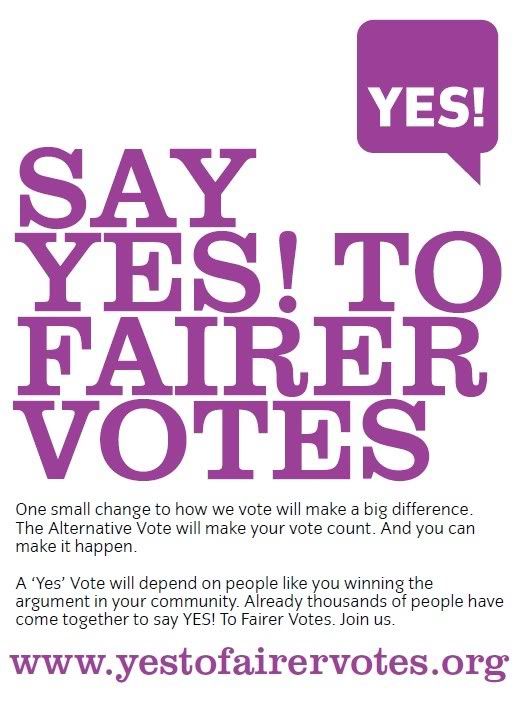
This is just about the best poster I've seen explaining why AV is fairer than the current FPTP system we use to elect MPs.
 

If you want to watch the longer explanation it was based on, it's in this video.

Bookmark and Share

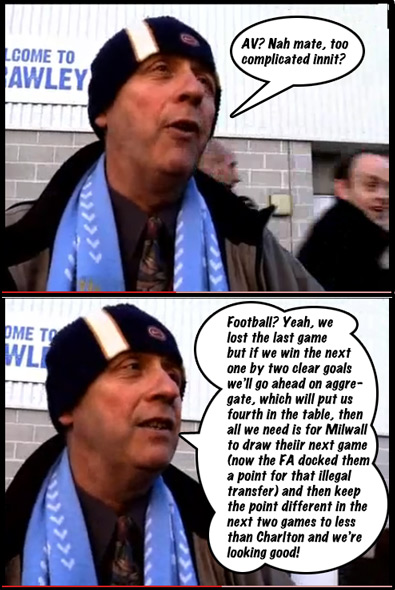
AV? Nah mate, too complicated innit?

Hat tip to Siônnyn for finding this picture.


Who said being able to count to three or four was too much for the average voter?

Bookmark and Share

The very worst thing about AV

One of the reasons I include David Jones on my bloglist is for entertainment value. He can be guaranteed to say something that will make him look a fool.

Today he blogged about AV, telling us about an encounter he had while canvassing:

In Mountain View Avenue, Mynydd Isa, I stopped to chat with a gentleman who was creosoting his fence. How, I asked, did he feel about AV?

“Disastrous,” he replied. “Do you realise that if we’d had AV at the last general election, that [expletive deleted] man Gordon Brown would still be running the country? It doesn’t bear thinking about.”

I must confess that the possibility hadn’t occurred to me, but it is probably the most compelling argument against the Alternative Vote system I have yet heard.

The worst thing about AV – David Jones, 20 April 2011

At this point, it might be worth reminding people about this story from the Telegraph in February:

     David Cameron: Gordon Brown would still be prime minister under AV

Poor David. Caught lying through his teeth. He's hardly the sharpest tool in the box, but not even he could be as dumb as he likes to make out he is.

Now if we read the article, what his leader said at the time was that under AV, Labour could have stayed in power. Sure. And my next door neighbours on both sides could each have won the lottery.

It would be very hard to work out what the results of a previous election would have been if AV had been used. You'd need to know if a person's expressed choice was their first preference or whether s/he was voting tactically; you'd need to know what their other preferences were; and also to know who else might be standing as a candidate, because one advantage of AV is that it would enable a wider range of candidates to stand because there would be no danger of them splitting the vote.

-

So then, what is the very worst thing about AV, I hear you ask?

Simple, that the mere mention of it encourages those who have a vested interest in maintaining the current voting system to tell even bigger lies than they normally would.

Bookmark and Share

Understanding and Misunderstanding AV

It was probably a repeat, but I happened to see a Daily Politics debate on AV in the early hours of this morning. The standard of debate was terrible; although that was due in no small part to the chairman, Andrew Neil, wanting to have much more of a say than those who were putting the case either for or against. The whole debate is available here on iPlayer, but I want to highlight this closing argument in favour of AV by Tessa Jowell.


The points she starts with are good, but she goes on to make the claim that AV will mean that an MP ...

would have to be elected by at least 50% of all those that are eligible to vote

This is completely untrue. What she probably meant to say was that an MP would have to be elected by 50% of those who do vote, because many of those who are eligible to vote don't do so. It might just be excusable if she had said it in the heat of debate, but this was a prepared closing statement. There are no excuses for her getting it so wrong.

And others who support AV make similar basic mistakes. Peter Hain might think he's getting it right when he says—as he does nearly every time he speaks on the issue—that under AV a candidate would need to be elected by at least 50% of those who vote (as opposed to those who are eligible to vote) ... but he's wrong too, and he has no excuse either.

-

So let me try to explain what they should be saying in a better way. The best way of thinking of AV is as a series of rounds in which the candidates who get least support get knocked out of the contest one by one. As an idea, there's absolutely nothing new, unusual or difficult to understand about this way of voting. It's the way nearly every talent contest on television works, for example, and it's even the way contests to decide the leader of the Conservative Party work. This is somewhat ironic, given that nearly all Tory MPs don't want ordinary voters to be able to do what they themselves already do ... but that's another story.

AV is a way of asking the question: "Who would you most like to see elected as your MP?" ... but with the follow-up question: "If s/he were knocked out of the contest, who would you like to see elected instead?" ... and with that question asked as many times as there are rounds in the contest.

The whole point is to allow voters more choice.

•  If people who are eligible to vote don't want to, they don't have to. It's their choice.

•  Those who do vote can express, in order, their preference for only one candidate, some candidates, or even all of the candidates. It's their choice.

•  But if all the candidates they express a preference for have been eliminated, then their vote no longer counts. They have effectively abstained from any further rounds.

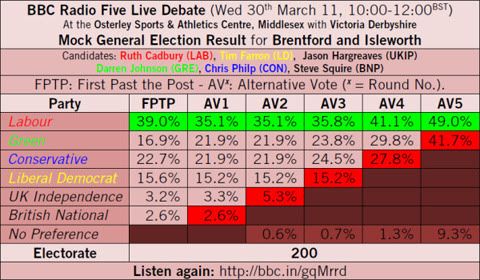
As an example of how this works in practice, Radio 5 Live conducted a dry-run election a couple of weeks ago which I read about on Guido Fawkes' blog. The results are shown in this table:


There were candidates from six parties standing. In the first round the BNP candidate was eliminated because he had the lowest vote. So the second preferences of the 2.6% who voted BNP were transferred to their second choice. Unsurprisingly, most of them put UKIP second, pushing up UKIP's share of the vote from 3.3% to 5.3%. But some of those who voted BNP did not express any other preference, so 0.6% effectively abstained from the rest of the contest.

In the second round the UKIP candidate had the lowest share of the vote, and was therefore knocked out. His 5.3% of the vote was split so that 3.6% went to the Tory candidate, 1.9% went to the Green and 0.7% went to Labour. But 0.1% expressed no other preference, or had expressed only a second preference for the BNP candidate who had already been knocked out.

Third time round, the LibDem candidate had the lowest share of the vote. So his 15.2% went to the second preferences of those who had ranked him first (and would have gone to the third preferences of any who had put him second after UKIP, and to the fourth preferences of any who had put him third after the BNP and UKIP ... although in this election nobody actually did either).

-

At this point it is perhaps worth commenting on one of the more misleading pieces of misinformation (why beat about the bush, lies) put out by the No to AV campaign. They would have people believe that it is unfair that those who put the BNP, UKIP or LibDems at the top of their list of preferences are now getting their vote counted two, three or even four times.

Well they are ... but that's equally true for everybody else.

Those who gave their first preference to candidates who are still in the contest have been getting their vote counted in every round too. Their vote counts just as much—no more and no less—than the vote of someone whose first choice was for the BNP, UKIP or LibDems. If somebody thinks this is unfair, we simply need to go back to the example of the TV talent contest or Tory leadership contest. If you vote for someone who is knocked out in the first or second round, that doesn't mean you're disqualified from voting for one of the remaining contestants in future rounds, does it? Nor does it mean that your opinion should now be worth less than the opinion of everyone else. In AV the opinion of every voter carries the same weight in every round.

-

But back to the contest. The 15.2% share of the LibDem candidate is now distributed according to the second preferences of those who had put him first. 6.0% goes to the Green, 5.3% to the Labour candidate and 3.3% to the Tory. 0.6% either had no other preference, or had only listed candidates who were knocked out in earlier rounds.

As a result of this, the Green candidate moves ahead of the Tory. This isn't in any way unfair to the Tory, it just means that given a three way choice between Labour, the Greens and the Tories, more voters prefer the Labour and Green candidates to the Tory. In a different constituency, it might well be another way round.

So for the final round, the second preferences of those who had put the Tory candidate first (together with the next preferences of those who had ranked the Tory below the LibDems, UKIP or BNP) are counted. 7.9% of the 27.8% went to the Labour candidate and 11.9% went to the Green; but 8% of those whose preferences included the Tories expressed no preference for either the Labour or the Green candidate.

This means that the Labour candidate won with 49.0% of the vote, against the Green candidate's 41.7%. In total 9.3% of those who voted did not have a preference for either of the two ... which is fair enough. AV leaves the choice entirely in the hands of each individual voter. Under AV nobody is forced to make a choice they don't want to make.

-

This dry run election shows why Peter Hain and others who claim that AV will mean that a candidate has to get at least 50% of the vote are talking rubbish. But that isn't the fault of AV ... it's just Peter Hain's inability to understand or explain it properly.

My point is that both Tessa Jowell and Peter Hain are not doing the Yes to AV campaign any good by misrepresenting it. In fact they're probably doing more harm than good.

To see why, just look at Guido Fawkes' post about it, here. The poor man can barely contain his glee, because he thinks that not getting 50% of the vote has somehow invalidated the result. Here are some extracts:

The BBC’s two hour attempt to sell AV to the listeners of Radio 5 backfired spectacularly

It didn’t work

The winning candidate could not get over 50% of the vote, rendering the whole basis for the change useless. The election would have been void.

The flawed result

It goes without saying that he has deliberately taken hold of the wrong end of the stick, for this doesn't invalidate the result at all. Quite the opposite, it shows how AV works and why it's fairer than FPTP. What we're seeing is merely another part of the stream of misinformation and blatant lies currently being put out by the No to AV campaign. And done with a professionalism that makes True Wales look like pussycats ... or should that be a cuddly inflatable pig?

Bookmark and Share

Small Change ... Big Difference

With a hat tip to Peter Black, here is a rather good video that explains how the Alternative Vote works:


I'm certainly going to vote Yes to AV, and I'd urge others to do the same. For me, the big difference is that it does away with the need for tactical voting; but apparently the "selling point" that seems to resonate with most voters is that MPs will have to work harder to secure support from a broad majority of voters, rather than just rely on their narrower core vote.

Bookmark and Share

A Party Without Principles

It all seemed so reasonable. A few weeks ago 77 prominent Labour figures including 39 MPs put their name to this letter in the Guardian:

Next year we have the opportunity to vote for a fairer voting system – one in which everyone's vote counts and every MP is required to get the backing of a majority of voters. It means that every Labour party member and supporter, in every seat in the country, can cast their vote for Labour and then mark any other preferences, knowing their vote won't be wasted.

First past the post isn't working. When just a few thousand people determine every election result in a few swing seats, the interests of the Labour party and the people we represent go unheard. The alternative vote means the majority get their voices heard; it will shut the door on extremist parties like the BNP.

When people switch off from politics it damages Labour, not the Tories. That's why the Tories don't want fairer votes. They don't want change; they say no! Labour is the party of fairness and change. Labour says yes. It's time for change.

Guardian, 8 December 2010

The four Welsh MPs included were Peter Hain, Chris Bryant, Susan Elan Jones and Kevin Brennan.

The sad thing is that the No to AV group have just released their list of Labour MPs who are opposed to the change ... and it is much, much longer with 114 MPs in total including eleven from Wales: Ann Clwyd, Geraint Davies, Chris Evans, Ian Lucas, Alun Michael, Paul Murphy, Nick Smith, Mark Tami, Albert Owen, Nick Smith and Mark Tami.

Should I laugh or should I cry?

What is there to say about a party that simply isn't capable of operating on the issue of principle? In the Yes group, the one thing that seems to matter most is that the Tories are against the Alternative Vote ... which means, to put it more bluntly, that these people in Labour think that AV will be of more benefit to themselves in Labour than to the Tory party.

Unfortunately (I say that because I support the change to AV, even though I would prefer STV) there are even more Labour MPs who think the opposite. Yet the No camp seem to be even more involved in narrow party politics. For example, they say that they:

challenged the Yes to AV campaign to "come clean" on their links to the Liberal Democrats

No to AV, 23 December 2010

But what on earth is wrong with being associated with the LibDems on a matter in which fairness should transcend party politics? I can only conclude that whole swathes of Labour MPs, who previously were committed to the Alternative Vote (and in fact went so far as to offer to introduce AV without a referendum if the LibDems got into bed with them rather than the Tories) have changed their minds only because they hope that a No vote on 5 May will put pressure on the ConDem coalition and lead to its collapse.

It's blatant, cheap opportunism that brings politics as a whole into disrepute.

Bookmark and Share

Shedding Darkness on the AV Referendum

I caught up with the Politics Show on iPlayer, and was completely amazed by the level of ignorance shown by the so-called expert that the BBC interviewed on the Alternative Vote referendum. Professor Russell Deacon made one or two complete howlers; see if you can spot them:


AV is not "the weakest form of proportional representation" ... it is not proportional in any way at all. It is not designed to, as Aled ap Dafydd suggested, solve the problem of the LibDems—or the Greens or UKIP for that matter—not getting a share of seats in the Commons that more closely represents the proportion of the overall vote that they get.

Because AV is not proportional, it won't make the prospects of getting a government with an absolute majority in Westminster any more or less likely than under the present first-past-the-post system ... but both interviewer and interviewee were happy to give the impression that it was.

Finally, Professor Deakin suggested that the additional member system that we use in Wales for Assembly elections was a means of expressing a second preference ... equating it with the second vote in London Mayoral elections (which is like AV, but you are only allowed one other choice). The man quite simply doesn't know what he's talking about.

-

So what is the point of AV? It solves one big problem with the current system:

     It does away with the need for tactical voting

Voters who want to keep a candidate from a particular party out will no longer be put into the awkward position of voting for a second or third choice candidate instead of the candidate they really want to vote for. They can put a "1" against their first choice candidate, and a "2", "3" and "4" against any other candidates they prefer ... not voting at all for the candidates they want to keep out. This will make it almost impossible for candidates and parties that polarize public opinion to be elected. For example, virtually no-one will put the BNP second ... a few extremists will put parties like the BNP first, but almost everyone else will put every other party before them.

Because no vote will be wasted, it should also increase voter turnout at elections. This is because more parties will stand and those people who don't vote because they don't like the politics of the established parties might find an alternative that they think is worth getting out and voting for.

For these reasons I will be voting "Yes" in the AV referendum and I would urge others to do the same. Unlike the much more important referendum that will be held in Wales next March, the Yes Campaign for AV has already been set up.


Just in case anyone hasn't read what I've said before on electoral reform, I would much prefer to see STV because it has the same advantages as AV, but is also proportional. I think it is better to take one small step in the right direction now than continue with all the unfairness of the current first-past-the-post system indefinitely.

Bookmark and Share

AMs in Wales

In my previous post I looked at the principles behind the proposed cut in the number of MPs in Wales and the consequent redrawing of constituency boundaries. There was a very good discussion in the comments section, and as a result I'd now like to address what I think was the major note of concern, namely that Wales would lose some of its political voice as a result of these changes.

-

As I set out before, I think that Wales should not be in the position of being over-represented in Westminster relative to the other parts of the UK. But I also think that the ConDem proposals are fundamentally flawed in terms of the rigidity that they want to impose. It is all very well to set out what you want to achieve just by looking at a map, but on the ground the situation is much more complicated. For those who are interested in recent history, I found a very good explanation of how previous redistributions of seats in Parliament have worked, and was struck by one passage in particular:

The Redistribution Acts of 1944 and 1958

The first House of Commons (Redistribution of Seats) Act, enacted in 1944, adopted many of the Vivian Committee’s recommendations. The Act set the limit of toleration at plus or minus 25 per cent of the electoral quota. It guaranteed representation for Scotland, Wales and Northern Ireland at their 1944 levels, as well as indicating a desirable maximum number of MPs for Great Britain (thereby implying a maximum for England). The Initial Review of Parliamentary constituencies, completed in 1947, was based on this Act.

Before the Initial Review was completed, however, the Boundary Commissioners claimed that they were unable both to meet the 25 per cent toleration limit and respect local government boundaries. The former requirement apparently dominated, since it came earlier in the Act’s Schedule of Rules. Parliament, however, determined that the ‘organic’ requirement to represent communities should take primacy over the ‘mathematical’ requirement of equal constituency population. They removed the 25 per cent deviation rule and replaced it with a rule that constituencies should ‘be as near the electoral quota as is practicable’. This new rule was placed after and, it was assumed, subsidiary to the rule regarding local government boundaries.

Electoral Knowledge Network - The UK System of Redistribution

If the Boundary Commission could not work within a toleration limit of 25% back then, how on earth does the ConDem coalition expect them to work within a 5% toleration limit now? They simply haven't learned the lesson of history. They think they can get away with leaving the detail to the Boundaries Commissions (we have one in each country) but they are handing them an impossible job. I mention this again in a post that focuses on AMs because I don't want us to be in the absurd position of having overlapping boundaries for Westminster and Senedd constituencies.
 

Bark and Bite

I don't want people to misunderstand what I said in the previous post. I do not want anyone to think that I am happy to see Wales lose any of its political "bark". I want to see a Wales which has both political bark and political bite. In Westminster, neither 40 seats out of 650ish nor 30 seats out of 600ish is going to give us any real control over what happens in Wales. It is the difference between "not very much" and "hardly any". If we rely on Westminster to make decisions for Wales, we will always get what suits the rest of the UK rather than what suits Wales.

As in the previous post, the key is to look at what has happened in the other devolved administrations in the UK. Scotland has a Parliament of 129 members for 5.1m people (39,000 per seat) and Northern Ireland has a Legislative Assembly of 108 members for 1.8m people (17,000 per seat). In contrast our National Assembly has 60 members for 3m people (50,000 per seat). Perhaps NI is not an exact comparison because their Assembly does perform some functions that we would associate with local government ( ... and it could also be argued that the special circumstances in the north of Ireland have produced two parallel legislatures, one for each community, sitting in the same building – which is why it is roughly twice as big as it otherwise would be). But we can compare ourselves with Scotland; and on a simple pro-rata basis with Scotland we should have an Assembly of 77 AMs rather than 60.

If it was right that the number of Scotland's MPs was cut from 72 to 59 because Scotland now has its own Parliament, then it must be equally right that Wales gets an increase in AMs when our Assembly gets a range of responsibilities closer to those of the Scottish Parliament. So we must be completely clear that a reduction in the number of Wales' MPs in Westminster must eventually result in an increase in the number of AMs in Cardiff. Some people talk about the Richard Commission recommending an Assembly of 80 AMs as if it were an arbitrary figure plucked out of nowhere. We have to be clear about why the Commission recommended it.

Therefore we cannot confine the argument to talking only about the fairness of reducing the number of Welsh MPs to the same pro-rata level as Scotland. We must at the same time talk about the fairness of getting the same pro-rata level of AMs as they have MSPs. The same argument cuts both ways.
 

Not now, but later

But that said, the time for doing it is not now. That is because Scotland's Parliament has a greater number of devolved responsibilities than we do in Wales. Two obvious differences are police and the justice system. Therefore—using exactly the same argument that we need to be treated fairly and equally rather than as some sort of special case—these must eventually be devolved to Wales as well.

By forcing a reduction of MPs on Wales, the ConDem government is in fact adding to the weight of argument for these areas of responsibility to be devolved to Wales. Every action has consequences. We should make it clear that devolving things like police and the justice system to Wales is the logical consequence of the proposal to reduce the number of our MPs by the same proportion as the number of MPs in Scotland was reduced in 2005. It might well be one of the proverbial "unintended consequences" that the Westminster government hasn't thought about ... but the logic is inescapable and ignorance is no excuse.

-

We all recognize that the public mood is for a decrease rather than an increase in the number of politicians. So we have to make a clear distinction between the general reduction in MPs across the UK and the specific reduction in MPs in Wales that will be the result of getting a law-making Senedd with greater responsibilities devolved to it. In round numbers, Wales is going to lose 3 MPs as a result of the general reduction and 7 MPs because of the specific reduction. So we have to make it crystal clear that any increase in the number of AMs is only balanced against the loss of those 7 MPs, not all 10 MPs.

However, we need to bear in mind that MPs cost us much more than AMs, not just in terms of greater salary but especially in terms of expenses. Last year, the average MP received expenses of £144,000 on top of a salary of nearly £66,000 ... making £210,000 per MP. This means that the money saved from not having these 7 MPs will easily pay for double that number of additional AMs.

So when the time comes to increase the number of AMs, we must use this sort of calculation as financial justification for the increase, just as the previous calculation showed the political justification for the increase. And for that reason—to make it clear that we too must take our fair share, but no more than our fair share, of the cuts—I would argue for a Senedd of about 72 members (maybe 75 at a pinch) rather than the 80 recommended by the Richard Commission.

Bookmark and Share

MPs in Wales

This clip from yesterday's Politics Show Wales serves as a reminder that the issue of the number of MPs in Wales, together with the redrawing of constituency boundaries, will be debated and probably decided this week.


I commented on the subject in a previous post here long before the current ConDem proposals were tabled, and have been disappointed with the responses of both Labour and some in Plaid Cymru who seem to have lost sight of the principles that should be applied, just for the sake of Wales having a few more seats. So now seems to be a very good time to set out again what I think these principles should be.

 
The Historical Context

For several decades, both Wales and Scotland were over-represented in the House of Commons. It would probably do more harm than good to go into detail about the reasons for this, except to make the general point that it was to give Wales and Scotland, as nations, a slightly louder voice in Parliament than could be justified by the size of our respective populations alone.

Scotland had 72 MPs, but after the establishment of the Scottish Parliament it was decided that Scotland's quota of MPs should be reduced, so that constituency sizes roughly averaged those in England. This change was implemented in time for the 2005 Westminster election, and meant that only 59 MPs were elected for Scotland. However a similar change was not introduced in Wales. This was not a case of inconsistency; the rationale was that Scotland was now able to make its own laws on all matters except those reserved to Westminster, but the Welsh Assembly was not set up with the power to pass primary legislation.

My view has always been that the number of Welsh MPs should be reduced to the same level as in England and Scotland, but that this should only happen when the Assembly gained primary lawmaking powers. However the ConDem government is determined to equalize the size of constituencies irrespective of whether the Assembly gets primary lawmaking powers or not, and irrespective of the fact that even when we get the powers currently proposed, we will have them in fewer subject areas than either Scotland or Northern Ireland. This determination means that principle is simply going to be steamrollered by the ConDem government in Westminster. To put it bluntly, even when over-represented with 40 MPs, the rest of the UK has far more MPs and can therefore pass whatever legislation they like, no matter what we in Wales say about it. Until we are independent, that will always be a hard fact of political life.

The only comfort is that things will probably work out right in the end, simply because all the polls consistently point to us getting a Yes vote in the referendum in March next year. In winning a Yes vote, we remove the rationale behind having so many MPs compared with Scotland and England. It will be quite indefensible for us in Wales to try to hold on to our over-representation when we have an Assembly with lawmaking powers. And if the devolution of more powers to Scotland and Northern Ireland than to Wales is an issue—which of course it is—then the answer is to press for the devolution of those same powers to Wales as well, not to squabble about a handful of seats that won't make any difference in a House of Commons that will always be dominated by English MPs because England has 85% of the UK population.
 

Variation of Constituency Size

Leaving to one side the situation in Wales, there is a considerable variation in constituency sizes in the remainder of the UK. Generally speaking, if strict equality were applied, more sparsely populated areas would end up with such geographically large constituencies that they would become unwieldy, with the communities at one end perhaps having very little in common with those at the other and therefore not seeing themselves as an entity. This would particularly be true where physical features such as estuaries, straits, rivers or mountains form natural divisions which have shaped the historical identities of the communities on each side.

The Boundaries Commission has always been aware of this, and goes to extraordinary lengths to strike the difficult balance between changing demographics and community identity. But it can only make the compromises it does because it is allowed sufficient leeway over sizes. At one stage the ConDem coalition was proposing that constituencies could vary in size by no more than 2.5%. The proposed figure is now 5%. But in my opinion this is still insufficient, and for this reason I have every sympathy with those who object to the unnatural constituency boundaries that would result from the rigid application of so small a variation.

One thing that particularly struck me recently was the attitude of Keep Cornwall Whole, where Philip Hosking said in the fourth comment of this post, that all parties in Cornwall were prepared to end up with Cornwall having one fewer MP, rather than end up with a constituency that did not respect the border defined by the River Tamar, not just as a physical boundary but more importantly as one that exists in historical and cultural terms.

It is therefore right that we should fight for an amendment to the proposed legislation that allows for the views of people in any region to be taken into account when deciding the size of constituencies. If people want to have fewer MPs than a strict mathematical exercise on a sheet of paper would produce, they surely must be given a mechanism by which that choice can be respected. But I have to say that the main impediment to achieving this is that MPs, particularly in Wales, seem fixated only on Wales losing seats and pleading some sort of special interest that applies to us but not to everyone else.

I repeat, if we in Wales can ditch the idea that Wales should continue to have more seats in the Commons than we deserve, we then open the way to a more constructive dialogue on getting more flexibility on the sizes of those constituencies within Wales. For this is not a Wales-only issue, but one that applies just as much to the more sparsely populated areas of Scotland and England too. We need to join together and fight on common ground, rather than hold ourselves up as a special case. One particular iniquity in the proposed legislation is that the ConDems have recognized Orkney and Shetland and Na h-Eileanan an Iar (the Western Isles) as special cases, but have not extended that recognition to more sparsely populated and geographically distinct areas of Wales or England. So we would be completely justified in fighting for this.

However, if we can't get this on a UK basis, we should accept a fair overall figure for the number of MPs in Wales, but then fight for the right for the Boundary Commission to have flexibility to vary constituency sizes within Wales beyond the 5% limit currently proposed. In fact this is what was recently proposed by the Welsh Affairs Select Committee:

The Boundary Commission, which will draw up the new constituencies, should be given a new remit to take into account Wales’ particular geography, which makes unifying existing seats in the South Wales valleys particularly challenging, say the MPs.

Western Mail, 25 October 2010

 
Voter Registration

Here I simply want to repeat a point made by many others, namely that we need to base constituency sizes on the overall number of people who live in a constituency, not those registered to vote.

The principle behind this is simple: MPs represent all those who live in a constituency, not just those who vote and certainly not just those who vote for them. An MP's workload is always determined primarily by the number of people s/he serves. In practice we know that not everyone who is eligible to vote registers to do so. Those that tend not to register are young adults and migrants, particularly those who move to towns and cities to find work and who think they are only going to be in their accommodation for a short time. This tends to mean that urban areas have lower levels of registration than suburban or rural areas.

The answer is to base constituency sizes on census information rather than electoral registration, though perhaps this should be cross referenced with other information such as registration with GPs. One of the few good points made by Alun Michael in the interview is that a 5% threshold will lead to frequent changes of boundaries; linking it to census information would mean that things are only revised on a ten-yearly cycle, which will provide a greater element of stability.
 

Linkage between Westminster and Senedd Constituencies

Labour in particular have made a lot of fuss about the linkage between Westminster and Senedd constituencies, and even presented this as a reason not to change the number of MPs in Wales. In my opinion they've blown this out of proportion as a pretext for keeping the over-representation Wales currently has.

There are a number of ways this can be solved. The first option is to redraw Westminster constituencies, but retain the Senedd constituencies as they are. This is what happened in Scotland. The main drawback to this is voter confusion, and for this reason I think it is a bad idea. It is also going to make it very difficult for political parties, though I'm sure that will matter rather less to most people. I'm sorry to say that I can't find the reference (any help much appreciated) but I recall a letter between Dafydd Elis Thomas and Cheryl Gillan which suggested that is what the Wales Office intended.

The second option is to have the same new constituencies for both, resulting in fewer first-past-the-post AMs but more regional members. I think this will not only be less confusing for the voters, but will also help to reduce the first-past-the-post bias to give a more proportional result for Assembly elections. If, as looks likely, we have 30 MPs, it would mean a balance of 30 constituency AMs and 30 regional AMs.

There are two reasons for being hopeful about this outcome. The first is what Jonathan Evans said in the interview:

... but if in due course it were the case that the National Assembly felt that they wanted to follow this change and have an alignment, then that's something that clearly could be looked at at that time

The second is something Nick Bourne said recently, as reported here:

When the Welsh Parliamentary constituencies are redrawn and cut to 30 that will have an immediate impact on the number of first-past-the-post members in the Assembly. They will also fall from 40 to 30. Unless nothing is done that will bring the number of Assembly members down to 50 ...

So it was revealing that at his weekly Press briefing this week Nick Bourne, the Conservative leader in the Assembly, confided that he had had a conversation with the Secretary of State for Wales, Cheryl Gillan, about this and won an assurance that the present number of AMs would not be allowed to fall.

... The obvious way would be to follow Scotland and retain the present 40 constituency boundaries for Assembly elections, thereby making separate constituencies for AMs and MPs. However, Nick Bourne said he was very much against this. It would create confusion in the minds of the electorate and be a nightmare for party workers who would have to create separate organisations in the same area to fight the various elections. No, he was committed – indeed, adamant – to have the same first-past-the-post constituencies for both Westminster and Assembly elections. It follows from this that the only way to retain the 60 members will be to have an extra ten elected on the List, two more for each of the five regional lists.

Click on Wales, 8 July 2010

Yet I fear this is another instance where raw power will sweep principle aside. The first-past-the-post system benefits Labour disproportionately, and for that reason they will fight tooth and nail to retain the 40 constituencies for Assembly elections. So Jonathan Evans is being rather naïve to suggest that an Assembly in which Labour have more seats than their share of the vote warrants will ever "feel that they want to" change the arrangement.

For me, the answer is simple. The current legislation that determines the way AMs are elected will have to be amended at Westminster. Therefore the new arrangements have to be decided and included as part of the new legislation that Westminster is going to enact. They have to specify something for now. I would much prefer that Westminster devolves responsibility for all electoral arrangements in Wales (at both Assembly and local level) to the Assembly. So does Nick Bourne, as he said in the same article:

It was interesting on this front that, at his Press conference Nick Bourne let slip that he was in favour of devolving responsibility for elections and the electoral system from the Home Office to the National Assembly.

But this is where he has to act rather more cleverly than he talks. It is pointless devolving such decision making power to an Assembly that does not have a fair voting system, and whose membership does not therefore represent Wales. Labour currently has 43.3% of the seats, but only obtained 32.1% of the constituency vote and 29.7% of the regional vote. Therefore it will only make sense to transfer the power after the Assembly has been elected on a fairer basis than it is now.

Bookmark and Share

Assembly elections on 2 June 2011

A vote was taken in the Commons yesterday to hold the AV referendum on 5 May 2011. Because the Bill is at committee stage it would still be technically possible to change it in a later vote on the whole bill, but for all practical purposes this vote has confirmed the date of the AV referendum. The voting figures of 335 to 207 show that any subsequent rebellion would be unlikely to get the date changed anyway.

As I'm sure everyone reading this will know, this is the same day as the elections to the Welsh and North of Ireland Assemblies and Scottish Parliament are due to be held. There has been quite some protest about the clash, but the ConDem government at Westminster has simply gone ahead anyway. It's not often that I agree with Chris Bryant (although the work he does with regard to teenage pregnancies is an honourable exception) but this is one occasion where I fully agree with what he said:

Mr Bryant, shadow justice minister, said there had been an "extraordinary" lack of consultation with devolved assemblies about the proposed poll date and its impact on devolved elections.

There was a "firm view" among these assemblies that the date was a bad idea and it showed a lack of respect to Scotland, Wales and Northern Ireland, he suggested.

"It would just seem to be common human decency to be able to consult," he told MPs, adding this "betrayed the rather London-centric view of the government."

BBC, 25 October 2010

This is matter has been on the table for some time. Back in May, in one of the first bilateral meetings between the Welsh Government and the new Welsh Secretary, the subject was raised ... but Cheryl Gillan did nothing to relay those concerns to the Westminster government, saying that she did not do so because the request wasn't made in writing. We can read about it in this report in the Western Mail in July:

     Wales ‘strongly opposed’ to election date clash

This is the position of the One Wales Government on the issue:

An Assembly Government spokeswoman said: “We do not believe that the UK Alternative Vote referendum should be held on the same day as the people of Wales choose their AMs for the next four years. There should be no distraction from the National Assembly election. That is why we have agreed with other parties in the Assembly that our own referendum should not be held on the same day as the Assembly elections. Indeed, we have raised with the Secretary of State the possibility of deferring the Assembly election so that there is a longer gap between the referendum poll and the Assembly poll.

“The First Minister therefore intends to make clear to both the Prime Minister and the Secretary of State for Wales at the earliest opportunity that we are strongly opposed to the AV referendum being held on the same day as the Assembly election.”

And there was even dissent from some Tory MPs:

Tory MP Bernard Jenkin told the BBC that most of his Conservative colleagues would support the principle of a referendum as it was part of the coalition agreement.

But he added: “I am astonished to hear that they are thinking of putting this referendum on the same date as the elections in the Scottish Parliament and Welsh Assembly because that’s going to lead to differential turnouts in the referendum in different parts of the country. In Scotland and Wales they will be thinking about who runs Scotland, who runs Wales, they won’t be focusing on the main question of the referendum.

“It’s clearly an attempt to stoke the turnout in areas of the country which already have different voting systems which is why I presume there will be less resistance to change to the UK system.”

My own view is that I'm not against the idea of holding different polls on the same day in principle, but I am against this particular clash. Rather than repeat myself, I set out my reasons in this post in May:

    When it is right, and wrong, for polls to clash

 
But what's done is done. The AV referendum is going to be on 5 May 2011 despite our objections. But all is not lost. There is a simple mechanism in Section 4 of the Government of Wales Act by which the date of the Assembly elections can be put back (or indeed forward) by up to a month.

This provision mirrors a very similar provision in Scotland, but in Scotland's case they are able to make that decision for themselves. In our case the decision is not up to us, but up to Secretary of State Cheryl Gillan. What's more, she can do it with or without the consent of the Welsh government ... she is merely under an obligation to consult with the Welsh Ministers.

So the question for the Welsh government is simple. If the protests made by Labour MPs in the Commons are more than just complaining for the sake of "having a go at" the Tories, our First Minister must now make a formal request to Cheryl Gillan to have the date of the Assembly elections moved to 2 June 2011.

The ball will then be in her court. But if she wants to hold on to the last remaining shreds of the ConDem government's much vaunted "respect agenda" for devolved government in Wales, she'd better say yes.

Bookmark and Share

Clegg in a Fluster

I've just read this very strange story in the Scotsman:

Nick Clegg: Time running out on dual poll

Deputy Prime Minister Nick Clegg has admitted that time is running out to find a solution to ensure the Westminster and Holyrood elections do not take place on the same day in 2015.

The Tory/Lib Dem government has come under fire for its plans to introduce a fixed term of five years that mean the two election dates clash. Opponents have said that it is evidence of a "disrespect agenda" with Scotland and other devolved nations, and that having the two polls on the same day would mean that the Holyrood vote would be overshadowed.

Mr Clegg has made it clear previously that he hopes to give the Scottish Parliament greater powers to move its election date from the one month variable power it has now.

However, giving evidence to the House of Lords' constitution committee yesterday, Mr Clegg said that the government was struggling to come up with a solution.

"There are no easy answers," he said. "I have looked at various suggestions which all have sorts of dilemmas of their own." The Deputy Prime Minister added that a solution needed to be found soon, "because with the devolved elections in May, bluntly, voters need to know what they are voting for."

The Scotsman, 14 October 2010

I find this ridiculous. Yes, it is important that the elections don't clash, but if the ConDem government is determined to have the Westminster election on the first Thursday in May 2015, the solution is to move the Welsh and Scottish elections so that they don't clash.

The power already exists to move these elections by four weeks (though Scotland can decide this for itself, but Wales needs the agreement of the Secretary of State ... that's an anomaly that should be fixed) but if this is not considered to be enough of an interval then it is a simple matter to legislate to allow them to move by more. Alternatively, I can't see it would make any real difference for one election to be on the first Thursday in April and the other on the first Thursday in June in those years when they clash, but on the first Thursday in May when they don't.

Nick Clegg is working himself into a tizz over something that is easy to sort out. Good grief, the ConDem government still haven't worked out what to do about the potential clash between the AV referendum and the Welsh and Scottish elections in May of next year, which is every bit as important an issue, but in much more urgent need of a solution. Why on earth is he getting flustered about something which is more than four years away, but not dealing with the more immediate problem?

It looks like Clegg is in headless chicken mode already!

Bookmark and Share

Cameron shows contempt

Shortly after becoming Prime Minister, David Cameron spoke repeatedly about a "respect agenda" for Wales and Scotland. In his speech at the Tory Party conference yesterday he showed us that he's either changed his mind ... or never meant it in the first place.


We will always pursue British interests. And there are some red lines we should never ever cross. The sight of that man responsible for the Lockerbie bombing, the biggest mass murderer in British history, set free to get a hero’s welcome in Tripoli. No. It was wrong. It undermined our standing in the world. Nothing like that must ever happen again.

As we can see, this was delivered with a clenched fist banging the lectern. It can only mean one thing: that if Cameron was Prime Minister when the Scottish Justice Minister made his decision to free Al Megrahi, he would have stepped in to prevent it.

Back in February in his speech to the Tories in Scotland, Cameron said almost the same thing, although it might just have been possible to understand what he said then as less of a threat. He said:

And it's shameful that during one of the most emotionally-charged moments in our recent history, when the Lockerbie bomber was released from jail to return home to Libya where he still is today, the Scottish Government and British Government refused to cooperate.

That would not happen on my watch.

At the time I said this about it:

The matter of compassionate release—whether one agrees with the decision in the Al Megrahi case or not—is a quasi-judicial decision exercised by a minister of government: in Scotland by the Cabinet Secretary for Justice and in RUK by the Secretary of State for Justice. So how precisely are two different governments meant to "cooperate" if they disagree?

It might mean that the government that did not have the responsibility for making the decision simply made whatever representations it wished to make in private. In fact the Labour government in Westminster did do exactly this, constantly saying in public that it was a matter only for the Scottish government. I think that was entirely right. But Cameron has called it "shameful". Read the sentence again carefully, he did not say the decision to release was shameful (although he undoubtedly thinks it was) but that what happened was a refusal to cooperate, and that the refusal to cooperate was shameful.

So what are the alternatives? Well, one alternative would be that each government openly declared its disagreement with the other. At least that's an honest position. The American government certainly voiced its disagreement with the decision in no uncertain terms. And the Conservative Party both in Holyrood and Westminster were particularly vocal in their disagreement too. But how on earth can open disagreement be described as "cooperation"?

So what's left? If Cameron's statement has any meaning, it can only be that he intends Westminster to overrule any similar decision the Scottish government might make in future. I find that very sinister.

Syniadau: Cameron on Scotland, 13 February 2010

Cameron seems to be very confused about this matter. How can the decision to release Al Megrahi possibly reflect badly on the UK? It wasn't the UK's decision to make, so the UK cannot be in any way responsible for it. The only people who are likely to be unimpressed with the UK are dictatorial governments who think that the hallmark of leadership is to ignore democracy and the rule of law, and instead to enforce your will over those who disagree with you by whatever means it takes. They'd call that "strong leadership", but why should any democrat care what people like that think? That Cameron obviously does care about it speaks volumes about his own attitude. It's the attitude of playground bullies everywhere: kow-tow to those who are bigger than you, while at the same time threatening those who are smaller than you.

So we can see how little the idea of mutual "respect" matters to David Cameron. For him it is only a one way street. And this puts into proper prespective what Cheryl Gillan meant when, as reported here, she echoed the call for the Assembly to show "respect" to the ConDem government in Westminster.

So forget the "respect agenda". These are empty words. The reality is nothing but arrogant contempt for the devolved governments of the UK.

-

I'd now like to turn to another subject in the same speech:

And I want to make something else clear. When I say I'm Prime Minister of the United Kingdom, I really mean it. England, Scotland, Wales, Northern Ireland – we are weaker apart, we are stronger together, and together is how we must remain.

Taken in isolation, these words might just mean that David Cameron wants the UK to stay together. That's perfectly reasonable, and he's as entitled as everyone else to his view.

But there are a couple of things which show that he has something more draconian in mind. The first is the use of the word "must". Why must the countries of the UK remain together? If we respect the idea of democracy, surely people in Wales, Scotland—and indeed England too—each have the right to decide for ourselves in a referendum whether we want to be independent of the rest of the UK. Indeed, he mentioned it in the context of Northern Ireland, where a fundamental part of the agreement is that Ireland will be be reunited if a majority in the North vote for it. Why the double standards?


So what did he mean by the heavy emphasis on the word "must"? Was it merely rhetorical flourish ... or was it exactly the same "must never happen" as he used to say he intended to trample over the independence of the Scottish legal system? If anybody is in any doubt, look at this part of his same speech:

Now I know that there will be compromises and I want to tell you that there may be things we have to do that sometimes we won't like. Next May, there'll be a referendum on electoral reform. Now I don't want to change our voting system any more than most of you want to change our voting system. But let me just say this: let's not waste any time trying to wreck this bill – let's get out there and win this vote in the country.

This statement is perfectly reasonable. He acknowledges that electoral reform is a subject that people should be allowed to decide in a referendum, so he has allowed the referendum to happen, even though he will campaign for a No vote in it.

So why will he not do the same on the matter of independence? Why does his party, along with the two other unionist parties, continue to refuse to allow a referendum on independence in Scotland? If he was being consistent he would say:

Now I don't want to change our voting system Scotland to become independent any more than most of you want to change our voting system Scotland to become independent. But let me just say this: let's not waste any time trying to wreck this bill the SNP's referendum bill – let's get out there and win this vote in the country.

But being consistent is hardly a Tory strong point. If the Tories were so confident that a vote on Scottish independence would be lost, they would surely welcome a referendum to prove it.

-

These two examples—lack of respect for the independence of the Scottish legal system and the unwillingness to allow a referendum on independence—clearly show us that the only thing that's strong about Cameron is his desire to use strong arm tactics at the expense of democracy.

Bookmark and Share