Showing posts with label Holtham. Show all posts

Parity with Scotland?

There are many things to criticize Plaid Cymru for, but the one thing that has disturbed me most is in fact the central plank of their election campaign: namely that they want parity with Scotland both in terms of devolved powers and in terms of funding.

I don't have a particular problem with parity of devolved powers because, as things stand, our National Assembly has fewer powers than the Scottish Parliament, and therefore parity would be a practical first step. I would only qualify this by saying that I wouldn't want the powers of the Scottish Parliament to act as a limit. To give one example: it looks likely that powers to set the rate of Corporation Tax will be devolved to the Six Counties, but not to Scotland. Therefore I would want Wales to have this power too, irrespective of whether or not Scotland gets it.

For me, the principle is that I want everything that is currently decided at Westminster to be decided by our National Assembly ... in other words, independence.

-

But I do have a very big problem with the idea that Wales should get parity of funding with Scotland. And I am frankly amazed that Plaid Cymru has abandoned its previous position of wanting fair funding for Wales, and now wants something that is patently unfair.

Of course I understand why and how it happened, but that doesn't excuse Plaid's behaviour. The Holtham Commission did a good piece of work, demonstrating that Wales was underfunded relative to need on the basis of an objective formula. At that time, the block grant to the National Assembly fell short of what we would get by applying this needs-based formula by roughly £300m a year. This was set to get worse because of the Barnett Squeeze, but in fact has not got worse because cuts in public expenditure have put the Squeeze into reverse. However the shortfall will increase again when public expenditure starts to rise over the next few years.

Because of this shortfall, coupled with general discontent with the way Barnett worked anyway with regard to Scotland, there seemed to be consensus among all the parties in the Assembly (the Tories, Labour and LibDems as well as Plaid Cymru) that Barnett had reached the end of its working life and needed to be replaced. The problem is that just before the Scottish independence referendum, those three Unionist parties panicked in the face of closer than expected opinion polls, and made a vow to retain Barnett.

It was at this point that Plaid Cymru panicked ... with the result that they came up with a policy to demand the same amount of funding per head as Scotland gets. Of course not all public spending in Scotland is channelled through the Scottish Parliament (for example most benefits and pensions are paid directly to individuals and families) but if the same "block grant per head" were paid to our National Assembly as is paid to the Scottish Parliament it would indeed, after making allowance for different devolved functions, result in Wales getting something like an additional £1.2bn in block grant.

Now what's wrong with that? Well, to put it bluntly, any child could see what's wrong with it. Why pick Scotland? Why not pick England instead and demand that Wales gets a block grant equivalent to the same level of funding per head as England? Simple, because if Plaid Cymru picked England, Wales would get much less of a block grant than we do now. In other words, picking Scotland is a blatantly biased choice. If the principle you adopt is equal spending per head, then that has to apply across the whole of the United Kingdom—which, by the way, is UKIP's policy—it cannot be applied selectively.

In effect what Plaid Cymru are doing is asking English taxpayers to give Wales much more than we need on any objective basis, and very much more than they give themselves. It is a wicked and stupid idea, and I have to say I'm very glad that I am no longer associated with a party that can come up with something that can only be described as a total perversion of any concept of either fairness or reason.

-

In principle there are some very basic rules about how to redistribute funding between different parts of a state. We need to consider two things: how much each part of the state produces in terms of tax revenue, and how much each part of the state needs. One sum will be usually be higher than the other, and an equitable funding formula must be somewhere between the two. It cannot be outside that range.

A needs-based formula on its own will not work because, as the Holtham Commission noted, if it were applied to Scotland, it would result in Scotland getting maybe £4bn a year less in block grant than it does now. However that does not mean that Scotland is over-funded, because Scotland provides more per head in tax revenue to the Treasury than most other parts of the UK. In Scotland's case, the proportion of tax revenue it contributes to the Treasury is more than its relative needs, therefore it is right that Scotland gets more than it needs.

But in the case of Wales, what we produce in tax revenue per head is quite a bit lower than other parts of the UK, and the sum is also lower than what we objectively need, based on the formula used by Holtham (which, by the way, is based on the way money is distributed by departments within England). It is therefore reasonable and justified to say that Wales deserves more money, but only as much as will bring us up towards what we objectively need ... not more than that. To ask for or expect more is nothing but greed. Yet this is what Plaid Cymru have sunk to. It's sickening and shameful.

-

It's also deceitful, because it is undeliverable. As I showed in the last post, even if the SNP win upwards of 50 seats on Thursday, they will not get to determine the direction of government. The same would be just as true if Plaid Cymru won 35 seats in Wales. 533 English MPs will never vote to give Wales more than it either contributes to the Treasury or needs.

That's not to say that there are other aspects of the way Wales is funded that can't be improved. In addition to the £300m shortfall in the block grant (or whatever it now is when the Holtham formula is applied) we can rightly call for our fair share of infrastructure investment so that, for example, Wales gets a pro-rata share of rail infrastructure investment or research funding relative to the rest of the UK. But we must make a reasoned and rational case for this, and we weaken any case we make if we, at the same time, are making unreasonable and irrational demands.

-

In closing, I would also ask people to consider, in practical terms, what the result of getting more money from England than we either need or contribute to the Treasury would be. How on earth would it help us stand on our own two feet as a nation? It would simply tie us closer into dependency on England. Yet this is party policy ... from a party that supposedly wants independence! Perhaps, under better leadership, Plaid Cymru might become a party that is worth voting for again ... but it certainly isn't worth voting for them now.

Bookmark and Share

Bad, twice as bad, or three times as bad?

On Wednesday, Gerald Holtham said this in his evidence to a House of Lords Select Committee looking into the economic effects of Scottish independence on the remainder of the UK:

[Wales] is not economically in good shape. It is running a deficit of 25% of GDP.

Wales Online, 4 July 2012

A video of the session is here. At first I thought that he had made a simple mistake, and had meant to say that there was a deficit of 25% between public spending in Wales and taxation accounted as having been raised in Wales. This would be in line with the findings of the Holtham Commission, which (in round terms) produced these figures:

Tax collected by UK treasury ... £17bn
Tax collected locally ... £2bn
Total tax take ... £19bn
Total expenditure ... £25bn
Fiscal deficit ... £6bn

Holtham Report, Section 4.17 onwards

But in this report on Dragon's Eye on Thursday, he repeated the claim in terms which made it very clear that he was talking about Wales' total economic output, i.e. our GDP:


We don't have GDP figures for Wales, but GVA is broadly equivalent to it and we can see from this table that Wales' GVA is £45.5bn. So if Wales' fiscal deficit is 25% of this, it would mean it is somewhere in the region of £11bn or £12bn a year ... in other words that it is roughly twice as bad as had been previously reported.

Now of course things probably have got worse since the Holtham Report, based on 2007-08 figures, was published. Companies will be employing fewer workers and be less profitable, reducing the tax take; and more people will be out of work, increasing welfare expenditure. But it seems highly improbable that Wales' fiscal deficit could be almost twice what it was only a few years ago.

And the plausibility of what he's saying is cast into yet more doubt when he goes on to say that Wales' fiscal deficit is the equivalent of us borrowing some £6,000 for every man, woman and child in Wales. As there are roughly three million of us, this would put Wales' fiscal deficit at about £18bn a year ... which is roughly three times as bad as in the Holtham Report.

-

Although we don't always see eye-to-eye in political terms, I definitely have time for Gerry Holtham's economic opinions. But I have to say that on this occasion the statements he made at the House of Lords and on Dragon's Eye appear not only to be self-contradictory, but also to contradict the figures in the Holtham Report.

I hesitate to say this, but I wonder if he isn't being rather sloppy with his figures in order to make a political point. There is a huge difference between £6bn and £12bn a year, and an even bigger one between £6bn and £18bn a year.

-

I, and I'm sure everyone else in Wales, would like to know what our fiscal deficit is. We know we have a problem, but don't have a hope of effectively dealing with the problem unless we are realistic about how bad it is, which was one of the things the Holtham Commission was set up to do. So my challenge to Gerry is to clarify what he has said this week and how it relates to the figures in the Holtham Report; and if the figures in the Holtham Report are now wrong, to provide us with the evidence to support whichever new set of figures is correct.

Bookmark and Share

Holtham's evidence on Scottish independence

I don't have time at the moment to write about Gerry Holtham's evidence to the House of Lords committee on the financial and economic consequences of Scottish independence, but it seems that others do. So please feel free to talk about it in this thread.

For those with an hour to spare, the video is available here, and David Williamson, who we can see taking notes in the background, wrote about it here in the Western Mail.

I've transferred the lengthy comment from the other thread to start the ball rolling. Have fun, and I'll join in later.

Bookmark and Share

Rhodri Waffles

I couldn't help but smile when I read what Rhodri Morgan had to say about the Freedom of Information disclosure which has now proved beyond doubt that Labour had absolutely no intention of changing the Barnett Formula when they were in power at Westminster.

     Plaid Cymru attack Labour's 'inaction' over funding – BBC, 4 April 2011

     ‘Shocking and unforgivable’ that Gordon Brown did not want to end
     Barnett Formula injustice – Western Mail, 4 April 2011

Let's look at what he said more closely:

“What Plaid forget is that in the first Assembly the funding coming to the Assembly grew by 10% a year in cash terms or 7% in real terms. That was well in excess of any previous increase but clearly was going to lead to convergence because that’s how the Barnett Formula works. In the second Assembly increases continued at a healthy lick of 6.5% in cash terms for those four years or just over 4% in real terms.

“By the end of the second Assembly, concern about the shrinkage of the average annual increases we were receiving were starting to build up.

“During the third Assembly those concerns have become more acute because by now the average annual increase was some 4% in cash terms or 2% in real terms. This was the time therefore that concern over the underfunding of Wales started to become really material."

Although he's tried to hide it with a lot of waffle and an attempt at a diversionary sideswipe at Plaid, he now claims that the increases in public spending were "clearly going to lead to convergence because that’s how the Barnett Formula works".

-

Much as they'd like to, Labour can't have it both ways. It's possible for them to say that didn't know it was going to happen, and they only found out about it after the Holtham Report was published. But if they take that line, it simply shows that Labour are financially incompetent. Or it's possible for them to say, as Rhodri Morgan claims, that Wales was inevitably heading for a funding shortfall that anybody with 28.35g of financial acumen should have been able to foresee. But if it was as clear to Rhodri as he now claims it to be, the question is much more damning:

    Why didn't Labour do anything about it when they were in power?

Personally, I think financial incompetence is a much more plausible explanation. Labour simply sat on their hands, and said and did nothing. They were happy just to spend all the extra money Wales was getting in the block grant without giving a thought to where the money was coming from, whether it was being distributed fairly within the UK, or whether it was sustainable. Labour in Wales were so parochial and introspective that they didn't notice that England was getting much more of an increase in public spending than Wales.

It took Plaid Cymru to point out to them that this could not last, and it was at our insistence that the One Wales agreement included the commitment to set up a commission on funding and finance. The good work of Messrs Holtham, Miles and Spahn put hard figures against what we knew was happening, most importantly by defining in objective terms the factors that should be used to quantify need.

-

Yet even after the first part of the report was published in 2009, Labour in Wales refused to accept what it said. This was because Labour were still in power at Westminster, and it was therefore politically impossible for them to criticize their leaders there. Instead, Labour simply rubbished Plaid Cymru when we made the £300m annual shortfall in funding a central plank of our 2010 election campaign ... though it's more like £400m this year, and will continue to get worse.

But for this Assembly election, and only because Labour are no longer in power in Westminster, they have had a Road to Damascus "conversion" and now agree with what Plaid Cymru have been saying all along. Remarkable, isn't it?

Rhodri Morgan has shown us how easy it is to pretend to be wise after the event, but that's the sort of waffle we've come to expect. The real lesson to be learned is that Labour did, and always will, put their interests as a party ahead of the interests of Wales.

Bookmark and Share

Bucketman and the Welsh Economy

One of Plan Flynn's most memorable lines was to compare Peter Hain with Odo in Deep Space Nine, a shape-shifter who, as he put it:

... liquefies at the end of each day and sleeps in a bucket to emerge in another chosen shape the following morning.

As we know, Peter Hain was the one responsible for taking the recommendations of the Richard Commission and giving us a watered down dog's breakfast called the Government of Wales Act 2006. By failing to implement what it recommended, we were instead landed with the tortuous LCO process by which the Assembly can—but only if the incumbent Secretary of State and Westminster allow us to—make laws in those devolved areas in which Welsh Ministers already have executive responsibility. This is the process that we will finally do away with when we vote Yes on 3 March.

He was also the person who said that this legislation would last for a generation, that he didn't want to see a referendum for many years, and that it could not be won before then ... even though the opinion polls were clearly showing the opposite. But then, when it became clear even to him that Labour was going to lose power in Westminster, he shape-shifted into a man who realized that the Assembly needed all the powers it could get to protect us from the worst effects of the public services cuts and privatization agenda of the ConDem government in Westminster.


But rather than being contrite after being shown to be so out of touch, Peter Hain has now emerged from his bucket to claim that this was all his idea from the beginning. And if we read this piece in the Western Mail yesterday, he does look like he is in favour of more powers for the Assembly ... until, that is, we look more closely. For in the same way as his fictional equivalent couldn't quite manage to get the shape of his ears right, the Odo-ous Mr Hain hasn't quite managed to shape-shift himself into a convincing pro-devolutionist.

A “YES” vote in the referendum on more powers for the National Assembly would give AMs the opportunity to “think big” and transform the economy of Wales, according to Shadow Welsh Secretary Peter Hain.

“I think there’s an opportunity now if we get a Yes vote in the referendum – and I don’t take that for granted at all – now for the Assembly to really lift its game and for everybody in Cardiff Bay and at Cathays Park to start really thinking big, and think about the big issues to transform the Welsh economy and make us world class, which we are certainly not.

Western Mail, 22 January 2011

We need to ask ourselves one simple question: In what way will voting Yes enable the next Welsh Government to "transform the Welsh economy"? The Assembly does not, and has never had, control over the levers of our economy. These are still firmly in the hands of the UK government at Westminster. It was for this very reason that Tory AM Alun Cairns decided to leave his seat in the Assembly and stand for election as an MP. Look at what he said in March last year when asked if he was doing the right thing:


Absolutely right. My greatest interest is the economy and business and that's where the powers lie for economy and business really, where I'd like to be able to make a contribution to the constituency.

... When you look at the economy and business and in terms of overcoming deprivation, child poverty and those sorts of issues, it is Westminster that has most of the levers and that's really what can make the biggest influence and difference to the Vale of Glamorgan and other constituencies.

Just about the only lever on the economy the Welsh government has is the ability to set the multiplier for non-domestic rates. But even this is not a matter of devolution, but of centralization. For local authorities had the ability to set this before Westminster took central control. And in the case of Wales it only has a marginal effect anyway because the money goes to the Treasury in Whitehall before being redistributed back to Wales.

We need to be clear that what is devolved to Wales is not the economy, but economic development. In essence, the Welsh government can spend some of the money it receives in the annual block grant as grants or loans to encourage businesses to locate in Wales, and fund schemes like ProAct and ReAct. These are of course useful, but only marginally effect the economy. To create a climate in which business as a whole, rather than just a few selected companies, can flourish we would need to have wider control over things like rates of business and personal taxation, national insurance, VAT and monetary policy.


So when Peter Hain shoots his mouth off and claims that voting Yes will "transform the Welsh economy", I have to wonder which side he's batting for. He's doing just the same thing as True Wales: ignoring what this referendum is actually about and claiming that it is about other things instead. Now whatever else Peter Hain is, he is certainly a shrewd political operator. It might indeed be reasonable for him to assume that the eyes of ordinary people in Wales will start to glaze over at the technicalities of what this referendum is about, so that in order to get people excited enough to get out and vote the thing needs to be sexed-up into something more interesting. Certainly people are more concerned about the economy because it affects fundamentally important issues like jobs and the level of public services.

But it's a mistake to do it; not only because it's dishonest, but because rash promises that you have no means to fulfil have a habit of coming back to bite you. Labour have form on this, after all, the previous ten-year plan was that Wales would improve its GVA figures relative to the UK as a whole ... but instead the gap has widened. Why? Because there was no mechanism by which the Welsh Government could pursue different economic policies from the remainder of the UK. We had a few limited powers which we could target at a few companies or sectors, but no power to make an across-the-board difference. Nor will this referendum give us those powers.

-

The only grain of truth linking a Yes vote to the ability to improve our economic performance is that the ConDem government in Westminster has made it clear that they will not consider the issues raised in the Holtham Report—either fair funding or devolution of some taxation powers—unless we vote Yes. But even a commitment to "consider" the Holtham report is no guarantee that Wales will get what it recommended. We might get yet another watered-down dog's breakfast instead of the real thing.

Bookmark and Share

Sharpening Up

I was particularly interested in something Betsan Powys' wrote in her blog today on the official launch of the Yes for Wales campaign.

It was about freeing politicians up to focus on delivery, said Mr Lewis. It was also about not conflating the Assembly Government's performance so far with the powers that would be given to the Assembly as an institution and any future government that will be at the helm.

Another difficulty. If it is not about political decisions taken already by this government, why does the campaign leaflet say that "it's good to know that our National Assembly is protecting schools, skills and hospitals" – the mantra of Labour and Plaid ministers? Where's the 'clarity' in that?

It won't be easy, was the gist of the response. Future leaflets would be "sharpened up." This is, after all, a cross party campaign, one having to explain what powers have been used for so far, what a 'yes' vote would mean and how more powers could be used in future. "That's the tightrope we're having to walk". In other words, we concede now that there'll be an occasional wobble.

Yes = No Excuses, 4 January 2011

I picked up on the "it's good to know that our National Assembly is protecting schools, skills and hospitals" line when the leaflet first came out, saying in this post that it had stretched things too far in a party political direction and wondering how comfortable Yes supporters from the LibDems and Tories could be with it. It wasn't a good start. Yes for Wales is meant to be a cross party campaign, and for that reason it has to be very careful about making statements that have the potential to alienate potential supporters.

So it is welcome and reassuring to hear that the campaign has taken notice of this and that future leaflets will be "sharpened up". It's a positive sign.


But it is a tightrope, and so it's perhaps inevitable that the campaign will sometimes stray from the issue of primary lawmaking powers and nothing but primary lawmaking powers, simply because others are trying to make out that it is to do with issues like independence, tax varying powers or the performance of particular parties that have formed the Welsh Government, at least up to now. So, as with any cross-political/cross-society group, we need to be careful not to take what someone might say if they do start talking about wider issues as necessarily representing the views of all the shades of opinion in the group. It is only reasonable to expect to Yes for Wales to deal with the issue it was set up to campaign for.

A good example of the danger is on this page of the Yes for Wales website on the subject of taxation. This first statement is perfectly correct:

The Assembly has no powers to increase or reduce taxes, whatever the outcome of this referendum.

But it is immediately followed by:

Any changes to taxes would require a further referendum.

Now that is a perfectly valid political opinion, but Yes for Wales is not in a position to determine whether a referendum will be required or not. Nor is any politician or political party. In constitutional terms, Westminster remains sovereign and can do whatever it likes. If Westminster decides to make the Welsh Government responsible for raising some of the money it spends, rather than simply giving a fixed block grant which we must either spend in its entirety or lose, it will be able to do so irrespective of whether we in Wales agree or not.

When his Commission's report was published, Gerry Holtham made the point that the issue of how Wales was funded was a matter of basic political accountability. In one interview he said that principle of accountability would apply even irrespective of the areas of responsibility that are devolved to Wales ... that it would apply if things stayed as they were, if more subject areas were devolved, or if half the currently devolved areas were re-centralized to Westminster.

-

Now I can understand why someone like Carwyn Jones would go out of his way to say that applying for tax varying powers was not on his political agenda. As he said a few times when he faced the Assembly Scrutiny Committee on 7 December 2010 (15:10 and 25:40 of this recording on Democracy Live) he thought that reform of Barnett was a greater priority. And I agree with that entirely, because without properly defining the principle of a fair baseline, there is nothing to set any tax variation against. It would just be horse-trading. But, that said, I have to note that the ConDem government seems determined to press ahead with that in Scotland without considering any replacement or reform of Barnett ... which is asking for trouble, as an ad hoc solution made now will only muddle things in the longer term.

In the second section, he did appear to be particular concerned that tax varying powers would be portrayed by some less scrupulous "mischief" makers (I'm sure we can all think of a name) as being linked in some way with the referendum on primary lawmaking powers. But I think he is being over-cautious in this respect. The two are not linked in any way, and even in the very unlikely event that this referendum were to be lost, the pressure for the Welsh Government to be accountable for raising at least some of the money it spends will still be there.

Bookmark and Share

I'm not proud of it ... it's so unfair

Here's a short video interview with Joel Barnett which appeared on the BBC yesterday:


Is the Barnett Formula a thorn in Lord Barnett's side these days?

Well, in one sense it is: in the sense that it's so unfair and my name is attached to it ... I'm not proud of having my name attached to something that's so unfair now.

He's not saying anything new, but it's a timely reminder of why it needs to be replaced with the sort of needs based formula worked out by the Holtham Commission. And of the fact that it gives Scotland extra money at the same time as it short changes us.

But Labour did nothing to change it when they were in power, and now the Tories and LibDems are refusing to do anything about it either ... on the prextext that they have to sort out the UK's finances before they can be bothered to deal with something that's patently unfair to Wales.

But if we in Wales complain about it, we're called whingers. Remember that in next year's Assembly elections.

Bookmark and Share

Déjà vu ... now in French and Dutch too

For those of us who are following the situation in Belgium, I thought this article from De Tijd shows striking similarities to the discussions of the Calman Commission in Scotland and our own Holtham Commission in Wales:

Parties start discussions on new financing act

The work group assigned to draft a new financing act set to work yesterday. The seven parties deliberating on state reform scrutinised the principle agreement for an amended financing act, which was concluded at the end of August. The principles include, among others, more fiscal autonomy for the federated entities without structurally impoverishing the regions. The latter was discussed in depth yesterday.

The Flemish parties are in favour of more fiscal autonomy for the regions, believing it could be done through a transfer of a portion of personal income and/or corporate tax for the regions, making them responsible for their own income and fiscal policy. In their view regions with a good policy must be rewarded, but those with a poor policy will be penalised. The possibility of the corporate tax being transferred to the federal states is however minimal. The Flemish parties SP.A and Groen! made it clear yesterday that they were not in favour of such a transfer, making rebates on corporate tax more of an option.

As far as a partial transfer of personal income tax is concerned, all Flemish parties seem to be in agreement. The Flemish Nationalists of N-VA defend the most far reaching fiscal autonomy. They want to scrap the existing dotations to the regions and communities and offer the regions and communities responsibility for the collection of a large portion of corporate and personal income tax.

The French-speaking parties are keeping a distance, pointing to the fact that as yet the regions could grant a 6.75 percent rebate on personal income tax, but that they failed to use it to the full. If an agreement is reached on the new financing act during the course of next week, an independent institution will calculate the financial impact on each region. Should the work group manage to make significant progress next week, government formation could be addressed.

De Tijd, 23 September 2010

The issues are almost exactly the same for them as they are for us in Wales and Scotland. The obvious main taxes to devolve are personal income tax and corporate taxes. There seems to be more of a consensus for devolving a proportion of income tax ... but more of a resistance to devolving corporate taxes, particularly from the left. My view is that it's essential to be able to control both, because it is only the balance between different sorts of taxation that enables government to have effective control of the economy.

However the sentence about "rebates on corporate tax" as an alternative to devolving those taxes does strike me as interesting. I've no doubt that details will unfold in due course. However, what emerges might well be a model for how we deal with our own corporation tax. As I've commented before, one of the few good things about the ConDem coalition's programme for government is the promise to consider a mechanism for reducing corporation tax in the north of Ireland. But a different rate cannot be imposed by central government, it can only be done within the parameters set by the Azores Ruling, which mean that the rate has to be set by the devolved government itself and that it must bear the financial consequences of its decision. But there is no reason why the mechanism that is eventually decided should not be applied to Wales and Scotland so that we can make our own decisions about corporation tax as well.

So it appears that Belgium has something to learn from us, and that we have something to learn from them. Perhaps my Dutch-speaking friend in Plaid's research team (you know who you are) would like to be a fly on the wall for this one.

Bookmark and Share

More Deliberate Lies

I've just noticed that John Tyler, one of True Wales' small core of supporters, has linked to this post I wrote last week on Holtham. Well, if he wants to draw attention to himself, let's show him for what he is. He said this about the report:

It failed the whole population of the United Kingdom by restricting itself to four entities …

England
Northern Ireland
Scotland
Wales

… its failure was to consider England as a single entity rather than a series of regions with differing needs, regions that change with time, without such considerations the report is fundamentally flawed.

Stonemason, 11 July 2010

Exactly the opposite is true.

The focus of the Holtham report (the subject of the first report, repeated in the final report) was to examine how much money Wales would get if it were treated on the same basis as an English region; because the different regions of England receive differing amounts of money from Whitehall departments according to their individual needs, rather than just the size of their population. That's why spending per head in London is much higher than it is in any other part of England, as well as being higher than it is in Wales, of course.

-

How could someone write on this subject, but manage to get what he writes not just wrong, but completely wrong?

Once again, one of True Wales' most prominent activists is deliberately spreading lies and misinformation in order to confuse people ... not just on his own blog, but in the unfailingly amusing comments on Betsan Powys' blog as well. There can be no other explanation.

True Wales are living down to their reputation. They obviously still believe that if you spread enough lies, some people will be gullible enough to believe them.

Bookmark and Share

Reacting to Holtham

I've found the reaction to the Holtham Commission's report interesting. There was a good selection of differing views on last week's Dragon's Eye:


It's probably fair to say that a good number of people think this report has come at just the wrong time ... or at least that the second part of it has. The recommendations contained in the first part of the report over replacing the Barnett Formula with a formula based on need remain unchanged, and the report has also incorporated the Commission's model for how a needs-based formula could be calculated. But the second part looked beyond the immediate problem at how Wales should be funded in future.

Betsan Powys might well have a point when she said that the range of political reactions to the second part has actually resulted in people from all sides of the political spectrum reaching a remarkable degree of consensus about the first part. Personally, I think the consensus was already forming, and that the only reason why the parties were not in open agreement was because of the election in May. But I suspect that the force behind that consensus is not primarily one of fairness or principle, but simply of wanting to get more money. If operating on the same principles happened to result in Wales getting less money, we can be sure that most politicians would find some new principles. But that is the one thing we cannot afford to do. If anything is clear from the interview with Gerry Holtham, it's that the power to tax is a fundamental part of government, and therefore the principle of having a Welsh Government that can just spend the money it is given without being accountable for how that money is raised is flawed. Even the most local level of government can set its own precept, which is then collected as part of Council Tax.

-

But against that backdrop, politicians from across the political spectrum seem anxious to say how much they are opposed to the Assembly getting tax varying powers, even though they are all in favour of devolution and even of extending the devolution settlement we have. Glyn Davies and Rhodri Morgan are two who made their opposition to tax varying powers perfectly clear.

Rhodri Morgan justified his position by saying that if the 1997 referendum had included an option on tax varying powers it would certainly have been lost. But I have to question that. As I see it, the issue was that we were being offered a very limited form of devolution not because we did not have the appetite for anything more, but because a tranche of Labour MPs were determined not to let us have anything better. It was very hard to stir any great enthusiasm for something so watered down, and that is why the turnout was low.

But, irrespective of what may or may not have been the case then, it is very clear what the situation is now. In a YouGov poll last year, this question was asked:

To what extent, if at all, do you agree or disagree with the following statement?

"The National Assembly for Wales should have the same level of powers as the Scottish Parliament."

Strongly agree ... 35%
Tend to agree ... 28%
Don't know ... 9%
Tend to disagree ... 15%
Strongly disagree ... 13%

YouGov, 23 October 2009

The margin of agreement was 63% to 28% ... over two to one. By clicking the link for the full data, we can see that supporters of every party agreed with the statement: the Tories by 54% to 42%, Labour by 68% to 24%, the LibDems by 59% to 34% ... and Plaid by a margin that makes me blush with pride.

So doesn't it seem rather odd that people like Rhodri Morgan and Glyn Davies should be so adamantly against what the people that vote for their parties want?

-

In the programme Betsan Powys also said that the polls commissioned by the BBC showed that about a third of people in Wales wanted a Senedd with powers of taxation ... and that this high a figure was unexpected. I have to tell her that she should be very much more surprised, because that was only those who want Wales to have powers of taxation as a devolved nation within the UK. It excluded those who want Wales to set its own taxes as an independent country.

These are the options and percentages for the past two years:

February 2010 (with 2009 in brackets)

Wales should become independent, separate from the UK and the European Union ... 4% (was 5%)

Wales should become independent, separate from the UK but part of the European Union ... 7% (was 8%)

Wales should remain part of the UK with its own Assembly which has full law making powers and some taxation powers ... 40% (was 34%)

Wales should remain part of the UK, with its own Assembly which has full law making powers BUT NO taxation powers ... 13% (was 10%)

Wales should remain part of the UK with its own elected Assembly which has limited law making powers only (as it has now) ... 18% (was 21%)

Wales should remain part of the UK and the Assembly should be abolished ... 13% (was 19%)

ICM, February 2010 and February 2009

So the latest margin in favour of taxation powers stands at 51% to 44%. In fact the answer to this question was very close to the 52% to 39% margin for those who said they would vote in favour of primary lawmaking powers in the same poll. So Betsan's "third" is considerably short of the mark. The appetite for the Assembly to have some tax setting powers is very much stronger than she and her colleagues thought.

In fact the question has been asked, although with slightly different options, for several years. The margins in favour of the Assembly having taxation powers were:

55% to 41% in 2006
47% to 44% in 2007
50% to 46% in 2008

I'm showing these figures to demonstrate that the appetite for powers of taxation is much stronger than some people would have us believe. I fully accept that people like Rhodri Morgan and Glyn Davies are against powers to set taxes and I respect their candour, but I have to say that I find the attitude of those who do want taxation powers slightly more difficult to understand.

Apart from in 2009, the BBC's annual poll has shown that more people are in favour of tax varying powers than are against. So those of us who want to see it shouldn't be frightened off saying so for fear that it will make next year's referendum on primary lawmaking powers harder to win. First it won't really make any difference one way or the other but, more importantly, I can imagine those who want to see it backing themselves into the position where they are kept on the defensive. I don't want people in Plaid Cymru to feel they have to answer the "slippery slope" question by saying, "Let's not talk about tax, this referendum is only about primary lawmaking powers."

It's true, but it's not a good enough answer. When asked, we should be bold enough to say that this referendum is just one step on the road to the Wales we want. When asked, we should say that we are working towards devolution of not only taxes and borrowing, but of police, justice and prisons, of large scale energy, and of the welfare and benefits system as well. As I noted here 59.5% of us want us to make decisions on the benefits system in the Senedd, compared to only 22.7% who want those decisions made in Westminster. We need to display the courage of our convictions, for we know where we want to go and people will follow us because we have a coherent vision. Look again at how Betsan characterized the "drama of the day" shock reaction of other parties to what the three economists said in the report ... but Plaid's reaction was to point out that they have now said something not dissimilar to what we've been saying for a very long time.

-

So if Yes campaigners from other parties want to explain that they are only in favour of primary lawmaking powers, but may or may not take a position on further devolution at some point in the future, we should let them do that explaining for themselves. But what is the point of us in Plaid Cymru—and those in other parties who have said that they want to take devolution yet further—trying to hide what we believe?

Bookmark and Share

Thoughts on Holtham

I've just read the Holtham Commission's final report. As with the first report last year, it's clear and thorough, yet it didn't strike me as being a particularly groundshaking piece of work. When I'd finished reading it I found myself asking, Is that all?


  Gerald Holtham   David Miles   Paul Bernd Spahn

 
   Fairness and accountability: a new funding settlement for Wales
   Summary
   Full text

 
1. A fair funding formula

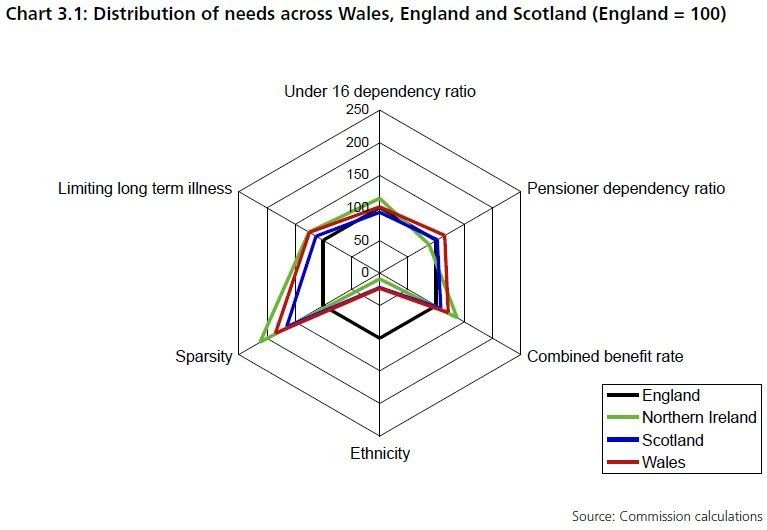
On the subject of replacing Barnett with a needs based formula, the report couldn't be clearer. In fact everything was already clear in the first report, and the Commission then published a working paper which outlined how a needs based-formula would work in December last year. The basic indicators are:

• Number of children
• Number of older people
• Ethnicity
• Income poverty
• Ill health
• Sparsity

And these come together in this rather neat graphic showing how they vary between Wales, England, Scotland and Northern Ireland:


But—perhaps tacitly acknowledging that there are political difficulties in implementing a new formula because of how Barnett benefits Scotland—the report repeats its recommendation that a floor be put in to protect Wales until a proper formula is agreed. Despite both Peter Hain saying, and Peter Black believing, that a floor has been put in place, it hasn't. The report also says the 114% floor they suggested before was deliberately conservative.

The political impasse will be hard to break. In my opinion it can only be broken in one way: to acknowledge that Scotland will get substantially less money on a needs-based assessment, but to make up for that by giving Scotland a fair share of the revenue from North Sea oil and gas in its waters in compensation. At present Barnett is trying to be two different things at the same time, and until the two things are separated, there will never be an acceptable political solution. But this will involve the UK government having to concede the principle that—in part at least—it is Scotland's oil and gas. That is a big bullet for the UK to bite.

 
2. Borrowing

This is the most uncontentious part of what the report has to say. Wales already has a £500m "overdraft" facility for short term balancing and, perhaps by coincidence (or perhaps not) the Treasury announced yesterday that Wales would be able to access the small discrepancy between what the Welsh Government spends each year and what it is entitled to spend: the year end flexibility that equates to about £200m. Taken together, these should cover short-term fluctuations.

The block grant already includes elements for capital expenditure, but there is no scope for independent long-term borrowing for infrastructure improvement. Up to now the Treasury have resisted this on the grounds that Wales and Scotland do not have a guaranteed income to service any long-term debt because each comprehensive spending review is only for three years. It was on this ground that the Treasury made such a fuss over the funding for the new Forth bridge in Scotland, effectively trying to tell the Scottish Government to do it by PFI or not at all. Of course the idea that Wales and Scotland might not get any money in the next CSR was laughable, and the report poured scorn on it.

So what is being recommended is that borrowing should be allowed only for capital expenditure. Holtham envisages that this would be on the same basis as local authorities can borrow now, namely through the National Loans Fund or Public Works Loan Board because (at Treasury rates) this is the cheapest way of doing it. I won't question that this is cheaper than borrowing commercially, but it fails to take account of the Treasury's eagerness to cut back on all borrowing. It may well be that other sources will be the only way of actually getting money, so I'd urge Westminster not to prevent us going to commercial lenders. We might well be able to devise new methods of borrowing that are similar to PFI in that the borrowing is not classed as public borrowing, but ensure that what would otherwise have been private profit for the PFI consortia is recycled back to the public purse instead.

 
3. Setting tax rates as well as spending money

Where this final report breaks new ground is on the ways in which the Welsh Government can be made responsible for not just spending money, but for how the money it spends is raised. The point of principle is that any body that spends large sums of public money should also be at least partly responsible for justifying how that money is provided.

After considering the pros and cons of each form of existing tax, it draws very much the same conclusions as Calman: that income tax is the best tax to be devolved. In two respects what Holtham proposes is better than Calman (and in my opinion should therefore apply to Scotland as well, though the report doesn't say that). The first improvement is that instead of "everything but 10p" applied to both tax bands (basic and higher ... but I guess also the new rate as well) it should be half of each tax band. The second improvement would be that the Welsh Government could set different rates for each tax band.

I have to say again that there is a basic flaw in one of the premises in the report, which I first commented on in this post. Holtham takes it for granted that a person's tax rate would be based on residence. I believe it would be much better to base it on workplace. I find Holtham's idea that Wales might set a lower higher rate in order to encourage high earners to live in Wales rather bizarre.

I'm also slightly disturbed by the idea that the differential of either rate form England should be no greater than 3p. I say that based on what happened in Scotland when the SNP (with LibDem support) wanted to abolish Council Tax and replace it with a Local Income Tax. As I read it, they would have done so if they could do it within the 3p variable rate ... but the sums didn't quite add up. They would probably have worked with 4p. So the proposed 3p limitation very much ties the hands of any government that wants to do something radical with the tax system.

As with Calman, there are several more minor taxes that could be devolved, but the big question is over corporation tax. This is where I find the report rather too tepid. It's definitely a candidate tax, but the final recommendation is a rather weak:

The Assembly Government should seek discussions with the UK Government and the other devolved administrations about the feasibility of devolving corporation tax.

But I suppose it's better than ruling it out altogether. We know that the ConDem coalition wants to reduce CT in Northern Ireland, and therefore it must make sense to establish a mechanism for a variation in Wales and Scotland too.

 
4. Contol of more than one lever

But the big criticism I have of the report is that it appears to me to be missing the point of what taxes can be used for. The whole section on tax is predicated on the idea that if a government puts up rates of tax it will have more to spend on services, and that if it lowers rates of tax it will have correspondingly less to spend ... but that treats the economy as something static.

I see tax as a tool to give the Welsh economy an international advantage. So if we, for example, by lowering business taxes encourage more companies to locate in Wales, or to expand their existing operations in Wales rather than in another country, we will have more jobs. What we lose in company taxation we gain by having more people paying income tax and fewer people out of work and on benefits.

So, at a minimum we need control over at least over two levers in order to gain an overall benefit. Control of some income tax alone just results in the one-dimensional:

higher tax rates
= more to spend on services (or vice-versa)

Adding the extra lever results in the two dimensional:

lower business tax rates
= more jobs
= more income tax
= the same to spend on services

But the vital third dimension is:

lower business tax rates
= more jobs
= more income tax and fewer people on benefits
= more to spend on other services

Holtham says yes to the first lever, maybe to the second, but doesn't even contemplate us getting any benefit from the third. That's what I find so disappointing about it. Yes, I've presented it in a simplified way, and I don't want to imply that it's as easy as that. Like flying a plane, you need a lot of skill and coordination to keep it in the air, let alone to get it to fly in the direction in which you want to go.

In this context it is worth asking why the Scottish government has never used its one lever to vary the basic rate of income tax by 3p. To my mind it is only because there is nothing with which to balance that variation. You can't get a plane to turn using just the rudder, you need control of the ailerons and elevators as well.

 
5. Political reality

OK, so it's not as much as I would have wanted, but it's probably a good reflexion of what any current UK government is likely to give us. It would be unrealistic to expect Wales to get much more fiscal autonomy than is currently being proposed for Scotland on income tax or Northern Ireland on corporation tax. But there really is no reason why we should expect less than they are getting.

But how do we implement these proposals? Or are we not going to implement them at all ... since there is a feeling among some commentators that this report will simply be kicked into the long grass? My feeling is that we must implement these recommendations in some form.

The report runs through what things can be implemented simply by agreement between Westminster and the devolved administrations, and concludes that nearly everything can be done by agreement; but that tax setting powers is a change that will require ratification in a referendum in the same way as the Scots were asked a separate question on tax-varying powers in the 1997 referendum.

I have to say that I question the need for this. There is no suggestion that the Scots are going to have to approve Calman in a referendum, so why should we have to go through it in Wales? As I said before, the previous tax varying powers for Scotland were so inadequate that they were never used, and could never realistically be used. What the Holtham Commission are proposing will give Wales broadly similar fiscal responsibilities as are (according to the ConDem coalition) now going to be given to Scotland without a referendum. Nor is anyone suggesting a referendum in Northern Ireland to set a mechanism to vary the rate of corporation tax there. Why treat Wales differently?

In the end, the over-riding principle is No representation without taxation. Spending cannot be done in isolation from the responsibility of having to justify to taxpayers why their money is being spent. This set of proposals is way short of the fiscal responsibilities I want us in Wales to have. So let's not set another hurdle for us to jump over before we can take this first step towards fiscal responsibility.

Bookmark and Share

Another roadblock to fair funding for Wales

I've just read today's article by Nick Bourne on Wales Home, and much of what he says in it can be put down to the Tories being Tories. But there is one sentence towards the end that stands out as being particularly pernicious:

We must settle the political accountability question in Wales – the responsibility issue – before turning to the funding question.

Wales Home, 13 June 2010

The ConDem coalition's programme for government had previously stated:

•  We recognise the concerns expressed by the Holtham Commission on the system of devolution funding. However, at this time, the priority must be to reduce the deficit and therefore any change to the system must await the stabilisation of the public finances.

The Coalition: our programme for government

As I said at the time, and again here, if all parties recognize that Wales is not fairly funded, it is a problem that needs to be addressed now. We all know that there are going to be huge cuts in public spending, and that we in Wales will need to shoulder our share of the pain ... but it must be our fair share. The action taken by the ConDem government to release the Fossil Fuel Levy owed to Scotland has meant that the cuts they have to face will be some £185m less than they would otherwise be. Why is Wales not entitled to a similar degree of fairness over the £300m that the independent Holtham Commission has identified as being owed to Wales?

But as if that wasn't bad enough, Nick Bourne has gone one step further than to say that we "must await the stabilization of the public finances" before we can expect this injustice to be addressed. He has declared that we "must settle the political accountability question in Wales – the responsibility issue – before turning to the funding question".

Why?

We have a situation in which the Welsh Government is responsible for spending the money it is given by the Treasury in London. We cannot raise taxes, we cannot borrow money, we cannot spend more than we are given. If the people of Wales don't like the decisions that the Welsh Government makes, they can vote for parties that they think might do better at the next election. That's how political accountability works in a democracy.

Now of course we should have responsibility for both sides of the fiscal equation. It is much better that the Welsh Government should have more fiscal autonomy by setting tax rates and balancing our spending against that tax take. I welcome any plans the ConDem coalition might have in that direction ... and we in Plaid Cymru have been pressing for this change for years.

But the simple fact is that we are being short-changed now, and we would be fools to let the promise of some sort of unspecified change to the system at some unspecified time in the future distract us from that fact.

Only last month, Tory and LibDem leaders in Westminster put up the first roadblock to fair funding for Wales by telling us that we have to wait for the public finances of the UK to be stabilized first. It was a way of kicking the issue of fairness for Wales into the long grass, in much the same way as Labour in Westminster refused to deal with the problem when they had a chance to do so.

But Nick Bourne has now put up a second roadblock to fair funding by telling us that we must also wait until the Tories and LibDems come up with a plan for the next stage of devolution in Wales. We've come to expect endless delaying tactics of that sort from politicians in Westminster, but you have to wonder what sort of masochism would make a Welsh politician ignore the £300m a year that his own country is owed.

Bookmark and Share

Money is the Bottom Line

As someone who generally feels much more at home exploring ideas and strategies, the last few weeks have been a rather different time for me. Election campaigns are about getting out onto the streets, the doorsteps and especially the screen in the corner of the living room ... but this blog is only read by a thousand or so people for whom politics matters most of the time, rather than by the millions for whom it only really comes alive at election time.

So the best I hope to do at this time is give others ideas about what things to emphasize, and my conclusion—as you might have guessed from how much I've repeated it—is that every pound Wales gets over the next five or ten years of cutbacks, while we claw ourselves out the debt we've been landed with, is what matters most to most people. Of course it's not the only thing that matters, but for most ordinary voters it's the bottom line.


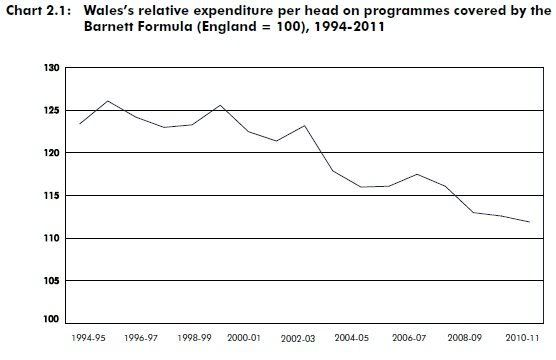
We are in a financial mess, and it's only right that we in Wales shoulder our fair share of these cuts along with the remainder of the UK ... but it must be our fair share. Wales has been systematically short-changed over the past thirteen years of Labour government. Public spending on things like hospitals and schools was increased, but as a percentage it was increased far more in the remainder of the UK than it was in Wales. This graph from the Holtham Commission report shows this in the clearest terms:


Elections are primarily about holding government to account for the way they spend the money they collect from us in taxes, and getting rid of them when they fail us. Labour have failed us.

The Tories and the LibDems have no specific plans to correct the unfairness of the way Wales is financed, even though the Holtham Commission has done all the detailed work about how it can be done more fairly. Neither will commit themselves to implementing its recommendations, they have only offered a non-committal promise to "look at" the funding of Wales.

That leaves only Plaid Cymru that will fight for Wales to get its fair share of funding. We have no country to care about other than Wales ... but to the other three parties Wales is just a small part of the UK with only 5% of its population and, critically, only 5% of its voters. In order to form or be part of a government in Westminster they have no choice but to pursue policies tailored to appeal to voters in the rest of the UK. They can never put Wales' needs first.


£300m might seem small in relation to the debt crisis in the UK, and in truth it is small. That makes the lack of commitment for the other three parties even more inexplicable. Gerry Holtham himself said the UK government were "silly billies" for not solving the problem. But to us in Wales, £300m will make a big difference.

As one example of what that amount of money could be spent on, take the proposed new specialist and critical care hospital at Llanfrechfa near Cwmbrân, the centrepiece of the Gwent Clinical Futures programme. It was due to cost £292m, but had to be put on hold as I reported in this post in July last year. It's a perfect illustration of what £300m actually means in human terms.


And next year—for this £300m is cumulative—it could be a couple of smaller hospitals elsewhere, or twenty new secondary schools at £15m a throw. Or to pay for more teachers and teaching resources, or on better transport ... or on any of a dozen other priorities.


Bookmark and Share

What Paxman couldn't understand

I quite like Jeremy Paxman but he's a BBC man through and through, and the BBC's rather limited view of Britishness—as we have seen in the fiasco over Plaid Cymru and the SNP not being given any place in the leaders' debates—seems hardwired into him. Would he have got his job if it wasn't?

Perhaps things are slightly different in BBC Cymru and BBC Scotland, but at BBC HQ in London the misconceptions about Wales and Scotland are all too apparent. The particular blindspot that surfaced on Newsnight last night was the complete inability to comprehend that public spending per head is actually much larger in London than it is in either Wales or Scotland.

When Eurfyl ap Gwilym disabused that misconception with hard figures, Jeremy Paxman found himself backed into a corner because he simply hadn't done his homework as well as he thought. No doubt some poor researcher at the BBC got it in the neck afterwards. As he phaffed about, Paxman even made the claim that London wasn't an English region. Incredible. And the scurry while Eurfyl left him to look through the figures for himself was one of those golden moments that will no doubt be replayed for years to come. So here it is again:


OK, it's all very well to laugh at a Jeremy Paxman who was out of his depth, but the point at issue is a serious one. Plaid Cymru is not asking for Wales to be immune from the public spending cuts that are certain to come. We are asking to be treated more fairly than we currently are. As I have shown on a number of occasions, Wales' share of public expenditure relative to England has fallen sharply in the thirteen years that Labour have been in power:


But over recent years, while relative expenditure in Wales has gone down, expenditure in England and Scotland has gone up relative to the UK as a whole.

So what Wales needs first is for the mechanisms which have resulted in this shortfall to be corrected. This means replacing the Barnett Formula with a needs-based formula. But in the short term—as an emergency fix in order to prevent things getting even worse—Gerry Holtham recommended putting a floor of 114% under future payments. Labour had every opportunity to implement this, but refused to make any firm commitment on it. In figures, this is £300m for this coming year.

-

However, cuts are bound to come over the next few years, whether under Labour or the Tories. To our cost, both under Thatcher and Major before and Blair and Brown after them, we know all about those two parties. But exactly the same will be true of the LibDems who will have to make even more cuts to pay for the tax break of £700 a year they plan to give every taxpayer ... even those who are on comfortable salaries. They too—just like the two parties they are trying so hard to be like—think that the UK can get out of this financial mess primarily by cutting spending on public services rather than by getting those who can afford it to pay more in taxes.

I'm all in favour of adjusting the tax bands so that more people in low paid employment don't have to pay Income Tax. Plaid also wants that. But if the starting point is increased by as much as the LibDems propose, the basic rate of Income Tax would need to be increased as well so that the overall tax take from those who pay the basic rate remains broadly the same. To put this into perspective, the £17bn that will be lost to the UK Treasury by doing this means that Wales will have to make do with about £850m less to spend on public services. That would be a disaster for Wales.

-

So what's the choice? The Tories and the LibDems alike say that they will "look at" a fair funding formula for Wales ... but won't commit themselves to anything despite the fact that an independent commission has done the hard work already, and come up with firm proposals about how things should be changed. Labour think they don't need to do anything. That leaves only Plaid to fight Wales' corner. The other three parties are much more concerned about winning votes in middle England than to actually do anything for this little corner of the island of Britain.

Bookmark and Share

A liability matched only by his ability to lie

Peter Hain did one of the things he does best in the Welsh Leaders debate on ITV last night: repeating the same lie over and over again in the belief that repeating it will make it true. The subject was replacing the Barnett Formula with a fairer way of funding Wales, using the sort of needs-based criteria by which departments allocate funding to the regions of England.

A wiser person might have thought twice before opening his mouth, especially when each of the other parties agree that the current system is unfair and needs to be replaced. But not Peter Hain. No, he wants us to believe that he has already sorted out the problem and secured fair funding for Wales.


Hain has secured no such thing. His vanity has got the better of him yet again. He can't bring himself to say that he tried to do this, but failed. So he must instead make out that his failure to do it was in fact a success.

Peter Hain's problem is that he has no idea how to fight for Wales at the Cabinet table. The Treasury have been able to run rings around him and, as a direct result, Wales has got far less of an increase in public spending than either Scotland or England. This graph, from the Holtham Commission's first report, shows just how much Wales' share of spending has declined relative the amount of money Labour has spent in England in the thirteen years they have been in power at Westminster.


Peter Hain did respond to this by going to the Treasury to ask for Wales to be fairly treated. But the Treasury ran rings around him again. In the debate he claimed that he had negotiated "a detailed reform of the Barnett Formula". But he's deluding himself and trying to mislead the rest of us. This is the final agreement in its entirety. It includes absolutely no figures or detail at all:

The Government welcomes many aspects of the Holtham report, which it continues to study in detail.

The new arrangements are as follows:

•  the Government agrees that the Barnett formula could lead to convergence to an extent that would be regarded as unacceptable although further convergence is not currently expected in the coming years;

•  the Government will make a full assessment of the extent of convergence with consideration of Wales' position relative to other parts of the United Kingdom as part of each spending review; and

•  following this assessment the Government would be prepared to take action if appropriate to ensure Wales is not disproportionately disadvantaged.

Wales Office, 26 November 2009

All of us can clearly see that this is only an agreement that the Treasury will assess the situation in future. Consider the three things I highlighted:

Regarded as unacceptable
To whom? The Treasury and the Wales Office obviously both regard it as acceptable for Wales' share of spending relative to England to have dropped from 125% to 113% in the thirteen years Labour have been in power. So at what point would it become "unacceptable"? So far as most people in Wales are concerned, it was surely unacceptable for there to have been any fall at all. So far as Plaid are concerned, the point of unacceptability has already been reached, because Holtham has confirmed that the absolute bottom line correction figure that should be applied to the existing Barnett Formula is 114%.

If appropriate
But why the "if"? If Peter Hain had won a firm agreement from the Treasury, there would be no "if" about it. This agreement leaves the matter entirely at the discretion of the Treasury. What if the Treasury thought there were circumstances that made it inappropriate to treat Wales as a special case ... for example, because public borrowing is out of hand and they think the UK can therefore not afford it?

Disproportionately disadvantaged
We can all see that Peter Hain conveniently misquotes this part of the agreement. This is not the same as the "disadvantaged" he now keeps quoting. Wales has already been systematically disadvantaged over the last 13 years. This agreement would allow that to continue, and could easily be taken to mean only that the Treasury would do something if the rate at which we have been disadvantaged over the past 13 years—about 1% per year relative to England—were to accelerate to more than 1% a year.

-

In other words the agreement does not deliver what Peter Hain claims it delivers. But he simply appears too stupid to understand that. He very obviously doesn't know enough about the subject to understand that the Treasury has made a fool out of him. This is most clearly illustrated by the fact that the Welsh Labour Manifesto makes the ridiculous claim that the Barnett Formula is already based on need ... it is simply not true.

Peter Hain is a liability to Wales. He has already cost Wales huge amounts of money, money that we would have secured if we had someone who knew how to fight Wales' corner. But the rest of Wales' Labour MPs aren't much better. They could have kicked up a fuss about it, but instead they just kept schtum; in part cowed by the Treasury, in part in the hope that the subject would be too complicated for the average person to understand.

-

Finally, it is encouraging that both the Tories and the LibDems want the Barnett Formula to be replaced with a "fair" needs-based formula. That's all well and good, but what does "fair" actually mean to them? Neither of them will say.

It is only Plaid that has put a figure on it, based on what the Holtham Commission has recommended. We are the only party that is prepared to put hard numbers against the shortfall ... 300 million reasons to vote Plaid.


I've written about the Holtham Commission and its report in a number of posts on Syniadau. Please click here to bring them up.

Bookmark and Share

Labour Spread Lies and Confusion

Right at the top of Labour's promises at the launch of their manifesto for Wales today was a commitment to fair funding. Peter Hain said:

"Today's fair funding guarantee means that, with Labour, Wales will not be disadvantaged in the future."

Well, I've just read through their manifesto, and it is quite clear that this is not only the most blatant of lies, but that Labour either do not understand the basis on which Wales is presently funded ... or that they do, but want to spread confusion and disinformation about it. This is what they say:

Right now, for every £100 that is spent on schools, hospitals and other vital services in England, £114 is spent in Wales under the ‘Barnett Formula’ because of the relative sparsity, ill health, deprivation and age of our population compared with England. This formula has served Wales well these past Labour years: for example, funding for the Welsh Assembly Government’s health and hospital programmes has more than doubled, in real terms.

Welsh Labour Manifesto, page 30

This is completely wrong. The Barnett Formula has nothing whatsoever to do with the "relative sparsity, ill health, deprivation and age of our population compared with England". It is based simply on population, nothing else.

Gerald Holtham and his colleagues have recommended that the Barnett Formula be replaced with a needs based formula that would take account of these and other factors, but Labour point-blank refused to commit themselves to that sort of change, as I explaned here. And this manifesto is most certainly not a promise that Labour will change their minds and introduce a replacement for the Barnett Formula, they are just repeating the fudge that they made previously.

So in short this is deliberate mendacity—blatant lying—of the very worst kind. The manifesto is peppered with lies and innuendo, but this is simply too big a lie to be ignored.
 

     It is disgusting and shameful that Labour are telling us
     the exact opposite of what is true
 

On the same page of the manifesto, Labour make much about how much spending in Wales has increased. Now it is true that public spending in Wales has increased. But what Labour don't say is that they increased spending in England and Scotland much more than they increased it in Wales. This graph, which I make no apology for showing yet again, shows just how much spending in Wales has gone down relative to the UK average:


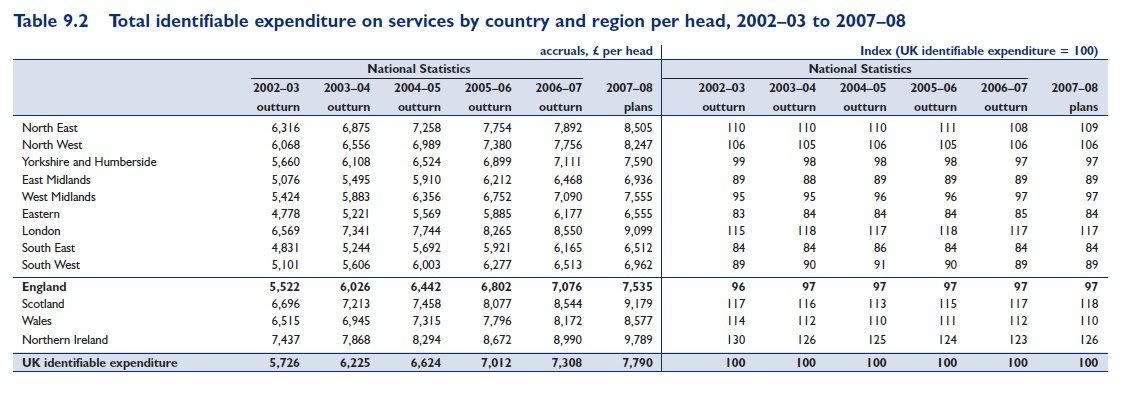
In short, Labour have deliberately and systematically used their 13 years in power at Westminster to see spending in Wales fall from about 125% to 114% relative to the UK as a whole. The biggest injustice is that relative spending levels in Scotland have been and still are much higher than in Wales. But, as the PESA figures in the table below show, over the past six years relative spending in Scotland has in fact gone up from 117 to 118, and in England from 96 to 97.


Put bluntly, we have been unfortunate to have Secretaries of State for Wales that have proved themselves completely incapable of standing up for Wales at the Cabinet table. The Scottish Secretary has managed to keep Scotland's advantageous position, but we have been lumbered with a second-rater who would rather praise himself than fight for the people he is meant to represent.

And, just in case anyone thinks that this was some sort of misprint in the Labour manifesto, Labour candidates have been putting out precisely the same lies in their leaflets. Nia Griffith in Llanelli is another perfect example of a Labour candidate lying through her teeth in the hope of trying to hold on to her seat, as I wrote about in this post.

-

But finally, I do not want to be critical of Labour without putting forward a better alternative:


Bookmark and Share

Llanelli

A week or so back, BlogMenai posted a copy of a letter sent out to every voter in Llanelli by the sitting Labour MP. I've nothing against Nia Griffith as a person, but what was said in her name was something else again:

You understand that Assembly funding and, to a large extent County Council funding, depend on Westminster, and only a Labour Government can deliver for Llanelli.

Liam Byrne MP, Alistair Darling's right-hand man, has agreed that we need to revise the Barnett funding formula to deliver a better deal for Wales. But only a Labour Government in Westminster can actually deliver that money for Wales.

... I'm counting on you to help me get the best deal for the people of the Llanelli constituency.

So let's have a look at those claims in a little more detail. Let's look at what the Labour Government in Westminster has actually delivered for Wales in their thirteen years in power.


This is a chart showing how spending in Wales relative to the remainder of the UK has fallen, taken from the Holtham Commission's report on finance and funding for Wales. We can see that Wales is now much worse off compared with the other countries of the UK than it was when Labour came to power. So Labour's claim to be the only party that can actually deliver money for Wales is nothing other than a barefaced lie. Precisely the opposite is true.

What has happened is this: Labour have spent a lot of money on the UK as a whole, and a lot of that money has been spent in Wales. The problem for us is that Labour were increasing their spending more per head in England and Scotland than they were doing in Wales. Yet Labour expect us to be grateful to them because we have received half a share, rather than a fair share. They rely on the fact that people in Wales won't look beyond the immediate horizon to see the bigger picture.


As we can see from this table, the PESA figures show that over the past six years relative spending (the UK as a whole is 100) in Wales has gone down from 114 in 2002-03 to 110 in 2007-08. But for the same period relative spending in Scotland has in fact gone up from 117 to 118, and in England from 96 to 97.

So why has this happened? It is simply because Labour Secretaries of State for Wales have not taken the same care to fight for Wales as their counterparts in Scotland, or the departmental Secretaries for England.

-

But the real scandal is that Labour won't do anything to change this unfair situation. Why do you think the letter mentions Liam Byrne rather than his boss Alistair Darling on one hand, or Peter Hain on the other? Simple, it's because Alistair Darling has refused to make any commitment to change things ... and that Peter Hain, rather than fight for Wales, prefers to take this snub and spin it into something else.

Back in November last year, the Wales Office—headed by none other than Peter Hain, never reluctant to bathe himself in the orange glow of self-praise—proudly proclaimed:

     Hain secures fairer funding agreement for Wales

But it was nothing of the sort. Hain was lying through his teeth. All he got was from the Treasury was the non-committal statement that everything to do with funding for Wales was essentially all right, that it always has been, and that nothing is going to change ... but that they might look at it in future if things get worse.

Gerald Holtham himself said that Labour were acting like "silly billies" for not doing anything to change the system while they could. If he wasn't on television I think he might well have used the sort of language I used when I looked at the Wales Office statement in detail in this post:

     Silly billies ... or yet more silly buggers?

So instead of actually fighting to "actually deliver that money for Wales" Labour meekly gave up the fight without winning any commitment from the Treasury other than to "look at it".

So why the hell should anyone in Llanelli actually vote Labour? In the thirteen years that Labour has been in power their track record has been precisely the opposite of what they claim.

-

And as for Nia Griffith herself? Yes, she probably does care about her constituents, I don't doubt that. But the real question is whether she has been able to make any difference for them in Westminster. Like so many Labour MPs, she's fine at standing up for things like keeping post offices open when she's in the constituency, but in Westminster she will do what the Labour whips tell her to do ... and vote to close them.

That's just one example of why what it says in her letter about a Labour MP being able to make a difference is so pathetic. Most Welsh Labour MPs are just lobby fodder to vote through what the Labour government in Westminster decides.

-

But Llanelli has a far better choice than to vote for Nia Griffith. Llanelli is going to be a contest between Plaid Cymru and Labour and I can guarantee that Plaid's Myfanwy Davies will stand up and fight for Llanelli and for Wales, rather than meekly turn into lobby fodder for the issues that matter to middle England.


It's a big ask, but she can do it. Labour's share of the vote in the 2005 election was 46.9% with Plaid at 26.5%. So it would take a straight swing of just over 10% for us to win. But that's quite close enough to mean that many of those who voted LibDem and Tory (12.9% and 13.7% respectively) will turn to Plaid simply in order to break Labour's hold on the seat.

Only by voting for Myfanwy will people in Llanelli be able to get rid of a Labour Party that does precisely the opposite of what it claims to do for Wales, and a candidate who isn't strong enough to stand up for her constituents when the Labour whips in Westminster tell her to do the opposite of what she told them she would do.

Bookmark and Share

Guto Bebb

Not so long ago Guto Bebb, the Tory candidate for Aberconwy, wrote a couple of posts about tax and borrowing powers for Wales. In the first he said:

The fundamental dishonesty of the debate surrounding Barnett in Wales is the fact that Plaid Cymru continually make wildly exaggerated claims about the unfairness of the current formula without ever attempting to explain what would happen if their stated aim of an Independent Wales was to be achieved.

Think about it. No Union = No Barnett Formula. Plaid Cymru claim that the current shortfall is hugely unfair to Wales. The current shortfall has been identified by Holtham as spending of £112 per head via the Assembly block grant rather than the £114 per head which Holtham thinks it should be if the needs based analysis used to distribute money to the English regions was utilised here in Wales. What would be the shortfall if the stated Plaid Cymru aim of independence was achieved? They never seem to be willing to respond to that question and their Honorary President conspicuously failed to address the issue last night when I made these very points.

The lesson is clear. When Plaid talk about Barnett ask them what they would do to make-up the shortfall if Barnett did not exist because that is the ultimate aim of their policy of independence.

Not much that Guto writes is that relevant, but this included several references to Plaid and posed some direct questions. So I replied with a comment based around what I said in this post:

     Holtham: Taxes and Barnett

I checked his blog again today as a result of reading this post by Alwyn ap Huw, and saw that Mr Bebb had simply deleted it. It appears he's very good at throwing out accusations, and of course he's quite entitled to put his fingers in his ears so that he can't hear any reply ... but it is something else to stop anybody who reads his blog seeing the reply.

Aberconwy is going to be a tight contest between Plaid and the Tories, but one that I think Phil Edwards will win. One of the things that will swing it for Plaid is that the Tories do seem to have made a rather unfortunate choice of candidate.

Bookmark and Share