Showing posts with label Greens. Show all posts

Will the Greens go for independence?

This weekend I was forwarded an interesting document from the Green Party in Wales. As most people reading this will know, Britain has had two separate Green Parties since the UK party split in 1990, one in England and Wales and one in Scotland. There has been talk over the last few years of the Welsh Greens forming a separate party, and things now appear to be coming to a head, with the leadership in Wales seeing it as a positive development. They have produced a paper for discussion, and I don't think they would mind me quoting the opening part of it.

Introduction

The Green Party of England and Wales was created in 1990 when the former Green Party covering the United Kingdom split into separate parties. The Scottish Greens and Green Party of Northern Ireland formed separate parties. The Wales Green Party (WGP) has Autonomous Regional status within the Green Party of England and Wales (GPEW) the details of which are laid out in Appendix B of the Constitution of the Green Party. Whilst the constitution of the GPEW says there is a federal structure in place the reality is that Wales has very limited autonomy under the current arrangements. Currently, the Leader of WGP sits on the Green Party Executive (the body in charge of day-to-day running of the party), and Wales has 2 representatives out of 20 on the Green Party Regional Council (the body in charge of strategy, party well-being and other longer-term issues).

Constitutional change within the United Kingdom has witnessed the creation of the National Assembly for Wales in 1998. The law-making abilities of the NAfW have increased since 1998 and are likely to further increase as a result of the Wales Act 2017.
 

Problems with the current arrangements

The Scottish Greens made a breakthrough into the Scottish Parliament many years ago, and have become an accepted part of the political mainstream in Scotland. We have had no such success in Wales. While the reasons for this are complex, there is no doubt that the predominantly London-based Green Party media operation has never put any effort into trying to cover Welsh issues; and GPEW generally is very English-centred in its thinking.
 

What is the point of this paper?

Wales Green Party Council (WGPC) has been discussing the future status of the Wales Green Party for the last two years. The view of WGPC is that breaking away from GPEW in the same way that Scotland and Northern Ireland have already done offers the best chance of a successful Green political party in Wales ...

I won't quote more than this because the paper goes into details about party finances and membership. However, a separate Welsh Green Party would be financially better off than it currently is as an autonomous region of the GPEW. And, just in case anyone sees obvious parallels with what is happening in Catalunya, the English Greens would certainly not respond by accusing the Welsh leadership of sedition or by threatening to suspend the Welsh party's autonomy.

-

I'm not a member of the Green Party, but their politics probably align more closely with mine than those of any other party in Wales, and I wish them well.

To put it bluntly, the Greens in Wales have virtually no chance of winning seats in Westminster, but they do have a very real chance of winning regional seats in the National Assembly. To do this, they need to be able to devote resources to developing, and more critically presenting, specific policies in areas that are devolved to Wales. Becoming independent would raise their profile in Wales.

What you are perceived to be is important. I know from numerous political discussions that one of the biggest obstacles the Green Party has faced at elections in Wales has been the perception that it is an "English" party. Becoming independent would change that perception. Additionally, I'm sure that a separate Green party in Wales would draw considerable support from people who currently vote for Plaid Cymru because they paint themselves as a green party, even though Plaid's green credentials don't really stand up to much scrutiny.

My advice to Green Party members in Wales is to take this opportunity and become independent.

Bookmark and Share

Green Party Conference

UKIP's party conference took place in Llandudno over the weekend, and the BBC devoted two programmes to it ... in the same way as they've covered the LibDem and Labour conferences, and will cover those of the Tories and Plaid. If you have a strong stomach, you can watch them here and here.

As it happens, the Greens' party conference also took place over the weekend, and the BBC ... umm, didn't cover it. In fact the BBC have a track record of not treating the Greens in the same way as they treat UKIP.

So, for the sake of some balance, here's a video of Alice Hooker-Stroud's speech.


Alice is leader of the Green Party in Wales and number one on the Mid and West Wales list. She was introduced by Amelia Womack, who is number one on the South Wales Central list. If we're going to have a Green AM in the Senedd in May, it will be one—or perhaps both—of these.

Bookmark and Share

The maths would work

I was surprised to see, as reported here and here, that talks about an electoral pact between the Greens, Plaid Cymru and LibDems for the Assembly elections in May had come to naught. There was a lot to be gained from such cooperation, although not as much as the total of 22 seats mentioned in the ITV report.

The reason for this is that the election system for our National Assembly is heavily weighted in favour of constituency seats. Two-thirds of the seats are decided on the first-past-the-post system, leaving only one-third of them to help correct that bias. Yes, these additional seats do correct it to some extent, by not to the same extent as in Scotland, where there is a 73/56 or 57%/43% split. So the key to electoral success in the Assembly is winning constituency seats.

A quick look at the results from 2011 shows that there are five constituency seats that could be won from either Labour or the Tories if the Greens, Plaid and LibDems were able to work together. Ordered by the size of the margin they are:

Cardiff Central
won by Labour with 37.9%, combined three party vote 44.9%

Aberconwy
won by the Tories with 34.0%, combined three party vote 40.4%

Llanelli
won by Labour with 39.7%, combined three party vote 41.5%

Montgomery
won by the Tories with 43.7%, combined three party vote 44.9%

Carmarthen West and South Pembrokeshire
won by the Tories with 35.8%, combined three party vote 33.6%

Of course a lot has changed since 2011. Opinion polls show that the LibDems have plummeted and that UKIP have risen. But UKIP are not likely to win any constituency seats, so whatever they get is irrelevant to winning seats from Labour and the Tories. The LibDem collapse is rather more pertinent. It means that Kirsty Williams will have to fight hard to hold Brecon and Radnor, and could do with all the help she can get. So negotiating an electoral pact could positively affect that seat too, making six constituency seats in total.

So why on earth did they fail to do it?

-

There are two answers. Squabbles over which party was chosen to fight these seats, and the complicating effect of the regional lists.

As I see it, the LibDems are in prime position to win Cardiff Central and Montgomery, and Plaid in prime position to win Llanelli, Aberconwy and, as a long shot, Carmarthen West. Put bluntly, the Greens aren't in prime position to win any of these seats, so if Plaid Cymru and the LibDems wanted to reach a bi-lateral agreement without the Greens, they could do so and gain from it.

-

Looking at the North Wales region first. The LibDems have no hope of winning any constituency seat and Plaid are certain to win two: Ynys Môn and Arfon. Both parties won a list seat in 2011, but the problem this time round is that UKIP are certain to win one list seat, and might well win two. As there are still only four list seats, the last thing Plaid wants is to be in the scrap to win one of them. The win-win situation would be for Plaid to gain Aberconwy with LibDem help, thereby dropping out of the running for a list seat. This would mean that the LibDems only have to fight the Tories and UKIP to hold their one list seat, although it's still a long shot because a Tory loss in Aberconwy would just result in them winning a list seat instead. If the LibDems were really clever they would encourage people to vote for a Tory win in Clwyd South ... but that might be a step too much for them.

-

The next interesting region is Mid and West Wales. This is where the LibDems have most to gain from an electoral pact. Looked at from an "unambitious" perspective, Kirsty Williams probably feels quite safe. Provided she is first on the LibDem list, losing Brecon and Radnor would just mean that she got a list seat instead. But the general collapse in LibDem support means that the LibDems would find it all but impossible to win two list seats. So the only realistic way for the LibDems to keep two seats overall would be for them to hold Brecon and Radnor and gain Montgomery from the Tories.

Plaid, from the same unambitious perspective, probably think in a similar way. Dwyfor Meirionnydd, Ceredigion and Carmarthen East were safe seats in 2011 and will remain safe this year. It didn't really matter to them that they narrowly lost Llanelli in 2011, because they made up for it by getting a list seat instead. However this time round they will almost certainly not get a list seat if they lose Llanelli, because of UKIP. I also think Plaid are far from certain of winning Llanelli this time, not least because Lee Waters is an exceptionally good choice of candidate for Labour. As a bonus, the pact would also give them an outside chance of gaining Carmarthen West from the Tories, a seat which they can have no serious prospect of winning without that help. Even if they didn't win it, they would have absolutely nothing to lose.

For the Greens, the advantage of a pact is that if the LibDems and Plaid were to win these constituency seats, they would then be completely out of the running for any list seats. The four available seats would instead be contested between Labour, the Tories, UKIP and the Greens. So even though a three party pact would not benefit the Greens in constituency seats, it could make all the difference in terms of them gaining a list seat. They might well be able to win the seat anyway, without a pact, but the pact would turn possibility into probability.

-

I don't think an electoral pact will make any difference to the outcomes in South Wales West and South Wales East, which leaves South Wales Central.

Despite all the optimism in the world Plaid and the Greens are not going to win any constituency seats on their own, and especially not Rhondda. Leanne Wood never stood a chance. In constituency terms, the only one of the three parties that could win on their own is the LibDems in Cardiff Central. Yet it would be far from easy because they have slipped a very long way.

There are two ways of looking at things, both dependent on the strength of the Green vote. In 2011, the Greens got a higher percentage of the list vote in Cardiff Central (9.1%) than in any other constituency in Wales.

In the first scenario, if the Greens had wanted the other two parties to stand down in one of the five constituency seats I listed above (leaving the others to Plaid and the LibDems) it would be this one. I wasn't involved in the negotiations, so I don't know whether the Greens made a stand on this. But from a LibDem perspective, they made up for losing Cardiff Central by gaining a list seat in 2011, and they would certainly win a list seat this time round if they stood down in favour of the Greens. So the LibDems had nothing to lose; one way or the other, they could only win one of the twelve seats in SWC ... and couldn't possibly win two.

The second way of looking at it is that if the LibDems won with Green and Plaid support in Cardiff Central they would then not win a list seat, and this would make it more likely for Plaid to win two list seats rather than one, or for the Greens to win one list seat.

The first option is better than the second, but either way, the overall result for the three parties is increased by an electoral pact. However the main factor will be how well the Tories do in the two SWC constituencies in which they stand a chance: if they win Cardiff North and/or the Vale of Glamorgan it will mean that they are that much less likely to win a list seat. With a pact (and Tory luck) the three parties could win four seats out of twelve if the Greens won Cardiff Central, or three if the Lib Dems won it. Without a pact they might end up with only two.

-

In short, an electoral pact was a no-brainer which would give the three parties a fair chance of winning five more seats than they are likely to win on their own. That's a lot to throw away.

Bookmark and Share

Voting against austerity

The latest YouGov poll for ITV Cymru Wales provides, as always, some very useful information about the state of the parties in Wales. This time round, it was quite startling to see that Plaid Cymru's overall support for the upcoming Westminster election has fallen to 10%, but that support for the Greens in Wales has risen by 3% points to 8%, putting them within touching distance of Plaid.

Plaid Cymru's response to this was to launch into an unabashed love-bombing campaign aimed at Green Party supporters in Wales, and what better person to do it than Dafydd Wigley. This is what he said to Adrian Masters.


Unsurprisingly, I agree entirely with the idea that the Green Party is the best party to support in England, after all, I've been advocating that for years. But, as Adrian noted, the second part of Plaid's agenda is to ask people in Wales who might be inclined to vote for the Greens to vote for Plaid Cymru instead ... and, as Dafydd admitted, he would be delighted if they did.

The problem is that neither he nor the other leaders of Plaid Cymru have thought things through clearly enough.

-

Plaid's biggest electoral problem is that their support in Wales is disproportionately concentrated in just some parts of Wales. Yes, given the unfair nature of the first-past-the-post voting system, Dafydd is right to say that it would make sense for Green voters in the parts of Wales where Plaid is strong to consider voting for Plaid. But, by that same logic, the opposite is true in those parts of Wales where Plaid has now become weaker than the Greens.

For although the headline voting intention in the YouGov poll for Wales as a whole puts Plaid marginally ahead of the Greens, we just need to look at the regional breakdown to see that in some parts of Wales Plaid is now a very poor second behind the Greens. In South Wales Central (which includes Cardiff) support for the Greens is now double the support for Plaid Cymru.

Westminster Voting Intention

All Wales ... Plaid 10% ... Greens 8%

North Wales ... Plaid 9% ... Greens 6%
Mid and West Wales ... Plaid 19% ... Greens 6%
South Wales West ... Plaid 10% ... Greens 6%
South Wales Central ... Plaid 6% ... Greens 12%
South Wales East ... Plaid 5% ... Greens 8%

YouGov Poll for ITV Cymru Wales, 27 January 2015

Obviously things will vary on a constituency by constituency basis. But in general terms, if the Greens, the SNP and Plaid Cymru are to make any inroads in May as a group of parties working together to oppose the austerity agenda that the Tories, Labour and LibDems have each signed up to, then it is better for those who would normally be inclined to vote for Plaid in South Wales Central and South Wales East to vote Green instead. The same is probably true for those in the eastern half of the North Wales electoral region.

The logic of what Dafydd was saying is perfectly valid. He and the rest of the Plaid leadership just hadn't looked carefully enough at the detail.

Bookmark and Share

A Green Yes

Just ahead of the SNP government's white paper on independence, the Scottish Green Party today launched their own campaign for a Yes vote in next year's independence referendum.


I think it's worth highlighting this line from the BBC report:

The Greens' message here this morning is that they're not nationalists. Instead, the party's belief in independence is rooted in a desire to transform politics and society. It's the kind of radical change, they argue, that Westminster is increasingly unlikely to deliver.

BBC Reporting Scotland, 15 November 2013

It echoes something that I've said before, but want to say again. Many of us in Plaid Cymru want independence for unashamedly nationalistic reasons: we believe that the people of Wales should decide how Wales is governed because that's what nearly every other nation in the world is able to do, and we deserve no less. That's a good reason to want independence and one that I fully support.

But some of us perhaps don't understand that others are indifferent—and sometimes quite opposed—to nationalism, and want independence not so much on principle, but more reluctantly, because they have come to realize it is the only alternative to being dragged along the ever-rightward political path that the UK has been relentlessly following for the past three decades, and is clearly going to continue to follow whether led by blue Tories or red Tories.

This is what the Greens in Scotland have decided is best for Scotland, and I have every reason to believe that people with the same views in Wales will come to the same conclusion. With that in mind, I'd recommend reading the Vision for Independence that the Scottish Greens have just published.


Much as I like the SNP, this is rather more "spiky" ... and therefore more in tune with many of our values in Plaid Cymru.

Bookmark and Share

Exposed: the secret behind Labor's failure

The reason for Julia Gillard's failure to win a majority in yesterday's Australian elections became apparent when this picture was published yesterday.


It clearly shows her voting Green. She later apologized, saying that she was concentrating so much on the media that she didn't realize what she had been doing.

Unfortunately for the Australian Labor Party, many of their previous supporters did the same. Labor's share of the vote fell by 5.4%, and more than twice as many of those votes went to Green Party than went to the right wing Coalition.

Bookmark and Share

Westminster's Second Green MP

As people will know from this and other posts, I'm delighted that Caroline Lucas has won Brighton Pavilion for the Greens. Well done.


I'm sure this will be reported as a first, but it's actually a second because Cynog Dafis won Ceredigion in 1992 on a joint Plaid Cymru/Green ticket. Cynog will be pleased to see England get its first Green MP, as he said here.

It's too early to say whether the numbers of seats won in Westminster will add up in such a way as to make a referendum on STV likely, but if it does we can look forward to two things: many more Green MPs and hopefully a much closer working relationship between Plaid Cymru and the Greens in Wales with supporters of each giving their subsequent preferences to the other party.

We already work together in the European Parliament as part of the Green-EFA Alliance, and we should be natural allies in Westminster too. There'll be space on our bench in the Commons for you, Caroline. More space than I expected there'd be.

Bookmark and Share

LibDem Maths

It's clear enough from the headlines in today's Western Mail:

Lib-Dems £3.1bn plan for green jobs

The Liberal Democrats yesterday launched a £3.1bn plan to create green jobs and bring £125m to Wales.

Western Mail, 20 April 2010

Yet the first thing that struck me was that this was far from being a good deal for Wales. Nobody needs a calculator to work out that our rightful 5% share of £3.1bn is £155m ... so we in Wales would immediately be short-changed relative to the remainder of the UK by £30m. On second thoughts, perhaps the LibDems do need someone to buy them a calculator.


But let's leave that to one side, because any additional spending on the Green economy is something I would welcome. Let's look to see if this still a good idea ... even if the rest of the UK will benefit from the money more than Wales. Their version of the story is here.

Did I say additional spending? Well, it turns out that it isn't additional spending at all. This is what they say:

The plans target £3.1bn of public spending that can be stopped and the money used to create jobs and protect the environment.

But as we might expect, there is absolutely no mention of what particular areas of public spending are in line to be "stopped". The Health Service? Education? Police? The Fire and Rescue services? Who knows? ... for the LibDems certain aren't telling us! We are simply expected to trust Kirsty Williams when she says these are "credible and costed plans". My guess is that these must yet more of the fabled "efficiency savings" that spring up whenever an election is called ... but haven't the LibDems banked on these savings at least once already? Perhaps we should just marvel at how a new batch of these savings can be plucked off the tree whenever the LibDems want to publicize a "new" idea.


But let's still give them the benefit of the doubt and look at how they intend to spend this money. As it happens, the MPs that we are about to elect to Westminster are not going to spend it at all ... they're going to give this £125m to the Assembly with "suggestions" about how it should be spent, since most of the things they want to spend it on in England are devolved matters in Wales and Scotland.

But here we hit a snag. For even though the LibDems aren't specific about which public spending budgets they will "stop" in order to create this new "Green" package, the Welsh block grant will have to be reduced by 5% of the £3.1bn they intend to save in the UK as a whole, because the Barnett Formula works both ways. So in fact this loudly proclaimed £125m—which would have short-changed Wales by £30m if it were additional money—is in fact a £30m cut in the block grant Wales would otherwise get ... a block grant that we already know is going to be cut back, and in all likelihood will be cut back further no matter which, or which combination, of the three UK parties forms the next Westminster Government.

In short, you couldn't make it up! Unless you're a LibDem, of course. This is the sort of maths that only makes sense on planet Clegg as seen from its attendant moon, Kirstopia.


Now at this point I want to be clear. I do agree that we should invest more money in the sort of things that the LibDems "suggest" the Welsh Government should spend things on. But devolution doesn't work that way. Those decisions are not for our MPs to take in Westminster ... the LibDems should save their "suggestions" for the Assembly elections next year, because it will be up to the AMs we elect to the Assembly to decide how we spend our block grant. That will include, if the LibDems get into a position to implement this new plan of theirs, the headache of how to do things with £30m less than we would otherwise be getting.

And many of their suggestions turn out to be things the Welsh Government is already doing. For example, the LibDems suggestion to expand the Home Energy Efficiency Scheme would be fine but, on a pro-rata basis, we would not have £20m more to do it with, but about £5m less.

The LibDems might have their hearts in the right place, but as soon as you look at what they propose in any degree of detail it doesn't take long to realize that it's the disconnexion from their heads that is the problem. It's all very well to put a "Green label" on any idea you come up with. But to really create a more Green economy, our thinking needs to be much more radical ... and our maths much more accurate.

Bookmark and Share

For England

I don't think it's any great secret that if I didn't vote Plaid I would vote Green. The Green Party launched their manifesto in Brighton yesterday and I don't think anyone who watches the video could fail to notice how many similarities there are between their policies and those of Plaid. Not just on the obvious environmental issues, but on the fundamental principles of a fairer, more equal and more just society. The two are intrinsically linked.


What was said by the very impressive Caroline Lucas, as well as Darren Johnson and Adrian Ramsay, was music to my ears. In fact I would go so far as to say that some aspects of their policy are more radical and better than Plaid's ... but we can each judge that for ourselves by glancing through this policy list or reading through the full manifesto, for the sake of cross-fertilization of ideas if nothing else. We in Wales are sometimes prone to look at things only from our own point of view, so this should help remind us that the Wales we want to build is not unusual from a wider global, continental or even island perspective ... just that our version is tailored so that it suits what is unique to our specific circumstances.


So I would urge any Welsh exile living in England (... well anyone living in England, for that matter) who can't vote for Plaid to vote Green instead. Their main target seats are Brighton Pavilion, Norwich South and Lewisham Deptford, and they do seem to have a real chance of making a breakthrough. This is what Betfair said about the Brighton Pavilion seat:

This is the first time since betting began that a candidate in this contest has been odds-on in this election. Caroline Lucas now has a 51 per cent chance of winning the seat, say [our] customers. The Conservatives are 15-8 (a 35 per cent chance) and Labour third on 9-2 (19 per cent), whilst the Lib Dems are seemingly out of the race at 59-1 (2 per cent).

Source

If the Greens do win this and the other two seats, I think there will be plenty of common ground on which we will be able to work and vote together ... as we, and also the SNP, already do in the European Parliament.

Bookmark and Share

In England's Green and pleasant land

I don't often write about English politics, but there's always room for an exception. Labour has announced that the by-election for Norwich North will be held on 25 July. Ian Gibson—rather peeved at the way he felt he had been unfairly singled out in the expenses scandal by the Star Chamber—decided to resign straight away rather than wait until the next general election.

He won the seat quite comfortably in 2005 with 44.9% of the vote, the Tories getting 33.2% and LibDems 16.2%. But things might be a little different this time round. Last week, ICM conducted a survey in the constituency. The results were:

Con ... 25%
Lab ... 17%
Green ... 9%
LibDem ... 8%
Other ... 5%
Don't know ... 24%
Refused ... 11%

ICM Survey, June 2009

What is remarkable is the very high percentage of don't knows and refusers.

But one other thing is going to make this an interesting by-election. If you look at the Euro Election results, Norwich was one of the three English areas in which the Greens topped the poll (Brighton and Oxford were the other two) ... and by a very handsome margin. The results were:

Green ... 25.0%
Con ... 17.5%
Lab ... 16.7%
LibDem ... 15.0%
UKIP ... 12.3%
Others ... 13.4%

European Election 2009 (Norwich)

This leads me to think that this might be a much more closely fought contest than pollsters who use the three party model might suggest. I suspect the Tories will win it, not least because of the ward-by-ward figures in the local elections. But I think there's a very real likelihood that the Greens will be their main challengers ... a view that Michael Crick of the BBC seems to share.


This is quite momentous in that the Greens have never got close to being in such a good position in England before. It opens up the possibility of the progressive, left-of-centre vote coalescing behind the Greens in this by-election; drawing support from traditional Labour voters who have every reason to be unhappy with Labour, and from a LibDem party that still hasn't managed to get over any message about what it's meant to be for.

In Wales, we have a left-of-centre party that offers an alternative to Labour. England has not had this ... and it is probably for this very reason that Labour in England has felt that it can move further and further to the right. They took it for granted that anyone who was left of centre would have to vote for them because there was no credible alternative.

In my opinion the Greens stand the best chance of becoming that alternative in England. I hope so. Perhaps it would be too much to hope that they might win, but by-elections are unpredictable things, especially when the number of don't knows and refusers is as high as 35%. So maybe, just maybe, Rupert Read can pull it off.

-

It might also be worth noting (the Scotsman certainly has) that the Labour party did not move a writ for the Glasgow North East by-election to also be held on 25 July, as had been expected. No prizes for guessing why. On 24 July last year Labour lost Glasgow East to the SNP.

Bookmark and Share

Analysis and Strategy - The Assembly

In my last post I looked at what the results of the recent European election might mean for Plaid in Westminster, so now it is time to turn to see what they might mean for the Assembly elections in 2011.

I'll start with an uncomfortable set of figures. If the same votes were cast in the Assembly election as were just cast in the European elections—and if people's second votes were all cast in the same way as their first votes—it would give this result:

Labour ... 20 (16 FPTP, 4 regional)
Conservative ... 17 (16 FPTP, 1 regional)
Plaid ... 11 (7 FPTP, 4 regional)
UKIP ... 6 (0 FPTP, 6 regional)
LibDem ... 6 (1 FPTP, 5 regional)

It is interesting to note that Labour, despite being second in the poll, would still be the largest party. This is a result of Wales not having enough regional seats to correct the distortion caused by the FPTP element of the voting system. This shouldn't be a surprise, because Labour set the system up to give them this advantage.

And of course it's also true to say that people won't necessarily vote the same way in the Assembly elections as they do in other elections. But even so the news doesn't look good for Plaid. And that means we have to do some serious thinking if we are to hold on to, let alone improve on, our current tally of fifteen seats.

I want to look at three things in particular: UKIP and the anti-vote, Plaid's own targets and strategies, and electoral alliances.
 

1. UKIP and the anti-vote

It's very easy for the other parties to say that UKIP only did well as a protest vote, especially because of the expense scandal at Westminster. But that, in my opinion, is only a very small factor. UKIP in fact has a far worse record than other parties on financial irregularities: one of their MEPs was jailed for making false claims and another is facing fraud charges.

It is more realistic to say that UKIP did as well as they did simply because of their policy position, rather than because of the expenses scandal. In fact UKIP in the UK as a whole got just about the same share of the vote in 2009 as they did in 2004. 16.5% as opposed to 16.2%.

To my mind UKIP's appeal is the simplicity of its position. On the subject of the EU, they know full well that people are so little informed about the EU that the European elections cannot be fought on the ground of policies in Europe ... it can only be fought on the black-and-white contrast of whether we should be in the EU or out of it. All the other big parties want us to remain part of the EU, so UKIP has a "unique selling point" which it can take full advantage of.

It also demonstrates that it's a lot easier to be against something than for it. An opposition party that has no chance of being in government can promise the earth, but knows it will never have to deliver anything.

-

So the question is whether UKIP might be able to play the same game in Wales. The answer is yes, but this time on devolution. All the big parties are now in favour of devolution and want to keep the National Assembly. UKIP wants to abolish it and have MPs to the job instead, so UKIP has a similar "unique selling point" ... it has another way of attracting the "anti-vote".

It's pointless looking at the statistics that show that an overwhelming majority of people in Wales want devolution. UKIP simply don't need overwhelming majorities, they only need to pick up the votes of those that are opposed to devolution. These are the results of the last four surveys to ask the question:

February 2009 (BBC/ICM)

13% ... Independence (5% outside EU, 8% inside EU)
34% ... Parliament with tax-setting powers
10% ... Parliament with primary law-making powers
21% ... Status quo
19% ... Abolish the Assembly
04% ... Other/don't know
 

December 2008, published March 2009 (AWC/GfKNOP)

06% ... Independence
37% ... Parliament with tax-setting powers
36% ... Parliament with limited law-making powers
11% ... Abolish the Assembly
10% ... Don't know
 

June/July 2008 (AWC/GfKNOP)

10% ... Independence
39% ... Parliament with tax-setting powers
31% ... Status quo
15% ... Abolish the Assembly
06% ... Don't know
 

February 2008 (BBC/ICM)

13% ... Independence (5% outside EU, 8% inside EU)
37% ... Parliament with tax-setting powers
26% ... Status quo
20% ... Abolish the Assembly
03% ... Other/don't know

If 11-20% of people in Wales want to abolish the Assembly, then there will be quite a lot of potential votes for UKIP if they are the only party to campaign on such a platform.

Of course not all of those anti-Assembly votes will go to UKIP, because most of the anti-devolutionists will probably accept that trying to turn the clock back on devolution is a lost cause and so will vote on the issues that matter: health, education and the like. UKIP just don't have a position on these issues.

I don't want to over-inflate UKIP's chances of doing well. In the last Assembly elections they only got 3.95% of the vote. But it would not take very much of an increase to get a regional seat. 6.4% is enough in some regions, 8.5% would get a seat in all five regions.

However I would note that a lot will depend on the Tories. While the Tories were lukewarm about devolution, they could hope to pick up most of the no-to-devolution-at-all-costs vote. The more they move towards a pro-more-devolution position, the more likely it is that UKIP will pick up the no-to-devolution-at-all-costs vote. This might well be the reason why the Tories have point-blank refused to publish the Roberts Report.
 

2. Plaid's own targets and strategies

My first point was about a potential threat, but the second point I want to make about the Assembly elections is much more concrete. Plaid has good reason to be confident about the seven FPTP seats we hold in the Assembly, however any further FPTP seats that we win are likely to reduce the number of regional seats we win, thus giving us no overall advantage.

In the last post, I said that Neath, the Rhondda and Caerffili were possibilities (no more than that) in the Westminster election. In the Assembly elections these become very much more winnable, simply because Plaid tend to do better in Assembly elections.

In addition to those three, the only other realistic possibilities are Clwyd West, Carmarthen West & South Pembrokeshire, Preseli Pembrokeshire, Aberafan, Cynon, Pontypridd and Islwyn. Thus we have a total of maybe ten FPTP targets, although it has to be said that some of these are remote possibilities.

-

However the problem is that for every one of these seats we win, we lose a regional seat. This has important implications for the way we campaign.

The normal way elections work is for parties to concentrate resources on the seats they hope to win, or those which they fear they might lose. As I've said many times before, Westminster elections are decided on the outcome of less than a hundred marginal seats, and parties put all their effort into those ... ignoring the others at a local level and relying almost entirely on national media coverage.

Plaid are no exception, and we will certainly have to do that for the Westminster elections. But the big mistake would be for us to rely on the same tactic for the Assembly elections. At best it would only mean that we hold our ground ... it would be impossible for us to get more Assembly seats than we currently have by employing it. In order to form a Welsh government, or to be the lead partner in a coalition government, we need to think differently.

-

Because any new FPTP seat that we win will result in us losing a regional seat, the only way we can improve our position is to increase the percentage of the vote throughout each region as opposed to concentrating on the winnable constituency seats. This is particularly true in the three South Wales regions.

Of course that doesn't mean that we don't aim to win the FPTP seats, it simply means that we mustn't concentrate on them at the expense of the less winnable constituencies. Increasing our share of the vote by say 5 or 6% overall is going to count for more than increasing the share of the vote by 10% in a winnable constituency but getting only a small increase in the others.

This isn't as implausible as it might at first seem. A few years ago people would have laughed at Plaid getting a decent share of the vote in many places in the eastern half of Wales. But these are some of the more surprising comparisons between the percentage of the vote we got in the last Assembly elections and what we just got in the European election:

Alyn & Deeside ... up from 6.63% to 9.32%
Wrexham ... up from 9.60% to 13.83%
Brecon & Radnor ... up from 5.47% to 8.00%
Blaenau Gwent ... up from 4.80% to 15.09%
Merthyr ... up from 12.00% to 15.21%
Cardiff North ... up from 7.39% to 9.01%

None of these is a winnable seat, but that's not the point. The aim is to make these sort of previously unlikely gains in our share of the vote across each region, so that we can win another regional seat in order to make up for the one we would otherwise lose by gaining a constituency seat.

-

This also has implications at local level. Quite simply it is not going to be enough for each branch to concentrate its resources only in its own constituency. The stronger branches are going to have to help (in terms of both manpower and money) in those constituencies where our support is less strong. This will require a change of attitude that might be hard, but I'm sure it is the only way that Plaid can get more seats than the fifteen we already have.
 

3. Electoral alliances

The previous point covered what Plaid can, and I believe should, do as a party. But there is one other way by which we can change the political landscape: by making electoral alliances with other parties and independents.

This will only work in very specific circumstances, but bear with me and I'll explain what these are.
 

Plaid has very strong support in Caerffili. Perhaps enough to win the seat, perhaps not. I mentioned before that Ron Davies' position has evolved to the point where his views are closer to ours in Plaid than they are to those of any other party. The only big point of difference is independence, which will not be on the agenda for the next ten years.

If he stands and wins as a Plaid candidate, Plaid will lose a regional seat. However if he stands as an independent, but unopposed by Plaid, the chances are that he'll win easily ... and that Plaid will not lose a regional seat.

At first glance this might appear to be electorally dubious, but it isn't. In fact it's exactly what he and John Marek did in 2007. They stood as independents, but Forward Wales stood as a party on the regional lists, so that they would not loose out as a party if either of the two men won a constituency seat. In the end it didn't make any difference, but their thinking was exactly right.
 

The second situation where an electoral alliance would work is in a region where Plaid has a high number of FPTP seats ... and therefore are unlikely to win an additional seat, or could at most expect to win one additional seat.

Let me explain what I mean by using Mid & West Wales as an example: Plaid are in all probability going to win 4 of the 8 constituency seats, and might just win a fifth or sixth in Preseli Pembrokeshire or Carmarthen West and South Pembrokeshire. Therefore it would be impossible for us to pick up more than 1 regional seat.

But Plaid share a lot of common values with the Green Party, and the Greens on their own are stronger in MWW than in any other region, polling 6.46% a fortnight ago. If we formed an electoral alliance with the Green Party, we would in essence forgo our chance of winning a regional seat, but would see them win (if all those who cast their second vote for Plaid in 2007 gave their second vote to the Greens instead) three of the four regional seats.

The same would be true of the North Wales region. Plaid would not win the one regional seat they got in 2007, but the Greens would again win three of the four regional seats.

-

Now this again might sound rather dubious, but isn't. There would probably be no way that Plaid could avoid putting up regional candidates in MWW and NW, therefore the success of this strategy would depend entirely on getting different messages across to our supporters in different regions. That is a tremendous challenge.

But if anyone said this strategy was in some way unfair, I would simply point out that the Labour Party set up the system we currently have precisely because it gave them an electoral advantage. In a region like South Wales West, they won 63.63% of the seats (seven out of eleven seats) with only 41.48% of the vote. I would call it redressing the balance ... and of course if we had STV there would be no need to vote tactically.
 

4. Conclusions

The bottom line is that we want Plaid to either form the next Welsh government or to be the largest party in the next Assembly. But I must warn our leaders and supporters that if we just drift into the election without doing this sort of strategic thinking now we will be lucky to end up with the fifteen seats we currently have, let alone increase them.

To increase our own seats, we need to focus our resources to increase our general share of the vote so that we can win additional FPTP seats without losing regional seats in the three South Wales regions.

However if we form strategic electoral alliances with Ron Davies as an independent, we retain a regional seat that we would otherwise lose. And if we forgo the chance of winning one regional seat in each of MWW and NW regions, the Green party could win up to three seats in each.

We therefore (as the Plaid/Green/Davies group) stand to make a net gain of five seats if we pursue these electoral alliances. There is also a lot of political kudos to be gained by setting this up before the election, so that it affects the way people vote in them, rather than negotiating everything afterwards.

If we want to be the largest party in the next Assembly, we have to think outside the box. I hope my analysis will stimulate debate both within Plaid and with those whose political viewpoint is broadly similar to ours.

Bookmark and Share

A very good night for the Green-EFA group

Of course I'm very disappointed that Plaid didn't top the poll in Wales. I didn't make my earlier predictions out of hype, I genuinely believed we could do it. But we've kept our one seat, and increased our share of the vote ... so we've certainly gone forwards rather than backwards.

However some of the things I predicted did prove to be accurate.

The first is that the three main parties were very close together in share of vote. Tories 21.21%, Labour 20.28%, Plaid 18.51% ... only 2.7 percentage points apart.

The second is that I was right about the Green share of the vote in Wales. I said 5 or 6%, they got 5.57%. If, as I had hoped, only half of those who voted Green had voted tactically for Plaid, our vote would have been 126,702 + 19,080 = 145,782. We would have just beaten the Tories and topped the poll. Unfortunately it wouldn't have won us the fourth seat because of UKIP's share of the vote ... but it would have felt good.

This is worth bearing in mind for the next European election. I would like to see Plaid and the Greens joining forces and fighting on a Green-EFA platform. Not for all elections, just for the European parliament. It would also be a very positive move for us to be seen to be fighting the next European election not simply on domestic issues, but on the wider European issues.

From Plaid's point of view it would have to mean putting a Green candidate second on our list. That of course is a sacrifice but, to counter that, the Green Party in Wales seems very receptive to supporting independence for Wales (as indeed the Scottish Greens do for Scotland). I'd be interested to know if others in Plaid or the Green Party feel the same way ... especially bearing in mind what happened in Ceredigion.

I'm delighted that the Green Party increased their share of the vote everywhere else in the UK, but sad that they still ended up with only two seats.


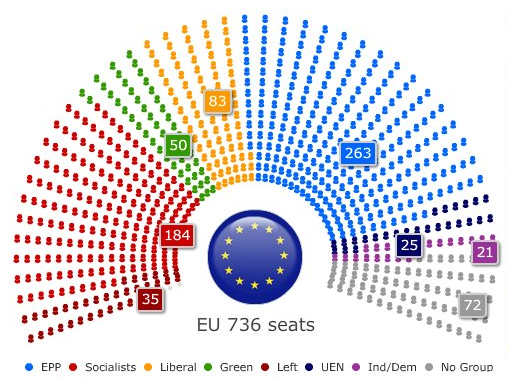
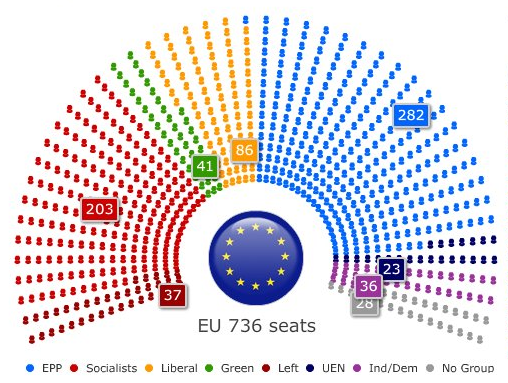
Turning to the overall European situation, we can celebrate the fact that the Green-EFA group has done very well. We previously had 41 seats, we now have 50, an increase of 22%. It is also possible that the EFA could pick up some more seats from newly elected parties that the BBC wouldn't have associated with stateless nations in Europe.


As you can see from the graphics on the BBC website (2009 on top, 2004 below) none of the bigger groups has improved. The PES (Party of European Socialists) are down from 203 to 184, the EPP (European Peoples Party) down from 282 to 263, and the ALDE (Alliance of Liberals and Democrats in Europe) down from 86 to 83. The EPP's drop reflects the Tories' withdrawal from that group.

That is good news for European politics, which—believe it or not—is what this election should have been about.

Bookmark and Share

An open letter to Green Party supporters in Wales

I hold no official position in Plaid, and what I'm writing is entirely my own opinion, written on my own initiative. I am going to ask you to do something difficult, but something I believe is in the best interests of both Wales and the political values and policies that I trust both you and I share.

I am asking you to vote for Plaid Cymru in the European Parliament elections on Thursday next week, rather than for your own party.


If we had a fair voting system, there would be no problem. You would number the Green candidates first, and I believe a very good number of you would number the Plaid candidates after that. But we do not have a fair voting system. We just get one vote for one party.

Wales has four European seats. The first three seats will almost certainly go to Plaid, Labour and the Tories, who will each get a share of the vote somewhere in the mid-twenties. The fourth seat would go to the fourth placed party if they were to get more than half the vote of the first placed party. That would mean getting around 13 or 14% of the vote. I do not think that either the Lib Dems or UKIP will get that in Wales, which means the fourth seat will go to the first placed party.

To put it bluntly, and with the highest respect for Jake Griffiths and the rest of your team of candidates in Wales, the Greens will not get anywhere near 13 or 14% of the Welsh vote. Therefore, unjust though that is, a vote for the Green Party will simply not count. So I'm urging you to vote tactically instead.

-

Of course the situation is completely different in England. England has larger constituencies, therefore it is perfectly possible for the Green Party to win a seat in several of them with around 8% of the vote. The latest YouGov poll showed support for the Greens at 7%, but at 9% of those who said they were certain to vote. So in England you have everything to fight for. There is every chance of Jean Lambert and Caroline Lucas holding their seats, and of you adding a couple of additional MEPs from other regions.

In particular I wish you every success in the North West, where the Greens and the BNP are running neck-and-neck and where voting for Peter Cranie is the best way of to stop the disgusting Nick Griffin winning a seat. And, as I'm sure there must be some Welsh ex-pats reading this in NW England, this video explains how close that race might be, and why voting Green is a more effective way of stopping the BNP than voting for one of the big three parties. I could even overlook the fact that Ynys Môn was left off the map!


But back to Wales. In asking you to vote for Plaid I would not insult your intelligence by pretending that voting Plaid would be the same as voting Green. Although all parties have to an extent come round to understanding the importance of environmental and ecological issues (call that jumping on the bandwagon if you want, but it's so obvious that no party could avoid the issue) very few have understood the idea of sustainability, and fewer still that the ecomony needs to be fundamentally rethought away from the idea that unsustainable "growth" is the panacea for all problems. Nor would I want to hide away from the attitudes and actions of some in Plaid which are definitely less than Green. For example, even though Plaid is an anti-nuclear party, we have a leader in the Assembly that supports a new nuclear station at Yr Wylfa. And in my opinion we made a mistake by not passing on the fuel duty rebate to bus companies, when we should have done all we could to help public transport.

But despite those things, I would not support Plaid Cymru if our policies on environmental issues were not better than those of the other main parties. Our record may not be perfect, but it's not too shabby either.


On a European level, as I'm sure you know, the Green Party and Plaid Cymru are both part of the Green-EFA Group in the European Parliament. We sit together, we work together, we lobby together, we vote together.

If there were any possiblity of the Green Party winning one of the four Welsh seats you would of course be right to go for it. But there isn't, so voting Plaid is the next best thing. But I would not ask you to do this unless there was something concrete to be gained. I need to persuade you that your vote would make a practical difference. So we need to look at some electoral maths in Wales.

-

Labour's share of the EP vote has slumped to 22% in the UK as a whole. In Wales, which is a more left-leaning country, Labour's slump will not be so bad. I reckon they will get somewhere around 26% of the vote.

In the last Euro election the Tories got 19.4% of the vote in Wales, compared with 26.7% in the UK as a whole. So even thought the Tories are doing relatively well in the UK as a whole, their performance will be about 7 percentage points lower in Wales, putting them again no higher than about 25%.

It's very hard to gauge Plaid's support, because none of the main polls includes Wales as a separate region. We got 17.4% in 2004. We got over 22% in the Assembly elections in 2007, but that is not the same thing. One recent poll put us at 27% in Assembly voting intentions, 5% more than in 2007, which seems to indicate that our support has grown. What I can say with certainty is that Plaid MPs have not been tainted by the expenses scandal in Westminster. So my best guess would be that Plaid's support will be at least in the low to mid 20s. Say 23 or 24% of the vote. I think it might well be higher, but there's no way of being sure about that. That's why we need your support.

At the last Assembly elections the Greens got 3.5% of the vote. That was two years ago. The polls show that your support has increased since then, but it's hard to give a figure specific to Wales. However it must be at least 5 or 6%.

If most of you can bring yourselves to vote for Plaid, our share of the vote goes up from around 24% to around 27 or 28%. That would be enough for us to narrowly beat both Labour and the Tories and therefore win the fourth Welsh seat. The Green-EFA group in the European Parliament therefore gets one more seat. That benefits both our parties, but more importantly it benefits Wales.

-

Thank you for bearing with me. I know I'm asking you to make a difficult decision, but I trust that the reasons I have given are enough to persuade you. I can only ask.

Bookmark and Share

Plaid to win two Welsh seats


With less than three weeks to go to polling day for the European elections, it's time to focus on what is going to happen. Most opinion polls headline what is happening in the UK as a whole, rather than what will happen in each country, but I'm going to start by looking at Scotland.

In the latest published YouGov poll (for the Sun, 13/14 May) the headline European voting intention in Scotland is:

SNP ... 40%
Labour ... 21%
LD ... 14%
Con ... 13%
Greens ... 4%
UKIP ... 4%

That is an amazing lead. Scotland's representation has been reduced to 6 seats in this election (if Scotland were independent it would probably have 14 seats, and if we were independent we'd have 11 ... but that's another story). It would give the SNP 3 seats, with Labour, the Tories and the LDs on one each. That will be a big success for the SNP.

-

From the same data it's hard to work out what would happen in Wales because Wales is included with the Midlands. Before the Telegraph got into full swing I thought that Plaid, Labour and the Tories would all poll in the mid-twenties, but I wasn't at all sure what the order would be. Each of these three parties will win one seat. The only real question is who will win the fourth (and final) seat. It's very hard to see either the LDs or UKIP getting more than half the vote of the biggest party, so the fourth seat will be won by the party with the biggest vote. A week or so ago I didn't have much confidence that it would be Plaid.

But since then the scandal over MPs' expenses has deepened, leading to a large part of the population baying for political blood. I might question the direction in which some of that anger is aimed, but the anger is genuine and justified. The YouGov poll shows a huge surge in support for UKIP as a reaction against the three big UK parties. But what does that mean for Wales?

As Vaughan Roderick noted in his blog today, UKIP draw their support from the right. So any growth in their support will be at the expense of the Tories. A week or so back I genuinely feared that the Tories might get the biggest share of the vote in Wales, but if that gets split with UKIP they won't.

Labour, it goes without saying, are in freefall. Their UK figure is now 20%. In Wales that will be higher, but maybe only 25%. The champagne socialism of the likes of the Kinnocks and Touhig, which has got up my nose for years, has now got up everyone's nose!

-

Which of course leaves Plaid. These may be "famous last words" on my part, but none of Plaid's MPs has been doing anything other than making reasonable claims for accommodation that nobody would question they need because of the distance and travelling time to London. After all, if UKIP are getting kudos for being seen as "clean" (even though, as VR points out, one of their MEPs was jailed for making false claims and another is facing fraud charges) then Plaid are certainly cleaner.

All this can only push Plaid's vote up, to the point where I now believe we can and will get somewhere around 27% of the vote, and therefore win the fourth Welsh seat. As support for Labour plummets, what other party will people with generally left leaning views vote for? The biggest challenge is to get people out to vote rather than stay at home in disgust, because not voting means that nothing will change.

-

Finally - even though, sadly, it seems that this election is going to be focused more on the misuse of privilege and the integrity of our elected representatives than it should be - we need to remember that elections are about policies. Irrespective of the candidates the parties put up, it is the policies they enact which effect our daily lives.

So with that in mind, I'd invite people to click on the picture and read the Plaid manifesto.

But if manifestos aren't your thing, then ask yourself this question instead:

Is it better to have MEPs from a UK party in the European Parliament ... or MEPs from a party that stands up and fights for Wales?

Bookmark and Share

Where I stand on the EU Profiler

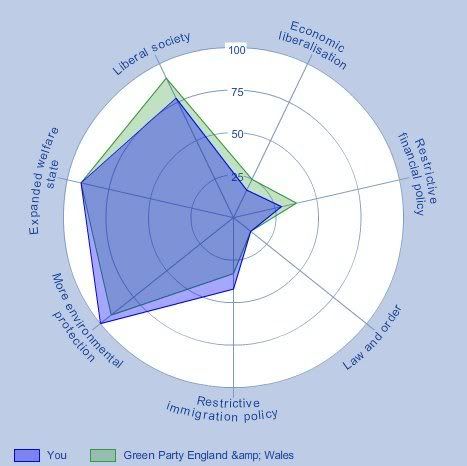
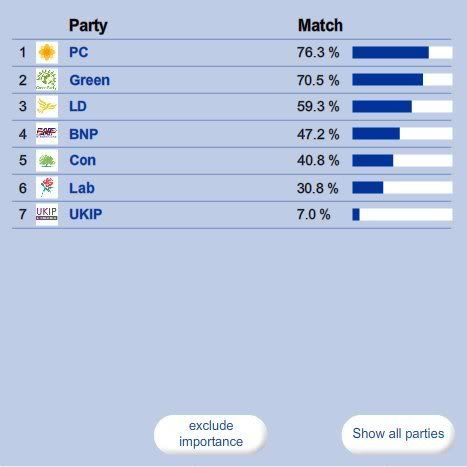
Thanks to Simon Dyda on Ordovicius, I have just tried out the EU Profiler. As this blog is new, I thought it would be good to share where I stand politically with my new readers ... at least I hope I'll have some new readers!

Things came out pretty much as I expected:

     MH-EUProfile-1.jpg

     MH-EUProfile-2.jpg

     MH-EUProfile-3.jpg

     MH-EUProfile-4.jpg

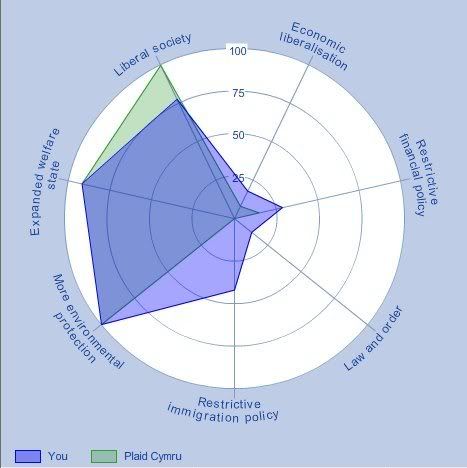
Someone once described me as Plaid Organic, and I'm happy with that description. If I didn't vote Plaid, I would vote Green.

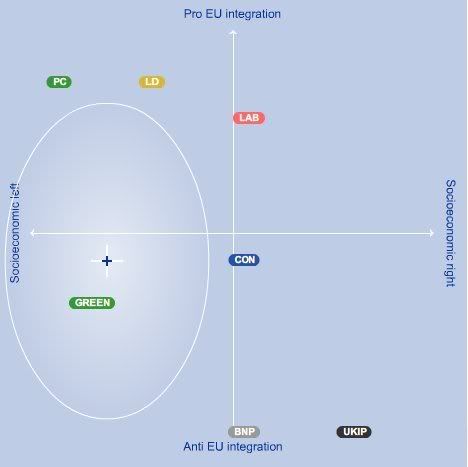
As you can see form the first graphic, the EU profiler puts Plaid and the Greens almost equally to the left. I wouldn't describe myself so much as left wing ... Plaid describes itself as a "decentralist socialist" party, and I put slightly more emphasis on the first word than the second.

According to the profiler, the big difference between Plaid and the Greens is the attitude to Europe. I don't see it so much that way. I am very firmly pro EU, but I also want its member states to be the level at which most legislation is decided, and I want Wales to be one of those member states in its own right. I believe in a Europe of distinct nations which have come together because we share broad common values. There's not much point in Wales being independent if it is subsumed into the EU instead.

Bookmark and Share