Showing posts with label Education. Show all posts

Bad reporting from the Guardian

Yes, from the headline, I guess most of you will have thought that I was referring to this article yesterday on Ysgol Llangennech and Welsh-medium education generally.

However what I had in mind was this report on a poll commissioned by Chatham House on what position the EU should take in Brexit negotiations. The Guardian's headline reads:

Two-thirds of Europeans believe EU should take hard line on Brexit – poll

But look more closely at this graphic from the article:


Yes, it is technically true that two-thirds of those outside the UK said that the EU should not compromise its core principles ... but what about the additional 20% who said that the EU should not compromise at all?

Do the maths. The truth is that more than 80% of those questioned think that the EU should not compromise over its core principles. In fact, even a majority in the UK think that the EU should not compromise its core principles. If we needed proof that the UK government is not going to get the outcome it says it wants, this survey should add to it. Twenty-seven democratically elected governments are not going to ignore such overwhelming strength of opinion in their respective countries.

So what are we to make of such reporting? Is it sloppiness? Maybe. Or is it that the Guardian, like every other media outlet, is inclined to write stories that support its own agenda, or (being more charitable) has an inbuilt, unconscious bias that it simply isn't aware of?

I don't share the general anger that I can see in many of the pro-Welsh-language comments on the Guardian's Llangennech article. I think it would be better to accept that every news outlet operates this way, and to filter what any article says accordingly. I'm glad the Guardian wrote what it did, simply because exposing such bias (whether intended or unconscious) is the best way of dealing with it.

Bookmark and Share

Offering us precisely nothing

It was interesting to read this story on the BBC website that the Tory government in Westminster is now prepared to offer the devolution of teachers' pay and conditions to our National Assembly, but surprising that the Welsh Government considered this to be an "encouraging development".

-

As I see it, teachers' pay and conditions are already devolved to Wales. Of course this was never intended by Westminster; it came about as a result of the Supreme Court ruling that the Assembly had power to determine pay and conditions for agricultural workers in Wales. As I mentioned in this post, by choosing to test out the Assembly's competence to retain an Agricultural Wages Board for Wales, Westminster was in fact asking the Supreme Court to rule on the general principle of whether something had to be specifically mentioned as being within the Assembly's competence, or whether it could reasonably be implied to be within the Assembly's competence because the overall subject area—in that case agriculture—is devolved.

That first post was written before the verdict had been delivered, but after it had been delivered I wrote this post, which showed beyond any doubt that politicians in Westminster fully realized that the principle could be applied to other devolved areas ... and that in this regard the Welsh Assembly has greater powers than even the Scottish Parliament. Because education is devolved, applying the same principle means that, for example, teachers' pay and conditions are devolved, as well as those of anyone else who works in education. The same would also apply to all the other devolved areas.

-

As others beside myself have noted, one of the Conservative Government's purposes behind the new Wales Bill is an attempt to roll back these, and other, devolved powers under the guise of a reserved powers model. Yes, the new Bill promises a few additional powers—and for me any additional powers will always be welcome—but these come at the cost of the repatriation of powers we already have back to Westminster. It's too high a price to pay. I think we must reject the repatriation of any powers back to Westminster on principle.

In other words, although this new "concession" proposed by the Tories is meant to look like a step forward for devolution, it is very far from being the "encouraging development" that the Welsh Government believes it to be. They are in fact offering us nothing that we don't already have.

Bookmark and Share

Steady growth in Euskara-medium education

Prompted by this article on Nationalia, I've just been skimming through the Fourth Report of the Committee of Experts on regional and minority languages in respect of Spain, and was encouraged to see the continued growth of education through the medium of Euskara, the Basque language, in sections 372-378.

2010-11

Pre-school ... 71.1%
Primary ... 63.7%
Secondary ... 55.9%

2011-12

Pre-school ... 72.3%
Primary ... 65.4%
Secondary ... 57.7%

2012-13

Pre-school ... 73.5%
Primary ... 67.4%
Secondary ... 59.4%

The next sections of the report also provide a useful insight into the place of adult education in developing new speakers of the language:

381 ... The Advisory Council on Basque has found that of the approximately 300,000 new Basque speakers attracted over the last three decades, 100,000 came from the teaching of adults and adult literacy and 200,000 from the general education system.

I must admit to some surprise at how high the figure for adult education is. Certainly we don't put anywhere near the same emphasis on teaching Welsh to adults. But then again, neither do we make competence in Welsh a reqirement for all but a small percentage of jobs in the public sector, nor do we fund adult leaning of Welsh to the tune of over €30m (£23m) a year.

Bookmark and Share

WM education in Cardiff: alarm bells ringing

 
I've just received this press relaease from RhAG. Hopefully, the story will also be reported the mainstream media.


Serious concerns that a starter class for Grangetown and Butetown will not open as promised this September is an indication of wider failures by Cardiff Council in the planning of Welsh-medium education provision across the city.

This is RhAG’s response to concerns of local parents that the Council will not keep their promise to open the starter class hosted at Ninian Park School, as a seedling of the new school which is proposed to open on a permanent site in 2017.

On the basis of Council figures for July, RhAG is aware that 105 pupils were refused first choice applications for a place in the city’s Welsh-medium primary schools. It is unclear how many children have been lost to the English-medium sector, nor how many are still in the appeals system. This represents a loss of 13% of all applications for the Welsh-medium September 2015 Reception intake. The loss for September 2014 was approximately 5%.

Michael Jones for Cardiff RhAG said, "Warning bells should now be ringing as many problems can be found throughout the city. In the East, between Bro Eirwg and Penypil 13 children have been unable to obtain a place without another nearby school a practical possibility. Glan Morfa has been turning pupils away for 3 years and more, and the same situation has arisen this year with 5 application refused. In the North, the situation at Mynydd Bychan (19 refused) is unacceptable and the Wern, at 75 applications cannot meet the demand with 3 pupils not being offered a place. The applications for Melin Gruffydd is 7 over their Standard Admission Number and Pencae at 21 applications over their SAN. In the West there is an urgent need to do something for Nant Caerau and Treganna is packed with 16 applications above their statutory number.

"We need immediate action by extending current provision as an interim solution and to open new schools to meet the demand. Honouring the commitment to open a starter class to serve Grangetown and Butetown is an indispensable part of the Council's plans to develop Welsh-medium education in the city, as has been incorporated into Cardiff Council’s statutory Welsh in Education Strategic Plan, which has been approved by the Minister of Education. Although the council had announced their intention to proceed with the class, the fact that parents were not made known of this until May and arrangements not confirmed until August, meant it was all far too late; so the current crisis is the result of a lack of acting early enough which has weakened parents’ trust and confidence. The current administration needs to restore this by taking control of the situation and providing firm and proactive action as a matter of urgency.

"In addition, we call on the Council to conduct an urgent city-wide review of the catchment areas for Welsh-medium schools and a thorough review of the school admissions process in order to provide greater fairness, clarity and certainty for parents in applying for places in Welsh-medium schools."

 
Ceri Owen
Cyfarwyddwr Datblygu / Director of Development
Rhieni Dros Addysg Gymraeg
Parents for Welsh Medium Education

E-mail | Website | Twitter | Facebook

Bookmark and Share

Crisis for WM school places in Cardiff

 
A couple of days ago I received a copy of a letter from RhAG, the group campaigning for more Welsh-medium education, that has been sent to the Director of Education at Cardiff Council. It goes into some detail about the impending crisis in providing sufficient Welsh-medium places in Cardiff, demonstrated by the surprisingly large number of parents whose children have been refused places at the Welsh-medium school of their choice. As it was also copied to the Education Correspondent of the Western Mail the intention was clearly for it to be made public, but as the Western Mail haven't—or haven't yet—run the story, I thought it would be a good idea to publish it on Syniadau.



RhAG has expressed its concern generally at the level of refusals on first allocation in relation to September 2015 primary admissions for WM schools, which is at an unprecedentedly high level and which must be attributed to the failure to plan proactively for growth. However RhAG does appreciate that the LA now have to cater for EM growth which was absent from 1995 onwards until about 2 or 3 years ago.

On first allocation, 685 places were given at WM schools to applicants and 110 were refused.

The total number of available WM reception places was a potential of 787 places which realistically would probably cover the 795 who gave a WM school as their first choice having regard to the various events that can change the demand over the 3-4 months between application and allocation. There were therefore probably enough places to meet the demand if one treats the demand and places on a city-wide basis. However it is apparent that there were not enough places to satisfy parental demand for WM primary places as parents want a school which is reasonably close to home, and it is not reasonable to expect a child in Trowbridge to have to travel to Pentwyn, for example.

In fact the first allocation of places was actually lower in number at 685 this year than the 693 allocated at the same stage last year. The number of refusals at 110 is the highest ever and it is more than likely that of those 110 only a small percentage, probably less than 25%, will ultimately find a WM place because the parents will have reluctantly taken an EM place which has the merit of being local even though the child will in 90% of the cases have started in a WM setting in nursery for 1 or 2 years. This is a loss wholly unacceptable to those who have worked hard to persuade parents of the benefits of WM education and have succeeded, only to be frustrated by the inadequacy of the provision, particularly as the increase of the percentage in WM education is Welsh Government policy to which the LA has subscribed by preparing its Welsh in Education Strategic Plan.

RhAG suggest that the city and county of Cardiff must do better next year, by increasing the accessible provision and altering the method of application for and consequent allocation of places.

 
1. INCREASE OF ACCESSIBLE PROVISION

It is apparent that the shortage of places and consequent high level of refusals is localised. In 7 out of 16 catchments there were no refusals or only one. In 4 schools there were refusals above or close to 20 and in another 3 refusals of 8 or 6. To some extent those refused were applicants resident outside the catchment but there were a total of 23 refused who were resident in catchment, and we suspect that some out of catchment applications were made by parents who had every reason to believe that they had no hope of a place in their catchment school.

The following is a review of the schools area by area, suggesting the remedies advocated by RhAG.

a. Far East

In this area the 2 schools are Bro Eirwg and Pen-y-pil, where respectively 8 and 2 children were refused places. We believe that the 2 unsuccessful out-of-catchment pupils at Pen-y-pil were Glan Morfa pupils whose parents believed, correctly, that they would not get in to Glan Morfa after 2 years of 10+ children being refused there. We cannot guess the origin of parents from out of catchment seeking places at Bro Eirwg unless, yet again they lived in the Glan Morfa catchment. Clearly both schools are full and the growing need can only be met by expanding Pen-y-pil to 2 streams.

b. South East

Glan Morfa is overcrowded with demand for the third year exceeding provision. The LA has a plan to meet this need which is for publication at the end of this month which must include a proposal to make additional provision at Reception level in September 2016

c. East Central

Between them Y Berllan Deg and Pen-y-groes can cope with the demand in this area. It would be helpful if the availability of places at Pen-y-groes could be widely advertised.

d. North and North Central

In this area 3 of the 4 schools are under pressure, namely Y Wern, Mynydd Bychan and Melin Gruffydd and the one with spare accommodation Glan Ceubal is really convenient to take overspill only from the southern part of the Melin Gruffydd catchment. The buildings of Melin Gruffydd and Mynydd Bychan are not capable of extension. We suspect that the out-of-catchment demand for Melin Gruffydd comes from parents in the area of Heath south of Heathwood Road who are in the Mynydd Bychan catchment but who have no hope of a place at Mynydd Bychan due to pressure for places from pupils living nearer the school site. As RhAG has repeatedly urged the only sensible thing to do for Mynydd Bychan school is to reduce its catchment so that it serves only Cathays and Little Heath (Y Waun Ddyfal). The rest of Great Heath (MYNYDDBYCHAN i.e. south of Heathwood Rd) should be transferred into the catchment of Y Wern which can be extended to a full 3 FE which will be immediately taken up. The pressure to overspill Heath children into Melin Gruffydd may then be relieved. Glan Ceubal can take overspill from Whitchurch village as well as from the Pencae catchment. We understand why the LA was reluctant to see unfilled places at Y Wern and thus refused RhAG's urging that it be made 3 FE at once but taking this step is the only way of relieving pressure on both MG and Mb which is evident from this year's figures.

e. Far North West

Creigiau and Gwaelod-y-garth are both just full. Further growth can be expected and we urge the LA to close the small EM provision at Gwaelod-y-garth and transfer it to Pentyrch which used to have spare capacity.

f. West

Two of the three schools here (Pencae and Nant Caerau) are oversubscribed but cannot be expanded on their sites. Pencae suffers from being adjacent to a major place of Welsh employment and is a convenient place to take out-of-catchment children (20 refusals of out-of-catchment children; a repetition of last year). However the LA should have regard to the proposal for housing to take the place of the BBC studios which will further increase the demand at Pencae. The developers will need to provide a 2 stream WM school to replace Pencae. Nant Caerau serves an area with a different demographic. Last year 10 children were refused places at NC; this year 21 of which 7 were in catchment (we imagine that the other 14 were from Ely also very local for whom there are only 11 places at Coed-y-gof, the catchment school). Something must be done to expand the buildings available to Nant Caerau. RhAG accepts that expansion cannot be on site. The possibilities are:

     1. Part of Glyn Derw
     2. New build on Ely Mill where the county has s106 rights
     3. At Michaelston when Michaelston moves out onto the Glyn Derw site.

There are currently 11 vacant places at Coed-y-gof which are likely to be filled by:

     1. Ely children refused at Nant Caerau
     2. 20 out of catchment children at Pencae
     3. The usual late applicants.

The total of the above is more than the number of vacant places. Does Coed-y-gof need a third stream?

g. South Central

Here we have 2 existing schools and the new Grangetown/Butetown school for which starter provision is to be made in the buildings formerly occupied by Tan-yr-Eos. At Treganna 16 have been refused who can be offered places at Tan-y-Eos. The total of applications in the Four Wards so far this year seems to be 161 but we would expect some of those refused at Pencae to opt for Pwll Coch. (We are aware of one child resident on the east of Cathedral Road and thus in the Pencae catchment who is likely to do this) We would urge that there be provision to accept 60 at Tan-yr-Eos in 2016 next year, having regard to the magnetic effect of a new Welsh-medium school which the new school will be.

 
2. APPLICATION METHOD

RhAG would urge that the LA in its literature for new parents highlight the difficulty of matching schools to children precisely, warning parents that if they want to choose WM education and have started a child in a Nursery class then it would be wise not only to choose one WM school but also a second to enable the council to meet demand with some flexibility. An effort should be made to avoid presenting a parent with a choice of one local WM school or a local EM school. If a WM school has been the first choice the LA should not couple a refusal of a WM place with the offer of an EM place but rather should indicate that another WM place is available which should not be an impossible journey away. Only in this way will the council fulfil its duty to promote the growth of WM education.

RhAG has expressed its concern at one aspect in particular of the admissions this year, which is its failure to honour the sibling link priority for admission to primary school.

The aspect of particular concern is the total of 8 applications refused in spite of the existence of a sibling link, a link which normally gives a high priority to the applicant which derives from the county's own rules, dating back to 1985 after the case of R v South Glamorgan County Council, ex p Evans 1984.

RhAG fails to understand why the sibling link now been ignored in 8 cases, 5 in Nant Caerau, 2 in Mynydd Bychan and 1 in Glan Morfa. RhAG has been made aware of a serious consequence of these refusals of places to children who were in the Nursery Class with parents having already been in touch with some schools to say that they will be withdrawing the elder children as they cannot face the complications of having children in 2 different schools, a consequence which the LA should have foreseen. RhAG is yet to receive explanation for the authority's failure to comply with its own long-standing rules and offer a proposal to rectify what has been done by offering places to all 8 children in the near future.

 
Ceri Owen
Cyfarwyddwr Datblygu / Director of Development
Rhieni Dros Addysg Gymraeg
Parents for Welsh Medium Education

E-mail | Website | Twitter | Facebook

Bookmark and Share

Welsh Language GCSE Results, 2014

Each year at this time I take a look at what the GCSE results can tell us about the way Welsh is taught in our schools.

There are three different types of Welsh GCSE: Welsh First Language, Welsh Second Language (full course) and Welsh Second Language (short course). However a substantial number of Year 11 students, even though they study Welsh, still do not take any Welsh GCSE. The number of entries for each can therefore be used as one indicator of the state of Welsh teaching in our schools.

-

This year the figures are again quite positive. Although the size of the cohort has decreased by about 1,100 compared with last year, the overall number taking Welsh GCSEs has increased by more than 200, and the number of students not taking any form of Welsh GCSE has fallen from 5,768 to 4,447 ... its lowest level ever in both numerical and percentage terms. These are the figures:

Total number of students aged 15 at start of year
35,262 (was 36,361) ... down 1,099

Welsh First Language
5,591 entries (15.86% of year) ... was 5,636 (15.50%) ... down 45 (up 0.36%p)

Welsh Second Language (full course)
10,566 entries (29.94% of year) ... was 10,183 (28.01%) ... up 383 (up 1.93%p)

Welsh Second Language (short course)
14,668 entries (41.60% of year) ... was 14,774 (40.63%) ... down 106 (up 0.97%p)

Total Welsh Entries
30,815 entries (87.39% of year) ... was 30,593 (84.14%) ... up 222 (up 3.25%p)

Number who did not take any Welsh GCSE
4,447 (12.61% of year) ... was 5,768 (15.86%) ... down 1,321 (down 3.25%p)

Source for GCSE results
Source for Cohort Size (Maintained Schools)
Source for Cohort Size (Independent Schools)

The graphs below show how the numbers and percentages have changed over the last couple of decades, and a spreadsheet with full details is available here:

Although the Welsh First Language entry is down very slightly in numerical terms, it has again risen in percentage terms. The long term trend should continue steadily upwards. The latest figure for Year 2 assessments in WFL is 22.4% of the cohort and, given the new emphasis on continuation between primary and secondary school, this should mean that the figure for WFL GCSE entries will be comfortably over 20% when these pupils reach Year 11.

In terms of Welsh Second Language teaching the percentage entries for both full and short course GCSEs have risen, but it is encouraging to note the significant increase in those taking the full GCSE rather than the short GCSE. It probably won't be very long before the short course is phased out altogether, and the challenge will be to make sure that pupils do in fact take the full GCSE exam rather than opt out of taking any exam in Welsh at all.

Bookmark and Share

Cardiff's re-think on WM school places

For those who might have missed it—and because the news doesn't seem to have been reported anywhere in English—I thought I'd re-post this report from Newyddion 9 yesterday evening.


Each local authority is required to produce a Welsh in Education Strategic Plan which, among other things, details how they intend to increase the provision of Welsh-medium education in their area. Cardiff's WESP (available here) had said that it intended to create another 47 reception places over the next three years, broken down as follows:

Ysgol Glan Ceubal ... 2 new places
Ysgol y Wern ... 15 new places
New school in Grangetown/Butetown ... 30 new places

Total ... 47 new places

But this has now been revised to:

Ysgol Glan Ceubal ... 2 new places
Ysgol y Wern ... 15 new places
New school in Grangetown/Butetown ... 60 new places
Splott/Adamsdown ... 30 new places

Total ... 107 new places

In addition to this, an extra 15 reception places would be available by refusing children who live in Rhondda Cynon Taf access to Ysgol Gwaelod y Garth ... although I think this would be a retrograde move as it is the most convenient school for Taff's Well, just across the river.

I've searched for details of the new plan, but haven't been able to find any so far. However I think it's fairly clear how the additional places would be provided.

First, it must mean that the new WM school for Grangetown/Butetown is going to be a two-form entry school from the outset. Cardiff produced a shortlist of six possible sites back in March, and I looked at each of these in some detail in this post. As I see it, the only two viable options for this new WM school are the Channel View Leisure Centre site in Grangetown (in turquoise) and the site immediately north of County Hall (in yellow).


Second, the most obvious way of expanding provision in Splott/Adamsdown is by increasing the size of the existing Ysgol Glan Morfa from one- to two-form entry.

Ysgol Glan Morfa shares a site with the English-medium Moorlands Primary (and Nursery) School. In the picture below Moorlands Primary is the two storey building, Moorlands Nursery is the single story building in the top left, and Glan Morfa is at the bottom.


On the right of the picture is a building which used to be a library but is now empty, although the grounds are used as a play area. My guess is that this would be used to provide the additional accommodation to make Glan Morfa into a two form entry school. The building is not in particularly good condition, so it might well be better to demolish it than try to refurbish it. But it was quite a handsome building in its day, and if it were up to me I'd look at a way of keeping the façade, but building something completely new behind it.


All in all, it is very good news indeed that Cardiff Council have re-thought their original plans, and are now aiming to provide more than double the number of new WM reception places originally proposed. These 107 new reception places will, as children move up through these schools, mean an extra capacity of 749 WM primary places. It will also make it all the more necessary for Cardiff to have a fourth WM secondary school.

The other piece of good news is that Cardiff intend to open the new Grangetown/Butetown school by 2016 rather than 2017 as previously proposed.

Bookmark and Share

OECD Report - Improving Schools in Wales

I had a bit of difficulty finding a link to the actual OECD report into the state of education in Wales, as reported by both the BBC and WalesOnline.

So to make it easier for others who are looking for it, it's here.


Bookmark and Share

A new WM school in Grangetown/Butetown

Last week, Cardiff Council announced that they had reconsidered their previous decision to back track on their commitment to build a new one form entry Welsh-medium school in Grangetown – something which had already been approved by the Welsh Government and for which a share of funding had been arranged under the 21st Century Schools programme. Instead, they now intend to provide an additional 60 entry places for both Welsh- and English-medium education in the Grangetown/Butetown area, and have produced a shortlist of six sites that they consider suitable for development, as reported here.

This in itself is a major victory for both the parents who have been campaigning for it and for Neil McEvoy, who was able to use his position to "call in" the original decision.

The new proposals are set out in detail in this document, which is being considered by the Children & Young People Scrutiny Committee tonight. In this post I'd like to look at the shortlisted options.

-

The map below shows the six sites. Two are in Grangetown: Ninian Park Primary in green and Ferry Road (behind Channel View Leisure Centre) in turquoise. Four are in Butetown: Mount Stuart Primary in lavender, St Mary the Virgin CiW Primary in blue, St Cuthbert's RC Primary in orange and unused land just north of County Hall in yellow.


If the Ninian Park Primary site were to be developed, it would be as a permanent extension to replace the existing temporary accommodation, probably in the area marked on the picture below, which will involve taking a small piece of land from Sevenoaks Park. It could therefore only provide English-medium places. It is a two form entry school at present, and the extension would make it a three form entry school.


My guess is that the Ferry Road site would be the area shown in turquoise below. It is a relatively small site, but it might well be enlarged by relocating some of the car parking at Channel View Leisure Centre and/or by taking a small piece of the Marl in the same way developing Ninian Park would take a small part of Sevenoaks Park. I do not know the exact site boundaries Cardiff have in mind, but it is worth noting that they believe the site is large enough and suitable for a two form entry school in their report, with the play/sports facilities on the Marl being used by the school.

Personally, I would have no objection to this site being developed as a one form entry WM school, especially as the site is relatively small, but Cardiff have a preference for larger rather than smaller schools.


Therefore if there is to be a Welsh-medium School in Grangetown, this is the only one of the identified sites that could accommodate it. The only alternative to a WM school on this site would be one in Butetown.

It is perhaps worth noting that in this post, Labour Councillor Ashley Govier is quoted as saying that the plan is to create "a fully integrated site of play, leisure and school", which might be taken to include the Grangetown Play Centre to the right of it in the image. He might well have inside information not available to the rest of us, but I do not see any reason why the playgroup should not stay exactly where it is, and the new school be built to the left of it.

-

There are four identified sites in Butetown. Three of them involve building on the playing fields of existing schools, and one is a currently unused brownfield site.

Mount Stuart Primary is shown below. I would guess the most promising part of the site to develop is marked in lavender. The idea is to extend the existing school, making it a three form entry English-medium school. There is also the potential to enlarge the site onto the green public space to the west and the south of the site to compensate for this.


Cardiff have identified the need for an additional 60 English-medium entry places in Grangetown/Butetown, and I think the best way of achieving this would be to provide 30 of them at Ninian Park Primary and 30 of them at Mount Stuart Primary. However I might also say that although I think the figures for the overall numbers of additional children are probably right, I think that Cardiff are underestimating the numbers for WM schools and over-estimating the number for EM schools. They are working on an annual 4% "uplift".

St Mary the Virgin CiW school is shown below, and Cardiff have identified their playing field (marked in blue) as a site for development. I just can't see this working. Losing the playing field will affect the existing school very severely. For me, it's a non-starter. However I would not rule out creating some additional places at this school if there was a specific demand for more Church in Wales faith school provision. It might well be possible to build a small block of two or three classrooms immediately adjacent to the school without needing to build on the playing field.


The picture below shows two sites. The site shown in orange takes up part of the playing field of St Cuthbert's RC Primary and some adjacent land. I think it is possible to build a new wing to this school to increase it from a one form entry to a two form entry school, but I would again question whether there is specific demand for this many more Catholic faith school places, particularly as it would mean that the vital piece of maintained green space at Letton Road will be lost to the community. Providing just one or two additional classrooms could probably be done without having to take this public space.


In contrast, the site shown in yellow to the north of County Hall seems a much better proposition, and is so close both the St Cuthbert and St Mary's sites as to make no real difference in terms of travelling times. So why take much-valued playing space away from either of those two schools? To me, this seems an ideal site to develop as a two form entry school.

-

So it is now a question of choosing which of these options are best. So far as Welsh-medium education is concerned, there are only two practical possibilities from the six sites that Cardiff has shortlisted: either a new school at Ferry Road (turquoise) or a new school at County Hall (yellow). In my opinion, it would be better to develop the Ferry Road site, because Grangetown is more densely populated and has the greatest immediate demand for WM places.

For children in Grangetown to have to travel east to the County Hall site would be almost as inconvenient as for them to have to travel west to Pwll Coch. Schools in urban areas should be within easy walking distance. There are already four EM schools in Grangetown (Grangetown Primary, Ninian Park Primary, St Patrick's RC Primary and St Paul's CiW Primary) so it is only fair that there should now be an equally accessible Welsh-medium school in Grangetown as well.

Bookmark and Share

Colour coding for schools made easy

I can't help but feel that today's announcement of a new colour code system to replace school banding is a bit of a political faux pas. This is how WalesOnline describes the categories:


"Schools at the lowest end of the scale (category four) will languish in the 'red zone'. Red schools will be those 'causing concern' and 'failing in most or all aspects of school performance'. They will be sent an automatic warning letter from their local authority and be subject to statutory powers of intervention where necessary.

"Leaked documents suggest red schools will suffer 'loss of autonomy' and 'a more directed approach' will demand specific expectations and timescales. There is a suggestion that schools permanently in the red zone will be at risk of closure."


"Schools in category three (orange) will be 'at risk of causing concern' and headteachers and governors will be 'clearly informed of the school's critical status."


"But, in a surprise twist, schools in groups one and two (green and yellow) will be expected to provide collaborative support and advice to those which are struggling."

Not so much of a surprise, really. Noblesse oblige.

Bookmark and Share

The Welsh for neutron is niwtron


The Welsh for neutron is niwtron
The Spanish for neutron is neutrón
The Italian for neutron is neutrone
The Irish for neutron is neodrón
The Turkish for neutron is nötron
The Portugese for neutron is nêutron
The Norwegian for neutron is nøytron
The Catalan for neutron is neutró
The Basque for neutron is neutroi
The Latvian for neutron is neitronu
The Slovenian for neutron is nevtronov
The Maltese for neutron is newtroni
The Lithuanian for neutron is neutronas
The Finnish for neutron is neutroni
The English for twp is Fabricant


This is the relevant section from Radio 4's Any Questions, broadcast from Neath on Friday 24 January, followed by the report on Newyddion 9 on Wednesday 29 January.

It's good to see Tories like Glyn Davies disowning Michael Fabricant's views, wondering why the BBC invites Tories from England onto a panel in Wales. And Efrogwr noted that, in the WalesOnline article, the Tory spokesman said that "we will continue our efforts to maintain and strengthen our national language."


Bookmark and Share

Ysgol Bro Alun's newest pupil

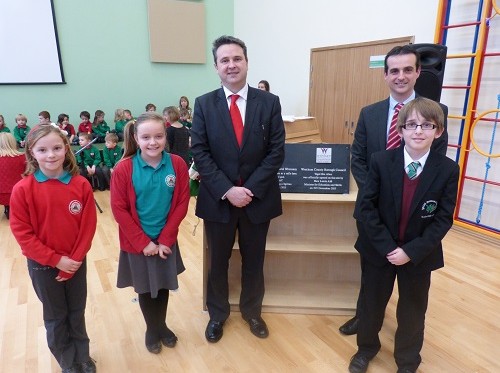
Close colleagues of Huw Lewis have, for the last few weeks, been strenuously denying that he needs to go back to school in the light of Wales' poor perfomance in the PISA tests. Yet it appears that the rumours were true ... for here he is, being officially welcomed as a new pupil by headteacher Osian Jones and the three pupils who have agreed to act as his mentors while he adjusts to the new experience.


The choice of a Welsh-medium school has raised some eyebrows among his colleages in the National Assembly. But, to his credit, Huw has been trying hard to learn Welsh, and feels that a couple of terms of language immersion a long way away from the distractions of Cardiff Bay should be enough for him to become fluent. Staff at the DfES are so delighted that they have decided to take the next two weeks off in celebration.

More pictures here.

Bookmark and Share

Figures for Welsh rise again ... at least a bit

While reading through Estyn's report on Welsh in the Foundation Phase published last week, I noticed in paragraph 23 that 22.9% of pupils in Wales were assessed in language, literacy and communication skills (Welsh) at the end of the Foundation Phase (Key Stage 1) in 2012.

This figure is different from the one quoted in the latest annual report on progress towards meeting the targets in the Welsh Government's Welsh-medium Education Strategy, which states that the percentage of Year 2 learners assessed in Welsh first language in 2012 was 21.9% (7,229 out of a cohort of 32,960).

I asked Estyn which figure was right, and the bad news is that their 22.9% was a typographic error. They will correct the online versions, though that is obviously going to take a little time. But the good news is that the figure for 2013 is 22.4%.

-

As I mentioned in this post a couple of weeks ago, progress towards meeting the targets in the WMES has been painfully slow. The figures for Outcome 1, the percentage of seven-year-old learners being taught through the medium of Welsh, had only increased by 0.1% over three years. So I can now, at least unofficially, update the table.

Outcome 1
More seven-year-old learners being taught through the medium of Welsh

Baseline (2009) ... 21%
Target for 2015 ... 25%
Target for 2020 ... 30%

Actual percentages
2009 ... 21.0%
2010 ... 21.8%
2011 ... 21.9%
2012 ... 21.9%
2013 ... 22.4%

Progress to date ... 1.4% ... still 2.6% short of 2015 target

It's not a huge increase, but it's certainly better than being at a standstill.

However this increase, welcome as it is, doesn't detract from the point I made in that previous post. The Welsh Government has admitted the targets won't be met, but they plan on doing absolutely nothing about it until after the 2015 figures have been released. This is shameful and unacceptable. The whole point of annual progress reports is to ring alarm bells so that remedial action can be taken before it is too late. But instead of doing that, Huw Lewis and Carwyn Jones have put their fingers in their ears.

Bookmark and Share

PISA ... looking back three years

As with probably everyone else in Wales, I've had to reflect hard on the PISA results announced this week. However when I read Professor David Egan's comment on what Victoria Winkler had to say in this post on the Bevan Foundation blog, it prompted me to look back to what I wrote three years ago.

It strikes me that nothing much has changed, and therefore I hope people won't mind me recycling it.


Poor academic performance ... or just poor?

It goes without saying that the results of the 2009 PISA survey published yesterday are disappointing. But although everyone knows there's something wrong, not many people are giving a coherent reason why.

However the answer one person has given does seem to me to be more plausible than most. Professor David Egan wrote this on This is my truth today ... though it's only an extract from his full article, which is here.


Far more significant, however, was the extremely strong relationship that exists in Wales, compared to more successful countries, between living in relative poverty and disadvantage and not doing well in PISA. That is again likely to be the most important cause that explains our overall performance and it is also possible that we will have slipped further in this respect relative to other countries, including England, who have begun to address the relationship between poverty and educational performance.

Put quite directly, where you are born in Wales, who your family and friends are and the community you live in has a profound effect, despite the raw talents and potential that may be your birthright, with what you will achieve in education and thereafter to a large extent in life. In essence if we want to explain PISA, we need to look no further than the insidious effect which poverty continues to have on our nation and its people, particularly our children.

Today, one day after the PISA results were published, this article in the Western Mail shows how Wales' GVA relative to the UK as a whole has slipped yet further.

     Wales confirmed as UK's poorest nation

The full data are here but the critical figures are:

Wales GVA per head relative to the UK as a whole

1989 ... 85.4%
1999 ... 77.4%
2010 ... 74.3%

This shows that there is a fairly good correlation between Wales' worsening GVA figures and our decline in academic achievement. That, of course, does not prove a connexion, but it certainly adds weight to the probability.

-

It is fair to say that the link between educational achievement and poverty is a subject that Professor Egan has raised on a number of occasions, for example here in March last year. I thought the figures in this table were particularly informative:

The percentage of children not meeting the expected grade in the lower Cynon Valley:

•  Age seven ... 25.1%
•  Age eleven ... 32.9%
•  Age fourteen ... 58.8%
•  Age sixteen ... 77%

Assuming this pattern is going to be pretty much the same for other areas of higher poverty in Wales, this probably does most to explain why Wales does relatively well compared with England in the early key stages, but that performance then declines markedly when children enter secondary school ... and it should be remembered that the PISA tests are taken by those aged fifteen. It would also explain why Wales then starts to do relatively well (at least when the Welsh Baccalaureate is taken into account, as I noted here) in post-GCSE education. This would be because children from more disadvantaged areas are less likely to be taking A levels and the Welsh Bac Diploma.

It is not a matter of poverty, but of relative poverty. Many of us will remember a generation where we were much poorer than we are now in absolute terms, but in a situation where the gap between rich and poor is widening rather than being narrowed, those who are already poor must feel an increasing sense of hopelessness about whether education—which always used to be the obvious route out of poverty—can now still bridge a gap that is continually widening.

-

If this analysis is true, then it would seem to suggest that the problem of our poor academic performance is not really going to be solved by focusing only on education, and in particular will not be solved simply by spending more money on education. To me, that solution seems to be a knee jerk response. People will suggest it either because they feel we have to "do something" no matter what, or because they are involved in education and want to see education cushioned from the severity of the cuts.

Money, particularly investment, is needed. But I think the target should not so much on changing the way we teach, for the changes we have made in the past few years seem to me to be perfectly reasonable, and need time to work through before we can judge them. Instead, the more pressing need should be to change the attitude of hopelessness that seems to be growing as the relative poverty of the most disadvantaged parts of our communities increases. I think Professor Dave Adamson's quote in this clip from the link above hits the nail on the head.


There's almost a social isolation that can occur, and young people can get locked in a local culture where they have very low aspirations. They don't expect to do well in school, their parents don't expect them to do well and, sadly, their teachers often don't expect them to do well. So it becomes a self-fulfilling prophesy that they won't do well.

 
My original post is here, and I'd advise people to look at it because of the quality of the comments and discussion afterwards ... which we can perhaps continue here.

Bookmark and Share

PISA incredulity

Rather than join in with the accusations and recriminations about the PISA results announced today, I would instead like to look at the sort of questions that were asked.

Apparently there are six levels in the mathematics section, and a sample question from each level is here. The first four levels are so easy that they're not worth bothering with, so I'll concentrate on the sample questions for Levels 5 and 6.

Level 5 Question

The Gotemba walking trail up Mount Fuji is about 9 kilometres (km) long. Walkers need to return from the 18 km walk by 8 pm.

Toshi estimates that he can walk up the mountain at 1.5 kilometres per hour on average, and down at twice that speed. These speeds take into account meal breaks and rest times.

Using Toshi's estimated speeds, what is the latest time he can begin his walk so that he can return by 8 pm?

Level 6 Question

Helen rode her bike from home to the river, which is 4 km away. It took her 9 minutes. She rode home using a shorter route of 3 km. This only took her 6 minutes.

What was Helen's average speed, in km/h, for the trip to the river and back?

Assuming that these sample questions reflect the actual degree of difficulty of the test itself, my problem is that I can't see how people could fail to answer them correctly. Yet the OCED average getting the Level 5 question right was only 13%, and the UK average 12%. For the Level 6 question the average for both the OECD and UK was only 3%.

So I would like to ask a genuine question. Are there people reading this who weren't able to work out the answers? Please don't be reticent, because according to PISA you'll be in good company. 7 out of 8 got the first one wrong and 32 out of 33 got the second one wrong; and I'd imagine the maths ability of the average 15 year old isn't too far removed from that of the average adult.

If these figures are even remotely accurate, it points to the whole of the so-called developed world being in a mess. And therefore it seems rather pointless to argue the toss about whether Wales would be doing OK if our figures suddenly rose to 1 in 6 and 1 in 25.


Update - 17:20, 10 December 2013

The full set of PISA maths questions for 2012 is here.

Unfortunately, it isn't clear from the paper what the time limit is, or whether calculators are allowed. However, as some square root calculations are required, I would guess they are.

Have fun.

Bookmark and Share

No sense of urgency ... and the WG doesn't care

Last weekend RhAG, Parents for Welsh-medium Education, held their annual conference in Cardiff. The event was reported by the BBC in Welsh, but not in English ... another example of the BBC continuing its policy of not bothering to report things that are of equal, if not greater, concern to those who don't speak Welsh than to those who do.

So I thought it would be a good idea to translate it for others to read:

RhAG: Growth in Welsh-medium education "too slow"


Parents for Welsh-medium Education (RhAG) have called on the Welsh Government to set more specific targets for local authorities to increase the number of Welsh-medium schools. During the organization's conference in Cardiff at the weekend, members said that "progress in expanding the Welsh-medium sector is far too slow".

According to RhAG, more needs to be done to ensure that the targets contained in the government's Welsh-medium Education Strategy [the BBC link is to Welsh in Education Strategic Plans] are met.

The government has acknowledged that they are likely to miss the targets, but said that it is the responsibility of local authorities to plan the provision of education in their areas.
 

Targets

RhAG claimed that the strategy is currently failing to facilitate the provision of new Welsh-medium schools, and that there was "a disconnect between central government strategy and what is happening locally".

The conference was held at the new Ysgol Treganna in the capital, which is not far from the Grangetown area. There has been considerable debate and protest in these areas of Cardiff, as in many other areas in Wales over the years, because of concerns about the provision of Welsh-medium education.

Lynne Davies, national chair of RhAG said, "We note that some counties have been proactive but others are still dragging their feet. As a result, progress in expanding the Welsh-medium sector is far too slow. There is still a gap between the aspirations of the Welsh Government in relation to Welsh-medium education and the progress needed to achieve the targets set out in the Welsh-medium Education Strategy.

"The Welsh Government has set a target that 25% of 7 year olds in Wales are educated through the medium of Welsh by 2015, increasing to 30% by 2020. At the moment, the strategy fails to facilitate the provision of a new Welsh-medium schools. The Welsh Government should set specific targets for local authorities to expand the number of Welsh-medium schools. There is very little hope of reaching this goal unless the Government issues clear instructions to ensure that local authorities take action."
 

"Responsibility of individual authorities"

In response to RhAG's comments, the Welsh Government has acknowledged that they are unlikely to meet these targets, but said it was the responsibility of individual authorities to plan Welsh-medium education.

A Welsh Government spokesman said, "We are increasing our support for Welsh-medium education and last week a campaign to provide information to parents was launched. However, we have to be honest in saying that we are not likely to reach the ambitious targets that were set in our Welsh-medium Education Strategy. These will be re-assessed in 2015 as part of the review of the Strategy and Action Plan.

"Earlier this year, the School Standards (Wales) Act 2013 was passed, which makes it a statutory requirement for local authorities to prepare Welsh in Education Strategic Plans. Subject to certain conditions, some authorities will need to measure the parental demand for Welsh-medium education and produce plans showing how they will respond to it. It is up to local authorities in Wales, not the Welsh Government, to plan the provision of education in their areas."

BBC Newyddion, 25 November 2013

There are two halves to this story. The first is to look at the targets in the Welsh-medium Education Strategy to see how much progress has actually been made. Very helpfully, though perhaps they regret it now, the Welsh Government publishes annual progress reports which can be downloaded from this page. After three reports, these are the figures showing progress to date on the first two key outcomes:

Outcome 1
More seven-year-old learners being taught through the medium of Welsh

Baseline (2009) ... 21%
Target for 2015 ... 25%
Target for 2020 ... 30%

Actual percentages
2009 ... 21.0%
2010 ... 21.8%
2011 ... 21.9%
2012 ... 21.9%

Progress to date ... 0.9% ... still 3.1% short of 2015 target

Outcome 2
More learners continuing to improve their language skills on transfer from primary to secondary school

Baseline (2009) ... 16%
Target for 2015 ... 19%
Target for 2020 ... 23%

Actual percentages
2009 ... 15.9%
2010 ... 16.0%
2011 ... 16.3%
2012 ... 16.8%

Progress to date ... 0.9% ... still 2.2% short of 2015 target

To save you from having to read a thousand words, I'll say it all with a picture instead.


But the second, and more damning, half of the story is the Government's response to this failure. This is their strategy, and it is totally unacceptable for them to wash their hands of it and try to put all the blame on local authorities instead.

Nor is it acceptable for them to say that they will wait until 2015 before taking any action. If the targets are not going to be met—which is perfectly obvious from the progress so far—ministers need to start banging a few heads together to make sure that things are addressed with a greater sense of urgency. Both Huw Lewis, as Education Minister, and Carwyn Jones, as Minister responsible for Welsh, need to act now. New interim targets need to be set prior to the 2015 review, and local authorities need to face some sort of sanction (probably financial) if they fail to meet them.

The opposition parties in the Assembly must also take their share of blame for not holding the Welsh Government to account when the annual progress reports were published. If we just sit on our hands and stay quiet when we should be standing up and speaking out, we let the Welsh Government get away with it.

Bookmark and Share

The story beneath another anti-Welsh headline

The Western Mail and its sister paper Wales on Sunday have a sorry record when it comes to reporting about the Welsh language, and they have made it yet worse with this story today:

     Autistic children banned from school canteen - because they
     do not speak Welsh

To start, some background information would probably be helpful. Brynglas Primary School was closed in July because it had an unsustainably large number of surplus places. The building was then taken over in September this year by Ysgol Bro Teyrnon, Newport's third Welsh-medium school, which had been temporarily housed at Maindee Primary School. I wrote about it here. It was probably not an ideal site for Ysgol Bro Teyrnon because it is to the north of the city and very close to Ysgol Ifor Hael in Bettws, but Welsh-medium education is growing so quickly that there was little choice but to locate it in the first building that became available.

However there is a small unit for children with Autistic Spectrum Disorders on the same site. It is the newer building with the pitched roof to the left of the main building in the aerial image below, and the second image shows it as seen from street level. Rather than making it part of Ysgol Bro Teyrnon, Newport Council made the decision that the ASD unit would be run as a satellite of Maes Ebbw School, the existing special needs school in south west Newport.


Underneath Wales on Sunday's damning headline about autistic children being "banned" from the canteen, the facts of the story are rather different:

First, the children at the ASD unit were not banned from using the canteen by Ysgol Bro Teyrnon. That was a decision taken by the teaching staff of the ASD unit and Maes Ebbw School. Apparently they thought it would be confusing for children with ASD if the children they were mixing with were speaking a language they didn't understand.

Second, even though teachers at the ASD unit decided it was better for the children not to mix, there is nothing to stop the ASD unit pupils from using the Ysgol Bro Teyrnon's canteen at a different time. That proposal was made in the very first week of term.

Third, it seems that the head of Maes Ebbw School has written to the parents of children at the ASD unit asking them what they would prefer to do. If they disagree with the teachers' initial decision and want the children to mix with children speaking Welsh, there's no reason why they can't. If they want them to use the canteen at another time, there's no reason why they can't. If they want them to eat in the classroom there's no reason why they can't. The only proviso is that there needs to be agreement between parents and teachers at the ASD as to which of these three options is best, as it obviously wouldn't be practical to have some mixing, some using the canteen at another time, and some eating in class. Lack of agreement is what seems to have triggered this story.

-

It seems clear that the parents of seven children at the ASD unit are not happy, and nobody can blame them for that. But it would appear that their unhappiness is due to rather more than just their children's eating arrangements. Despite what the head of Maes Ebbw says, it is very hard to see how "being part of the Maes Ebbw family" is of any practical benefit to children in the ASD unit because Maes Ebbw is 5km away on the other side of the city. The arrangement is one of administrative convenience, not one that is designed to meet the educational needs of autistic children. The lack of opportunity for contact with other children is the root of the problem.

In educational terms, and subject of course to individual assessments and the level of disability, it is generally right for children in an ASD unit to have a good degree of contact with children in mainstream schools, and the very last thing anyone would want is for them to be isolated. Autism is isolating enough in itself without making things worse. The best way to deal with this is to have small ASD units attached to mainstream schools ... but they must obviously be attached to schools which have the same medium of instruction.

-

What has happened is that Newport's plans have been badly thought through, and create as many problems as they are designed to solve. As can be seen by reading the documents on this page, the council had planned to close the ASD unit at Brynglas and establish a new ASD school on the premises currently occupied by Gaer Infants, again in the south west of the city. But this would mean closing the current Gaer Infants School and moving the pupils to Gaer Junior School, which is obviously contentious. [Note: The decision to close Gaer Infants has now been confirmed. See comments for details.] The two buildings are shown below, with the infants school on the right.


But the next problem is that Gaer Infants is much too big for twelve autistic children, and the documentation makes it clear that the only way the plan would be viable would be for the new school to admit additional pupils with ASD from outside Newport. The fundamental flaw with this proposal is that it involves educating autistic children further away from their homes, as well as concentrating more of them into one building, which is the exact opposite of trying to integrate them as much as possible with children in mainstream schools.

There are plenty of English-medium schools in Newport with surplus places, and it should be possible to choose one, or maybe two, of them and remodel some of that surplus space to suit the additional requirements of autistic children. Those children would be educated closer to their homes, and doing things this way would actually safeguard the future of one or two English-medium schools which might otherwise have to close, which is a win-win situation.

However it would appear from the documentation that the amalgamation of Gaer Infants and Juniors is probably justified anyway on the grounds of rationalizing surplus places; and if that is the case I would suggest that a better use of the Gaer Infants building would be to establish a much-needed fourth Welsh-medium primary school in the south west of the city.

Bookmark and Share

Live in Wales: Learn in Welsh ... the video

Following the lowest of low-key launches for the Welsh Government's new campaign telling parents about the benefits of Welsh-medium education, I've just discovered that they've put up this video on their YouTube channel.


It's a great video but, as I write this, it has only been viewed 21 times.

So I'd like to invite people reading this to change things by sending the YouTube link to everyone you know using Twitter, Facebook or just plain email.

Bookmark and Share

An awareness campaign ... but don't tell anyone

Thanks to Golwg 360, I found out about the launch of a new campaign to make parents aware of the benefits of Welsh-medium education for their children. It was also featured on Newyddion 9 last night:


Since then, I've searched through the rest of the media to see if this new campaign had been reported anywhere in English. So far as I can see, it hasn't been reported on the BBC, ITV, the Western Mail or the Daily Post. The only mention of the campaign in English is on the Welsh Government's website.

How on earth can we take a so-called awareness campaign seriously if no attempt is made to have it reported in the English language media. After all, the target audience of the campaign is specifically parents who do not speak Welsh, not those who already can.

In part, this is the fault of the Welsh Government for not taking enough trouble to have the campaign publicized in the English language media. But it is also the fault of the media organizations for not bothering to do it ... especially the BBC, since they have must have taken a conscious editorial decision to report the story in Welsh, but not bother to report it to the very people the campaign is meant to be aimed at.

-

So, in an attempt to spread the message to those who only speak English, let me reproduce what it says on the WG website:

First Minister launches Welsh-medium education campaign

First Minister, Carwyn Jones, has today launched an information campaign to raise awareness of Welsh-medium and bilingual education, Live in Wales: Learn in Welsh?


The First Minister launched the campaign at Ysgol Gymraeg Trelyn, Blackwood, where he met with parents and read a Welsh language story to children in the reception class.

The three year campaign will target expectant parents and parents with children aged 0-3, offering them information and advice so that they are fully informed when making a decision on whether to send their child to a Welsh-medium or bilingual school or not. The campaign aims to dispel some of the myths around Welsh-medium education.

The First Minister spoke to parents who do not speak Welsh about their experience of sending their child to a Welsh-medium school. The First Minister said:

"Parents are not always aware, or do not have easy access to information about Welsh-medium schools. This three year campaign will raise awareness of Welsh-medium and bilingual education so that parents can make an informed choice.

"I understand the concerns some parents may have about sending their children to Welsh-medium and bilingual schools, especially if they don’t speak Welsh themselves. This campaign is designed to ensure parents have all the information they need to be confident that whatever choice they make is the right one for them and their child."

Education Minister, Huw Lewis said:

"Our Live in Wales: Learn in Welsh? campaign aims to dispel some of the myths around Welsh medium education, such as that non-Welsh speaking parents are unable to help their children with homework and their development.

"Welsh-medium education can offer children new skills and can be a very enriching experience. We know that some parents are put-off because of a lack of understanding of the support available for those who are non-Welsh speaking. Our campaign aims to inform and reassure parents when making the important decision about their child’s education."

The growth in Welsh-medium education has been very successful, especially in the Caerphilly area which has seen the largest growth across Wales in Welsh-medium education during the last ten years. As people said in Y Gynhadledd Fawr, building on this success is key to ensuring the language continues to thrive.

For further information about the campaign, parents can visit the Welsh Government website and the Choice-Dewis facebook page.

Welsh Government, 18 November 2013

I've tried to find a copy of the booklet featured in the video and on the facebook page, but can't find it. So to me, it looks like a very half-hearted start all round. It matches the tone of what Carwyn Jones said in the Newyddion 9 interview. Instead of emphasizing the benefits, his message was, "Well, it's up to parents. There's nothing stopping them."

Let's hope it gets better.

Bookmark and Share

A small sign

The governors of Ysgol Teilo Sant in Cardiff were worried that pupils wouldn't be able to find the new school building, so they decided to put up a small sign.


Bookmark and Share