Showing posts with label 2011 Welsh Election. Show all posts

The final word on policing in Wales

One of the areas recommend for devolution to the Assembly by the Silk Commission was policing. However not all of the four parties in the Assembly agreed with this, and therefore it was not included in the St David's Day package announced by Stephen Crabb earlier this year.

Plaid Cymru and the LibDems want to see policing devolved to Wales. And so of course do the Greens, who want Wales to have the same devolved powers as Scotland. But the Tories are opposed, and Labour sit awkwardly (to my mind at least) between the two. Labour's manifesto says:

Policing

Labour is committed to bringing policing closer to people and the communities where they live.

That is why the next UK Labour Government will devolve to the Welsh Government the powers to shape the priorities for policing in Wales. This would give the Welsh people a greater say over how they are policed and improve integration with the other emergency services, which are already devolved to Wales, such as the ambulance and fire service.

Under Labour, Welsh Ministers would have the power to draw up an All Wales Policing Plan, setting the priorities for Welsh policing, including governance structures, in consultation with the Home Secretary. This will ensure alignment between all of the emergency services in Wales, while maintaining vital crossborder collaboration and co-ordination.

Through investing to deliver 500 extra Community Support Officers, Welsh Labour Government has shown a commitment to community safety, these new powers would allow a future Welsh government greater opportunity to build on that commitment.

2015 Welsh Labour Manifesto

So what exactly does this mean? There was a Home Affairs debate this afternoon on BBC2. The full programme is here, but in this extract from it Labour's Shadow Home Secretary, Yvette Cooper, shed some light on Labour's intentions.


The first thing to note is that what Labour is proposing is ambiguous. Andrew Neil was under the impression that Labour wanted to devolve policing to Wales, and I'm sure that Labour would be quite happy if voters in Wales were left with that impression too. But it isn't quite what Labour are saying.

The idea is that the Welsh Government is able to draw up a policing plan for Wales, but would need to discuss that plan with the Home Secretary in Westminster.

I don't think there is any real problem with placing the Welsh Government under an obligation to consult with the Home Secretary in Westminster about policing. There are many cross-border issues which properly need to be addressed. But the real, and unanswered, question is who gets to finalize and implement the plan.

Although it isn't spelt out, Labour's intention might well be that ultimate power over policing in Wales will remain with the Home Secretary in Westminster who would, at his or her discretion, decide whether to implement any Policing Plan either in full, in part, or not at all. As such, it would be uncannily like Labour's previous idea for Legislative Competence Orders under the GoWA 2006, which proved to be so unworkable that the whole idea had to be dropped even though Labour thought that the system would last for a generation.

-

I wonder if Labour really have thought this through properly. Just like with LCOs, the proposal might just be made to work if there were Labour governments in both Cardiff and Westminster; but if the two Governments were led by different parties, then it would be highly unlikely that any plan would or could be agreed or implemented. However there's always the possibility that this is exactly what Labour intend. Perhaps this proposal is designed to ensure that only Labour's ideas on policing can be implemented in Wales because, barring a political earthquake, Labour are the only party that could realistically lead governments in both Cardiff and Westminster. But, if so, it is very short-sighted.

As always, there are two competing factions within the Labour Party in Wales: those, mainly the MPs, who are very reticent about devolution; and those, mainly the AMs, who want to see more devolution. The wording of the manifesto pledge might therefore be deliberately ambiguous about the crucial issue of whether the Welsh Ministers or the UK Government gets the final say in the event of any disagreement.

I would urge Labour to think about the consequences of getting this wrong. Even if Labour get to lead the next Westminster government after these elections, they will in five or ten years' time be replaced by a Tory-led government at Westminster as surely as night follows day. So if the final say on policing rests with the Home Secretary in Westminster, then all Labour's plans for policing in Wales could be undone in an instant by a future Tory Home Secretary. Yes, it is not unreasonable to require statutory consultation between the Welsh Ministers and the Home Secretary in drawing up any formal policing plan for Wales; but in the event of disagreement, it must be the Welsh Ministers who make the final decisions about policing in Wales. A clear statement about this from Labour would be very welcome.

Bookmark and Share

Lost Deposits

One of the indications of how sad a life I lead is that I like looking at statistics. But one thing that brightens up everybody's day is to look at how badly other parties did ... especially the LibDems.

They managed to lose 17 out of 40 deposits in the general election last week, with pride of place going to their performance in Blaenau Gwent:

Blaenau Gwent ... 1.82%
Llanelli ... 2.10%
Rhondda ... 2.48%
Cynon ... 2.62%
Islwyn ... 3.12%
Ynys Môn ...3.15%
Torfaen ... 3.82%
Carmarthen West & SP ... 3.90%
Neath ... 4.12%
Caerffili ... 4.15%
Arfon ... 4.53%
Vale of Glamorgan ... 4.55%
Cardiff North ... 4.63%
Vale of Clwyd ... 4.72%
Carmarthen East & Dinefwr ... 4.81%
Dwyfor Meirionnydd ... 4.82%
Ogmore ... 4.86%

It's particularly interesting to note their performance in Cardiff North, for next door in Cardiff Central they managed to get 37.73% and only missed holding onto that seat by 38 votes.

Next in the parade come the Tories, who did fairly well by only losing one deposit:

Rhondda ... 4.84%

I'm very pleased to say that we in Plaid managed to keep all our deposits, although our 5.48% in Blaenau Gwent was a little too close for comfort. And Labour did too, although they only managed to get 8.75% in Ceredigion.

Bookmark and Share

Doing a deal with Labour

On the Politics Show yesterday, Owen Smith suggested that it was up to other parties to come to Labour if they wanted to do a deal. Although I can't speak on behalf of Plaid, this is what I think we should say.

Plaid Cymru's goals are long term: to develop and enhance the constitutional position of Wales so that decision-making power in more and more areas is devolved to Wales. Put more simply, our principle is that we in Wales are better able to make decisions about Wales than people who are not in Wales.

For this reason, our "red-line" issues should not be the day-to-day policy decisions in areas which are already devolved, such as health or education. In 2007, the one big thing we wanted was Labour's commitment to a referendum on primary lawmaking powers for Wales. Without that, the One Wales Agreement would never have got off the ground. All the other things in the One Wales Agreement, even though good in and of themselves, were of secondary importance.

So this time round we must similarly concentrate on the big issues rather than the small ones. In my opinion there are three:

     •  Devolution of the police, justice system, prisons and probation
     •  Devolution of some taxation powers, as recommended by Holtham
     •  A fair voting system for the Assembly

That's not to say there aren't other constitutional matters that could be considered such as reform of the civil service or broadcasting, but these are the three areas that I think matter most. If we can reach agreement with Labour on these, then there is nothing to stop us adding more; but without these three things I don't think there would be any point in doing a deal at all.
 

Devolution of the police, justice system, prisons and probation

On this subject, I want to start by saying that it is absolutely inevitable that a Wales will become a distinct legal jurisdiction. It is therefore pointless to negotiate a deal on something that is going to happen anyway.

We need the complete package to be devolved to Wales.

Our position should be simple, if this area is devolved to Scotland and Northern Ireland it is only right for it to be devolved to Wales as well. It also solves the tricky problem of dealing with the ConDem coalition's proposals for elected Police and Crime Commissioners. At one level, Westminster can currently impose whatever it wants on Wales. But it is impossible to impose a system where we get a very powerful individual, but do not also get a mechanism for scrutiny of that individual. For that scrutiny to be democratic, it must consist of elected representatives at local level, and local government is devolved.

It would also enable us to go ahead with building a much needed prison in north Wales, but of a size that suits the needs of north Wales (500 or so at the very most) as opposed to Labour in Westminster's previous plan for a prison to house some 1,500 ... most of whom would have come from England. We would also be able to build much smaller facilities for the very low numbers of women and youth offenders who need to be in custody. These units might house as few as 15 to 25 people. They could of course be built through the BuildforWales model.

Devolving prisons and probation also makes sense because of their natural interdependence with areas that are already devolved to Wales such as education, health and social services. We will be able to develop a joined up approach to reduce the numbers that re-offend.
 

Devolution of some taxation powers, as recommended by Holtham

A simple, but fair, summary of Labour's position with regard to Holtham is that they want what is in the first part of the report, but don't want what is in the second.

We can all now agree (even though it took Labour some time to realize it) that the way Wales is funded is unfair. But it is utterly naïve for Labour to think that Wales can get a fair funding formula without also having to accept a degree of responsibility for how the money the Welsh Government spends is raised. You can't cherry pick. Both parts of the Holtham Report are equally important.
 

A fair voting system for the Assembly

Although Labour don't like it, they have lost the battle over the number of MPs in Wales. The question for us now is how to adapt the Assembly voting system to suit. Now of course we could simply have two different sets of constituencies for the Assembly and Westminster, but I think that would be confusing.

There are two possibilities: one is to keep the current voting system but base it on the same 30 constituencies as will be used for Westminster, but to increase the number of regional AMs from 20 to 30; the second is to adopt STV.

A second factor is that is the overall number of AMs. I strongly believe we should not increase the number of AMs unless further areas of responsibility are devolved to Wales. But if we get police and the justice system devolved to Wales, that would justify an increase to 75 or 80 AMs.

-

These three are tricky areas in that the decision about whether nor not we get them rests with Westminster; they are not deliverable by the Assembly on its own. But the name of the game will be to present a united front to Westminster with the aim of persuading them to devolve these powers to us. For as long as Labour press for these things to be devolved, it should be possible for us to work with Labour. But if no progress is made, Plaid's support will be withdrawn.

Bookmark and Share

Don't knife Ieuan

If Plaid had won 14 seats, everyone in Plaid would have been hugely relieved and we would be hailing it as a real achievement. But for the sake of just a few votes in a few key places we ended up with 11, and it's called a disaster.

It isn't. It's a disappointment.

And for those who say that something has now got to change, I would say it's just too easy to blame Ieuan Wyn Jones for not being as charismatic a leader as Alex Salmond. It might be part of our problem, but it wasn't the root cause of our problem.

As I see it, we put all our effort as a party into securing the referendum on primary lawmaking powers ... and then, of course, winning it. That was a huge achievement, and it is almost entirely down to us as a party and, if I can say so, to Ieuan's leadership. No-one else in Plaid could have held Labour's hand and led them to accept it. Similarly no-one else could have got Labour to see that Wales was being unfairly treated in financial terms by the Labour government in Westminster before last May, and by the Tories and LibDems in government in Westminster now.

But we were worried about the referendum result. We thought it would be close, and we put our effort into winning the referendum without really thinking what we wanted after we'd won it. We then produced a "shopping list" of all the things we wanted, putting them into our manifesto. What we wanted was all good, but what it lacked was an overarching framework ... a clearly defined road map of where we want to take Wales.

It's not enough to say we want a "better Wales", for who doesn't want that? We have to spell out what that better Wales is. Yes, it will be an independent Wales. We must say that, and say that clearly, no matter whether it puts people off or not.

But independence is a means to an end. We need to show how we, as an independent nation, will be richer than we are now, richer than we ever would be as part of the UK, and richer per head of population than the rest of the UK. We need to show how to use our wealth to create a more equal Wales, a Wales that does not just deal with the symptoms of poverty, but dramatically narrows the gap between rich and poor. We need to show that we have abundant natural resources in our tide and waves, and that the energy we export to the rest of this island and further afield will make us rich.

We need to hammer out a route map that will get us there. And if that involves others from outside Plaid, all the better, for Plaid should not have a monopoly on independence. But hammering this out and making it a primary subject of civil and political debate in Wales (which will be made all the more easy because it will now be the big topic in Scotland too) must be more important than thinking we can do better simply by choosing a new leader.

Bookmark and Share

Watching the results come in

Having snatched a few hours rest earlier this evening, I and my trusty espresso machine should be able to make it through the night watching the results come in.


Perhaps I'll get egg all over my face if my predictions turn out to be wrong. But never mind, I'll scrape them off and enjoy them lightly poached with a garnish of caviar.

-

I'll also have one eye on the Scottish election, and even though I'm sure it will be mentioned on S4C and BBC Wales, I'll be watching STV's coverage, which will be online here. From past experience it's much less deferential than the BBC's coverage.

The Scottish election has the promise of being much more momentous than ours; for if the SNP and Greens can get a majority, there will be a referendum on Scottish independence within the next four or five years. Whether it is won or lost, the processes leading to it—in particular the legal and constitutional questions that will have to be asked and answered—will go a long way towards setting out a route map for other non-independent countries in the EU to become independent, including Wales.

-

For Wales, whatever the results, I think Labour will continue to lead us on a steady downhill course in terms of economic performance and prosperity relative to the rest of the UK. If we don't vote to change anything, why should we expect anything to change? We will only change this when we are ready to take the levers of the Welsh economy into our own hands. But who knows, perhaps we will take one or two steps towards weening ourselves off dependency in this Fourth Assembly ... even if we have to drag Labour to the point where they are no longer terrified of us taking responsibility for ourselves.

Bookmark and Share

Vote Plaid ... but only 1.95 times

Today's the big day. Get out and vote to make Wales a better place.

We each have two votes. On the regional ballot paper, which will only have the party names rather than the names of the candidates standing, Always Vote Plaid.

On the constituency ballot paper, which will have the name of the candidate as well as the party s/he is standing for, vote for the Plaid Cymru candidate unless you live in Montgomery, Cardiff North or Cardiff Central. In these three seats we need to hold our noses and vote tactically in order to make it more likely that Plaid will win one of the regional seats:

•  Montgomery ... vote for Russell George, Conservative
•  Cardiff North ... vote for Jonathan Morgan, Conservative
•  Cardiff Central ... vote for Nigel Howells, Liberal Democrat

But everywhere else in Wales the answer is simple: Vote Plaid Twice.

Bookmark and Share

Analysis ... Wales as a Whole

I've now completed a series of analyses for the five electoral regions of Wales, which people can read by clicking these links:

     South Wales West
     South Wales Central
     South Wales East
     North Wales
     Mid and West Wales

Now the time has come to put it all together and predict what the overall picture will be. I firmly believe that in order to make proper sense of the election—and of course the result—we cannot consider constituency results in isolation from the regions that those constituencies are in. Very often, winning in a particular constituency will result in losing a list seat, and vice versa.

South Wales West

Labour ... 7
Conservative ... 2
Plaid Cymru ... 2

South Wales Central

Labour ... 6
Conservative ... 2
Plaid Cymru ... 2
Liberal Democrat ... 1
Green ... 1

South Wales East

Labour ... 6
Conservative ... 2
Plaid Cymru ... 2
Liberal Democrat ... 1
UKIP ... 1

North Wales

Labour ... 6
Plaid Cymru ... 4
Conservative ... 3

Mid and West Wales

Plaid Cymru ... 4
Labour ... 4
Conservative ... 3
Liberal Democrat ... 1

Wales as a Whole

Labour ... 29
Plaid Cymru ... 14
Conservative ... 12
Liberal Democrat ... 3
Green ... 1
UKIP ... 1

The question to ask is whether this is reasonable. I don't think that anyone will be particularly surprised at Labour getting 29 seats. This seems to be in line with a good many forecasts which show Labour increasing their number of seats but failing to get a majority.

However, when it come to Plaid Cymru, I have to say that 14 seats is more than my gut feeling would say is right; and my gut also tells me that the Conservatives should do better. If the figures had worked out at 14 for the Tories and 12 for Plaid Cymru, it would be in line with what most people are forecasting and made my gut feel more comfortable.

So I've given it some thought, yet have to stick with the sum of my five regional analyses. For the Tories, the key factor is that they might well get a few percentage points more than in 2007, and they might even win seats that they don't hold. But because they are not dominant in any part of Wales, what they gain in constituencies tends to be cancelled out in the regional list; and similarly, anything they lose at constituency level can be made up in the regional list.

In arriving at my 12 seat prediction for the Tories, I have included them gaining new seats in Aberconwy and Montgomery, and said they will hold the key marginal seat of Cardiff North. Yet this still only leaves them with 12 seats. I can't see where a thirteenth seat could come from.

-

For Plaid Cymru, I have tried not to indulge in wishful thinking, and perhaps over-compensated for that by saying that we will lose Aberconwy. Yet I can see how Plaid might not get 14 seats, because in a number of cases Plaid are picking up the fourth list seat in a region at the expense of smaller parties. So for example, we might lose one regional seat in South Wales West if the LibDems get more than half our share of the vote; or we might lose a seat in South Wales Central if the Tories fail to hold Cardiff North; or we might lose a seat in North Wales if the LibDems or UKIP do better than I expect them to. So yes, Plaid could go down to about 11 seats, but I'll stick to my prediction of 14.

-

I don't think my prediction of the LibDems losing seats will come as much of a surprise to anybody. The question has always been just how low they could go, and my prediction of 3 seats is definitely in the lower range of expectations. I am predicting that they will hold Cardiff Central, but the three key issues will be whether they can hold Montgomery and whether they can get enough of the regional vote in South Wales West and North Wales to win a regional seat. They can get more seats than I've predicted, but I think it's unlikely.

-

In predicting that the Greens will win a seat, I might well accuse myself of wishful thinking because I certainly want them to win a seat. But whether they win one in South Wales Central actually depends far less on their share of the vote than on whether the LibDems hold Cardiff Central and the Tories hold Cardiff North. This is one region where tactical voting will be crucial.


So who will form the next Welsh Government?

In a sense, UKIP are the wildcard in any calculation. I've predicted they will win one seat, and they could possibly win another in North Wales. This might well make some in Labour think twice about whether they can form a minority government, for although a "rainbow coalition" of Plaid, the Tories and the LibDems might be remotely possible (or indeed a "super rainbow" that includes the Green AM) it is completely out of the question for it to include UKIP.

Labour will of course toy with the idea of doing a deal with either the Greens or the LibDems. Unfortunately for them, Jake Griffiths is highly unlikely to support them if they support nuclear power. And Labour do now say they support nuclear power, and claim that what it says in their manifesto for this election is worthless, because what it says in their 2010 manifesto for Westminster must take precedence over it. John Dixon beat me to saying what I thought of that here.

-

As for a deal with the LibDems, two factors come into play. The Labour leaders in Westminster might put pressure on Carwyn Jones to do a deal with the LibDems in order to demonstrate to LibDems in Westminster that there is an alternative to them being in coalition with the Tories. The primarily ambition of Labour is to be in power in Westminster and, as we have seen, Labour have played this election in Wales almost entirely in reaction to what the Tories and LibDems are doing in coalition in Westminster rather than on Welsh issues.

On the other hand, as one of my friends told me last night, Labour might well regard this as an opportunity to kill off the LibDems for good. If Labour give credibility to the LibDems by including them in government, they will be giving them a lifeline by which they can rebuild themselves in Wales. Why would Labour want to do that, especially because a good part of their surge in support in the polls has come from angry and disaffected LibDems turning to Labour?

-

So that leaves One Wales 2 as the only option to ensure a stable programme of government for the next five years. When the results come out on Friday, a lot of us will be asking if anything has really changed. Labour will have three more seats, the LibDems will have three less, and Plaid and the Tories will be where they were before the election. A lot of the faces will have changed, but the numbers won't have changed much at all.

Bookmark and Share

Analysis ... Mid and West Wales

On the principle of leaving the best until last, my final analysis is for the Mid and West Wales region.

This was the result in 2007:

    
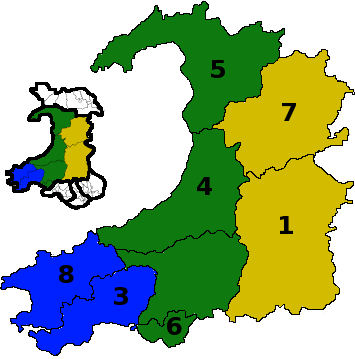
Mid and West Wales


Constituencies
 
1   Brecon & Radnor
2   Carmarthen East & Dinefwr
3   Carmarthen West & SP
4   Ceredigion
5   Dwyfor Meirionnydd
6   Llanelli
7   Montgomery
8   Preseli Pembrokeshire
 
Regional seats
 
1   Labour
2   Labour
3   Conservative
4   Plaid Cymru
 

This was the only region in Wales where Labour failed to win a constituency seat. However they did get 18.4% of the regional vote which entitled them to two regional seats. They were very close to winning a third, but Plaid Cymru just beat them to it.
 

The Constituency Vote

It's probably easiest to start with the LibDems. They won two seats—Brecon and Radnor, and Montgomery—and got a creditable 36.1% in Ceredigion, coming second to Plaid.

I think they are likely to hold Brecon and Radnor not least because of Kirsty Williams, who has proved to be a relatively good leader of her party. She's feisty, and she can sometimes lay a verbal glove on minsters in the Labour-Plaid One Wales government ... although maybe only one time in ten. If that is what an opposition leader is for, she probably makes a better job of it than the Tories. I'm not sure that her party has anything very positive to offer as an alternative, though.

What will see her through is that her margin of victory last time was 52.3% to the Tories' 33.5% ... with both Labour and Plaid down in single figures. This margin is simply too big to be eroded away completely, especially because the only party that has a chance of taking the seat from her is the Tories. No LibDem—no matter how angry they might be about what their party is doing in Westminster—will switch to the Tories because of it.

-

Things are slightly different in Montgomery. Although this seat was won by Mick Bates by a margin of 39.0% to 30.2% over the Tories, he was obliged to leave the LibDems as a result of his conviction for assault and some commentators might consider this to be an independent rather than a LibDem seat as a result.

The LibDems lost this seat at Westminster level in May last year, but there were some unusual factors. We had the strange and rather ridiculous antics of Lembit Öpik, who made the mistake of thinking that any personal publicity, no matter how inappropriate, was a way of promoting politics. And he was up against the popular Glyn Davies who, because of his conversion to devolution and clearly expressed commitment to a Senedd with primary lawmaking powers, is someone I would call a decent Tory.

This result will be crucial to the overall distribution of seats in this region and the Assembly as a whole. It is highly unlikely that the LibDems will get 13% of the regional vote, and as such they would only be entitled to one of the twelve seats on a proportional basis. If the LibDems lose Montgomery, they will not get a regional seat to make up for it. If they win, they will effectively take away a regional seat from one of the other parties. Because of this, people who do not support the LibDems need to vote tactically. It will be close, but the bookies are showing Russell George, the Tory candidate, slightly ahead.

Of course voting for a Tory is something most people in Wales would only do after a full frontal lobotomy. So I need to explain that the Tories will not gain anything in overall terms if they win this seat. They will simply get one less regional seat and end up with the same number as they would get based on their share of the regional vote. I'll explain how it works in more detail later in this post.

-

In Ceredigion the LibDems might feel they have a chance, largely because Mark Williams held the seat comfortably in 2010, by a margin that came as a shock to most people in Plaid. But there are factors that would explain this, and the most important of these is incumbency.

As a particular type of MP, Mark Williams is second to none. He makes himself known all over the constituency, picking up every complaint and promising to deal with it. He faithfully writes the letters or asks the questions, then reports back able to say that he did his best for them. Of course nothing he says or does could actually have made one scrap of difference, because the LibDems did not have the power to change anything. Nor could he ever be criticized for voting one way or the other, because whichever way he voted would make no difference to the result. That is the luxury of being neither in the government nor in the opposition. But who has ever heard of Elizabeth Evans?

The incumbency factor also works for Plaid Cymru's Elin Jones, but in a different way. She is a minister in the One Wales government, and probably the only AM that could successfully deliver on agriculture and rural affairs ... simply because nobody in Labour has got the first clue about it. She has done that job particularly well. I actually think the biggest danger in Ceredigion comes from Plaid not being forthright on its policies, particularly with regard to green issues. Our failure to explicitly state in our manifesto that we are against nuclear power is likely to cost us votes from those who do care passionately about the environment. The LibDems have done this, and this might sway a good number of voters to them.

It is a ridiculous situation for Plaid to find itself in because our opposition to nuclear would come across clearly if it were not for Ieuan Wyn Jones. He seems to have calculated that he stands more chance of winning votes in Ynys Môn by supporting nuclear power there, but opposing it everywhere else. Even at a pragmatic level he is being much too defensive, for his seat is safer than he thinks and much safer than Ceredigion. The margin in Ynys Môn is 22.3%, in Ceredigion it is 13.1%. But on the level of principle, I would go so far as to say that his equivocation on matters like this might well be primarily responsible for our lack-lustre showing in the opinion polls. A leader at odds with his party will constantly be forced onto the back foot. We need to be sending clear messages rather than mixed messages.

Even so, I don't think this will be enough to see Elin lose her seat. But it will make it much closer than it otherwise would be, and will also have a generally negative effect elsewhere in Wales that could make all the difference between Plaid winning and losing regional seats.

-

Dwyfor Meirionnydd and Carmarthern East and Dinefor are and will remain rock solid Plaid seats. The fourth constituency Plaid hold is Llanelli. Helen Mary Jones won this with 50.1% of the vote, comfortably ahead of Labour with 36.1%. That's a large margin and the seat should be safe for Plaid, even though it will be a lot tighter than before. However even if Plaid were to lose the seat, it would probably make no difference to the overall result because we would gain a regional seat to make up for it, and Labour would simply win one regional seat less. Again, I'll explain how that works in more detail later.

-

This leaves two other constituencies currently held by the Tories. In 2007 the Tories won Preseli Pembrokeshire with 38.6% of the vote, with Labour and Plaid not too far behind on 27.4% and 24.7% of the vote respectively. This time round, it should be a battle between the Tories and Labour. Will the Tory vote hold up, or will the general surge to Labour overtake it? The bookies favour Labour and I'd probably go along with that, but I do have a suspicion that the Tories might hold on. Yet whichever way it goes won't make any difference to the overall number of seats each party will win.

In 2007 Carmarthen West and South Pembrokeshire was a very tight contest in which fewer than 300 votes separated the three main parties. The Tories won it with 30.1% of the vote, with Labour on 29.7% and Plaid on 29.2%. In better times, this is a seat that Plaid should expect to win if we ever hope to make a breakthrough in Welsh politics; and I'm sure it was for this reason that Nerys Evans chose to fight this seat now rather than stay on the regional list. Although it must be said that Plaid would have very little hope of winning a list seat if it won five constituency seats, so in that respect she made the right choice.

But it doesn't look like she will win. If Llanelli is going to be tight when Plaid are defending a margin of 14%, I don't think there is any realistic chance of Plaid overtaking Labour in Carmathen West, despite all of Nerys' qualities. This seat will be a battle between Labour and the Tories. I think Labour will win but, in just the same way as in Presceli, the outcome won't make any difference to the overall number of seats either Labour or the Tories will win in the region.

So let's now look at the regional vote to see why.


The Regional Vote

These are the details of the regional vote in 2007. Seats are determined by the percentage of the vote on the second ballot paper, but seats already won at constituency level are taken into account. After a seat has been won, the percentage necessary to win another seat is the original percentage divided by two, then three, then four, etc.

Plaid Cymru ... 31.0%
Conservative ... 22.9%
Labour ... 18.4%
LibDem ... 13.3%

Round 1 ... Plaid Cymru 31.0% ... already won
Round 2 ... Conservative 22.9% ... already won
Round 3 ... Labour 18.4% ... regional seat 1
Round 4 ... Plaid Cymru 15.5% ... already won
Round 5 ... LibDem 13.3% ... already won
Round 6 ... Conservative 11.5% ... already won
Round 7 ... Plaid Cymru 10.3% ... already won
Round 8 ... Labour 9.2% ... regional seat 2
Round 9 ... Plaid Cymru 7.8% ... already won
Round 10 ... Conservative 7.6% ... regional seat 3
Round 11 ... LibDem 6.7% ... already won
Round 12 ... Plaid Cymru 6.2% ... regional seat 4

This time round, the two things we can say with relative certainty are that Labour will increase their share of the vote and will probably come top; and that the LibDems will lose votes. I reckon Plaid will still beat the Tories. As it happens, this is also what the latest YouGov poll suggests. So I'm content to use their figures to project the likely result even though I think YouGov's polling methods tend to over-estimate Labour's share of the vote:

Labour ... 29.0%
Plaid Cymru ... 27.0%
Conservative ... 25.0%
LibDem ... 8.0%

Round 1 ... Labour 29.0%
Round 2 ... Plaid Cymru 27.0%
Round 3 ... Conservative 25.0%
Round 4 ... Labour 14.5%
Round 5 ... Plaid Cymru 13.5%
Round 6 ... Conservative 12.5%
Round 7 ... Labour 9.7%
Round 8 ... Plaid Cymru 9.0%
Round 9 ... Conservative 8.3%
Round 10 ... LibDem 8.0%
Round 11 ... Labour 7.3%
Round 12 ... Plaid Cymru 6.8%

The first thing to note is that it will be impossible for the LibDems to win more than one seat in this region on a proportional basis. Even if they managed to get 13% of the regional vote—which is highly unlikely with the polls showing them at only 8%—they would still only get one seat.

But the additional member electoral system has an inbuilt bias towards constituencies, because these are taken into account first. So if the LibDems win both Brecon and Radnor and Montgomery, they will end up with one more seat than they would otherwise be entitled to, and this will effectively take away a regional seat from one of the other parties. That's why it's important for supporters of other parties to vote tactically for the Tory candidate if they live in Montgomery, but then use their regional vote for their first choice party.

If the LibDems win two seats at constituency level, it means only ten seats are available for the other parties. But if we can hold them to one, it means that eleven seats are available.

-

None of the three main parties is likely to win more constituency seats than they would be entitled to based on the regional vote. So it is the regional vote that will determine the overall number of seats they win, irrespective of the results in any individual constituency. Because of this, voting tactically for the Tory candidate if you live in Montgomery will not give an overall advantage to the Tories ... for they will still win the three seats they are entitled to from their share of the list vote, and are very unlikely to win a fourth seat.

The Tories will get three seats and only three seats. Even in the all but impossible event of them holding Preseli and Carmarthen West, and winning Montgomery from the LibDems, they will still get three seats overall. But it is much more likely that they will win just one constituency, but then get two of the regional seats.

Labour look likely to get four seats overall. As I've said, I think they will win both Carmarthen West and Presceli, but not win Llanelli. If I'm right, that will mean that they win two constituency and two list seats. But if I'm wrong and they do win Llanelli, they'll simply get one less regional seat, making no difference to the overall result.

Finally for Plaid, we will definitely win Dwyfor Meirionydd, Carmarthen East and Ceredigion, and I think we'll just hold on in Llanelli. But even if we lose Llanelli, we will probably get the fourth regional seat anyway ... providing we get more regional votes than the Tories and more than four times the vote of any of the minor parties. Either the Greens or UKIP would need to get somewhere around 7% to take it from us.


The Prediction

The overall result hinges on two key constituency battles: whether the Tories can win Montgomery from the LibDems and, although to a much lesser extent, whether Plaid hold Llanelli. Both will be tight, but this is how I think things will work out:

•  Labour will win both Preseli Pembrokeshire and Carmarthen West and South Pembrokeshire from the Tories, but will fail to take Llanelli from Plaid. They will win two regional seats if they lose Llanelli, but only one if they were to win it. Either way, Labour will get four seats in total.

•  Plaid Cymru will hold each of the constituencies they won in 2007: Dwyfor Meirionnydd, Carmarthen East and Dinefwr, Ceredigion and Llanelli. But if Plaid were to lose Llanelli we would win a regional seat instead. Either way, Plaid will get four seats in total.

•  The Tories will win Montgomeryshire from the LibDems, but will lose the two constituencies they currently hold. They will win two regional seats, giving them three seats in total.

•  The LibDems will hold Brecon and Radnorshire but lose Montgomeryshire to the Tories. They will not win a regional seat, leaving them with only one seat in total.

Bookmark and Share

Analysis ... North Wales

The three electoral regions in south Wales: South Wales West, South Wales Central and South Wales East, are characterized by heavy support for Labour with only a small handful of seats that could be won by other parties. As a consequence of this it is virtually impossible for Labour to win any additional seats in the three south Wales regions, and all those who vote for Labour on the regional ballot paper are in effect wasting their vote.

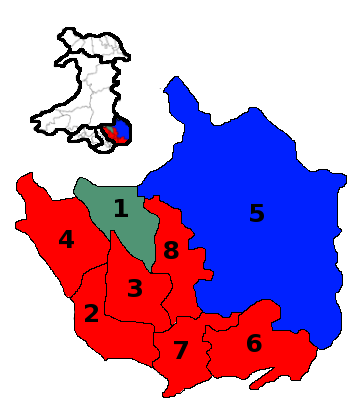
But elsewhere in Wales the constituency map is not predominantly red, and this means a different set of factors come into play. This is how things worked out in the North Wales region in 2007:

    
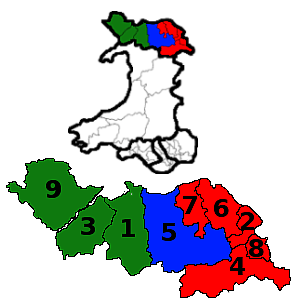
North Wales


Constituencies
 
1   Aberconwy
2   Alyn & Deeside
3   Arfon
4   Clwyd South
5   Clwyd West
6   Delyn
7   Vale of Clwyd
8   Wrecsam
9   Ynys Môn
 
Regional seats
 
1   Conservative
2   Conservative
3   LibDem
4   Plaid Cymru
 

Labour are strong only in the north east, where they won five constituency seats. The Tories generally ran them close, but only succeeded in winning Clwyd West. Plaid Cymru are strong in the north west, winning all three seats. The LibDems are no more than also-rans, with their greatest pocket of support around Wrecsam ... but even there they only got 16.7% of the constituency vote.

The regional vote was remarkable in that Labour, Plaid Cymru and the Tories each got virtually the same share, with 27.9%, 27.2% and 27.0% respectively. The LibDems managed only 8.2%.

Yet in total Labour ended up with 5 seats, Plaid with 4, the Tories with 3, and the LibDems with 1. This is a very good illustration of why having only 4 regional seats out of a total of 13 is not enough to compensate for the inherent unfairness of the first-past-the-post voting system used for the constituencies. Under a fairer system, each of the three main parties would have won 4 seats in total.


The Constituency Vote

It's probably easiest to start with the five seats Labour already hold. In each of these the Tories came second, and the results were sometimes very close:

•  In the Vale of Clwyd, Labour got 36.4% and the Tories 36.0%
•  In Delyn, Labour got 34.6% and the Tories 32.3%
•  In Clwyd South, Labour got 35.1% and the Tories 29.3%
•  In Wrecsam, Labour got 28.8% and the Tories 17.2%
•  In Alyn and Deeside, Labour got 38.9% and the Tories 22.9%

Yet even in the Westminster election last year, where there was a general swing away from Labour to the Tories, all these seats remained Labour. It is therefore very hard to see Labour losing them now, especially with the general swing to Labour shown in the polls.

However this doesn't mean that there's nothing for the other parties to fight for. The main job of all the candidates in these constituencies will be to increase their party's share of the regional vote, for even though we might urge people to use their two votes in different ways according to where they live, it is much simpler to campaign by urging people to vote the same way twice. That's what most voters do anyway. So a good showing at constituency level might not affect the constituency result, but it will most definitely affect the regional result ... as I hope will become clear later.

-

In the north west, there is no real doubt that both Arfon and Ynys Môn will be held comfortably by Plaid Cymru.

-

But this leaves to seats which are best described as three-way marginals. These were the results in 2007:

Clwyd West

Conservative ... 34.0%
Labour ... 27.9%
Plaid Cymru ... 27.3%
LibDem ... 6.5%

Aberconwy

Plaid Cymru ... 38.6%
Conservative ... 30.4%
Labour ... 21.8%
LibDem ... 9.3%

In Clwyd West, the question is whether the general upswing in the Labour vote will be greater than the Tories' ability to hold on to their share of the vote. I don't think Plaid stand much chance. I'm inclined to say that Labour will edge this seat; but if they do win it, the Tories will not lose out in overall terms. They will pick up a regional seat to replace it.

Aberconwy is a more difficult seat to predict, not least following the result in the Westminster election last May, when the Tories won the seat with 35.8% of the vote, with Labour second and Plaid in fourth place behind the LibDems. I think it's fair to say that people in Plaid are still trying to figure out what happened, because it wasn't what anyone on the ground was predicting ... or at least admitting to. There was a real sense of having been misled, although my view is that there was no deliberate intention of doing so; it was more a case of allowing ourselves to believe the hype.

But Assembly elections are very different, so there's no reason why Plaid should not get back above 30%, and the Tories should also be in the middle-to-low 30% region, which will make this seat a close contest between Plaid and the Tories. I actually think the Tories will edge it; but if they do they will lose a regional seat and Plaid will gain one.

This leaves us in the position that the actual result in both these seats becomes irrelevant to the overall regional performance of the parties. This has two practical consequences: first, that the regional vote matters much more than the constituency vote; and second, that no tactical voting in the constituencies is necessary, for it will make no difference to the overall result.


The Regional Vote

These are the details of the regional vote in 2007. Seats are determined by the percentage of the vote on the second ballot paper, but seats already won at constituency level are taken into account. After a seat has been won, the percentage necessary to win another seat is the original percentage divided by two, then three, then four, etc.

Labour ... 27.9%
Plaid Cymru ... 27.2%
Conservative ... 27.0%
LibDem ... 8.2%
UKIP ... 4.3%

Round 1 ... Labour 27.9% ... already won
Round 2 ... Plaid Cymru 27.2% ... already won
Round 3 ... Conservative 27.0% ... already won
Round 4 ... Labour 13.9% ... already won
Round 5 ... Plaid Cymru 13.6% ... already won
Round 6 ... Conservative 13.5% ... regional seat 1
Round 7 ... Labour 9.3% ... already won
Round 8 ... Plaid Cymru 9.1% ... already won
Round 9 ... Conservative 9.0% ... regional seat 2
Round 10 ... LibDem 8.2% ... regional seat 3
Round 11 ... Labour 7.0% ... already won
Round 12 ... Plaid Cymru 6.8% ... regional seat 4

I think that Labour's vote will go up, and that both Plaid's and the Tories' share of the vote will go down. But I think that North Wales is one region where the LibDem vote is likely to completely collapse, because it has no cores of strong support that could be relied on to hold it up.

So I think the overall share of the vote will be something like:

Labour ... 38.0%
Plaid Cymru ... 25.0%
Conservative ... 22.0%
LibDem ... 6.0%
UKIP ... 5.0%

Which would result in this distribution of seats:

Round 1 ... Labour 38.0%
Round 2 ... Plaid Cymru 25.0%
Round 3 ... Conservative 22.0%
Round 4 ... Labour 19.0%
Round 5 ... Labour 12.7%
Round 6 ... Plaid Cymru 12.5%
Round 7 ... Conservative 11.0%
Round 8 ... Labour 9.5%
Round 9 ... Plaid Cymru 8.3%
Round 10 ... Labour 7.6%
Round 11 ... Conservative 7.3%
Round 12 ... Labour 6.3%
Round 13 ... Plaid Cymru 6.3%

As I said above, I think Labour are certain to win in five constituencies and Plaid Cymru certain to win in two. But these are are less than the number of seats they are entitled to according to my prediction of their share of the vote on the regional list. This means that the additional member system will be able to deliver a broadly proportional result in a way that it is not able to do in the three south Wales regions.

The only way a disproportionate result could be achieved is if Labour win in both Clwyd West and Aberconwy. For there would then not be enough regional seats available to restore proportionality. However I think it is very unlikely that Labour will win in both constituencies.

But Labour are very likely to win six seats in total, either by gaining one constituency seat (probably Clwyd West) or by picking up a regional seat if they fail to do so.

-

The Tories will win three seats in total no matter whether they win or lose individual seats at constituency level. If they hold Clwyd West and win Aberconwy they will get one regional seat. If they lose Clwyd West but gain Aberconwy they will get two regional seats. If they hold Clwyd West and fail to win Aberconwy they will get two regional seats. If they don't win either, they will get three regional seats.

-

Plaid Cymru are certain to hold Arfon and Ynys Môn. It doesn't particularly matter whether we win or lose Aberconwy, because we will get at least one regional seat to make up for it at about the 8.3% level. But provided that Labour do not win Clwyd West and Aberconwy (which is unlikely) there will still be one more regional seat available.

This seat should go to Plaid, provided that we get more of the regional vote than the Tories and more than four times the vote of either the LibDems or UKIP. This is where percentages become critical. If Plaid get 25% of the regional vote, it means that both UKIP and the LibDems must get no more than 6.25% of the vote.

I doubt very much whether UKIP will reach that figure, because people with views on the right of the political spectrum will vote Tory. But I also think that the LibDems are unlikely to reach that figure because they have no strong pockets of support in the region. For that reason I think Plaid will get the final regional seat.


The Prediction

North Wales is an unusual region because Labour, Plaid Cymru and the Tories each have substantial support, even though it is unevenly distributed. It means that the additional member system can work effectively to produce an outcome that is broadly proportional to the percentage of the regional vote as a whole. However this makes the results in the two marginal constituencies—Aberconwy and Clwyd West—less important than they might otherwise be ... except of course to the individual candidates concerned.

I'm fairly confident that Labour will win six seats in total, the Tories will win three, and Plaid will win at least three. That leaves one seat to be decided, and I think it will be won by Plaid. However this overall outcome can be achieved in several different ways, and I'm less certain about the individual results. But I should put myself on the spot, and this is how I think things will work out:

•  The Tories will lose Clwyd West but win Aberconwy. They will get two regional seats, giving them three seats in total.

•  Labour will retain control in the five constituencies they already hold—Alyn and Deeside, Delyn, the Vale of Clwyd, Clwyd South and Wrecsam—and will win Clwyd West. They will not win a regional seat, but will get six seats in total.

•  Plaid will hold Arfon and Ynys Môn. We will lose Aberconwy to the Tories, but win two regional seats ... making four seats in total.

Bookmark and Share

Beermats

If any of you are going out for a well-earned drink tonight, these special election beermats might well come in handy:


Bookmark and Share

The Distorting Mirror

I was amused by this short paragraph in today's Western Mail:

Last year’s poor showing for Wales in the Pisa (Programme for International Student Assessment) tables on literacy and numeracy led to Education Minister Leighton Andrews calling for major improvements in school standards.

Western Mail, 29 April 2011

We have to admire that brave Mr Andrews, calling for major improvements in school standards when nobody else in Wales was at all concerned about what the PISA results had shown.


Meanwhile back in the real world, rather than a distorted mirror image of it, pretty much everyone in Wales was concerned about our poor showing in the PISA tables ... and in fact, most of them were calling for Leighton Andrews to do something about it.

Yes, I know that's completely unreasonable. Why should it have anything to do with the Minister for Education? When under pressure, start pointing the finger of blame at everyone but yourself. Anybody would think there was an election on.

Bookmark and Share

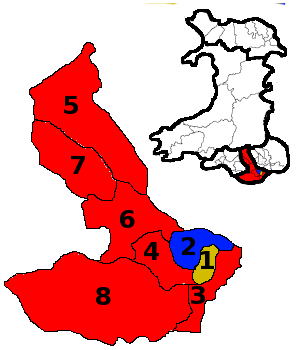
Analysis ... South Wales East

This is the third in my series of analyses for the five electoral regions of Wales, following South Wales West and South Wales Central. In 2007 the result was:

    
South Wales East


Constituencies
 
1   Blaenau Gwent
2   Caerffili
3   Islwyn
4   Merthyr Tudful & Rhymni
5   Monmouthshire
6   Newport East
7   Newport West
8   Torfaen
 
Regional seats
 
1   Plaid Cymru
2   LibDem
3   Conservative
4   Plaid Cymru
 

The eight constituency seats were all held by Labour with the exception of Tory Monmouthshire and Blaenau Gwent, held by Trish Law as an independent affiliated to Peoples Voice. Two of the regional seats were won by Plaid, although one of these was lost to the Tories when Mohammad Asghar defected in 2009. Of the other two regional seats, one was won by the LibDems and one by the Tories.
 

The Constituency Vote

Monmouthshire is, and is certain to remain, rock solid Tory.

In Blaenau Gwent Trish Law is standing down, and even though Jayne Sullivan is standing as an independent with her backing, Blaenau Gwent seems certain to revert to Labour. Alun Davies ran a typically vicious personal campaign when first selected for the seat, but after Trish Law announced she was standing down he realized he no longer needed to.

The two Newport seats were not entirely comfortable wins for Labour. In Newport West the Tories ran them close with 34.6% of the vote to Labour's 40.5%, and in Newport East the LibDems got 27.6% to Labour's 32.0%. But because of the current ConDem coalition in Westminster, the share of the vote for each of these two parties is likely to go down, meaning that Labour should hold both without too much trouble.

The three remaining seats were all marked by strong showings from independents, but won by Labour. Merthyr Tudful and Rhymni had a total of five independents who between them collected 30.3% of the vote. It's a perfect illustration of why we would be better off with AV, because these candidates split the vote and allowed Labour an easy win. In Islwyn Plaid got a strong 21.6% of the vote, and because no independent is standing this time round our share of the vote should go up, but it still won't be enough to beat Labour.

-

The really interesting seat in this region is Caerffili. Plaid got 25.8% of the vote behind Labour's 34.6%, a margin that in itself would make this seat one of Plaid's main targets; but because the person who was standing as an independent is now Plaid's candidate, it has become a seat that Plaid should expect to win.

Ron Davies got 22.2% of the vote as an independent, and adding the two percentages together gives 48.0% ... which would beat Labour comfortably. But is it reasonable to add them together? My answer is yes. Plaid's core vote last time is going to remain largely intact, though subject to the same swings common to the rest of the country, of course. The question is whether Ron's own personal vote will stay with him. Fairly obviously those who turned against him because he was no longer in the Labour party had already done so in 2007, which indicates that they are more impressed with his personal qualities than his political affiliation. These people will not switch back to Labour. So it is only those who would rule out voting Plaid in any circumstances that will turn away from him now. Some of his 22.2% may feel that way, but it certainly won't be half.

So I think Ron Davies will make it, though it will be tighter than it otherwise would be simply because Labour are riding high in the national polls. It will be good to see him back, for the Assembly does not have that many heavyweights.


The Regional Vote

These are the details of the regional vote in 2007. Seats are determined by the percentage of the vote on the second ballot paper, but seats already won at constituency level are taken into account. After a seat has been won, the percentage necessary to win another seat is the original percentage divided by two, then three, then four, etc.

Labour ... 38.4%
Conservative ... 21.4%
Plaid Cymru ... 14.6%
LibDem ... 11.8%
UKIP ... 4.9%

Round  1 ... Labour 38.4% ... already won
Round  2 ... Conservative 21.4% ... already won
Round  3 ... Labour 19.2% ... already won
Round  4 ... Plaid Cymru 14.6% ... regional seat 1
Round  5 ... Labour 12.8% ... already won
Round  6 ... LibDem ... 11.8% ... regional seat 2
Round  7 ... Conservative 10.7% ... regional seat 3
Round  8 ... Labour 9.6% ... already won
Round  9 ... Labour 7.7% ... already won
Round 10 ... Plaid Cymru 7.3% ... regional seat 4

This time around, the regional vote is going to be enormously hard to predict. Having spent many an hour looking at the spreadsheets, it looks like the final regional seats will be decided on very small percentage differences at around 6.5%.

What we can say with relative confidence is that the LibDems will get one, but only one, regional seat. It actually doesn't matter too much what their percentage share of the vote will be, because it can't possibly be more than 12% and won't be less than about 7% ... and anywhere in that range will get them one seat. Newport East and to a lesser extent Merthyr have a good core level of LibDem support which will stop them falling too far.

A few months ago I had thought that Plaid would at least break even, either holding our two regional seats or winning Caerffili and holding one regional seat. I'm not so sure about that now, but we are able to win a total of two seats in two different ways.

If Plaid win Caerffili, then either of these two things needs to happen to get one regional seat:

•  to get more than twice the regional vote of UKIP
•  to get more than two-thirds of the regional vote of the Tories

But if we lose Caerffili, both of them need to happen to get two regional seats.

We could scrape it if we get about 13% of the vote. This would be down on our 2007 showing of 14.6%, but not disastrously so. We have solid core support in Caerffili and Islwyn, and this should help to keep any fall lower than it would otherwise be.

UKIP are an unknown quantity, and I've never been convinced that those who want to get rid of the Assembly will ever be motivated to get out and vote in Assembly elections. They might say they'll vote UKIP at home on the phone or sitting in front of their computers, but I think they will stay there on polling day. What's the point of voting to get rid of something that all five electoral regions of Wales have just voted to enhance by an overwhelming margin? So although the latest poll puts them at about 8%, I'd expect them to get more like 6.5%.

There's no doubt that the Tories will be down on their 21.4% showing in 2007, but the question is by how much. I think it will be less than the polls suggest because of their core support in Monmouthshire and Newport West. This might also be bolstered by people who would not normally vote in an Assembly election, but who vote Tory in Westminster elections, turning out to vote No in the AV referendum. My guess is that the Tories will get about 19%.

-

Now if these share of the vote predictions for Plaid, UKIP and the Tories are right, it means that there will be a very tight three-way battle for the third and fourth regional seats if Ron Davies wins in Caerffili, or for the fourth regional seat if he doesn't. Although the actual percentages are different, they each boil down to a figure of around 6.5% when divided to take account of the seats already won:

Half of Plaid's 13% ... vs ... all of UKIP's 6.5% ... vs ... a third of the Tories' 19%

One thing is obvious: Plaid's chances of getting two seats in total will be better if we win Caerffili. However this is not just because of the extra seat that will be available. The beauty of the situation is that it will be a fight between one party on the left and two parties on the right, so people with views on the right of the political spectrum will have to choose between the Tories and UKIP. Therefore if we win Caerffili, it wouldn't matter if one of the two does better than Plaid; for what one right wing party gains, the other right wing party will lose ... and that will leave Plaid with, at worst, the fourth regional seat.

Given a choice between them, I hope UKIP wins. A UKIP AM continually sniping against the Assembly will tend to make the three other unionist parties more united in favour of further devolution for Wales. And from Plaid's point of view, we hardly want the Tories to become the second largest group in the Assembly at our expense.

However if we don't win Caerffili, we will easily win the first regional seat with 13% of the vote, but this will mean that there is one less seat to fight over at the 6.5% level. Plaid would only then get the final regional seat by getting more than twice UKIP's vote and more than two thirds of the Tories' vote. So Plaid need to fight hard, for if we win Caerffili it is possible for Jocelyn Davies to lose her seat. She has shown herself to be a competent and determined deputy minister, and it would be a great shame to lose her.


The Prediction

If I were more cautious, I wouldn't dream of predicting the overall result in South Wales East. But seats are not won by being cautious, so this is my prediction:

•  Ron Davies will win Caerffili for Plaid; the Tories will win in Monmouthshire; and the six other constituency seats will be won by Labour.

•  The LibDems and Tories will win the first two regional seats, and it doesn't matter which way round. The two remaining regional seats will be won by Plaid and UKIP.

Bookmark and Share

Looking Back at Blaenau Gwent

Rather like watching a documentary on dinosaurs, two lumbering beasts clashed horns. One was the Labour Party, moribund from years of being unchallenged at a local level. The other was the Labour Party, shorn of all the values and ideals that made it what it was, with a bright shiny new leader determined to remould it to reflect the moral values of the new age ... or in other words, Thatcherism.

In most places the fight was over before it had begun. Labour's new values prevailed; for in order to become electable, the Labour Party had no choice but to adopt the values of middle England, and Labour MPs either changed their values to suit or were replaced by candidates with those new values. But in some remote valleys where Labour votes were weighed rather than counted, the hierarchy of the old beasts still held sway. Peter Law would not stand aside in favour of a candidate parachuted in from middle England. He stood as an independent, won, and Peoples Voice was born.

In terms of policies and ideas, People's Voice didn't have many. Those who were elected—Peter and then Trish Law, and Dai Davies—were probably just "more Labour than Labour" and were elected more for their hearts being in the right place than for having any distinctive policy platform. For me, the one good idea that stood out was a proposal to make public transport free ... it was lifted from the Scottish Socialist Party, but no less good an idea for that.

-

Meanwhile the bright shiny Labour Party simply carried on regardless; even though the shiny bits got tarnished and rusty, some bits fell off and had to be replaced, and the well oiled machine ended up looking like a collection of spare parts with only a trace of anything human remaining. How could one AM or one MP hold out for long? They didn't, and on Thursday next week the assimilation of Blaenau Gwent into the collective will finally be complete. Resistance was futile.


Apparently Labour are going to change things in Blaenau Gwent so that any future displays of independent thinking will be crushed before they get a chance to develop. They've started with the name; it is now going to be known as the Blaenau Organized Regime, Gwent. They strongly deny that the BORG will become one of the greatest threats mankind will ever face.

Bookmark and Share

Analysis ... South Wales Central

Following my analysis of the constituency and regional seats in South Wales West a few weeks ago, here is my long overdue analysis for South Wales Central.

    
South Wales Central


Constituencies
 
1   Cardiff Central
2   Cardiff North
3   Cardiff South & Penarth
4   Cardiff West
5   Cynon Valley
6   Pontypridd
7   Rhondda
8   Vale of Glamorgan
 
Regional seats
 
1   Plaid Cymru
2   Conservative
3   Plaid Cymru
4   Conservative
 

Six out of the eight constituency seats are currently held by Labour, but the LibDems hold Cardiff Central and the Tories hold Cardiff North. Plaid Cymru and the Tories each have two regional seats.
 

The Constituency Vote

It is very hard to see Labour losing any of the seats they hold. But strange things have happened in politics before, and some strange things are happening at the moment in Pontypridd. In the 2007 election Labour got 41.8% of the vote with the LibDems in second place with 27.6%.

Given the general fall in the popularity of the LibDems as a result of them being in coalition with the Tories in Westminster, you'd expect Labour to feel safe; but they are clearly rattled by the tactics of the LibDem candidate, who they are accusing of harassment. One thing we should know from previous elections is that the LibDems are not above, what shall we say, "robust" local techniques. But having complained six times before and had each one dismissed, to do it again does appear to be an over-reaction. It's very unlikely, but Labour might just succeed in throwing this seat away.

Plaid Cymru did relatively well in Rhondda and Cynon Valley last time with 30.1% and 27.9% of the vote. But in both seats Labour were comfortably in the upper 50s and should therefore be safe.

-

The two interesting seats are Cardiff Central and Cardiff North. In 2007 Cardiff Central was won by the LibDem's Jenny Randerson with 51.8% of the vote, way ahead of Labour with 21.9%. She is not standing this time, and the LibDem candidate is Nigel Howells. The two factors against him are that he is less well known (though he is a Councillor) and the general drop in support for the LibDems. The two factors in his favour are the previous margin of victory and the fact that the LibDems can fight very intense and effective local campaigns even when their national showing is poor.

In reality the result actually matters much more to Labour than it does to the LibDems. For Labour, their only chance of winning a majority in the Assembly is to win more constituency seats. They cannot win any list seats in any of the three south Wales regions. But if the LibDems lose this seat, they do stand a chance—though no more than a chance—of picking up a regional seat instead.

This means that those who don't want to see Labour win a majority are going to have to vote tactically for the LibDem candidate, even if it means holding your nose as you do it. This is especially true for those who would normally vote for Plaid, the Greens or the Tories. If the LibDems win this constituency, it means that they will win one fewer regional seat than they could otherwise win ... and that seat will then go to either Plaid, the Tories or the Greens. It is a no-brainer. If you live in Cardiff Central and would normally vote Plaid, Green or Tory, you would be mad not to vote LibDem for the constituency, and then for your preferred party in the regional vote.

-

The scenario is almost exactly the same in Cardiff North, though not quite. Jonathan Morgan won this seat for the Tories in 2007 with 45.3% of the vote, with Labour second on 30.9%. That margin would be safe enough in most circumstances. Factors in Labour's favour are that it is a smaller margin to overcome than in Cardiff Central and the relatively high profile of Julie Morgan, who used to be the MP for this seat until she lost it to the Tories this time last year.

Factors against Labour are that Julie Morgan will be 67 years old this year, and with this term set to last for five years rather than the normal four, some might well ask why she has not taken the opportunity to join husband Rhodri in a happy retirement. The answer is probably that only someone with her profile could hope to beat Jonathan Morgan. Yet it does beg the question of how short people's memories are. Can people in Cardiff North really have forgotten why Gordon Brown's party was voted out of office in Westminster? And do people really think that the cuts in our block grant now would have been at all different if Labour were still in power? Labour are blaming the Tories for what they would have had to do anyway.

The consequences for the regional vote are slightly different in this seat. The Tories currently hold two regional seats as well as this constituency seat. If they lose Cardiff North it is all but impossible for them to win a third regional seat to make up for it. If you're a Tory, this makes it all the more important that you hold onto this seat, and the Tories are and will be putting a lot of their energy and resources into keeping it.

Yet the result will also matter for Plaid, the LibDems and the Greens; for although the Tories will not gain a regional seat if they lose this constituency, there is a very real chance that they will still lose a regional seat even if they hold it. But if they lose Cardiff North, then they will almost certainly hold on to their two regional seats. This means that it is absolutely vital for supporters of these parties who live in Cardiff North to vote Tory; for doing so actually increases Plaid's chance of holding on to our two seats, and increases the possibility of the LibDems or the Greens winning one.

I certainly don't underestimate how hard it will be for people who hate the Tories (or at least strongly dislike their policies) to vote Tory. But it's going to be a tight contest, with the bookies currently showing Labour slightly ahead; so we need to make it clear that voting tactically for the Tories will help the chances of your first choice party. Doing it will feel like a betrayal of all your principles, but it really is the best way of both helping your own party and of preventing Labour from getting an overall majority.


The Regional Vote

Now let's turn to look at the way the regional vote works in more detail. Seats are determined by the percentage of the vote on the second ballot paper, but seats already won at constituency level are taken into account. After a seat has been won, the percentage necessary to win another seat is the original percentage divided by two, then three, then four, etc. This is how things worked out in 2007:

Labour ... 36.7%
Conservative ... 23.4%
Plaid Cymru ... 16.7%
LibDem ... 15.7%

Round 1 ... Labour 36.7% ... already won
Round 2 ... Conservative 23.4% ... already won
Round 3 ... Labour 18.3% ... already won
Round 4 ... Plaid Cymru 16.7% ... regional seat 1
Round 5 ... LibDem ... 15.7% ... already won
Round 6 ... Labour 12.2% ... already won
Round 7 ... Conservative 11.7% ... regional seat 2
Round 8 ... Labour 9.2% ... already won
Round 9 ... Plaid Cymru 8.3% ... regional seat 3
Round 10 ... Conservative 7.8% ... regional seat 4

The most important point to note is that Labour, because of the seats already won at constituency level, have absolutely no chance of winning a regional seat. Even if Labour were to lose Pontypridd this time round and fail to win both Cardiff Central and Cardiff North, they would still have no chance whatsoever of winning a regional seat. This means that a regional vote for Labour is a completely wasted vote. Labour supporters should instead vote for the party they rate second after Labour.

For Plaid supporters in South Wales Central, it is the regional vote and only the regional vote that matters. This may sound obvious, but people would be surprised at how many voters vote for their first choice party at constituency level, but think that they should give their regional vote to a second choice party. Labour supporters should do this in all three of the south Wales regions, but not Plaid supporters.

-

Predicting the results this time round will depend on the percentages each party gets and whether they have won a constituency seat. Much as I hate to say this, the order is probably going to be Labour (because most of their supporters won't realize that they are wasting their vote, and Labour certainly won't tell them that they are) followed by Plaid and the Tories neck-and-neck, the LibDems, and then the Greens and UKIP neck-and-neck.

With that order, and excluding the Labour vote because it is irrelevant, Plaid will hold onto their two regional seats if any of these things happen:

•  They get more of the vote than the Tories
•  They come second to the Tories, but the Tories hold Cardiff North
•  They come second to the Tories and the Tories lose Cardiff North; but Plaid get more than twice the votes of any other party
•  They come second to the Tories and the Tories lose Cardiff North; but the LibDems hold on to Cardiff Central

I'm pretty confident that one of these four things will happen, so our two seats will be safe.

After that, things get more complicated, and perhaps too complicated to list. The Tories stand a chance of holding on to their two seats, even if they hold Cardiff North; and if the LibDems lose Cardiff Central they might not win a regional seat to make up for it.

-

As for the Greens, they reckon South Wales Central is their best chance of winning a seat. I've got a lot of respect for most Green policies and would like to see them pull it off, but it's a big ask.

The only way they can do it is if the LibDems hold Cardiff Central and the Tories hold Cardiff North, as this effectively moves them up two steps. But they would also need to get all three of these things as well:

•  more votes than UKIP
•  more than half the vote of the LibDems
•  more than a third of the vote of the Tories, or more than half the vote of Plaid

The latest YouGov poll shows Plaid on 18%, the Tories on 14%, the LibDems on 7%, and both the Greens and UKIP on 4%. I think that probably puts the Tories too low, yet if the Greens can get 5% then they will win the fourth seat providing the LibDems get less than 10% and the Tories get less than 15%. If they can make it to 6% then they will get the fourth seat if the LibDems get less than 12% and the Tories get less than 18%. That's well within the realms of possibility.

Because supporters of the other parties besides Labour should all vote for their first choice party on the regional ballot, everything will depend on those Labour supporters who are aware enough to realize that it is pointless for them give their regional vote to Labour. For their vote to count, they have to give it to their second choice party, and it's safe to guess that they will be much more inclined to vote either Plaid or Green, as these are the other left-leaning or—as Labour would say—progressive parties. Even if only some of that Labour switch goes to the Greens, it should be enough to get them a seat.


The Prediction

So now for my final prediction. I reckon that Labour will hold onto their six constituency seats; that the LibDems will hold on to Cardiff Central by a reduced but still comfortable margin; and that the Tories will just, but only just, hold on to Cardiff North.

Plaid will hold their two regional seats, irrespective of whether they come ahead of or behind the Tories; but the Tories will lose one of their two regional seats to the Greens.

Bookmark and Share

Labour's Failure on Child Poverty

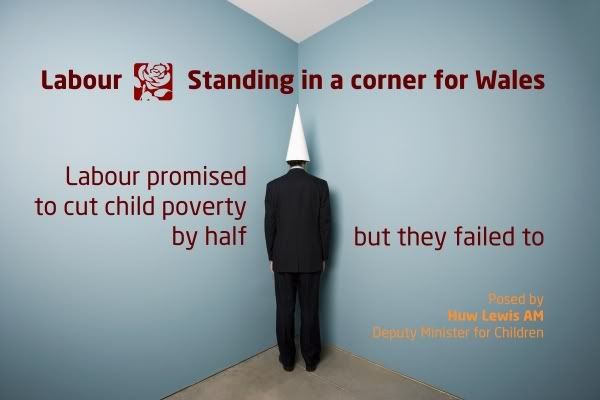
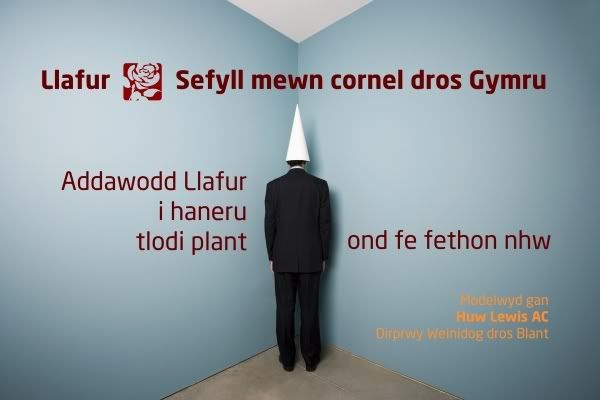
I'm pleased to announce that Huw Lewis has stepped onto centre stage to pose for the next poster in the campaign to highlight just how well Labour has been "standing up for Wales".


Postcard | Hi-res image | PDF

Cerdyn post | Delwedd safon uwch | PDF

By any standard, the failure to cut child poverty levels has been the worst of all Labour's failures. A party that used to pride itself on standing up for those who are less well off conveniently managed to forget all those values when in power. Instead it pandered to the rich, allowed (in fact encouraged) its new friends in big business and the financial institutions to become even more filthy rich, and hoped against hope that some of this money would somehow trickle down to the less well off in our communities.

But their blind trust in the free market economy—and of course they made it more free by not adequately regulating the financial institutions—not only failed to make an impact on child poverty before the credit crash, but brought us all to the brink of ruin when the results of that failure to regulate hit home.

-

So why is Huw Lewis in the spotlight for this? Dear old Screwloose is a good example of someone whose heart is probably in the right place. There are all sorts of things we can do to alleviate the worst effects of poverty for children in Wales. But the bottom line is that poverty is a matter of money. It is a question of how we as a society create wealth and how we distribute that wealth fairly.

Labour have done nothing for Wales in that respect. Relative to the rest of the UK Wales is progressively getting even poorer, and no amount of spending money on special programmes or placing new responsibilities on local authorities and other bodies is going to do any more than make a small dent in the problem. To make a real difference we must also take the levers that control the Welsh economy into our own hands.

But Welsh Labour are absolutely terrified of taking any sort of responsibility for things like taxation and the benefits system in Wales. This is all the more surprising because having an Assembly with taxation powers has consistently been the most popular model of governance in the annual St David's day poll [see here], and because 60% of people in Wales think that the Welsh Government should have control over the benefits system, with only 23% thinking it should remain in the hands of the UK government [see here].

-

There's only one conclusion we can draw from this: Labour are great at spending money on programmes, but are absolutely clueless when it comes to turning Wales into a more prosperous country. It is only by taking the levers of the economy into our own hands that we will have any hope of putting an end to child poverty in Wales.

Bookmark and Share

To devolve policing ... or not?

Thanks to Ffranc Sais, who I have to say is one LibDem blogger who generally has something interesting to say, I looked at this story in the Daily Post:

Former Deputy Chief Constable slams plans for Police Commissioners


A former deputy chief constable of North Wales yesterday warned plans to appoint Police Commissioners could take policing back two centuries “to political partiality.”

And Bill Brereton added he was concerned at proposals to devolve policing to the Assembly and would argue the case against it ...

“I am also concerned at proposals to devolve policing to the Assembly – I do not think that is right and will argue the case against it strongly.”

Daily Post, 18 April 2011

The first part is fair enough. I don't like the idea of elected Police Commissioners either, and I hope we are able to avoid having them imposed on Wales. Devolving responsibility for policing to Wales would be the best way to ensure that it doesn't happen ... though Labour haven't quite managed to work out that blindingly obvious fact for themselves yet.

This Bill Brereton is in fact the LibDem candidate for Wrecsam in the forthcoming Welsh general election. Yet the LibDems say they are unequivocally in favour of devolving responsibility for the police to Wales. This is again from the Daily Post, only ten days ago:

Plaid Cymru and Lib Dems want control of police in Wales

The Welsh Liberal Democrats said that the party had consistently called for the strengthening of devolution and argued the case for the devolution of policing and criminal justice in its last Assembly election manifesto.

“We shall remain committed to that proposal when our manifesto is published shortly. It remains ludicrous that an issue so crucial to local communities is still governed from Westminster.”

Daily Post, 11 April 2011

And indeed that commitment is in their manifesto:

We will make Welsh communities safer for everyone by ... continuing to press for the devolution of policing and justice by producing evidence to support the case. Devolution of policing could allow for better, Welsh solutions to Welsh problems.

Welsh LibDem Manifesto, 2011

That's a very welcome commitment, of course. Therefore we have to ask why the LibDems have chosen a candidate who intends to do the exact opposite of what it says in the manifesto he's standing on. How on earth did he get selected? But more importantly, how on earth can the LibDems expect anyone to take what they promise to do in their manifesto seriously?

At least there's a silver lining ... he has absolutely no hope of being elected. Let's make that true of every other LibDem who's standing on 5 May.

Bookmark and Share

A Shameful Omission from Plaid's Manifesto

I've thought hard about whether I should write this post or not, but in the end have decided to do so because politics should always be about principle, and a party that compromises its principles should not be surprised if it loses votes as a result of being afraid to say what it believes and why.

Plaid is a party that has long opposed nuclear power and remains opposed to nuclear power. So I have to say that I am ashamed that Plaid's manifesto makes no mention of this. It is particularly galling because other parties fighting this election are not afraid to make their position clear.

The Greens say:

We can get all of our energy from clean renewable sources, we do not need dangerous nuclear power.

We would ... Phase out nuclear power and resolutely oppose any new nuclear power stations. Stop any further investment in new coal-fuelled power stations.

Green Party of Wales Manifesto, 2011

The LibDems say:

We will lead a green revolution in Welsh energy supply by ... issuing a formal statement that the Welsh Government supports renewable and community energy projects as a priority and opposes new nuclear power both because of its detrimental impact on human health and its long-term unsustainability. We will also oppose new carbon-based power that does not have appropriate capture and storage built in.

Welsh Liberal Democrat Manifesto, 2011

Here are two parties making clear statements against nuclear. But to see a party I support largely, though of course not only, because its green credentials are second only to those of the Green Party itself failing to make a clear statement against nuclear in its manifesto is simply not good enough. It's not good enough because the manifesto that a party fights any election on is more important than what is contained in a policy statement somewhere else. A manifesto is the party's contract with the electorate, and the public are entitled to hold each party to account for what they choose to put in it.

-

Now I do accept that a manifesto is a short document that cannot include every detail of every policy. But it could and should refer to where that detail can be found. Labour's manifesto for this election provides a good example of how to do this. It says:

The Assembly Government's Low Carbon Energy Statement sets out how we intend to maximise energy savings and energy efficiency, making the majority of the energy production we need in Wales from low carbon sources.

Welsh Labour Manifesto, 2011

And if we turn to that document, it says:

Our approach to nuclear power in Wales is ... we remain of the view that the high level of interest in exploiting the huge potential for renewable energy reduces the need for other, more hazardous, forms of low carbon energy and obviates the need for new nuclear power stations.

Low Carbon Energy Statement, March 2010

I hardly need to remind anyone that Plaid Cymru was a part of the One Wales government that produced this statement. Yet if Labour can refer to a clear statement that Wales does not need new nuclear power stations, it makes it all the more amazing that Plaid Cymru does not.

However one thing I do find interesting is that Labour has changed its position from the one it held in the 2010 election to Westminster. Labour's manifesto for that election did include unequivocal support for new nuclear power:

•  We will make Wales a leading provider of green energy, produced not only by wind, but also from biomass, marine and microgeneration. This will not only combat climate change but generate thousands of new jobs, for example through Anglesey's vision of an 'energy island' with offshore wind and other industries located there, and construction of the Wylfa B Nuclear Power Station which Labour fully supports.

Welsh Labour Manifesto, 2010

I pointed out at the time that this was a direct contradiction of what the Welsh Government had said in its Low Carbon Energy Statement, a document which had been published only a few weeks beforehand. This, of course, is a sign of the deep divisions between the Peter Hain and Carwyn Jones factions in the party. If I were an optimist, I could say that the fact that Labour's previous support for Wylfa has been dropped from the Assembly manifesto is a sign that the Peter Hain faction was losing. But the realist in me knows full well that Hain and Jones are simply playing out the roles of "hard cop" and "soft cop". It is one thing to make a manifesto commitment, but quite another thing to be credible when making it. When a party flip-flops on an issue, people are bound to ask whether they will flip, or flop, again.

-

Nonetheless, so far as Plaid is concerned, the uncomfortable fact remains: we have allowed three other parties to present themselves to the public in this election with better statements on nuclear power than us.

I am not one to talk often about "sending a message" because the phrase is normally used as some sort of code to criticize or support a policy that has only marginal relevance to something else. But a party manifesto is all about sending a message, because it is a document in which a party sets out what it considers to be important. That means that the public have every right to conclude that anything not mentioned in it is of no, or of very little, importance to that party.

-

It is no secret that Plaid Cymru has a leader who is at odds with his party on the matter of nuclear power. To an extent that is acceptable ... but only to an extent. Let me set out what those limits should be.

It is obvious that in all parties there will be agreement and disagreement about some things, with not every member agreeing on every aspect of policy. That is healthy. But to me it is fundamental that a party decides policy through its membership and organizational structure, for the only alternative is for the leadership of the party to dictate what its policy should be. I'm glad that Plaid is not that sort of top-down party; but the inevitable consequence of being an open, democratic party is that there will be some subjects on which a prominent member is at odds with the majority of his or her party.

However we go beyond what is acceptable when we try to brush a policy under the carpet simply because our leader happens to disagree with it. And that is exactly what Plaid Cymru has done on this issue.

I'm sure that Ieuan Wyn Jones might consider it something of a success that he has managed to get this policy quietly dropped from the manifesto. But it is a hollow victory that I think he will come to regret, because it will lose us far more votes than we could hope to gain. For in the eye of the public what loses votes is not so much whether you hold one policy or the other; what loses votes is for a party to be two faced on an issue of principle.

Bookmark and Share