On the Politics Show yesterday, Owen Smith suggested that it was up to other parties to come to Labour if they wanted to do a deal. Although I can't speak on behalf of Plaid, this is what I think we should say.
Plaid Cymru's goals are long term: to develop and enhance the constitutional position of Wales so that decision-making power in more and more areas is devolved to Wales. Put more simply, our principle is that we in Wales are better able to make decisions about Wales than people who are not in Wales.
For this reason, our "red-line" issues should not be the day-to-day policy decisions in areas which are already devolved, such as health or education. In 2007, the one big thing we wanted was Labour's commitment to a referendum on primary lawmaking powers for Wales. Without that, the One Wales Agreement would never have got off the ground. All the other things in the One Wales Agreement, even though good in and of themselves, were of secondary importance.
So this time round we must similarly concentrate on the big issues rather than the small ones. In my opinion there are three:
• Devolution of the police, justice system, prisons and probation
• Devolution of some taxation powers, as recommended by Holtham
• A fair voting system for the Assembly
That's not to say there aren't other constitutional matters that could be considered such as reform of the civil service or broadcasting, but these are the three areas that I think matter most. If we can reach agreement with Labour on these, then there is nothing to stop us adding more; but without these three things I don't think there would be any point in doing a deal at all.
Devolution of the police, justice system, prisons and probation
On this subject, I want to start by saying that it is absolutely inevitable that a Wales will become a distinct legal jurisdiction. It is therefore pointless to negotiate a deal on something that is going to happen anyway.
We need the complete package to be devolved to Wales.
Our position should be simple, if this area is devolved to Scotland and Northern Ireland it is only right for it to be devolved to Wales as well. It also solves the tricky problem of dealing with the ConDem coalition's proposals for elected Police and Crime Commissioners. At one level, Westminster can currently impose whatever it wants on Wales. But it is impossible to impose a system where we get a very powerful individual, but do not also get a mechanism for scrutiny of that individual. For that scrutiny to be democratic, it must consist of elected representatives at local level, and local government is devolved.
It would also enable us to go ahead with building a much needed prison in north Wales, but of a size that suits the needs of north Wales (500 or so at the very most) as opposed to Labour in Westminster's previous plan for a prison to house some 1,500 ... most of whom would have come from England. We would also be able to build much smaller facilities for the very low numbers of women and youth offenders who need to be in custody. These units might house as few as 15 to 25 people. They could of course be built through the BuildforWales model.
Devolving prisons and probation also makes sense because of their natural interdependence with areas that are already devolved to Wales such as education, health and social services. We will be able to develop a joined up approach to reduce the numbers that re-offend.
Devolution of some taxation powers, as recommended by Holtham
A simple, but fair, summary of Labour's position with regard to Holtham is that they want what is in the first part of the report, but don't want what is in the second.
We can all now agree (even though it took Labour some time to realize it) that the way Wales is funded is unfair. But it is utterly naïve for Labour to think that Wales can get a fair funding formula without also having to accept a degree of responsibility for how the money the Welsh Government spends is raised. You can't cherry pick. Both parts of the Holtham Report are equally important.
A fair voting system for the Assembly
Although Labour don't like it, they have lost the battle over the number of MPs in Wales. The question for us now is how to adapt the Assembly voting system to suit. Now of course we could simply have two different sets of constituencies for the Assembly and Westminster, but I think that would be confusing.
There are two possibilities: one is to keep the current voting system but base it on the same 30 constituencies as will be used for Westminster, but to increase the number of regional AMs from 20 to 30; the second is to adopt STV.
A second factor is that is the overall number of AMs. I strongly believe we should not increase the number of AMs unless further areas of responsibility are devolved to Wales. But if we get police and the justice system devolved to Wales, that would justify an increase to 75 or 80 AMs.
-
These three are tricky areas in that the decision about whether nor not we get them rests with Westminster; they are not deliverable by the Assembly on its own. But the name of the game will be to present a united front to Westminster with the aim of persuading them to devolve these powers to us. For as long as Labour press for these things to be devolved, it should be possible for us to work with Labour. But if no progress is made, Plaid's support will be withdrawn.
It's good to see it up and running at last, not least because it means we now have something to stand alongside and complement the Welsh language Theatr Genedlathol Cymru, set up back in 2004. If we are serious about becoming a truly bilingual nation it is important that we promote and celebrate the many strands that contribute to our rich cultural diversity in both our languages.
I'm particularly proud that establishing an English language National Theatre for Wales was one of Plaid Cymru's manifesto pledges in the 2007 Assembly election, and that this was something that we managed to negotiate into the One Wales Agreement with Labour, who were opposed to the idea and had done nothing to set up an equivalent to Theatr Genedlathol Cymru in all the time they were in power before ... either when in coalition with the LibDems or in power on their own.
-
But that's enough politics. This is a taste of what to expect:
And there's more information about this and future productions here.
National Theatre Wales has taken another huge step forward with its official launch today, as reported here:
National Theatre Wales to launch with global webcast
After years of waiting, Wales will finally get its own National Theatre today.
... Although exact details of the programme will not be unveiled until the launch, McGrath has revealed that NTW won’t be shying away from any challenges. There will be 12 productions during the launch year, which runs from March 2010 to spring 2011. And they will be staged throughout Wales.
Like the National Theatre of Scotland, NTW does not have its own performing house so the company will take productions to existing theatres as well as work at site specific locations.
... After years of talk, detailed plans were finally announced in 2007 for NTW and the Welsh Assembly Government invested £750,000 in preparatory work. Now the company is receiving £3m from WAG during the first three years. NTW will run alongside the Welsh language company Theatr Genedlaethol Cymru.
It will be another few months before the first performances, but to get a taste of what's to come why not take a look at their website.
A good question to ask would be why it has taken so long to set up an English-medium National Theatre, when we have had the Welsh-medium Theatr Genedlaethol Cymru since 2004. The answer is in a post I wrote on the WalesOnline forum a couple of years ago:
The (English-medium) National Theatre of Wales
I'm pleased to see that the first steps have been taken to set up an English-medium National Theatre of Wales.
If we really are committed to achieving a fully bilingual Wales, this means being committed to English just as much as Welsh. We have a fine tradition of English language literature and drama here in Wales, and it would be quite unfair to sideline that at the expense of Welsh. We have our Theatr Genedlaethol Cymru ... an English equivalent is long overdue.
There has been talk about such a project for a long time, but no political commitment to make it a reality. But it is part of the One Wales Agreement, and Heritage Minister Rhodri Glyn Thomas is mandated to make it a reality.
-
Now, just in case you are wondering why we get it only now (though I daresay it will take another year or so to become a reality) when the Welsh version has been up and running since 2004, you just have to look at the manifestos for the May election.
Plaid wanted it, Labour didn't. That's why we didn't get it before now. But we managed to negotiate it into the One Wales Agreement.
Plaid Cymru supporting English isn't the sort of picture our opponents want to paint of us ... but the reality is somewhat different, isn't it?
We are just as committed to supporting English as we are to supporting Welsh.
Now that I've had a chance to read it (sadly, I don't get an advance copy) it's time to comment on the National Transport Plan that Ieuan Wyn Jones announced yesterday.
As I listened to what he said, I punched the air and let out a shout loud enough to disturb my neighbours—or at least give them grounds to think I was disturbed—when he confirmed that the Gwent Levels motorway had been ditched. I was half-confident that it would be, simply on the basis of the principles that were laid out in the previous document. But the sustained pressure over the past few weeks from those elements that think road building is the only thing that matters made me wonder if he would fold.
He didn't. In fact I was very impressed with the confidence of his performance in yesterday's debate. He came across as a man who knew what he was doing and, more importantly, why he was doing it.
-
Now of course all the news in the morning papers is about the M4. But I want to start by saying that the Plan is much more than that. It is about building an integrated and sustainable transport system. What is groundbreaking about this is that it is the product of new and better thinking about what transport is for. For some decades we have had governments, of all political hues, that have seen road building as the prime, if not only, means of improving transport infrastructure. Only very recently have governments started to think in terms of a more balanced transport mix: something which has either been motivated by gridlock in large cities such as London, or by concerns for the environment.
So the emphasis of this plan is not about what we are not going to do, but about the better things we are going to do instead.
-
Now it seems that some people just can't get their heads round this. Not only did we see this from the Tories in the debate yesterday, but it was repeated by David Rosser of CBI Cymru in this clip from the news last night:
He seemed to think that it was:
... too big a project for the Welsh Assembly Government's budgets. What does that say about devolution? ... how do we take forward Wales' infrastructure needs in the decades to come?
He's got hold of completely the wrong end of the stick. The money would not have come directly from the block grant. When the new motorway was proposed, it was always intended to be financed by PPP/PFI, which would in the long term have cost us maybe twice as much as traditional funding through borrowing. But let's take a step back and look at the bigger picture.
First, the problem that needs to be solved is relatively minor. There is some peak hour congestion, which is mostly the result of private car commuter traffic. If the whole emphasis of transport policy is to try and get people out of their cars and onto public transport it makes more sense to solve the problem by developing park and ride facilities linked to new rail stations, as I noted here. IWJ has confirmed that this is indeed what is going to happen. That is very welcome news.
Second, the cost is obscene. It is not a question of it being "unaffordable" ... it is a question of this particular scheme being a bad thing to spend this amount of money on. £1bn is out of all proportion to the benefits it could ever be expected to bring. True, that cost would have been funded by PFI/PPP ... but that would of necessity have involved tolling. A "shadow" toll (such as operates on the A55) would have cost the Welsh Government a lot of money. A user-paid toll could only have been made to operate on the same financial basis as the new Severn Crossing: in order to avoid switching, both M4s would need to have matching tolls. I don't think many people would put up with that. The tolls would certainly have had a negative rather than positive effect on business.
Finally, it is not the only route across Newport. What IWJ proposed today is exactly what I said should be done a few years ago, after one of the accidents that closed the motorway:
What I find strangest about incidents like these is how they have "knock-on" effects to the rest of the political agenda.
So, for example, because this crash caused delays to motorists, the news story quickly becomes, "What's happening with the new Gwent Levels toll motorway"
My reaction to this is that people have been killed ... and if that means a few hours delay, and even if this happens say four or five times a year, so what? Inconvenience doesn't compare with lives.
We need better solutions to our transport infrastructure than building new motorways. We built a parallel M4 for the new Severn Crossing. Now the ball just rolls along a few miles. If we double the M4 to get past Newport, are we then going to double it to get past Cardiff too? Make no mistake, we'll have to, because we'll just create a new bottleneck a few miles further on.
Yes, I do accept that this bit of the M4 is problematic, particularly because of the Brynglas tunnels. But there are better ways of increasing road capacity than a new toll motorway. Why not simply improve the road from the Magor Junction (23a) that runs through the old Llanwern site (Queensway) then go over the new road bridge built just a few years ago? Turn the single carriageway sections to dual carriageway. Maybe tunnel under a few of the surplus roundabouts. Judicious minor works to improve traffic flow. Not a complete new motorway ... and certainly not a restricted access, private toll motorway!
-
Ultimately, though, the problem is the number of people using cars to get to work and lorries to carry goods. The way to solve that problem ... the only way ... is to make a coordinated shift from road to rail.
Quite rightly, the proposed new motorway needs to be subject to a number of planning, environmental and legal procedures. The public enquiry is due in a two years. Of course the Tories want to rush it forward to get a new private toll motorway as quickly as possible. No big surprise.
The political task for Ieuan Wyn Jones is to get a rail improvement plan (both passenger and freight) into proper form by then, so that it (together with minor road improvements as outlined above) will form a convincing alternative to the new toll motorway.
Reading the Western Mail's version of the story at the time, it would appear that IWJ was still thinking in terms of building the new motorway. According to yesterday's BBC story, what is now proposed is pretty much exactly what I suggested back then:
[IWJ] said the assembly government would instead spend between £64m and £110m improving the existing M4 network.
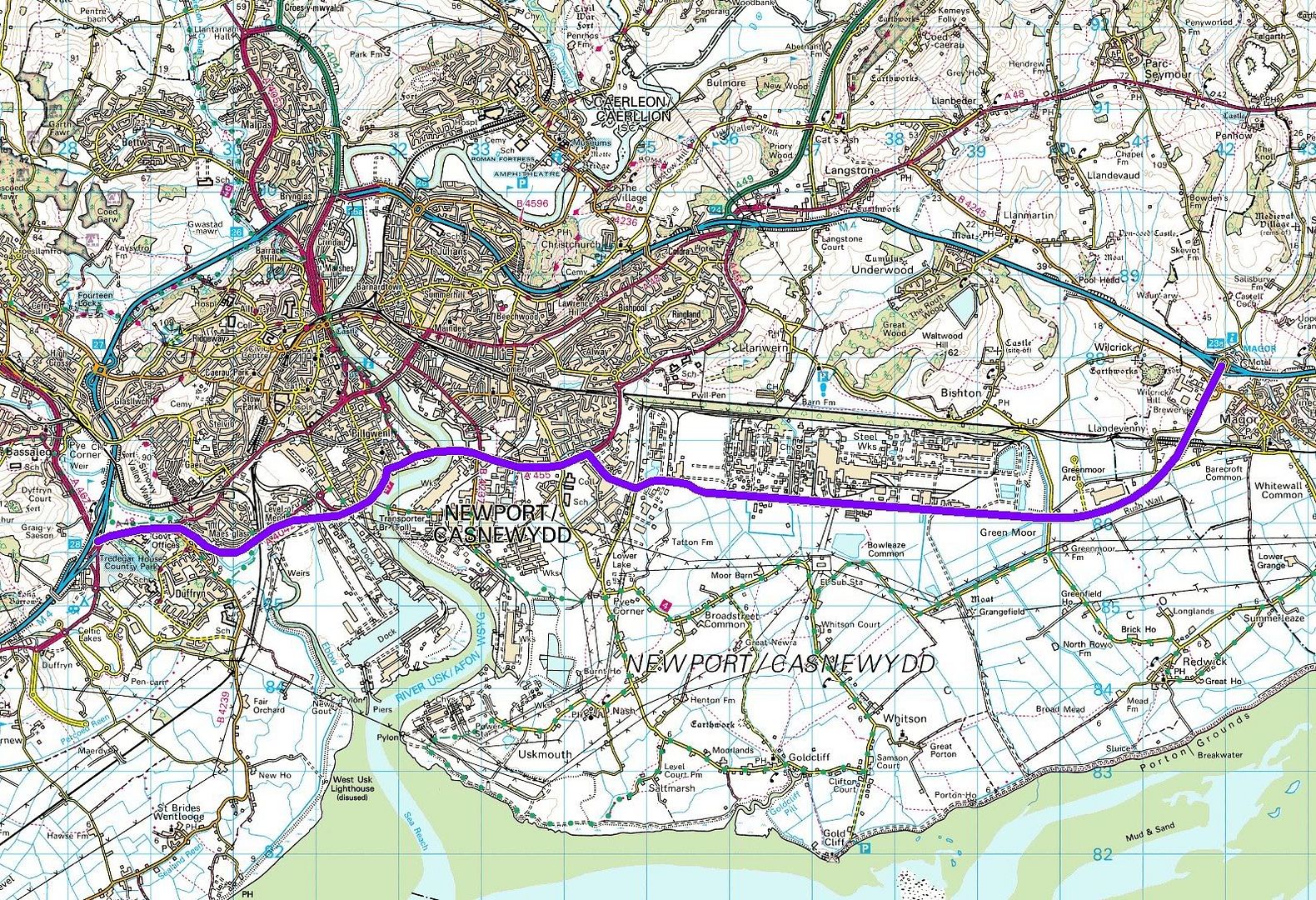
Measures would include improvements around Tredegar Park junction, the Brynglas tunnels and the Coldra roundabout, bringing into public use a seven-mile dual carriageway through the Corus site in Newport, and improving the southern distributor road through Newport.
Now of course I'm not taking credit for that. To my mind it was just stating the obvious, and I'm sure others reached the same conclusion long before I did. I'm only glad that the argument has been won. Just in case it isn't clear, this is the route that is now likely to be developed. Click the map for an enlarged version.
It does exactly what it is meant to do: relieve pressure at one pinch point on the perfectly good motorway we already have. Building a brand new six lane motorway would be like taking a sledgehammer to crack a nut. It is overkill.
-
I suppose I can't really avoid commenting on the Cardiff Airport link road, either. For once I'm going to give some credit to David Jones, because at least he can see the bigger picture, even though he sees it the wrong way round. What he wrote is here.
Most of the plans for a new road from the M4 (probably J34) to Cardiff Airport were based on it also serving the development at St Tathan. A road that would serve both is more feasible than a road that would serve the airport alone. It might even be justifiable, but that depends on the extent of the development.
Now of course St Tathan itself is a completely different issue. It's something I've mentioned before, but not on this blog, so I'll put it on record that I am not against the development of a large defence establishment on the site. If the MoD want a centralized facility, it is better for this part of Wales that it's here than elsewhere. However, what I do have very grave reservations about is the private nature of the proposal and the particular multinational arms companies that will develop and run it.
I am not particularly impressed with "School of Death" labels. Any military training establishment is by definition a place where people learn to kill other people. That is what war is all about! I believe that Wales should retain an effective military after we become independent; the issue is not about us having armed forces, but about what we do with them. So the development itself will serve us very well when we get to run it.
But at present it is far from clear how "on track" the proposed development is. David Jones seems to want it both ways at the same time. For example he quotes Vale of Glamorgan MP John Smith as saying, "If that road is not built, the college will still open ... " but then goes on to say, "The announcement [about the link road] will undoubtedly cause uncertainty over the future of the St Athan project."
My view is that we should wait and see. If the development does go ahead on the scale planned, then it might well make sense for the road to be built; in which case it would serve Cardiff Airport too. Win win. But the airport alone certainly does not justify it.
What is ridiculous, not to say foolish, is the idea that the Welsh Government should build the road first in order to try and swing the balance on whether St Tathan goes ahead. Tails do not wag dogs.
-
Let's move on. Because the next thing to note is that this Plan is not some sort of vendetta against road building. We need good roads. But we need put them into a larger context. It is very easy for a local AM like Huw Lewis to think that the A465 is the most important road in the world ... but it is only the most important road for him and his locality. The same goes for John Smith's view on a new road to Cardiff Airport. The job of the Welsh Government is to do what is best for Wales as a whole.
A month or so back, I made this post in response to what Huw Lewis had written. He was feigning ignorance about why the Heads of the Valleys road should not be Wales' number one transport priority. I reminded him that the One Wales Agreement had made improving North South links a priority:
• We envisage a Wales where travelling between communities in different parts of Wales is both easy and sustainable. We are firmly committed to creating better transport links, both road and rail, between the North and the West of Wales and the South.
• We will develop and implement a programme for improved North-South links, including travel by road and rail.
• We will press ahead with improvements to major road links between the North, the West and the South of Wales, investing over £50 million for this purpose over the four year Assembly term.
To allay Huw's fears, dualling the A465 is still going to go ahead. That was confirmed, once again, yesterday ... and perhaps it's worth noting that this road will provide a better alternative to the M4 for traffic from south Wales to the Midlands and North of England via the A40 and M50, thus in itself reducing the long term need to increase capacity on the M4. But the Plan lists a number of improvements to the main North South road link, namely:
We will:
c. Start work on the programme of proposals, by 2011, to the north-south road corridor to address sub-standard alignment, journey reliability, safety and local environmental issues:
• A470 from Penloyn to Tan Lan, Llanrwst;
• A470 from Cwmbach to Newbridge;
• A470 at Gelligemlyn;
• A470 from Maes yr Helmau to Cross Foxes;
• A470 at Alltmawr;
• A470 from Pentrefelin to Bodnant West Lodge;
• A487 at Porthmadog, Minffordd and Tremadog;
• A483 at Four Crosses.
d. Start work on the programme of proposals, by 2014, to the north-south road corridor to address sub-standard alignment, journey reliability, safety and local environmental issues:
• A470 at Rhayader;
• A470 at Plas Maenan and Bodhyfryd;
• A470 and A483 through Builth Wells;
• A487 from Caernarfon to Bontnewydd;
• A483 in Newtown.
Some of these schemes have been around for a long time. One, the Porthmadog bypass, was given the go ahead only a few weeks ago. But what this Plan does is to bring the proposals together as a co-ordinated set, so that we finally—after years of talking about it—get a half decent road linking north and south Wales. This is an enormous step forward for Wales as a whole.
-
Anyway, this post is quite long enough. I've concentrated only on the headline issue of roads because that is the main focus of debate and comment in the media today. I've got plenty to say about the public transport that runs on roads, the rail network, and short distance local transport, including cycling and walking. These elements are every bit as important, but I'll have to address them later.
I was pleased to see that a Measure (the Assembly equivalent of an Act) has been proposed which will cap non-residential care charges by local authorities at £50 per week.
But I think it might be worth commenting on how long it has taken us to get there. In the first instance the Labour party said they would abolish these charges altogether as one of their 2003 manifesto commitments. They decided not to honour that pledge when they got into government.
In their 2007 manifesto the commitment been watered down to:
We will also seek new powers to allow a third-term Labour Assembly Government to amend the law in relation to charging for domiciliary care, so that charges for similar services are made more consistent and less variable across Wales.
In marked contrast, Plaid's 2007 manifesto included:
• stopping the hospital closure programme, and capping and then scrapping the council tax and care charges for the elderly. New ideas for a new era.
OK, that last sentence might have been a little over-the-top. After all, Labour had said they would scrap care charges ... although they didn't actually do it. Either that, or one of the "new ideas" the author had in mind was the startlingly novel idea that a party in government should do what it says it will.
In more detail, the Plaid commitment was:
Free Care
Plaid believes in securing free care provision for older and disabled people, in principle and as an aim. We reject the distinction between nursing and personal care. Intimate personal care can not be described as optional or a matter of convenience for the patient. By linking entitlement to care given by nurses, the current funding structure leads to older people and disabled people being denied appropriate care thereby causing preventable health deterioration and often hospitalization.
In the short term a Plaid Government will:
• Cap Charges set by Local Authorities.
• Raise the savings threshold for contributing towards residential costs to more accurately reflect the value of an average family home.
• Create Benefit Take Up teams in every Local Authority to ensure that older and disabled people receive benefits to which they are entitled.
To bring in our policy of free care, a Plaid Government will request the necessary powers to create a National Care Fund financed through a proportion of the revenue received as part of our proposed local income tax.
OK, so we didn't mange to negotiate all of it into the One Wales Agreement we made with Labour after the election. But I think you can clearly see from which side the initiative and momentum that has now led to this Measure came.
-
The second thing I would like to note is the timescale. We've been part of the One Wales Government for two years now. Why is this Measure only being announced today?
The answer is the LCO system. The Assembly had no powers to pass the sort of law that would cap the amount that local authorities could charge. We had to go through the drawn-out process of asking Westminster for permission to do it. But in the end they said yes, so let's give them credit for that.
But now think what would happen if a different party happened to be in power at Westminster. It would be very easy to imagine the Tories vetoing the ability of the Assembly to make such a law on the grounds that:
"It is up to local authorities to decide how much to charge. They are answerable to their ratepayers. The Assembly shouldn't interfere with democratic local government, therefore we won't give you the power to make such a law."
That of course sounds quite reasonable ... until you take a look at the huge discrepancies between local authorities. If an authority like RhCT can charge as little as £16.20, why should other authorities charge more than ten times that amount? It is clearly and obviously unfair, and it is therefore right that the Assembly should be able to set limits ... not least because local autorities only raise a comparatively small proportion of their income from local Council Tax payers.
-
We need to bear this in mind over the next few years, when we will all come under great financial pressure because public money will be in short supply. In essence there are always two ways of handling a problem like this: the first is to use money from the block grant to solve every problem; the second is to use legislation as a means of ensuring that others take a fair share of that responsibility.
The Welsh Government could have chosen to just give money to local authorities so as to make their care charges more uniform. That wouldn't require legislation, just money. But think of the consequences. It would have meant a high charging authority would get more money than a low charging authority. That in turn would have meant that low charging authorities would put their charges up, knowing that they would then recoup the higher charge. So it would result in an upward spiral of costs.
But on the other hand the ability to require local authorities to keep charges down by law has a dampening effect on costs ... and doesn't require additional money to be found from the block grant. Win win.
-
In other words, the ability to legislate has very real and practical consequences for the ability to deliver public services effectively. This is why we must ensure that we gain the right to legislate without having to ask permission from Westminster every time.
So, if Labour really are serious about defending Wales from the effect of the cuts which are on their way, they know what they must do: make sure that the Assembly gets primary lawmaking powers.
Earlier this week, the Western Mail carried a story by David Williamson which was ostensibly about forcing Ieuan Wyn Jones, whose responsibilities include transport, to publish the advice he was given when he formulated the new road building/improvement strategy last year.
In essence the new strategy revised the previous priorities for road building in Wales. It moved up eight improvement schemes for north-south links, and it moved down six improvement for east-west routes. The question being asked was why IWJ chose to do this.
Deputy First Minister Ieuan Wyn Jones may be forced to reveal the advice he was given to formulate his road-building strategy.
Mr Jones’ changes to the priorities of the Assembly Government’s road-building programme have been controversial. The CBI business organisation warned in a statement on May 7 that: “From an economic perspective, the 2008 reprioritisation of the trunk road forward programme (moving up eight North-South schemes and moving down six East-West schemes) is a step in the wrong direction. We believe the Deputy First Minister is mistaken in making the top priority of this new programme to ‘provide better links between strategic centres of population.’
“Faced with a global economic recession, the need to invest in roads that will deliver an economic dividend is more important than ever. Redirecting finite road building resources to connecting communities within Wales—instead of improving economically vital east-west road links—will see our infrastructure punching below its economic weight.”
... Labour’s Mr Lewis said: “We can’t get an answer from the minister as to why he has done this ... He has upended the Assembly Government trunk road programme.”
Now of course I can fully understand that people will have different opinions on which projects should be given priority. Very clearly the CBI disagrees with the new priorities, and they're quite entitled to.
But Huw Lewis is an entirely different case.
Instead of just disagreeing (which is perfectly reasonable) he tries to make out that he has no idea whatsoever about why the Welsh Government has changed the old priorities. He has even made a couple of posts on the subject in his blog recently, here and here. In the second he claims that:
It is this report which has apparently led to a huge reshaping and reorganisation of WAG's road building policy.
This made me smile, because he has now shifted from feigned ignorance about why the decision was made, to trying to plant the suggestion that it was this advice that led to the change of priority. Sneaky.
The answer is very simple ... and one that I'm sure Huw Lewis is very well aware of. However if he still claims ignorance all he needs to do is remind himself of what it says in the One Wales Agreement:
• We envisage a Wales where travelling between communities in different parts of Wales is both easy and sustainable. We are firmly committed to creating better transport links, both road and rail, between the North and the West of Wales and the South.
• We will develop and implement a programme for improved North-South links, including travel by road and rail.
• We will press ahead with improvements to major road links between the North, the West and the South of Wales, investing over £50 million for this purpose over the four year Assembly term.
If you read through the whole document you will see there is no specific mention of other road schemes in the OWA. So the simple fact is that the Labour Party and Plaid Cymru agreed to make improving north-south links the main road transport priority. This, by definition, must mean "re-prioritizing" the previous administration's road programme.
-
Now it's no secret that Huw wasn't too pleased about the One Wales Agreement, and that is probably why he doesn't hold any ministerial position in the One Wales Government. Sticking with your principles is something that should be commended. And as the local AM of course he should be concerned about the stretch of road that passes through his own patch. That too is commendable ... although there are 59 other AMs who have just as much right to be concerned about the roads that serve all the other parts of Wales.
But what is very definitely not commendable is trying to blame Ieuan Wyn Jones for going ahead and delivering on the agreed One Wales programme of government ... especially by trying to pretend that what prompted the re-prioritization was some advisory report. That is cheap and disingenuous.
-
Politics is about making decisions ... tough decisions. In my opinion one of the most disturbing trends in politics over the past decade or so is for politicians to use so-called expert advice as a way of distancing themselves from the decision making process; conveniently hiding the fact that the terms of reference which they set for such reports usually pre-determine what the resulting advice will be. It seems to me to be a very New Labour trait.
Improving north-south road links is a political decision. A black-and-white commitment that both Plaid Cymru and the Labour Party signed up to when they came into coalition.
Plaid are simply sticking with that agreement. As I said in response to Huw on his blog:
I'm sure you wouldn't want to be seen to be undermining or reneging on your own party's commitments, Huw. Is delivering on commitments so hard a principle for you to understand?
This blog has been set up to complement the Syniadau Forums.
Much of what will appear on this blog will also appear in the Syniadau Forums, but the emphasis on this blog is slightly different. The forums are focused more on the structures and institutions that Wales will need to develop in order to become a successful independent nation, arranged on a subject by subject basis, but the blog will have more of an emphasis on day to day political news and developments.
People are welcome to reply or leave comments either here or on the Syniadau Forums. If anyone wants to initiate a new subject they are very welcome to do so there.