Showing posts with label Carwyn Jones. Show all posts

N is for National, National means Wales

In my last post, I commented on Owen Smith's speech to the Labour conference at Llandudno last weekend, particularly his repeated emphasis on the idea of Britain (or the UK, for he used both interchangeably) as "one nation". I noted that this was very different from what he had said at the Labour Conference in Manchester last October, for all the emphasis in his speech then was on "the nations of Britain" as opposed to Britain as "one nation".

These two different positions effectively delineate the long-standing fault line in the Labour Party in Wales between those who want Wales to take increasing responsibility for its own affairs and those who are more sceptical about, if not exactly hostile to, the devolution settlement moving forward. This difference became very apparent recently not only in the reported "roasting" that Carwyn Jones received from Labour MPs for making a submission to the Silk Commission without first having consulted the wider party, but also in the contrast between Owen Smith's and Carwyn Jones' speeches last weekend.

The difference between those speeches has been widely commented on already, but I thought that this part of the speech from Mark Drakeford provided the clearest and most forceful rebuttal of the idea of Britain as "one nation":


The point of me writing this is not to try and magnify the rift, nor to take political advantage from it. It is to try and persuade people within the Labour Party that it is far more appropriate to see Britain as a collection of nations that share much in common rather than as "one nation". It is not a matter of party politics or ideology. It simply reflects the way that most people on this island see themselves, as the census results show all too clearly.

Bookmark and Share

Carwyn: bogus, inept ... or worse?

One very odd thing about today's Welsh Government reshuffle is the health portfolio.

Only last week, Carwyn Jones announced that he was going to take the controversial Betsi Cadwaladr UHB reorganization decision personally. The reason he gave was that the proposed changes affected Lesley Griffiths' own constituency, resulting in a conflict of interest. These are his actual words:

"Just to make it clear, I will be taking that decision, because the minister herself has a constituency within the Betsi Cadwaladr Board area."

Wales Online, 15 March 2013

Even if that reason held water before, it certainly doesn't now. So what will happen? As there is no longer any conflict of interest, will Carwyn now hand the decision back to the new health minister Mark Drakeford?

•  If he doesn't, it means that the reason he gave last week was completely bogus.

•  But if he does, it means that last week's announcement was completely unnecessary. Or, to be more precise, means it was unnecessary if he knew that he was going to reshuffle his cabinet now. It would show him to be inept.

Neither of these reflects particularly well on his leadership.

-

But there is another factor at play. At a guess, I would say that Carwyn actually intended to make the reshuffle not now, but after the matter of the health reorganization had been decided in a few weeks' or months' time. It would have allowed the new health minister to start the job with a clean slate.

The only explanation that makes sense to me is that Lesley Griffiths was not at all happy that Carwyn had chosen to take these decisions away from her. Presiding over health reorganization—or to put it more bluntly, health cuts—is an unenviable and thankless task, and the very least she could have expected was that she would be able to make the final decisions by herself.

I think Carwyn disagreed with the decisions she was about to make and therefore took it out of her hands, leaving her with no choice but to resign. That forced him into making the reshuffle sooner than he had wanted to.

Bookmark and Share

15%

As reported in Wales Online today, Carwyn Jones has come up with the same old-knee jerk reaction to an independent Wales by saying,

Plaid Cymru would argue for independence. My view is that it would leave a 15% difference between what we raise and what we spend. Now that gap is not easy to make up, and for me that's why independence makes no financial sense.

Wales Online, 29 December 2012

Now it may well be true that there is a 15% difference between the two, and that it is a big difference. But that assessment has, to a large extent, to be based on assumptions because the Welsh Government steadfastly refuses to collect the figures in the same way as the Scottish Government does for Scotland in GERS.

-

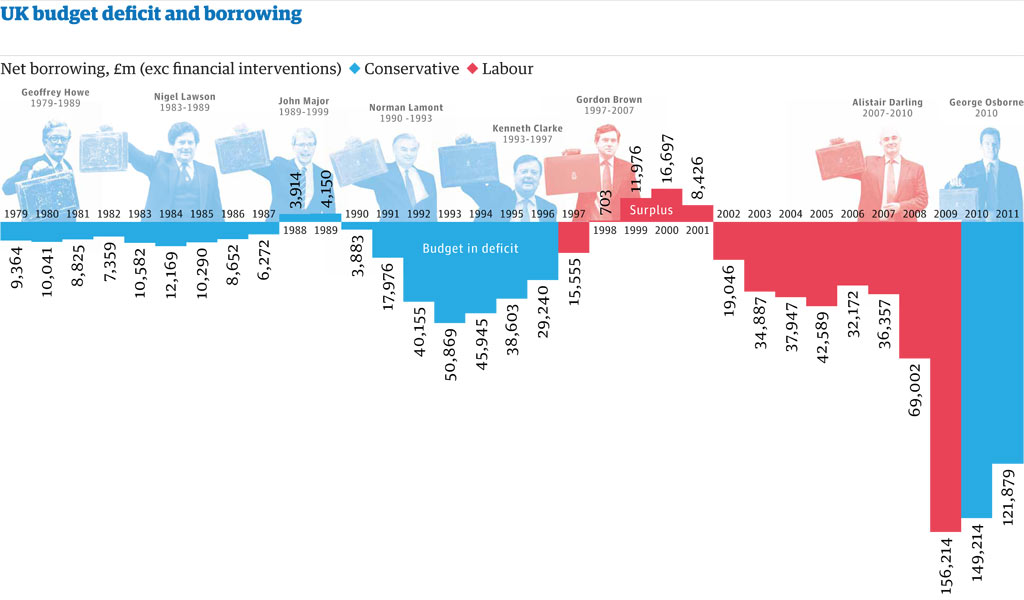
However it is silly to use any difference between income and expenditure as a reason for not wanting Wales to be independent. In fact the difference between what the UK raises and what it spends is much greater than 15%, and the UK only manages to survive because it keeps borrowing money each year to make up the shortfall.


The figures for the UK's deficit are here, and the figures for UK public spending are here. By subtracting the first from the second, we can see how much the UK raises in taxes, duties and other charges. For the last three years, the figures are:

2009 ... income £465.2bn, spending £621.4bn, difference £156.2bn or 33.6%
2010 ... income £511.6bn, spending £660.8bn, difference £149.2bn or 29.2%
2011 ... income £559.4bn, spending £681.3bn, difference £121.9bn or 21.8%

So don't be taken in by a glib answer from a glib politician, even if he is the First Minister of Wales.

Bookmark and Share

Sharp End Question of the Year

This question by Paul Flynn was so sharp that it made any answer Carwyn Jones might give sound rather silly. So I'll spare him the embarrassment of showing it.


Your recent arguments have been that an independent Wales would not have a new nuclear power station in Wylfa and would not have Trident at Milford Haven. Are these arguments for, or against, independence?

Bookmark and Share

Dreaming of World Domination

Although nothing he has done previously has indicated any ambition for Wales, Carwyn Jones seems to have woken from his latest afternoon snooze with a game plan that might just make a difference to our fortunes.

Personally, I blame it all on Kim Howells. His one brief moment of fame came when he chaired a session of the United Nations Security Council ... and he has never stopped telling any of his party colleagues about it since.


     Kim Howells chairs the UN Security Council

Some medical experts say that this is the cause of Carwyn's narcolepsy. For faced with the same endlessly repeated tale, falling asleep is usually a much better option that running amok with a machete or sub-machine gun, and Carwyn isn't really cut out for anything so active.

But as he slumbered, Kim's words worked their way deep into his subconscious mind. Yes, he thought, my small country can hold the superpowers to account. They will listen to us ... if only ... if only ...


Then it came to him in a flash – and the explosive force of several megatons of TNT proved to be enough, though only just, to wake him up while he still remembered what he had been dreaming about. When Scotland becomes independent, the UK will have to find a new home for its weapons of mass destruction nuclear deterrent. The Scots have been complete fools not to want to keep them. Any real country would surely want to get its own way be a force for good in the world.

But what if Wales took them instead?

Carwyn isn't stupid. He has known for some time that Wales will become independent ... although maybe not for the next ten years. So if we can fool the UK government into spending a fortune to build a new nuclear submarine base in Milford Haven, but declare independence after that and then decide to keep the nuclear weapons rather than force England to find yet another home for them (which they probably couldn't afford to build anyway) we will be the ones that inherit the former UK's permanent seat at the United Nations Security Council.

Wales will finally be on the map. The Russians and the Chinese—not to mention those pesky Americans—will have to listen to us now. And in just the same way as the French have used their position at the table to ensure that all UN documents are translated into French, we will be able to ensure that everything is translated into Welsh.

At last we in Wales will have achieved our aim of world domination.

Bookmark and Share

Carwyn rips up Labour's manifesto

Towards the end of First Minister's questions on Tuesday there was this exchange between Carwyn Jones and Leanne Wood, which I want to thank Naturiaethwr for drawing to my attention:


Leanne Wood: What discussions has the First Minister had recently with the UK Government on the natural resources of Wales?

First Minister: I attended the joint ministerial committee last month, where I repeated my call for the people of Wales to control renewable energy projects up to 100 MW.

Leanne Wood: Thank you for clarifying that, First Minister. Can you confirm that you only asked for energy projects up to 100 MW and that you did not ask for anything more? If you can confirm that, can you explain to us why your ambition for Wales is so limited?

First Minister: Because it's in renewable energy that we have the greatest potential in projects up to 100 MW. I suspect that that question is based on nuclear ...

Leanne Wood: No, not at all. It is nothing to do ...

First Minister: We fully support Wylfa B as a development for the people of Anglesey. I do not know whether your party does or not. We certainly want to ensure that, when it comes to renewable energy, the people of Wales have proper control over their resources.

Poor Carwyn was wrong on two counts. First, he claimed that the greatest renewable energy potential was in projects up to 100 MW. It isn't ... not by a very long way.

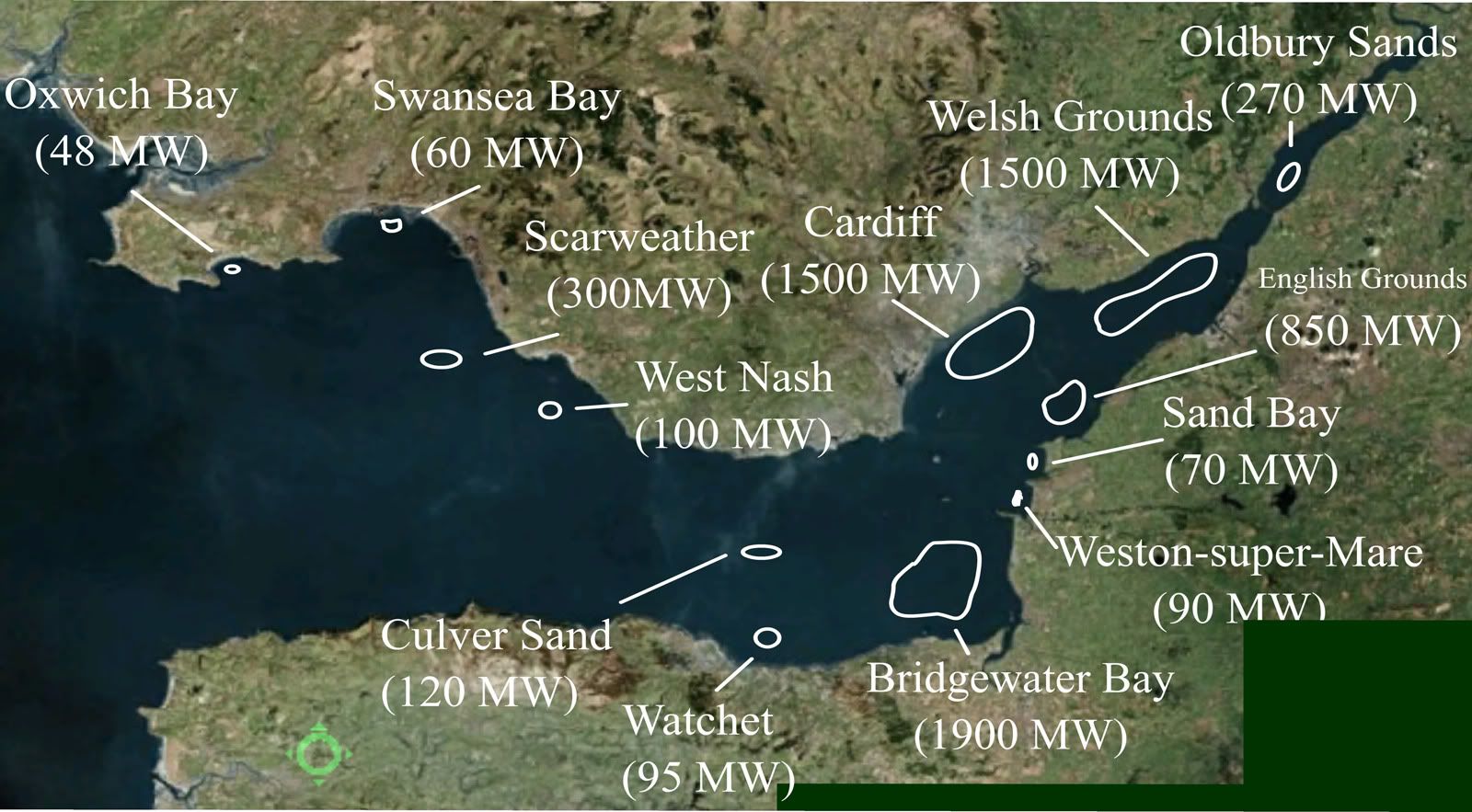
In terms of offshore wind, the size of the large projects in Rounds 2 and 3 completely dwarfs all the other windfarms in Wales put together. Gwynt y Môr, currently under construction, is 576 MW. The Atlantic Array in the Bristol Channel is 1,500 MW with about a third of this in Welsh waters. The Irish Sea Zone windfarms will probably have an installed capacity of 3,715 MW in Welsh waters, as I described in this post. At present, the total installed capacity of onshore windfarms, every one of which is below 100 MW, is about 377 MW. Even if we add the Round 1 offshore windfarms of North Hoyle at 60 MW and Rhyl Flats at 90 MW, there is still nine times more potential in larger schemes than in smaller ones of 100 MW or less.

In terms of energy from tidal lagoons—our other big potential source of renewable energy—the WS Atkins study for Tidal Electric identified six sites on the Welsh side of the Bristol Channel. The three larger ones totalled 3,300 MW, and the three that were 100 MW or less totalled 208 MW.


So there is fifteen times more potential in larger schemes than smaller ones of 100 MW or less. Carwyn really didn't have the first clue what he was talking about. He's looking at the small things, but completely missing the big picture.

-

But his second mistake was worse. For some reason he got in into his head that Leanne was asking him specifically about nuclear power. She wasn't, but that didn't stop him displaying his ignorance about Plaid Cymru's policy on nuclear energy in Wales.

Perhaps we can forgive him that, for there are one or two mavericks in Plaid who have tried hard to confuse people by misrepresenting what our policy is. But there really is no excuse for him not knowing what his own stated policy on nuclear energy is. Labour's manifesto for the Assembly election in May last year says:

The Assembly Government's Low Carbon Energy Statement sets out how we intend to maximise energy savings and energy efficiency, making the majority of the energy production we need in Wales from low carbon sources.

Welsh Labour Manifesto, 2011

And in that document it says:

Our approach to nuclear power in Wales is ... we remain of the view that the high level of interest in exploiting the huge potential for renewable energy reduces the need for other, more hazardous, forms of low carbon energy and obviates the need for new nuclear power stations.

Low Carbon Energy Statement, March 2010

Every one of Labour's AMs was elected on the basis of a manifesto pledge that Wales had no need for nuclear power. So what was Carwyn playing at by claiming that "we fully support Wylfa B as a development for the people of Anglesey"?

Is he just showing us how ignorant he is of his own party's manifesto? Has his government's policy position changed ... and was this done with the consent or even knowledge of his fellow Labour AMs? Or has the Labour party now got itself a maverick leader who's decided that what he thinks party policy should be on this issue is more important than the manifesto he and his fellow AMs were actually elected on?

Bookmark and Share

Still time to get that amendment in, Carwyn

As a result of Peter Hain's performance in front of the cameras over the last few days, Change of Personnel today asked a question about who is seen to be leading, or at least speaking for, the Labour Party in Wales.

But despite the accolades it got me wondering, if you didn’t know any better and let’s face it most people who watched across the UK and further afield wouldn’t, you’d believe from last week that Peter Hain was Wales’s First Minister and leader of the Welsh Government, not simply the Shadow Secretary of State for Wales.

He managed to totally out think and outmanoeuvre Carwyn Jones (admittedly not a particularly difficult task) who was there and met with families but remained in the background as Peter with help from his advisers took the lead on every front from the start of the unfolding tragedy. Everything from talking with the families, appearing with the police at press conferences and updating the gathered media to launching the appeal for families - would Alex Salmond, Peter Robinson or Martin McGuiness have allowed their respective Shadow Secretaries of State to take the lead in such circumstances in Scotland or Northern Ireland? I sincerely doubt it.

So why is Carwyn Jones, who is after all supposed to be the man elected as Wales’s First Minister, so willing to let Peter Hain do it in Wales? Is what’s best for the Labour Party still more important than doing his job and leading the country, especially during such a dreadful tragedy?

Change of Personnel, 19 September 2011

I don't particularly want to concentrate in this post on the tragedy that has unfolded over the last few days. That is something that rightly puts politics into the shade. I thoroughly dislike the idea of any politician taking more of the media spotlight than the police, the rescue teams and people speaking on behalf of the families. So although I think Peter Hain should have said very much less than he did, I would apply that to any politician. I saw Carwyn Jones, Bethan Jenkins and Gwenda Thomas interviewed about what happened, as well as some local councillors (there may have been others that I missed) and I think their shorter contributions were much more appropriate than those made by Mr Hain, who even when he wasn't speaking seemed to take inordinate trouble to be seen in the background.

Yet the question about who is seen to be leading the Labour Party in Wales is important, even though overshadowed by the tragedy at the Gleision Colliery.

-

First, we need to realize that Carwyn Jones is only the leader of the Labour group in the National Assembly, and is First Minister because of that. There is no Welsh Labour Party; there is just one Labour Party with Ed Miliband as its leader. Peter Hain and Carwyn Jones have to fight between themselves about which one of them is the most prominent Labour politician in Wales, with the right to speak for Labour in Wales.

Carwyn Jones is disadvantaged not only by his own lack of drive and ambition (something Peter Hain could never be accused of) but by the fact that the Labour Party itself regards what is decided by Labour in Westminster as more important than what is decided by Labour in Cardiff Bay. A good example of this was that the Labour manifesto for the Assembly election in 2011 was opposed to nuclear power, but a week before the election a Labour spokesman said that the party's definitive position on the issue was in fact in their Westminster manifesto of 2010, which supported nuclear power on Ynys Môn. As John Dixon noted, the clear message was that whatever the party in Wales thinks is irrelevant if it clashes with what the party in Westminster wants.

-

At present the arrangement in Scotland is exactly the same as it is in Wales; but they are now set to change it, as reported here only a week ago:

Scottish Labour breaks free of Miliband

Labour has announced plans to create a new Scottish leader and a beefed-up party north of the Border to fight back against electoral dominance by the SNP. The radical reforms, to be made following the crushing loss to the SNP in May's Holyrood elections, will lead to the loosening of ties with the UK Labour movement with UK leader Ed Miliband no longer in charge of party fortunes in Scotland.

The results of a review into the Labour trouncing at the polls were made public yesterday and were billed as the biggest shake-up of the party in Scotland for 90 years. They come a week after calls for the Scottish Conservative Party to be transformed and mean that the two leading UK parties are now undergoing changes that could bring a weakening of their bonds with Scotland. Further reforms to Scottish Labour will see local party associations, which are currently drawn on Westminster seats, being scrapped and reformed along Holyrood's boundaries in a move designed to shift the party's focus to Edinburgh and away from Westminster.

The moves were agreed by the party's ruling Scottish Executive committee yesterday, but they still have to be ratified by the UK Labour Party at its conference next month. The reforms were signed off in Glasgow after the three-month review led by MSP Sarah Boyack and MP Jim Murphy. They said that while the party had delivered devolution, it had failed to follow the same principles itself.

"This is about turning the Scottish Labour Party into Scotland's Labour Party. Today, we are completing the devolution of the Scottish Labour Party," Murphy said. "From now on, whatever is devolved to the Scottish Parliament will be devolved to the Scottish Labour Party."

Boyack said: "Labour devolved Scotland when we set up the Scottish Parliament in 1999, and we are proud of that. Labour used that Scottish Parliament to deliver important reforms for Scotland, but we didn't reform ourselves. Now we need to make devolution a reality within our party too."

Scotland on Sunday, 11 September 2011

As it happens, the Labour Party conference is next week rather than next month, but it seems fairly clear that the plan for the Labour Party in Scotland to be separately constituted, able to make its own policy in the areas devolved to Scotland, and with one clear elected leader, is going to be approved.

Therefore the obvious question is why this should happen for the Labour Party in Scotland but not for the Labour Party in Wales. The areas devolved to Wales might differ from the areas devolved to Scotland, but the principle should surely be the same.

Now, I can well imagine that someone in Labour might say that there now needs to be a separate Scottish Labour Party in response to their poor showing in the election in May ... but that nothing needs to change in Wales because Labour are doing perfectly well as they are. Why fix something that isn't broken? But my answer is that this change actually has nothing to do with Labour's poor performance in Scotland. The idea was in fact a key plank of Ed Miliband's campaign to become leader of the Labour Party back in June 2010:

Miliband says Scots Labour must make own policy

Labour leadership contender Ed Miliband says the party has to embrace differences north and south of the Border.

On a campaigning visit to Holyrood yesterday to meet MSPs he backed the idea of the Scottish Parliament going its own way from Westminster on legislation, and of the party in Scotland having complete control over policy.

"The policies in Scotland for Scottish Labour should be decided in Scotland – that should not be controversial," he said. "Under my leadership we would lighten up about difference.

"The whole nature of the devolution settlement is accepting that within a United Kingdom we can learn from each other and there will be particular policies and ideas which would be appropriate to Scotland and that Scotland should be able to pursue."

The Herald, 1 July 2010

Remember that this was said at a time when Labour were miles ahead in the opinion polls in Scotland, and when nearly everyone expected them to form the next Scottish Government. So the issue actually has nothing to do with Labour having lost heavily to the SNP; the principle would have applied even if Labour had managed to form a government in Scotland, and therefore applies just as much to Wales, even though Labour have been able to form a government here.

-

Now of course I have no way of knowing what the agenda for Labour's party conference will be, though it's a safe bet that this subject will be on it somewhere. But will the motion only talk about a separately constituted Scottish Labour Party ... or will fairness and consistency demand that Wales is treated in the same way as Scotland?

If you were ever serious about standing up for Wales, it's not too late to get that amendment in, Carwyn.

Bookmark and Share

Carwyn's Website

While checking one of my previous posts, I noticed that the site which Carwyn Jones set up to support his to bid to become leader of the Labour Group in the Assembly is now being used for rather different purposes.

I'd advise those who are easily offended not to visit Carwyn4Labour.com

But those who do will no doubt be pleased to see that someone's found a way to enhance, extend and prolong the site's effectiveness.

Bookmark and Share

Carwyn's double standards

Night owl that I am, I've just seen the rerun of yesterday's First Minister's questions on S4C and was struck by the marked difference in his response to two of the questions.

When asked about whether the Welsh Government had been active in preparing a business plan to support the electrification of the south Wales line between Cardiff and Swansea, he said that nothing had been done because this was not devolved to Wales, but that the WG would help the UK government if and when asked to.

But when asked about potential changes in the electoral system to the Assembly due to the change in Westminster constituencies, he said that the UK government should not make any changes without the consent of the Assembly, even though this is something that is not devolved to Wales.

Our rather slow-witted First Minister seems want to have his cake and eat it.

Bookmark and Share

Trainspotting

When Carwyn Jones was younger, every boy wanted to be a train driver when they grew up. Saving their pocket money for a platform ticket, they would spend many an afternoon marvelling at the power of the locomotives and the skill of the men who drove them.


But some people never had the drive to realize their ambition. So while the governments of Scotland and Northern Ireland are now driving the locomotive of change in these islands, an older Carwyn Jones and his friends in the Welsh Labour party seem quite happy to be left on the platform watching the train pull away.


Bookmark and Share

The Ghost of George Thomas

One should always be wary of a man in a wig, and with good reason. For when an apparition from the past aroused Carwyn Jones from his afternoon slumber and told him to sign on the dotted line, he didn't really have time to gather his wits together and understand what he was doing.


Unfortunately, he's just gone and committed the himself to holding an investiture whenever the next member of the Windsor family decides it's time for a little more publicity.

Bookmark and Share

Hyperactivity

The biggest laugh of today must be from Paul Murphy's endorsement of Carwyn Jones here on WalesHome. The classic piece of spin was:

In an age where hyperactivity is often mistaken for effective leadership ...

In other words, it might look as if he's asleep, and he probably is asleep ... but we have no choice but to call it a good thing.

And indeed it is, for just think of the damage he could inflict on Wales if he had more energy and determination. As one of Labour's most prominent dinosaurs, Paul Murphy knows every bit as much as one of the others what it's like for a faster and cleverer Plaid Cymru to run rings around an all "too dull" Labour Party.

Long may it continue.


Never particularly fast on his feet, we don't call him Cobweb Jones for nothing.

Bookmark and Share

Beermats

If any of you are going out for a well-earned drink tonight, these special election beermats might well come in handy:


Bookmark and Share

Carwyn and too much cheap booze

When Carwyn Jones said on Friday that Wales was now "a full and equal partner" in the United Kingdom it was either because the euphoria of the occasion had gone to his head, or an attempt at a not so coded message that Labour wants people in Wales to be content with the constitutional settlement we now have and not expect any further progress for a long, long time.

That's simply not good enough. The truth is that Wales is still very far from having the same devolved powers as either Scotland or Northern Ireland ... as this story from Northern Ireland illustrates perfectly:


Plans to set Northern Ireland alcohol prices

The Health and Social Development Ministers are proposing to introduce a new minimum price for selling alcohol in Northern Ireland in a bid to curb binge drinking.

Alex Attwood and Michael McGimpsey are pushing for a minimum price per unit of alcohol to be set between 40p and 70p in off-licences, supermarkets, pubs and registered clubs as part of a government drive to reduce irresponsible drinking. They say alcohol abuse, particularly among teenagers, is costing Northern Ireland as much as £700m a year.

Detailed research from Sheffield University highlights the real impact setting a minimum price of 40p has on reducing alcohol consumption.

In Northern Ireland, the minimum price introduction would mean a six pack of beer containing approximately 11 units of alcohol would cost £4.40 if the price of 40p per unit is accepted or £7.70 if the price of 70p per unit is chosen.

Scotland has already consulted on a 45p per unit minimum price, however, bringing this forward as legislation has proved unsuccessful.

UTV, 7 March 2011

As it happens, Northern Ireland is the third devolved administration to propose a minimum price for alcohol. The Scottish Government attempted to introduce a 45p per unit price last year, but the SNP couldn't command a majority for it in Holyrood, and that part of the bill was defeated.

That's fair enough ... democracy is all about what people, through their elected representatives, want. But the point of principle is that both Northern Ireland and Scotland would be perfectly entitled to pass a law setting a minimum price for alcohol if the proposal had majority support in Stormont or Holyrood.

-

Only Scotland's attempt to pass such legislation was mentioned in the UTV report, but we in Wales have also been trying to introduce a minimum price for alcohol. I talked about the background to it in this post in August last year. But unlike Scotland, our problem was not that we couldn't get a majority of our AMs to vote for it, but that the Wales Office simply refused to entertain the idea. This is what David Jones, the Parliamentary Under Secretary of State at the Wales Office said at the time:

The Wales Office has accused the assembly government's health minister of breaking the devolution agreement by calling for powers over alcohol licensing. Edwina Hart has asked fellow cabinet members to help her "take control and take action" over alcohol policies.

But David Jones said alcohol licensing will never be devolved. He agreed that alcohol abuse was a "major blight" but said laws over it would never be devolved.

Mr Jones added: "Alcohol pricing is specifically excluded from a devolution settlement, it will never be part of the devolution settlement and I'm rather surprised that Mrs Hart made the announcement in the way she did. What it shows is it is useful if assembly ministers consult not only with their own colleagues in the assembly government, but also with colleagues at Westminster before making announcements of this sort."

He said "I fully agree with Edwina Hart to the extent that alcohol is a major blight upon the social life of this country."

Mr Jones said among the proposals the UK coalition government was working up were to ban the sale of alcohol below cost pricing and to review alcohol taxation and pricing to tackle binge drinking. He said they would consult with the assembly government, but "it is a process that should be developed at an England and Wales level."

BBC, 17 August 2010

It's an almost exact parallel of the situation we faced with the smoking ban. We in Wales were only allowed to implement it after Westminster decided to do it in England. But why on earth should things "be developed at an England and Wales level"? If it is acceptable for both Northern Ireland and Scotland to be able to legislate on behalf of their people in areas like this, why shouldn't our National Assembly be able to do the same?

Wales has still got a second class devolution settlement compared with both Scotland and Northern Ireland. Yes, last week's referendum has made some difference to what we can legislate on, but only some. We have a long way to go before we can be considered "a full and equal partner" in the UK. Perhaps when the euphoria has worn off, Carwyn Jones and his party will join us in realizing that we still have a lot more to fight for.

Bookmark and Share

Carwyn makes a fool of himself

Who knows, perhaps Martin Shipton has got hold of the wrong end of the stick, but if what he is saying in the Western Mail is true (and I'm sure he has the press release to back him up) then it is Carwyn Jones who is making a fool of himself.

Wales is losing £800,000 a day because the National Assembly does not have primary law-making powers, Carwyn Jones will claim today.

The First Minister will tell an audience at the National Eisteddfod that winning a referendum on the issue next year would trigger a reform of the funding formula experts say robs Wales of £300m a year.

Mr Jones will go on to say: “Now, given that Wales is underfunded by some £300m per year, it means that for every single day Wales doesn’t have these powers, we lose £800,000 each and every day.”

Western Mail, 4 August 2010

Revising the way Wales is funded for devolved areas of spending has absolutely nothing to do with the referendum on primary lawmaking powers. At any time during the last ten years—or indeed in the years when spending decisions were made by Secretaries of State for Wales and Scotland—the Barnett Formula could and should have been revised.

This is just cheap, nasty, misinformation designed to get people who don't know better to vote Yes in the referendum. We simply do not need to resort to such tactics. Doing so plays into the hands of people like True Wales who will take it as further encouragement to spread their own brand of misinformation. We don't need two groups muddying the water.

-

Now it is true that we will save money by getting rid of the LCO process. But it will be a marginal saving. It will cost us more to draft legislation, but this will be offset as money will be saved by avoiding duplication of time and effort in Westminster and Cardiff Bay ... as well as the fact that AMs cost us much less than MPs, partly in salary but mostly in expenses.

That would be a reasonable point to make, and indeed Carwyn Jones does go on to make it. But to claim that getting rid of the wastefulness inherent in the LCO process is linked to changing the way the block grant is calculated is disingenuous, to put it at its mildest.

Bookmark and Share

The Grey Cobweb

Believe it or not, I did draft a post congratulating Carwyn Jones on managing to get a slot on the Andrew Marr show on Sunday, and for his rather good toolbox illustration. In the end I thought it was too un-newsworthy, though I did finish it off by saying the question I would have asked is whether he had sent the letter off to Peter Hain.

As we've learned today, he hasn't.

Which says just about all we need to know about Carwyn Jones and why he got his reputation for being so dozy. He's so laid back he might as well be horizontal. I had thought he'd dyed his hair grey in order to follow in Rhodri Morgan's footsteps. Now I realize it's just a cobweb.


Beneath the grey cobweb, there's precious little decisive activity in the grey cells. Nick Bourne was right. Peter Hain is, in the shadows, still very firmly in control of Welsh Labour. It looks like we'll have to wait some time before we get to the N of the Bang.

Just remember that David Cameron has only said he will not stand in the way of the Referendum Order, and that he will give his MPs a free vote. Nobody in Labour will be able to say that they weren't warned when his MPs either vote it down or impose new conditions. Peter Hain will be laughing. He might just get what he wanted all along ... to scupper the referendum for the next ten years.

Bookmark and Share

Pulling the trigger for the Referendum

Peter Black was definitely confused this morning about what is going on behind the scenes over the referendum. But one thing is perfectly clear, he wants to know whether the vote that Carwyn Jones said would be held on 9 February will be the vote that triggers the request for a referendum or one that is only an intermediate step towards it. Well, we all want to know that.

Just after midday I read a post on Betsan Powys' blog in which she gave us a snapshot of what was going on. But it didn't make any sense for the Tories to be saying that they needed "back pocket" assurances that the referendum wouldn't be on 5 May 2011 before they would vote for it, because the draft Referendum Order must contain both the date and the wording of the question. She then expanded the post to try and make more sense of it, but the explanation made even less sense because if the vote was merely a preliminary vote rather than the actual trigger vote, it would not need a two-thirds majority, and could be carried without needing Tory or LibDem support. I'm not in any way criticizing Betsan ... she was simply trying to present a picture of what was happening behind the scenes.


So far as Plaid, the Tories and the LibDems are concerned, October 2010 is a perfect time to hold the referendum. The Tories are adamant that the referendum should not be on the same day as the Assembly elections and the LibDems would prefer it not to be. I and others in Plaid would have no objection to it being on the same day if all else failed, but it is much better for it to be held at a time that everybody in the Assembly can agree on. If we can achieve unanimity across all the parties, it will send a very positive signal to both Westminster and Wales as a whole.

But there must obviously be a problem that prevents Labour committing to that date, otherwise we could simply go ahead without this confusion. We can all speculate about what this problem might be, but I am sure that certain elements of the Labour party are putting pressure on AMs not to commit to a date in order to "leave the options open". As I have said repeatedly, many Labour MPs only want the Assembly to get primary lawmaking powers if the Tories win the Westminster election. If Labour were, by some miracle, to stay in power they would want the LCO system to continue just as it is, because it gives a Labour Secretary of State and a Labour-dominated Welsh Affairs Select Committee power to veto any new area of legislation they do not agree with.

What they forget is that the Tories feel exactly the same way. If they win the election they are not going to want to give up their control over the Assembly through a Tory SoSW and Tory-dominated WASC either. David Cameron has only said that he will allow MPs a free vote; he knows full well that the natural anti-devolution instincts of Tory MPs—no doubt orchestrated by the likes of David TC Davies—could either prevent the referendum happening, insert additional options, or put additional conditions on it to require more than a simple majority of votes. Therefore the only safe way of getting the referendum through is to set it up before the General Election, because the Tories will be less inclined to re-visit something that has already been agreed.


The anti-devolution MPs in the Labour Party—of which there are still many—know that the best way of preventing the referendum is delay. And that is why such frantic efforts are being make behind the scenes to prevent a clear trigger vote on 9 February. Confusion is the name of the game.

Betsan reported that people were thinking that there needed to be two votes, both of which would require a two-thirds majority. This simply isn't true. There is only one vote that requires a two-thirds majority, namely the formal, final vote to approve the draft Referendum Order (technically the draft of the statutory instrument containing the Order in Council for the referendum) for the First Minister to send to the Secretary of State, for him in turn to lay before Parliament.

There is, of course, nothing to stop the Welsh Government holding a vote to decide on whether to have a vote ... but it will be a completely pointless and unnecessary exercise. When Carwyn Jones announced that there'd be a debate in the Assembly on 9 February, we were left in the dark about whether it would in fact be this trigger vote or not. The answer was a tantalizing "wait and see", but the motion that will be debated and voted on must be published by 2 February in order to give AMs time to consider it properly.


So everything now depends on what happens over the weekend. I think it is clear that Carwyn Jones wanted to pull the trigger on 9 February. In some ways he went out in a limb, hoping to bring things to a head while there was still (though only just) time to get the Referendum Order through Parliament before the election. I reckon most Labour AMs are behind him, but that Peter Hain and other MPs are waging a frantic battle trying to persuade them to delay things just a little longer ... no doubt citing party unity and the need to focus on beating the Tories in Westminster as reasons. Bogus reasons, because we will not start fighting the referendum campaign until after the general election is done and dusted.

But there is a public perception battle to be won. We all wanted to know whether the vote on 9 February would be the trigger vote or not. Everybody knew what "trigger" meant. But now, going by what Betsan has reported, it seems that some clever bastards are trying to introduce a distinction between what I will call "cocking the trigger" and "pulling the trigger". It is clear to me that the intention behind this is for Labour to be able to say that Carwyn was able to deliver a trigger vote, despite the fact that it is not looking at all likely that it will be the trigger vote he wanted.

-

Failure will have serious consequences for the future of the One Wales Government. If Peter Hain manages to succeed in putting the referendum off, Carwyn will be a lame duck First Minister within a few weeks of getting the job. Lame ducks do swim in circles ... they go round and round and end up getting nowhere.

This weekend will either make or break him. In fact, if he fails to deliver a "pull the trigger" vote on 9 February, there's a good chance that he may not be First Minister at all.

Bookmark and Share

Carwyn Jones was being more than just dozy

In this post on Tuesday I mentioned that Carwyn Jones had gone out of his way to lecture Alun Cairns about how Barnett Consequentials worked, when it would have been far simpler to give a straight answer to the question he had been asked.

As a Labour politician, he should have already known what his Labour colleagues were doing in Westminster instead of claiming that he was waiting for an answer.


As it happens, the £50m that the Boiler Scrappage Scheme is expected to cost in England will be new money from the Treasury rather than taken from existing departmental budgets. That means that Wales can expect to get an additional £4m. There is no obligation for the Welsh Government to spend it on the same thing, or in the same way, although this story from the BBC yesterday shows gives us a good idea of what the policy is likely to be:

Environment minister Jane Davidson said any such scheme in Wales would put more emphasis on fuel-poor households.

"There has been a substantial amount of interest in this scheme since it was announced and I want to update people in Wales on proposals to introduce a similar scheme in Wales," she said.

"The Welsh Assembly Government is considering introducing a similar scheme in Wales, and we are currently working up a series of proposals taking into consideration the impact on those in fuel poverty, the relative carbon savings and value for money."

"If a boiler scrappage scheme is introduced to Wales, there is likely to be more emphasis on targeting fuel-poor households under a Welsh scheme."

BBC - 15 January 2010

That sounds good to me. But, as I was sure would be the case, this was already known to be spending which would attract a Barnett Consequential when the scheme came into effect on 5 January 2010. Neither did it take a Labour insider to find that out, for I've just got the information by reading this blog post made on 5 January—a full week earlier—by Patrick Harvie, the leader of the Green MSP group in Holyrood. Smoking gun.

     NEWS RELEASE - Boiler scrappage scheme

Perhaps it would be unfair to expect Carwyn Jones to have Rhodri Morgan's remarkable memory and grasp of detail. But what gets up my nose is that instead of a simple "I don't know, but I'll write to you later" Carwyn chose instead to launch into what I can only describe as a patronizing and condescending lecture about Barnett as an elaborate cover-up for not knowing an answer he was embarrassed not to know.

There's a simple name for it: It's called bullshitting.

Carwyn, I know that as a new leader you have plenty to prove, but that was not the way to do it. A simple "I'm sorry" would certainly not go amiss.

Bookmark and Share

On the back burner

So the new First Minister has today announced that a debate on the Referendum Order has been scheduled for 9 February. At one level this is looks like good news, for it is inconceivable that Labour would bring this up without having decided that they will vote in favour of the request.


But there is a lot about this announcement that seems strange, especially went considered against the very tight timetable that I outlined in this post. The RO request must either be approved in Parliament before it is dissolved prior a general election or it must be laid before Parliament all over again by whoever is the Secretary of State for Wales after the general election. There is no half way house.

OK, it is not absolutely impossible to get it through before the Easter recess if the Assembly votes to formally request the RO on 9 February, but it is unlikely. If there was any real intention of doing so it is rather profligate to waste a whole fortnight for no good reason. Ostensibly, the delay is to allow time to discuss the issue with the LibDems and the Tories. As if! There isn't all that much to discuss that couldn't be agreed in the couple of weeks between now and 26 January ... so why would anyone need or want the additional fortnight? The LibDems have made their position on this issue clear for the last year at least and Nick Bourne has already said that most, if not all, Tory AMs would vote in favour. So why put it on the back burner?


There are three possible explanations:

•  that the Referendum Order is something that has been so precisely choreographed in its passage through the Assembly and Westminster that it isn't going to need so much time

•  that it's a matter of just going through the motions without any real intention to get the RO through while the matter is in Labour's hands

•  that Carwyn Jones is simply bumbling his way through the process relying more on optimism rather than hard-headed reality

So which is it? Is he being positive, disingenuous or incompetent?

Whether he likes it or not, Carwyn Jones has gained a reputation for having a somewhat languorous style ... and even though his last job as Counsellor General was not the sort of position where it was possible to be proactive, the idea was that this would change when he became Labour leader. I'm sorry to say that he didn't do anything to shake off his old image in his first exposure to First Minister's Questions this afternoon.

As it happens, the question that illustrated this was also about gas. He was asked whether Wales would introduce something similar to England's Boiler Scrappage Scheme. His answer was that he didn't know yet because he didn't know whether the scheme in England was going to be financed through existing departmental budgets or by additional money from the Treasury. If it's the latter, then Wales would be entitled to a proportionate share of additional money as a Barnett incremental; if not, the Welsh Government would have to find money to implement a similar scheme in Wales from our existing budgets ... with the fairly obvious implication that there wouldn't be the money to do it.

As we probably remember, the scheme was first announced on 9 December, and came into effect last week. So while Carwyn might be excused for not knowing where the money would come from immediately after the announcement last year, he has absolutely no excuse for not knowing how it is going to be paid for now that the scheme has already been put into effect. The UK government cannot pay out this money without taking it from a particular pot. Of course, they may not yet have published this in any official figures, but Carwyn Jones is a Labour First Minister who is very happy to be portrayed as a confidant of the Labour leadership in Westminster ... and who therefore should know.

Is he so dozy that he hasn't even bothered to ask his own colleagues only 130 miles down the M4? Or did he ask, only to be fobbed-off by an evasive answer from the Treasury. Either way, it doesn't look good, because if two sides of the same party can't liase and exchange information over something as simple as the Boiler Scrappage Scheme, what hope is there of them doing it over the Referendum Order?


So although there is a possibility that Carwyn Jones is not simply going through the motions, it seems to me that it is much more likely that this is all he is in fact doing. His refusal to answer a direct question about whether the vote on 9 February would be a formal vote to request the referendum or merely some sort of intermediate step on the way certainly tends to confirm it.

He wants to give out the impression of a united Labour Party, but that's probably true only insofar as Labour AMs are concerned. By leaving everything until it's too late, he is simply giving Labour MPs the opportunity to claim that they won't have time to consider it or make a decision when called upon to do so. And if they can avoid making a decision, they can then sit back on the opposition benches (the ones who are still MPs after the election, that is) and blame the Tories for delaying it, introducing new conditions, or voting it down in the free vote that David Cameron has said he is going to give MPs in the Commons. Labour seems to have forgotten that the Tories have not given any commitment that a Tory Government would vote to pass the Referendum Order ... a free vote means that they can simply stand to one side and let the obvious anti-devolution instincts of their MPs carry the day.

If Carwyn Jones wanted to engender any sort of confidence in his ability to lead, he needed to start by being a lot more positive and proactive than he has shown himself to be today.

Bookmark and Share

Strawberry it is!

Congratulations to Carwyn Jones on becoming leader of the Labour group in the Assembly.

It's a victory for "steady as you go" and "more of the same" and the subliminal message on the cover of his manifesto was there for all to see: Labour will simply continue to go downhill under his leadership.


Just a gentle downhill, just a bit-by-bit decline. Perfect. May 2011 can't come too soon.
 

P.S. The title of the post will make more sense if you read this.

Bookmark and Share