Showing posts with label Child Poverty. Show all posts

PISA ... looking back three years

As with probably everyone else in Wales, I've had to reflect hard on the PISA results announced this week. However when I read Professor David Egan's comment on what Victoria Winkler had to say in this post on the Bevan Foundation blog, it prompted me to look back to what I wrote three years ago.

It strikes me that nothing much has changed, and therefore I hope people won't mind me recycling it.



Poor academic performance ... or just poor?

It goes without saying that the results of the 2009 PISA survey published yesterday are disappointing. But although everyone knows there's something wrong, not many people are giving a coherent reason why.

However the answer one person has given does seem to me to be more plausible than most. Professor David Egan wrote this on This is my truth today ... though it's only an extract from his full article, which is here.


Far more significant, however, was the extremely strong relationship that exists in Wales, compared to more successful countries, between living in relative poverty and disadvantage and not doing well in PISA. That is again likely to be the most important cause that explains our overall performance and it is also possible that we will have slipped further in this respect relative to other countries, including England, who have begun to address the relationship between poverty and educational performance.

Put quite directly, where you are born in Wales, who your family and friends are and the community you live in has a profound effect, despite the raw talents and potential that may be your birthright, with what you will achieve in education and thereafter to a large extent in life. In essence if we want to explain PISA, we need to look no further than the insidious effect which poverty continues to have on our nation and its people, particularly our children.

Today, one day after the PISA results were published, this article in the Western Mail shows how Wales' GVA relative to the UK as a whole has slipped yet further.

     Wales confirmed as UK's poorest nation

The full data are here but the critical figures are:

Wales GVA per head relative to the UK as a whole

1989 ... 85.4%
1999 ... 77.4%
2010 ... 74.3%

This shows that there is a fairly good correlation between Wales' worsening GVA figures and our decline in academic achievement. That, of course, does not prove a connexion, but it certainly adds weight to the probability.

-

It is fair to say that the link between educational achievement and poverty is a subject that Professor Egan has raised on a number of occasions, for example here in March last year. I thought the figures in this table were particularly informative:

The percentage of children not meeting the expected grade in the lower Cynon Valley:

•  Age seven ... 25.1%
•  Age eleven ... 32.9%
•  Age fourteen ... 58.8%
•  Age sixteen ... 77%

Assuming this pattern is going to be pretty much the same for other areas of higher poverty in Wales, this probably does most to explain why Wales does relatively well compared with England in the early key stages, but that performance then declines markedly when children enter secondary school ... and it should be remembered that the PISA tests are taken by those aged fifteen. It would also explain why Wales then starts to do relatively well (at least when the Welsh Baccalaureate is taken into account, as I noted here) in post-GCSE education. This would be because children from more disadvantaged areas are less likely to be taking A levels and the Welsh Bac Diploma.

It is not a matter of poverty, but of relative poverty. Many of us will remember a generation where we were much poorer than we are now in absolute terms, but in a situation where the gap between rich and poor is widening rather than being narrowed, those who are already poor must feel an increasing sense of hopelessness about whether education—which always used to be the obvious route out of poverty—can now still bridge a gap that is continually widening.

-

If this analysis is true, then it would seem to suggest that the problem of our poor academic performance is not really going to be solved by focusing only on education, and in particular will not be solved simply by spending more money on education. To me, that solution seems to be a knee jerk response. People will suggest it either because they feel we have to "do something" no matter what, or because they are involved in education and want to see education cushioned from the severity of the cuts.

Money, particularly investment, is needed. But I think the target should not so much on changing the way we teach, for the changes we have made in the past few years seem to me to be perfectly reasonable, and need time to work through before we can judge them. Instead, the more pressing need should be to change the attitude of hopelessness that seems to be growing as the relative poverty of the most disadvantaged parts of our communities increases. I think Professor Dave Adamson's quote in this clip from the link above hits the nail on the head.


There's almost a social isolation that can occur, and young people can get locked in a local culture where they have very low aspirations. They don't expect to do well in school, their parents don't expect them to do well and, sadly, their teachers often don't expect them to do well. So it becomes a self-fulfilling prophesy that they won't do well.

 
My original post is here, and I'd advise people to look at it because of the quality of the comments and discussion afterwards ... which we can perhaps continue here.

Bookmark and Share

Labour's Failure on Child Poverty

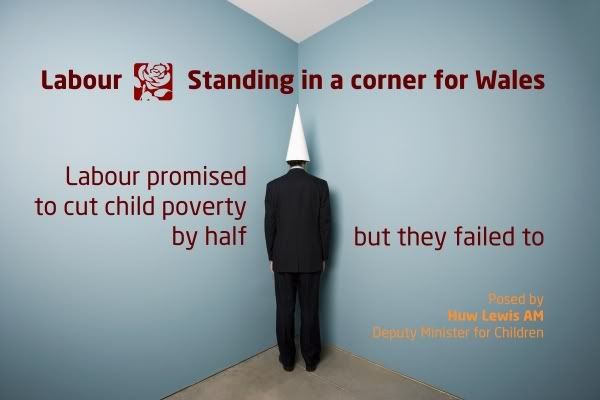
I'm pleased to announce that Huw Lewis has stepped onto centre stage to pose for the next poster in the campaign to highlight just how well Labour has been "standing up for Wales".


Postcard | Hi-res image | PDF

Cerdyn post | Delwedd safon uwch | PDF

By any standard, the failure to cut child poverty levels has been the worst of all Labour's failures. A party that used to pride itself on standing up for those who are less well off conveniently managed to forget all those values when in power. Instead it pandered to the rich, allowed (in fact encouraged) its new friends in big business and the financial institutions to become even more filthy rich, and hoped against hope that some of this money would somehow trickle down to the less well off in our communities.

But their blind trust in the free market economy—and of course they made it more free by not adequately regulating the financial institutions—not only failed to make an impact on child poverty before the credit crash, but brought us all to the brink of ruin when the results of that failure to regulate hit home.

-

So why is Huw Lewis in the spotlight for this? Dear old Screwloose is a good example of someone whose heart is probably in the right place. There are all sorts of things we can do to alleviate the worst effects of poverty for children in Wales. But the bottom line is that poverty is a matter of money. It is a question of how we as a society create wealth and how we distribute that wealth fairly.

Labour have done nothing for Wales in that respect. Relative to the rest of the UK Wales is progressively getting even poorer, and no amount of spending money on special programmes or placing new responsibilities on local authorities and other bodies is going to do any more than make a small dent in the problem. To make a real difference we must also take the levers that control the Welsh economy into our own hands.

But Welsh Labour are absolutely terrified of taking any sort of responsibility for things like taxation and the benefits system in Wales. This is all the more surprising because having an Assembly with taxation powers has consistently been the most popular model of governance in the annual St David's day poll [see here], and because 60% of people in Wales think that the Welsh Government should have control over the benefits system, with only 23% thinking it should remain in the hands of the UK government [see here].

-

There's only one conclusion we can draw from this: Labour are great at spending money on programmes, but are absolutely clueless when it comes to turning Wales into a more prosperous country. It is only by taking the levers of the economy into our own hands that we will have any hope of putting an end to child poverty in Wales.

Bookmark and Share

Poor academic performance ... or just poor?

It goes without saying that the results of the 2009 PISA survey published yesterday are disappointing. But although everyone knows there's something wrong, not many people are giving a coherent reason why.

However the answer one person has given does seem to me to be more plausible than most. Professor David Egan wrote this on This is my truth today ... though it's only an extract from his full article, which is here.


Far more significant, however, was the extremely strong relationship that exists in Wales, compared to more successful countries, between living in relative poverty and disadvantage and not doing well in PISA. That is again likely to be the most important cause that explains our overall performance and it is also possible that we will have slipped further in this respect relative to other countries, including England, who have begun to address the relationship between poverty and educational performance.

Put quite directly, where you are born in Wales, who your family and friends are and the community you live in has a profound effect, despite the raw talents and potential that may be your birthright, with what you will achieve in education and thereafter to a large extent in life. In essence if we want to explain PISA, we need to look no further than the insidious effect which poverty continues to have on our nation and its people, particularly our children.

Today, one day after the PISA results were published, this article in the Western Mail shows how Wales' GVA relative to the UK as a whole has slipped yet further.

     Wales confirmed as UK's poorest nation

The full data are here but the critical figures are:

Wales GVA per head relative to the UK as a whole

1989 ... 85.4%
1999 ... 77.4%
2010 ... 74.3%

This shows that there is a fairly good correlation between Wales' worsening GVA figures and our decline in academic achievement. That, of course, does not prove a connexion, but it certainly adds weight to the probability.

-

It is fair to say that the link between educational achievement and poverty is a subject that Professor Egan has raised on a number of occasions, for example here in March last year. I thought the figures in this table were particularly informative:

The percentage of children not meeting the expected grade in the lower Cynon Valley:

•  Age seven ... 25.1%
•  Age eleven ... 32.9%
•  Age fourteen ... 58.8%
•  Age sixteen ... 77%

Assuming this pattern is going to be pretty much the same for other areas of higher poverty in Wales, this probably does most to explain why Wales does relatively well compared with England in the early key stages, but that performance then declines markedly when children enter secondary school ... and it should be remembered that the PISA tests are taken by those aged fifteen. It would also explain why Wales then starts to do relatively well (at least when the Welsh Baccalaureate is taken into account, as I noted here) in post-GCSE education. This would be because children from more disadvantaged areas are less likely to be taking A levels and the Welsh Bac Diploma.

It is not a matter of poverty, but of relative poverty. Many of us will remember a generation where we were much poorer than we are now in absolute terms, but in a situation where the gap between rich and poor is widening rather than being narrowed, those who are already poor must feel an increasing sense of hopelessness about whether education—which always used to be the obvious route out of poverty—can now still bridge a gap that is continually widening.

-

If this analysis is true, then it would seem to suggest that the problem of our poor academic performance is not really going to be solved by focusing only on education, and in particular will not be solved simply by spending more money on education. To me, that solution seems to be a knee jerk response. People will suggest it either because they feel we have to "do something" no matter what, or because they are involved in education and want to see education cushioned from the severity of the cuts.

Money, particularly investment, is needed. But I think the target should not so much on changing the way we teach, for the changes we have made in the past few years seem to me to be perfectly reasonable, and need time to work through before we can judge them. Instead, the more pressing need should be to change the attitude of hopelessness that seems to be growing as the relative poverty of the most disadvantaged parts of our communities increases. I think Professor Dave Adamson's quote in this clip from the link above hits the nail on the head.


There's almost a social isolation that can occur, and young people can get locked in a local culture where they have very low aspirations. They don't expect to do well in school, their parents don't expect them to do well and, sadly, their teachers often don't expect them to do well. So it becomes a self-fulfilling prophesy that they won't do well.

Bookmark and Share

Child Poverty ... what can Wales do about it?

Thanks to Valleys Mam, I downloaded Victoria Winckler's research paper for the Joseph Rowntree Foundation on child poverty in Wales.

     What is needed to end child poverty in Wales?

It's a very good piece of work. And as it's only eight pages long, I really would urge people to read it. It says nearly everything I could think of saying about the subject—and a great deal more that I hadn't thought of—far better than I could say it.

-

If I wanted to add anything, it would be that better public transport is one factor that would help (by no means at the top of the list, but on it somewhere). It is mentioned in the paper, though only once. The big things are getting more people into work and improved childcare.

In London, for example, there has been a scheme for those on Income Support to get half price travel on buses and trams. That was introduced by Ken Livingstone but, more surprisingly, Boris Johnson has extended that scheme to include those on Job Seekers Allowance and the new Employment and Support Allowance. The reason is this:

[The scheme] is designed to help people back to work by making it easier to travel to interviews, and access libraries, job centres, and other amenities.

Mayor of London Press Release, 2 April 2009

We sometimes forget that London has a few devolved powers. So if they can do it, why shouldn't we? It's worth noting that this concession can continue for up to six months after the person gets work. I like that, because it might make all the difference to someone's ability to take a job. There is always some uncertainty in the first few months about how things might work out in a new job.

And I would also add the need to better enforce the minimum wage, as there are many examples of employers flouting the rules, and too few enforcement officers in Wales.

-

I'd like to widen this discussion. Doing away with child poverty is one thing that must surely unite all of us, no matter what political views we hold. It is shameful, and we must do something about it.

So I'd like to invite people to suggest what we could do in Wales to improve our particular situation. If we are serious about devolving more powers to our Assembly, we are not going to do it simply by arguing in general terms. We need to be able to give specific examples of how the political power to do things differently in Wales will make things better.

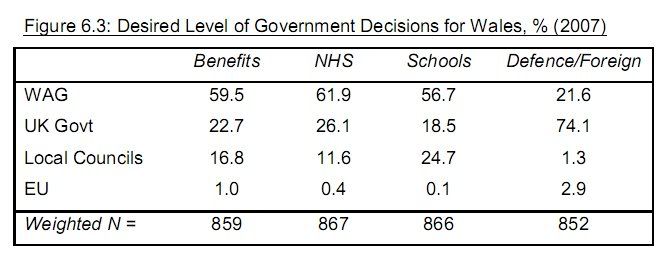
I'll start with this. A couple of months ago, I was surprised (although very pleasantly surprised) to read that a 2007 survey had found that a large majority of people in Wales think that the Welsh government should be the body that makes decisions about the benefits system in Wales. I mentioned it on the Syniadau Forums.

Survey respondents were asked about which level of government "ought to make most of the important decisions for Wales" for four key policy areas: Welfare Benefits, the National Health Service, Schools, and Defence and Foreign Affairs. Results are presented in Figure 6.3 below. These show not only clear majority public support for the devolved level of government to have control over areas where they already make many decisions—on schooling and healthcare—but also a similar level of public endorsement for those powers to extend to an area like welfare benefits. The latter is striking, as it is a policy area that currently remains very much reserved to Westminster.

Source

The reply format in a blog is fairly limited, especially in terms of formatting and the ability to include images, etc. So if anyone wants to reply in more depth, you are welcome to respond on a new thread I've opened on the Syniadau Forums.

Bookmark and Share