Showing posts with label Barnett. Show all posts

Parity with Scotland?

There are many things to criticize Plaid Cymru for, but the one thing that has disturbed me most is in fact the central plank of their election campaign: namely that they want parity with Scotland both in terms of devolved powers and in terms of funding.

I don't have a particular problem with parity of devolved powers because, as things stand, our National Assembly has fewer powers than the Scottish Parliament, and therefore parity would be a practical first step. I would only qualify this by saying that I wouldn't want the powers of the Scottish Parliament to act as a limit. To give one example: it looks likely that powers to set the rate of Corporation Tax will be devolved to the Six Counties, but not to Scotland. Therefore I would want Wales to have this power too, irrespective of whether or not Scotland gets it.

For me, the principle is that I want everything that is currently decided at Westminster to be decided by our National Assembly ... in other words, independence.

-

But I do have a very big problem with the idea that Wales should get parity of funding with Scotland. And I am frankly amazed that Plaid Cymru has abandoned its previous position of wanting fair funding for Wales, and now wants something that is patently unfair.

Of course I understand why and how it happened, but that doesn't excuse Plaid's behaviour. The Holtham Commission did a good piece of work, demonstrating that Wales was underfunded relative to need on the basis of an objective formula. At that time, the block grant to the National Assembly fell short of what we would get by applying this needs-based formula by roughly £300m a year. This was set to get worse because of the Barnett Squeeze, but in fact has not got worse because cuts in public expenditure have put the Squeeze into reverse. However the shortfall will increase again when public expenditure starts to rise over the next few years.

Because of this shortfall, coupled with general discontent with the way Barnett worked anyway with regard to Scotland, there seemed to be consensus among all the parties in the Assembly (the Tories, Labour and LibDems as well as Plaid Cymru) that Barnett had reached the end of its working life and needed to be replaced. The problem is that just before the Scottish independence referendum, those three Unionist parties panicked in the face of closer than expected opinion polls, and made a vow to retain Barnett.

It was at this point that Plaid Cymru panicked ... with the result that they came up with a policy to demand the same amount of funding per head as Scotland gets. Of course not all public spending in Scotland is channelled through the Scottish Parliament (for example most benefits and pensions are paid directly to individuals and families) but if the same "block grant per head" were paid to our National Assembly as is paid to the Scottish Parliament it would indeed, after making allowance for different devolved functions, result in Wales getting something like an additional £1.2bn in block grant.

Now what's wrong with that? Well, to put it bluntly, any child could see what's wrong with it. Why pick Scotland? Why not pick England instead and demand that Wales gets a block grant equivalent to the same level of funding per head as England? Simple, because if Plaid Cymru picked England, Wales would get much less of a block grant than we do now. In other words, picking Scotland is a blatantly biased choice. If the principle you adopt is equal spending per head, then that has to apply across the whole of the United Kingdom—which, by the way, is UKIP's policy—it cannot be applied selectively.

In effect what Plaid Cymru are doing is asking English taxpayers to give Wales much more than we need on any objective basis, and very much more than they give themselves. It is a wicked and stupid idea, and I have to say I'm very glad that I am no longer associated with a party that can come up with something that can only be described as a total perversion of any concept of either fairness or reason.

-

In principle there are some very basic rules about how to redistribute funding between different parts of a state. We need to consider two things: how much each part of the state produces in terms of tax revenue, and how much each part of the state needs. One sum will be usually be higher than the other, and an equitable funding formula must be somewhere between the two. It cannot be outside that range.

A needs-based formula on its own will not work because, as the Holtham Commission noted, if it were applied to Scotland, it would result in Scotland getting maybe £4bn a year less in block grant than it does now. However that does not mean that Scotland is over-funded, because Scotland provides more per head in tax revenue to the Treasury than most other parts of the UK. In Scotland's case, the proportion of tax revenue it contributes to the Treasury is more than its relative needs, therefore it is right that Scotland gets more than it needs.

But in the case of Wales, what we produce in tax revenue per head is quite a bit lower than other parts of the UK, and the sum is also lower than what we objectively need, based on the formula used by Holtham (which, by the way, is based on the way money is distributed by departments within England). It is therefore reasonable and justified to say that Wales deserves more money, but only as much as will bring us up towards what we objectively need ... not more than that. To ask for or expect more is nothing but greed. Yet this is what Plaid Cymru have sunk to. It's sickening and shameful.

-

It's also deceitful, because it is undeliverable. As I showed in the last post, even if the SNP win upwards of 50 seats on Thursday, they will not get to determine the direction of government. The same would be just as true if Plaid Cymru won 35 seats in Wales. 533 English MPs will never vote to give Wales more than it either contributes to the Treasury or needs.

That's not to say that there are other aspects of the way Wales is funded that can't be improved. In addition to the £300m shortfall in the block grant (or whatever it now is when the Holtham formula is applied) we can rightly call for our fair share of infrastructure investment so that, for example, Wales gets a pro-rata share of rail infrastructure investment or research funding relative to the rest of the UK. But we must make a reasoned and rational case for this, and we weaken any case we make if we, at the same time, are making unreasonable and irrational demands.

-

In closing, I would also ask people to consider, in practical terms, what the result of getting more money from England than we either need or contribute to the Treasury would be. How on earth would it help us stand on our own two feet as a nation? It would simply tie us closer into dependency on England. Yet this is party policy ... from a party that supposedly wants independence! Perhaps, under better leadership, Plaid Cymru might become a party that is worth voting for again ... but it certainly isn't worth voting for them now.

Bookmark and Share

Wales should now get £1.9bn

I'm very pleased that the UK Transport Secretary has today announced that the HS2 line between London and Birmingham is to go ahead.


This investment of £33bn is entirely within England. By all rights Wales should get a Barnett consequential of 5.83% in so far as it is funded from the Treasury or other public funds. On the full sum, this would equate to just over £1.9bn.

The priority now is to make sure we get it, rather than have to put up with the same sort of fudge that we had to endure over the expenditure on the Olympic Games. Having seen coverage of the statement in Westminster, I think our politicians would do far better to concentrate their efforts on securing this money for Wales rather than talking about about tunnels through the Chilterns.


Update - 18:45, 10 January 2012

For those who aren't aware of it, just before Christmas the current UK Government were obliged, under the inter-governmental disputes procedure, to make a U-turn over the Barnett consequential for the Olympic Games in London ... but only for that period in which they have been in power. Details here.

Sadly, the vast majority of the expense was incurred before that when Labour were in power in Westminster, so we're only getting a small fraction of what we should have got. But the point of principle has been established. Therefore the question is whether the Welsh Government will fight for a similar Barnett consequential in this case.

Bookmark and Share

Sharpening Up

I was particularly interested in something Betsan Powys' wrote in her blog today on the official launch of the Yes for Wales campaign.

It was about freeing politicians up to focus on delivery, said Mr Lewis. It was also about not conflating the Assembly Government's performance so far with the powers that would be given to the Assembly as an institution and any future government that will be at the helm.

Another difficulty. If it is not about political decisions taken already by this government, why does the campaign leaflet say that "it's good to know that our National Assembly is protecting schools, skills and hospitals" – the mantra of Labour and Plaid ministers? Where's the 'clarity' in that?

It won't be easy, was the gist of the response. Future leaflets would be "sharpened up." This is, after all, a cross party campaign, one having to explain what powers have been used for so far, what a 'yes' vote would mean and how more powers could be used in future. "That's the tightrope we're having to walk". In other words, we concede now that there'll be an occasional wobble.

Yes = No Excuses, 4 January 2011

I picked up on the "it's good to know that our National Assembly is protecting schools, skills and hospitals" line when the leaflet first came out, saying in this post that it had stretched things too far in a party political direction and wondering how comfortable Yes supporters from the LibDems and Tories could be with it. It wasn't a good start. Yes for Wales is meant to be a cross party campaign, and for that reason it has to be very careful about making statements that have the potential to alienate potential supporters.

So it is welcome and reassuring to hear that the campaign has taken notice of this and that future leaflets will be "sharpened up". It's a positive sign.


But it is a tightrope, and so it's perhaps inevitable that the campaign will sometimes stray from the issue of primary lawmaking powers and nothing but primary lawmaking powers, simply because others are trying to make out that it is to do with issues like independence, tax varying powers or the performance of particular parties that have formed the Welsh Government, at least up to now. So, as with any cross-political/cross-society group, we need to be careful not to take what someone might say if they do start talking about wider issues as necessarily representing the views of all the shades of opinion in the group. It is only reasonable to expect to Yes for Wales to deal with the issue it was set up to campaign for.

A good example of the danger is on this page of the Yes for Wales website on the subject of taxation. This first statement is perfectly correct:

The Assembly has no powers to increase or reduce taxes, whatever the outcome of this referendum.

But it is immediately followed by:

Any changes to taxes would require a further referendum.

Now that is a perfectly valid political opinion, but Yes for Wales is not in a position to determine whether a referendum will be required or not. Nor is any politician or political party. In constitutional terms, Westminster remains sovereign and can do whatever it likes. If Westminster decides to make the Welsh Government responsible for raising some of the money it spends, rather than simply giving a fixed block grant which we must either spend in its entirety or lose, it will be able to do so irrespective of whether we in Wales agree or not.

When his Commission's report was published, Gerry Holtham made the point that the issue of how Wales was funded was a matter of basic political accountability. In one interview he said that principle of accountability would apply even irrespective of the areas of responsibility that are devolved to Wales ... that it would apply if things stayed as they were, if more subject areas were devolved, or if half the currently devolved areas were re-centralized to Westminster.

-

Now I can understand why someone like Carwyn Jones would go out of his way to say that applying for tax varying powers was not on his political agenda. As he said a few times when he faced the Assembly Scrutiny Committee on 7 December 2010 (15:10 and 25:40 of this recording on Democracy Live) he thought that reform of Barnett was a greater priority. And I agree with that entirely, because without properly defining the principle of a fair baseline, there is nothing to set any tax variation against. It would just be horse-trading. But, that said, I have to note that the ConDem government seems determined to press ahead with that in Scotland without considering any replacement or reform of Barnett ... which is asking for trouble, as an ad hoc solution made now will only muddle things in the longer term.

In the second section, he did appear to be particular concerned that tax varying powers would be portrayed by some less scrupulous "mischief" makers (I'm sure we can all think of a name) as being linked in some way with the referendum on primary lawmaking powers. But I think he is being over-cautious in this respect. The two are not linked in any way, and even in the very unlikely event that this referendum were to be lost, the pressure for the Welsh Government to be accountable for raising at least some of the money it spends will still be there.

Bookmark and Share

I'm not proud of it ... it's so unfair

Here's a short video interview with Joel Barnett which appeared on the BBC yesterday:


Is the Barnett Formula a thorn in Lord Barnett's side these days?

Well, in one sense it is: in the sense that it's so unfair and my name is attached to it ... I'm not proud of having my name attached to something that's so unfair now.

He's not saying anything new, but it's a timely reminder of why it needs to be replaced with the sort of needs based formula worked out by the Holtham Commission. And of the fact that it gives Scotland extra money at the same time as it short changes us.

But Labour did nothing to change it when they were in power, and now the Tories and LibDems are refusing to do anything about it either ... on the prextext that they have to sort out the UK's finances before they can be bothered to deal with something that's patently unfair to Wales.

But if we in Wales complain about it, we're called whingers. Remember that in next year's Assembly elections.

Bookmark and Share

If you don't understand ... email a friend

Like many others, I read with interest Gerry Holtham's explanation of why Wales has suffered disproportionately compared with Scotland and Northern Ireland as a result of the ConDem government's recent spending review.

     Why Wales has been hit

At the end of his explanation he added the line:

Got that? If not try reading it again!

I have to admit that I didn't understand it (or perhaps it would be better to say that I understood some of it but not all of it) and so I read it again. Still not there. So I then made myself a double espresso to get my brain into top shape for the third attempt, but finally had to admit defeat. It was at that point I emailed a friend.

We met up last night, with some others, and it was one of the things we talked about. The consensus seemed to be that a lot of people hadn't really understood the point he was making either, including those (even in the House of Commons) who we thought would have understood. But our friend didn't let us down, and I am relieved to say that I now understand the point Gerry Holtham was making.

It's not that the details weren't already there. In fact, it was probably the detail that got in the way of me seeing the big picture. But having it explained from a slightly different angle, I can now re-read Gerry Holtham's article and see that it all makes perfect sense. Therefore, in the hope that it might help some others, this is the simpler version:

•  Non-Domestic Rates are collected from businesses by local authorities. In England and Wales they are then forwarded to the Treasury in Whitehall and put into a common pot. The Treasury then adds additional money to that pot and redistributes it.

•  In Scotland and Northern Ireland Non-Domestic Rates do not go to Treasury in Whitehall, but the Treasury still forwards the same percentage of additional money to the individual pots of the governments of Scotland and Northern Ireland, who then redistribute it.

•  In both cases the collected NDRs are about 82% and the top up is about 18% of the final redistributed total.

•  The UK government has decided to cut the amount of the top up by a total of 27% over four years.

So far, everything is fine in principle. We might not agree with the cuts, but we have to live with them. The problem is that the Barnett Formula is only designed to determine what is paid out to the devolved nations from the Treasury, and doesn't take into account what these nations pay in. As a result of this anomaly:

•  Scotland and Northern Ireland get to keep all of the NDRs they collect because they didn't go into the Treasury pot, and will only suffer a 27% cut in the top up.

•  But Wales, because our NDRs have been paid into the Treasury pot, has to suffer a 27% cut over the entire redistributed total ... not only the top up, but the NDRs that have been collected from businesses as well.

Put another way, it means that the Treasury is going to hold on to a considerable proportion of the money we collect from businesses in Wales. As Gerry Holtham says:

This ... is more than enough to explain the whole difference between the Welsh total fall of 7.5 per cent in public spending, Scotland’s 6.8 and Ireland’s 6.9 per cent reduction.

I hope that those, like me, who didn't really understand the original article will now understand it. And I particularly hope this includes those in the House of Commons, because the only possible response to this is to be angry ... very angry indeed.

This can't be swept under the carpet with the excuse that the Barnett Formula will one day be replaced. This is a problem that affects us now. It is a loophole that can be fixed very easily by simply "ring-fencing" the NDRs we pay into the Treasury, so that the 27% cut only applies to the top up sum, not to the whole redistributed sum. It is an issue that should unite MPs from every party in Wales ... including the Tories and LibDems.

Come on. Let's see you stand up and fight.

Bookmark and Share

A port in Wales for our growing wind industry

Let's start with the good news. It's right that the UK government has decided not to cut the £60m fund earmarked for the development of ports from which to build and maintain offshore windfarms. There was definitely a question mark over whether this money would survive the spending cuts, so I'm very glad it has.

But the bad news is that the UK has decided that only ports in England can bid for this money, as we can read in these reports:

     Call for 'level playing field' on wind turbine subsidy
     Wind farm scheme biased, says Welsh MP

I was going to write something short and scathing about this decision when I heard about it on the news this evening, but soon realized that the matter isn't quite as black and white as it appears.

The first thing to say is that Wales, Scotland and the north of Ireland will get a Barnett consequential from this England-only spend. For Wales, this will work out to about £3.53m under the present arrangements. However it should be said that if the ConDem government introduces the "Barnett Floor" as recommended in the Holtham Commission report, we would get 117% of this, i.e. about £4.13m. This should be a timely illustration of why we cannot let the matter of fair funding for Wales continue to go unaddressed. In times like this, every half million counts.

-

But if we are going to get our share of the money anyway, why exactly are Ieuan Wyn Jones and Albert Owen making such a fuss? Well, they haven't made that clear, but I hope at least one of the two will have thought of it like this:

£60m is not a lot of money. Any sort of construction work in order to develop a port to be able to handle the size of wind turbines involved is going to cost many tens, if not hundreds of millions of pounds. So for any grant from government to actually make a meaningful difference, the £60m pot of money can only realistically be divided between two or three ports. £20m will be a significant investment which should be enough of a sweetener to attract the rest of the investment necessary, but £5m won't make any real difference one way or the other. So even if we were to get our full £4.13m, we could not use it for a Welsh port in such a way as to compete if the UK government chose to give that money to say Liverpool, Barrow or Avonmouth.

The second factor in the equation is that DECC only this week signed a letter of intent with the Crown Estate setting out a strategy for the UK as a whole, rather than one that recognized the devolved administrations. We can read the details here:

     The Crown Estate and Government
     Signal Boost for UK Offshore Wind Supply Chain

So we have the classic muddle of one department of the UK government (Energy and Climate Change) working on a UK basis, while another department of the same government (Business Innovation and Skills) just thinks about England, because the money is classed as industrial support ... or at least that is what the UK government is saying in order to justify its decision to invest the £60m only in England.

Where, we have to ask, was our Secretary of State for Wales when this was being decided? It's her job to make sure that this sort of muddle does not happen ... but Cheryl Gillan has once again failed to do her job.

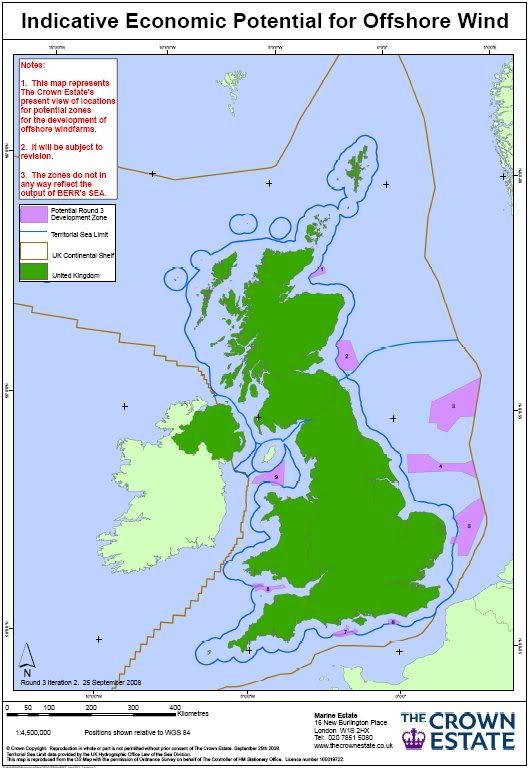
The end effect of this decision is clear enough. There will almost certainly be one manufacturing and maintenance port on the west coast of England, and either one or two on the east coast. A glance at this map of the new Round Three wind farm zones should make it obvious why: the largest new wind farm zones are in the North Sea.


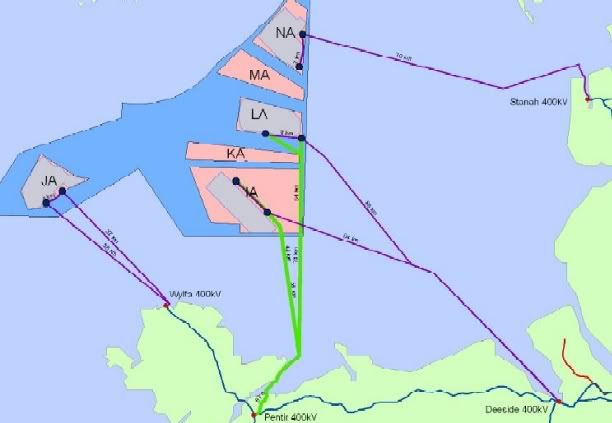
But on the west coast by far the largest Round Three zone is in the Irish Sea and, as the second map shows, the closest large port to it is Holyhead. So if the decision on where to provide money to help build new port facilities on the west coast is limited to England, it becomes pointless for us in Wales to provide a duplicate ... not that our £3.5m Barnett consequential could compete with the £20m or £30m that a port like Liverpool or Barrow could be awarded anyway.

That's why this decision is unfair. We have the potential to make Ynys Môn the nerve centre of the offshore wind industry in the Irish Sea, but Westminster seems determined to make sure that a port in England is given an unfair advantage over one in Wales, even though Holyhead is in a much better location for it. It's yet another example of the contempt agenda. Westminster simply concentrating on what's best for England, rather than working with the devolved administrations to develop a joined-up strategy.

Bookmark and Share

Peter Black makes a fool of himself

As if it wasn't enough for Carwyn Jones to make a fool of himself by saying that we wouldn't get the £300m by which Wales is currently short-changed unless we voted Yes in a referendum on primary lawmaking powers, Peter Black has now stepped in to muddy the waters yet further.

Over on Freedom Central he said:

The claim that for every day the coalition fails to act on the Barnett formula it costs Wales £800,000 is also misleading and disingenuous. Gerry Holtham himself has suggested that it could take 10 to 14 years before Wales receives the full benefit of such a reform. It cannot be achieved overnight and it does not help that Wales’ most senior politician goes public in this way to suggest otherwise. Where is his evidence? Clearly, Carwyn does not want the facts to get in the way of a good story.

The cost of a no vote - 5 August 2010

The fact Peter can't quite face up to is that Wales is currently losing £300m a year. Carwyn Jones was not wrong about the figure, he was wrong to link it to a Yes vote in the referendum. This is the figure calculated by the Holtham Commission, based on a lower end estimate of what Wales would get if it was funded on the same criteria as a region of England.

The next thing he misunderstood was the timescale necessary to address the problem. It will not take years. Gerald Holtham said that a fix could be applied immediately: namely to establish a "floor" so that future Barnett incrementals to Wales would be multiplied by 114%. Indeed, it's fair to say that Peter Hain probably did try to establish such a floor in his last days as Secretary of State, but the Treasury refused to make any commitment to apply it, saying only that they would "look at the situation" and act if it was clear that Wales was being "disproportionately disadvantaged".

Gerald Holtham was incredulous. He said the government were acting like "silly billies" for not making such a commitment because, at a time when it was clear that public spending was not going to rise at the rates it had been doing, it would cost the government very little to apply such a floor straight away. I commented on it here.

-

OK, that was before the Westminster election, and Labour clearly missed their opportunity. But now the ball is in the ConDem government's court. They can do what Labour failed to do. The perfect opportunity to apply the floor will be as part of the Comprehensive Spending Review that is due in October.

The 10 to 14 years is a red herring that Peter is using as an excuse for his government's inaction. Gerry Holtham was talking about the long-term replacement of the Barnett Formula rather than the 114% floor that could be applied immediately. Peter wants to imply that because Labour did nothing to replace the Barnett Formula in the 13 years that they were in power, the government that his own party is part of can be excused for doing nothing as well. But that misunderstands the situation. The true picture is quite clear from the Holtham Report:


To put it in blunt terms, if the indicators of Wales' needs relative to England are in the band between 114% and 117% (which is what Holtham has calculated) then Wales was probably getting more than it should have got in past years ... although this would also have been the case for NI, and even more true for Scotland which by every measure is overfunded relative to need. But as public spending increased, the application of the Barnett Formula produced a convergence of spending relative to England ... something known as the Barnett Squeeze. It is only in the last few years that this has resulted in Wales getting less than it should on a needs based formula. But if the situation is not dealt with now the gap will get bigger and bigger, though by how much will depend on the rate of growth or contraction of public spending.


That is why Peter Black, is completely "away with the fairies" when he goes on to say this:

And of course if this is so important then why is it that Labour did nothing to reform the Barnett Formula for the 13 years when they were in power both at Westminster and in Wales? On the First Minister’s calculations that inaction has cost Wales £3.9 billion since 1997.

Peter really should leave maths to people who have some grasp of numbers ... though I suppose if he did have any numeracy skills, it would make him noticeably different from his LibDem colleagues.

Bookmark and Share

Carwyn makes a fool of himself

Who knows, perhaps Martin Shipton has got hold of the wrong end of the stick, but if what he is saying in the Western Mail is true (and I'm sure he has the press release to back him up) then it is Carwyn Jones who is making a fool of himself.

Wales is losing £800,000 a day because the National Assembly does not have primary law-making powers, Carwyn Jones will claim today.

The First Minister will tell an audience at the National Eisteddfod that winning a referendum on the issue next year would trigger a reform of the funding formula experts say robs Wales of £300m a year.

Mr Jones will go on to say: “Now, given that Wales is underfunded by some £300m per year, it means that for every single day Wales doesn’t have these powers, we lose £800,000 each and every day.”

Western Mail, 4 August 2010

Revising the way Wales is funded for devolved areas of spending has absolutely nothing to do with the referendum on primary lawmaking powers. At any time during the last ten years—or indeed in the years when spending decisions were made by Secretaries of State for Wales and Scotland—the Barnett Formula could and should have been revised.

This is just cheap, nasty, misinformation designed to get people who don't know better to vote Yes in the referendum. We simply do not need to resort to such tactics. Doing so plays into the hands of people like True Wales who will take it as further encouragement to spread their own brand of misinformation. We don't need two groups muddying the water.

-

Now it is true that we will save money by getting rid of the LCO process. But it will be a marginal saving. It will cost us more to draft legislation, but this will be offset as money will be saved by avoiding duplication of time and effort in Westminster and Cardiff Bay ... as well as the fact that AMs cost us much less than MPs, partly in salary but mostly in expenses.

That would be a reasonable point to make, and indeed Carwyn Jones does go on to make it. But to claim that getting rid of the wastefulness inherent in the LCO process is linked to changing the way the block grant is calculated is disingenuous, to put it at its mildest.

Bookmark and Share

Fair Funding for Wales? Forget it!

I've just been reading the full ConDem coalition agreement, but had to stop when I read this:

•  We recognise the concerns expressed by the Holtham Commission on the system of devolution funding. However, at this time, the priority must be to reduce the deficit and therefore any change to the system must await the stabilisation of the public finances.

The Coalition: our programme for government

Which is likely to take a very, very long time. The first part of the Holtham Report was an excellent piece of work which exposed the extent to which Wales has been systematically underfunded. It led to all parties having no choice but to recognize that the current funding mechanism was unfit for purpose and needed to be changed, and that it was particularly unfair on Wales.

Well, it's very easy to say you want it changed before an election ... but then find an excuse to do absolutely nothing to change it when you get into power.

It's a shameful decision for which both parties now in power in Westminster will pay dearly in the polls ... and Labour too, for they had the opportunity to change it when they were in power, but refused to do so.

Bookmark and Share

Guto Bebb

Not so long ago Guto Bebb, the Tory candidate for Aberconwy, wrote a couple of posts about tax and borrowing powers for Wales. In the first he said:

The fundamental dishonesty of the debate surrounding Barnett in Wales is the fact that Plaid Cymru continually make wildly exaggerated claims about the unfairness of the current formula without ever attempting to explain what would happen if their stated aim of an Independent Wales was to be achieved.

Think about it. No Union = No Barnett Formula. Plaid Cymru claim that the current shortfall is hugely unfair to Wales. The current shortfall has been identified by Holtham as spending of £112 per head via the Assembly block grant rather than the £114 per head which Holtham thinks it should be if the needs based analysis used to distribute money to the English regions was utilised here in Wales. What would be the shortfall if the stated Plaid Cymru aim of independence was achieved? They never seem to be willing to respond to that question and their Honorary President conspicuously failed to address the issue last night when I made these very points.

The lesson is clear. When Plaid talk about Barnett ask them what they would do to make-up the shortfall if Barnett did not exist because that is the ultimate aim of their policy of independence.

Not much that Guto writes is that relevant, but this included several references to Plaid and posed some direct questions. So I replied with a comment based around what I said in this post:

     Holtham: Taxes and Barnett

I checked his blog again today as a result of reading this post by Alwyn ap Huw, and saw that Mr Bebb had simply deleted it. It appears he's very good at throwing out accusations, and of course he's quite entitled to put his fingers in his ears so that he can't hear any reply ... but it is something else to stop anybody who reads his blog seeing the reply.

Aberconwy is going to be a tight contest between Plaid and the Tories, but one that I think Phil Edwards will win. One of the things that will swing it for Plaid is that the Tories do seem to have made a rather unfortunate choice of candidate.

Bookmark and Share

None so blind ...

For a party that claims the Westminster election is a straight choice between them and the Tories, Labour do seem to be putting rather a lot of emphasis on trying to keep the United Kingdom together. This is what Gordon Brown said in an interview in this morning's Western Mail:

I think everybody knows that Wales, like Scotland, is stronger within the Union, and the strength of Great Britain and the United Kingdom is important to developing the modern economy and international relations that we need.

Because we can work together, we're stronger together than we are apart. I want a Britain that grows together and doesn't grow apart.

Gosh. Anyone might think the real challenge to his party is coming from another direction.

-

He then goes on to make this even stranger statement:

He also suggested that Labour could look again at the contentious system of funding Wales from Westminster, saying: "The principle should be that Wales and Scotland and the regions of England should be funded according to their need.

"How you implement that depends on you coming forward with proposals to do so, and we're always ready to look at any proposals that come forward."

This may come as news to Mr Brown, but the Holtham Commision has already put forward proposals to do exactly that.

-

So what are we left with? A Labour Party leader who knows that the funding formula is unfair, who knows the principle on which a fairer funding system should be based ... but who claims that someone has yet to come up with a way of changing the formula.

Now why would he do that? It's obvious: if Gordon Brown were to acknowledge the work already done by the Holtham Commission he knows people would then ask him why the Labour government did nothing to implement any changes. So it's better for him to turn a blind eye to it.

But he still expects people in Wales to vote for his party. Fat chance!

Labour have had plenty of chances to deal with the problem. They've chosen not to do so because unfairness to Wales matters little to a party whose main purpose is to hold onto power in Westminster.

Bookmark and Share

The Western Mail

Wednesday's editorial in the Western Mail was one of those rare occasions when I have been genuinely surprised by a newspaper's stance on an issue.

Powers that would boost Welsh democracy

Devolution, as Ron Davies memorably said, is a process not an event. While the next step in Wales will be the referendum on further lawmaking powers, an equally important debate concerns the level of financial autonomy that should be available to the Assembly Government.

Many will be instinctively reluctant to grant any kind of tax-levying powers to Cardiff Bay, fearing that that would inevitably result in a higher tax burden. But that is by no means necessarily the case, as the Scottish Government has demonstrated by choosing not to vary the rate of income tax during the first 10 years of devolution.

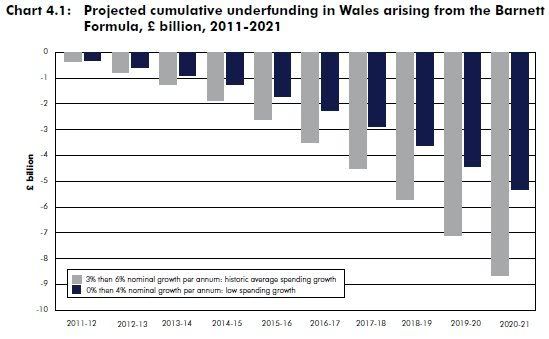
We believe there is a strong argument for changing the way the Assembly Government is funded. There is already substantial concern about the workings of the Barnett formula, which allocates resources to Wales, Scotland and Northern Ireland. The Holtham Commission, which has been asked by the Assembly Government to investigate current arrangements, has already concluded that Wales stands to lose £8.5bn in Treasury funding over the next decade because of the way Barnett works. A move to a robust needs-based formula is clearly appropriate.

But there is a wider issue of accountability that suggests granting the Assembly Government the power to levy or at least vary taxes would strengthen Welsh democracy. At present AMs are only able to make decisions about how to carve up the block grant from the Treasury – they have no ability to vary the total amount of the cake. In this respect, they are in a less powerful position than the smallest community council in Wales, which can fix its own precept. Political parties and others often deplore the lack of political engagement with Welsh politics. Nothing would be more likely to stimulate a greater interest in the affairs of the National Assembly than the possibility of a tax increase. More crucially, the existence of tax-levying powers would force parties to concentrate their minds on the need to create the wealth from which tax revenue springs.

We also support calls for the Assembly Government to be granted full-scale borrowing powers. In the short term, this would allow a forward-looking administration to overcome the constraints on capital spending to be introduced whoever wins the general election. It would also give ministers greater flexibility in planning projects like new hospitals.

An additional reason for supporting tax-levying and borrowing powers is that Wales cannot afford to lag behind Scotland as devolution goes forward. With the Scottish Government likely to be granted income tax-varying power of up to 10p in the pound, our politicians should be trusted with the same responsibility.

Western Mail, 24 February 2010

The last time Martin Shipton said something that made my jaw drop was when the first part of the Holtham Commission's report came out in July.

As I mentioned in this post at the time, the doyen of Welsh political journalism—or weathered old hack, if he doesn't mind a little affection—said this:

The importance of the Holtham Commission’s findings about the way the National Assembly is funded cannot be overestimated.

... What is particularly neat about the Holtham report is the way the Commissioners have deployed the very same formulae used by the UK Government to allocate funds in the English regions to demonstrate that Wales is likely to lose out by billions of pounds over the next decade.

It is astonishing – and grossly unjust – that what is considered the right way to do things within England is regarded as unnecessary or unacceptable in the context of the UK as a whole.

Western Mail, 8 July 2009

The subject is the much same, so I'm not surprised at that. However what has changed is that the earlier statement was just one journalist's opinion, but it has now become the Western Mail's editorial position.

That is quite some shift ... and of course it is one that I welcome.

Bookmark and Share

Holtham: Taxes and Barnett

A few people have followed up on a post on Tom Bodden's blog about what Gerry Holtham had to say in one of the Plaid Conference meetings over the weekend. Although some good comments were made (and some not so good) I'd like to offer a different perspective. This is what he said:

On Taxes

Some 100,000 people commute across the Wales-England border each day, many of those in the North East, while some 25% of population live within 50 miles of the border.

Varying the basic rate of tax by one or two pence, adding a few hundred pounds to tax bills 'wouldn't pay the cost of the removal van' for the economical mobile to up sticks and leave.

But raising the upper rate of tax, adding £10,000 to £20,000 to the bill ... well, 'they are gone.' You would get virtually no revenue from the upper rate of income tax and if you raise it too far you would probably lose it. If you want to maximise revenue you would cut the upper rate of income tax, then if you put a penny on basic rate ... How you explain that to the Welsh electorate I don't know.

I wasn't there, so I can only comment on what he was reported as saying, but it strikes me as a truism to say that adding 1p to the basic rate of income tax paid by, say, one million people in Wales is going to bring in more money than increasing the top rate of tax for a few thousand high earners by, say, 10p in the pound. That's just simple maths. It wouldn't be right for me to speculate why he would say it ... except maybe as a counter to the assumption that raising taxes for the rich is some sort of "silver bullet" that would solve any country's financial problems at a stroke.

But tax is not just a matter of raising money, it is a matter of fairness too. I am not in favour of "squeezing the rich until the pips squeak" ... but I am all in favour of squeezing the rich until it hurts them (and I realize I've sometimes been in that category) as much as it hurts everybody else. The UK is in the scandalous situation that the poorest pay a bigger proportion of their income in taxes than the richest, as reported here and no doubt elsewhere too. That is immoral and the balance must be reversed.

Where I would take particular issue with GH is his idea that people would "up sticks and leave" if the top rate of tax was 10p higher on one side of the border than the other. Tax is complicated, and every country in the world seems to take the default position of wanting to claim tax from you whether you earned it in one country or another. But to avoid the unfairness of paying two sets of taxes, countries enter into "double tax agreements". These are all different because every country has a slightly different system, but I've no reason to doubt that the UK would want to do much the same as in its agreement with France for people who live in France but work in England (a situation that was not uncommon with commuting on Eurostar). The principle was that tax was primarily paid where it was earned, rather than where the taxpayer lived.

So, in our case, if someone had a £150,000 job in Wrecsam it would of course be a no brainer for him or her to choose to live in the country that had the lower taxes if the rules were set up that way. But—if the UK is consistent—it won't be done that way. People will be taxed according to where the money is earned. So the choice is not where to live, but to try and find another £150,000 job in England. That is something very different.

On Barnett

The Holtham Commission discovered that, in his words, Wales received 'slightly less' under the Barnett Formula than it would if it were treated in the same way as an English region, that is £300m-a-year less. If Wales received a share as an English region it should at least receive about £114 for every £100 on spent on average in England. It actually receives £112.

The Treasury, Mr Holtham reports, are 'fairly reluctant to do anything' about that. Northern Ireland receives £125, when it should get £121, while Scotland's share is £120 compared to £105. So while Wales is £300m under-funded, according to Holtham's calculations, Scotland receives £4.2bn-a-year more.

And running into a General Election where the main opponents to Labour in Scotland is the SNP, Holtham reckons: "If you think they're going to change that, forget it." The Calman Commission in Scotland suggested extending the tax-raising powers there by sharing the income tax base, allowing the Scottish government to tax at 10p in the £, or to vary the bill, and reducing its block grant from the Treasury by say £5bn in recompense. Holtham says this is attractive because it "clarifies political accountability" for the electorate. If the UK Government accepts that argument for Scotland, then it should do so for Wales, he said.

What about a resources tax, say charging more for Welsh water exported to England? The Treasury would probably respond by cutting the Welsh block accordingly, says Holtham and, at any rate, it would be slim pickings, some 5% on £600m turnover would raise £30m, and half of that would lost.

The second part of what Gerry Holtham said is to do with the Barnett formula. Specifically that Scotland does much better out of it than would be the case if a needs based formula were to be applied. Well again, that is undeniably true. But the complicating factor is that Scotland's position is a sort of compromise that in practice reflects the fact that Scotland contributes a substantial amount to the Treasury through North Sea oil and gas even though in theory it is a simple head count formula. More by luck than judgement, the two tend to balance each other out.

Of course it's right to say that Labour, in particular, would never want to open the "can of worms" for fear of increasing support for the SNP if it treated Scotland as severely as it has treated Wales over the last decade or so. But I think the question is much easier to solve if the two issues are kept strictly separate:

•  Firstly, the UK should adopt a needs based formula for funding to replace Barnett. The Holtham Commision has suggested a number of simple to apply indicators that could be used to assess need. That would result in Wales getting more and Scotland getting less, thus being fair to Wales.

•  But secondly, the UK should adopt some way of allowing Scotland to keep a proportion of the taxes raised from North Sea oil and gas. In other words what Scotland loses on one side, they would stand to gain on the other. By separating, rather than conflating, the two issues it should be possible to reach a fairer overall solution.

Of course allowing Scotland to set the level, and keep, some of the taxes which used to go directly to the Treasury is one step further towards fiscal autonomy. But a degree of fiscal autonomy is now inevitable for Scotland because Calman, set up by the three unionist parties to establish a common position between them, has recommended its minimalist proposals for further devolution. In my opinion the principle is right (it is one half of what I said above) but what is wrong with the 10p proposal as it stands is that it gives Scotland control of only one lever. Effective taxation requires a balance of taxes tailored to suit each country's unique circumstances, to promote particular policies (such as green taxes) and to create fairness (because the 10p proposal has no mechanism for varying allowances, tax bands and higher rates it could increase the gap between rich and poor).

I think Gerry Holtham has got it wrong about any taxes Wales raises on its resources. It would be pointless to automatically reduce the amount of block grant Scotland or Wales gets to the same extent that we gain from any money we raise by taxing our natural resources. Of course the Treasury, under its present political masters, would try to do it, even though it would be unfair. One of the problems the UK has is that the Treasury acts as judge in its own cause ... so we need a more objective and independent way of making such decisions. For example, in a federal UK the federal chamber (currently the House of Lords) would make such decisions in a quasi judicial way, with each of the countries of the UK having its own Parliament ... the current House of Commons becoming England's.

-

However, for as long as we remain in the Union, we should expect to keep only a proportion of taxes raised in that way, or to get a proportionately, rather than strictly equal, lower block grant. The path towards fiscal autonomy must be one of increasing the proportion we keep from the taxes we set and raise, while reducing the proportion we get because of needs.

So for Scotland, for example, there would be an absolute needs based formula for assessing the block grant, but only 80% of it would be paid if 20% of the baseline taxation raised from Scotland were retained by Scotland. Scotland would of course be free to vary its taxes from that baseline in line with what it sees as its priorities. Later, the proportions could by mutual agreement be adjusted to 60%-40% ... 40%-60% ... and so on. There is also no reason why the proportions should be the same for Wales, Scotland, NI and England. Each could be negotiated separately after allowing for common expenditure such as defence, and it would of course be prudent to set aside a proportion as a common reserve or contingency.

And if any country got down to 0%-100% it would effectively be independent ... at least in fiscal terms. Though I think the political decision to be independent will have been made before then.

Bookmark and Share

The Lords' Verdict on Barnett

Hard on the heels of the Holtham Commission report, the House of Lords Select Committee on the Barnett Formula has just published its first report, which can be downloaded here:

     Lords Select Committee Report on the Barnett Formula

Including the evidence, it's a mammoth 409 pages. But the report itself is a more readable 45 pages. There's no separate Executive summary, but it starts with a one page Summary (p7), and then condenses its Conclusions and Recommendations into two-and-a-half-pages (pp8-11). I'm grateful.

 
There are no prizes for guessing what these are: namely that Barnett is arbitrary and unfair, and that it should be scrapped.
 

But we all know that. So the real question is what should be done about it, and over what timescale.
 

1. The Treasury

The report is particularly critical of the UK Treasury for acting as "judge in its own cause" when it comes to distribution of money within the UK. Their decision making process is obscure and needs to be replaced with:

A clear process and open consultation with the devolved administrations.

Furthermore although the economic data the Treasury provides is better than it used to be, it still falls short of acceptable standards. The report says that:

Clear, thorough and readily accessible data on public spending across the United Kingdom are not yet being provided.

What we should be getting is:

A single, coherent and consistent publication ... [which] should contain all material data on devolved finance, showing the allocations of grant to the devolved administrations, changes from previous years and explanations for any changes made.

 
2. An Independent Funding Commission

Although it is right that the UK Treasury is responsible for setting out overall levels of public spending, the Committee recommends that a new, independent body be set up to properly allocate that money between the devolved administrations.

It is particularly impressed with the way things work in Australia (the Commonwealth Grants Commission) and this body provides a model of how things could work in the UK without us having to re-invent the wheel.

The critical question is of course what criteria it should use in making the allocation, but it is absolutely unequivocal about the allocation being made on the basis of relative need. As I mentioned in this post on the Holtham Commission, "need" isn't necessarily a measure of deprivation (although it often can be) it is more accurately a reflection of the cost of providing public services of an equal quality to each region. It is as much a measure of, say, the geography or the age profile of a particular region as it is of deprivation.

The report recommends that:

The new system should be based on the following principles:

• It should consider both the baseline and any increment in funds;
• It should be fair and seen to be fair;
• It should be comprehensible;
• It should respect territorial autonomy; and
• It should be stable and predictable.

Any needs assessment should take these aspects into account:

• The age structure of the population;
• Low income;
• Ill-health and disability; and
• Economic weakness.

 
3. The Bottom Line

Yes, it's pointless talking in purely academic terms. What actually matters is what will happen to the amount of money that the devolved administrations get. This is what the Lords say:

On the basis of our initial analysis, we believe that Scotland now has markedly lower overall need than Wales and Northern Ireland in comparison to England. The current allocation of spending does not properly reflect this basic pattern across the devolved administrations.

In blunt terms, both Wales and Northern Ireland are being short changed. As I mentioned in my post of 10 July, the huge injustice is that the PESA figures show that, in relative terms, public spending in England and Scotland is going up, but that spending in Wales and NI is going down. Exactly the opposite of what is fair and right.

The Lords have not done a detailed analysis, but this is where the work recently done by the Holtham Commission comes into its own. They have done the sums, and have concluded that a correction factor of 1.14 needs to be applied to any future adjustments.

I want to re-emphasize that this Holtham Correction is just a short term fix to be applied until new allocation criteria are developed for all the devolved administrations.

The Lords envisage that it will take between three and five years to before the final arrangements of the new Independent Funding Commission are in place ... perhaps even seven years. That's a long time, and a lot of money for Wales to lose. So I repeat that the emphasis must be on our politicians—from all parties—to press for the Holtham Correction to be applied immediately.

This is an issue that should unite everybody in Wales. Kick up a fuss. Don't let the work of not one, but now two, expert bodies be kicked into the long grass.

Bookmark and Share

Holtham and Hain

Here is a clip from Dragon's Eye last night including interviews with Gerald Holtham and Peter Hain:


Gerald Holtham repeated the key point from his Commission's findings: namely that if Wales' devolved public services were funded on the same needs-based formulas the UK spending departments apply to the English regions, we would get 114% of average English spending.

It's good to hear it from the man himself.

But Peter Hain's response ... well that's something else entirely. Let's start with these two quotes:

"Barnett has got Wales to a roughly fair position at the present time."

"I'm persuaded that Wales' funding is pretty well fair now ... but it could deteriorate."

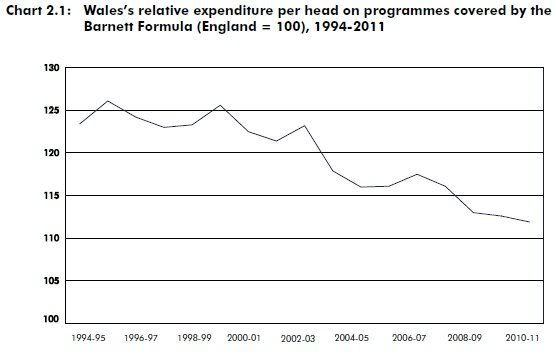
Really? Why not take another look at this chart?


So what is Peter Hain saying? If he thinks that 112% is just about fair now what he's really saying is that Wales was vastly overfunded when relative spending was roughly 125%. Therefore in the twelve years that Labour has been in power, it has been the conscious policy of the Labour government in Westminster to drive down public spending in Wales relative to England.

Is that something for Labour in Wales to be proud of? As Adrian Masters said, it's Peter Hain's job to get a better deal for Wales. But his response was,

"I do precisely that."

No, Peter. You're letting your vanity get the better of you again. That's precisely what you didn't do. Relative spending has dropped from 125% to 112%. Under Labour's stewardship, the relative difference has been cut to less than half what it used to be.

-

Now of course it could be claimed that it was wrong for Wales to have had such high relative spending back in the 90s. It might be unpopular but, in intellectual terms at least, it's semi-cogent.

But only semi-cogent. Because if you want to argue that it is right for public spending per head in Wales to be driven down, then it must be right that public spending in Scotland—where the differential is very much greater—is brought down too.


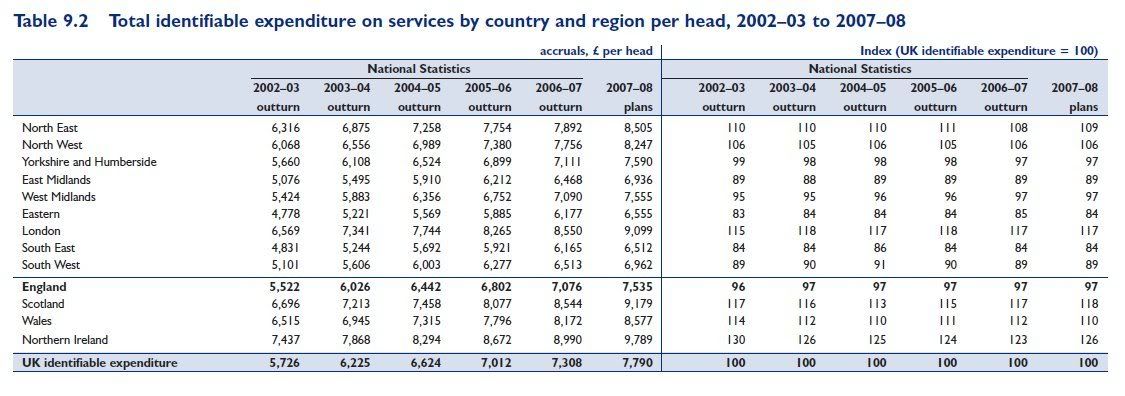
If you click on the table above, you will be able to see that this simply hasn't happened. The PESA figures show that over the past six years relative spending (the UK as a whole is 100) in Wales has gone down from 114 in 2002-03 to 110 in 2007-08. But for the same period relative spending in Scotland has in fact gone up from 117 to 118.

So the Secretaries of State for Scotland have obviously been fighting Scotland's corner well enough. It's only in Wales that the Secretary of State hasn't been doing his job!

So what does Hain do next? He wanders off into a fantasy world and says:

"Is Rhodri Morgan going to go to Alex Salmond and demand a bit of Scottish money from Edinburgh?"

No, Peter. It's your job to demand the money. But you don't have to go to Scotland for it. The people you need to deal with are all in London. Alex Salmond doesn't decide how much money Scotland gets ... the Labour government in London decides how much both Wales and Scotland get. You need to be fighting Gordon Brown and Alistair Darling to make sure Wales gets its fair share.

-

I was at this point going to launch into Peter Hain's hypocrisy. But I thought better of it. Peter Hain is what Peter Hain is. His political priority is London. That's his main home, that's where his bread is buttered, that's where his shadowy think tank, the Progress Peter Forum, is based. Neath was just a safe seat for him to be parachuted into.

Wales has 28 other Labour MPs and, addressing you directly, nearly all of you have a closer association with Wales. If Peter Hain won't fight for Wales, then you must. Your party is in government, your party can do something about it.

What you can do is simple and straightforward: insist that the "Holtham Correction" is applied now. I won't repeat what I said before, I'll just quote verbatim from the Holtham report:

The immediate priority

6.7 We are realistic about the scale of the political challenge and are aware that developing and implementing the new system may take some time. However, the arbitrary and obsolete nature of the formula requires some immediate changes that follow from already agreed principles and can be implemented without any radical innovations in practice.

6.8 Our analysis has shown that Wales currently receives less than it would were it to be funded by the UK Government using the formulae it applies to England. In the absence of reform, the gap between Welsh relative needs as assessed on the UK Government’s criteria and the level of funding provided by that same Government, will increase. This situation cannot be left unresolved until political agreement is secured on more substantive reform.

6.9 As a matter of principle, Barnett-driven convergence should cease when a devolved administration’s budget is no larger than it would be were it funded as an English region. In the case of Wales this point has already been reached; our analysis has demonstrated that Wales would receive £114 to spend on devolved activities for every £100 spent in England if its budget were determined by English funding formulae.

At a minimum, no further convergence in relative funding per head should occur in Wales until a new funding system is in place. A straightforward remedy would be to simply multiply any positive increments allocated to Wales by 114 per cent. This small adjustment to current arrangements would place a floor under the funding provided to Wales, and would prevent any further convergence until such time as more comprehensive reform has been agreed.

Bookmark and Share

Understanding Holtham


  Gerald Holtham   David Miles   Paul Bernd Spahn

 
The Independent Commission on Funding & Finance for Wales, a three man expert Commission chaired by Gerald Holtham, published its first report yesterday, which can be downloaded here:

     Summary Report
     Full Report

I wasn't sure what to expect, but I didn't expect a report quite like this. When a weathered hack like Martin Shipton of the Western Mail can open an article by saying:

The importance of the Holtham Commission’s findings about the way the National Assembly is funded cannot be overestimated.

Western Mail, 8 July 2009

... it means that we all should sit up and take notice. Of course I don't mean to offend the old hack by describing him that way. He has been around for a long time, and has read more reports and seen more political spin than most others. He's seen it all ... but he knows that this report is something of a different order.

One of the first things to say about the report is that it is a model of clarity. But I realize that even with the best intentions not many people are going to sit down and read it. So what I want to do in this post is give a summary of what it says and why it reaches the conclusions it has. If we are serious about changing the way that funding for Wales works, it requires a lot of us to shout out about it. If we don't do it—or rather, if not enough of us do it—then it won't matter what a few politicians and economists say. A small number can always be ignored, no matter how right they are.

Westminster will want to try and forget about it. It is always easier and more comfortable to hide behind the status quo than change something. To bring about change we need to kick up a fuss ... but we need to know what we're kicking up a fuss about. We need to be able to say why the current system is short-changing us, and we need to have a clear idea of what to put in its place.
 

1. How DOES the Barnett Formula work?

Historically, public spending in both Wales and Scotland has been at a higher level per head than England. Back in the 70s, when devolution was first considered and might well have become a reality, some method needed to be found to formalize the relative funding arrangements so as to avoid a political bun fight between the UK government and the devolved countries at every spending review. So the Barnett formula was devised to calculate changes in funding to Wales and Scotland based on the changes in spending in England, the degree to which a particular area of spending was devolved, and the size of population.

As it turned out devolution did not become a reality in the 70s, but the formula could still be applied because there was a Welsh and a Scottish Office, headed by the respective Secretaries of State, which made decisions about how money was spent in Wales and Scotland. When devolution became a reality in 1999, the Assembly and Scottish Parliament made those spending decisions instead.

However, because the formula takes account of population, but does not take any account of the original difference in spending per head, it has meant that the relative difference in spending per head has been steadily eroded over the years. This is known as the "Barnett Squeeze" and its affect on Wales is shown in this chart:


Back in the 90s public spending per head in Wales was about 25% higher than in England. Now it is only half that ... and will continue to fall. The rate at which it will fall depends on a number of factors, but the Holtham Commission has worked out a best and worst case scenario:


Under the worst case scenario, the next ten years will see Wales lose out by £8.5bn. That is a problem too big to ignore.
 

2. How SHOULD things work?

At this point, there is a simple political question to ask. Is it right that, in general terms, governments should spend the same amount of money on everyone? Or is it right that governments should focus public spending on those areas that need it more?

There is no absolute right or wrong answer to these questions. It is a matter of political judgement. However it is worth noting that nearly every developed country in the world adjusts their public spending on a region by region basis, on the principle that it wants to ensure that public services are of more or less equal quality everywhere.

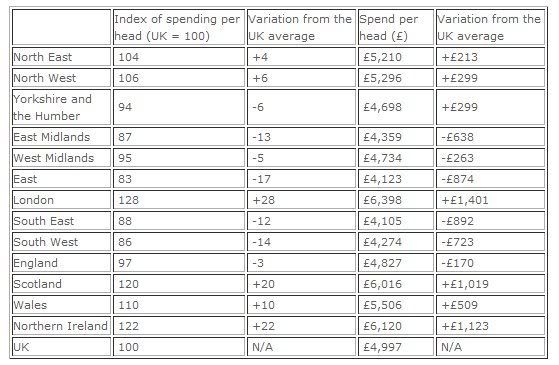
England is no exception. The UK government makes decisions on public spending on behalf of England, but it does not give the regions equal amounts of money per head of population. It applies a range of formulas based on the relative needs of the nine regions of England, spending what is necessary to ensure that the quality of public services is more or less equal. This results in very large differences in spending per head within England. These are the figures for 2008-09 from the IPPR website:


One thing that should be immediately obvious is that there is not necessarily a direct link between public spending per head in each region and the prosperity of each region. A prime example of this is London. Public spending per head in London is much greater than anywhere else in England ... and greater than it is in Wales, Scotland and NI too.

So we need to make a clear distinction between prosperity and need. The reason London gets more money spent on it per head is not because it is less prosperous. The exact opposite is true; it is the richest, most prosperous part of England by far. Neither does it get more money spent on it because it contributes more in taxes. It gets more money purely and simply because its needs, measured by a variety of different formulas, are greater. In this context, "need" isn't necessarily a measure of deprivation (although it often can be) it is more accurately a reflection of the cost of providing public services of an equal quality to each region. It is as much a measure of, say, the geography or the age profile of a particular region as it is of deprivation.

So the issue is this: if the UK government thinks it right to apply a needs based formula to determine relative levels of public spending in the regions of England, it is unfair—in fact downright hypocritical—for it to apply a different set of criteria for determining public spending levels per head in Wales and Scotland.

-

The clever thing the Holtham Commission has done is apply the UK Treasury's own funding formulas used for determining public spending for English regions to Wales. So far as I know, nobody has done this calculation before. But the three men on the Commission are all experts and know what they are doing ( ... if you doubt it, they explain how they've done it in the report) and the result of those calculations is that Wales would receive 14% more than we currently do if the same formulas were applied to us.

The Holtham report acknowledges that agreeing a new funding formula will be difficult. So it also outlines a simple and practical way of dealing with the problem on a temporary basis: namely that any future adjustment to the money that we get by operating the Barnett formula is adjusted by a factor of 1.14.

This won't change the past injustice. Nor will it take us back to the levels of spending (relative to the other countries of the UK) we had fifteen years ago. But it will be a "safety net" to ensure that the injustice doesn't continue to grow larger.

And they mention other things that can also be done immediately. This time not to change the allocation of spending, but to make the process of allocation more transparent. The logic of doing this is inescapable. The public mood following the expenses scandal means that we must get open and transparent mechanisms and processes, so that we can see exactly how and why public funds are distributed in the way they are. We were right to get angry about the attempts politicians made to hide the money they got from public funds. But it is a drop in the ocean compared with the sums involved for national and regional public spending. Flipping homes and claiming for iPods is as nothing compared to a loss of £8.5bn over ten years.
 

3. So what happens next?

Well, let's start with the obvious. Every politician who claims to represent Wales, of every political party both in the Assembly and at Westminster, must stand united in making the case for adopting this 114% "Holtham Correction" now, as an interim measure pending a new allocation system.

It's been good to see that politicians are being positive about this. But it does take more than simply saying that Barnett needs to be revised. We all know that Barnett needs to be revised ... in fact we have known it for some considerable time.

We need a firmer and more precise commitment from our politicians: namely that they will press the Treasury to immediately put in place the 114% Holtham Correction.

Bookmark and Share

Getting a fair share of funding ... and getting value for money

I was quite impressed by an article on the health service by Jon Osborne in today's Western Mail.

     We must make sure NHS in Wales stays healthy

He makes a point that I have made many times before: that the abolition of the NHS internal market in Wales and the commitment not to use PFI as a means of funding new building projects will save us a lot of money in the long term.

So although it's all too easy to focus on free prescriptions or hospital parking charges as targets for saving money when our block grant is squeezed over the next few years, these are actually very small costs in the overall budget of our NHS. We get a better NHS by identifying and fixing the big structural problems, not the trimmings.

Making a political point, I would note that the decision to do away with the internal market in the NHS was a U-turn by Labour in 2007. In the early years of the Assembly Labour went about creating a Welsh copy of the NHS that new Labour was creating - and is still pressing ahead with - in England.

-

But later in the article, Jon Osborne makes an even more pertinent point:

What about the cash? Why is Wales so badly off? Although funding on the block grant does not look too bad, the Treasury has a peculiar method of releasing funding for UK special projects that should have a Welsh share, its hypothetical funding.

The trouble is the Treasury mandarins have perfected the art of smoke and mirrors to make it hard for anyone in the Assembly to work out where the money is coming out and whether it has been badged as “England only” to prevent Wales having its share.

At the very least we need an Assembly select committee dedicated to extracting the cash from the Treasury using Freedom of Information requests and other methods of scrutiny.

Of course this doesn't only apply to NHS spending, but to all spending. To be nit-picky, he isn't expressing it in quite the right way. It is actually to our advantage to have spending allocated to England, because it means that we and Scotland then get our proportionate share as a Barnett consequential. The iniquity is for projects in England to be labelled as "UK projects" ... because that means we don't get a Barnett consquential. The Olympics are a perfect example.

But yes, his point is right. We need a way of holding the Treasury to more transparently account for the way it distributes money. In the early years of devolution both here and in Scotland there was very little incentive to do this, because Labour was in power in Westminster as well as in Cardiff Bay and Holyrood. But now we have a different party in power in Scotland, it has highlighted the need for more formal and accountable decision making that is open to public and political scrutiny, rather than have decisions agreed in private by politicians and officials from the same party.

Bookmark and Share