Showing posts with label Finance. Show all posts

Borrowing, Taxation and Barnett

There are two types of borrowing. One type of borrowing is invariably bad. A couple of examples of particularly unwise borrowing are that Labour funded the abolition of the 10p tax rate in 2008 by borrowing (or didn't fund it at all and simply left it as a deficit, which amounts to the same thing); and the decision by the Welsh Government in May last year to fund the backlog of road maintenance by co-ordinating the borrowing powers of local authorities in Wales (see here). Apart from short-term borrowing in an emergency or to smooth fluctuations in cash flow, borrowing is only good if the investment produces a return, or avoids the necessity of paying a greater sum for something else.

But even if borrowing meets these criteria, there is a second question to be asked: Who benefits from the return on the investment, or from not having to pay greater sums of money for something else?

-

Take building a new school as an example. Imagine two small schools each with surplus places, both housed in old buildings which with a considerable backlog of outstanding maintenance work, and with little of no insulation costing a small fortune in energy bills. It would clearly make sense to invest in one new building with minimal maintenance costs and with vastly reduced energy requirements, which would pay for itself in maybe 15 years.

In this instance the savings in energy and maintenance costs would be retained by the local authority, so it would make sense for the local authority and the Welsh Government (because a large part of local authority income is distributed through the WG) to borrow the money to pay for it. Wales would pay the costs of financing the investment, but in the long term the financial benefits of the investment would accrue to Wales.

Now that the Welsh Government has been given borrowing powers, we should have no hesitation in setting out a long-term programme of investments of this nature, because they will pay for themselves and Wales will get an overall financial benefit from the investment. There is in fact a huge backlog of investment of this sort in Wales because we, very wisely, did not expose ourselves to PFI to the same extent as England and Scotland have done ... not that we had more sensible ways of investing, we simply didn't invest to anywhere near the same extent at all, which is why our backlog is now so big.

-

But let's take another example: new roads. The decision to build a new road such as the proposed new motorway around Newport, or a maybe a new bridge over the Menai, is not only a matter of doing a benefit-to-cost ratio analysis. It is also a matter of questioning who gets the benefit and who pays the cost.

In the case of a new road the benefits are not direct, but indirect. A new road might well mean fewer delays, and time is money ... but whose money? In the first place it will go to increase the profits of businesses who rely on the route, or enable those companies to expand and take on more workers, or attract new companies to locate on or near the route. These are good, positive results for the companies and workers concerned. But there will also be an indirect return through more workers paying income tax and national insurance, companies paying corporation tax and national insurance, and shareholders paying tax on dividends. If those extra workers had previously been unemployed, then there will be savings on social security benefits. If there are more vehicles on the road (which inevitably happens when any new road is built) there will be more vehicle excise duty, fuel duty and VAT from fuel sales. In other words there are any number of indirect ways to get an economic return on investment to build a new road.

However all the indirect returns I've just listed will go to the UK Treasury in Westminster, not to the new Welsh Treasury. This means that the Welsh Government are playing a mugs game if they use the new borrowing powers they have just been given to build a new M4 at Newport, a new bridge over the Menai, or any other similar scheme. Yet this is exactly what they say they want to use the these borrowing powers for, and what the media reports have focussed on relentlessly.

All that will happen is that Wales would end up paying interest on the construction cost (which would mean having less to spend on other public services) while the economic return from the investment would, albeit indirectly, be reaped by the UK Treasury rather than by us.

The lesson is clear. Borrowing cannot be separated from taxation. It is therefore economic madness for the Welsh Government to welcome one, but reject the other. Strictly speaking, the Welsh Government doesn't actually need the power to set rates of taxes, but there does need to be a mechanism by which taxes, all taxes, are apportioned to Wales. The principle that should be applied is that if an investment results in an increase in the tax take, that increase needs to go into the coffers of the Welsh Treasury, not the UK Treasury. However once there is a system of apportionment, it would be only a very small and uncontroversial step to then take control over setting the rates of these taxes.

     

But this raises another question. Since it is economic madness for the Welsh Government to borrow money to pay for things like new roads because there is currently no mechanism for the economic return from the investment to accrue to Wales, how should projects like new roads in Wales be funded?

The answer is that it must be done by a consistent application of the Barnett Formula. In essence, the Barnett Formula is very simple: if the UK Government spends money in England, it must then give the devolved administrations a proportionate amount for them to spend in Wales, Scotland and the Six Counties.

This issue came to the fore only last week with HS2. At first, it looked as if Wales had got a Barnett consequential on the first, albeit quite small, tranche of Treasury expenditure on HS2. Then there was a flurry of claims and denials, but in the end (I think this article by Jon Antoniazzi is probably the most helpful) it became clear that we had got it, although whether the sums were worked out properly and whether the consequentials will continue in future is still open to question.

I am in no doubt that Wales, Scotland and the Six Counties should get consequentials on capital expenditure of this sort. In fact I believe I was the first person to call for Wales to get a Barnett consequential when HS2 was given the go-ahead in January 2012, and I'm pleased that others have picked up that baton both in Plaid Cymru and now in other parties as well. I don't think it's valid to argue that places not served by HS2 should accept that someone has to be first and wait their turn, because of the long timescales involved. Wales' turn might not come for another 50 years. After all, we should remember that electrification of the main line from Glasgow to London was started in 1959 and it has taken more than 50 years to get a commitment to do the same for the main line from Swansea to London. The problem is that there are no rules in place to ensure that Wales, Scotland and the Six Counties get our share of money spent in England, because the UK Treasury acts as judge and jury in its own cause.

A Barnett Formula that was properly and consistently applied—which would require some sort of arbitrator independent of the UK Treasury to ensure fairness—is at present the only fair way of funding capital projects such as new roads. The principle is that because the return on investment accrues to the UK Treasury through an increased tax take (and reduced benefits expenditure) as a result of increased economic activity, then it is right that the UK Treasury should bear the cost of any borrowing required to pay for them, not the devolved administrations.

-

My fear is that in our euphoria over being granted borrowing powers, nobody seems to have grasped this. Even in Plaid Cymru, we put out a press release welcoming borrowing powers for Wales that said:

"Borrowing powers have great potential to revive the economy across Wales, they could allow us to revolutionize our transport and communications infrastructure in all parts of the country. Broadband, the reopening of Beeching-cut rail lines, a national house-building programme, investment in school buildings and a home energy efficiency scheme are all shovel-ready schemes which will create jobs."

Plaid Cymru welcomes Silk announcement, 1 November 2013

We cannot lump all borrowing together in this way. All the things listed above are good (I especially like the re-opening of rail lines) and probably have a positive benefit-to-cost ratio. But that is not the only question to ask. In considering what schemes should be funded by Welsh Government borrowing now that we have been given the power to borrow, we must also ask the question whether the return on that investment will accrue to Wales or accrue to the UK. If the bulk of any return on the investment will go into the coffers of the UK Treasury, that borrowing should continue to be funded through the UK Treasury and given to us as part of the block grant and Barnett consequentials.

The Welsh Treasury should be careful to use its new borrowing powers only to fund schemes that will bring an economic return to Wales. New and improved schools, hospitals and home energy efficiency schemes fall into that category. New roads (unless they are toll roads) definitely do not.

Bookmark and Share

Disaggregated tax receipts for Wales

While reading this story about the proposed Scottish Oil Fund that will be established when Scotland becomes independent, I noticed that HM Revenue and Customs had only yesterday published, for the first time, a set of "experimental" figures which estimate the tax take from the four nations/regions of the UK. The links to the documents are on this page.

-

For Wales this is a major first, and its importance cannot be overestimated. This information has been produced for some time for Scotland in the form of GERS (Government Expenditure and Revenue Scotland) and for the Six Counties in the form of NINFBR (Northern Ireland Net Fiscal Balance Reports) but the Welsh Government has never asked for or itself produced an official equivalent for Wales ... although estimates have been produced by Oxford Economics and by the Holtham Commission.

I know Gerry Holtham has urged the Welsh Government to follow the example of both Scotland and the Six Counties, and he believes they have not done so because the situation is so serious in Wales that they think it would be better not to tell the patient exactly how bad things are. That's one way of looking at it. The less charitable explanation for their refusal to do so is that no government would want to draw attention to how bad things are because it would only increase public pressure on them to do something about it.

For me, it is only by finding out exactly how bad the economic situation is in Wales that we will be able to properly direct our efforts to improve it. And indeed this is reflected in Plaid Cymru's renewed emphasis on our economic performance in launching Offa's Gap last year. Owen Donovan did a comprehensive analysis of the situation here.

-

This is what HMRC say about the information they've now published:

This publication apportions total UK tax receipts, tax credits and benefit payments administered by HM Revenue and Customs to England, Wales, Scotland and Northern Ireland.

It attempts to measure the true economic incidence of taxation, based on the underlying activity, which can often differ from how or where the tax receipts are collected. Actual administrative data is available for capital gains tax, inheritance tax, stamp duty land tax, child and working tax credits and child benefit; for the others, the estimates are arrived at using best available data and statistical techniques, including assumptions and adjustments where necessary. The numbers in this publication do not represent an estimate of the tax revenue that would be raised if each tax was set at the devolved level.

All statistical methodologies have an inherent degree of uncertainty and, for this publication, a variety of alternate methodologies could justifiably be applied, each leading to a different estimate.

The full data are available on the page I linked to above, but I have extracted the cash and percentage figures for Wales for 2012-13. Wales has 4.8% of the UK population.

Based on actual administrative data

Capital Gains Tax ... £64m ... 1.6%
Inheritance Tax ... £83m ... 2.7%
Stamp Duty Land Tax ... £139m ... 2.0%
Child and Working Tax Credits ... £1,545m ... 5.2%
Child Benefit ... £573m ... 4.7%

Based on estimates

Total Income Tax (Gross of Negative Tax Credits) ... £4,763m ... 3.1%
National Insurance Contributions ... £3,689m ... 3.6%
VAT ... £4,170 ... 4.1%
Corporation Tax (onshore) ... £830m ... 2.4%
Bank Levy ... £30m ... 1.9%
Bank Payroll Tax ... £0m ... 1.9%
Fuel Duties ... £1,311m ... 4.9%
Stamp Tax on Shares ... £4m ... 0.2%
Tobacco Duties ... £451m ... 4.7%
Spirits Duty ... £143m ... 4.9%
Beer Duty ... £183m ... 5.4%
Wine Duties ... £139m ... 3.9%
Cider Duties ... £27m ... 8.4%
Betting and Gaming ... £68m ... 4.1%
Air Passenger Duty ... £8m ... 0.3%
Insurance Premium Tax ... £124m ... 4.1%
Landfill Tax ... £50m ... 4.5%
Climate Change Levy ... £35m ... 5.5%
Aggregates Levy ... £22m ... 8.2%
Customs Duties ... £103m ... 3.6%
Other Taxes ... £17m ... 4.8%

Total receipts

Total ... £16,337m ... 3.5%

It's not a pretty picture. We have 4.8% of the UK population, but generate only 3.5% of the UK's tax receipts. In terms of the big taxes, we generate only 3.1% of income tax, 3.6% of NI contributions, 4.1% of VAT and 2.4% of corporation tax.

However it must be emphasized that many of these figures are based on estimates, that these estimates are each based on a particular methodology, and that different methodologies might result in different figures. This why, for example, the Scottish Government produces GERS instead of relying entirely on UK Government figures. It is now open to the Welsh Government to do the same thing if it believes that using different methodologies will present our fiscal situation in a better light.

In terms of political reality, the publication of these figures is almost guaranteed to spur the Welsh Government into producing a GERW because they no longer have the option to hide how bad the situation is from the Welsh people, and will now have to spend effort trying to make the situation appear less bleak in order to lessen the pressure on them to improve things. Some of it will be justified (for the UK Government has no incentive to make things look good for Wales, and may well have made wrong assumptions that need to be corrected) but some of it will be spin. We will have to decide which is which, in just the same way as people in Scotland have to decide between differing interpretations of Scotland's overall fiscal situation. That's politics.

However the importance of the publication of this data by the UK Government (and the intention is to publish them every year) is that official figures are now in the public domain to be analysed, discussed and argued over. It is only by facing up to how bad things are—and what, in particular, is bad—that we can target our efforts towards making things better.

Bookmark and Share

Public opinion on financial powers for Wales

The reports in the media hardly do justice to the wealth of information and detail in the ICM/John Curtice/Richard Wyn Jones research document prepared for the Silk Commission and published this morning.

There isn't a link to it on either the BBC website or WalesOnline. So in case anyone hasn't figured out how to download it, just click the image below:


There's lots to say about it, and one or two things in it that raised my eyebrow. More on that later.

Bookmark and Share

Ysgol Bro Teyrnon

Because it was only reported by the BBC in Welsh, I thought it would be a good idea to tell anyone who missed it about the official opening of Ysgol Bro Teyrnon in Newport last Friday.


     Ysgol Gymraeg newydd i Gasnewydd

This school had its first intake of children last September, and was planned to take 17 in the first year. It started with 16, but the demand has meant it has now had to take 24. Roughly the same number of new pupils will start this coming September. In total, more than 105 new pupils are expected to be admitted to Newport's three Welsh-medium primaries in September, and the demand is expected to keep on growing.


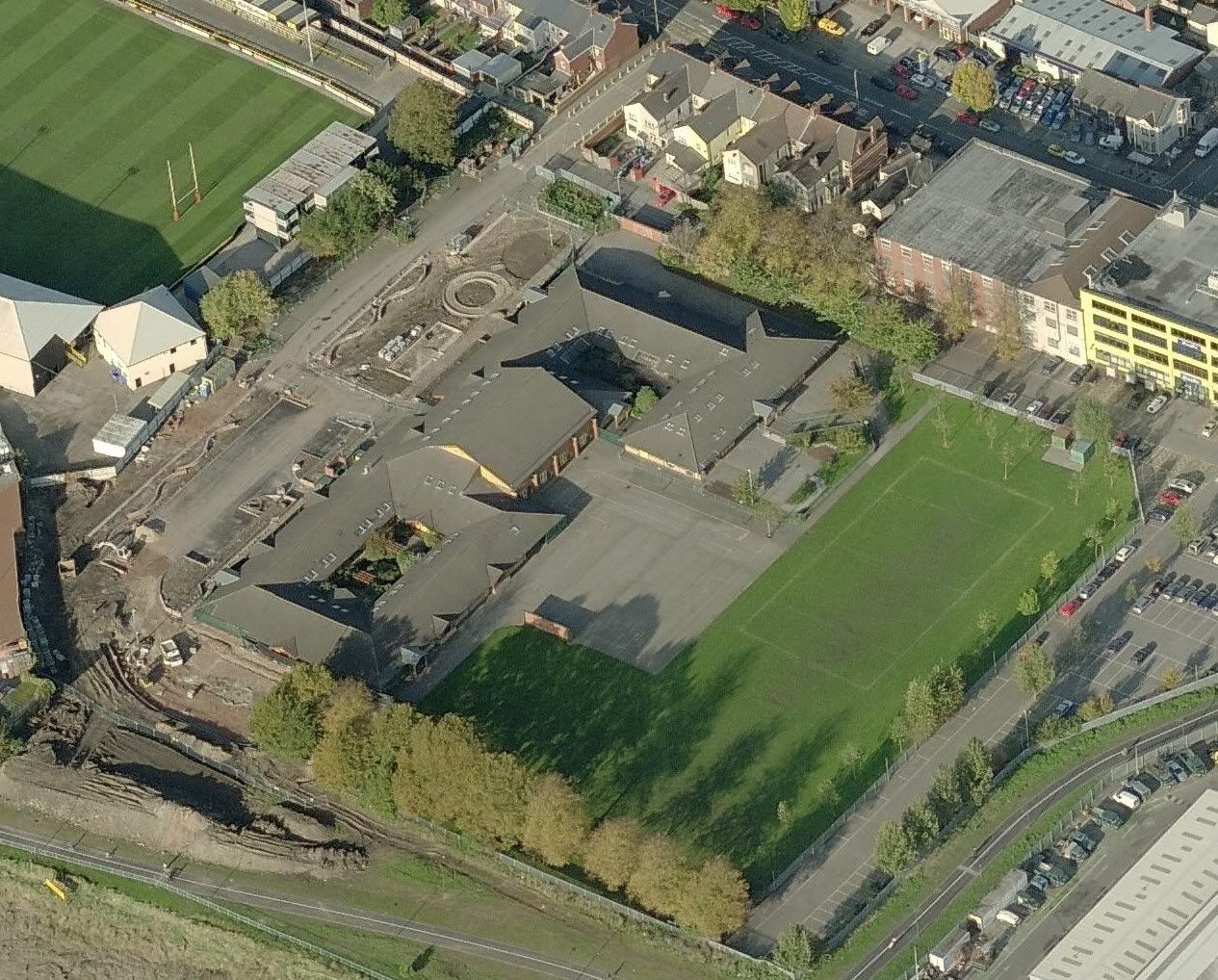
The problem is that Ysgol Bro Teyrnon does not have a permanent home. For now, it is being housed in Maindee Primary School—just behind the Rodney Parade rugby ground as we can see in the picture above—which has enough surplus space to accommodate maybe three WM year groups, but no more. Newport had planned to build a brand new two form entry WM school at Percoed Reen, to the south west of the city between Dyffryn and Coedcernyw as part of their original 21st century schools bid, at a cost of £12.5m. But the cuts to that programme of capital spending resulted in it being dropped in their revised bid:

Welsh-medium primary provision has been reduced in concept by a reduction in capital from £12.5m to a mere £1m, taking this project from a new build to remodelling within the current estate in order to relocate to a permanent site.

Revised 21st Century Schools Bid, November 2011

This means that the new home for Ysgol Bro Teyrnon will have to be in an existing school building, and the options are limited. I believe (though someone with more local knowledge might tell me better) that the former Durham Road Primary school building has not been disposed of following the move to the brand new Glan Usk Primary school a few years ago. The old building is hardly ideal, but it's better than nothing.


Apart from moving into vacated school premises the only other option would be to amalgamate two existing schools onto one site, and then use the other building. Needless to say, that would be fraught with difficulties.

-

As mentioned in the video report, the next big problem will be to open a WM secondary school for these children to move up to in a few years' time. At present children in Newport, Monmouthshire, Torfaen and Blaenau Gwent move on to Ysgol Gyfun Gwynllyw in Trefethin, but the continuing expansion of WM education across Gwent means that a second school will be needed within the next few years.

The obvious location would be somewhere in Newport; but if Newport can't afford to build a new WM primary, it's unlikely that they will be able to afford at least twice as much to build a brand new WM secondary. The most likely solution would therefore be to take advantage of the fact that Torfaen are planning on amalgamating Llantarnam and Fairwater schools on a new site (with the support of both schools, as we can read here) which they can still afford to do within their revised 21st Century Schools bid.


As we can see form the map above, Llantarnam School is less than 2km from the Newport border and has good transport links to take children from Newport and Ysgol Y Ffin in Caldicot, and perhaps from Cwmbran too. From the picture below it appears to be in serviceable condition, but if appearances are deceptive it could at least be a temporary solution until a new school can be built.


Taking one step back to see the wider picture, the biggest long-term problem is finding the capital to build new school premises. This is particularly true in Newport because it does not have a great number of surplus places in EM schools, mainly due to population growth. The original 21st Century Schools programme allowed for 70% funding from the Welsh Government and 30% funding from local authorities. In the revised programme, the split is 50% each.

The Welsh Government cannot borrow, and this situation is unlikely to change anytime soon. It certainly won't happen until after Silk has reported, and in my opinion won't happen even then unless the WG agrees to accept significant tax setting powers at the same time. The Treasury's argument is that you can't borrow money on your own account unless you have at your control the means of raising money to pay it back. But there are two other possibilities.

The first is the Build for Wales model, which is essentially PFI but through a not-for-distributable-profit body. The problem with PFI is the excessive profits made by the consortia, particularly on maintenance over a 25 or 30 year period; but that problem disappears if the profits are recycled to the next scheme (or back to the public purse) rather than distributed to private shareholders.

The second possibility is for the Welsh Government to coordinate the existing borrowing powers of local authorities, but to directly reimburse them for the cost of that borrowing. This has already been done once: only last month the WG set up a £60m programme with local authorities to pay for road repairs. As I mentioned in this post at the time, we should not be borrowing money to pay for maintenance, but it would be perfectly acceptable to use the same model for capital expenditure on new schools.

Bookmark and Share

Failing to stimulate the Welsh economy

While some of the media have been looking to stir up a row over the relatively insignificant figure of less than £400,000, plans for spending a far greater amount were announced by the Welsh Government yesterday. This is from their news statement:

Capital investment for growth and jobs will accelerate in Wales, says Jane Hutt

"We remain a Government committed to the provision of infrastructure and the creation of jobs", Finance Minister Jane Hutt said ahead of the publication of the Wales Infrastructure Investment Plan for Growth and Jobs.

The Wales Infrastructure Investment Plan for Growth and Jobs – a commitment in the Programme for Government – will outline how the Welsh Government will invest more than £3.5bn over this Spending Review period and around £15bn over the next decade in capital projects.

Welsh Government, 22 May 2012

It's meant to sound impressive, but in fact isn't. In response to the criticism, Jane Hutt is reported as saying this about it:

Finance Minister Jane Hutt accepted a number of projects had already been announced or are already underway. But she stressed the plan was also designed to raise new money, potentially more than £1bn to cope with a 40% cut in the capital budget.

New sources of finance could involve specially-designed companies to borrow the money needed for specific projects.

BBC, 22 May 2012

When the ConDem coalition undertook its comprehensive spending review in 2010, it drastically cut (by 41%) that part of the Welsh block grant which is reserved for capital investment. In fact it cut it more severely than the equivalent figures for Scotland (a 38% cut) and Northern Ireland (a 37% cut) but that's a different story. The figures are in Table 2 of this document.

For the next three years the capital expenditure part of our block grant will be £1.2bn, £1.1bn and £1.1bn, and this accounts for the whole of the £3.5bn mentioned in yesterday's announcement after rounding. Although the devolved administrations are free to spend some of the revenue part of their respective block grants on capital projects, they are not allowed to shift any of the capital budget into revenue expenditure. So in blunt terms the Welsh Government is saying that it intends to spend the absolute bare minimum it is legally obliged to spend on capital projects, and no more. In essence, the plan just explains how the existing allocation of money in the block grant is going to be carved up. There's nothing in it that I can see (the full document is here) that will raise "potentially more than £1bn" of new money.

As for their ten-year projection, no-one is in a position to know what the next Westminster CSR will contain, but £11.5bn over the remaining seven years is only £1.65bn a year. As the baseline figure for 2010-11 was £1.7bn, they seem to be assuming that levels of investment won't return to what they were before for at least a decade.

So in short there is nothing ambitious or groundbreaking in the Welsh Government's investment programme, and absolutely nothing to justify the idea of "acceleration". It's just a lot of spin with no increase in speed.

-

It's a shame, for things could be very different. An ambitious Welsh Government—knowing that increased investment in infrastructure would be a very good way of protecting Wales from the worst effects of the cuts and do more than anything else to create jobs and help our economy become competitive—would surely have tried rather harder to find ways to invest more money in improving our infrastructure. An ideal way of doing it would be to use the Build for Wales model developed and advocated by Plaid Cymru, details of which are here.

It's not exactly as if this Labour government are lazy good-for-nothings, despite Carwyn Jones' natural propensity for taking things easy instead of standing up for Wales. In fact it recently put a lot of effort into an innovative way to increase borrowing by coordinating the existing borrowing powers of local authorities, as I mentioned in this post only last week. In principle it's a clever idea; except that it will misdirect this borrowing into revenue expenditure on road maintenance rather than capital expenditure on new infrastructure. This is exactly the sort of bad borrowing that was a major contributory factor to the debt crisis we now find ourselves in. Labour in Wales are doing exactly what Labour did when they were in power at Westminster.

This is a missed opportunity that will have severe long-term consequences for our economy. We have a passive and incompetent government that is more comfortable pointing the finger of blame at the Tories in Westminster rather than getting off its backside to take responsibility for stimulating our economy through increased capital investment.

Bookmark and Share

Borrowing money for the wrong things

I think most people reading this will know that the Welsh Government (unlike the Scottish Government) is not able to borrow any money, but that our local authorities can. So on the face of things it looks like the Welsh Government's decision to co-ordinate existing council borrowing powers, and specifically to pay the cost of that borrowing through its annual revenue grants to local authorities, is a clever idea.

     Welsh councils' £60m road repair borrowing could pave way for new money

And in principle it is ... but everything depends on what that money is spent on.

-

Borrowing to pay for capital investment projects is generally a good idea. We need things like new schools, new hospitals and new transport links, and it is simply a question of doing the sums to see if the benefit to cost ratio of any particular scheme is favourable. It very often is: especially if, for example, the new school or hospital replaces an old building that will cost more to maintain and provide energy for than a new building would, or if a new road or railway investment will save people and businesses time and money and thus boost the economy. In both cases the investment will pay for itself in the medium to long term.

But borrowing money simply to pay for the maintenance of existing infrastructure is something very different. It doesn't pay for itself, and never can. Even if this £170m over 3 years pays for some badly-needed repairs to our roads, no-one in their right mind could imagine that it will be 22 years (the time it will take to pay this loan off) before many of the very same roads will need repairing again. What will happen after five or ten years? Will the Welsh Government co-ordinate another round of borrowing on top of this one ... and yet another round of borrowing five or ten years after that? It is mad-house economics. It is a short-term fix at the expense of long-term planning.

Co-ordinating local authority borrowing powers is a good idea, but only if used for capital investment rather than maintenance.

Bookmark and Share

Build for Scotland

To judge from what's quoted in the media, anyone would think that today's announcement of £1.4bn for the 21st Century Schools programme was something positive. In reality it's rather pathetic. What was to be £4bn of work has been more than halved in scope, and the money is now to be stretched over seven years instead of three. £200m a year isn't much, especially when only half of it is now going to come from the Welsh Government.

This, and indeed other essential infrastructure investment, could have been much greater if the Labour government was more ambitious and imaginative. To see what a more enterprising government can do we just need to look to Scotland, where the SNP are this week going to announce an infrastructure investment programme of £60bn.

SNP’s £60bn plan to boost the economy

Ministers will this week unveil plans to commit up to £60 billion to finance dozens of infrastructure projects to help prevent Scotland from tipping back into recession.

Amid fresh warnings that the UK is heading for its worst peacetime economic downturn since the end of the 19th century, the Scottish Government will announce plans to fund more than 80 building projects as part of a 15-year plan. Expected funding of up to £4bn a year will come from public funds, but also from a mix of new loans and investment from banks and private lenders.

Ministers are also planning to use new powers in the Scotland Bill going through the UK parliament to enable them to borrow up to £2bn from the UK Treasury’s coffers and have asked that the limit be increased so they can borrow up to £5.6bn. In the meantime, they plan to raise the rest for their capital projects programme through “innovative” financing methods.

Ministers insist the extra cash will not create a re-run of the costly high-interest loans created by old PFI deals in Scotland, which have left the taxpayer paying back far more than the capital cost for new public buildings.

The Scotsman, 4 December 2011

So what might these "innovative financing methods" be? At the bottom of the article we can see that this will be a "non-profit distributing model". Yes, it sounds exactly like the Build for Wales model that Plaid Cymru have been proposing. I'm only surprised they didn't put a bright yellow poppy on it and call it Build for Scotland.


It puts the Labour government in Wales to shame. I'm left with the feeling that any attempt at doing something positive has been put to one side simply in order for Labour to repeat, ad nauseam, that it's all the fault of the Tory cuts. Of course we've been kicked in the stomach by the Tory and LibDem cuts, but a bolder Welsh government would get up off the floor and find a way round the constraints ... just as they have in Scotland.

Bookmark and Share

Build for Wales: Plaid Cymru's scheme to fund infrastructure investment in Wales

On Tuesday last week, Ieuan Wyn Jones announced Build for Wales, Plaid Cymru's scheme to fund infrastructure investment in Wales. The idea attracted considerable interest in the media, as well as some incredulity from Plaid's political opponents, as we can read here:

     Plaid to campaign on £500m jobs fund - Western Mail, 16 March 2011
     Plaid Cymru City bond idea attacked by rivals - BBC, 16 March 2011

Betsan Powys attempted to explain the issues in her blog, both here, and later here. But there were still several unanswered questions, so I asked Madoc Batcup, one of those in Plaid who has been at the centre of developing the idea over the last few years, if he would write something to explain the proposal in more detail.
 

Madoc Batcup is an independent financial consultant, with interests in structured financial products and in the environmental industry. He has also served as a member of the National Association of Pension Funds’ property advisory committee.

Madoc is a law graduate of Cambridge University and of the Institut d’Etudes Européennes in Brussels. Prior to becoming a financial consultant he worked for the investment banking arm of Swiss Bank Corporation in both London and Tokyo.

He is also Director of Wales in London.

 
BUILD FOR WALES

An Infrastructure Investment and Management Company for Wales

Plaid Cymru recently announced a ‘Build for Wales’ project to create a new entity to invest in public infrastructure. In explaining what this innovative approach is expected to achieve, it is perhaps worthwhile to look at the context and background of the constraints to public sector investment in Wales.

Although housing is currently very expensive, it is generally considered desirable for people to aspire to own a house, for most the biggest capital investment they are ever likely to make. Because it would be impossible for all but the most extravagantly wealthy of individuals to purchase a house out of their current income, and because it would take a very long time to save up the money necessary to purchase a house, a mortgage market has developed which allows individuals to buy houses and live in them as they gradually pay off their debt over a number of years.

The situation of governments is not so terribly different. If they want to undertake large amounts of capital expenditure to invest in new schools, hospitals, roads etc. they must either use current income, save until they have enough money, or borrow the money over the years and repay as they use the facility.

In the case of the Welsh Government it can’t borrow, and it can’t tax to increase its income. If it saves then it lays itself open to the possibility of the Treasury taking back the money on the basis it is unspent as it did recently - the Treasury’s housekeeping can lead to perverse incentives against prudence. So something that most individuals take for granted and is generally thought to be a good thing, the ability to borrow long term to buy an expensive capital asset and pay for it gradually, is denied to the Welsh Government.

-

It is true that Westminster came up with an alternative; PFI, which in essence is a form of glorified inefficient and expensive hire purchase. Given the lack of any alternative form of funding, many parts of the UK reluctantly undertook capital projects using PFI because they had little choice. The Treasury has now acknowledged that PFI often represents poor value for money, hence the cancellation of the Building Schools for the Future programme in England. To its credit, Wales financed very little using PFI (about one tenth of the amount of Scotland, and less than 1% of the UK total). However, this has meant that Wales has a substantial backlog of capital projects in the public sector. The announcement by the Chancellor of the Exchequer in last October’s Spending Review that the capital expenditure budget for Wales would be slashed by 41% over the next four years has added a huge amount of further pressure on already severely constrained funding.

This means that the Welsh Government (and the Welsh public sector generally) has an urgent need to find an alternative way of investing in its infrastructure. In addition it must try to do so within its funding allocation under the Barnett formula given the current financial challenges which the UK faces.

It is to meet this challenge, as well as to provide a mechanism for improving public sector procurement and management and driving down costs, that Wales needs a new approach and a new entity. A Welsh Infrastructure Investment and Management company, christened as ‘Build for Wales’ (BfW) would have the following key characteristics:

•  The company would be a not for distributable profit private company, limited by guarantee, with a structure comparable to that of Glas Cymru. Profits retained in the company would be used to improve the company’s balance sheet and to invest in further public sector infrastructure projects in Wales. It would focus exclusively on infrastructure projects in Wales, and as its portfolio grew it is anticipated that it would build up a substantial body of knowledge and expertise in the area of tendering and negotiation, as well as in the operation and management of public sector occupied real estate.

•  The company would be responsible for the funding and implementation of public sector infrastructure projects, such as schools and hospitals, and this could also extend to roads and housing. It would also be responsible for operating them and managing them after construction. It would represent an alternative to PFI and to direct borrowing by a public sector body. The company would not seek to bundle together construction contracts and operating and service contracts, as in PFI, but only to be the landlord of the building/owner of the asset with a standard lease. In addition any profits the company made would be recycled into further investment in Welsh public sector infrastructure. This would make it fundamentally different from PFI. Public sector bodies would not be obliged to make use of the new entity, but it would provide an important funding alternative to conventional PFI and public procurement on the basis of their own spending priorities. BfW would seek tenders from private sector construction companies to deliver the infrastructure on its behalf, but BfW would be responsible for funding the infrastructure, managing it, and repaying the relevant debt under a long term lease arrangement.

The establishment of such a vehicle would enable the public sector to plan capital expenditure over a longer period, and benefit from the expertise of an arm’s length body which would be focused on the infrastructure sector and delivering value for money. In the case of building a school for example, the local education authority could ask BfW to build a school on its behalf. The LEA would enter into a long term lease to occupy the school, and the lease payments made by the LEA would service the debt raised by BfW to build the school. The LEA would be responsible for the day to day management of the premises.

Such an approach should, over a period of time, lead to standardisation in both contractual documentation and in procurement procedures and requirements, lowering costs and increasing transparency and certainty, and enhancing the likelihood of the efficient delivery of public infrastructure. For local education authorities, health trusts and other public bodies it provides access to a centre of expertise, which although private has a public sector mission, capable of delivering capital projects for them on a more efficient basis, resulting from being specialised in the sector, and being able to build on its funding and construction experience.

The aims of creating this new independent company include:

•  Enabling the Welsh Government to use part of its current expenditure as capital investment in an efficient manner. This is something that the Treasury normally welcomes as being a prudent approach. Since Wales has done very little PFI compared to the other parts of the UK it has more room to invest in capital projects.

•  Enabling access to private sector finance on a fairer and more efficient basis than PFI at a time of severe government borrowing constraints

•  Creation of a specialist company experienced in procurement and negotiation with contractors, resulting in a more efficient delivery of public sector infrastructure projects, and the driving down of costs, another aim of the Treasury

•  Profits made by the company would be retained for further investment in the public sector, another aim of the Treasury.

This approach has therefore specifically been tailored to meet a number of the Treasury’s key goals as well as the needs of the Welsh Government. It would have the added advantage of providing demand in the construction industry at a difficult time, protecting and creating jobs and investing at pricing levels which should be very competitive compared to a few years ago.

The Welsh Government would need to provide a certain amount of loan capital out of its own resources to the company to get it started and might assist the company by way of a contingent guarantee to the extent consistent with it being an independent company. The amount lent would be paid back out of retained profits after an agreed period of time.

The amount that BfW would invest in infrastructure projects would depend on the demand from the Welsh public sector, but if this amounted to e.g. £500 million over the five years after its establishment, the total annual servicing costs would be about 0.3% of the Welsh budget. This therefore actually represents a rather cautious approach to the expansion of public sector infrastructure investment.

-

The Treasury has acknowledged that PFI is not good value for money and is looking for an alternative at a time when the public finances of the UK are exceptionally constrained and yet there is the need to provide a growth stimulus, not least in the construction industry. While the Welsh Government has comparatively more capacity to transfer current spending to capital investment, this approach would be equally applicable in the rest of the UK.

This alternative to PFI has been discussed with major banking and accountancy institutions and proposals to take it further with the Treasury have been initiated by the Welsh Government. It is to be hoped that as the details of this approach become clearer, and in the seeming absence of any other researched suggestions as to how Wales as a whole might meet its future public sector investment challenges, this approach might garner cross-party support.

Bookmark and Share

Another roadblock to fair funding for Wales

I've just read today's article by Nick Bourne on Wales Home, and much of what he says in it can be put down to the Tories being Tories. But there is one sentence towards the end that stands out as being particularly pernicious:

We must settle the political accountability question in Wales – the responsibility issue – before turning to the funding question.

Wales Home, 13 June 2010

The ConDem coalition's programme for government had previously stated:

•  We recognise the concerns expressed by the Holtham Commission on the system of devolution funding. However, at this time, the priority must be to reduce the deficit and therefore any change to the system must await the stabilisation of the public finances.

The Coalition: our programme for government

As I said at the time, and again here, if all parties recognize that Wales is not fairly funded, it is a problem that needs to be addressed now. We all know that there are going to be huge cuts in public spending, and that we in Wales will need to shoulder our share of the pain ... but it must be our fair share. The action taken by the ConDem government to release the Fossil Fuel Levy owed to Scotland has meant that the cuts they have to face will be some £185m less than they would otherwise be. Why is Wales not entitled to a similar degree of fairness over the £300m that the independent Holtham Commission has identified as being owed to Wales?

But as if that wasn't bad enough, Nick Bourne has gone one step further than to say that we "must await the stabilization of the public finances" before we can expect this injustice to be addressed. He has declared that we "must settle the political accountability question in Wales – the responsibility issue – before turning to the funding question".

Why?

We have a situation in which the Welsh Government is responsible for spending the money it is given by the Treasury in London. We cannot raise taxes, we cannot borrow money, we cannot spend more than we are given. If the people of Wales don't like the decisions that the Welsh Government makes, they can vote for parties that they think might do better at the next election. That's how political accountability works in a democracy.

Now of course we should have responsibility for both sides of the fiscal equation. It is much better that the Welsh Government should have more fiscal autonomy by setting tax rates and balancing our spending against that tax take. I welcome any plans the ConDem coalition might have in that direction ... and we in Plaid Cymru have been pressing for this change for years.

But the simple fact is that we are being short-changed now, and we would be fools to let the promise of some sort of unspecified change to the system at some unspecified time in the future distract us from that fact.

Only last month, Tory and LibDem leaders in Westminster put up the first roadblock to fair funding for Wales by telling us that we have to wait for the public finances of the UK to be stabilized first. It was a way of kicking the issue of fairness for Wales into the long grass, in much the same way as Labour in Westminster refused to deal with the problem when they had a chance to do so.

But Nick Bourne has now put up a second roadblock to fair funding by telling us that we must also wait until the Tories and LibDems come up with a plan for the next stage of devolution in Wales. We've come to expect endless delaying tactics of that sort from politicians in Westminster, but you have to wonder what sort of masochism would make a Welsh politician ignore the £300m a year that his own country is owed.

Bookmark and Share

Stadtwerke München

I was looking through the press release for the consortium that will build and operate Gwynt y Môr to try and get some idea why Wales only obtained contracts of £2.2m in a scheme with an overall investment value of £2bn.

The consortium comprises three partners:

•  RWE Innogy ... the energy company, holding a 60% equity stake

•  Siemens ... the manufacturer, which holds a 10% equity stake, but has been awarded the main contract to supply, install and maintain the wind turbines and grid connexions worth over €1.2bn

•  Stadtwerke München ... the Munich Municipal Utility, holding a 30% equity stake

RWE won the original Round 2 bid and are the energy company driving the scheme, but they were looking for venture partners to take up to a 50% share. It is not unusual for a contractor in such a large project to have a limited equity stake: if nothing else it gives them an incentive not to get too "contractual" with their client as they both win or both lose together. But the third partner is rather more interesting.

Stadtwerke München, as we can read here, supplies power, water and other utilities to the Munich area. It is hard to see what Stadtwerke München is actually contributing to the project other than money, plus of course the kudos of being able to present Munich as a "green city". It's odd to read that their aim is for Munich to have all its electricity supplied from "green" sources, but that they are quite prepared to include projects in other countries as a way of fulfilling that aim:

By 2025, SWM even wants to produce enough green electricity to cover the consumption rate of the entire Munich power requirement – 7.5 billion kWh. To attain these ambitious goals, SWM has started the Renewable Energies Expansion Offensive.

SWM is engaged locally, regionally and in the regions of Europe, in which there is corresponding potential. Since the yield is limited in Munich. The wind blows on the sea more strongly and constantly, the sun shines more intensively in Southern Europe and more often than it does here. The electricity is supplied there, where it is produced, in order to avoid losses in the lines through long transport routes, among other things. Nevertheless, the environmental effect is advantageous for those living in Munich. Since the European electricity grid can be compared to a gigantic sea. Anyone who produces electricity feeds into this “sea of electricity”; anyone who uses electricity removes something. The same everywhere. Each additional kilowatt of green electricity prevents greenhouse gases and makes the “sea” cleaner.

Stadtwerke München website

Obviously Gwynt y Môr fits that bill, and SWM also includes the Andasol 3 solar power plant in Andalucia as a way in which it fulfils these aims, saying that its 48.9% share is providing energy for 33,000 homes in Munich. It's not exactly "wrong" to say this but, as with all "offsets" of this kind, things are very prone to get double counted. The Gwynt y Môr consortium proudly boasts that it will provide enough energy for 400,000 homes in Britain but—if it applies the same standards—SWM's next glossy brochure will no doubt claim that its 30% stake is supplying 120,000 homes in Munich with green electricity. In the meantime most of the electricity actually being generated in Germany will probably still be coming from coal and lignite, with plans for expansion in the number of coal-fired plants.

OK, that could be considered to be more Germany's problem than ours, but it's hardly doing much for the planet. Thanks for the investment, but no thanks for the double standards.

-

But there is something else about Stadtwerke München that makes its involvement in Gwynt y Môr remarkable. It is a company that is completely owned by the city of Munich. Now of course the mutual benefit is obvious because the main contractor, Siemens, is based in Bavaria and it is therefore for the general good of the city that private firms in the region get as much work as possible. But it surely must raise questions about whether this is in effect an indirect subsidy with what is effectively public money because, like all public bodies, a city can't exactly go bust.

I've got nothing against Munich, and I've got nothing against this being a German consortium; but I can't help but feel that Wales has missed a trick. The quid pro quo for Munich's involvement must surely be an understanding that as much manufacturing work as possible will be based in Munich and the surrounding area. This, more than anything else, probably explains why Wales has only had contracts of £2.2m in a £2bn project and why we shouldn't expect to get much more.

-

But if Munich can do this through a wholly publicly owned company why can't Wales do the same thing?

Munich is a city of 1.3m people with a metropolitan area of maybe 5m. This means it is more or less comparable with Wales. If we wanted to be really serious about making sure that Wales got a larger slice of the manufacturing and supply opportunities that come from multi-billion pound investments in renewable energy round our own coast we should consider trying to develop a similar vehicle.

We cannot change what the UK government has already landed us with. Tenders have already been made for the Round 3 Irish Sea zone, which at 3,715MW will probably have at least six individual windfarms of the size of Gwynt y Môr. The same is true for the 1,500MW zone in the Bristol Channel. But the financial reality is that the successful bidder/s will almost certainly have to seek venture partners once a detailed scheme has won consent, as has been the situation with Gwynt y Môr and the London Array in the Thames estuary. The projects are too big to handle in any other way.

In essence all that SWM has done is provide money rather than any service or expertise, but providing some of the money enables you to call some of the shots. There are many companies to whom RWE Innogy could have gone, most of whom would have undercut SWM, since SWM are themselves going to have to raise their share of the capital from other companies or institutions. But for SWM the name of the game was not just to get a commercial rate of return directly, but to get a much more valuable indirect return through ensuring that Munich got a large chunk of the work. Perhaps they will make some direct profit from the investment, perhaps they will only break even or run the risk of making a loss; but the indirect profit—the benefit of securing local work—outweighs that risk.

-

It's clever, but the Germans don't have a monopoly on clever ideas. It might even be bending the rules a little ... though not breaking them. I'm not crying foul. I'm simply making the point that if the city of Munich can do it through a company in which it is the sole shareholder, why can't we in Wales set up something similar in order to ensure that Wales gets more than £2.2m out of the next £2bn contract?

Bookmark and Share

Fair Funding for Wales? Forget it!

I've just been reading the full ConDem coalition agreement, but had to stop when I read this:

•  We recognise the concerns expressed by the Holtham Commission on the system of devolution funding. However, at this time, the priority must be to reduce the deficit and therefore any change to the system must await the stabilisation of the public finances.

The Coalition: our programme for government

Which is likely to take a very, very long time. The first part of the Holtham Report was an excellent piece of work which exposed the extent to which Wales has been systematically underfunded. It led to all parties having no choice but to recognize that the current funding mechanism was unfit for purpose and needed to be changed, and that it was particularly unfair on Wales.

Well, it's very easy to say you want it changed before an election ... but then find an excuse to do absolutely nothing to change it when you get into power.

It's a shameful decision for which both parties now in power in Westminster will pay dearly in the polls ... and Labour too, for they had the opportunity to change it when they were in power, but refused to do so.

Bookmark and Share

Two Great Western Stories

A couple of things to do with the Great Western rail link between south Wales and London caught my eye. The first is Vaughan Roderick's post today on the electrification of the line.

In short, there have been some persistent rumours that the Tories will scrap the electrification when they are in power at Westminster, as part of their programme of spending cuts, and in an attempt to reduce the levels of public borrowing. And even that Labour, by approving the scheme, were more concerned about setting a trap for the Tories than actually delivering the electrification. His point was that this line must go through at least a dozen marginal constituencies that the Tories would hope to gain, so the Tories would be fools to scrap it.

It's a fair point. However when the scheme was announced, Lord Adonis did make it particularly clear that this would be a self-financing scheme ... that the investment cost would be recouped within 40 years because electric trains are cheaper to maintain than diesels. So I don't think so much depends on today's report from Network Rail. It simply needs to confirm that these sums do indeed add up. What then needs to be nailed down is the mechanism to support that borrowing. If Network Rail simply borrows through the government, it will go down on the books as public borrowing, so the danger is that this electrification could be steamrollered by a Tory party that is so focused on reducing borrowing for headline reasons that it fails to see the detail, and merits, of this particular scheme. £1.1bn is too juicy a cherry to ignore if they end up struggling to meet a self-imposed target for borrowing reductions.
 

The second story that crossed my eye was a debate in the Commons yesterday on the redoubling of the short, 21km stretch of line between Kemble and Swindon. The Hansard record is here.

Redoubling is generally considered desirable, if not essential, as a back up for services to south Wales (the Severn Tunnel is closed for maintenance one day a week) as well as allowing a much better daily service from Gloucester and Cheltenham to London. As Elfyn Llwyd said:

I congratulate the hon. Gentleman on obtaining time for this important debate. He realises that we in Plaid Cymru have no designs on Swindon, but the impact on south Wales would be severe if there were no redoubling. I remind him that an emergency such as a crash or a tunnel collapse would also have a severe impact. More to the point, redoubling would mean an hourly service for 17 hours a day between London and south Wales, which would be important economically. What he is saying has broad acceptance and goes much wider than the Swindon area.

The gist of the story is that redoubling will cost between £50 and £60m. £20m is available from the Regional Funding Allocation, and at least £20m (perhaps £30m) would be available if the money saved by scrapping the nearby Westbury bypass was vired (i.e. transferred) to this scheme instead. But it still leaves a shortfall of something like £15m.

The government minister who answered the debate was Chris Mole. His line seemed to be that yes, it's a good idea ... but the government have no idea where the money is going to come from. The problem is that the £20m RFA can't be carried over, and will just go back to the Treasury if it is unspent, and similarly the money that was allocated for the Westbury bypass. So it's a question of "use it or lose it". A decision needs to be made quickly.
 

Both stories highlight just how inadequate funding arrangements for infrastructure in the UK are. Both these schemes are very important for both SW England and Wales, but it is only central government that can release the funding. Even if the local economic case is overwhelming, such schemes can only go ahead at the "grace" of central government.

So for the sake of £15m or so of funding (the interested parties, including of course the Welsh Government, have commissioned a detailed study from Network Rail, which is due out in December) we are in danger of losing a £50m or so project. With good will on all sides perhaps the money can be scraped together from various budgets. But that remaining £15m could probably be raised very easily if the Welsh Government, or the south west of England were allowed to borrow.

It's simplistic, but nonetheless true, that there is "good" and "bad" borrowing. Good borrowing pays for itself in the longer term, and should be used for things like infrastructure improvements. In this situation, the Welsh Government does at least have a large budget, and so could probably afford to bridge this funding gap out of the block grant. But it is madhouse economics because there isn't any mechanism by which we could recoup the investment. We would just be giving our money to that part of England because the UK government wasn't prepared to do it instead. The sad thing is that we might end up having to.
 

But perhaps there is one way out of the impasse, which neatly draws the two strands of this story together. When the electrification work is done there is bound to be disruption, and that will especially be true when the Severn Tunnel is electrified. An extra £15m is peanuts compared with the £1.1bn cost of electrification and could easily be included in it. It could be justified as work necessary to minimize disruption to services, and I'd be very surprised if there weren't other items of a similar nature in there already.

It just needs joined-up thinking.

Bookmark and Share

Usury

Usury: The practice of lending money and charging the borrower interest, especially at an exorbitant or illegally high rate.

Two unrelated stories that caught my eye earlier this evening cry out to be brought together. The first was the news that Credit Unions in Wales are to get a boost of £750,000:

     Credit Unions land £750k funding - BBC, 22 July 2009

The second was this feature from Newsnight:


We live in a widely unequal society and, in spite of the stated intention of some of our politicians, the gap between rich and poor is not decreasing. One of the reasons for that is access to affordable money. If you aren't in a job, or don't have enough savings, or have any sort of bad financial history you—especially now that the credit crunch has taken hold—get relegated to what can only be described as an economic underclass.

It then becomes expensive to make the sort of financial transactions that the better off among us take for granted. Normal borrowing on overdrafts and credit cards is about 17%-19%, that virtually doubles for those whom the banks and financial institutions regard as greater risks and, if it becomes impossible to get even that your only way of getting credit is through loan sharks and pawnbrokers that could charge maybe 100% or more.


Although the Newsnight piece was presented from a religious point of view (the three monotheistic religions all condemn usury) I would not want to make any point based specifically on faith or belief. However I don't think there can be many people who would not be disgusted about charging the poorest and most vulnerable members of our society exorbitant amounts of interest and fees while the better off get easy access to cheap money. Whether we have any religious beliefs or not, it is still morally repugnant.

Furthermore, it is even worse that financial institutions charge such high rates of interest on borrowing when they themselves can borrow money at only a tiny fraction of the rates they charge. All the more so for banks which are still in business only because they were bailed out at huge expense by the taxpayer.


Now, I might well take the point made by Peter McNamara on Newsnight that small, short-term loans need to be arranged, and that the administration costs money. He might have a point about fees ... but certainly not about the rates of interest they charge.

This is where Credit Unions come into their own. Because they operate at a completely different scale, they do not need to make the same sort of charges. And because they operate at a community level, the attitude that people take towards them is likely to be quite different from the attitudes thay have towards a big bank that can splurge millions on bonuses and pensions. They encourage a greater sense of financial responsibility from those that use them.

So we, at a political level, need in our turn to do what we can to encourage the growth of Credit Unions. I was particularly encouraged to see that some CU's had begin to offer card transaction services in collaboration with the Co-operative Bank, which I mentioned here:

     Syniadau Forums, 30 January 2009

Of course £750,000 is a drop in the ocean compared with the bail out that some of the mainstream banks received. It won't change the world, but it will make a significant difference to the thirty or so Credit Unions we have in Wales. Hopefully, they will now be able to offer services to more people, as a way for them to climb out of the financial underclass we as a society have created.

But as for the banks—as well as for the less reputable organizations and individuals that offer "financial services" of course—we urgently need to have laws that limit the amount that can be charged in fees and interest ... probably on a sliding scale, in proportion to the size and term of loan and to the base rate. And we need to have stronger, criminal sanctions available to use against the loan sharks.

Bookmark and Share