Showing posts with label Belgium. Show all posts

A year without a Belgian Government

It has now been exactly a year since the Belgian Federal elections, but no federal government has yet been formed. In the early days I followed the negotiations with some sense of anticipation, and you can read some of the things I wrote in these posts. I still check up every week or so, but nothing now seems to be happening.

In a nutshell (and excluding the small German speaking community in Wallonia) Belgium is made up of two language communities and three regions: Dutch speaking Flanders, French speaking Wallonia and bi-lingual Brussels. The Flemish N-VA campaigned on the basis of fundamental reform of Belgium, giving more autonomy to the regions. They made a breakthrough in Flanders, becoming the biggest party there. In Wallonia the Parti Socialiste won most seats, wanting to keep Belgium as it is because Wallonia is less prosperous than Flanders and they fear they will lose out in any arrangement that gives the regions more autonomy. I think it's fair to say that Flanders and Wallonia would have gone their separate ways years ago had it not been for Brussels, which neither are willing to let go of.

-

What you think of the negotiations and who is to blame for the impasse will depend on which region you're from. Although the N-VA want the eventual independence of Flanders, the other Flemish parties are not prepared to contemplate diluting the N-VA's demands for more autonomy in order to make a deal with the French speaking parties.

There are probably two reasons for this: first, that they want more autonomy too, although maybe not independence; but second, because public opinion in Flanders is not only still very firmly behind the N-VA, but in fact growing. No other party would turn their backs on a party that has far more public support than they do. It would be electoral suicide. These are the results of a poll from last week:


     Flemish Nationalists confirm their No 1 status – FlandersNews, 10 June 2011

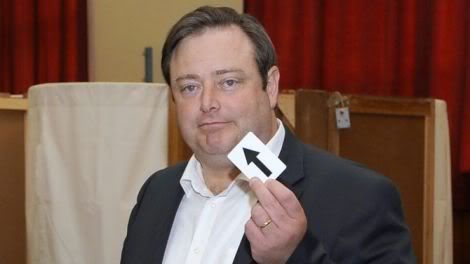
Support for the N-VA has gone up by over five percentage points at the expense of all other parties except the Greens; and Bart De Wever, the N-VA leader, has a personal popularity rating of 53%. What's his secret? We in Plaid could do with some of it.


So what happens next? The BBC seems to think that there won't be new elections because it won't change anything. I'm not so sure. Something has to happen, and new election will provide an excuse for some compromise, even though the faces round the table might be exactly the same. The N-VA are in a position of strength, and so have nothing to fear from a new election. In fact it will probably further strengthen their hand.

Has the year been a waste of time? Well, probably not. The N-VA's stated position has been that they want to see Belgium "very gently disappear". Is there a better way of convincing others that the Federal government is irrelevant than to simply do without one for more than a year? The sky hasn't fallen on their heads. It's now too late to organize an election before summer, but I think there'll be one in autumn.

Bookmark and Share

Belgium Celebrates

Belgium today broke the world record for failing to form a government. A crisis? Well, not really. Belgium hardly needs a federal government because most day-to-day government is handled perfectly well by the devolved regions.

So today has become an excuse for festivities:

Belgians digest "world record" with chips and beer and with no clothes on

Flandersnews, 17 February 2011

Not a pretty sight. To avoid a repeat showing it might be a good idea to get something sorted out before the impasse extends to a year.

It's been hard to keep track of events over the past few months, and I'm not going to try and explain them in this post. Probably the most informative site is here. It sums things up quite well.

Bookmark and Share

Exporting Our Water

One of the things in Wales that is better than anywhere else in the world is our water. The English can't get enough of it, but exporting our water to them is not our only option.

I've just read that a memorandum of understanding is to be signed between Fluxys, who operate Belgium's gas network, and the state of Qatar in the Gulf. Flanders imports liquefied natural gas by tanker from Qatar, and up until now the otherwise empty ships have returned to Qatar with sea water ballast, for stability. The plan is to use fresh water instead:

The Gulf emirate of Qatar is planning to import water by ship from Belgium. The water will return in the tankers delivering liquid natural gas (LNG) at the port of Zeebrugge.

When the gas is transported, the ballast tanks are filled with sea water so as to stabilise the ship’s weight. “But why not, instead of sea water, fill the tanks with fresh water as ballast, we thought,” explains Daniël Termont, head of the gas network administrator Fluxys and mayor of Ghent. “Then the ships can return home carrying fresh water that can be used for irrigation in Qatar.” The port of Zeebrugge is consequently set to build a large fresh water reservoir next to the four existing LNG storage tanks. TMVW, the water company serving Zeebrugge, shall be responsible for supplying it. The quality will be comparable to tap water, and a memorandum of understanding is to be signed between Fluxys and Qatar in early February during a trade mission headed by the Flemish minister-president, Kris Peeters (CD&V).

The lack of water is a major source of worry in the Gulf States, which have huge reserves of oil and gas, but remain in desert conditions as far as water is concerned. Qatar, with no rivers, is facing an increasing demand for fresh water as a result of population growth, rapid urbanisation and the changing consumption patterns. Importing fresh water from Belgium is an attractive alternative to desalinising Qatar’s sea water, which is an extremely expensive and environmentally unfriendly process. Meanwhile, for Fluxys the impending deal fits in with the plans for the Belgian gas network administrator to join hands with the major producers in the world. “If we can deliver water to Qatar, we will reinforce our long-term relationship with a very big gas producer,” Termont said.

LNG World News, 18 January 2011

Qatar are fairly desperate for fresh water. I did a bit of searching and found this report from 2009 about them trying to buy water from the American state of Washington, something that didn't happen because their local laws prevented it.

This raises an interesting question, because one of the sections that Peter Hain inserted into the Government of Wales Act 2006 when he was Governor General (I think that's an appropriate term in this particular context) gave him and his successors power to intervene if any proposed legislation by the Assembly:

might have a serious adverse impact on water resources in England, water supply in England or the quality of water in England

GoWA 2006, 101.1.b

But I'm not sure that a commercial agreement to sell water either requires or comes within the scope of legislation. As well as that, we are not talking about drinking water, but fresh water that will be used for irrigation.

-

As I'm sure most people are aware, we have recently started importing large quantities of liquefied natural gas from Qatar to South Hook in Milford Haven. In fact the Qatargas 2 terminal there, as we can read on their website, is the largest LNG re-gasification terminal in Europe. If we look at the picture, we can see that these are exactly the same ships. So we need to ask a rather obvious question:

What on earth is stopping Wales from doing the same as Flanders?

Someone from the Welsh Government should be on the phone to them first thing Monday morning.

Bookmark and Share

Belgium is "clinically dead"

These are the rather dramatic words of Flemish CD&V MP Eric Van Rompuy—brother of the Herman we know rather better—as reported here:

     Belgium coalition talks back to square one

To update the situation from my last report, the technical talks to try and find a way for each region of Belgium to set and retain a proportion of its own income tax have broken down. Early on, it had become fairly clear that the Parti Socialiste and the Green parties would not budge at all on corporate taxation, but they had appeared to accept the principle of reform of personal income tax, which is at present collected by the federal treasury and distributed to the three regions ... in much the same way as currently happens in the UK.

As I noted before, to split income tax half-and-half as the Flemings want is pretty much what the Calman Commission proposed for Scotland (which the ConDem government in Westminster has committed itself to implement) and what our own Holtham Commission has proposed for Wales. So it looks like the PS is digging its heels in on something that hardly seems very radical on this side of the Channel.

It's hard to say whether the impasse is just brinkmanship or the final collapse. The rhetoric still seems to be more designed for the media than for constructive, down-to-business negotiation ... and the mind boggles at quite what sort of "garden gnomes" Bart De Wever has been offered by the PS.


The normal mechanism for resolving a situation like this would be to hold fresh elections. But all the signs are that the French-speaking vote would harden around the PS, and that the Dutch-speaking vote would harden round the N-VA. The second largest party in Flanders, the Christian Democrat CD&V, fully supports the same sort of fiscal autonomy as the N-VA ... and that means a new election would be pointless. The issues to be resolved would be exactly the same.

Personally, I think a deal will be done. The only alternative is for Belgium to split, which would mean that Wallonia would be left with 100% fiscal autonomy. So if they are concerned about losing out financially, it is surely better to retain a degree of tax redistribution through a central Belgian treasury rather than lose it completely.

-

Yet politics is not always as pragmatic as that: pride, principles and personality also come into the equation and sometimes people anxious to save face end up by cutting off their noses. But that said, if Belgium does split I think separation will turn out to be a very good thing for Wallonia in the longer term. The socialist politicians in Wallonia have been worried about Flanders with 6m people using a different tax regime to unfairly compete with their smaller population of 3.4m, but it is nearly always the case that the smaller country is able to benefit more from any differential with its larger neighbours. Think Luxembourg; think Switzerland ...

... and think what another country with a population of just over 3m people might learn from their example.

Bookmark and Share

Déjà vu ... now in French and Dutch too

For those of us who are following the situation in Belgium, I thought this article from De Tijd shows striking similarities to the discussions of the Calman Commission in Scotland and our own Holtham Commission in Wales:

Parties start discussions on new financing act

The work group assigned to draft a new financing act set to work yesterday. The seven parties deliberating on state reform scrutinised the principle agreement for an amended financing act, which was concluded at the end of August. The principles include, among others, more fiscal autonomy for the federated entities without structurally impoverishing the regions. The latter was discussed in depth yesterday.

The Flemish parties are in favour of more fiscal autonomy for the regions, believing it could be done through a transfer of a portion of personal income and/or corporate tax for the regions, making them responsible for their own income and fiscal policy. In their view regions with a good policy must be rewarded, but those with a poor policy will be penalised. The possibility of the corporate tax being transferred to the federal states is however minimal. The Flemish parties SP.A and Groen! made it clear yesterday that they were not in favour of such a transfer, making rebates on corporate tax more of an option.

As far as a partial transfer of personal income tax is concerned, all Flemish parties seem to be in agreement. The Flemish Nationalists of N-VA defend the most far reaching fiscal autonomy. They want to scrap the existing dotations to the regions and communities and offer the regions and communities responsibility for the collection of a large portion of corporate and personal income tax.

The French-speaking parties are keeping a distance, pointing to the fact that as yet the regions could grant a 6.75 percent rebate on personal income tax, but that they failed to use it to the full. If an agreement is reached on the new financing act during the course of next week, an independent institution will calculate the financial impact on each region. Should the work group manage to make significant progress next week, government formation could be addressed.

De Tijd, 23 September 2010

The issues are almost exactly the same for them as they are for us in Wales and Scotland. The obvious main taxes to devolve are personal income tax and corporate taxes. There seems to be more of a consensus for devolving a proportion of income tax ... but more of a resistance to devolving corporate taxes, particularly from the left. My view is that it's essential to be able to control both, because it is only the balance between different sorts of taxation that enables government to have effective control of the economy.

However the sentence about "rebates on corporate tax" as an alternative to devolving those taxes does strike me as interesting. I've no doubt that details will unfold in due course. However, what emerges might well be a model for how we deal with our own corporation tax. As I've commented before, one of the few good things about the ConDem coalition's programme for government is the promise to consider a mechanism for reducing corporation tax in the north of Ireland. But a different rate cannot be imposed by central government, it can only be done within the parameters set by the Azores Ruling, which mean that the rate has to be set by the devolved government itself and that it must bear the financial consequences of its decision. But there is no reason why the mechanism that is eventually decided should not be applied to Wales and Scotland so that we can make our own decisions about corporation tax as well.

So it appears that Belgium has something to learn from us, and that we have something to learn from them. Perhaps my Dutch-speaking friend in Plaid's research team (you know who you are) would like to be a fly on the wall for this one.

Bookmark and Share

Hergé's adventures in Belgium ... continued

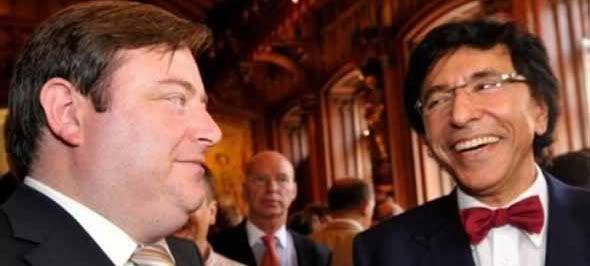
Capten Hadog has just given me another update on the situation in Belgium over negotiations to form a federal government. Since Elio di Rupo of the Walloon Parti Socialiste gave up the role of preformateur, causing the talks to officially break down, the Belgian king appointed two "elder statesmen" from the two largest parties to sound things out on a less formal level and take the spotlight away from the two leaders in the hope of cooling things down.

At that time, and for the first time, the PS started talking openly about splitting Belgium. Not their favoured option by a long way, but what the francophone press started calling "Plan B". The "B" stood for Brussels, and the idea was that they would be happy for the Flanders region to become a separate state provided they left Brussels to Wallonia. Needless to say, this wasn't really taken seriously by the Flemings ... and it since seems to have died a quiet death.

The Flemings were non-plussed with this for the fairly obvious reason that the Brussels region relies on more money from the federal coffers than it contributes (that's why the the PS wanted an additional €500m a year for Brussels) and Wallonia also receives more than it contributes. Although I'm sure he wouldn't actually say it out loud, I can imagine Bart De Wever thinking, "Go on, make my day."


Since then Di Rupo and De Wever have resumed talks. They don't have any real choice but to deal with each other, since the opinion polls show that both leaders are supported by a very large percentage of their respective communities. But these talks haven't been pleasant. The PS was talking of "perjury" and the N-VA talking about the PS wanting to survive on "pocket money" from the federal government. But the important thing is that they're talking again ... even if only just. Here are a couple of reports:

     Open war between PS and N-VA
     Two biggest parties at loggerheads

There was one piece of very disturbing news yesterday. The Speaker of the Flemish Parliament, Jan Peumans, was beaten up in Wallonia. But I sincerely hope (and have no reason to believe otherwise) that this was just an isolated incident. There is no civil unrest and no demonstrations in the streets.

-

I'm not too pessimistic. Talk about constitutional principles isn't too difficult; things only start to get heated when money is at stake. It's hard to make out what the detailed figures they're haggling over might be. Belgium, like the UK, is a state where all except local taxation goes into a central federal treasury, and is then distributed to the three regions. I've heard rumours that the PS are talking about that being reduced to 85%, with 15% being set and retained by the regions from which the tax was collected. The N-VA would be looking for something much more like a 50%-50% split. No prizes for guessing that they'll probably meet somewhere in the middle. But the devil is in the detail: what percentage of which particular taxes ... and for that a lot of financial geeks will be running computer models late into the night for the next few weeks.

The final outcome? If this was to be a one-off settlement I'd expect a 67%-33% split, but if it were linked to an agreed review every five years or so I think the N-VA might settle for something less. I'd emphasize that this is nothing more than my own feeling. I think the split of Brussels from Halle-Vilvoorde and additional money for Brussels is fairly certain, as these had essentially been agreed a fortnight or so ago; but for obvious reasons nobody will confirm this until there is a final agreement on finances.

-

Finally, for those who might be asking why I keep posting on what is happening in Belgium and in Spain, it's for two reasons. First, because those of us who want independence for Wales and Scotland need to be aware that we are far from alone in wanting this for our countries. What we want is shared by people in Flanders, Catalunya and Euskadi.

But secondly, we need to be aware of the political processes by which we are going to get there. We have to look at what the particular issues that drive the desire for independence are, how support for that option or alternatives to it grows, how those who do not want a split react ... and, most importantly, what methods actually work and what methods don't work. By learning from what others in similar situations do, we'll make our own path to independence that much easier.

Bookmark and Share

Frieda Brepoels, the N-VA ... and Martin Shipton

Martin Shipton seems determined to stir up a row about Plaid inviting Frieda Brepoels to speak at our conference, but I'm pleased that we did. The N-VA promote an inclusive civic nationalism, as opposed to the exclusive race-based nationalism of many other parties, and that is reason enough to work with them as part of the Green-EFA group in the European Parliament even though they are a centre-right party.


But he certainly makes a surprising number of blatantly incorrect statements in his attempt. Let's look at some of the claims his article makes.

Recently the Wall Street Journal reported that the party, which is in power in the Flemish Parliament, had ordered libraries to stock at least 75% Flemish books, and was insisting that blood donation drives should be conducted among people who were mono-lingually Dutch.

This isn't true on two counts. First, the N-VA has only 16 members in the 124 member Flemish Parliament. The Christian Democrat CD&V, the Liberal Open VLD, Vlaams Belang (a far right nationalist party that does make race and religion an issue ... and probably the party Shipton was trying to confuse the N-VA with when he described it as "the controversial Flemish Nationalist party") and the Socialist SP.A each have more seats ... though that probably won't be the case after the next election. So whatever policies the Flemish Parliament has voted for have more to do with these parties than the N-VA.

But second, look at Martin Shipton's careful mangling of a sentence to give it a completely different meaning. The Wall Street Journal article says:

... blood drives to be monolingually Dutch

Martin Shipton alters it to:

... blood donation drives should be conducted among people who were mono-lingually Dutch

Nice try Martin, but you refer to a newspaper report, you should expect someone to check out whether or not you are distorting it. It's a reference to the language of the campaign, not that only mono-lingual Dutch speakers are encouraged, or allowed, to give blood.

-

Now let's look at the claim of Bart De Wever:

... denying that people from Antwerp assisted in deporting Jews from Belgium during the Second World War.

Again, that's demonstrably wrong. He did exactly the opposite. He said that the authorities in Antwerp did assist the Nazis in that deportation, but that:

Antwerp did not organise the deportation of the Jews, it was the victim of Nazi occupation ... Those who were in power at the time had to take tricky decisions in difficult times. I don't find it very courageous to stigmatise them now.

Economist, 31 October 2007

So why on earth did Martin Shipton turn a statement about not being keen to blame the authorities in Antwerp for their role in the deportation into an outright denial that they had any involvement in it? Sloppy journalism, or another example of distortion?

-

Now let's look at the claim made by Labour MEP Derek Vaughan on education:

What these right-wing separatists have to teach the people of Wales is a question worth asking? Are Plaid seriously thinking about replicating some of their domestic policies? The N-VA, for example, think that preferential choice in schooling should be given to Belgian families who have at least one Dutch-speaking parent.

Derek has jumped at his opportunity to take hold of the wrong end of the stick. The N-VA policy applies to Brussels, not the whole of Belgium. It is very difficult for people in the supposedly bilingual Brussels region to get their children educated in Dutch. The N-VA want at least those who have one parent who speaks Dutch to be able to insist that their child gets a Dutch-medium education. Strange that a Labour politician in Wales should criticize that, not least because we allow every parent, whether they speak Welsh or not, the right to choose a Welsh-medium education for their children. In due course, I'd like the same to be true in Brussels ... as, I'm sure, would the N-VA.

Our big problem is that some Local Authorities still make it very difficult for parents to exercise that choice without having to travel inordinately long distances to get it ... but we can't single out Labour in this respect, for the LibDems can be just as bad where they are in control. Swansea in particular.

-

Now of course, since the N-VA are a centre-right party, you wouldn't expect someone like me to agree with all their policies. But for a balanced view of what Frieda Brepoels actually stands for, this article should be of some help.

-

Finally, I've just taken some time to find out more on the question of Alexia Philippart de Foy being refused permission to buy a house in Flanders. The law in question is "Wonen in eigen streek" which means "Live in your own area". It applies to social housing and to new developments built on land that was in public ownership, for period of twenty years. In that sense, it is not unlike a planning condition. It does not apply to ordinary private sales of existing housing. There are three criteria by which someone would qualify:

•  6 years continuous residence in the municipality or an adjoining municipality;

•  At least a half-time job in the municipality;

•  Having family, social or economic ties with the community.

Any one of the three would be sufficient.

That does not strike me as being particularly unreasonable, and indeed it might be a model for protecting the character of an area. It doesn't seem so very different from these sort of criteria for the Lake District National Park Authority in England.

I should also remind people again that this law was passed by a 124 member Parliament in which the N-VA has only 16 seats. The policy was championed by CD&V, as we could read on this site if our Dutch were up to it, but can all read here. That doesn't mean to say that the N-VA doesn't agree with it, but that it is a policy broadly agreed by a majority of Flemish parties, not just the N-VA.

It's also worth noting that language is not one of the legal criteria, and that the CD&V spokesman cited problems with people from the Netherlands moving to the area around Antwerp, as well as the general problem of people from cities moving out to smaller surrounding communities, pushing up prices and making it harder for young local people to buy a home in their own community. It is primarily an issue of localism, not language.

-

Yet of course language is one of the most noticeable casualties in certain situations, so I don't want to shy away from that subject. Personally, I think the idea of competing monolingualisms in Flanders and Wallonia has been a mistake. Bilingualism is a much better model, but it only officially applies to Brussels.

In fact, the language situation in Brussels is not so dissimilar to that in some parts of Wales. First, there has been language shift through which Flemings whose parents and grandparents spoke Dutch have lost the language because the language of administration was French; and second, there has recently been a high level of immigration from French speaking areas of Belgium, and they have been much more reluctant to learn Dutch than Dutch speakers have been to learn French. A third factor in Brussels is the high level of immigration from ex-colonial French speaking countries, which is not particularly mirrored in Wales.

But even though Brussels is officially bilingual, it is often very difficult to get any satisfactory provision of public services in Dutch, a situation which is exactly mirrored in many parts of supposedly bilingual Wales ... even 17 years after the Welsh Language Act. That is why initiatives such as the right to Dutch-medium education in Brussels, even if limited at first, are so important.

It is also (as I'm sure one or two readers of this blog might have noticed ;-) why I focus so much on us taking the steps we need to take in order to ensure that everyone who grows up in Wales is competent in both Welsh and English. I might berate how slowly we are moving to achieve this goal, but I am convinced that we in Wales—in a consensus shared by all parties and started before Plaid Cymru was ever part of government—have chosen a much better path than to draw a line and call one area Welsh-speaking and one area English-speaking.

Bookmark and Share

Cats in Belgium ... and less important matters

The Guardian has a rather, shall we say, special way of looking at the world ... and of course I value it greatly. But it is extraordinarily Brito-centric. So, while attempts to form a federal government in Belgium are floundering, the Guardian could hardly be expected to make that it's main story about Belgium. No, there's something else that they know the bulk of their readership will find far more important: the impending doom for Belgium's burgeoning cat population.

Belgium plans to neuter most cats as feline population explodes

Almost all Belgian cat owners will be obliged to have their pets
sterilised and registered by 2016

Guardian, 3 September 2010

Still, I learned something I didn't know.

Cat culls have a long history in Belgium. In Ypres, in western Flanders, they've been hurling the animals from the belfry of the 12th-century Cloth Hall for hundreds of years in an annual ritual to ward off the devil.

The massacre continues, now every three years. But nowadays the cats are fluffy, velveteen toys.

Bagpuss is horrified. He's wondering whether it might be better to throw politicians from the belfry instead.

-

However, for those whose who might be interested in what's happening in Belgian politics, the answer is that the talks to form a federal government have now collapsed. The situation last weekend has developed in these ways. Di Rupo offered to split the extra finance he wanted for Brussels into two parts: €250m a year now, set alongside splitting Brussels Halle-Vilvoorde; and €250m a year as a fixed part of any future deal on a new funding formula for the three regions. De Wever said he would only accept immediate additional funding for Brussels if it was for a maximum of two years, with no fixed sum pre-allocated to Brussels in whatever new deal was agreed. So Di Rupo went back to the king to tender his resignation as preformateur for a second time.

A selection of reports is here.

What happens next? My guess is that things will cool down for a while, so as to see what less formal, unofficial talks might yield. However, it isn't quite fair to understand this as only a Flanders vs Wallonia issue, it is also a matter of simple right vs left politics. Both the big parties in Flanders are centre-right, so the financial reform they want is as much about overall deficit and debt reduction (and the balance to be struck between reducing services or increasing taxes to pay for it, and how quickly) as it is about sharing spending between the three regions.

But the choices are stark. Either a compromise deal is done and a federal government formed or, if no deal can be done, Flanders and Wallonia will have to separate. But there's no rush, it can wait another month or so.

Bookmark and Share

Negotiations in Belgium

It's been some time since the political situation in Belgium has been in the news here, but what has happened over the weekend is probably enough to justify a progress report.

The federal election took place on 13 June this year, and resulted in large gains for the N-VA in Flanders and for the Parti Socialiste in Wallonia, but negotiations have still not led to a federal government being formed. That shouldn't be a surprise to anyone, as it was always expected that negotiations would take months rather than weeks. It goes without saying that the situation is complicated, but I'm going to attempt to explain things as I see them. As the EU has a penchant for pillars, I'll build on that theme.
 

Pillar 1

The basic premise on which agreement will be reached is that—even though the N-VA is the largest party, and therefore its leader Bart De Wever might normally expect to be Prime Minister—the Parti Socialiste leader Elio di Rupo would be Prime Minister, provided that the constitutional changes wanted by the N-VA were implemented.

The longstanding outstanding issue is the electoral/judicial district of BH-V (Brussels Halle-Vilvoorde) whose constituent parts have different constitutional statuses. Brussels is one of the three geographical regions of Belgium (the other two being Flanders and Wallonia) but Halle-Vilvoorde is part of Flanders. The three regions are constitutionally distinct from the three language communities of Belgium (Dutch, French and German-speaking) with Brussels having bilingual status. It is this overlap between "regions" and "communities" that gives rise to the problem, both at a political level (because political parties in Belgium operate as separate linguistic entities) and in terms of administration of justice.

There are of course a number of ways in which the BH-V problem could be solved, and indeed some do not see a problem at all ... or, to be more precise, would see the problem not as the electoral region itself, but in the idea of the current arrangement of regions and communities. However the Constitutional Court has ruled that the current arrangement is anomalous and must to be resolved, but has not said how. In general terms, Dutch speakers are primarily concerned that Halle-Vilvoorde remains unambiguously part of Flanders; whereas French speakers see the area as a suburb of Brussels, especially the narrow southern strip that separates Brussels from Wallonia. The map below shows Halle-Vilvoorde in red and Brussels in white. In grey is Leuven, the other district in Flemish Brabant. Wallonia is to the south.
     
So the first plank of the deal is that BH-V is split as the main Flemish parties want.
 

Pillar 2

If BH-V is split, Brussels itself becomes more tightly defined and might be seen to be disadvantaged. In time honoured fashion, the solution is to smooth any reform by means of money. So, as I read the situation, the consensus seems to be that the Brussels region should get a better financial deal. The sum being talked about is €500m a year. In political terms Brussels is run by the Parti Socialiste. So, as far as Elio di Rupo is concerned, the deal should stand on these two pillars alone ... and he does have the agreement of the Flemish Greens and Socialists, as well as the Walloon parties in the negotiations.

But the two big Flemish parties, the N-VA and CD&V, the Flemish Christian Democrats, do not want to agree a deal for financing Brussels without a wider agreement on a formula for rebalancing finances of Flanders and Wallonia as well. The negotiations now seem to have broken down on this point.

It isn't really clear what the precise sticking points are because nothing has yet been committed to paper. In general terms Flanders wants more of tax money retained at regional level rather than forwarded to federal government. Wallonia is anxious to maintain the current arrangement because it is a net beneficiary of federal redistribution. According to this report about €14bn of public spending should shift from being spent by the federal government to being spent by the regional governments, but this is only a very small part of overall public spending which is just short of €200bn a year. Also, as we in Wales and Scotland know only too well, having a budget to spend is only half of the fiscal equation – good governance is not only about spending money, it is about being responsible for how that money is raised.

-

So it remains to be seen what will happen next. As the report I linked to says:

On Sunday Di Rupo said rival sides positions' were "incompatible" and announced he would give up his mediation efforts. But a day later he said he bowed to demands by King Albert II to soldier on 'out of a sense of loyalty to the state.'

Flemish newspaper De Standaard argued that the weekend's events seriously compromised relations between the main political players, dashing initial hopes that arch-rivals Di Rupo and De Wever could strike a business-like partnership.

"We are not yet negotiating the final split-up of the Belgians. Feelings and intentions are not there yet. But on Sunday night we took a further step in that direction," the paper warned ominously.

I don't think it's reached that point yet, either. The major reason why Belgium has not split so far is because of deciding what to do about Brussels and the surrounding areas. So, if the situation as I read it is correct, an agreement about what exactly constitutes Brussels and what constitutes Flanders is more important for the eventual independence of Flanders than any shorter-term arrangement about finances. I do not think the Flemish parties would throw that away. If things are as reported, the BH-V split without additional concessions to French speakers in Halle-Vilvoorde has given them what they wanted.

But equally, the Flemish parties are not going to be content without any move towards greater fiscal autonomy for the regions. The balance between taxes set and collected by the federal treasury (about 90%) and those set and retained in the regions would need to shift. Di Rupo has proposed a Commission "to formulate proposals to suggest new funding models" but, as we in Wales and Scotland know, this might be of little value unless matched by political commitment.

-

To us it might seem strange that Belgium could run without a government since June, but it isn't really a problem for them. It's not even a hundred days yet. Up until now things have been very cordial and consensual. So perhaps this first sign of so-called irreconcilable disagreement is evidence that the hard negotiation has only just begun.

Bookmark and Share

More on Flanders and the N-VA

I've been following the reaction to the Belgian election last Sunday, and been particularly disappointed by some of the presumptions made about the Nieuw-Vlaamse Alliantie (New Flemish Alliance) in the UK media.

The general it seems that nationalism and the desire for a Flemish State are seen as racist and exclusive, and very few commentators here have been able to distinguish between the inclusive, civic nationalism of the N-VA and the exclusive, sometimes racist, nationalism of Vlaams Belang, whose share of the vote fell dramatically. They have linked the N-VA's success in Belgium with the rise (though only to 15% and third place, with the other parties refusing to work with them) of Geert Wilder's vehemently anti-Islamic Partij voor de Vrijheid in the Netherlands.

As a short illustration of how wrong that perception is, this is a short feature from the N-VA website:

Met de 28-jarige Nadia Sminate uit Londerzeel en de “Limburgse” Antwerpse Zuhal Demir (30) stuurt de N-VA voor het eerst in haar bestaan twee jonge leeuwen van allochtone origine naar de Kamer. Zuhal en Nadia zijn respectievelijk van Turks-Koerdische en Marokkaanse afkomst. Ze vinden in de N-VA een partij die gaat voor echte ipv bepamperende integratie en voor een streng maar rechtvaardig migratiebeleid. Zuhal wil zich als advocate in het parlement toeleggen op arbeidsmarktbeleid, net zoals Nadia die zich zal concentreren op de optimalisatie van de combinatie arbeid en gezin.

With the 28-year-old Nadia Sminate from Londerzeel and the "Limburg" Antwerper Zuhal Demir (30) the N-VA has for the first time sent two young lions of immigrant origin to the Chamber. Zuhal and Nadia are, respectively, of Turkish-Kurdish and Moroccan origin. In the N-VA they find a party that wants real integration instead of patronizing, and a firm but fair immigration policy. As a lawyer, Zuhal wants to focus on Labour Market Policies, while Nadia will concentrate on optimizing the balance between work and family life.

Highlights, 17 June 2010

I've relied heavily on Google for the translation, and would welcome any improvements. Perhaps I should also explain that one layer of the reference to "lions" is that the flag of Flanders is a black lion on a yellow background.

-

As I said when the results came in, it will take some time for the shape of the new Belgian government to become clear. N-VA leader Bart De Wever has been appointed as the informateur charged with negotiating a working coalition. If it can command a two-thirds majority, it will be able to break the constitutional impasse that led to the dissolution of the previous parliament. The consensus view seems to be that Francophone socialist leader Elio Di Rupo will become Prime Minister, with Bart De Wever content to let that happen in return for constitutional reform.

Bookmark and Share

Slowly but surely, Belgium will very gently disappear

Some people are convinced that Belgium was only ever a hoax perpetrated by the "Liberati" as part of their plan for world domination ... and that any protest to the contrary was an obvious over-reaction which proved their point:


But for those of us that want to see the stateless nations of Europe take our place on the world stage on the same basis as the other countries of the world, Belgium—just like the UK—is a state that does exist, but shouldn't continue to.

Belgium has become increasingly dysfunctional for years, with the people of Flanders increasingly seeing themselves as a nation in their own right, but with Wallonia anxious to maintain the status quo. Last month the fragile federal government broke down again and a snap election was called for today to break the impasse. The results are just coming in [this seems to be a good source] and they show a quite remarkable result for the N-VA, who are Plaid Cymru's partners in the EFA group in the European Parliament. They are currently standing at 28.4% in Flanders and 20.6% in Belgium as a whole. This makes them comfortably the largest party, and this is all the more amazing because they were founded less than ten years ago and were nowhere in the last Belgian election. It looks like Flander's time has come.

-

Jill Evans posted details of a press conference they gave last week in response to their rapid rise in the polls, which is worth reading to find out more about them. Like Plaid Cymru and the SNP the N-VA are inclusive, civic nationalists fundamentally opposed to the far right, exclusive nationalism of Vlaams-Belang (who I'm pleased to say did not do well, which was quite a relief following the increased support for the equivalent party in the Netherlands in last week's Dutch election). But unlike Plaid, they are a party of the centre-right rather than the left ... though it should be said that politics in Flanders is generally right-leaning while that of Wallonia generally leans to the left. The biggest party there is the Parti Socialiste, with 35.0% support in Wallonia and 10.3% in Belgium as a whole.

-

It will take a while—maybe a long while—for things to become clear as the parties negotiate to form a government, but it does seem clear that Flanders is bound to gain more autonomy, while the power of the federal government will reduce. That's encouraging news for us, because what happens next will provide one model—though not necessarily the only one—for how similar stateless nations in the UK and Spain can move towards independence.


Bart De Wever, the N-VA leader, said that he is not looking for outright independence straight away, but to move from the current federal system to a confederal system in which Belgium will "slowly but surely, very gently disappear".

Bookmark and Share