Showing posts with label BYIG. Show all posts

National Savings & Investments is the joke

Because of the date, I wasn't sure whether this article on the BBC website yesterday about National Savings and Investments scrapping their Welsh language service was meant to be a joke or not and, to be honest, I'm still not entirely sure. So, at the risk of making a fool of myself, I'll treat it seriously.

Apparently, NS&I are proposing to end all Welsh language services on 22 April this year. The reason they give is that they are "not a cost effective use of public funds", saying that only 107 people corresponded with them in Welsh and that this worked out at about £900 per customer.

The first thing to note is that this is a minuscule amount in relation to the sums of money they handle. It works out at £96,300. This is less than a millionth of the £98bn of savings that they manage on behalf the Treasury, a total that represents 16% of the entire UK national debt (details here).

The second thing to note is that they are legally obliged to provide a service in Welsh, in accordance with the Welsh Language Scheme they agreed with the Welsh Language Board in 2007. It is quite inconceivable that a public body should renege on an agreement they freely entered into, for there is nothing in the agreement that makes the provision of this service dependent on the number of people using it. It's a red herring.

-

But, that said, the whole problem with Welsh Language Schemes was that there was no way that they could ever be enforced. All the Welsh Language Board could do was conduct an investigation and "name and shame" any organization that broke the terms of their agreement. This was the main reason why the new Welsh Language Measure gives the Commissioner power to take the matter to a tribunal and impose a financial penalty on organizations that fail to comply with the new Language Standards. However, because we do not as yet have any Language Standards, there is nothing to enforce.

Until then, the Commissioner keeps the residual power of the WLB to investigate breaches of existing WLSs, and it is all but certain that Meri Huws will produce a suitably damning—but entirely deserved—report in due course. However that won't, in itself, change anything in the short term. The only real hope of getting NS&I to reverse the decision before it is implemented is by public and political pressure. I trust that the right people will step up to the plate to bring them into line.

In the longer term, everything will depend on the Language Standards that are eventually approved. So I hope that this episode will convince both Leighton Andrews and the Welsh Government that these will need to be strong and strictly enforced. With that in mind I'd like to look at the specifics of this case, because I think it will shed some light on what needs to be done.

Although NS&I is an agency of the Treasury, its day-to-day operations have been contracted out to private organizations. The service was previously run by Siemens IT Solutions and Services, but they were bought out in 2011 by a French multinational operating under the name of Atos IT Solutions and Services. Atos, for those who don't recognize the name, is the very same multinational that is responsible for managing Work Capability Assessment on behalf of the Department of Work and Pensions, and will implement the new Personal Independence Payment that is set to replace the Disability Living Allowance. In short, they are the organization charged with implementing, and given incentives to implement, some of the most draconian aspects of the ConDem coalition's programme of cutting back expenditure on services to the public. With such a remit, it shouldn't come as too much of a surprise that they would look to look to penny-pinch a sum that represents less than a millionth of the money they manage for NS&I.

A second factor is that NS&I has radically changed the way it operates. Shortly after Atos took over the contract, they announced that products would only be available by telephone or online. Premium Bonds are now the only things available over the counter at Post Offices. This decision was obviously taken to save money, and that is not necessarily a bad thing ... except that it is a contributory factor in the viability of Post Offices and is bound to lead to more of them closing. But it does go a long way to explain why so few people deal with NS&I in Welsh. NS&I simply doesn't provide either a telephone or online banking service in Welsh. Some basic, very limited, information about their services is available in Welsh, but you cannot register for or access these services in Welsh. It can only be done in English.

This is, of course, the main reason why so few people use the Welsh language service. If you telephone their English line, you can talk about and get specific answers about your accounts. The only way you can get any specific information about your accounts in Welsh is by post. The choice is either to spend time, effort and money to get an answer in Welsh several days later, or to get an instant answer via a freephone number in English. You can't even get specific information about your accounts by email.

The reasons they give for this are tired and predictable, but still laughable. They say it is "er mwyn eich diogelwch" or "for your security". But do they seriously believe that a breach of security is more likely by someone, somewhere in the world, hacking a phone conversation or online communication in Welsh than it is in English? There must be more Welsh speakers in the world than I thought.

-

There is silver lining to this. It shows in the clearest terms what silly excuses and underhand practices even an agency of government will resort to in an attempt to avoid its duty of providing an equal service to the public in both English and Welsh. We can, and need to, learn from this. The underlying rule in formulating the new Language Standards must be that whatever service is provided in English must also be provided in Welsh. An equal telephone banking service. An equal online banking service. Equally available information and publicity.

Anything less would be a joke.

Bookmark and Share

Two faced about our two languages

Although not reported anywhere in English, both Golwg and the BBC's Newyddion carried a story about an application for funding from the Big Lottery Fund being refused to one of the Papurau Bro on the grounds that the paper is in Welsh only, rather than bilingual.


Apparently the Welsh Language Scheme agreed between the Big Lottery Fund and the former Bwrdd yr Iaith stipulates that lottery funds should only be granted for bilingual projects. This is the translation of what Fflur Lawton said in the interview:

"The terms and conditions of every grant that we give out ask for [the applicants] to make provision for their projects to be in Welsh and English.

"So if they have things like websites or send things out to people, we ask for them to be bilingual; and this is part of the terms and conditions of their grants."

The new Language Commissioner's reaction was to say that they had given advice that it was appropriate to give grants to bodies that work entirely in Welsh if it was to promote or facilitate the use of Welsh. However this advice seems to have been given a couple of years before the WLS was agreed, and not to have been reflected in the final agreement.

It's very easy to say the BLF should make an exception in this case, especially as it would appear that the amount involved is relatively small (for publishing software). But I'm not sure that's the right way of looking at it. Wouldn't it be much better to get the BLF to stick to what they actually agreed, and insist that they do in fact only give grants to projects in Wales that are delivered bilingually?

-

I don't want to pick on any one organization that has received lottery funding from the BLF, but the first thing that came up when I Googled "Projects in Wales, National Lottery" was FareShare North Wales. As we can read here, Crest Co-operative recently received £246,926 to help set up the first ever FareShare project in Wales to provide free meals for vulnerable members of the community.

The aims of the project are of course thoroughly praiseworthy. But if we look at their website we can see that it certainly isn't bilingual, nor is the specific page of the project they received funding for. So it appears that Fflur Lawton was being disingenuous; the Big Lottery Fund is being two faced when it comes to treating our two languages equally.

It would be well worth checking whether the BLF actually pays any more than token lip service to what it claims is part of the terms and conditions of every grant it makes in Wales. Some £75m of lottery money will be distributed in Wales each year by the BLF and other distributors. To my mind it is better that none of this money is given to any project that is only going to be delivered in one language, whether that language is English or Welsh. Sticking to that principle would make much more of a difference in overall terms than if we asked the BLF to make a one-off exception for a few hundred pounds of software.

Bookmark and Share

Struggling with Statistics

Whenever I see a statistic quoted—or at least one that appears implausible—my first reaction is to ask where it's from and whether it's being used in the right way. So that's exactly what I did when I saw this claim by S4C's new chairman, Huw Jones, at the start of an article on the IWA website yesterday.

Welsh broadcasters struggle with adverse statistics

S4C is working out its future against a backdrop of Wales suffering a net loss of 3,000 Welsh speakers every year ...

Click on Wales, 5 August 2011

Where does this number come from? A quick Google found this article by Siôn Jobbins, in which he says:

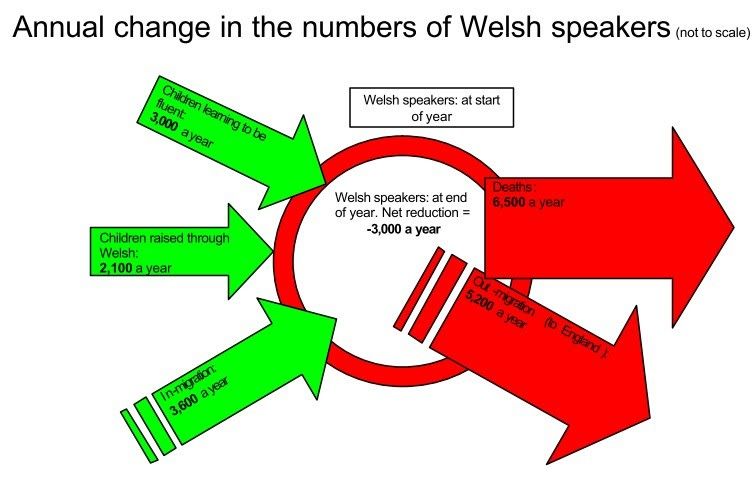
A Welsh Language Board Statistical Trends presentation in 2004 (which is on their website) estimated that among the Welsh-speaking community the number of deaths at 6,500 and out migration to England at 5,200 outran the number of children born to Welsh-speaking homes or raised Welsh-speaking plus immigration of children into Wales (from England mostly) by 3,000. These aren’t precise figures and are maybe skewed towards the more western, Welsh-speaking parts of Wales to the detriment of the east. Having said that, the presentation calculated that the Welsh language community is running at an annual deficit of 3,000 a year.

Daiaspora – Cambria Magazine, September 2007

That presentation was produced by Hywel Jones and can be downloaded from here. This is the relevant diagram from it:


The very first thing to note is that the net loss of 3,000 Welsh speakers relates to fluent Welsh speakers only, not the total number of Welsh speakers. Huw Jones is therefore painting a blacker picture of the difficulties facing S4C than is warranted from the source he is quoting. The other statistics he quotes may well be correct, but that one definitely wasn't.

In general terms, this survey shows that 57% of those that speak Welsh (i.e. described themselves that way in the 2001 census) consider themselves fluent. But we can be more precise about the figures for children.

-

By a welcome coincidence, the set of statistics which has a direct relevance to how fluent children are in Welsh was highlighted by Tory AM Suzy Davies only this week, although the figures she was quoting were in fact released last year:

     Davies: Pupils’ Welsh fluency levels "unchanged" since 1986

But even though the figures she was quoting are correct, she too was using them wrongly by making a direct comparison between 1986-87 and 2009-10. This is because the assessments of whether a child is able to speak Welsh, and whether they can speak it fluently, were made by teachers prior to 2002-03 but by parents from then on. Suzy Davies' press release didn't mention it at all. Let's be charitable and assume that she wasn't aware of the change and wasn't knowingly trying to mislead anybody. Kudos to Tom Bodden for picking this up in the Daily Post, though without making any comment on how this change was significant.

The percentages were actually going up fairly steadily year by year, but the change in the assessment method produced a sudden reduction in the figures. The figures back as far as 1998-89 are available here and here on the StatsWales site. These are the figures for primary schools:

1986-87 (teacher assessment)

Fluent at home ... 7.2%
Fluent, but not at home ... 5.8%
Total fluent ... 13.0%
Can speak Welsh, but not fluently ... not known
Cannot speak Welsh ... not known

2001-02 (teacher assessment)

Fluent at home ... 6.2%
Fluent, but not at home ... 10.5%
Total fluent ... 16.7%
Can speak Welsh, but not fluently ... 31.2%
Cannot speak Welsh ... 52.0%

2003-04 (parental assessment)

Fluent at home ... 8.4%
Fluent, but not at home ... 4.5%
Total fluent ... 12.9%
Can speak Welsh, but not fluently ... 19.9%
Cannot speak Welsh ... 63.5%

2009-10 (parental assessment)

Fluent at home ... 7.6%
Fluent, but not at home ... 5.4%
Total fluent ... 13.0%
Can speak Welsh, but not fluently ... 24.0%
Cannot speak Welsh ... 62.9%

As I said when I commented on the figures in this post last year, they are not very reliable because parents who speak little or no Welsh are in no real position to assess how well their children can speak it, and it's a subjective judgement which varies according to how much Welsh is spoken in a particular area. Teacher assessment was more objective. But the figures can be used to track relative changes. The trends are that fewer children are growing up in Welsh speaking homes, but that the number of children who are fluent in Welsh as a result of being taught it in school has been going up constantly under both methods of assessment. I won't deny that the increase has been smaller than I'd like, especially in the last six years, but since 1986-87 the overall fluency figure has increased by more than a quarter.

It's also worth noting that the figures represent the whole range of primary school years. Obviously children from Welsh-speaking homes will be fluent from the beginning, but it can take a few years for those learning Welsh to become fluent; so an average of 13% will be few points lower in Year 1, and a few points higher in Year 6. This pattern continues into secondary school. If anyone is interested, I've put the information available from StatsWales into a spreadsheet which can be downloaded here. This makes it easier to compare the year on year changes.

-

Now the big question is how the StatsWales figures fit alongside the BIYG analysis from 2004. Those figures had shown an "input" of 2,100 children a year fluent at home and 3,000 a year becoming fluent at school: a total of 5,100 a year. The figures for 2009-10 for 11-15 year olds at secondary school are:

Fluent at home ... 15,311 = 3,062 a year
Fluent, but not at home ... 12,059 = 2,412 a year
Total fluent ... 27,370 = 5,474 a year
Can speak Welsh, but not fluently ... 65,099 = 13,020 a year
Cannot speak Welsh ... 81,445 = 16,289 a year

This shows that Hywel Jones' overall "input" figure for children fluent in Welsh was broadly correct, and is a few hundred higher now than it was before. But the StatsWales figures also show that the annual "input" of children who can speak Welsh is very much greater than the figure we get if we only include those who can speak Welsh fluently. I haven't done a calculation on whether the "losses" due to emigration from Wales and death are the same as they were a few years ago (perhaps it's best to wait until the results of the 2011 census are published next year) but if they are broadly the same, it's reasonably clear that the net increase in Welsh speakers will be at least 10,000 each year.

-

In summing up, I don't want to detract from Suzy Davies' point that our education system should be doing more than it currently is to ensure that more of our children are able to speak Welsh fluently. Even though the figures are in fact going up, they need to go up faster still.

But I am very disturbed by what Huw Jones has said, because far from there being a net loss of 3,000 Welsh speakers each year, there is in fact a net increase in Welsh speakers of more than three times that amount. Now I wasn't there to hear the whole debate, I just read what was reported on the IWA website and Huw might well have qualified his opening statement. But it strikes me that he has made a rather lame-brained and, to put it bluntly, misleading attempt to make out that S4C is somehow having to battle its way up a demographic hill. S4C's potential audience is in fact growing at a healthy rate year by year, not falling.

Bookmark and Share

Choosing Welsh-medium Education

There's a story on the BBC website today about why so many parents, particularly parents who do not themselves speak Welsh, are choosing Welsh-medium education for their children.

     Di-Gymraeg yn dewis addysg Gymraeg

Strangely—or perhaps not—this story is only in Welsh and doesn't appear on the English pages of the BBC website; even though it is primarily about, and therefore of interest to, parents who do not speak Welsh. As far as I can tell, the only English media to carry the story is the Caerffili Observer.

The full version is on the Bwrdd yr Iaith website, which I've copied:

Language no longer a barrier as more parents send children to Welsh language schools

Parents who cannot speak Welsh themselves are no longer viewing their inability to speak the language as a barrier to sending their children to Welsh medium schools, according to the findings of a new survey.

The survey which was carried out by the Welsh Language Board found that 65 per cent of parents who send their children to a Welsh medium school are not Welsh speakers themselves and do not view their inability to speak the language as a hindrance in their children's education.

The survey also found that over half of the parents questioned did not have Welsh speakers within their extended family, suggesting there is no longer a language barrier in educating a child outside of their first language. 97 per cent pinpointed the desire for their children to be able to speak the language as the main incentive for them choosing a Welsh medium education for their children.

The survey questioned parents with children in primary aged Welsh language education and was conducted in conjunction with the Welsh Language Board's 'Introducing Welsh' campaign. The 'Introducing Welsh' campaign reflects the advantages of introducing children to the Welsh language and promotes benefits such as an improvement in communication skills and greater job prospects for the future and can be viewed in Welsh or English.

 
Speaking in response to the survey findings Meri Huws, chair of the Welsh Language Board, said: "These findings demonstrate that parents should not be put off from sending their children to Welsh medium schools, even if they do not speak Welsh themselves. The benefits of learning Welsh from a young age are highly advantageous for both their education and in their future careers.

"It is fantastic to see the continuing trend of parents no longer perceiving their own inability to speak the language as an obstacle in their children's education.

"It is also great to see that parents are taking on board and championing the benefits of being bilingual as they make education choices for their children. Nearly half those surveyed believed that the single greatest benefit for their child speaking Welsh was the greater employment prospects that it would deliver, which in this highly competitive jobs market is a huge advantage."

 
The 'Introducing Welsh' campaign looks to encourage parents, in particular new parents, to give their child a head-start in life by introducing them to Welsh. It gives parents advice on the advantages of using Welsh in the home and raising children bilingually and encourages you to get friends, family and neighbours involved in your child's development.

Bwrdd yr Iaith, 21 June 2011

However the BBC Cymru version adds this personal touch to the end of their story:

Rhys Evans, a non Welsh speaking parent in Cardiff, "definitely wanted" his children to speak Welsh.

"How can an additional skill be a bad thing for them to have, especially when that skill is their own country's language?" he said.

His five year old daughter is already at school, and his three year old daughter will start Welsh medium education in September.

"I'm helping her with maths. Maths is tedious no matter what language it's in!"


Update

Full details of the survey are available here. Several things should be noted:

The survey was commissioned by BYIG, but not carried out by them, and the press release was produced by the company that did the survey. There was no specific question about whether parents viewed their inability to speak Welsh as a hindrance in their children's education, although that could reasonably be concluded from their decision to send their children to WM schools. Obviously, the fact that parents can't themselves speak Welsh will affect their ability to help their children's education, and that particular question was asked in the context of then asking about the support available to parents. But that's not the same thing as saying it hinders their children's education.

It should also be noted that some parents gave more than one response to the questions about their main motivation for choosing WM education and what they thought was the single main benefit of being able to speak Welsh for their child.

The press release was withdrawn from the BYIG site, and that's probably a good thing. With some better editing it would have been fine, but that can't be done after it's gone out. However the faults in the press release don't invalidate the survey itself.

Bookmark and Share

Playing Silly Buggers

In my post on Tuesday about the fiasco over proposals for translation of the Assembly's Record of Proceedings and, in particular, the compromise announced on Monday, I said:

I'm only left wondering what the precise logistics will be, because they surely won't publish one version of the Record with the English translation immediately, then publish another version with both translations a week later. That would just be more work and money wasted. So I'd be willing to bet we just have the same version as we have now, but published after three days. If they leave it any longer, then those who need the translation into English will start complaining loudly enough.

I lost that bet.

As we can read on Vaughan Roderick's blog today, the Assembly Commission have gone and done exactly that. As this both unreasonable and illogical, I can only conclude that the Assembly Commission are playing a game of silly buggers.

-

As I said in the previous post, the obligations which the Assembly have undertaken with regard to translation are set out in their Welsh Language Scheme. In it there is no mention at all of the timescale for producing a translated Record of Proceedings. There is no obligation on them to produce it within 24 hours, or three days ... or even a week! Therefore, if they had taken the decision to delay releasing the Record for a day or two (in order to, as they claim, save money on translation) that decision would have been entirely consistent with their obligations.

However, if they decide to translate from Welsh to English first ... and then wait another few days before translating from English to Welsh, they are very clearly not treating both languages equally, and are therefore breaking not only their own WLS, but also the basic principle behind the 1993 Act.

As I said, if they had chosen to produce the full bilingual Record after a few more days, the Welsh Language Board would have had no grounds to step in. But by choosing to do it as a two-stage process, the Assembly Commission has now given the WLB new grounds to step in. Indeed it is their job to do exactly that.


But leaving obligations and legal matters to one side, the route the Assembly Commission has now taken is quite obviously perverse. The stated idea behind the change was to save money. Producing two separate documents costs more money than producing one. It is also inefficient from the point of view of the translator's time, which of course equates to even more money. Previously a translator would have worked on both at the same time, now the same translator is being asked to think in two languages but translate in only one way ... and then put that work to one side for a day or two, only to have to come back to it, do the very same thinking all over again, and translate it the other way.

No rational person could propose doing things in such a way. The decision is perverse and illogical. That is what why this decision can only, in my opinion, have been taken as some political point scoring exercise. Dafydd Elis Thomas seems to be on some sort of crusade against the WLB because they had the temerity to challenge the Commission's original proposal.


There is one other point to raise. This "saving" was first put forward as part of the budget proposals. These budget proposals need to be approved by the Assembly. They haven't yet been voted on. Yes, it is the Commission's job to make day-to-day management decisions about how the Assembly operates. But this is not a "day-to-day" decision ... and neither was it presented as such. It was presented as part of the annual budget proposal. Therefore the Commission is completely out of line to make any change to the existing arrangements before the annual budget has been approved.

-

But as a word of advice to any AM who might be reading this blog, I would urge you not to insist on producing a fully bilingual version of the Record within 24 hours when (as it surely must be) the matter is debated in Plenary. If the current arrangement requires overnight work (though I'm not convinced it does) then there probably is some scope for saving money by doing it during normal working hours instead. Agreeing to publish the Record on-line by the end of the next day would achieve this. So why not compromise on "within 36 hours" and let everyone come away from this sorry episode with some of their dignity left intact?

Bookmark and Share

The Assembly Commission caves in

I haven't yet said anything on this blog about the row over translation of the record in Plenary into both Welsh and English. But I think it's time to say something now, in the light of this statement from the Assembly Commission, taken from the Politics Cymru blog:

As Wales’s principal democratic institution, the Assembly has a duty to enable all citizens and Assembly Members to be informed about, and contribute fully to, the democratic process in their chosen language – through Welsh or through English. The Government of Wales Act 2006 stipulates that “In the exercise of the functions of the Assembly Commission effect must be given, so far as is both appropriate in the circumstances and reasonably practicable, to the principle that the English and Welsh languages should be treated on the basis of equality.” (Schedule 2 Section 8(3)). Since 2007, the Assembly Commission has significantly developed and extended the bilingual services provided by the Assembly ...

In June and July this year the Commission considered its strategic priorities in relation to the draft budget which will be laid tomorrow. Our aim was to limit the budget increase for 2010-11 as far as possible, so as to make as much of the Welsh block as possible available to support public services, while still delivering effective services for the Assembly. One of the options that was considered related to the translation of the Record of Proceedings. At the Commission meeting today we took account of the representations that have been made to us by Assembly Members and others. We concluded that we should take four main steps ...

Firstly, we will continue to translate the Record of Plenary Proceedings from English into Welsh so that a fully bi-lingual written record is produced, but to do so within 3 to 10 days of each plenary meeting.

Secondly, we will introduce the facility for all proceedings related to legislation (i.e. all proceedings at Stages 2, 3 and 4 as well as committee scrutiny) to be translated.

Thirdly, we will establish an independent review to examine our delivery of bilingual services prior to the formal review of the Assembly’s Welsh Language Scheme in 2010.

Fourthly, we will take steps to bring forward legislation to put the status of the two languages used in the business of the Assembly on a sound statutory footing.

The Welsh Language Act 1993 was never intended to provide a framework within which a national legislature operates ... but the Legislative Competence Order (LCO) on the Welsh language, when made, will provide us with the power to do so. The Commission intends to consider the options which will be open to the Assembly when the LCO in question becomes law.

I would start by saying that what the Commission originally proposed went against its own Welsh Language Scheme. WLSs are generally misunderstood, and the Assembly Commission seems to have done its best over the last few weeks to add to that misunderstanding.

In particular, the Welsh Language Board does not dictate—and does not have the power to dictate—what any WLS contains. It can persuade, based on the principles laid down in the 1993 Act and the grounds of reasonableness. But in the end, it is up to the public body concerned to set out the specific things it will do in relation to the Welsh language. In the case of the Assembly, it made the commitment to translate the Plenary record into both Welsh and English (and, pointedly, the decision to only translate the record of non-Plenary sessions into English). What the Assembly Commission proposed a few weeks ago was against its own WLS, and the WLB only stepped in because it is their statutory duty to monitor how well WLSs are implemented.

So when Dafydd Elis Thomas said this on The Politics Show on Sunday:


... we don't want to be in a situation where the legislature is being told by bodies answerable to government ministers how it should operate ... and that's the basis of my deep constitutional unease about what the Welsh Language Board has been doing over the past months.

... he was being entirely disingenuous. He was just trying to muddy the waters, by deliberately confusing a simple issue of sticking to commitments into one of "constitutional principle". I'm reminded of the attitude of some parliamentarians in Westminster who take the attitude that they, as members of the body in which sovereignty ultimately rests in the UK, think it puts them above the law. Look at where such arrogance led them over the issue of MPs' expenses!

No, the truth is that any person or organization is answerable to the law. A WLS is essentially a contract, and you cannot break such contracts with impunity any more than a government can renege on a treaty.

Now of course it is open to the Assembly to renegotiate the terms of a contract, and they are quite free to do so and agree a brand new WLS. But no, the Assembly Commission thought their lawyers could argue that their WLS was just a good-will exercise and not binding on them. They were always completely wrong about that, and now they have backed down ... which is only sensible, seeing as it would have cost them more than the money they hope to save to actually take the matter to law.

-

The compromise is that they will take a few days longer to produce the record. Under the terms of the WLS there is no specific mention of a precise timescale, so what they propose does fall within the letter of what they agreed to do in their WLS. This compromise means there are no grounds for the WLB to step in. And it shouldn't make too much difference to most people, because all the sessions are on Senedd.tv

I'm only left wondering what the precise logistics will be, because they surely won't publish one version of the Record with the English translation immediately, then publish another version with both translations a week later. That would just be more work and money wasted. So I'd be willing to bet we just have the same version as we have now, but published after three days. If they leave it any longer, then those who need the translation into English will start complaining loudly enough.


But that's only the headline issue. The second point in the statement is actually very positive because it addresses the obvious question of why Plenary sessions were treated differently from non-Plenary session in the first place.

My only query is what "we will introduce the facility for all proceedings related to legislation to be translated" actually means in practice. The facility already exists, the question is whether they will use it or not! Peter Black, who is the LibDem member of the Commission, is very definitely of the opinion that:

... we also extended the present service by agreeing that in future all committee records in which legislation is discussed and scrutinised will also be bilingual.

A Solution Offered

But Peter has a habit of not using words as precisely as he should. Even so, I hope his understanding is right and I'm sure it will be clarified in due course.


As for point three, it looks like the Commission is trying to have another little dig at the Welsh Language Board. As if they are hoping that someone they appoint as "independent" might just be a little less scathing than the WLB are likely to be. The fact remains that it is the WLB's job to monitor and review whether the Assembly has abided by its own WLS.

A point four is just a statement of the obvious. When the Language LCO gets through, there will be a new Welsh Language Measure.


So where does all this leave us? I think the Assembly Commission can only have been shocked at the outcry their proposal raised. And to me it is heartening to see this outcry from people in all parties in the Assembly.

Providing the statement on translation of non-Plenary sessions into both languages is actually made watertight, I think we probably come out of this wholly unnecessary mess with more than we might have hoped for.

Bookmark and Share

The BBC does the right thing ... well, sort of ... in the end

In my post entitled Lost in Translation on Friday I noted that the BBC had mistranslated the English version of its story about the Welsh Language Survey conducted by Beaufort on behalf of Bwrdd yr Iaith Gymraeg.

I'm delighted to say that they've just got round to correcting it.

     Welsh rated same as green issues

But I notice the header at the top still says that the page was last updated on 22 May 2009 at 11:15. Sneaky. The original version (for reference purposes) is available as an mht here:

     Language rated above green issues

But on a more general point, very often the Welsh version of a story on the BBC's website is an obvious translation of the English. All too often it also a condensed version which contains less information than the English equivalent. I believe that doing this is detrimental to their otherwise laudable attempts to provide a news service in Welsh on the web. Who on earth would read the Welsh version when there was a fuller version in English? It's counterproductive to provide a second-rate version.

What happened on Friday, however, was one of the much rarer instances when the boot was on the other foot. It was those who read the English version who were disadvantaged (misled, to be blunt) by an inadequate translation of a much fuller piece originally written in Welsh.

I would urge the BBC to do two things:

• The first is to ensure that both the Welsh and English versions of a story are treated equally in every respect, and indeed that more of their stories are available in Welsh as well as English ... not just the ones they deem to be "of Welsh interest" but their UK and international stories as well. Welsh speakers pay their licence fees too, are we not equally entitled to read what is happening in the world in Welsh?

• The second is to encourage the BBC to produce more original journalism in Welsh first (which should also be translated into English, of course). The best way of improving their standards of written Welsh is to allow their journalists to write more news stories and articles in Welsh.

My fear is that somebody in a layer of middle management in the BBC has now written an internal memo to the effect that all stories should be written in English (and translated afterwards) so that those reading in English never have to suffer another unfortunate mistranslation of this sort. That would be entirely the wrong response.

At a time when a new daily news provider has stepped into the arena in the form of Golwg 360 (even with its teething troubles) the BBC should be raising the quality and scope of its news service in Welsh, not looking to lower it.

Bookmark and Share

Welsh Language Survey, part 3: Final thoughts

Most of what is in the survey is very positive, but not everything in the garden is so rosy. The biggest negative is this:

Welsh is heard less frequently in this area these days

Agree strongly ... 19%
Agree ... 38%
Neither agree nor disagree ... 15%
Disagree ... 18%
Disagree strongly ... 6%

|||||||||||||||||||¦¦¦¦¦¦¦¦¦¦¦¦¦¦¦¦¦¦¦¦¦¦¦¦¦¦¦¦¦¦¦¦¦¦¦¦¦¦···············¦¦¦¦¦¦¦¦¦¦¦¦¦¦¦¦¦¦||||||
Net agreement ... 33%

The number of Welsh speakers has risen, in the main because of a large increase in the numbers of Welsh speakers in areas where the language has been most weak. But one of most disturbing trends is that there are fewer communities where Welsh is spoken by nearly everybody (80% or more). This is largely because of population movement ... both outwards because of limited employment opportunities for the young, and inwards because of people moving in to retire.

Personally, I would not want to see anything done to restrict free movement of people. I think the answers lie in better economic opportunities, better use of planning controls to prevent the sort of developments that would have a detrimental effect on communities, and better controls on holiday homes (both through the planning process and by rates of tax).

-

But that is the only big negative. Most of us believe that Welsh is not irrelevant to modern life, and that it is not dying. But it still needs help:

Welsh is relevant to modern life

Agree strongly ... 15%
Agree ... 31%
Neither agree nor disagree ... 19%
Disagree ... 21%
Disagree strongly ... 9%

|||||||||||||||¦¦¦¦¦¦¦¦¦¦¦¦¦¦¦¦¦¦¦¦¦¦¦¦¦¦¦¦¦¦¦··················¦¦¦¦¦¦¦¦¦¦¦¦¦¦¦¦¦¦¦¦¦|||||||||
Net agreement ... 16%

Welsh is a dying language

Agree strongly ... 9%
Agree ... 27%
Neither agree nor disagree ... 17%
Disagree ... 32%
Disagree strongly ... 11%

|||||||||¦¦¦¦¦¦¦¦¦¦¦¦¦¦¦¦¦¦¦¦¦¦¦¦¦¦¦·················¦¦¦¦¦¦¦¦¦¦¦¦¦¦¦¦¦¦¦¦¦¦¦¦¦¦¦¦¦¦¦¦|||||||||||
Net disagreement ... 6%

Finally, these are some of the statistics I found intriguing, although not especially meaningful:

Welsh is hard to learn

Agree strongly ... 33%
Agree ... 35%
Neither agree nor disagree ... 12%
Disagree ... 9%
Disagree strongly ... 2%

|||||||||||||||||||||||||||||||||¦¦¦¦¦¦¦¦¦¦¦¦¦¦¦¦¦¦¦¦¦¦¦¦¦¦¦¦¦¦¦¦¦¦¦············¦¦¦¦¦¦¦¦¦||
Net agreement ... 57%

Welsh can be awkward socially

Agree strongly ... 9%
Agree ... 28%
Neither agree nor disagree ... 22%
Disagree ... 25%
Disagree strongly ... 8%

|||||||||¦¦¦¦¦¦¦¦¦¦¦¦¦¦¦¦¦¦¦¦¦¦¦¦¦¦¦¦······················¦¦¦¦¦¦¦¦¦¦¦¦¦¦¦¦¦¦¦¦¦¦¦¦¦||||||||
Net agreement ... 4%

But the bottom line is this. We are moving in the right direction, and we will reach the goal of a fully bilingual Wales in the end:

Welsh will be stronger in 10 years' time than it is today

Agree strongly ... 13%
Agree ... 28%
Neither agree nor disagree ... 22%
Disagree ... 20%
Disagree strongly ... 7%

|||||||||||||¦¦¦¦¦¦¦¦¦¦¦¦¦¦¦¦¦¦¦¦¦¦¦¦¦¦¦¦······················¦¦¦¦¦¦¦¦¦¦¦¦¦¦¦¦¦¦¦¦|||||||
Net agreement ... 14%

Future generations will be grateful to us for maintaining and reviving the Welsh language

Agree strongly ... 30%
Agree ... 39%
Neither agree nor disagree ... 16%
Disagree ... 6%
Disagree strongly ... 4%

||||||||||||||||||||||||||||||¦¦¦¦¦¦¦¦¦¦¦¦¦¦¦¦¦¦¦¦¦¦¦¦¦¦¦¦¦¦¦¦¦¦¦¦¦¦¦················¦¦¦¦¦¦||||
Net agreement ... 59%

Because learning any langauge as an adult is not easy, the best way of changing things is by ensuring that our children and grandchildren become bilingual when they are young. That means it will take a generation or two to get a fully bilingual Wales. But this is something that we want, and something that we are acting to bring about ...

... therefore it is something that we will achieve.

Bookmark and Share

Welsh Language Survey, part 2: Strong business support

This next group of questions is generally related to the use of Welsh in business.

If an organisation wants to offer customers bilingual services, how important do you think it is that an organisation should ensure that self-service tills offer the customer the choice of using Welsh?

Very important ... 21%
Important ... 33%
Moderately important ... 19%
Of little importance ... 13%
Not important at all ... 8%

|||||||||||||||||||||¦¦¦¦¦¦¦¦¦¦¦¦¦¦¦¦¦¦¦¦¦¦¦¦¦¦¦¦¦¦¦¦¦···················¦¦¦¦¦¦¦¦¦¦¦¦¦||||||||

If an organisation wants to offer customers bilingual services, how important do you think it is that an organisation should ensure that their marketing materials and advertisements are bilingual (Welsh and English)

Very important ... 23%
Important ... 35%
Moderately important ... 19%
Of little importance ... 12%
Not important at all ... 6%

|||||||||||||||||||||||¦¦¦¦¦¦¦¦¦¦¦¦¦¦¦¦¦¦¦¦¦¦¦¦¦¦¦¦¦¦¦¦¦¦¦···················¦¦¦¦¦¦¦¦¦¦¦¦||||||

If an organisation wants to offer customers bilingual services, how important do you think it is that an organisation should ensure that staff who can speak Welsh wear badges to show they can speak Welsh?

Very important ... 27%
Important ... 34%
Moderately important ... 17%
Of little importance ... 11%
Not important at all ... 6%

|||||||||||||||||||||||||||¦¦¦¦¦¦¦¦¦¦¦¦¦¦¦¦¦¦¦¦¦¦¦¦¦¦¦¦¦¦¦¦¦¦·················¦¦¦¦¦¦¦¦¦¦¦||||||

If an organisation wants to offer customers bilingual services, how important do you think it is that an organisation should ensure that their products have bilingual packaging?

Very important ... 18%
Important ... 29%
Moderately important ... 22%
Of little importance ... 18%
Not important at all ... 9%

||||||||||||||||||¦¦¦¦¦¦¦¦¦¦¦¦¦¦¦¦¦¦¦¦¦¦¦¦¦¦¦¦¦······················¦¦¦¦¦¦¦¦¦¦¦¦¦¦¦¦¦¦|||||||||

If an organisation wants to offer customers bilingual services, how important do you think it is that an organisation should ensure that their web site is bilingual?

Very important ... 21%
Important ... 36%
Moderately important ... 17%
Of little importance ... 11%
Not important at all ... 8%

|||||||||||||||||||||¦¦¦¦¦¦¦¦¦¦¦¦¦¦¦¦¦¦¦¦¦¦¦¦¦¦¦¦¦¦¦¦¦¦¦¦·················¦¦¦¦¦¦¦¦¦¦¦||||||||

If an organisation wants to offer customers bilingual services, how important do you think it is that an organisation should ensure that staff training is available so that staff can learn Welsh?

Very important ... 30%
Important ... 35%
Moderately important ... 16%
Of little importance ... 10%
Not important at all ... 4%

||||||||||||||||||||||||||||||¦¦¦¦¦¦¦¦¦¦¦¦¦¦¦¦¦¦¦¦¦¦¦¦¦¦¦¦¦¦¦¦¦¦¦················¦¦¦¦¦¦¦¦¦¦||||

These responses show that there is very strong support across Wales for Welsh to be more used and more prominent in the sphere of business and commerce. In every case there is an absolute majority of people who think the use of Welsh is important. That should act as a sobering reminder to our AMs and MPs as they look at the Welsh Language LCO.

One point to note is that each of the questions starts with "If an organisation wants to offer customers bilingual services ... " The more astute among us would realize that there must of course be some businesses and organizations which do not want to offer their customers any sort of service in Welsh.

But think about it. What we have seen fairly consistently over the past decade or so is that most large companies do at least pay lip service to offering a bilingual service. Some of them boast about it. But anybody who has tried to use the services provided knows that they are often patchy and second rate.

Some of the questions, about badges and bilingual self-service tills for example, are completely uncontentious no-brainers. They cost virtually nothing. But marketing and packaging materials in Welsh are a step beyond what we currently do. I think there is every case for saying that all statutory information (nutritional information, lists of ingredients, return policies, guarantees and the like) that currently has to be provided in English should also be provided in Welsh.

-

However the last question above strikes me as being most important, because it recognizes the practical steps that need to be taken in order to provide a proper bilingual service. I've kept one proposition back as a "trump card", which is this:

When staff want to learn Welsh to use at work, the government should help their employers to provide training for them

Agree strongly ... 33%
Agree ... 39%
Neither agree nor disagree ... 13%
Disagree ... 6%
Disagree strongly ... 4%

|||||||||||||||||||||||||||||||||¦¦¦¦¦¦¦¦¦¦¦¦¦¦¦¦¦¦¦¦¦¦¦¦¦¦¦¦¦¦¦¦¦¦¦¦¦¦¦·············¦¦¦¦¦¦||||
Net agreement ... 62%

This is important because it again falls into the overwhelming support category. Only 10% disagree. The vast majority of us agree that public money should be spent on helping staff learn enough Welsh to be able to provide a proper bilingual service.

Far from complaining about public money being used to help people learn Welsh, it appears that the vast majority of us will support our tax money being used in this way.

Bookmark and Share

Welsh Language Survey, part 1: Overwhelming general support

The survey I linked to in the last post takes the form of propositions which people are invited to either agree or disagree with, either strongly or not.

There's quite a lot of information, so I thought I'd group things together under some broad headings. This first group comprises general statements about how people in Wales regard Welsh, and I'm pleased to say that the response is one of overwhelming support.

Welsh is an asset to Wales

Agree strongly ... 35%
Agree ... 39%
Neither agree nor disagree ... 11%
Disagree ... 7%
Disagree strongly ... 4%

|||||||||||||||||||||||||||||||||||¦¦¦¦¦¦¦¦¦¦¦¦¦¦¦¦¦¦¦¦¦¦¦¦¦¦¦¦¦¦¦¦¦¦¦¦¦¦¦···········¦¦¦¦¦¦¦||||
Net agreement ... 63%

Welsh is something to be proud of

Agree strongly ... 44%
Agree ... 38%
Neither agree nor disagree ... 10%
Disagree ... 3%
Disagree strongly ... 3%

||||||||||||||||||||||||||||||||||||||||||||¦¦¦¦¦¦¦¦¦¦¦¦¦¦¦¦¦¦¦¦¦¦¦¦¦¦¦¦¦¦¦¦¦¦¦¦¦¦··········¦¦¦|||
Net agreement ... 76%

Welsh belongs to everybody in Wales

Agree strongly ... 36%
Agree ... 37%
Neither agree nor disagree ... 14%
Disagree ... 6%
Disagree strongly ... 2%

||||||||||||||||||||||||||||||¦¦¦¦¦¦¦¦¦¦¦¦¦¦¦¦¦¦¦¦¦¦¦¦¦¦¦¦¦¦¦¦¦¦¦¦¦··············¦¦¦¦¦¦||
Net agreement ... 65%

Welsh is important for Welsh culture

Agree strongly ... 45%
Agree ... 36%
Neither agree nor disagree ... 10%
Disagree ... 4%
Disagree strongly ... 1%

|||||||||||||||||||||||||||||||||||||||||||||¦¦¦¦¦¦¦¦¦¦¦¦¦¦¦¦¦¦¦¦¦¦¦¦¦¦¦¦¦¦¦¦¦¦¦¦··········¦¦¦¦|
Net agreement ... 76%

The responses to these propositions show an overwhelmingly high regard for Welsh. This is not particularly new news, but it's always good to confirm what we already know.

In essence there is a broad consensus about how important Welsh is to people in Wales, and that is why all the main political parties pursue policies aimed at promoting and strengthening the language. No serious political party is going to oppose public opinion which is so unequivocally clear.

Bookmark and Share

Lost in Translation

The results of the Beaufort Survey for BYIG were published today. Quite a wait, seeing that the survey was conducted in November last year, but fascinating reading which I'll discuss in more detail in another post. However one thing I noticed was a marked difference between the Welsh and English versions of the same story on the BBC website.

     Yr iaith 'mor bwysig â'r amgylchedd'
     Language rated above green issues

I understand that the Welsh version came out first thing this morning and the English followed later. But I happened to read the English version first and, as someone who cares passionately about both Welsh and the environment, it seemed rather like asking whether my left leg was more important to me than my right leg.

Anyway, I checked the BYIG website, and the full survey is available to download here. The actual wording of the question was:

To what extent do you agree or disagree with - Protecting the Welsh language is as important as protecting the environment in Wales?

Agree strongly ... 27%
Agree ... 28%
Neither agree nor disagree ... 15%
Disagree ... 17%
Disagree strongly ... 9%

|||||||||||||||||||||||||||¦¦¦¦¦¦¦¦¦¦¦¦¦¦¦¦¦¦¦¦¦¦¦¦¦¦¦···············¦¦¦¦¦¦¦¦¦¦¦¦¦¦¦¦¦|||||||||

In other words a net agreement of 29% (i.e. 55% minus 26%)

So where did the writer of the English version get the headline from? I can only assume that s/he took the mor in "mor bwysig â'r amgylchedd" to mean more important than the enviroment rather than as important as the environment.

I always knew you didn't need to be able to speak Welsh to get a job at the BBC ... but I reckon this proves it.

Bookmark and Share

76% want goods and services advertised bilingually

An interesting piece of research on attitudes to bilingual policies is in the news today.

Mae arolwg yn awgrymu bod mwy na thri chwarter pobl Cymru (76%) yn credu bod cwmnïau'n hysbysebu eu gwasanaeth neu gynnyrch yn ddwyieithog yn bwysig.

Holodd cwmni Beaufort fwy na 1,000 o bobl dros 16 oed ar gyfer yr arolwg.

Dim ond 11% oedd yn ystyried eu hunain yn rhugl yn y Gymraeg. Ond roedd 82% yn dweud fod y Gymraeg yn rhywbeth i ymfalchïo ynddi.

Dywedodd 81% eu bod yn credu bod hyfforddi staff i ddysgu Cymraeg yn bwysig.

BBC, 27 April 2009

In a nutshell it says that:

76% ... consider it important for companies to advertise their products or services bilingually

82% ... said Welsh was something to be proud of

81% ... said they believed training staff to speak Welsh was important

The survey was conducted by Beaufort, who asked a sample of 1000 people over 16. As 11% considered themselves fluent in Welsh (compared with Language Use Survey data of 12.12%) it would appear to be a properly weighted survey.

At the end of the report Meirion Prys Jones of BYIG is quoted as saying that, in the last few months, both HSBC and Nat West have introduced some web pages in Welsh. I've just checked that, and have to admit that I can't see anything. Entering searches for "Cymraeg" and "Cymru" brings up no results.

Does anybody who uses either of these banks know any more about this?


Update - 22 May 2009

Although there was no link in the BBC story, the survey is almost certainly from November 2008, and is available here.

It might be worth noting that the actual wording of the questions was:

•  If an organization wants to offer customers bilingual services, how important do you think it is that an organisation should ensure their marketing materials and advertisements are bilingual?

•  How much do you agree with [the statement] Welsh is something to be proud of?

•  If an organization wants to offer customers bilingual services, how important do you think it is that an organisation should ensure that staff training is available so that staff can learn Welsh?

There were many more questions in the survey, which I've written about in more detail here, here, here and here.

Bookmark and Share