Showing posts with label Environment. Show all posts

Trashing the planet for commercial advantage

Carwyn Jones has today said that he would scrap long-haul Air Passenger Duty if it were to be devolved to Wales.

I agree that control of this tax (and, for me, all other taxes) should be devolved to Wales, but I certainly don't agree with the idea that it should be scrapped. APD was introduced to reflect the fact that aviation fuel isn't (and probably can't be) taxed in the same way as other fossil fuels, so it is designed to provide a similar "disincentive" to unnecessary fossil fuel use, because the emissions have an adverse affect on climate change.

Of course there would be a commercial advantage for Wales if (to use the most quoted example) flights from Cardiff were cheaper than flights from Bristol. But that's rather like saying that there would be a commercial advantage for Wales if companies in Wales were able to dump toxic waste directly into rivers, or didn't need to recycle. Taking care of the environment costs money, but it's something that we need to do for the sake of the planet.

-

That said, I think that there are more subtle ways of using the devolved tax that could better achieve the aim of reducing unnecessary flights, while still giving Wales a competitive advantage. For example, the tax could be applied on an individual basis so that, say, the first two flights a person makes in any year were charged at a low rate, but the tax would then rise progressively with each additional flight so that a person flying six times a year would end up paying much very more than they do now.

As well as the environmental benefits, such a tax would also be progressive in that it would target richer people who are more able to afford it, rather than those who are just flying off for a couple of weeks' holiday once a year.

Bookmark and Share

Hug a Husky

From Peter Brookes in the Times:


Bookmark and Share

In praise of the European Union

Today is the day on which the EU received the Nobel Peace Prize for the part it, in its evolving forms, has played in creating the conditions for peace in Europe over the past 60 years.

I think it's well deserved. Mutual trade and prosperity are much better guarantees of long-term peace and security than military strength or being able to repel invasions.


But, as it happens, today also gave us another reason to be grateful that we are part of the EU, which is what I want to focus on in this post.

It appears that the EU Commission is so concerned about the way that the new Pembroke Power Station operates that it has taken the unprecedented step of issuing notices of infringement against the UK government for the damage it is causing to the local marine environment.


It's a sad tale. The problem is that any fuel-based power station is inefficient, producing large quantities of waste heat. Originally, the intention was for the surplus heat to be used for industrial or other processes nearby. But this was always fanciful. It is difficult enough to find a suitable user for surplus heat at the best of times, but with a power station of this size it is for all practical purposes impossible. The rule of thumb for CHP (combined heat and power) generation is to locate small power stations close to where the heat can be used (an industrial estate, for example) because electricity can be transmitted over great distances, but heat can only be piped a few kilometres.

That basic, fundamental rule was simply ignored when this plant was designed. In fact the whole process by which this plant was built would be a farce if it wasn't for the fact that it will cause very severe environmental damage. The planning authority, the UK Department of Energy in this case, and the operators of the plant, RWE nPower, should have known that this plant was far too big for its location. So the first part of the blame rests squarely with them.

However RWE nPower seem to be hiding behind the fact that they were given approval to operate the plant from the Environment Agency.

"We've worked with all of the relevant authorities and the competent authority being the Environment Agency.

"It's not us that determine whether we can do this, it's those guys that do that.

"They've looked at all of our processes, our method statements, worked with the contractors, worked with the actual process designers that build power plants and the complex systems that are within them and they have been completely satisfied, and if they weren't satisfied they would not have issued the permit."

BBC, 10 December 2012

That's true enough, but the EA have proved themselves to be very far from "competant" as an authority. As I noted a couple of years ago in this post, the EA relaxed (by a factor of six in one instance) the emission standards they had previously considered safe in relation to the wood-burning power station proposed for Port Talbot. I think it is obvious that even if there had been an objective, scientific basis for their first decision, they later revised it for the sole reason that it suited the commercial interests of the potential operators. Scientific objectivity came a very poor second to commercial expediency.

It is clear to me that exactly the same thing happened in this case. Instead of refusing RWE nPower an operating permit, the EA simply threw away any semblance of scientific objectivity in order to allow them to get away with whatever suited them ... and what suited them was the financially cheap but environmentally expensive solution of simply pumping the warmed water straight into the Cleddau, a largely enclosed body of water where the heat cannot be dissipated in the same way as it would be if the warm water was pumped out into the open sea. The consequences to marine life in the estuary are disasterous.

-

Everybody will point the finger at someone else. But the real fault is that the UK government allowed all this to happen. By letting an "arm's length" body make the decision, they clearly hoped to absolve themselves of any blame for the consequences.

In such circumstances the European Union is just about the only body that can hold the UK government to account and insist that either a less damaging cooling system be installed, or limit the production capacity or time that the plant can operate to reduce the overall amount of heat produced. It's one of many reasons why we in Wales should be glad we are part of it.

Bookmark and Share

The Swansea Bay Tidal Lagoon

In the news last week was the story that a scoping document has been submitted to National Infrastructure Planning as a first step in the process of getting permission to construct a tidal lagoon at Swansea Bay.

     Multi-million pound tidal lagoon could power all of Swansea
     Swansea Bay tidal power could 'supply 100,000 homes'

As someone who has been quite unequivocal in support of the need for Wales to invest in tidal power, and particularly to invest in tidal lagoons rather than a barrage (here, for example) I decided to look at this proposal in more detail. The scoping document is here:

     Tidal Power Swansea Bay Scoping Document

The first thing to note is that this project is not the same as the previous proposal from Tidal Electric Limited (TEL), details here, which I fully support. It is in roughly the same position, but instead of being an offshore structure built away from the shoreline, it has been modified to become an "attached" tidal lagoon. I've produced this map showing the new proposal from Tidal Power Swansea Bay (TPSB) in blue and the TEL scheme in yellow.


Environmental Considerations

In general terms, attached tidal lagoons are not a good idea. The point of building tidal lagoons offshore rather than against the shoreline is to minimize any ecological damage to both the sea shore and inter-tidal area. By building the sea wall facing the shore just beyond the lowest low tide line, the inter-tidal marine life is untouched, and the natural tidal flow parallel to the shoreline is not completely blocked, meaning that sand and silt can move normally. In contrast, an attached tidal lagoon will cause exactly the same sort of damage to inter-tidal marine and bird life as a barrage will, and it is for this for this reason I am opposed to the attached tidal lagoons that have been proposed further east, as shown on this map.

However in this particular case the damage will be less pronounced. As we can see from the map, the new sea wall enclosing the lagoon is not built against a stretch of natural shoreline, but against the man-made wall of Swansea docks. This means there will be that much less wildlife to damage ... or at least it won't be any more damaged than it was when the docks were built in the first place. But I'd still be concerned about the triangle between the eastern sea wall, Crymlyn Burrows and the Neath navigation channel.

 
Construction

The second thing to note is that the construction of the sea wall in the TPSB scheme is more massive—and therefore more expensive—than that proposed in the TEL scheme. TEL envisaged the sea wall as a minimal structure designed only to retain water. It therefore only extended marginally above the height of the highest tide, and didn't have a vehicle roadway on top of it. It simply wouldn't matter if waves broke over the top of it in storm conditions. As it happened, this was one of the reasons why the DTI rubbished the TEL scheme (in this report) which contributed to it not going ahead. The DTI made a number of very odd assumptions, one of which was that a more massive sea wall was required, in order to claim that TEL had underestimated the cost. The sea wall accounts for the major part of the overall cost of the project, and because the only practical way of constructing it is by piling up material on the sea bed, any increase in height results in an exponential increase in cost.

But although a sea wall with a roadway on top would not be needed for an offshore tidal lagoon, it actually makes some sense for an attached lagoon. In addition to making maintenance easier, the public can use it as a walkway. It therefore has the potential to become a tourist attraction, the twenty-first century equivalent of a Victorian or Edwardian pier. This is what TPSB are proposing:

The presence of a permanent connection to the shore would also open up tourism, recreation or educational opportunities for the Lagoon during its lifetime.

In addition to this, located adjacent to the O&M facilities it is proposed that there will be visitors’ facilities. The exact details of these will be determined during the EIA process and could include:

•  Watersports and activities facilities – potentially incorporating a clubhouse, toilets/changing facilities, café, boat or equipment storage units, additional slipways – one inside and one outside the lagoon;

•  Cycle hire points for public equipment use;

•  Parking provision, public transport pick-up/drop-off and landscaped circulation space suitable for 70-100k visitors per year; and

•  Safe, secure visitor access between the two seawall landfall points so a complete circuit can be made.

... it is proposed to have a visitor centre building offshore, located near and integrated with the turbine housing area approximately 5km out along the lagoon wall. The exact appearance and facilities within this building are still to be determined but they are likely to include:

•  Architecturally significant design/appearance, with the objective of creating an iconic building

•  Lobby;

•  Café/restaurant/toilets;

•  Permanent renewable energy exhibition space(s);

•  Interactive physical exhibitions for education and interest;

•  Multi-use exhibition/function space; and

•  Navigational lighting as required.

Scoping Document – Pages 8 and 9

For me, the important thing is for a tidal lagoon to produce electricity. If that is the "cake", then the visitor attraction aspects of the scheme are the "icing" put on top of it. But if designed well, I think it could be an exciting part of an expanding and vibrant city, and this could help justify the additional cost of the more massive structure. But we need to be clear that the difference in cost is quite considerable. TEL estimated the cost of their sea wall at just under £50m, the DTI's roadway version cost £137m.

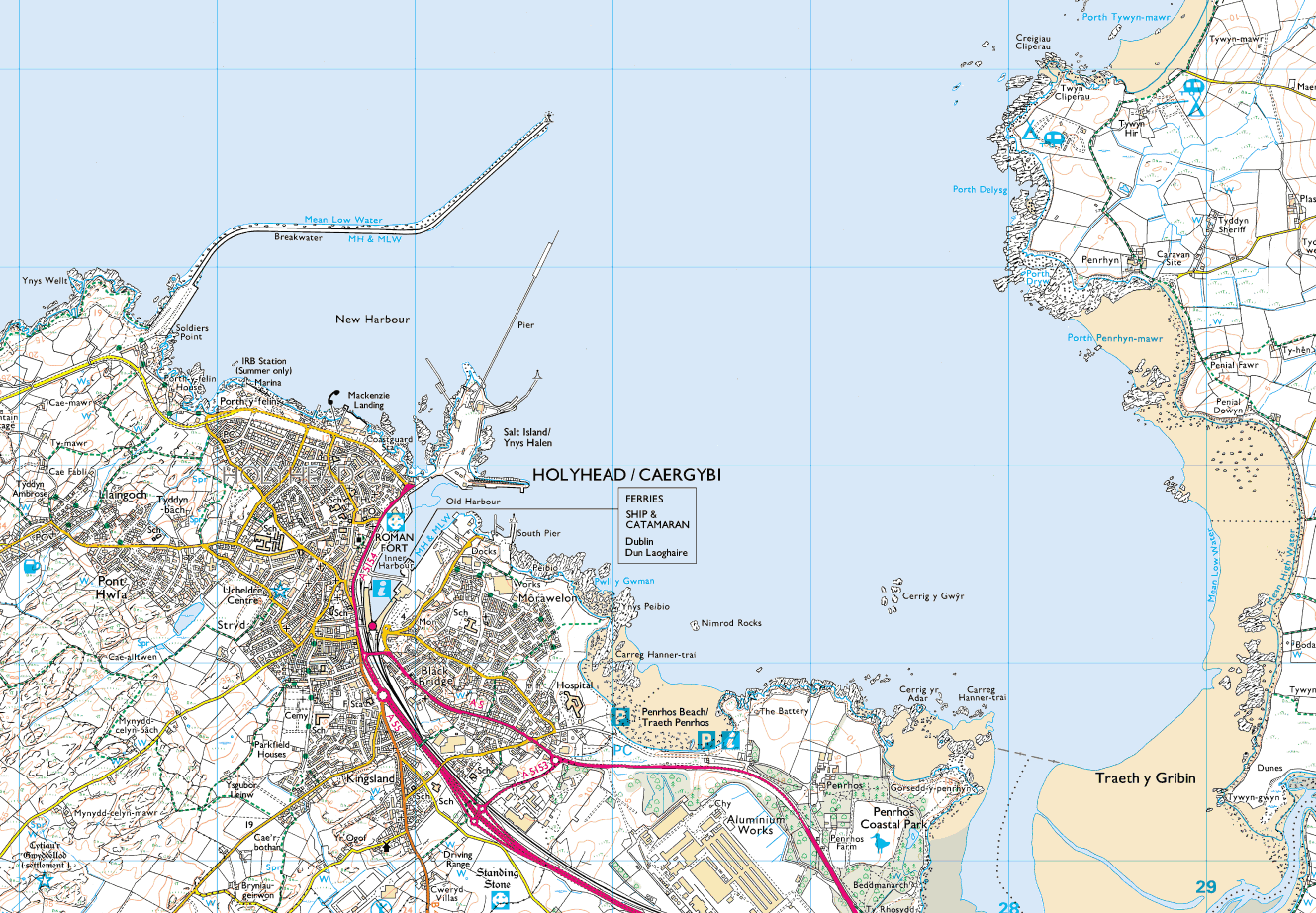
It might also be worth saying that at 9.3km, the round trip will be quite a long walk or cycle ride. To give some idea how big it is, both the maps below are to the same scale. The breakwater at Holyhead is only 2.5km long.


Electricity Generation

One thing that I found rather odd about the TPSB scheme is that the turbines will have an installed capacity of 250-350 MW, but that the TEL scheme had an installed capacity of 60 MW.

Although there is a big difference in installed capacity, it isn't all that significant. The amount of electricity that can be generated from a lagoon depends on the area of impounded water and the height difference between low and high tides. Having more (or bigger) turbines produces more electricity, but over a shorter period, by filling or emptying the lagoon more quickly. In overall terms the total electricity produced is going to be the almost same.

The area of the TPSB scheme is just short of double the area of the TEL scheme, and the tidal range is obviously the same, so it should generate about twice the electricity. But it is harder to figure out why the installed capacity of the TPSB scheme should be so much greater. My best guess is that TPSB are proposing two separate sets of turbines, one set to generate on the ebb tide and one set to generate on the flow. TEL's scheme envisaged bi-directional turbines, and uni-directional turbines might well be more efficient. The question is whether the greater efficiency of two sets of turbines would justify doubling the cost of the turbines and turbine house. It might do, for these are much less significant elements of the overall cost than the sea wall.

TEL estimated the output of their scheme at 187 GWh/yr. So with just under double the area of impounded water but more efficient turbines, TPSB's claim of 400 GWh/yr is probably justified. This equates to about 2% of the 20 TWh of electricity Wales needs to produce each year to meet our current needs. It would be the equivalent of a 130 MW offshore wind farm ... say 36 turbines rated at 3.6 MW each, which is the size of the turbines proposed for Gwynt y Môr.

 
Conclusions

When I first saw looked at TPSB's scheme in detail, I was disappointed to see that the TEL concept had been abandoned. Yet although I have grave reservations about attached tidal lagoons in general, I think that this scheme probably can be justified because no natural stretch of coastline is affected.

In terms of its contribution to our energy needs I have no doubt whatsoever that a lagoon of this sort, generating some 400 GWh of renewable energy a year, is exactly what we need. Given the fact that we are blessed with the second or third largest tidal range on the planet, not to make use of it would be recklessly irresponsible. I would hope that this is the first of many tidal lagoons.

I am a little less convinced by what I described as the "icing" on the cake. Not because I don't like icing, but because a project in which the sea wall is built high enough and strong enough to take a roadway and be safe as a visitor attraction for the public is going to be very much more expensive than a project that is only designed to produce electricity. But if someone can put together a business plan to justify it, why not? It will certainly put Swansea on the map.

I think we should have built the scheme proposed by TEL, and I can't think of any good reason why their offer was refused. But this scheme is an opportunity to build something that, at least in terms of generating electricity, is substantially similar. We must grasp this opportunity.

Bookmark and Share

Nuclear: what the UK government and media aren't telling us

I'm going to make no apologies for re-posting two items which Paul Flynn has just highlighted on his blog concerning the continuing nuclear disaster at Fukushima. It's important that these reports reach as wide an audience as possible ... both because the mainstream media in the UK are not going to report it, and because the Westminster government is doing everything it can to play down the dangers of nuclear power in its pig-headed determination to build new nuclear reactors here.

The first report is from Al Jazeera. I've just quoted some highlights, but it's worth reading the whole article by clicking the link at the bottom.

Scientific experts believe Japan's nuclear disaster to be far worse than governments are revealing to the public

"Fukushima is the biggest industrial catastrophe in the history of mankind," Arnold Gundersen, a former nuclear industry senior vice president, told Al Jazeera.

"Fukushima has three nuclear reactors exposed and four fuel cores exposed," he said, "You probably have the equivalent of 20 nuclear reactor cores because of the fuel cores, and they are all in desperate need of being cooled, and there is no means to cool them effectively."

TEPCO has been spraying water on several of the reactors and fuel cores, but this has led to even greater problems, such as radiation being emitted into the air in steam and evaporated sea water - as well as generating hundreds of thousands of tons of highly radioactive sea water that has to be disposed of.

"The problem is how to keep it cool," says Gundersen. "They are pouring in water and the question is what are they going to do with the waste that comes out of that system, because it is going to contain plutonium and uranium. Where do you put the water?"

Even though the plant is now shut down, fission products such as uranium continue to generate heat, and therefore require cooling.

"The fuels are now a molten blob at the bottom of the reactor," Gundersen added. "TEPCO announced they had a melt through. A melt down is when the fuel collapses to the bottom of the reactor, and a melt through means it has melted through some layers. That blob is incredibly radioactive, and now you have water on top of it. The water picks up enormous amounts of radiation, so you add more water and you are generating hundreds of thousands of tons of highly radioactive water."

"They are still emitting radioactive gases and an enormous amount of radioactive liquid," he said. "It will be at least a year before it stops boiling, and until it stops boiling, it's going to be cranking out radioactive steam and liquids."

"Units one through three have nuclear waste on the floor, the melted core, that has plutonium in it, and that has to be removed from the environment for hundreds of thousands of years," he said. "Somehow, robotically, they will have to go in there and manage to put it in a container and store it for infinity, and that technology doesn't exist. Nobody knows how to pick up the molten core from the floor, there is no solution available now for picking that up from the floor."

Al Jazeera, 16 June 2011

The second is an interview with American scientist Michio Kaku, from CNN. As well as this video, the transcript is here.


The lesson to be drawn from these two reports is that we were being drip fed false information at the time. The policy seems to have been to systematically understate how serious the disaster is (is, not was, for it will be many months before they can shut the reactors down, let alone start the clean up operation) in the hope that when the truth eventually does come out, Fukushima will have ceased to be headline news.

Several countries in Europe have heeded the lesson and have now decided to cancel their plans to build new nuclear power stations. The UK needs to do the same.

Bookmark and Share

The Nuclear Legacy

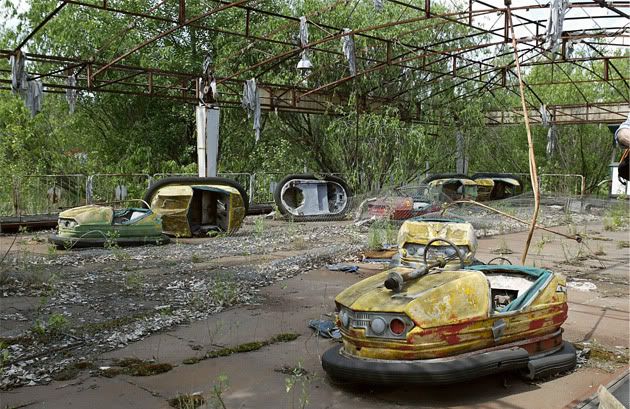
Today is the 25th anniversary of the Chernobyl nuclear disaster, and harrowing though it is, it is worth looking again at the Independent's photo essay on the aftermath from last year. These are a just a few of the shots from it:


I certainly don't want to be sensationalist, nor do I want to overstate the dangers of nuclear power. My position has always been that the risks are low, provided that we spend very large sums of money on strict safety regimes.

Nevertheless, even with a such safety regimes, the risk can never be zero. We have to consider not just the level of risk of an accident, but the seriousness of the consequences if one happens. For example, if I walk on top of a two foot high wall around a flower bed in the local park on a clear, calm day, it's very unlikely that I'll fall off, and the worst that could happen if I did is that I would sprain an ankle. If I walk on top of an equally wide parapet wall at the top of a ten story building overlooking that park, the risk of me falling is exactly the same, but the consequences of falling are very much more serious. I might do the first, only a fool would do the second.

-

As Wales can easily produce all the energy we need from renewable sources, it is foolish for us to spend huge sums of money on nuclear, not least because we will have to keep spending it for hundreds of years after any nuclear power station has stopped producing electricity. Nor can we rely on the companies concerned to pay for the clean up afterwards; companies can go bust ... especially when they are no longer making money because no more electricity is being produced. Our children, our grandchildren and generations to come will then be left to pay for the problem of any nuclear power station we allow to be built in Wales.

There's a political dimension to this story, which I'll save for later. But as this article in today's Western Mail reminds us, our farming industry is still suffering the consequences of Chernobyl. And as this story only last week from Belgium illustrates, the radioactive cloud might well have claimed several victims of cancer even there.

Bookmark and Share

No Need for Nuclear

With a hat tip to Paul Flynn, I'd like to draw people's attention to a new website set up to demonstrate why Britain, and of course Wales, does not need a new generation of nuclear power plants. Click the image:


Most regular readers of Syniadau will know that I am against nuclear power in Wales, but might also have noticed that I have not taken advantage of the ongoing crisis at Fukushima to make an argument against nuclear power based on understandable but largely unreasonable fears. For me, the reasons for being against nuclear power in Wales would be the same whether a large earthquake and tsunami had hit the east coast of Japan or not.

On a world scale, nuclear might still be part of the answer. I would agree with George Monbiot that it is far better for countries like China or India to generate the ever-increasing amount of electricity they need from nuclear power rather than from fossil fuels such as coal. My argument is simply that neither Wales nor Britain as a whole needs it.

Put simply, we can generate more than twice as much electricity as we need from the renewable sources we have in abundance, and can use renewables to meet our entire fuel needs, including transport and heating. Although Wales and Scotland have the lion's share of renewable resources on and around this island, Britain as a whole can do without nuclear, as I noted in this post on the Zero Carbon Britain report last June.

I'm pleased to say that the No Need for Nuclear site—at least what I have seen by skimming though it—puts the case against nuclear in rational way that relies on research and hard evidence. Yet would be foolish not to admit that Fukushima has brought nuclear power to the forefront of political debate, and foolish not to take advantage of the fact that the public are now more interested in the nuclear debate than they otherwise would be. We were in danger of passively resigning ourselves to nuclear power because successive UK governments were not doing enough to make the alternatives a reality ... now we have a much better chance of showing that there is a better way. Take this opportunity. Sign up.

Bookmark and Share

Burning Wood

Prenergy's proposed wood burning power station at Port Talbot is in the news again. It was originally approved by the UK government in November 2007. Then last September it was granted a licence by the Environment Agency Wales, on the condition that it operated within strict emission limits. But the EAW has changed that decision and is now saying that it is "minded to approve" new limits which are very much less stringent than in the original licence.


The changes proposed are:

•  Increasing emission limit for nitrous oxide (N2O) from 20mg/m3 to 40mg/m3
•  Increasing emission limit for sulphur dioxide (SO2) from 6mg/m3 to 50mg/m3
•  Increasing emission limit for hydrogen chloride (HCl) from 7mg/m3 to 10mg/m3
•  Allowing the burning of wood pellets as well as wood chip

Now we might well argue about at what point any level of emissions is damaging to health, but one thing is clear: EAW should not have imposed the original operating conditions unless they considered them to be the maximum emissions permissible without causing levels of pollution that could damage public health.

So this u-turn by EAW should be a source of great concern. If, as they now claim, the relaxed harmful emission limits will not compromise air quality standards it means that their original decision was arbitrary rather than based on any scientific evidence. After all, we are not talking about small changes. In the case of sulphur dioxide, they are now prepared to see the emissions increase more than eight times. It must surely be obvious that the EAW have been put under pressure to change their original decision, and that they have given way to that pressure.
 

The Practical and the Political

Now why would this be? There are two reasons: one practical and one political. The practical reason is that it is proving very hard to get high quality fuel that would burn with such low emissions. That sort of wood does exist, but the problems is the scale of the operation. This would be the largest wood-burning power station anywhere in the world, consuming three million tonnes of wood each year. Raising the level of emissions enables Prenergy to use cheaper wood.

My belief is that Prenergy have convinced the EAW that they are unable to get hold of the amount of high quality wood on which the original calculations had been based, and that the relaxed emissions standards are tailored to wood that can be sourced at a cheaper price. The thinking must be that rather than maintain limits that would mean it was impossible to operate the plant, it is better to relax the limits to the point where it is commercially feasible to operate it.

But why should there be such an imperative for the plant to operate at all? The reason for this is entirely political.

Both the UK and Welsh governments have set themselves targets for the production of electricity from renewable sources and are therefore anxious to do whatever it takes to meet those targets. A large 350MW power station of this sort would, on paper at least, go a long way towards it. But the sums didn't quite work out. That is why the new UK government provided an additional large financial incentive for biomass in August last year, by guaranteeing that Renewable Obligation Certificate levels would be fixed for 20 years rather than being subject to reviews every four years ... this longer lifespan being referred to as "grandfathering". Prenergy's owners, the Italian private equity firm Clessidra, welcomed this change because they have been trying to sell the project on for the past year, and were having considerable difficulty finding a buyer for it.
 

Semi-renewable

But for me, the political initiatives to promote this sort of energy are fundamentally misconceived. Energy produced from burning wood can at best only be described as semi-renewable. The theory is simple enough. If the wood cut down and used as fuel is replaced by new trees, then those new trees will absorb as much CO2 as the wood that has been burned. The first problem is that it takes 15 or 25 years, perhaps more, before the carbon balance gets back to zero. The second problem is that cutting down and transporting the trees, converting them to chips or pellets, and then transporting them half way round the world to be burned in Port Talbot also consumes fuel; and therefore contributes additional CO2 to the atmosphere. Even so, there is still a net benefit, but it up to half of it could be lost. EAW say that greenhouse gas emissions will only be 50-80% less than those of a coal or gas power station.

So at best the process can only by described as semi-renewable, yet we see both the UK and Welsh governments treat this way of producing electricity as if it were fully renewable. It's a con. It is being promoted, given financial incentives, and allowed relaxations on strict emissions standards simply in order for both Welsh and UK governments to be able to say they are meeting their targets for fully renewable energy.
 

More than we need

Although it could be argued that the UK as a whole might need the additional energy that would be produced by a new power station at Port Talbot, Wales certainly doesn't need it. We already produce far more electricity in Wales than we need, as well as having the potential to produce all our electricity from fully renewable sources without any harmful emissions at all.

So why are we in Wales producing electricity for export to England by burning a dirty fuel brought half way across the world? From the point of view of the planet, why isn't the wood being burned in North America or China where it will be grown? That would save the economic and carbon cost of transporting it. From the point of view of electricity generation on this island, why isn't the plant being built at a port in say the Thames estuary, close to where the electricity will be consumed? That would save transmission losses in the grid.

We have until 11 February to respond to EAW's proposal, and the details of how to do so are here.


As I researched this, I looked again at some excellent contributions to the debate which I'd recommend to anyone who wants more background information. One is by Duncan Higgitt in a comment to this post on Syniadau last June.

Then there are two articles by Bethan Jenkins, one on her website and another on Wales Home.

Bookmark and Share

Systematically undermining direct action

There was always something odd about the conviction of a group of twenty climate activists for planning to shut down the coal-fired power station at Ratcliffe-on-Soar in Nottinghamshire late last year. Double standards were at play, because in 2007 a Greenpeace group actually succeeded in occupying Kingsnorth power station in Kent and painting "Gordon" in huge letters on the main chimney stack ... yet they were acquitted of the charges against them on the grounds that their protest was justified.

I posted an article about it here. It's well worth looking at the video of their story again:


The reports from the Guardian and Independent at the time are here:

     Not guilty: the Greenpeace activists who used climate change as a legal defence
     Cleared: Jury decides that threat of global warming justifies breaking the law

The Independent's headline was misleading. The significance of the verdict was that this direct action was not in fact against the law. Yes, there was damage, but the court decided that the damage was justified in order to prevent greater damage.

At first I wondered if the conviction in this case was more because of differences in perception between the north and south of England, and thought that the similar differences between Wales and England explained why a jury in Caernarfon would not convict the Penyberth Three, so that the trial had to be moved to a place where the UK authorities could find a jury that would convict them. In fact I looked forward to the time when a jury in Wales would refuse to convict those from Cymdeithas yr Iaith for the very minor damage to shops resulting from their direct action, on the grounds that it was justified in order to prevent much greater damage to the Welsh language.

-

Yet today the picture widened in a way that shows how large the gulf is between the largely sympathetic way the public see peaceful civil disobedience and the way the authorities fear it. The trial that has just been abandoned was against another six people arrested at the same time, but on more serious charges. This excellent article from Newsnight gives the background:


It beggars belief that the rather disturbing National Public Order Intelligence Unit should plant an undercover officer for a period of seven years. How can such tactics—not to mention the cost—be justified against non-violent protesters? How many more officers might currently be doing the same?

I think Mark Stone/Kennedy deserves some credit for finally doing what is right. If he hadn't spoken out, I'm sure that the trial would have progressed with neither the defendants nor the public being any the wiser. He might also be at risk as a result. Some might say he deserves it, but he was just a pawn. I think the authorities that run the United Kingdom deserve much greater condemnation for systematically indulging in what can only be described as political policing to suppress those who are prepared to take principled, non-violent direct action on things that matter.

Bookmark and Share

Enviroparks wins planning permission

I'm very pleased to see that Enviroparks have been granted planning permission for their proposed waste treatment and energy plant in Hirwaun.

     £120m waste energy park for Rhondda approved

I wrote an article in March explaining why I thought this was a much better way of dealing with waste than any other process currently available. It's too long to repeat here, but this is a short extract which explains the basic technology:

The process is multifaceted, but involves recycling, the separation of food and non-food waste with food waste going to an anaerobic digester to produce gas to be used as fuel, the plasma gasification (as opposed to incineration) of other waste to again produce gas, and burning the gas from both sources to produce electricity. This animation shows how these processes work together:

The crucial difference between this and incineration is that burning the gas is clean, whereas burning waste directly gives rise to high emissions of dioxins, nitrous oxide, toxic metals and particulates. The plasma arc breaks these down into individual atomic elements.

The Wiki article is here, including a list of projects planned or already operational. Enviroparks own website is here.

Enviroparks ... a better way to deal with waste, 5 March 2010

There was quite a lively discussion in the comments section of the original post. But the way I see it, it is only by embracing this sort of technology that we can avoid the much more damaging effects of waste incineration on both public health and the environment.

-

Update: This video from the Enviroparks website should give some idea of the size and layout of the plant:


Bookmark and Share

Why Wales should build offshore tidal lagoons

I'm pleased to hear that the ConDem government has decided not to proceed with construction of a Severn Barrage, but I'm not at all pleased by the decision to do nothing about harnessing the renewable energy available to us from the Severn. So what I want to do in this post is try to explain from a technical point of view what the options are, what's good and bad about them ... and propose a way forward. For some, this will be an unnecessary lesson in how to suck eggs; but I hope it will be useful to others. Sometimes it's possible to be given so much technical detail that it is impossible to see the big picture. This is meant to be an overview of what matters and why it matters.
 

Types of tidal power

There are two types of tidal power. Tidal flow relies on the speed of the tide coming in and going out. It is harnessed by means of turbines, fairly similar to wind turbines, but underwater. The best tidal flow sites are around headlands or in the channel between islands, or islands and the mainland. For us in Wales, there are good sites off Ynys Môn and St Davids Head. The Severn estuary also has a good tidal flow, but this is at its best further out to sea than any location that has been proposed for a barrage.

The second type of power comes from tidal range. What matters here is the difference between low and high tides. The Severn estuary has one of the greatest tidal ranges in the world. The Bay of Fundy in Canada is first, and the Severn estuary is either second or third, vying with Baie de St Malo in Brittany. To harness this power requires building an impoundment to contain water at high tide, then to release it through turbines when the water level on the other side of the impoundment is at its lowest. In terms of operation, the turbines work in the same way as in any hydro-electric dam.
 

Types of impoundment

There are three different types of impoundment. A barrage is built across the mouth of an estuary, with the shores of the river/s which feed it forming the rest of the enclosure. An attached tidal lagoon or connected tidal lagoon is built against the shore but does not impede the flow of the main river. An offshore tidal lagoon or detached tidal lagoon is built close to the shore, but not right up against it.

Perhaps the best way of illustrating them is to look at this map showing the "long listed" schemes proposed for the Severn. Click it to open a larger version:
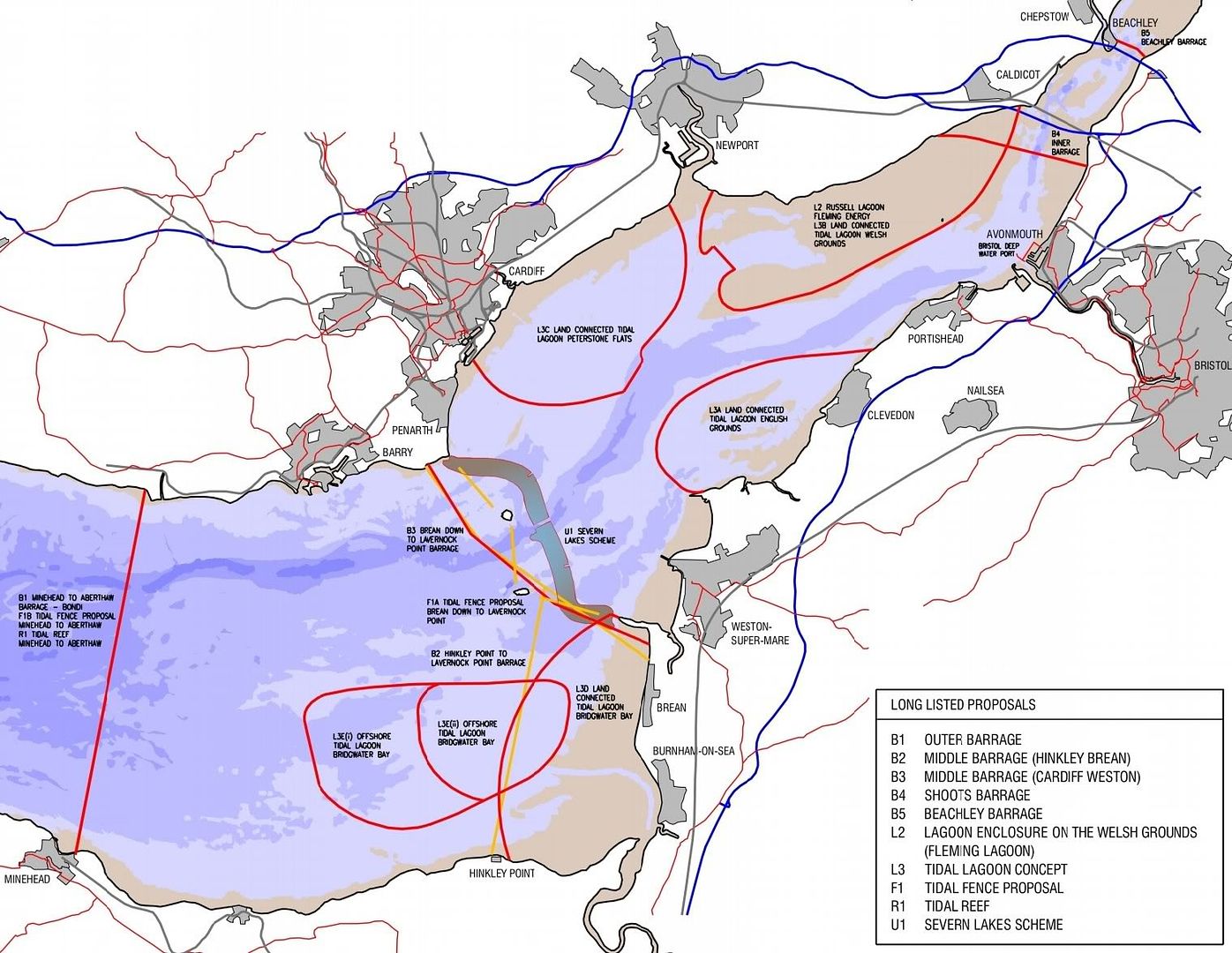
     

•  There are three barrages across the Severn: Lavernock-Brean, Shoots (or inner barrage) just next to the new Severn Crossing, and Beachley just next to the Severn Bridge.

•  There is one barrage across Bridgewater Bay, although this is called a lagoon.

•  There are two attached lagoons on the Welsh side: Russell between the Severn Crossing and Newport, and Peterstone between Newport and Cardiff ... and one on the English side at English Grounds.

•  There is one offshore tidal lagoon in Bridgewater Bay, plus an extension to it.

The line shown between Aberthaw and Minehead is not an impoundment, but a "tidal fence" ... a line of turbines designed to harness tidal flow.
 

Barrages

The main factor in favour of barrages is that, if built in the right place, they are relatively short compared to the area of water contained behind them. However they have to cross the deepest part of the river, and building a structure up from the bottom of the river makes them more expensive than something built closer to the shoreline. Building something twice as deep costs four times as much; building something three times as deep cost nine times as much. This is because the only practical way to build the impoundment is to pile up rocks on the sea bed, so the cross-sectional shape is always the same, and the amount of material is therefore the square of the height.

The main disadvantage of any barrage is the fact that they can only practically generate electricity at low tide. The reason for this is twofold: first because the impounded area is constantly being filled by the river; but second—and more critically—because river water contains heavy concentrations of silt. The Severn and the tributaries which feed it are particularly heavy in silt from the lower lying areas of England. We can all see this silt at low tide, and a centimetre or so is left behind inland when the river floods. If it were not for this silt, it would be possible to generate electricity both at high tide and low tide ... and this is indeed what the French thought they would be able to do when they built La Rance in Brittany in the sixties. But after a few years they realized that the only practical way of stopping silt build-up was to operate it in one direction only.
 

Attached Tidal Lagoons

The reason I have classified the Bridgewater Bay "lagoon" as a barrage is because the River Parrett carries a good deal of silt, though not nearly as much as the Severn. The secret of building a good attached tidal lagoon is to minimize the amount of river water that feeds into it. Or, second best, to make sure that the river water is relatively silt free. The shorter, faster flowing rivers of Wales fit that bill; but the less water that feeds into the lagoon from rivers, the better. To the extent that these two criteria are met, the huge advantage of a lagoon is that it is able to generate electricity both at high and at low tide. Therefore lagoons produce twice as much electricity relative to their surface area compared with an estuary barrage.

However, what is even more important than the total amount of electricity produced is the fact that it is produced more frequently. Roughly speaking, a barrage will produce electricity for maybe a two hour period every twelve-and-a-half hours. A lagoon will produce electricity for the same two hour period every six-and-a-quarter hours. In terms of the way the electricity grid works, this makes a huge difference for the better. But better than that, as grace would have it, high tide around the coast of Wales varies by about five hours, and the Severn is not the only place where we can build lagoons. The stretch of coast between Swansea and Porthcawl is also good, and so is the north Wales coast ... because even though the tidal range in Liverpool Bay isn't quite as high as the Severn's, it is still good. A series of lagoons will be able to feed a more or less continuous supply of electricity into the grid.
 

Offshore Tidal Lagoons

A detached tidal lagoon has exactly the same advantages as an attached tidal lagoon with no rivers feeding into it, and therefore no problem with silting. In technical terms the differences are in the length and depth of the impounding structure.

The length of the impounding structure that needs to be built is shorter for an attached lagoon because the shoreline itself does part of that job. However the depth of water gets less towards the shore, so the electricity generating potential is not simply a matter of surface area, but of the tidal range across that area. The ideal place to build an offshore lagoon is on a relatively shallow area of sea bed just—but only just—beyond the line of the lowest tide. On the map above, it is beyond the beige of the exposed mud, in the lightest blue area. If we look in more detail at the map, this should explain why the offshore lagoon in Bridgewater Bay is where it is.

In my opinion an equally good area to build an offshore lagoon would be more or less where the Peterstone lagoon between Newport and Cardiff is, but with the inner wall on the line between beige and light blue. This would allow the Rhymni to continue to flow directly into the Severn estuary. The Russell lagoon east of Newport is in a less ideal place, because it does not harness the full benefit of the tidal range.

The second big advantage of offshore tidal lagoons is that is it relatively easy to link them together. By building the impoundment only slightly higher (say a metre or two) than the highest high tide, there is the potential to use any electricity produced from one lagoon in the middle of the night (when demand is low) to pump water into the other lagoon, to then be released back to produce electricity a few hours later when demand is higher.

-

But the main advantage of offshore tidal lagoons is ecological. There is a wealth of wildlife in the area between low and high tide, adapted to survive with that tidal cycle. Offshore lagoons do not interfere with this, leaving wildlife untouched. These environmental considerations may not rank highly with some people, and it is possible to argue that the damage might not be too bad. But why risk it ... after all, isn't the whole point of switching to renewable energy in order to save the environment? Yes, offshore tidal lagoons will cost more to build because the length of the impounding structure is longer, but this will be partly offset by being able to harness the full tidal range across the whole area of the lagoon.
 

Roads and Railways

I want to address this matter separately, because one of the reasons often cited for building a barrage across the Severn is that it can then also be used as a road or rail link. This is one of the reasons most often given by those who favour the Shoots barrage.

The impounding structure for a barrage used only for the purpose of generating electricity is a relatively simple to construct. It involves building up a pile of material from the sea bed up to the highest high tide. It does not need to be any higher than say half a metre above that, because it simply won't matter if waves break over the top of it in stormy conditions.

But once we start thinking about putting a road or railway on top of it, things become much more complicated. First, we have to build it higher so that waves don't break over the top of it, probably four or five metres higher. We also have to make the structure much more stable, because huge damage will be done to the road/rail surface if there is any substantial structural movement. This will increase the cost substantially. In contrast, if a simple impounding structure is damaged by a storm, it can be fixed relatively easily from a floating barge. The second factor is what to do about shipping. If any shipping is to pass, there needs either to be a swing or lift bridge section of the road/railway ... and I find it hard to imagine this being acceptable on, say, a new high speed rail line. We would therefore have to build the line higher than the shipping that would pass below it, and because the line would have to have minimal gradients we would in effect be building a bridge. The two structures simply do not mix.

If we want a barrage, we should build a simple barrage. If we want a crossing for transport, I think it will always be better to build a different structure rather than try to combine the two.
 

Conclusions

In my opinion it is insane not to make use of the best form of dependable renewable energy we have available to us in Wales. For that reason I would not have been entirely unhappy if the decision had been made to go ahead with the Lavernock-Brean barrage. Clean renewable energy for at least a hundred years, if not more, is not something that should be spurned. In fact I would prefer us to build the Lavernock-Brean barrage in preference to one of the other barrages.

But it is definitely one of what the French would call les grands projets. It is an all-your-eggs-in-one-basket solution that has the potential to go horribly wrong and cost many times more than anyone envisaged. Once started, there is no way of scaling it back if things go wrong. To the credit of the ConDem government, they seem to have recognized this and are not prepared to take the risk.

If I were English, the scheme I would build is the smaller Bridgewater Bay offshore lagoon – though I would design it in such a way as to allow for the expansion at a later date if the inevitable unexpected problems are not as bad as they might otherwise be. The lessons we learn from building the first will reduce the risks we take when building the second ... and so on.

But I'm not English. I want this energy for us in Wales. For that reason, of the sites shown on the map above, I would build an offshore tidal lagoon, roughly sharing the same footprint as the Peterstone lagoon. On the map below it is called "Cardiff". The locations shown are from the Tidal Electric website, and their preferred first option is Swansea Bay, for which WS Atkins have produced a technical study. The idea is to start small, and build up from there.
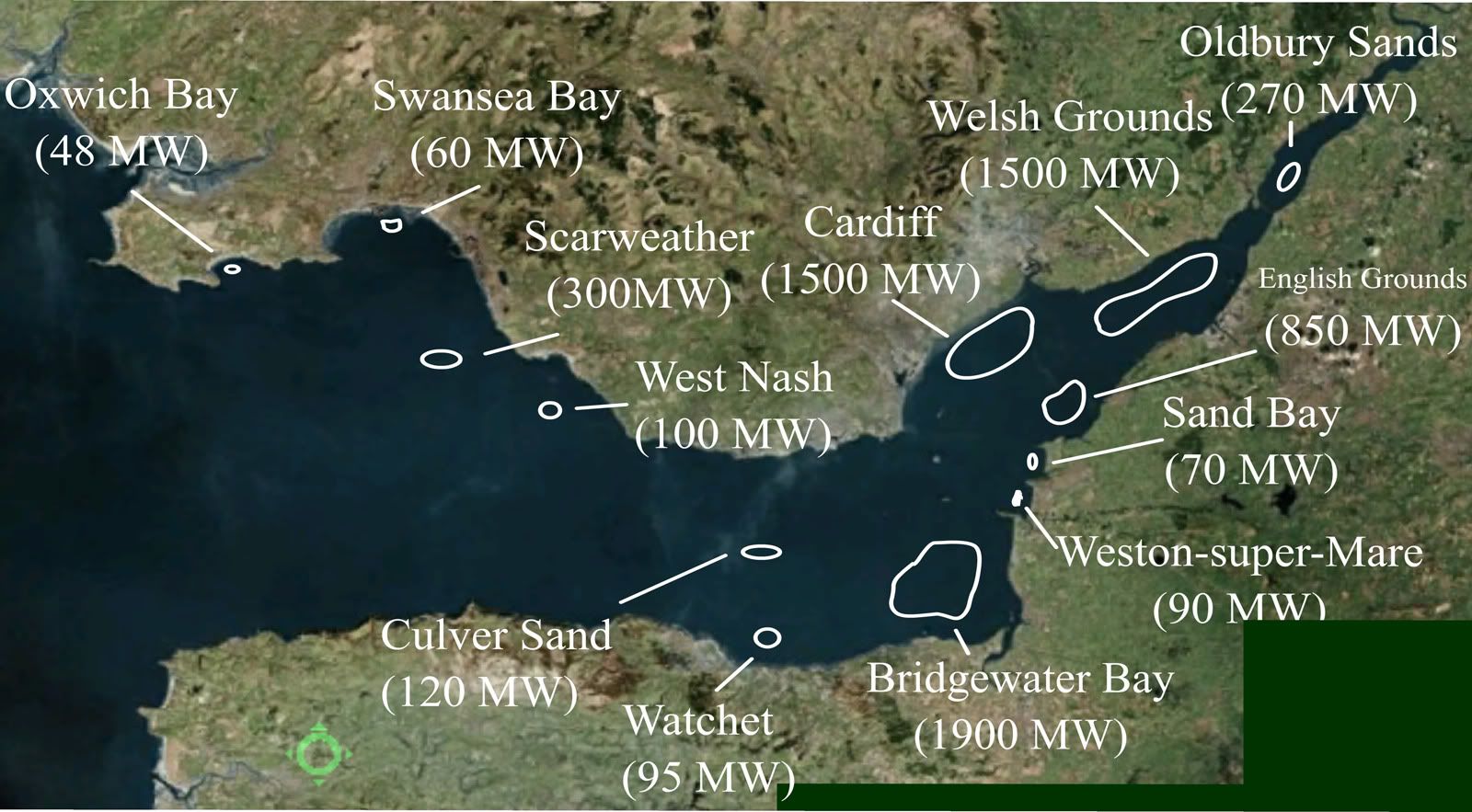
     

The politics of the matter is something else. Obviously I have my views on it, but I wanted in this post to concentrate on the technical reasons why I think a series of offshore tidal lagoons is a much better solution to harnessing renewable energy from the tidal range of the Severn estuary than any barrage could be.

Bookmark and Share

Zero Carbon Britain

With a hat-tip to Bronglais, I've just learned that Wales' very own Centre for Alternative Technology at Machynlleth has published a report called Zero Carbon Britain 2030. Download it by clicking the image:


This is a summary of what it's about:

A great many solutions to climate security are the same as solutions to energy security and to long-term economic recovery. A flagship of a new economic approach, ZCB2030 will show how we can re-focus the ingenuity of the finance sector on the actual challenges at hand. Rather than residing precariously at the end of the peaking pipeline of polluting fossil fuel imports, Britain can head an indigenous renewable energy supply chain powering a lean, re-localised economy. Every field, forest, island, river, coastline, barn or building holds the potential to become an energy and revenue generator, with different technologies appropriate to every scale or location.

Zero Carbon Britain 2030 clearly illustrates how the parallel de-carbonisation and re-vitalisation of the UK economy would work, creating a single document of immediate relevance to policy-makers everywhere.

Press Release, 16 June 2010

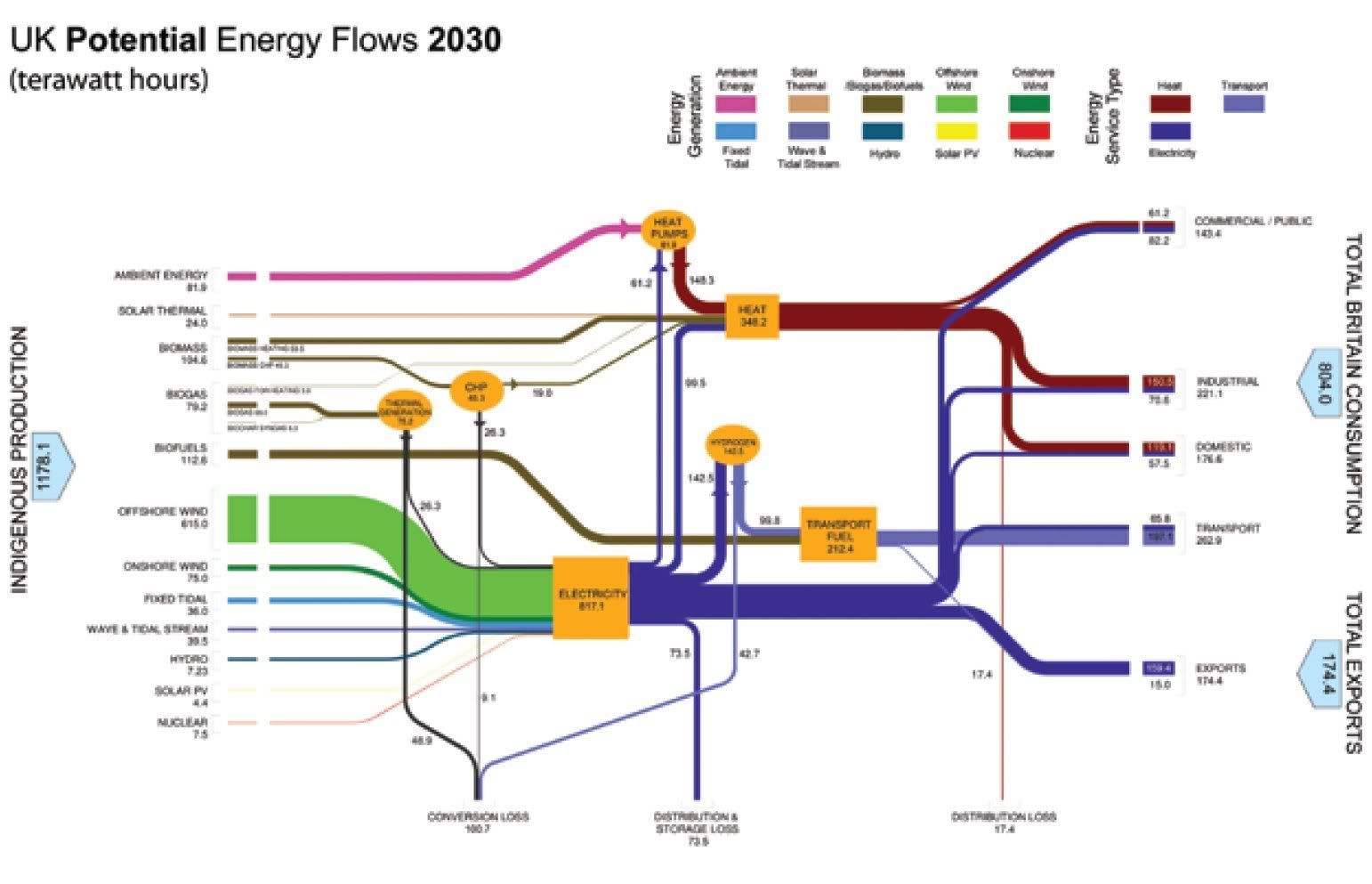
This report follows hard on the heels of the report by the Offshore Valuation Group that I mentioned in the second part of this post. The major conclusion reached by each report is the same: that we simply don't need nuclear energy. The difference is the OVS report concludes that we can generate all the electricity Britain needs from offshore renewables by 2032, whereas this report says that we can produce the overall energy we need by 2030, including onshore renewables and biomass and with a programme of energy saving measures in buildings, transport and behavioural change. This diagram shows how:


For me, the most useful chapter was the one on Renewables, which says:

This chapter demonstrates how Britain can create a carbon-free, electricity-based energy system by 2030, using renewable energy and biomass alone, and without recourse to nuclear power.

As full report is 384 pages long, it might be best to start with the executive summary at the beginning and that chapter. But this is the full list:

•  Climate science
•  The energy security context
•  Equity
•  Climate and the built environment
•  Transport
•  Motivation and behavioural change
•  Land use and agriculture
•  Renewables
•  Distributed generation and microgrids
•  Policy and economics
•  Employment
•  Residual emissions

All in all it's a good handbook of information to download and use for reference. If Wales is to avoid being landed with a nuclear power station that we don't want, we need all the authoritative information we can get on better alternatives to it.

Bookmark and Share

The Nuclear Legacy

Chris Huhne gave an interview to the Guardian yesterday evening in which he highlighted just how much it would cost to decommission the UK's nuclear power stations and deal with the cost of containing nuclear waste.

Chris Huhne warns of £4bn black hole in nuclear power budget


Britain is facing a £4bn black hole in unavoidable nuclear decommissioning and waste costs, Chris Huhne, the energy and climate change secretary disclosed tonight.

The decommissioning costs over the next four years revealed by officials to Huhne are so serious that he has already flagged the crisis up to the cabinet.

The revelation places an unexpected burden on his department's £3bn annual budget ahead of difficult spending negotiations this summer. "As you can imagine, this is a fairly existential problem. The costs are such that my department is not so much the department of energy and climate change, as the department of nuclear legacy and bits of other things," Huhne told the Guardian.

The additional costs derive from slowly rising expenditure on nuclear decommissioning, and falling income due to the closure of ageing power plants, Huhne said.

Huhne disclosed that in current financial year the Nuclear Decommissioning Authority's budget is expected to be in balance. From 2011-12, the deficit suddenly rises to £850m, in 2012-13 the gap increases further to £950m and then to £1.1bn in the two subsequent years.

Guardian, 1 June 2010

The short term issue is relatively simple: that government cuts cannot be made in this area because of the risk to public safety. So we have no choice but to pay for it out of the public purse. But the long term issue is much more serious: these costs are rising because the nuclear industry is no longer earning (or will in the next few years no longer be earning) as much money as the plants reach the end of their useful lives. The cost of nuclear decommissioning was never properly factored into the overall cost equation. Each estimate was essentially just a fudge, and every few years was replaced with a new estimate which was just as likely to be another fudge.

So, for example, the latest figure for decommissioning was revised upwards from £63bn to £73bn only in 2008. But as soon as we get a new government in Westminster, we see that even that budget allocation was inadequate. It was underestimated by more than £1bn per year. As I said in this post the previous government's consultation document on the costs of Funded Decommissioning was based on inadequate estimates that amounted to even less than the revised 2008 figure. This should ring alarm bells for anyone who assumed that nuclear power would be any sort of easy answer to our future energy needs. The sums only "add up" if the costs of decommissioning are not fully taken into account.

-

In Wales, we can generate all the electricity we need form renewables, but we can only do that if we invest in renewables. Offshore wind technology is now well proven, but the main source of energy that we now need to invest in is tidal power ... particularly in the form of offshore tidal lagoons.

The irony is that this form of energy investment is an exact mirror image of nuclear. Nuclear is relatively cheap to build and run ... and all the big costs are in decommissioning and taking care of dangerous waste for centuries thereafter. With tidal lagoons all the big costs are in the civil engineering works necessary to create the impoundment ... but after that we get abundant, reliable and cheap electricity for centuries. Nothing dangerous or harmful is produced and nothing has to be cleaned up. Ecological damage is minimal compared with a barrage or shoreline tidal lagoon.

So why don't we do it? Simply because the costs of tidal lagoons are big and upfront; you need to spend all the money before you get any electricity. With nuclear it is easy to fudge the issue because the big costs only kick-in in thirty or forty years time.

The answer is to start small and build from there. And the beauty of this approach—as opposed to one large megaproject—is that high tide varies by several hours around the Welsh coast, giving us the potential to produce round-the-clock electricity. A detached tidal lagoon produces energy on a six-and-a-quarter hour cycle because it generates on both ebb and flow tides; because of silting a barrage can only produce electricity on a twelve-and-a-half hour cycle.

Bookmark and Share

LibDem Maths

It's clear enough from the headlines in today's Western Mail:

Lib-Dems £3.1bn plan for green jobs

The Liberal Democrats yesterday launched a £3.1bn plan to create green jobs and bring £125m to Wales.

Western Mail, 20 April 2010

Yet the first thing that struck me was that this was far from being a good deal for Wales. Nobody needs a calculator to work out that our rightful 5% share of £3.1bn is £155m ... so we in Wales would immediately be short-changed relative to the remainder of the UK by £30m. On second thoughts, perhaps the LibDems do need someone to buy them a calculator.


But let's leave that to one side, because any additional spending on the Green economy is something I would welcome. Let's look to see if this still a good idea ... even if the rest of the UK will benefit from the money more than Wales. Their version of the story is here.

Did I say additional spending? Well, it turns out that it isn't additional spending at all. This is what they say:

The plans target £3.1bn of public spending that can be stopped and the money used to create jobs and protect the environment.

But as we might expect, there is absolutely no mention of what particular areas of public spending are in line to be "stopped". The Health Service? Education? Police? The Fire and Rescue services? Who knows? ... for the LibDems certain aren't telling us! We are simply expected to trust Kirsty Williams when she says these are "credible and costed plans". My guess is that these must yet more of the fabled "efficiency savings" that spring up whenever an election is called ... but haven't the LibDems banked on these savings at least once already? Perhaps we should just marvel at how a new batch of these savings can be plucked off the tree whenever the LibDems want to publicize a "new" idea.


But let's still give them the benefit of the doubt and look at how they intend to spend this money. As it happens, the MPs that we are about to elect to Westminster are not going to spend it at all ... they're going to give this £125m to the Assembly with "suggestions" about how it should be spent, since most of the things they want to spend it on in England are devolved matters in Wales and Scotland.

But here we hit a snag. For even though the LibDems aren't specific about which public spending budgets they will "stop" in order to create this new "Green" package, the Welsh block grant will have to be reduced by 5% of the £3.1bn they intend to save in the UK as a whole, because the Barnett Formula works both ways. So in fact this loudly proclaimed £125m—which would have short-changed Wales by £30m if it were additional money—is in fact a £30m cut in the block grant Wales would otherwise get ... a block grant that we already know is going to be cut back, and in all likelihood will be cut back further no matter which, or which combination, of the three UK parties forms the next Westminster Government.

In short, you couldn't make it up! Unless you're a LibDem, of course. This is the sort of maths that only makes sense on planet Clegg as seen from its attendant moon, Kirstopia.


Now at this point I want to be clear. I do agree that we should invest more money in the sort of things that the LibDems "suggest" the Welsh Government should spend things on. But devolution doesn't work that way. Those decisions are not for our MPs to take in Westminster ... the LibDems should save their "suggestions" for the Assembly elections next year, because it will be up to the AMs we elect to the Assembly to decide how we spend our block grant. That will include, if the LibDems get into a position to implement this new plan of theirs, the headache of how to do things with £30m less than we would otherwise be getting.

And many of their suggestions turn out to be things the Welsh Government is already doing. For example, the LibDems suggestion to expand the Home Energy Efficiency Scheme would be fine but, on a pro-rata basis, we would not have £20m more to do it with, but about £5m less.

The LibDems might have their hearts in the right place, but as soon as you look at what they propose in any degree of detail it doesn't take long to realize that it's the disconnexion from their heads that is the problem. It's all very well to put a "Green label" on any idea you come up with. But to really create a more Green economy, our thinking needs to be much more radical ... and our maths much more accurate.

Bookmark and Share

Nuclear fall out

The launch of the Welsh Labour manifesto was a carefully choreographed piece of showmanship. Peter Hain and Carwyn Jones stood side by side, Westminster and the Assembly supposedly equal.

This is what the manifesto they presented has to say about nuclear energy:

•  We are committed to delivering a diverse, flexible and more secure energy policy for Wales that recognises the very real threat facing our planet. Wales has the potential to produce twice the amount of electricity it currently uses from renewable sources by 2025.

•  We will make Wales a leading provider of green energy, produced not only by wind, but also from biomass, marine and microgeneration. This will not only combat climate change but generate thousands of new jobs, for example through Anglesey's vision of an 'energy island' with offshore wind and other industries located there, and construction of the Wylfa B Nuclear Power Station which Labour fully supports.

Welsh Labour Manifesto

Is that really true?  No of course it isn't ... it's just another example of Labour being Labour. Nuclear power in Wales is most definitely not what the Labour AMs in our Assembly want. This is the Welsh Government's definitive position on the matter, reaffirmed only last month:

We remain of the view that the high level of interest in exploiting the huge potential for renewable energy reduces the need for other, more hazardous, forms of low carbon energy and obviates the need for new nuclear power stations.

Western Mail, 16 March 2010

Yes, the Welsh Government—comprising far more Labour AMs than Plaid AMs—is very firmly against nuclear power in Wales. Not only that, but it has resisted the attempt to bulldoze through a new nuclear station at Wylfa B, repeating its call for a public inquiry into it only three weeks ago, as this report shows:

     WAG to press for a public inquiry into N-plant proposal

So how did Carwyn Jones, standing alongside Peter Hain, react to the patently absurd claim that Welsh Labour "fully supports" a new nuclear station at Wylfa B? Well, rather than fall out in public, he just fell in, grinned sheepishly and hoped no-one would notice that Peter Hain was riding roughshod over what Labour's AMs want.

-

Once again we see Labour in Westminster imposing what it wants for England onto Wales. Once again we see what Labour really thinks about devolving decision-making power to Wales: devolution is fine ... providing, that is, you only decide to do what we in Westminster agree with.


Plaid's position on the issue is perfectly clear: we are against nuclear power in Wales. This is what it says in our manifesto:

We reaffirm our opposition to the construction of any new nuclear power stations in Wales.

and

We would create green electricity through renewable energy projects.

Plaid Manifesto

Now it's true that a small minority in Plaid Cymru do not share this view. Ieuan Wyn Jones may well be personally in favour of nuclear power in Môn ... but that doesn't make any difference to Plaid's policy. Thankfully, he was outvoted by the rest of us.

And, for what it's worth, even the LibDems are against nuclear power:

In both the National Assembly and Westminster, as appropriate, we would:

•  Say no to a new generation of nuclear power stations; nuclear power is a far more expensive way of reducing carbon emissions than promoting conservation and renewable energy.

LibDem Manifesto

So we have three parties in the Assembly who are opposed to nuclear power in Wales, about two-thirds of voters altogether. Yet if you vote for Labour you will get what their leaders in Westminster want in order to meet England's energy needs ... for even Labour acknowledge that Wales can produce twice the electricity we need from renewables.

If England needs the energy, and the people of England decide that they want nuclear energy to be a part of that, then they should be free to do so. But if they do, those power stations should be built in England, and England must pay for all the risks and costs involved.


In writing this, I am aware that many people will think that a new generation of nuclear power stations is a done deal in the wake of Horizon's (a joint venture by E.On and RWE npower) recent announcement that they intend to make a planning application for Wylfa B. This isn't true. So I now want to concentrate on how best to ensure that it doesn't happen.

It is certainly true that Labour in Westminster have been pressing hard for the nuclear power industry. It's true that they have done all they can to change the rules so as to fast-track a the new stations they want. I wrote about the new Infrastructure Planning Commission here, but in essence this body only exists to implement the decisions already made in what are called "National Policy Statements". So it is in many ways too late to prevent new power stations being built by means of the planning process. The only hope of preventing companies who want to build nuclear power stations is by a change of policy at UK level. The most obvious and direct way of doing this would be to devolve decision making on energy to Wales, where the majority of Welsh AMs would reject it.

-

But there is another way of fighting to stop nuclear power: the Tories in Westminster have said that any new generation of nuclear plants must not be subsidized by the taxpayer. This is what it says in their manifesto:

To limit harmful emissions from UK power stations, we will take steps to encourage new low carbon energy production, including:

•  clearing the way for new nuclear power stations – provided they receive no public subsidy

Conservative Manifesto

Now of course the Tories may have a whole raft of ways to by which they can hide such subsidies if they chose to. But Labour have already done precisely that by including the potential nuclear power industry within the scope of Strategic Investment Fund and also intend to use the Green Investment Bank they would set up to help finance the nuclear industry. That certainly constitutes "public subsidy". At a time when we are up to our ears in public debt, we certainly can't afford to increase public debt even further by bailing out energy firms to provide a source of electricity that Wales doesn't even need.

-

The major issue is not the cost of building the stations (although that is of course an issue, although it would be one for the companies concerned) but the cost of cleaning up the waste they produce and of decommissioning the site when it has come to the end of its productive life. These costs are much, much greater than the cost of construction. In principle, the government's idea is that the power companies would set aside money each year so as to pay the costs of decommissioning and clean up. The fundamental flaw in that approach is that a private company can either go bust or refuse to honour its contract commitments at any time, in much the same way as happened when National Express walked away from the East Coast rail franchise last year. The taxpayer will be left to pick up the bills. The very nature of private companies is that they make a profit when they can ... but when they can't they can be wound up, leaving others to pick up the pieces.

In these situations, the only way to guarantee that the costs will still be met if the company folds is for them to put the money up front, in the form of some sort of bond, perhaps backed by insurance. This happens in the construction industry, but the costs involved in nuclear clean up are way beyond that scale ... not least because it's virtually impossible to predict how much something will cost in maybe 40 years time. So the Labour Government have been trying to run with a compromise mechanism called "Funded Decommissioning" which, in order to make the cost in any way affordable for private companies, seeks to put limits on their liabilities.

At present this is the subject of a public consultation which began last month and is set to run until June. The details are on this page. But this is the stated aim:

The purpose of this consultation is to seek views on whether or not the proposals within this document provide clarity for both operators of new nuclear power stations and the public on the financing arrangements the operator of a new nuclear power station will have to put in place to meet the full costs of decommissioning and their full share of waste management costs.

In my opinion these are the best grounds for fighting against nuclear power in Wales. We should by all means fight to stop permission to build new power stations from being granted, and that might still prove successful. But as things stand, the outcome has already been stitched-up. I have no doubt that if we are mad enough to re-elect them, a Labour government in Westminster would try and stitch this up as well by setting unrealistically low costs.

But if we stand firm on the basic principle that whoever wants to build a nuclear power station must ensure that the full cost of decommissioning and waste storage is met without public subsidy—irrespective of whether they go bust at some time in the future—no private company will go ahead with construction because they simply would not be able to afford to provide that sort of binding, enforceable guarantee.

Bookmark and Share

Quixotic Quisling

I wasn't aware of Carl Morris' blog until now. I noticed that people had come to Syniadau through his link in this post ... and then saw that he'd left a comment on this thread.

In three parts, Carl has posted a video of George Monbiot's lecture about Wales becoming the first carbon-negative country in the world at the recently inaugurated Pierhead Sessions. When you have a hour and a half to spare, why not watch it? A much better way of having a stimulating evening in than hiring the latest blockbuster on DVD ... and free.

-

I watched it last night. I wouldn't have expected anything else, but what he said about the Ffos-y-Frân open cast mine in Merthyr at the start of the second clip was very welcome. Not least because my friend Glyndwr Jones is standing for Plaid in Merthyr, and that this is one of the things that Plaid joined with the community to fight hard against ... but sadly lost.

George said that the scale of destruction was worse than anything he had seen in Europe. A truly disgusting piece of work, as he put it. A stitch up between the Labour Government in Westminster and Labour in the Assembly. Both Dai Basra Havard and Screwloose Lewis have a lot to answer for on that score. I'd ask the people of Merthyr to remember that and vote accordingly ... both this May and in May next year.

-

And while I agree with George that Jane Davidson shows signs of being a better minister than her predecessors, I'm still not entirely sure that the penny has dropped with regard to open cast mining. For example Glamorgan Power is currently looking to develop an open cast mine at Farteg, between Pontypool and Blaenafon. As Marcus Warner mentioned in his blog, it would be within a few hundred metres of not only housing, but also school. In addition to that, there is no obvious way of transporting the coal extracted, except by truck on minor roads that run through residential areas. If Jane Davidson wants to show that the Welsh Government has changed, what better place to start? This is one seam of coal that is best left in the ground.

Bookmark and Share

Britain. A breath of foul air

Today the Independent on Sunday ran one of the campaigning articles it does best on its front page:

Britain. A breath of foul air

The UK faces £300m in fines after failing to meet EU pollution targets, but Britons also pay the price with heart disease, asthma and cancer

More than 50,000 people are dying prematurely in the UK every year, and thousands more suffer serious illness because of man-made air pollution, according to a parliamentary report published tomorrow. The UK now faces the threat of £300m in fines after it failed to meet legally binding EU targets to reduce pollution to safe levels.

Air pollution is cutting life expectancy by as many as nine years in the worst-affected city areas. On average, Britons die eight months too soon because of dirty air. Pollutants from cars, factories, houses and agriculture cause childhood health problems such as premature births, asthma and poor lung development. They play a major role in the development of chronic and life-shortening adult diseases affecting the heart and lungs, which can lead to repeated hospital admissions. Treating victims of Britain's poor air quality costs the country up to £20bn each year.

Nearly 5.5 million people receive NHS treatment for asthma, and more than 90,000 people were admitted to hospital as a result of the disease in England in 2008/09. US research has found that the lungs of children who live in highly polluted areas fail to develop fully.

Poor air quality is caused by three key pollutants – nitrogen oxides, particulate matter and ozone – where Britain fails to meet European safety targets.

Britain is Europe's worst emitter of nitrogen oxides and exposed 1.5 million people to unsafe levels in 2007, according to the World Health Organisation (WHO). Long-term exposure can cause breathing problems, worsen asthma and bronchitis in children and aggravate allergies. They are by-products of burning fuel, and contribute to acid rain and make plants more susceptible to disease. Despite almost halving emissions since 1990, Britain is widely expected to fall short of the 2010 EU target for nitrogen oxides, which are a precursor to particulate matter (PM), the most dangerous of all pollutants. They play a major role in the development of chronic obstructive pulmonary disease in adults which will affect more people than heart disease by 2020.

Particulate matter is airborne and comes from materials ranging from sulphates, ammonia, carbon and water to mineral dust. Sources include coal burning, exhaust emissions, tyre wear, quarrying and construction. There is no safe level of PM; some people are affected by very low concentrations over a long period. It is also linked to heart disease and cancer ...

Independent on Sunday, 21 March 2010

Obviously this is a headline grabbing story, and that makes it hard to break things down into any detail to look at specific solutions to the problem. The report tomorrow will have the detail. But the big picture is clear: we are part of a UK that takes an extraordinarily blasé, cavalier approach to air pollution and health. The UK simply does not take it as seriously as it should.

The cause of the vast majority of this pollution is burning things: to produce energy and for transport in the main ... though another thing that is set to increase markedly in the next few years, with the potential for yet more harmful effects, is burning waste.
 

So how does this relate specifically to Wales?

 
Earlier in the week, the Welsh Government published its policy statement on energy, A Low Carbon Revolution. I was going to write something about it, but John Dixon beat me to it in this post and said much of what I would have said anyway. He does that a lot. He said the policy aims are all well and good, but the document said very little about how those aims are going to be achieved. What I would add is that a prime reason for this is that the Welsh Government is simply not able to do much more than talk about energy; the decision making power generally lies with the Department of Energy and Climate Change in Westminster ... although implementation of policy for large scale schemes has now passed to the Infrastructure Planning Commission, something I commented on here.

However one thing is stands out very clearly from the Welsh Government's document:

Based on Wales’ natural advantages in areas such as wind and marine renewable resources, our aim will be to renewably generate up to twice as much electricity annually by 2025 as we use today and by 2050, at the latest, be in a position where almost all of our local energy needs, whether for heat, electrical power or vehicle transport, can be met by low carbon electricity production.

We can easily generate all the electricity we need in Wales from renewable sources, though I'm not entirely sure that I'd put the figure as high as twice what we need. I reckon it's possible, but I'd rather concentrate on some firm plans for generating what we need first. (It's also worth noting the semantic shift in the quote. The first part is energy from renewables, the second is for "low carbon" electricity ... which would include nuclear. But we definitely do not need nuclear energy to generate the electricity we consume. They seem to envisage a scenario where we have electricity coming out of our ears, so that we'll have to use the surplus for cars and heating ... but that's an aside.)

The big problem for Wales is that we're attached to the rest of the UK. On our own, we already produce more electricity than we need, and we're set to produce a whole lot more with two new gas-fired power stations at Newport and Pembrokeshire. Energy policy in Scotland is devolved, and in Northern Ireland is considered on an all-Ireland basis, but we are lumped in with an England that has very different needs ... consequently we are forced to live with an energy policy that suits England rather than Wales. England has much more limited choices than we have: it has less favourable renewable energy resources anyway, but this is exacerbated by it being a much more densely populated country. It therefore needs fuel-burning electricity production in a way that Wales doesn't, and I think that it is because of this need that the government is so cavalier about the amount of pollution burning such fuels produces.

But what is so unfair about the way Wales is treated is that we're still tied to polluting ways of producing energy. Not only is a coal burning power station like Aberthaw one of the dirtiest ways of burning fuel for electricity, but we actively pursue even more dirty ways of extracting the coal to feed into it. Where else but in Wales would we develop open cast mines within a stone's throw of houses and schools? Why would we even think of then opening new ones such as at Varteg and Rhyd-y-car? The dust produced from such operations directly adds to health problems.

Then on top of that we are actively proposing waste incineration plants which will throw even more pollutants into the air than any power station, because there is no way of controlling the quality of waste when burnt as a fuel. For more on that, please read this.

-

So what are the solutions? First and foremost we must be free in Wales to decide our own energy policy for ourselves. What the UK stubbornly refuses to do, we can easily do. Our priority in Wales must be to achieve the goal of generating all our electricity from renewables. That means putting an emphasis on investing in technologies that suit our most prevalent natural resource, the tides. Instead of one "all or nothing" mega-project of the sort so loved by outgoing governments as a legacy which others will have to pick up the bill for, we need to have started developing lots of smaller projects to harness both tidal range and tidal flow. I am convinced that we could get all party consensus on this issue, particularly since it was part of the All Wales Accord (or Rainbow Alliance) between Plaid, the Tories and the LibDems to generate all our electricity from renewables.

The second is that we must stop generating electricity from coal, and must wind down open cast mining in Wales. Irrespective of climate change, we cannot justify either mining or burning it on health grounds. But to get that policy changed will mean not returning a Labour Government at the next Assembly elections, for they are the ones who forced things like Ffos y Frân onto Merthyr ... with willing assistance from local Labour Councillors. We'd do better to save it for the time we'll need it ... because when there's no oil left for burning as fuel, it will be needed for the plastics and chemicals industry.


It might also be worth noting that on the same day as the Welsh Policy was announced, DECC also published its Marine Energy Action Plan 2010 which paid more attention about how to move forward, rather than just state targets. I feel another post coming.

Bookmark and Share