Showing posts with label Western Mail. Show all posts

The story beneath another anti-Welsh headline

The Western Mail and its sister paper Wales on Sunday have a sorry record when it comes to reporting about the Welsh language, and they have made it yet worse with this story today:

     Autistic children banned from school canteen - because they
     do not speak Welsh

To start, some background information would probably be helpful. Brynglas Primary School was closed in July because it had an unsustainably large number of surplus places. The building was then taken over in September this year by Ysgol Bro Teyrnon, Newport's third Welsh-medium school, which had been temporarily housed at Maindee Primary School. I wrote about it here. It was probably not an ideal site for Ysgol Bro Teyrnon because it is to the north of the city and very close to Ysgol Ifor Hael in Bettws, but Welsh-medium education is growing so quickly that there was little choice but to locate it in the first building that became available.

However there is a small unit for children with Autistic Spectrum Disorders on the same site. It is the newer building with the pitched roof to the left of the main building in the aerial image below, and the second image shows it as seen from street level. Rather than making it part of Ysgol Bro Teyrnon, Newport Council made the decision that the ASD unit would be run as a satellite of Maes Ebbw School, the existing special needs school in south west Newport.


Underneath Wales on Sunday's damning headline about autistic children being "banned" from the canteen, the facts of the story are rather different:

First, the children at the ASD unit were not banned from using the canteen by Ysgol Bro Teyrnon. That was a decision taken by the teaching staff of the ASD unit and Maes Ebbw School. Apparently they thought it would be confusing for children with ASD if the children they were mixing with were speaking a language they didn't understand.

Second, even though teachers at the ASD unit decided it was better for the children not to mix, there is nothing to stop the ASD unit pupils from using the Ysgol Bro Teyrnon's canteen at a different time. That proposal was made in the very first week of term.

Third, it seems that the head of Maes Ebbw School has written to the parents of children at the ASD unit asking them what they would prefer to do. If they disagree with the teachers' initial decision and want the children to mix with children speaking Welsh, there's no reason why they can't. If they want them to use the canteen at another time, there's no reason why they can't. If they want them to eat in the classroom there's no reason why they can't. The only proviso is that there needs to be agreement between parents and teachers at the ASD as to which of these three options is best, as it obviously wouldn't be practical to have some mixing, some using the canteen at another time, and some eating in class. Lack of agreement is what seems to have triggered this story.

-

It seems clear that the parents of seven children at the ASD unit are not happy, and nobody can blame them for that. But it would appear that their unhappiness is due to rather more than just their children's eating arrangements. Despite what the head of Maes Ebbw says, it is very hard to see how "being part of the Maes Ebbw family" is of any practical benefit to children in the ASD unit because Maes Ebbw is 5km away on the other side of the city. The arrangement is one of administrative convenience, not one that is designed to meet the educational needs of autistic children. The lack of opportunity for contact with other children is the root of the problem.

In educational terms, and subject of course to individual assessments and the level of disability, it is generally right for children in an ASD unit to have a good degree of contact with children in mainstream schools, and the very last thing anyone would want is for them to be isolated. Autism is isolating enough in itself without making things worse. The best way to deal with this is to have small ASD units attached to mainstream schools ... but they must obviously be attached to schools which have the same medium of instruction.

-

What has happened is that Newport's plans have been badly thought through, and create as many problems as they are designed to solve. As can be seen by reading the documents on this page, the council had planned to close the ASD unit at Brynglas and establish a new ASD school on the premises currently occupied by Gaer Infants, again in the south west of the city. But this would mean closing the current Gaer Infants School and moving the pupils to Gaer Junior School, which is obviously contentious. [Note: The decision to close Gaer Infants has now been confirmed. See comments for details.] The two buildings are shown below, with the infants school on the right.


But the next problem is that Gaer Infants is much too big for twelve autistic children, and the documentation makes it clear that the only way the plan would be viable would be for the new school to admit additional pupils with ASD from outside Newport. The fundamental flaw with this proposal is that it involves educating autistic children further away from their homes, as well as concentrating more of them into one building, which is the exact opposite of trying to integrate them as much as possible with children in mainstream schools.

There are plenty of English-medium schools in Newport with surplus places, and it should be possible to choose one, or maybe two, of them and remodel some of that surplus space to suit the additional requirements of autistic children. Those children would be educated closer to their homes, and doing things this way would actually safeguard the future of one or two English-medium schools which might otherwise have to close, which is a win-win situation.

However it would appear from the documentation that the amalgamation of Gaer Infants and Juniors is probably justified anyway on the grounds of rationalizing surplus places; and if that is the case I would suggest that a better use of the Gaer Infants building would be to establish a much-needed fourth Welsh-medium primary school in the south west of the city.

Bookmark and Share

What the Western Mail refused to publish

In this post yesterday, I criticized Plaid Cymru for not publishing any detail about our proposal for a sugary drinks tax or levy. As it happens, this was not entirely our fault because we had produced an article that explained the proposal in much greater detail. We asked the Western Mail to publish it, but they refused to do so.

This is an important policy from a party that might well lead the next Welsh Government after 2016. It impacts on two policy fields which are of crucial importance to Wales.

The first is that we have an obesity crisis that is getting worse. Dr Nadim Haboubi, a consultant at Nevill Hall hospital in Abergavenny and chair of the National Obesity Forum for Wales has said:

[Wales' obesity problem is] huge, massive, worse than England, worse than anywhere in the UK and among the worst in the western world, I would argue. The worst is probably the USA but we're certainly not far behind.

It's a drastic epidemic and it's worsening. It's because of so many reasons, such as inequalities, social deprivation and unemployment.

BBC, 31 August 2012

The second factor is that we have an acute shortage of doctors in Wales. This is from an article in the Daily Post in June:

Call to act now over Wales' doctor shortage crisis

Wales has fewer doctors per head of population than Kazakhstan and Moldova and lies 22nd in a league table of 24 European countries for clinical staff, Plaid Cymru claimed.

Analysis of World Health Organization figures showed Wales had 24 physicians per 10,000 people compared to 38 in Kazakhstan and 36 in Moldova. Only Poland and Romania employed fewer doctors by comparison.

Plaid Cymru leader Leanne Wood said that the Welsh Government had to tackle urgently its doctor recruitment problems if district general hospitals were to function properly. A shortage of clinicians has been a major factor in decisions over where to site specialist services, and were a key consideration in the suggested move of intensive care for premature babies to the Wirral. Ms Wood said: “These figures highlight the long term failure by the Welsh Government to effectively plan for the recruitment of doctors.”

Ceredigion AM Elin Jones said Plaid Cymru propose financial incentives to encourage graduate doctors to stay and work in Wales; investment to encourage talented Welsh students to study medicine; and promotion of Wales as a place to live and work, with increased recruitment from other EU nations. She said: “It is essential that the Welsh Government takes action to increase the number of doctors recruited to Wales. Wales is currently in the EU relegation zone when it comes to the number of doctors.”

Dr Richard Lewis, British Medical Association secretary in Wales, said: “The inadequate number of doctors applies to general practitioner numbers as well as hospital doctors. It is little wonder some patients find difficulty in accessing appointments in general practice. The answer isn’t in asking more of the already stretched GP numbers, but in increasing the GP workforce to adequate levels.”

Daily Post, 5 June 2013

To which I would add that decisions like the one to downgrade Accident and Emergency services at Llanelli from a doctor-led service to a nurse-led service, as reported here, would not be necessary if we did not have a such a shortage of doctors.

-

It amazes me that the Western Mail should refuse to publish details of a policy that would make a big difference in two areas which are of such major concern to the Welsh public. It speaks volumes about the paucity of serious news coverage in Wales. The editors and proprietors of Western Mail should, quite frankly, be ashamed of themselves. It is blatant political bias which, on this occasion, allowed Carwyn Jones to both blatantly misrepresent our policy and claim that we had been "entirely silent" about it. We weren't silent, we were gagged.


This is the article that we asked the Western Mail to publish, which is has now been put up on the Plaid Cymru website:

Leanne Wood on the sugary drinks levy

A Plaid Cymru government in 2016 would have tax powers if the recommendations of the Silk Commission’s first report are implemented.

The Silk Commission says that Welsh Government should be able to adopt new and innovative taxes, particularly those with policy ‘nudge’ implications, like our proposed sugary drinks tax.

We have long had ‘nudge’ taxes to reduce consumption of tobacco and alcohol products and our sugary drinks tax should also be considered a public health issue.

Across the former coalfields of the south, more than 60% of the population are overweight. Excess calories contribute to weight increase. Rising levels of type 2 diabetes suggests a further link with sugary products.

Although innovative in Wales, taxing sugary drinks is not unique. The majority of US states have some form of ‘soda excise tax’ while Finland and Hungary both tax these products. A new tax was introduced in France last year and the Republic of Ireland has been considering the idea for some time.

According to the British Soft Drinks Association, an average of 227 litres of soft drinks is consumed per person per year. 39% of these are ‘regular’ drinks compared with 61% which are low calorie or no added sugar products. However, products with no added sugar can still be high in sugar, and can often contain other ingredients which are not good for you in excess, such as caffeine or aspartame.

The BSDA distinguish between a range of products. These include carbonated drinks (such as cola drinks), dilutables (such as squash), fruit juice and smoothies, still and juice drinks, energy and sports drinks (with energy drinks in particular often having large quantities of both sugar and caffeine), as well as bottled water.

61% of carbonated drinks consumed are considered ‘regular’ sugary drinks alongside 24% of dilutables and 58% of still and juice drinks.

Final details for a sugary drinks tax would be ironed out in consultation and legislation, of course. Plaid Cymru would consider the inclusion of all drinks which include additional sugar, as well as those which are high in natural sugars such as fruit juices and smoothies.

The Party of Wales believes that fruit juices and smoothies cause no problems when drunk in moderation, and will consider whether a full or reduced level of tax should be levied.

Our proposals are for a 20p per litre tax on sugary drinks (broadly 7p on a 330ml can, or 10p on a 500ml bottle).

We propose a tax on volume rather than price for two reasons. A tax on price would allow supermarkets to absorb the increase into the standard cost or discount bulk purchases, removing its impact. A tax on volume ensures consistency of pricing structure. Plaid Cymru considered whether a tax per gram of sugar should be implemented and concluded that this approach will be too complicated to introduce in the short term but should be re-considered at a later date.

Wales drinks approximately 306 million litres of sugared drinks, with a further 58 million litres of fruit juice and smoothies. At the full 20p tax rate on these, the take would be around £72.8 million or £61.2 million not including fruit juice and smoothies.

The overall aim is for public health rather than to raise tax revenues. In France, where the tax rate of 7c per litre was introduced, there was an immediate 3.3% sales drop. Using a higher tax rate, closer to that we suggest, academics estimate an elasticity of demand of around 8-10% for soft drinks.

Assuming a full 10% fall in sugared drink consumption, the tax take would be around £65.5m or £55m without fruit juices and smoothies.

The public health effect due to reduced consumption, based on models in the similarly sized Republic of Ireland, would be to reduce obesity by 10,000 people. In total, 15,000 people would no longer be overweight – with all of the related healthcare complications that being obese or overweight create.

-

Plaid Cymru is committed to the introduction of 1,000 additional doctors to Wales. Currently, Wales has fewer doctors per head than almost every other country in the European Union and fewer than any other country in the UK.

Wales requires a range of doctors – with different grades and specialisms. Taking the median mid-point pay scale for various types of doctors would give an average wage for a consultant of around £82,000 p.a., general practitioners £70,000 p.a., associate specialists £62,000 and junior doctors around £33,000. There are further on-costs relating to employers’ NI and pension contributions in particular.

Assuming a mix, for example, of 100 consultants, 300 GPs, 200 associate specialists and 400 junior doctors and allowing for 20% for additional on-costs this would be around £66m.

Of course, this would not have to be funded from a hypothecated health tax. Incremental increases in doctor numbers could also be met by providing for an increase in the budget each year. An extra £13m per year over 5 years within the budget for a health priority should not be a problem. Savings from the £50m per year spent on agency and locum staff should also be possible if we have better staffing numbers and availability.

-

These are bold, innovative and ambitious Plaid Cymru policies. The Welsh Government says that we can’t do it. We say that we can.

That ‘can do’ attitude and ambition to improve Wales is why Plaid Cymru must be the next Welsh Government.

The Slate, 14 November 2013

Bookmark and Share

Buy a hat, Martin

As someone who has no hair on my head, the best advice I can give to someone with as wispy a head of hair as Martin Shipton is to go out and invest in a good Panama.


It's been hot and sunny for the past few days ... and if people let the sun get the better of them, they'll believe and write all sorts of silly nonsense.

Bookmark and Share

The Pulizleg Prize

This year's Pulizleg Prize for pointless journalism must surely go to Graham Henry of the Western Mail for this article about the latest census figures on Welsh language ability. It carried the sub-headline:

     New figures from the 2011 Census show the number of children speaking
     Welsh is more than twice that of those aged 16-64 and the over 65s

In fact, every single figure quoted in the article was available from previous releases. The thing that was new in yesterday's release was that Welsh language ability was correlated with country of birth and national identity.

-

Wales Online may have missed the significance of the new data, but at least Newyddion 9 understood what the new figures meant. They correctly reported that:

•  of the 830,000 people in Wales who were not born in Wales, only 66,000 could speak Welsh

•  in Ceredigion, 75% of those born in Wales could speak Welsh, but only 15% of those not born in Wales could

•  in Gwynedd, 89% of those born in Wales could speak Welsh, but only 20% of those not born in Wales could

•  in Sir Gâr, 54% of those born in Wales could speak Welsh, but only 13% of those not born in Wales could

For those who want the full data, the figures for Welsh language ability correlated with country of birth are here, and with national identity are here.

-

But even though Wales Online aren't that good with numbers, they sometimes make up for it with their pictures. This one is brilliant:


Bookmark and Share

More rubbish in the Western Mail

Gwilym Levell has been spewing his bile on the letters page of the Western Mail for long enough to become a comedy legend. But even I was surprised that the editor published this piece of blatant misinformation from him today.

SIR – Is Aled G Jôb for real? (Letters, 26 December)

It is well known that less than half the population of the four heartland counties can speak Welsh, less than a quarter can read it, less than one eighth can write it, yet he wants those four county councils to conduct all the business in Welsh to provide jobs for Welsh-speakers and gross inconvenience for more than half the population ...

Western Mail Letters, 4 January 2013

The actual figures are here. In total there are 436,681 people aged three or over in Ynys Môn, Gwynedd, Ceredigion and Sir Gâr.

228,580 of them (52.3%) can speak Welsh; 200,447 of them (45.9%) can speak and read Welsh; and 183,627 of them (42.1%) can speak, read and write Welsh.

Bookmark and Share

Just add "for Wales" and we'll swallow it

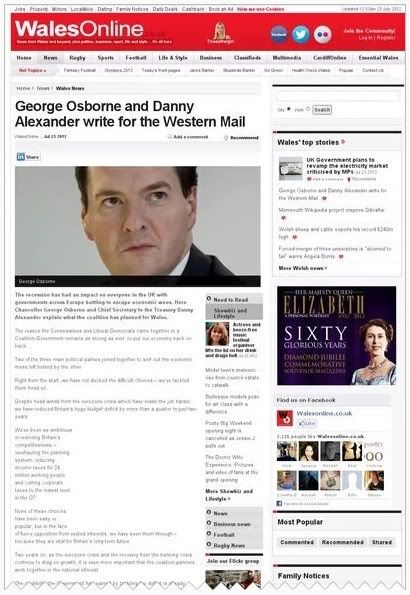
The Western Mail has made a big thing of an article it published today under this headline:


Gosh, I thought. Things must be quiet if these two men had time to write an article about Wales. There might be some good in them after all. And it would be quite a scoop for the Western Mail too, maybe they can halt their decline in sales.

So I read it, but something didn't quite ring true. Yes, they mentioned Wales a few times, but it wasn't really about Wales at all. So I googled one of the paragraphs and found that it was just a recycled version of a story that they had written for Politics Home last week:

     George Osborne and Danny Alexander: Govt credibility can boost infrastructure

Word for word, the story is exactly the same, apart from the fact that the words in bold have been rather awkwardly added to these four paragraphs:

The credibility the Government has earned by tackling the deficit is already benefiting millions of British taxpayers, families and businesses across Wales through consistently low interest rates.

With the Bank of England, we launched action to make loans and mortgages cheaper and more easily available, providing welcome support to families and businesses throughout Wales.

Last week we committed to the biggest overhaul of our rail system since the Victorian times – including electrification of the lines from Cardiff to Swansea and the Welsh Valleys.

But as coalition partners in these difficult economic times – as difficult perhaps as any our country or our continent has faced outside of war – we are totally committed to working together to 2015 to put our economy, and Wales’ economy, back on track.

It's a trick that's been pulled many times before, but we can draw these conclusions from it:

     •  First, that Osborne and Alexander were not writing for the Western Mail.
     The paper is just trying to big itself up to make it look as if it's more important
     than it actually is.

     •  Second, that Osborne and Alexander don't have any specific policies for
     Wales at all.

Who knows, perhaps the same story will appear in other newspapers with tags like "across the West Midlands", "throughout the North East", "including electrification of the line to Sheffield", and "Scotland's economy".

Or perhaps not.

Somehow I think we'll find that only the Western Mail thought people in Wales would be gullible enough to believe that this was a story about Wales.

Bookmark and Share

In the gutter, and heading down the drain

The only explanation I can think of for the disgraceful editorial in this morning's Western Mail is that its circulation must be falling like a stone, and the order must have come from on high to resort to cheap sensationalism to stave off seeing it reduced to a weekly.


I took a quick look at Wiki to see what its circulation figures were. Wiki still has the figure for August 2009, namely 32,926. But that figure has now dropped by more than 7,000 to 25,898, as we can see here.

It obviously can't go on like this, and desperate directors do desperate things. In fact the Monday to Friday circulation is an even more disturbing 23,777 so the paper relies very heavily on its Saturday sales of 36,015 ... and this explains why becoming a weekly is on the cards.

It's a shame, because if it were run in Wales, for Wales (perhaps amalgamated with the Daily Post to become a true national newspaper for the whole nation) it might rebuild itself into something we could respect.


Update - 17:55, 22 May 2012

Many thanks to Huw Aaron for this cartoon:


Update - 12:25, 24 May 2012

For future reference, I've embedded the BBC's news report (it was only on Newyddion, not Wales Today) and the Radio Wales phone-in:


Bookmark and Share

The Wrong Headline

There was a story in the online version of the Western Mail this morning which was carried under the headline:

Welsh primary school pupils outperforming English counterparts

But when I looked again an hour or so later I couldn't help but notice that the headline had been changed—even though the story was exactly the same—to:

Welsh pupils fall behind English counterparts after primary school

That's more like it. The number one rule of journalism is that you must never let junior staff write headlines that show Wales in a good light.

We should be grateful that the more senior editors at what they like to call our national newspaper have a better sense of perspective about how bad Wales is.

Bookmark and Share

It was THIS big ... honest

It's not often that I venture into the murky world of misinformation on the Western Mail's letters page, but this peach of a letter from a certain D Matthews must certainly be one of the favourites for this year's award.

£125m for Welsh

SIR – I note with interest and amazement that Jane Hutt, the WAG Business Manager, has given preferential treatment to the Welsh language in her draft Welsh Assembly Budget proposal.

Why does promotion of the Welsh language have a capital budget of £125m? The Welsh Assembly obviously feels it is more important to get everyone in Wales speaking Welsh than looking after our health service, education, employment etc, which have all received cuts to their budgets.

How are we going to attract desperately needed new businesses to Wales when the Welsh Assembly are hell bent on insisting that Welsh should be our first language and that all businesses will have to use it, whatever the cost to them. What sort of Welsh Government do we have, that puts the Welsh language above all else in these times of austerity. Why would we want to want to vote to give WAG more powers, when they are already abusing the powers they have?

D MATTHEWS
Newbridge, Gwent

Western Mail Letters, 30 November 2010

Just one slight problem. The draft budget is here and we can see, on page 17, that the figure is not £125m but £125,000. D Matthews was only exaggerating by a factor of a thousand.

Well, make that two slight problems. The £125,000 is the figure for the current financial year. The proposal in the draft budget is for this to be reduced next year by £50,000 to £75,000 ... a cut of 40% in monetary terms, but of course more in real terms because of inflation.

-

But perhaps the much bigger problem is that the Western Mail is so quick to print such demonstrably obvious trash. Any junior editor who had the slightest knowledge about Wales should have been able to spot the "mistake".

Unless, of course, it was an orchestrated part of the paper's anti-Welsh agenda as we approach the referendum next March.

Bookmark and Share

The Western Mail

Wednesday's editorial in the Western Mail was one of those rare occasions when I have been genuinely surprised by a newspaper's stance on an issue.

Powers that would boost Welsh democracy

Devolution, as Ron Davies memorably said, is a process not an event. While the next step in Wales will be the referendum on further lawmaking powers, an equally important debate concerns the level of financial autonomy that should be available to the Assembly Government.

Many will be instinctively reluctant to grant any kind of tax-levying powers to Cardiff Bay, fearing that that would inevitably result in a higher tax burden. But that is by no means necessarily the case, as the Scottish Government has demonstrated by choosing not to vary the rate of income tax during the first 10 years of devolution.

We believe there is a strong argument for changing the way the Assembly Government is funded. There is already substantial concern about the workings of the Barnett formula, which allocates resources to Wales, Scotland and Northern Ireland. The Holtham Commission, which has been asked by the Assembly Government to investigate current arrangements, has already concluded that Wales stands to lose £8.5bn in Treasury funding over the next decade because of the way Barnett works. A move to a robust needs-based formula is clearly appropriate.

But there is a wider issue of accountability that suggests granting the Assembly Government the power to levy or at least vary taxes would strengthen Welsh democracy. At present AMs are only able to make decisions about how to carve up the block grant from the Treasury – they have no ability to vary the total amount of the cake. In this respect, they are in a less powerful position than the smallest community council in Wales, which can fix its own precept. Political parties and others often deplore the lack of political engagement with Welsh politics. Nothing would be more likely to stimulate a greater interest in the affairs of the National Assembly than the possibility of a tax increase. More crucially, the existence of tax-levying powers would force parties to concentrate their minds on the need to create the wealth from which tax revenue springs.

We also support calls for the Assembly Government to be granted full-scale borrowing powers. In the short term, this would allow a forward-looking administration to overcome the constraints on capital spending to be introduced whoever wins the general election. It would also give ministers greater flexibility in planning projects like new hospitals.

An additional reason for supporting tax-levying and borrowing powers is that Wales cannot afford to lag behind Scotland as devolution goes forward. With the Scottish Government likely to be granted income tax-varying power of up to 10p in the pound, our politicians should be trusted with the same responsibility.

Western Mail, 24 February 2010

The last time Martin Shipton said something that made my jaw drop was when the first part of the Holtham Commission's report came out in July.

As I mentioned in this post at the time, the doyen of Welsh political journalism—or weathered old hack, if he doesn't mind a little affection—said this:

The importance of the Holtham Commission’s findings about the way the National Assembly is funded cannot be overestimated.

... What is particularly neat about the Holtham report is the way the Commissioners have deployed the very same formulae used by the UK Government to allocate funds in the English regions to demonstrate that Wales is likely to lose out by billions of pounds over the next decade.

It is astonishing – and grossly unjust – that what is considered the right way to do things within England is regarded as unnecessary or unacceptable in the context of the UK as a whole.

Western Mail, 8 July 2009

The subject is the much same, so I'm not surprised at that. However what has changed is that the earlier statement was just one journalist's opinion, but it has now become the Western Mail's editorial position.

That is quite some shift ... and of course it is one that I welcome.

Bookmark and Share