Showing posts with label Poverty. Show all posts

Rising wealth inequality

With a hat-tip to Bella Caledonia, I think these videos are worth sharing as widely as possible.


I'm sure we've all seen many tables which compare average incomes in the UK with those of the rest of the OECD, and we generally get the impression that the UK is comfortably in the middle.

But the fact that the UK has such a huge gap in income between the richest few percent and the rest of us artificially inflates the UK's position in these tables, with the result that the poorest 20% in the UK are significantly worse off than the same 20% in the rest of the OECD.

This is from the High Pay Centre blog:

What would the neighbours say? How inequality means the UK is poorer than we think

 
Analysis of OECD figures suggests the poorest fifth of the UK population are the poorest in Western Europe
 

The poorest fifth of UK households are significantly worse off than the poorest fifth in other Western European countries, according to analysis of Organisation for Economic Co-operation and Development (OECD) data published by the High Pay Centre think-tank today.

The High Pay Centre examined the ‘OECD Better Life Index’ which estimates the average net disposable household income for the world’s richest economies, as well as the average for the poorest and richest 20% of households in each country.

In the UK, the incomes of the poorest fifth of households have an average income of just $9,530, much lower than the poorest fifth in other North West European countries such as Germany ($13,381), France ($12,653), Denmark ($12, 183) or the Netherlands ($11,274).

In fact, the poorest households in the UK are closer to the poorest in former Eastern bloc countries Slovenia and the Czech Republic than to the poor in Western Europe. This is despite the fact that the OECD estimates average incomes in the UK ($25,828) are similar to Denmark ($25,172) and the Netherlands ($25,697). The UK’s average is inflated by the incomes of the top 20% of households - at around $54,000, the third highest in the EU. In Belgium, the Netherlands and the Nordic countries, the top 20% make between $44,000 and $49,000.

The High Pay Centre analysis also notes that if the UK’s total income of around £1 trillion was divided in the same way as total incomes in Denmark or the Netherlands, 99% of UK households would be better off by around £2,700 per year.

High Pay Centre Blog, 16 June 2014

The full report is here.

Hopefully, this information will help put the repeated stories we get about the Welsh economy being on a par with eastern Europe into perspective. A significant part of our poor economic performance is not intrinsically to do with us, but is a failure of the UK state to distribute wealth (for although household income figures are different from regional income figures, there is a correlation, because the super-rich in the UK tend to be concentrated in London and south east England).

Much of the argument for Wales remaining part of the UK is that we are able to "share resources", as Unionist politicians have become fond of saying in the context of the Scottish independence referendum. But what is the point of being in such a union when it is clear that the UK doesn't share them ... or at least doesn't share them to anywhere near the same extent as happens elsewhere in Europe? And what hope is there for the future of the UK when the inequality between rich and poor is rising rather than falling?

Bookmark and Share

Leanne's IWA interview, and article on poverty

For any who haven't seen it, this is the video of a discussion between Leanne Wood and Lee Waters of the IWA hosted by Prifysgol Glyndwr last week. The audience was quite small, but the quality of the questions they asked at the end more than made up for it ... and the answers weren't too shabby either.


Lee mentioned an article Leanne had recently written for Prospect magazine on poverty. That was news to me, but just click the image below to download and read it.


Leanne's article is entitled Plaid Cymru, independence and closing the wealth gap. It's always good to see the argument for independence put into the context of what we need independence for.

As Scotland's Future highlights, under the Westminster system we are locked into one of the most unequal economic models in the developed world. Since 1975 income inequality among working-age people has increased faster in the UK than in any other country in the OECD. The increasing geographical imbalance concentrates jobs, population growth and investment in London and the south east of England, but no action has been taken to address this by successive Westminster governments. The only way to change this is to take responsibility for ourselves.

Bookmark and Share

Paying for Universal Free School Meals

On the whole, the announcement that all children in England aged 7 and under will get a free school lunch is something to be welcomed. In fact I've just read an opinion piece by Jemima Lewis in the Telegraph, of all places, and pretty much agree with every word she wrote. It was quite disconcerting!


     Everyone benefits from free school meals

For those who are interested, the full report on the pilot studies in Durham and Newham is here.

I would, however, want to add one thing to what she said. Schemes which provide a universal benefit—rather than those in which eligibility for the benefit is determined according to the ability to pay—are some of the most useful tools available to government for redistributing wealth and alleviating the effects of poverty. It goes without saying that the benefit is paid for out of general taxation rather than being "free", but that is a good thing in so far as we have a progressive tax system in which the rich pay more tax than those on middle incomes, and those on middle incomes pay more tax than the poor.

This is why, for example, the idea put about by Tories in Wales that rich people shouldn't get free prescriptions, because they can afford to pay for them and would be prepared to pay a nominal sum for them to ease financial pressure on our NHS, is completely bogus. Of course rich people should pay more, but it is much better for them to do it through paying higher taxes rather than over the counter for each item.

The new universal FSM scheme in England is expected, according to this report, to cost some £600m a year, although I'm not sure whether this is the overall cost for all children, or just the additional cost for those who are not currently receiving FSMs. As some 20% currently claim FSMs, the overall cost might be in the order of £750m a year. But bringing the 80% who are not currently receiving FSMs into the scheme represents a very considerable extension of provision. In fact it would be a much greater extension than would be the case with free prescriptions, because the vast majority of prescriptions issued in England are already free.

And of course it would be even better if FSMs were extended to all primary school children rather than just the younger ones, and if they were extended to secondary school children as well.

-

So in principle this is a great idea and should be supported, but in practice there is one major problem with what has been proposed. It would be fine if this £600m were to be raised by increasing taxation, but there are no plans to increase it. This means that the scheme can only be funded by yet more cuts to other public services, on top of the savage cuts that have already been imposed and which have yet to fully bite in any case.

It means that this proposal is not really going to help the poor, because they are already getting FSMs. It is only going to help the better off, who will save some £400 a year for each child. The poor will in fact lose out because they rely disproportionately on the existing public services that will have to be cut to pay for it.

The ConDem government has done exactly the same thing with income tax. Yes, it is a good idea to take the lower paid out of income tax altogether by raising the threshold, but this should have been balanced by increasing the basic rate of income tax so that the overall tax take remained the same. As things stand, increasing the threshold from £6,475 in 2010/11 to £10,000 in 2014/15 will give every basic rate taxpayer an extra £705 a year (although an allowance needs to be made for inflation, making it maybe £400 or £500 in real terms). So, once again, the overall effect is to reduce the amount the UK government has available to spend on public services which the poor need more than those on middle incomes.

The LibDems will claim credit for both raising the income tax threshold to £10,000 and for UFSMs for those aged 7 and under. They will say they are helping to create a fairer, more equal society. They will say that by being in government, they have managed to save us from the rabid excesses of a government entirely made up of Tories. But this isn't really true. What they've "giving" with one hand is being clawed back by the other.

If universal benefits are to be extended, they need to be paid for by corresponding increases in general taxation. This is the only way that other public services can be maintained rather than cut.

Bookmark and Share

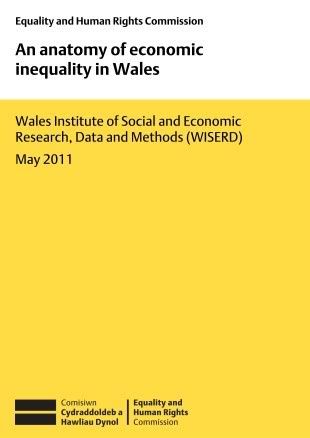
An Anatomy of Economic Inequality in Wales

There is an interesting story on the BBC website about a report on the economic inequalities that exist in Wales. I don't think there's anything surprising about the headline:

     'Social background affects poverty' in Wales says study – BBC, 12 May 2011

Yet this does appear to be a very heavyweight piece of research. A quick skim through it has convinced me that it is going to be well worth reading, and I'm writing this in the hope of persuading others to do so too. Just click the image:


The Executive Summary is fairly concise, so I thought I'd copy it as a taster of what's inside.

Executive Summary

The report sets out outcomes in education, employment, earnings, income, poverty and wealth in Wales in comparison to other areas of the UK. The data analysis compares outcomes by gender, age, ethnicity, religion, disability and housing tenure. Analysing inequality within a small country that has relatively low incidence of certain population sub-groups (e.g. ethnic minorities) sometimes limits the degree of detail that can be achieved in the analysis. Despite this, the following key findings emerge:
 

•  The historical productivity gap relative to the UK is continuing to widen for Wales. The industrial and business structure produces weak demand for skills, with individuals’ earnings in Wales being, on average, lower than the UK average. Disadvantage in education, and subsequently in employment and earnings, attaches particularly to young people, those of Bangladeshi and Pakistani ethnicity, and people who are work limiting and DDA defined disabled. Within each of these groups, women are generally more disadvantaged.

•  While overall in 2009 two-thirds of pupils in Wales attained key stage 4 qualifications at National Qualifications Framework level 2 (NVQ level 2 or equivalent) by the time they were 16, the chance of gaining these qualifications was strongly related to family income. Pupils eligible for Free School Meals (FSM) are 2.5 times less likely to get A*-C grades in core subjects than their ineligible peers. People defined as both DDA disabled and as having a work limiting condition have by far the lowest educational achievements of all the equality categories. Both men and women in these groups are 3 times more likely to have no qualifications compared to non-disabled people.

•  People who are both DDA disabled and have a work limiting condition experience most disadvantage in relation to employment. Seventy four per cent are not employed. This is more than 3 times the overall UK proportion of 22%. Women are disadvantaged in employment terms: in almost all population groups women face an above-average incidence of non-employment. This is particularly the case for some ethnic minority groups in Wales, particularly women of Indian, Bangladeshi and Pakistani and Chinese ethnicity.

•  The median hourly earnings of men in Wales (£9.88, measured between 2004/5-2008/9) were just above the overall UK median (£9.81), while median female earnings (£8.04) were only 82% of the UK median, giving a Wales gender gap of 19% in hourly earnings. Using a low-pay threshold defined as two-thirds of UK median earnings, the proportion of employees who are low-paid is higher in Wales than in the UK as a whole. In terms of hourly earnings 26% of employees in Wales are low-paid, compared to 22% in the UK. The incidence of low weekly pay for full-time employees in the UK is 22%, in Wales 28% and for women full-time employees in Wales it is 38%: a ‘gender penalty’ of 10%. Groups whose median earnings fall below the two thirds of the UK median for full-time employees are young people; those of Bangladeshi or Pakistani ethnicity; workers with no educational qualifications, workers who live in social housing and employees (particularly those working part time) in Elementary Occupations, Retail and Customer Services occupations and Personal Services.

•  Approximately a fifth of the Welsh population live in poverty (measured after housing costs). Those living on the lowest incomes are once again the youngest, disabled people, those of Pakistani and Bangladeshi ethnicity and those living in rented accommodation. However, lone parents are the most susceptible group, with almost half living in poverty. Being in work does not necessarily provide a route out of poverty, with 13% of in-work households in Wales living in poverty. In-work poverty is again most prevalent among lone parent households, Asian households and those who are renting. Levels of wealth are lowest among young people, lone parents and single households, non-white households and those with a work-limiting illness or disability. The lower levels of educational attainment observed among protected groups will effect the positions they achieve in society and the resources and opportunities that these positions confer.

•  Overall levels of inequality within Wales are not as wide as in the rest of the UK as Wales has relatively few people who earn the highest salaries or who are ‘very rich’. Those who are among the wealthiest 10% of people in Wales have around £100,000 less total wealth compared to the wealthiest 10% across the UK as a whole. The level of inequality within most sub-groups of the population is generally narrower than that observed across the population as a whole. Inequality between groups therefore does indeed contribute to overall inequality. However, there is a considerable level of inequality between rich and poor within each of these groups, unconnected with and unexplained by group membership.
 

The UK NEP report suggested that there is little awareness of the enormity of economic disparity which ‘runs through society, from rich to poor,” and that this ‘acts as a constraint on any policies designed to contribute to reducing inequality’ (NEP 2010:398). This report provides the most thorough examination of the material consequences of difference undertaken within Wales. The findings in this report represent a significant body of new evidence on socio-economic inequalities. In each case, the evidence connects the distribution of economic outcomes to social characteristics both between and within equality groups. A widespread recognition of inequality, its causes and effects, is a precursor to the use of policy to intervene to interrupt its reproduction.

Additionally, the raw data can be downloaded in the form of spreadsheets from this page.

-

Without wanting to be too dramatic, the economic situation in Wales is very serious, and generally worse than it is in other parts of the UK. As a nation, we need to address this and do something about it.

Of course it is right and good that we focus resources on those in our society who are disadvantaged, and that we do everything we can to overcome the effects of poverty ... but that is to deal only with the symptoms rather than the cause. Poverty is the lack of money. We need to become more wealthy and more prosperous as a nation.

I firmly believe that this is something that we must do for ourselves, rather than relying on the richer parts of the UK to bale us out. We have been living like this for much too long. In the short term it is right that we should seek fair funding on the basis of need ... but only in the short term. The long term answer is to make ourselves more self-sufficient, and this will require taking the levers that control our economy, such as taxation, into our own hands. If we shy away from this, how can we expect anything to change? Our economic decline relative to the rest of the UK will continue until we do.

Bookmark and Share

Usury

Usury: The practice of lending money and charging the borrower interest, especially at an exorbitant or illegally high rate.

Two unrelated stories that caught my eye earlier this evening cry out to be brought together. The first was the news that Credit Unions in Wales are to get a boost of £750,000:

     Credit Unions land £750k funding - BBC, 22 July 2009

The second was this feature from Newsnight:


We live in a widely unequal society and, in spite of the stated intention of some of our politicians, the gap between rich and poor is not decreasing. One of the reasons for that is access to affordable money. If you aren't in a job, or don't have enough savings, or have any sort of bad financial history you—especially now that the credit crunch has taken hold—get relegated to what can only be described as an economic underclass.

It then becomes expensive to make the sort of financial transactions that the better off among us take for granted. Normal borrowing on overdrafts and credit cards is about 17%-19%, that virtually doubles for those whom the banks and financial institutions regard as greater risks and, if it becomes impossible to get even that your only way of getting credit is through loan sharks and pawnbrokers that could charge maybe 100% or more.


Although the Newsnight piece was presented from a religious point of view (the three monotheistic religions all condemn usury) I would not want to make any point based specifically on faith or belief. However I don't think there can be many people who would not be disgusted about charging the poorest and most vulnerable members of our society exorbitant amounts of interest and fees while the better off get easy access to cheap money. Whether we have any religious beliefs or not, it is still morally repugnant.

Furthermore, it is even worse that financial institutions charge such high rates of interest on borrowing when they themselves can borrow money at only a tiny fraction of the rates they charge. All the more so for banks which are still in business only because they were bailed out at huge expense by the taxpayer.


Now, I might well take the point made by Peter McNamara on Newsnight that small, short-term loans need to be arranged, and that the administration costs money. He might have a point about fees ... but certainly not about the rates of interest they charge.

This is where Credit Unions come into their own. Because they operate at a completely different scale, they do not need to make the same sort of charges. And because they operate at a community level, the attitude that people take towards them is likely to be quite different from the attitudes thay have towards a big bank that can splurge millions on bonuses and pensions. They encourage a greater sense of financial responsibility from those that use them.

So we, at a political level, need in our turn to do what we can to encourage the growth of Credit Unions. I was particularly encouraged to see that some CU's had begin to offer card transaction services in collaboration with the Co-operative Bank, which I mentioned here:

     Syniadau Forums, 30 January 2009

Of course £750,000 is a drop in the ocean compared with the bail out that some of the mainstream banks received. It won't change the world, but it will make a significant difference to the thirty or so Credit Unions we have in Wales. Hopefully, they will now be able to offer services to more people, as a way for them to climb out of the financial underclass we as a society have created.

But as for the banks—as well as for the less reputable organizations and individuals that offer "financial services" of course—we urgently need to have laws that limit the amount that can be charged in fees and interest ... probably on a sliding scale, in proportion to the size and term of loan and to the base rate. And we need to have stronger, criminal sanctions available to use against the loan sharks.

Bookmark and Share