The Thick of It, a Better Civil Service for Wales

In his blog yesterday, Gareth Hughes mentioned one of the conspicuous omissions from the new Programme for Government published by Carwyn Jones.

It contained many worthy aspirations, but the one major area that might determine whether his programme sinks or swims was missing. In Labour's manifesto they had the intention:

"to review and seek realignment of the governance and performance of the Assembly civil service, better to reflect the developing requirements of devolution whilst remaining part of the Home Civil Service."

Now it wasn't by chance that this appeared in the manifesto. It wasn't one of these meaningless commitments thrown into bulk out the document. It was heartfelt. It appeared because many ministers in the last government felt that the civil service was "not fit for purpose." Not up to the job, but Ministers weren't able to do anything about it. Hence, their determination to change things. They really thought that if it went into the manifesto it would happen.

But today, nothing, not a whisper. Oh, never underestimate the basic conservative instinct of civil servants.

Sir Humphrey has ensured that his comfortable little number will not be scruninized by the Hackers of this world. How confident can Carwyn Jones be that his “Progamme for Government” will be met if it’s left to an unreformed civil service to carry out?

Gareth Hughes, 27 September 2011

My reaction to this omission is, as people might expect, a little different. If all you have to offer is a lacklustre set of proposals, it probably helps to be able to blame someone other than yourself for the lack of ambition behind them. Who better to blame than the Civil Service? They're hardly the best loved of public servants, anyway.

-

And yet—by one of those coincidences that can only be described as excruciatingly embarrassing rather than merely unfortunate—on the very same day that Labour in Wales admitted that they aren't going to bother to try and make the Civil Service work better for Wales, a report has been published showing how the Civil Service in Scotland has been successfully transformed, and transformed for the better. Click the image to download it.
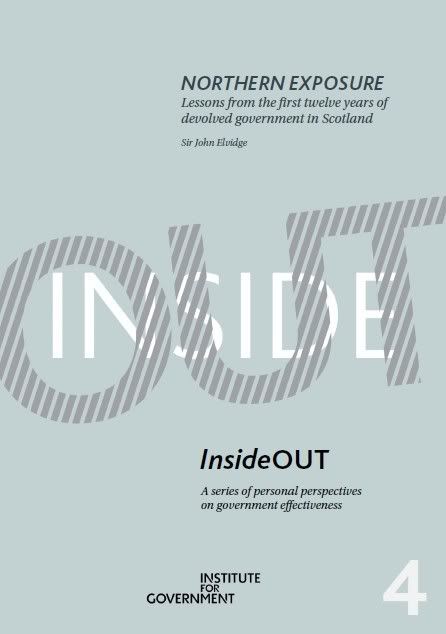
     

The report was written by Sir John Elvidge, who is the former permanent secretary to the Scottish government. This is a short summary of it from eGovmonitor:

Scottish Government Leads the Way on Radical Civil Service Reforms in the UK - New Paper

Whitehall can learn more from the successes of the civil services reform north of the border in Edinburgh, a new paper from the Institute for Government (IfG) written by Sir John Elvidge, former permanent secretary to the Scottish government has claimed.

In his paper, Northern Exposure: Lessons from the first twelve years of devolved government in Scotland, he articulates how he as the senior most civil servant in Scotland worked with the minority SNP government, to radically transform the structure of government so it works together around a "common national purpose". These measures included reducing the number of ministers and abolishing departments and aligning the whole Scottish public sector around a single framework of national purpose – whose outcomes would be tracked and measured: "at the heart of [this] was the concept of government as a single organisation ... the idea of "joined up government taken to its logical conclusion".

In stark contrast to the Whitehall civil servants who were criticised recently by a Parliamentary Committee for lack of inertia and flexibility, the Elvidge paper praises the civil servants in Scotland for the role they played in the reforms. "As well as providing essential continuity of understanding about the processes of government, it has displayed agility and energy in assisting the adaptation of that understanding to fresh challenges," he said.

He says the model of Scottish government structure reforms was based on "an explicit rejection of departmentalism as a basis for effective government and involves the abolition of a departmental structure within the Scottish government."

"In partnership between civil service and political leadership, a radical Scottish model of government has developed since 2007, building on the learning from the earlier period of devolution. It is based on the effort to have government function as a single organisation, working towards a single defined government purpose based on outcomes, and establishing a partnership based on that purpose with the rest of the public sector which is capable of being joined by other parts of civil society," he wrote. "It places strategic leadership and the facilitation of co-operation between organisations and sections of society at the heart of the role of central government, rather than a managerialist view of the relationship of central government to others."

The former top civil servant in Scotland highlighted the role played by the Scottish public leadership forum, which brings together all Scottish public sector leaders, in ensuring the changes were not just limited to Edinburgh. He argues "my central proposition is that we are making less use than we could and should within the UK of the opportunities for transferable learning from the experience of devolution."

Lord Adonis, the former Labour Cabinet Minister and now the Director of the IfG echoed his thoughts and said the Scottish model does offer a successful alternative and it's time for Whitehall to "wake up to the changes" north of the border in Scotland.

eGovmonitor, 27 September 2011

I can only echo that alarm call. Wake up, Carwyn. If you swallow your pride for long enough to read what has happened in another devolved administration, or take any pride in the idea of a similar "common national purpose" for Wales, you might learn about some practical ways to implement what you said you wanted to do in your party's manifesto.

It appears to me that this is exactly what we in Wales need. Not just as an effective way of implementing policy, but a more efficient way of doing it.

It is also worth pointing out that Scotland does not have a separate Civil Service (although Northern Ireland does) but shares a common Home Civil Service with us in Wales and with Whitehall. So implementing changes of this sort does not require any constitutional change, and therefore is in line with your manifesto commitment. It just requires reorganization to move away from the departmental rivalries and entrenched interests that characterize the way Whitehall works. Make no mistake, we in Plaid Cymru would want to go further, but this would be a very big step in the right direction.

And, in purely practical terms, this model was set up during a period of a minority Scottish government. Therefore these ways of working will be particularly appropriate for the difficulties your current minority government is inevitably going to face in Wales. So don't use the Civil Service as an excuse, Carwyn. Make it work for Wales in the same way as the SNP have made it work for Scotland. If you're prepared to get into the thick of it, you'll certainly have cross-party support from Plaid Cymru.

Bookmark and Share

A joke that's no longer funny. It's time to act

Catching up with some of the television I missed during the week, I came across this snippet from Dafydd El Cid on Sharp End:


No serious constitutional changes at all, eh? No devolution of police and the justice system? No devolution of broadcasting? No control over our natural resources? No control over energy? No powers to set taxes?

How can we possibly have "self determination" when control of all these things lies outside Wales?

No wonder this man can think of little else than joining the Labour Government at the first opportunity. I can't help thinking that this would be the perfect place for him, for Carwyn Jones isn't really serious about devolving more to Wales either. They both clearly think the referendum in March was quite enough and that our constitutional settlement shouldn't be progressed any further.

-

As far as I'm concerned, Dafydd El ceased to have any relevance to Wales when he chose to join the House of Lords. I didn't mind him continuing to be a member of Plaid simply because of his record before then. When he then became a member of the National Assembly, things just about worked out because he took the position of Llywydd, which precluded him (or at least should have) from being an active party politician in a similar way as applies to the Speaker of the House of Commons. But when he hinted in December last year that he no longer wanted that job, I said that I thought there was no place for him as an elected politician within Plaid Cymru and that the party should act to prevent him standing if it was his intention to step down from being Llywydd.

But we didn't do that, and we are now suffering the consequences, because loose cannons are dangerous.

There is simply no room in Plaid Cymru for people who are content with the current constitutional settlement for Wales. For many years the first and foremost aim of the party, as stated in the party constitution, has been:

2.1 To promote the constitutional advancement of Wales with a view to attaining Full National Status for Wales within the European Union.

Plaid Cymru Constitution

But even this statement has now been superseded, because at conference this year delegates voted in favour (I think it was unanimous, for even the one person who spoke against the motion did not actually vote against it, but it easily got the two-thirds majority necessary) of this change:

INDEPENDENCE FOR WALES IN EUROPE
(Canton and Llandaf branch / Caerffili Constituency / Pontllanffraith and Maesycwmer Branch)

1. Conference reaffirms its support for independence for Wales in Europe.
2. In order to clarify the party’s constitutional stance, conference agrees to delete paragraph 2.1 of the constitution and insert:

“secure independence for Wales in Europe.”

Plaid Cymru Conference Handbook, 2011

This means there can be no place in Plaid Cymru for people who do not share this aim. In fact, it is clearly set out in the constitution (4.2i) that members must "agree to further the aims of the party as described in this Constitution". The five aims, as amended in accordance with the vote at conference, are:

2. As the National Party of Wales, Plaid Cymru - The Party of Wales's aims shall be:

2.1 To secure independence for Wales in Europe.

2.2 To ensure economic prosperity, social justice and the health of the natural environment, based on decentralist socialism.

2.3 To build a national community based on equal citizenship, respect for different traditions and cultures and the equal worth of all individuals, whatever their race, nationality, gender, colour, creed, sexuality, age, ability or social background.

2.4 To create a bilingual society by promoting the revival of the Welsh language.

2.5 To promote Wales’s contribution to the global community and to attain membership of the United Nations.

We need to be clear that there is plenty of room for disagreement over individual policy issues ... and indeed we have very lively debates over what our policies should be, as do all democratic parties. But there can be no place in the party for those who are openly opposed to the party's fundamental aims as set out in its constitution.

-

Dafydd Elis-Thomas has put himself on record as not only being opposed to independence for Wales, but of being opposed to the constitutional advancement of Wales. These are his exact words:

"I wouldn't advocate any serious constitutional changes at all."

If Plaid Cymru continues to tolerate the likes of Dafydd Elis-Thomas as even a member of the party, let alone one of our elected representatives, we will make ourselves a laughing stock in the eyes of the people of Wales. If we are seen as a party that doesn't take its own fundamental aims seriously, how can we ever expect the people of Wales to take us seriously?

We need to get rid of this dead weight.

Bookmark and Share

Taxi for Clegg

Thanks to the Independent for the cartoon.


What sort of taxi did you think I meant?

Bookmark and Share

Still time to get that amendment in, Carwyn

As a result of Peter Hain's performance in front of the cameras over the last few days, Change of Personnel today asked a question about who is seen to be leading, or at least speaking for, the Labour Party in Wales.

But despite the accolades it got me wondering, if you didn’t know any better and let’s face it most people who watched across the UK and further afield wouldn’t, you’d believe from last week that Peter Hain was Wales’s First Minister and leader of the Welsh Government, not simply the Shadow Secretary of State for Wales.

He managed to totally out think and outmanoeuvre Carwyn Jones (admittedly not a particularly difficult task) who was there and met with families but remained in the background as Peter with help from his advisers took the lead on every front from the start of the unfolding tragedy. Everything from talking with the families, appearing with the police at press conferences and updating the gathered media to launching the appeal for families - would Alex Salmond, Peter Robinson or Martin McGuiness have allowed their respective Shadow Secretaries of State to take the lead in such circumstances in Scotland or Northern Ireland? I sincerely doubt it.

So why is Carwyn Jones, who is after all supposed to be the man elected as Wales’s First Minister, so willing to let Peter Hain do it in Wales? Is what’s best for the Labour Party still more important than doing his job and leading the country, especially during such a dreadful tragedy?

Change of Personnel, 19 September 2011

I don't particularly want to concentrate in this post on the tragedy that has unfolded over the last few days. That is something that rightly puts politics into the shade. I thoroughly dislike the idea of any politician taking more of the media spotlight than the police, the rescue teams and people speaking on behalf of the families. So although I think Peter Hain should have said very much less than he did, I would apply that to any politician. I saw Carwyn Jones, Bethan Jenkins and Gwenda Thomas interviewed about what happened, as well as some local councillors (there may have been others that I missed) and I think their shorter contributions were much more appropriate than those made by Mr Hain, who even when he wasn't speaking seemed to take inordinate trouble to be seen in the background.

Yet the question about who is seen to be leading the Labour Party in Wales is important, even though overshadowed by the tragedy at the Gleision Colliery.

-

First, we need to realize that Carwyn Jones is only the leader of the Labour group in the National Assembly, and is First Minister because of that. There is no Welsh Labour Party; there is just one Labour Party with Ed Miliband as its leader. Peter Hain and Carwyn Jones have to fight between themselves about which one of them is the most prominent Labour politician in Wales, with the right to speak for Labour in Wales.

Carwyn Jones is disadvantaged not only by his own lack of drive and ambition (something Peter Hain could never be accused of) but by the fact that the Labour Party itself regards what is decided by Labour in Westminster as more important than what is decided by Labour in Cardiff Bay. A good example of this was that the Labour manifesto for the Assembly election in 2011 was opposed to nuclear power, but a week before the election a Labour spokesman said that the party's definitive position on the issue was in fact in their Westminster manifesto of 2010, which supported nuclear power on Ynys Môn. As John Dixon noted, the clear message was that whatever the party in Wales thinks is irrelevant if it clashes with what the party in Westminster wants.

-

At present the arrangement in Scotland is exactly the same as it is in Wales; but they are now set to change it, as reported here only a week ago:

Scottish Labour breaks free of Miliband

Labour has announced plans to create a new Scottish leader and a beefed-up party north of the Border to fight back against electoral dominance by the SNP. The radical reforms, to be made following the crushing loss to the SNP in May's Holyrood elections, will lead to the loosening of ties with the UK Labour movement with UK leader Ed Miliband no longer in charge of party fortunes in Scotland.

The results of a review into the Labour trouncing at the polls were made public yesterday and were billed as the biggest shake-up of the party in Scotland for 90 years. They come a week after calls for the Scottish Conservative Party to be transformed and mean that the two leading UK parties are now undergoing changes that could bring a weakening of their bonds with Scotland. Further reforms to Scottish Labour will see local party associations, which are currently drawn on Westminster seats, being scrapped and reformed along Holyrood's boundaries in a move designed to shift the party's focus to Edinburgh and away from Westminster.

The moves were agreed by the party's ruling Scottish Executive committee yesterday, but they still have to be ratified by the UK Labour Party at its conference next month. The reforms were signed off in Glasgow after the three-month review led by MSP Sarah Boyack and MP Jim Murphy. They said that while the party had delivered devolution, it had failed to follow the same principles itself.

"This is about turning the Scottish Labour Party into Scotland's Labour Party. Today, we are completing the devolution of the Scottish Labour Party," Murphy said. "From now on, whatever is devolved to the Scottish Parliament will be devolved to the Scottish Labour Party."

Boyack said: "Labour devolved Scotland when we set up the Scottish Parliament in 1999, and we are proud of that. Labour used that Scottish Parliament to deliver important reforms for Scotland, but we didn't reform ourselves. Now we need to make devolution a reality within our party too."

Scotland on Sunday, 11 September 2011

As it happens, the Labour Party conference is next week rather than next month, but it seems fairly clear that the plan for the Labour Party in Scotland to be separately constituted, able to make its own policy in the areas devolved to Scotland, and with one clear elected leader, is going to be approved.

Therefore the obvious question is why this should happen for the Labour Party in Scotland but not for the Labour Party in Wales. The areas devolved to Wales might differ from the areas devolved to Scotland, but the principle should surely be the same.

Now, I can well imagine that someone in Labour might say that there now needs to be a separate Scottish Labour Party in response to their poor showing in the election in May ... but that nothing needs to change in Wales because Labour are doing perfectly well as they are. Why fix something that isn't broken? But my answer is that this change actually has nothing to do with Labour's poor performance in Scotland. The idea was in fact a key plank of Ed Miliband's campaign to become leader of the Labour Party back in June 2010:

Miliband says Scots Labour must make own policy

Labour leadership contender Ed Miliband says the party has to embrace differences north and south of the Border.

On a campaigning visit to Holyrood yesterday to meet MSPs he backed the idea of the Scottish Parliament going its own way from Westminster on legislation, and of the party in Scotland having complete control over policy.

"The policies in Scotland for Scottish Labour should be decided in Scotland – that should not be controversial," he said. "Under my leadership we would lighten up about difference.

"The whole nature of the devolution settlement is accepting that within a United Kingdom we can learn from each other and there will be particular policies and ideas which would be appropriate to Scotland and that Scotland should be able to pursue."

The Herald, 1 July 2010

Remember that this was said at a time when Labour were miles ahead in the opinion polls in Scotland, and when nearly everyone expected them to form the next Scottish Government. So the issue actually has nothing to do with Labour having lost heavily to the SNP; the principle would have applied even if Labour had managed to form a government in Scotland, and therefore applies just as much to Wales, even though Labour have been able to form a government here.

-

Now of course I have no way of knowing what the agenda for Labour's party conference will be, though it's a safe bet that this subject will be on it somewhere. But will the motion only talk about a separately constituted Scottish Labour Party ... or will fairness and consistency demand that Wales is treated in the same way as Scotland?

If you were ever serious about standing up for Wales, it's not too late to get that amendment in, Carwyn.

Bookmark and Share

Another example of Labour's insouciance

Following Chris Bryant's failure to understand what the word insouciant means, Neil Kinnock has kindly stepped in to provide us with a perfect definition. Referring to reports in the press that his son Stephen is gay, he said:


“When you are up against garbage like that, the only way to respond is with a shrug and a smile."

Wales on Sunday, 18 September 2011

But did he just shrug it off and smile? Of course he didn't.

According to Wales on Sunday he's reacted with "fury" and "launched a blistering attack" on the media. He called what was written about Stephen "a lot of bilge" and said it was an example of one of "the most vicious forms of personal attack".

-

Isn't it strange that Labour politicians like Neil Kinnock and Chris Bryant say one thing, but in fact do the exact opposite of what they say?

Why is it that remarks about a person's sexuality result in furious and very vocal complaints from both these politicians, but others are expected not to kick up a fuss or complain when their language is attacked?

Bookmark and Share

Dydd Owain Glyndŵr

Campaigning for independence ... and two national holidays for Wales!


Bookmark and Share

Welsh Independence

I've only just found out that the Welsh Independence blog has been brought back to life, and looks set to do some kicking. Definitely one to add to our bloglists.


Two articles are well worth highlighting. The first is a video report from Russia Today last week, which I've embedded below. The words that go with it are here.


The second is a slightly fuller version of an article by Siôn Jobbins which appeared in Cambria Politico last month. There aren't that many differences, but it's worth reading again anyway.

     Too Poor to be Independent – the same old story

Bookmark and Share