Update on New Welsh-medium Schools

Having talked about education in Euskara (the Basque language) last week, I thought I should balance it by talking about some developments in Welsh-medium education.
 

One year delay in Vale of Glamorgan

I mentioned the Vale of Glamorgan's plans for expansion of WM education here in November. I praised VoG for taking the initiative in both surveying demand properly and coming up with a good set of proposals in the form of starter schools. So I was rather disappointed to read their official consultation document, and find that they have had to put those plans back by a year. Instead of starting these new schools in September 2010, they are now proposing to launch them a year later.

The demand for Welsh-medium schools has increased substantially in the past three years to the extent that current demand now exceeds capacity; this is especially the case in Barry and the rural Vale.

To confirm future demand for Welsh medium education a survey was undertaken during July and August 2009 of parents with children under three years of age living in the Vale of Glamorgan. The survey revealed that, of those who responded, 26% are very likely to require a Welsh medium school place for their children. The survey highlights an unmet or latent demand for Welsh medium education. This is due to the existing distribution of Welsh medium primary schools across the Vale and the travel distances involved to access these schools, especially Ysgol Iolo Morganwg in Cowbridge.

Analysis of Welsh medium demand for September 2010 indicates a shortage of places throughout the Vale to accommodate parental demand for Welsh medium reception school places. The Council, therefore, is in danger of not meeting its statutory obligations.

Ysgol Iolo Morganwg serves the rural vale including Llantwit Major. There is insufficient capacity to accommodate the anticipated demand for Welsh-medium reception school places for September 2010 onwards from those resident within the school’s catchment area. Around 40% of children attending Iolo Morganwg (66 children) live in Llantwit Major and the surrounding area and receive free school transport to Ysgol Iolo Morganwg costing the authority in the region of £115,000 per annum.

Due to the length of the statutory processes required by the Welsh Assembly Government including the need to undertake proper and reasonable consultation when proposing the establishment of new schools, we will not be in a position to open new schools in September 2010 as originally planned. The opening dates for both new schools will be set at September 2011.

Consultation Document

The reason they have given is that the statutory procedures they have to follow are so complicated that they cannot act as quickly as they had hoped to. I don't want to engage in any finger pointing because I don't know the full circumstances. My main reaction is simply disappointment.

It's almost certainly too late to do anything differently in terms of formal procedure now, but there are still immediate issues to be dealt with; namely that there will be parents who want WM education for their children this coming September. These can't simply be turned away. Therefore it looks to me as if VoG are going to have to find one or two more temporary classrooms for their existing WM schools.

But if VoG wanted to be more proactive they might well look at what Cardiff did in a very similar situation last year ...
 

Ysgol Gabalfa, Cardiff

Cardiff planed to open a new WM starter class in Gabalfa Primary School in September last year. The existing EM school had a large number of surplus places so it made perfect sense to put it there, especially to relieve pressure on Ysgol Melin Gruffydd, about a 1km to the north, which is full to bursting and with no room to expand.

But as it happened, even though Gabalfa was quite happy with the arrangement, there were still the same drawn out formal procedures to go through (if there is even one objection, the matter has to be referred to the Assembly) and these simply could not be completed in time for September 2009. Therefore the Education Minister in the Welsh government gave permission for it to happen in September 2010 instead.

But this is where Cardiff got clever. When it was obvious that the decision would be delayed they could have just let things rest for a year, but instead they went ahead and set up the starter class. However they did so not on the basis of it being a new starter stream, but as temporary accommodation for Ysgol Melin Gruffydd ... which just so happened not to be on the Melin Gruffydd site.

So the question is, Why can't VoG do exactly the same? Some of the new starter schools they propose will be on land that is currently part of other schools, so it might well be possible to go ahead anyway but with the temporary accommodation "technically" being part of the existing school. I'm not saying it can be done, perhaps there are insurmountable difficulties, but I am suggesting that someone tests the water to see what's possible.
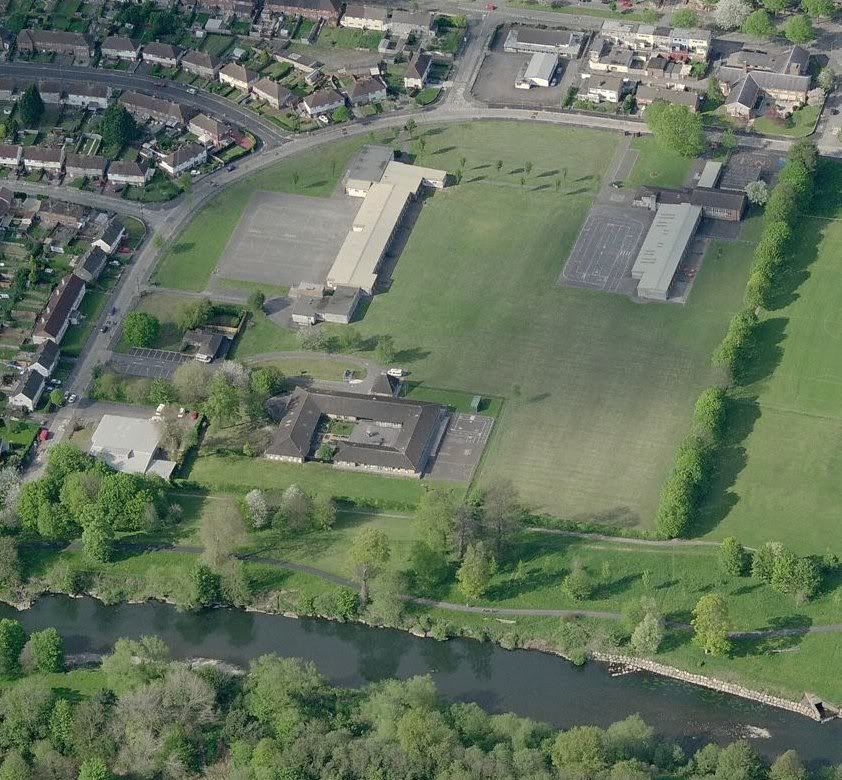
     

Meanwhile, the good news for Gabalfa is that Cardiff Council have now decided [details here] that they want the starter class to become a permanent WM school. As we can see in the picture above, Gabalfa Primary has separate Infants and Junior blocks, and the intention is to convert the Infants block (top right) into a 1FE WM school, leaving the Junior block (top left) as a 1FE EM school. The building in the foreground is a special school. One of the good things about this plan is that the site has an abundance of open space, so in future there would be room to expand the WM provision as the demand for WM places increases.
 

Ysgol Glan Morfa, Cardiff

At the same meeting, Cardiff also decided that they want to increase the age range of Ysgol Glan Morfa in Splott from 4-11 to 3-11, i.e. to incorporate nursery provision [details here]. Cylch Meithrin Gwaun Sblot are providing a nursery in the school on a non-statutory basis, but if the Local Authority step in it will provide a more solid core service, enabling the Cylch Meithrin to use its resources to provide an extended wrap-around service.

-

Of course these positives in Cardiff still leave a number of more long-standing problems in the city such as the Whitchurch reorganization and the future of Treganna/Lansdowne. The second of these is in Leighton Andrews' intray, and what he does with it should provide us with an idea of whether he'll prove to be any good at his new job.

Bookmark and Share

High Speed Wales

A GUEST POST BY PENDDU

There has been lots of discussion over the last year about Britain’s High-Speed Rail network, or rather its lack of one, and there have even been promises made about electrifying the Great Western Main Line from London to Cardiff and possibly Swansea. Ignoring the obvious electioneering and political gamesmanship, this issue has major implications for the Welsh economy, and needs to be looked at carefully.

There have been a number of reports published by various rail lobby groups and there is a report due to be published soon by the UK government, but the most significant one is arguably this one published last month by the Bow Group:


The Bow Group who are a Conservative policy body, and considering that the Conservatives are almost certainly going to form the next UK government their views are particularly relevant.

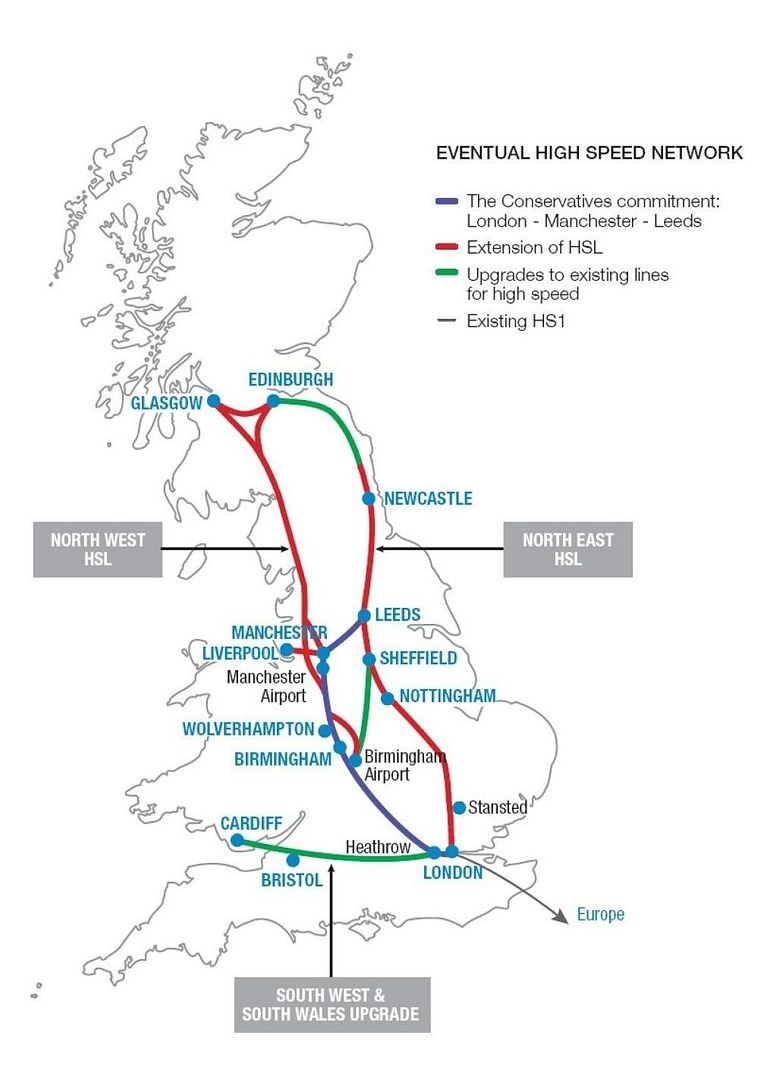
Before considering the Welsh implications in more detail, their report proposes a new High Speed line – HS2 – running from London Euston to Heathrow then on to Birmingham, Manchester and Leeds. The line would allow direct connection to the existing HS1 line to Paris and Brussels, and could be extended later from Manchester to Glasgow and from Leeds to Newcastle and Edinburgh.

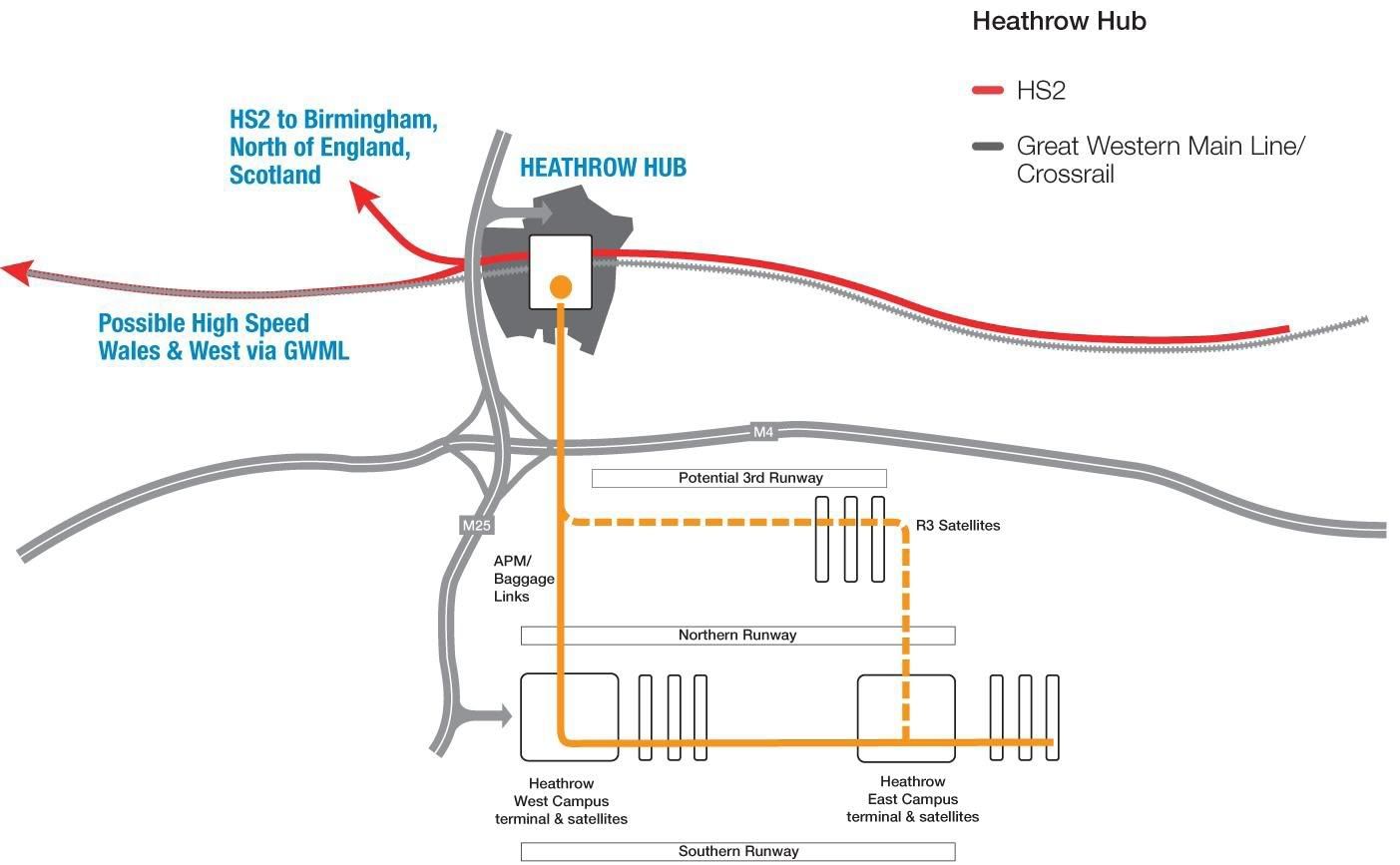
The report comes out very strongly in favour of routing the line via Heathrow, where a major transport interchange would be created, linking HS2, The Great Western Main Line, CrossRail and local services. This station would be situated a few km north of the airport itself, adjacent to the M4 and M25 and with a people mover system used to shuttle passengers from the station around the various airport terminals.

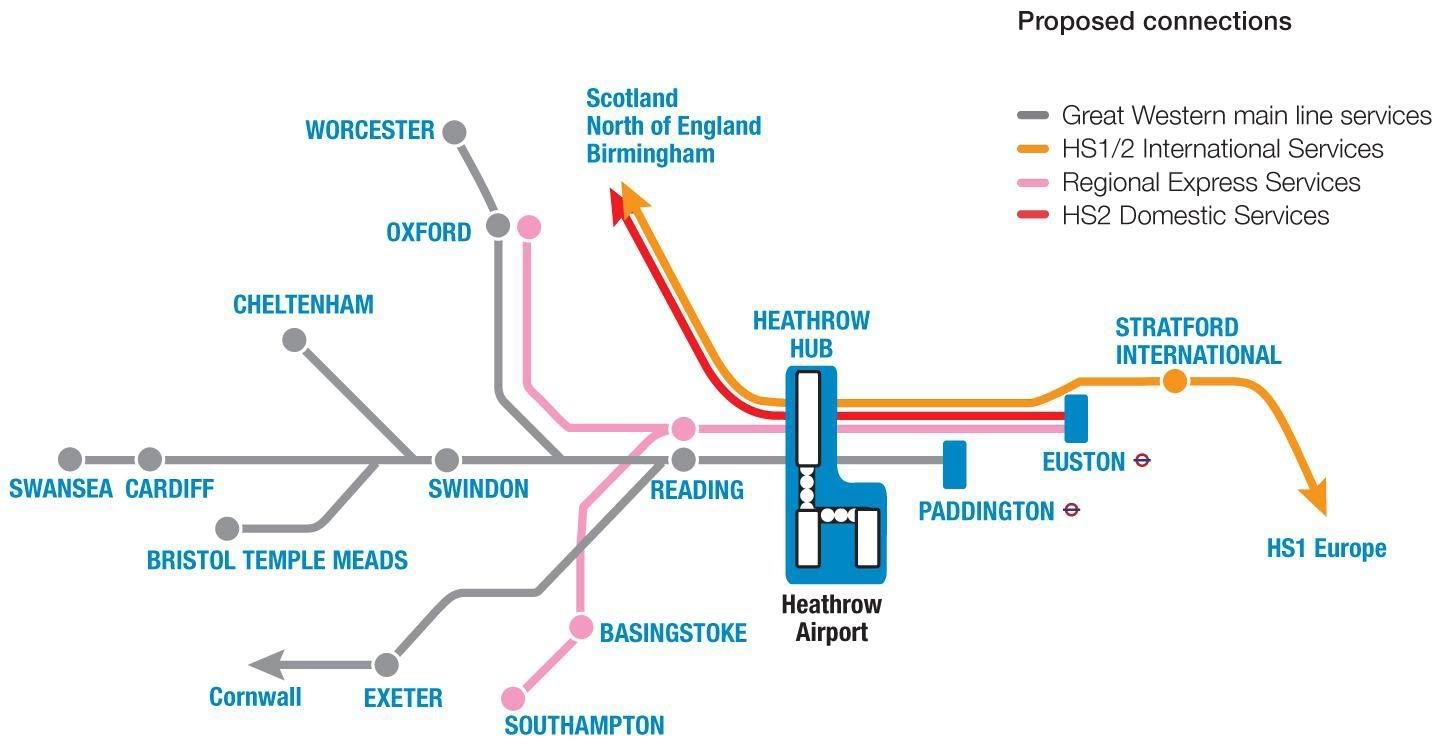
And it is the Heathrow Hub which is key to Wales. As a frequent flyer myself, it is very difficult to get to Heathrow from Wales by train, and many businesses will have chosen not to locate in Wales because of its poor air connections. But simply by locating a HS2 station at Heathrow – adjacent to the GWML, it immediately makes Heathrow more accessible from Wales, reducing the connection time significantly as well as providing an opportunity to connect to international trains with a simple cross platform transfer.

But the report goes further than that – it notes that the GWML is already built to an excellent alignment and could easily be upgraded to a 200 mph capable route mostly by just resignalling, although the Severn Tunnel would remain a bottleneck. It even suggests that a high speed GWML would be completed before the HS2, reducing the Cardiff–Heathrow journey time to as little as 1 hour. This would make South-East Wales a much more attractive location for international businesses.

The report does not make any specific proposals for North Wales, although a station at Manchester Airport is proposed which would effectively become the gateway to North Wales, and we need to ensure that the North Wales railway network can connect directly to Manchester Airport in order to reap the same benefits as HS2 will bring to the South.


For some information and discussion about various other High Speed Rail proposals, please look at this page on the Syniadau Forum.


14:30 - Monday 22 February 2010

MH: These two images from the Bow Group's report show the location of the Heathrow Hub in relation to both the airport and to the wider rail network. Not only would it be easy to get to Heathrow from south Wales (and the south west of England) directly by rail, but it would also be possible to change at the Heathrow Hub to catch a High Speed train directly to Europe.

Passengers from mid Wales would travel by rail to Birmingham, and passengers from north Wales to an interchange just south of Manchester, in order to catch a HS train to directly to Europe.

At present only 27% of journeys to Heathrow from south Wales are made by public transport, either train or bus. 73% of journeys are made by car or taxi. From south west England the figures are 34% and 66%.


Bookmark and Share

Strange ways of thinking

The news that all six Councils in north Wales are in favour of the government building a 1,500 place prison in north Wales amazes me.

     Welsh councils campaign for new prison in North Wales
     Cynghorau'r gogledd o blaid carchar yn yr ardal

As there are only somewhere around 700 men from north Wales in prison, it means that the majority of the future inmates of a 1,500 place prison will be from England. So if the prison is built anywhere in north west Wales, it will mean those English prisoners being as far away from their families and the facilities that will be required to reintegrate them back into society as prisoners from north Wales are now. Of course it is nothing short of scandalous that prisoners from north west Wales are accommodated so far away at present, but why swap one scandal for an equal and opposite scandal?

So the only viable location for a large prison in north Wales would be in north east Wales, close to the English border. Therefore I have to question the sanity of Gwynedd, Ynys Môn and Conwy Councils. Why are they supporting this joint bid when it is almost certain that any prison that is built would be in Wrecsam, Sir y Fflint or Sir Dinbych? No wonder Aled Roberts of Wrecsam is all in favour. And is a prison in north east Wales really going to solve the problem of distance for those in north West Wales?

-

Of course there is one reason why the Councils are falling over themselves to get it. Jobs. I know I won't be popular for saying this, but some jobs come at too high a price. If this Labour government had stuck to their original plans, we would now be building a 600-or-so place prison just outside Caernarfon. That would have been a good solution: it would still bring jobs to the area as well as serving the interests of reducing reoffending.

The main reason why the Caernarfon site suddenly became unsuitable was that it was only big enough for a medium size prison, but the Labour Government in Westminster changed their mind and wanted fewer, bigger prisons instead. Even if there were problems of ground contamination at the Friction Dynamex site that would be expensive to remediate, it should be easy enough to find another site in north west Wales for a 600-or-so place prison ... anywhere along the A55 corridor would be fine, but the closer to Caernarfon the better, because that's where we've just spent millions on a brand new Criminal Justice Centre.

Do the Councils of north west Wales not realize that if a large prison is built in north east Wales, it reduces the chances of getting a prison in north west Wales at any time in the future to precisely zero? For why would anyone build a smaller prison in north west Wales if north Wales already has a prison that is more than twice as big as we need?

It is surely better to let this 1,500 place prison be built somewhere in England, and wait for a government that is prepared to build a prison that suits the needs of north Wales, rather than one that will primarily serve the needs of England.

Bookmark and Share

Virtually no demand for Castilian-medium schools in Euskadi

I came across a story in El Periódico about the language preferences for primary schools in Euskadi (the Basque Country)

Euskadi will not open Castilian-medium classrooms for lack of a quorum

The Basque Government will not be able to open Castilian-medium classes next year due to lack of applications. In the whole of Euskadi, a total of 104 Basque families have requested to enroll their two or three year old children in Castilian in schools that do not offer Model A, in which all subjects are taught in Castilian.

As reported yesterday in The Courier, no school, either public or mixed, received the 20 applications that would bring the opening of new classrooms in Castilian. There is not even a school that reaches a minimum of 15 pre-registrations, the threshold proposed by the Peoples Party [strongly unionist, right of centre].

At the close of the pre-matriculation campaign, there were 728 applications for Model A, a huge gap compared to 4,077 applications for B (bilingual) and 13,436 for D (all in Euskara). Requests for full education in the Basque language are 20 times greater than those for Castilian. Demand for Model A represents only 4% of the total.

El Periódico - 18 February 2010

The translation may not be perfect, but the picture is clear enough. In many respects the language situation in Euskadi is remarkably similar to that in Wales. Euskara is spoken by 25.7% of the population (665,800 out of 2,589,600) although it should be noted that the Basque Autonomous Community (where the schools figures are from) is only one of three areas that make up the Euskal Herria (Basque Country) ... but it is not markedly more Basque-speaking than the other two areas.

In essence, even though only a minority of parents speak Euskara, the overwhelming majority of them want their children to speak it. And of course, just as with Welsh-medium education, children that go to Euskara-medium schools come out being able to speak both Euskara and Castilian, whereas most of those who only learn it as a subject in Castilian-medium schools don't.

-

I'm sure some people will think I am being over-optimistic, but I see this as a pattern of what we should expect to see happening in Wales. We know that in some areas of Wales (Ynys Môn, Gwynedd, Ceredigion and Sir Gâr) most primary education is Welsh-medium, in some cases over 90%. Elsewhere in Wales the demand is far greater than the current provision. Only a few Local Authorities have properly surveyed demand, but I think it would be safe to say that over 40% of parents in Wales as a whole would send their children to WM schools now if there were enough of them, and if they were close enough to where they live.

We also know that because Welsh is so ineffectively taught in EM schools, many Local Authorities are increasing or aiming to increase the amount of Welsh used both in teaching and non-teaching activities. If this trend continues we might well see that EM schools as we know them today become the exception, and that they will become bilingual schools instead. However, this trend should not be used as an excuse not to provide full WM education for those who want it.

-

So how long will it take until we get to the situation Euskadi is in now, with 74% of our own primary education being WM, 22% being bilingual and only 4% EM?

Well, democratically elected devolved government started in Spain in 1978, just over twenty years before devolution in the UK ... though of course the big changing point in education in Wales came ten years earlier as a result of the 1988 Education Reform Act. So I think it's reasonable to expect us to reach figures like these in twenty years, if not ten.

Which of the two it is will depend on whether the political decisions we take now respond to the ever-increasing parental demand for WM education. Two things are crucial: we need to put in place the resources to ensure we have enough teachers able to teach in Welsh, and we need to see more EM schools being turned into WM schools.

Bookmark and Share

Interview with Elfyn Llwyd

Elfyn Llwyd was interviewed by Andrew Neil on Straight Talk last week. As it is no longer available on iPlayer I've taken the liberty of posting it here:


There's one small thing that he got wrong. Crossrail in London is a £16bn project which is being paid for partly by money from Central Government, partly by London businesses and partly by borrowing against anticipated fare income. Although it wasn't obvious at the time of the first announcement (in fact when I talked about Crossrail on the WalesOnline forum I said the same as Elfyn has just said) after a little arm-twisting it was agreed that the portion of the cost funded by Central Government, some £5.5bn, will attract a Barnett incremental for Scotland, as mentioned here:

     Scotland given £500m sop for Crossrail - Evening Standard, 29 October 2007

And confirmed more officially here:

     Select Committee on the Barnett Formula - §44

That means that we in Wales will receive our proportionate share too, about £320m.

Of course, as the Select Committee report confirms, many other projects such as the Olympics are classed as UK-wide money and so won't attract any Barnett consequential. The decision is made by the Treasury and is actually quite arbitrary, rather than based on any consistent rules. So Elfyn's general point is quite valid ...

... and everything else was top notch.

Bookmark and Share

The Grey Cobweb

Believe it or not, I did draft a post congratulating Carwyn Jones on managing to get a slot on the Andrew Marr show on Sunday, and for his rather good toolbox illustration. In the end I thought it was too un-newsworthy, though I did finish it off by saying the question I would have asked is whether he had sent the letter off to Peter Hain.

As we've learned today, he hasn't.

Which says just about all we need to know about Carwyn Jones and why he got his reputation for being so dozy. He's so laid back he might as well be horizontal. I had thought he'd dyed his hair grey in order to follow in Rhodri Morgan's footsteps. Now I realize it's just a cobweb.


Beneath the grey cobweb, there's precious little decisive activity in the grey cells. Nick Bourne was right. Peter Hain is, in the shadows, still very firmly in control of Welsh Labour. It looks like we'll have to wait some time before we get to the N of the Bang.

Just remember that David Cameron has only said he will not stand in the way of the Referendum Order, and that he will give his MPs a free vote. Nobody in Labour will be able to say that they weren't warned when his MPs either vote it down or impose new conditions. Peter Hain will be laughing. He might just get what he wanted all along ... to scupper the referendum for the next ten years.

Bookmark and Share

A Workable Compromise?

As I'm sure we'll remember—and if it's faded we can, as I have, refresh our memories here—the decision to hold three televised election debates between three of the party leaders was seen as unfair to both the SNP and Plaid, and open to legal challenge.

Obviously things have been going on behind the scenes since the announcement was made, and it is very welcome news that Sky now seems to be on the point of inviting Alex Salmond of the SNP to participate in their debate. Jeff Breslin of SNP Tactical Voting picked up the story from Techwatch, though I have to say that I'd be more comfortable if it were to be confirmed from the horse's mouth ... or even if the story carried some sort of quote or reference to back it up.

Nonetheless I hope it is true. It is a step in the right direction (though it would be even better for each participant to appear on equal terms) and may prove to be the basis for a workable compromise in the other two debates. The first debate on ITV and the third on the BBC could be similarly modified to address the concerns of other parties. I would suggest that Plaid Cymru—represented by either Elfyn Llwyd or Ieuan Wyn Jones—is invited to participate in one of these on the same terms as Alex Salmond. All it would take is for one of either ITV or the BBC to make the offer. Perhaps another party such as UKIP could be in the third, though that would be harder to justify because UKIP do not have any elected MPs (Bob Spink was elected as a Tory) if not, the third could be between the three larger parties as originally intended.

It would also be good if one of the debates was held in Wales, one in Scotland and one in England. That may seem hard on Northern Ireland, but politics there is rather too different for the model to fit.

Bookmark and Share