Twitter

I have never understood the desire to tell the world what you are eating for breakfast or that you're just about to walk the dog. Yet—amazingly—it looks like Twitter can also be used for the really important things in life ... such as letting people know when something is posted on Syniadau.

So it now is, just click the button!


Blame Ramblings for goading me into the second decade of the 21st century.

Bookmark and Share

Child Porn?

The circumstances surrounding the departure of Jeremy Colman were strange when first announced, but are becoming stranger. Using a workplace laptop to download pornography is certainly a serious enough disciplinary matter in any organization, and especially a public organization ... but if downloading pornography itself were an offence, then probably half the male population would be guilty of it.

Therefore the news that he has been arrested was rather more sinister, and the Evening Standard in London has today made the specific allegation that he has been arrested for possessing indecent images of children.

     Spending watchdog arrested over child porn

If this is indeed true, then he deserves all that the law can throw at him. However the risk is that by looking only at this man's personal conduct, we might overlook the situation in the Wales Audit Office itself. This is a much more important matter for Wales as a whole.

-

The WAO would appear to be rife with internal difficulties, as reported here, and when the story first broke it appeared to me that the pornography was the straw that broke the camel's back, a convenient pretext to get rid of the head of one of the "factions" within the management structure. But we must not simply assume that because Jeremy Colman himself has gone, everything in the WAO will now be alright. His personal predilections may well—I say that because nothing has yet been proved—be despicable, but that would not necessarily mean that the ideas of his faction in the senior management structure of the WAO are similarly discredited.

I would hope that the Assembly, and in particular the Public Accounts Committee, take this opportunity to do more that simply replace the person at the top. We need to step back and take a long hard look at the way this body is structured and how it does its work.

Bookmark and Share

Ysgol Panteg

Last summer I mentioned that Torfaen had given approval for a new Welsh Medium school in Griffithstown. So I was pleased to see from this announcement in the latest edition of Torfaen Talks that everything has been sorted out with the Welsh Government, and that the school will open in September.

Welsh education is growing faster in Gwent than any other area in Wales

More than 1,600 children are taught through Welsh in Torfaen and a new Welsh-medium school, Ysgol Panteg, is opening in September in Griffithstown, following Welsh Assembly approval.

The 150-place primary school, which will be located at the former Griffithstown Infant School site, will have a nursery unit of 13 places.

Initially the school will open with a reception and nursery class. Parents don’t have to be Welsh speakers to send their children to a Welsh-medium school.

For further information, contact Jackie Watkins on 01633 647343 or jacquiline.watkins@torfaen.gov.uk

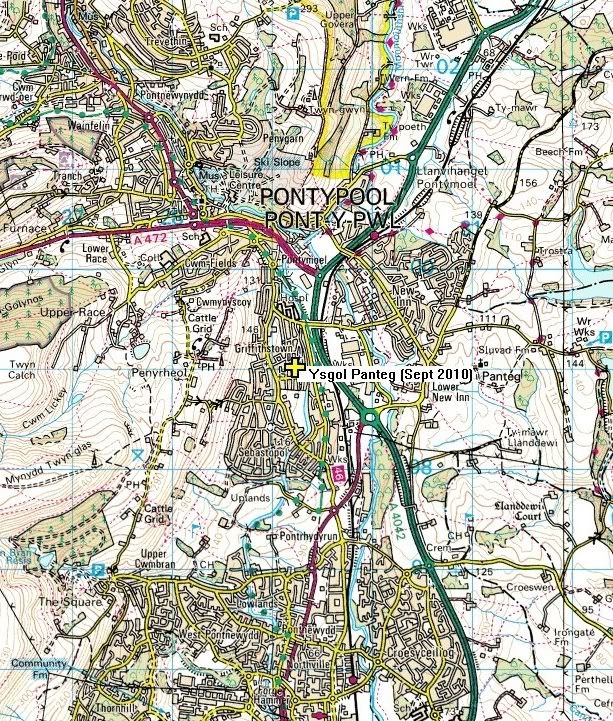
It sounds like a good name. There are at present two Welsh medium schools in Torfaen. Bryn Onnen is just north of Pontypool towards Blaenafon and Ysgol Gymraeg Cwmbrân is in the southern half of Cwmbrân, so this new school fits nicely between them, and should draw in a new set of children who live in the areas shown on this map:


We know from here [4.7] that 81% of people in Wales think it is important that children learn to speak Welsh (only 7% disagree and the rest don't have an opinion) and we also know that—even though Welsh is a core subject in English medium schools—English medium schools usually don't do more than provide a basic grounding in the subject. That means that the best, and of course easiest, way of ensuring that your child grows up able to speak both languages is through WM education. So it's up to you.


And for those who don't live in Torfaen, why not get in touch with RhAG (Parents for Welsh-medium Education) who I'm sure will be more than happy to tell you what you can't pick up from their website. Better to sort things out now rather than leave it until just before September.

Bookmark and Share

I've no idea what anybody's talking about

Don Touhig was always the exemplar of champagne socialism. After twenty years as a Councillor he was rewarded with a safe seat in Westminster, and after a few years made a clear profit of about £200,000 from selling his second home there, a home which had been funded by the taxpayer. Plenty to celebrate.


Don Touhig didn't do a particularly bad job as MP for Islwyn. He was generally competent, a backbencher who touched the fringes of government but was quietly dropped. No different from many other MPs. But he's now decided not to contest the seat again, and he gave his reasons in this interview:


Hold on a moment! Click back to 1:55 and notice how he described his job:

The public at large—if I walk down Blackwood High Street—are more interested in jobs, the economy, health, education, care of their elderly parents ... these are the bread and butter issues that I come here to argue on behalf of the people of Islwyn.

This tells us rather more than he intended about why he never quite made it. He goes to Westminster to represent his constituents on "health, education and care of their elderly parents" does he?

Health, education and pretty much everything to do with care of the elderly are devolved issues. If he really did spend so much of his time trying to get answers on these issues he'd only have been told—politely at first, but more pointedly as the years went on—that it was AMs in the Assembly who had been elected to do that job.

Who knows, perhaps that's why he was so peeved at the creation of the Assembly. It took away his sense of importance. Note the emphasis he put on the word "I" in the quote. Or perhaps he's spent the last eleven years of his parliamentary career in a perpetual state of denial ... refusing to accept that there was an Assembly and going round the departments of Whitehall insisting that ministers with responsibility for things like health and education only in England should treat the residents of Islwyn as a special case.

-

And the same trademark refusal to accept reality would also explain why, when asked about possible involvement in the referendum campaign, he shook his head and muttered "What No campaign?" followed by a rather too emphatic "I've no idea what anybody's talking about."

Perhaps it is better to leave people with the impression that you are a political dimwit who doesn't have a clue about what is happening in Wales. What's the alternative? You wouldn't want people to think that you were lying through your teeth, would you?

But time will soon tell us whether you were.

Bookmark and Share

A finger of fudge is just enough ...

A GUEST POST BY MADOC BATCUP

Madoc Batcup is an independent financial consultant, with interests in structured financial products and in the environmental industry. He has also served as a member of the National Association of Pension Funds’ property advisory committee.

Madoc is a law graduate of Cambridge University and of the Institut d’Etudes Européennes in Brussels. Prior to becoming a financial consultant he worked for the investment banking arm of Swiss Bank Corporation in both London and Tokyo.

He is also Director of Wales in London.

 
The recently announced agreed takeover of Cadbury’s by Kraft has been greeted (if that is the right word) with a sense of disbelief that the venerable maker of so many brands of indulgence tailored to the British taste should have become the property of others. Cadbury, a firm founded by Quakers, has a proud history of having a mission of fair play both towards its customers and its workforce. The housing it created for its workforce on the Bourneville estate was and is a powerful symbol of a more caring approach to capitalism. However since the members of the Cadbury family gradually sold out their shareholdings in the company that bears their name the company has increasingly been run along lines similar to those of any other large multi-national corporate, and only a comparatively small part of its workforce is now actually located in the United Kingdom.

The future of Cadbury, like many of its products, will no doubt result in large chunks being taken out of it after a limited shelf life, and the company’s operations in the UK will doubtless be deemed to be past their sell-by date in the not too distant future. Despite all the sweet words, the finger of fudge is in effect a very large raised American middle finger of one hand. In the other hand is some £12 billion to buy all this comfort food.

The sale of such a familiar name is a jolt and it has highlighted in an unsettling way the unpalatable truth that the purchase and sale of companies even with such iconic brands and history as Cadbury is a decision purely for the shareholders of a company, and comes down purely to price; it is a matter solely for the owners of the equity in the company concerned.


This feeling of unease that this is not the way that things should be done is not unfounded. The example of Cadbury is just one of many thousands of mergers and acquisitions that are happening all the time in various countries and on differing scales. It reflects a very deep schizophrenia in the developed world; a contradiction that we do not care to dwell on. A situation that has been well and truly fudged. It is symbolic of the wider issues of the current economic crisis. In looking at the near collapse of the banking system and the growing inequality in our society, highlighted by the bankers’ bonus issue, the fundamental tenets of capitalism are being questioned. The governments of the developed world proclaim loudly that they are firm believers in one person one vote, indeed they urge this system of governance on other countries, but in the case of companies they turn a blind eye to the fact that they are run on the basis of one pound one vote. In the civic sphere we believe in democracy, but in the corporate sphere we accept the purest form of plutocracy ever devised by mankind. The fate of Cadbury was sealed by a vote of the money. No-one else got a look in. A short period before accepting Kraft’s offer the chairman of Cadbury commented that Kraft hadn't been good at integrating deals, hadn't been good at improving their own results. Perhaps he was only saying it to talk up the price but if he was right, the current shareholders will have sold their shares at the right time and condemned the employees of the company in the UK and elsewhere to a very uncertain future in which they have had no say.

This is really the reason why there is an underlying concern about capitalism – it is controlled by money, and yet we continue to celebrate the triumph of democracy in government. Corporate capitalism is a strange bedfellow for democracy, not only is it wholly and deliberately undemocratic, but it doesn’t even work. This system of plutocracy masquerades under the description of ‘shareholder democracy’, but it has little to do with most shareholders and nothing to do with democracy. The collapse of Enron highlighted the fact that shareholders have little effective control over the management of large companies, and even when there is supposed to be some ‘shareholder’ control, this is often shorthand for insurance companies and other institutional investors rather than the individuals who are the ultimate beneficial owners of the shares.

Corporate capitalism is so entrenched in our society partly because of historical accident and partly because it is not communism – which is taken to be the only alternative and shown to be unworkable. But this is a false dichotomy. The real choice to be made is between democracy and plutocracy, between control by people and control by money. Not only is the voting control mechanism of a company completely alien to the principles of democracy, but it undermines faith in democracy. As citizens (or at least as subjects in the UK) our vote gives us the right to throw out governments which have lost our confidence. No such rights exist in companies. On the contrary, while management can show their lack of confidence in the workforce by sacking them, the workforce has no way of showing confidence, or lack of it, in their management.


If we really believe in representative democracy as a way of groups making decisions then it should be applicable in the commercial sphere as well as in the civic sphere, particularly in respect of large companies. The employees of a company should be entitled at the company’s Annual General Meeting to have a confidence vote in the board of directors, and the right to replace them if they feel they are not managing the company effectively. This would revolutionise the relationship between management and workforce: not only would management feel the need to keep the workforce much better informed about how the company was faring, but they would have to justify their salary levels to their colleagues and co-workers – perhaps a more difficult task than to a remuneration committee. In a system comparable to representative democracy in the civic sphere the workforce would have no rights to manage the company, any more than the electorate has the right to run a country, but they would have the right to hold the board of directors to account in the same way that governments can be voted out of office. This would give the workforce no rights to the profits of a company, the commercial rights of ownership would remain as before, but it would make the management accountable.

The origin of the word company is the Latin words ‘cum panem’ meaning literally ‘with bread’ and implying a group of people with whom one shares bread. If management and workforce alike considered themselves as ‘companions’ instead as employer and employee, then their working relationship might become more collaborative and less contentious. The John Lewis mutual model shows that a business can be run efficiently when employees have a say, but this way of working is not restricted to a mutual framework. By giving the workforce the right to vote at AGMs and the power to agree mergers and acquisitions, the way in which companies are managed could be transformed.

2010 is the 400th anniversary of Sidereus Nuncius, or the ‘Starry Messenger’, the work published by Galileo which as a result of his observations of the moons of Jupiter reinforced the idea that the earth went round the sun rather than vice-versa. The Catholic Church subsequently forced him not to publish further research on the subject, and when he was finally allowed to publish his view that the earth went round the sun he was forced to recant. In this anniversary year it is time to consider that the orbits of the business system should also be viewed differently, heresy though this may seem, and that in the future instead of labour revolving around capital, capital should revolve around labour.


This article can be downloaded as a pdf from here.

Bookmark and Share

Is this a parallel I see before me?

The Grauniad was going to print a story about the referendum on primary lawmaking powers for the National Assembly yesterday, but some copy editor in London got hold of the wrong end of the stick and changed it.

I've just been sent a copy of the original version, with the editor's corrections:

Brown promises to push through law before election
to pave way for referendum


Gordon Brown vowed today that he would overcome a daunting timetable to force through a law in the next two months requiring a referendum to be held on primary lawmaking powers for the Welsh Assembly changes to the voting system for the Commons after the election.

After weeks of delay and tactical disagreements inside the Welsh Labour Party cabinet, Brown staked his authority on committing his party not just to a referendum on primary lawmaking powers the alternative vote, but also to making the law introducing the referendum a legislative priority in the remaining six weeks of parliament before the election is called.

In the One Wales Agreement his autumn conference speech, Labour Brown promised a referendum on primary lawmaking powers AV, but at the last minute excised a commitment to pass a law setting a date for a referendum after the election. The referendum will now be held by October 2010 2011, the prime minister announced today ...

Guardian Recycling Bin - 2 February 2010

We know that Peter Hain is all in favour of AV, and that he will therefore be instrumental in pushing the legislation on a referendum on the Alternative Vote through Parliament before the Westminster election.

But will he pull his finger out and do the same for our referendum?

Bookmark and Share

The B of the Bang

It was Linford Christie who said that a sprinter had to be ready to start running not on the Bang, but on the B of the Bang. But things don't quite work that way in Wales. The starting pistol has been fired, but our Bang is going to be a rather more protracted affair.


Motion: To propose that the National Assembly for Wales:

resolves, in accordance with section 104(1) of the Government of Wales Act 2006, that a recommendation should be made to her Majesty in Council to make an Order in Council under section 103(1) of the Act.

As we can now see, the motion to request a referendum on primary lawmaking powers does not make any mention of the date, the wording of the question, or anything else. I have already said that I think this is ludicrous, because there is nothing in the Act itself that limits the request the Assembly can make. The reason that there is no mention of the date is therefore only because the Welsh Government still wants to "keep the options open". We need to ask why that might be.

To be blunt, I would say that the Welsh Government (and I include my own party as part of that) is playing political games with the two opposition parties in the Assembly, since we know they would have no hesitation in making the vote on the referendum motion unanimous if a date in October 2010 had been part of it. Why sacrifice the enormous symbolic victory of a unanimous vote in order to play games?

Yes, it does seem that the LibDems will join Labour and Plaid in voting for it. Reluctantly and with reservations perhaps, but they simply cannot vote no (or abstain) on an issue that they have been so unequivocal about for so long. It would be political suicide for them.



So we've reached the B, and as it will be a few months yet until we get to the G we should celebrate this milestone. It has taken a lot of effort to get this far, and it is a major victory for all of us who want to see the referendum. Some of us have wanted to see it from the moment the compromised and flawed GoWA was passed in 2006, others have needed a lot more persuasion. For me, in more posts on this blog than I care to count, the big battle has always been to persuade a very sharply divided Labour Party that it was in Labour's own interests for the Assembly to get these limited lawmaking powers. Labour's AMs were largely in favour, but many of their MPs were against it. The majority of those MPs have now been brought round. The prospect of losing the Westminster election this May has been the decisive factor in that change of attitude, since Labour know they cannot afford to let a Tory Secretary of State for Wales have the same veto over any new areas of legislation as their own Secretaries of State have been able to exercise.

We may not like it, but the simple political reality is that parties will only do things when they are convinced that it is in their own interests to do so ... or at least that doing something will not harm their interests. No matter what arguments we put forward in terms of the constitutional settlement for Wales, or in terms of democracy, accountability and transparency of government, we could not have reached this point until Labour (since they are the biggest party in the Assembly) had come round.


So now it's time to move on and focus on the next stage. We know that we're going to get a referendum, but we have work out when it will be.

It will come as no surprise that exactly the same considerations will apply. On the one hand we will have arguments based on principle, but on the other hand the date will be decided according to what is in the best interests of the Labour Party. I want to look at both in turn:
 

In principle

The only real issue here is whether it is right to hold the referendum on the same day as the Assembly elections in May or not. I think there are good arguments both ways.

In favour: Holding the vote on the same day is almost certain to increase participation. Although a majority Yes vote on any turnout will be legitimate, we need to face the fact that this is a referendum on a relatively minor technical point, and that most people in Wales will be far more concerned with what the parties are going to do if they form the next Welsh Government than the procedures necessary to pass the laws that will enable them to do it. There is a very real possibility that overall turnout will not reach 40%

Against: Holding two separate votes will keep the two issues completely separate. It will enable those in each of the Yes and No campaigns to campaign together, even though the policies they would pursue if the Assembly did (or indeed did not) have primary lawmaking powers would be different.
 

In practice

Politicians are politicians, and we should all know by now that politicians are capable of highlighting their points of principle, even though they may have more immediate pragmatic reasons for adopting a particular position. In this case, the key issue is the way that each party's own supporters are likely to vote in the referendum, and we have a good idea of how things are likely to break down from this YouGov poll published in October last year:

YouGov/Aber Poll
Assembly voting intentions (FPTP)

Lab ... 32% ... split 43% - 40%
Con ... 25% ... split 33% - 54%
Plaid ... 24% ... split 74% - 13%
LD ... 12% ... split 36% - 44%

This gives Yes percentages of:

Lab ... 43% of 32% = 13.8%
Con ... 33% of 25% = 8.3%
Plaid ... 74% of 24% = 17.7%
LD ... 36% of 12% = 4.3%

It should be noted that these figures are based on Assembly voting intentions. The figures are slightly different for Westminster voting intentions, as I examined in this post. For each party, the situation is slightly different:
 

Plaid Cymru

From our point of view, we are in the happy position of being able to carry a very significant proportion of our voters with us on the referendum (on Westminster voting intentions we carry even more). All our politicians want a Yes vote, and a very big majority of our supporters want the same thing. That means that it will be very easy for us to campaign for a Yes vote in the referendum at the same time as campaigning for the Assembly elections. There will be no mixed messages.

But equally there will be no harm to us if the two campaigns are completely separate. We have no axe to grind either way.
 

Liberal Democrats

In one sense the LibDems are in the same happy position. All of their politicians will be united in campaigning for a Yes vote, so there will be no mixed messages from them either.

However the LibDems are in the rather strange position of having supporters who are generally against primary lawmaking powers. This is a conundrum that I think even they would find difficult to explain. I have always been perplexed by precisely what it is that makes someone vote LibDem ... but it seems to me that the two biggest planks of their political identity are electoral reform and a federal United Kingdom in which the majority of powers are devolved from Westminster to Wales, Scotland, NI and the regions of England, leaving only matters such as defence foreign affairs and monetary policy in the hands of the UK government.

The LibDems' dilemma is that if they major on what their politicians and activists believe, they risk alienating the majority of their support and would therefore loose seats. That, to my mind, is the primary practical reason why they do not want the referendum on the same day as the Assembly elections.
 

Conservatives

We all know that a majority of Conservative supporters are against primary lawmaking powers for the Assembly. What is perhaps surprising is that the margin of difference is so small. As I noted before Peter Hain is under the delusion that all Tory supporters will vote No, but this is very far from being the case.

If the referendum is held on the date of the Assembly elections the Tories will find themselves in a very awkward position. Even though nearly all their AMs are likely to press for a Yes vote, all parties rely on their other elected politicians to pull their weight in any campaign. Their MPs are all very solidly in the No camp. It is this prospect of a split in their ranks that most concerns the Tories, and with some justification. They know there is no way that they can keep a loose canon like David Davies quiet on the issue. For people like him the Assembly is a side show compared to Westminster, and he would in fact relish the chance to widen any split between pro and anti devolution Tories.
 

Labour

At first glance it might seem that the situation for Labour is the same as that for the Tories, because the poll shows that Labour supporters are fairly evenly split between Yes and No ... though marginally in favour of a Yes. But it isn't quite like that.

The big thing that has changed since the poll was taken is that Labour have fought their battles out behind closed doors over the Christmas/New Year break and have now reached an agreement. Make no mistake, we would not be having this trigger vote next week unless the two Labour groups had put their differences to one side. Now of course there will be a few Labour MPs and Councillors who cannot accept this, and Labour's leadership will of course have asked themselves how to minimize any damage that could be done to the party if this became open warfare.

If the referendum was to be held on a different date to the Assembly elections, there would be nothing to stop the Labour refuseniks campaigning for a No vote in the same way that Kinnock and Crew did before. They know that such actions would not damage the party all that much, because they can patch things up in order to fight the Assembly elections on a united platform after the dust has settled. They know full well that the media would give a them a lot more publicity than their numbers warrant because the media like highlighting differences ... and what politician in a minority position would not want to raise their media profile?

-

So let me ask you, if you were in the Labour leadership, what would you do? Simple, if you hold the referendum on the same day as the Assembly election, you minimize the chance of dissenting voices within your own party being heard, since the small number of refuseniks are not likely to send out a message that weakens their own chance of holding onto Labour seats. In fact, Labour would also benefit in two other ways: first they know that the Tories will be hit harder by splits that they cannot avoid, and second it will help their bank balance. Labour are going to spend a lot of money trying to hold onto their seats in Westminster this May, they will then be faced with spending money in Wales for the Assembly elections next May, so the very last thing they want or need is to spend money on a separate referendum at a date between the two.

At first glance it might seem that finance is a factor that will affect all parties equally, but not so. We in Plaid are in the happy position of being able to concentrate resources on the four seats we expect to win at Westminster and save the bulk of our money for the Assembly elections, and the Tories have got rich backers coming out of their ears. That means Labour will be hit disproportionately harder, and that gives them a financial incentive to hold the referendum on the same day as the Assembly elections.

-

But the most important factor in Labour's decision about the date will be the way they intend to campaign for a Yes vote in the referendum. Labour know that it will be difficult for them to win their supporters over on the grounds of constitutional principle alone, not least because those are the very grounds on which they were previously divided. They also think that the rights and wrongs of the devolution settlement will be lost on most of their supporters. Labour are only really happy when things are reduced to their most basic level and the battle cry that comes easiest to them—as we hear repeated by Peter Hain on every occasion he opens his mouth—is "It's either us or the Tories."

Labour will calculate that they can deliver a Yes vote in the referendum more easily by making it another "us or the Tories" issue. They think that the benefits of getting the "other half" of their supporters to vote Yes because it will spite the Tories will outweigh any lost votes from Tory supporters that would have been inclined to vote Yes. The sad fact is that if their supporters can be won by arguments like that, the electoral maths is on their side. But I think that is an insult to their intelligence ... which is why fewer people vote Labour at every election.


So how do I react to this? With mixed feelings. I want to see a Yes vote more than anybody, but I want to see a Yes vote primarily for the sake of Wales and its future ... not for the sake of Labour's electoral advantage. I'm not sure how easy it will be to get that message across if the campaign is fought that way. I would find it easier to campaign for a Yes vote alongside those in the Tory and Lib Dem parties who want to put right the dog's breakfast of a devolution settlement that Labour landed us with because it is not right in principle that we should have executive power devolved to ministers in Wales, without also having a legislature with actual legislative powers that can hold those ministers to account by changing the way things are done rather than just changing the minister who makes the decisions.

I would love to see a united Yes campaign fought on the fundamental constitutional issue that we in Wales are no less capable of passing laws for matters that affect only Wales than the people of Scotland and Northern Ireland are. It is always better to fight for what matters in a way that unites people across the political spectrum, rather than by playing one party against the other. But I suspect Labour have other ideas.
 

Bookmark and Share