Final thoughts on electrification

There's been an interesting exchange on Alwyn ap Huw's blog about electrification. He regards it as a bad thing and, in the subsequent discussion, it seems that some people think that the money spent on the line in Wales (say £250m of the £1.1bn) would be better spent elsewhere ... particularly on improving north-south links.

There's something to that. If I were to be handed £250m to be spent on transport in Wales, I might well decide that it would be better spent on improving other aspects Wales' rail network such as reopening old routes. But that choice was never open to us. The UK government has made the decision to use UK money (Railtrack is essentially a public entity) to electrify the UK rail network. After that, it was just a question of which lines they would do first.

I read through the DfT's document:

     Britain's Transport Infrastructure: Rail Electrification

One diagram in it particularly struck me:
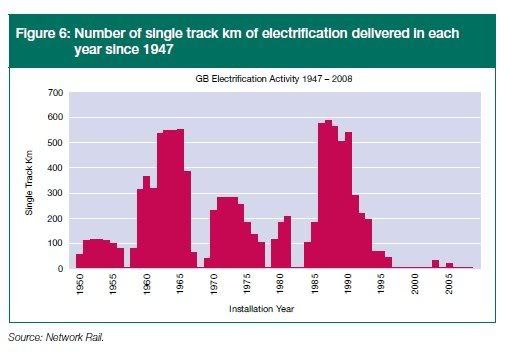
   

It shows that Britain has had several "spurts" of electrification since the 50s, but that since the 90s there has been virtually no investment in electrification. It is hardly a coincidence that 1993 was when the rail network was privatized under John Major. Perhaps it is not so surprising that the standards of maintenance also fell after privatization, and were a factor in a number of rail accidents. Since Potters Bar in 2002 there has been a real effort to improve maintenance for safety reasons, and safety standards are probably back to where they should be. So now it is a question of making up for the fifteen year delay.

Electrification pays for itself; mainly in reduced maintenance costs for both trains and track. So although it costs money to do the work it will be recouped in about 40 years. Of course if we were to have a carbon pricing scheme (as we almost certainly will) there will then be additional savings in cost. Also the saving in journey times will give a proportionate increase in overall capacity.

That really does make electrification a no-brainer for most main line routes, and for shorter distance commuter routes. It is just a question of what order the lines are done in. We were in fact lucky to be chosen. The business case for the Midland main line to Sheffield was stronger than for the Great Western, and we managed to jump the queue. That can only be down to good negotiating skills.

The question now is whether a future UK government will turn these two projects (GWR and Liverpool-Manchester) into a rolling programme to cover the Midland main line, the GWR to South West England and Cornwall, our North Coast line to Holyhead and the cross country routes that do not radiate out from London.

-

I'd also like to draw people's attention to what could be a serious potential problem over the route west of Swansea. Many of us will want to ensure that direct trains will be able to run to Carmarthen and Fishguard. Part of the reason for making this decision on electrification now is to do with the new trains that will replace the old HSTs. That decision is pretty much finalized, and the new trains will be the Hitachi Super Express from a consortium called Agility Trains.


     Technical Specification

Nice video. Bright shiny new trains. But the carriages will be longer, so there is a question mark over whether they will be able to go round the tighter curves.

     Better trains could be worse for West Wales
     Western Mail, 25 February 2009

I'd guess the question must have been answered for the route as far as Swansea, but I have not heard anything regarding the route west of Swansea, or the alternative routes such as the Vale of Glamorgan line. I hope someone has got it in hand, because any structural modifications required will be expensive and take time. If anyone has any information, please let me know.

-

Anyway, in conclusion electrification is just making a sensible and long overdue decision about the rail network we've already got. In the long run it is simply cheaper to electrify this line than not to electrify it ... and the same will be true of the rest of the network in due course, including the existing lines in Wales. Because it is a sound, commercially justified decision, it should make no difference whether Network Rail or the Welsh Government borrows the money to do it.

To my mind, the real test of our vision for what we want as a nation is to reopen closed routes and open up new routes to give Wales a properly integrated rail network that works on a national and local level. Welcome as it is, we must not regard this investment as a substitute for the additional investment necessary to expand the rail network in Wales.

Bookmark and Share

L'Éminence Noire

John Dixon posted this picture from Friday's Western Mail on his blog and, of the suggestions for a caption, I think his own was probably the best:

Not so fast you two. I'm in charge here!

Yes, it was the Labour roadshow arriving in Cardiff before fanning out for a series of horribly over-choreographed photo opportunities, culminating in a cabinet meeting in which I'm sure the main subject of discussion was how well they'd each come across on the evening news.

The joke is that Peter Hain might well be doing his best to hold things in Wales back, but when his bosses sweep into town, he's very much shunted into the background.

But who are his bosses?

Well, Gordon Brown and Alistair Darling, obviously. But there is a much more formidable presence floating in the creaking, shadowy hulk of the Labour government at Westminster. More than just an Éminence Grise, the Prince of Darkness demands a darker epithet. He was at the GEAE factory near Caerffili.


Now if anyone can work out a masterplan to take Labour through to next May's election, it is Peter Mandelson. That's what he was exhumed—yet again—from the political grave to do. He strikes fear into all those who would dare oppose him. Which explains why he's a force not to be messed with ... and, on the other hand, why he's completely unelectable.

So it was with some interest that I read what he had to say about Wales in the Western Mail.

Mandelson praises Welsh measures to fight recession
 

WALES has blazed a trail for other parts of the country to follow in its response to the recession, Labour powerbroker Peter Mandelson said yesterday.

Baron Mandelson of Foy and Hartlepool—who staged a dramatic political comeback last year when he was recalled from the European Commission to play a leading role in Gordon Brown's Cabinet—also paid tribute to First Minister Rhodri Morgan.

Mr Mandelson, who holds the title of First Secretary of State, Secretary of State for Business, Innovation & Skills and Lord President of the Council, said the people of Wales should be free to decide if the Assembly should gain law-making powers.

He singled out the Assembly Government's anti-redundancy ProAct initiative for praise, saying: "I think the Welsh Assembly Government has been on the front foot during the recession—both in using innovative measures like ProAct, which we don't operate elsewhere in the UK, but also in delivering more pragmatic assistance to businesses to help them get through the severity of the recession. They have seen the threat, they have taken it seriously, they have responded and I think they have provided a good model for other devolved administrations."

When asked whether the picture of devolution which exists across the UK resembles what was envisaged when Labour took power more than a decade ago, he said: "Devolved government works best when it's flexible, when it's fast and when it's able to spot opportunities and pursue them. It's very important layers of Government don't get in the way, that officialdom backs up ministers in their desire to act quickly.

He paid tribute to the First Minister, who is expected to step down later this year, saying: "He's been a very important figure in bedding down devolution. He is a man of strong conviction and strong commitment and is an entertaining character, and that's a good combination."

When asked if he wanted to see Welsh devolution move towards the Scottish model, he said: "I can't comment on that because it's really up to the people of Wales to choose how they want to see devolution evolve in the future. The first thing we need to do is take our cue from them and not tell Wales what it needs."

Now, what are we to make of this? I can only read it this way:

      Labour have decided to let us have the referendum
      on primary lawmaking powers.

My reasons for thinking this? Look again at the two pieces I highlighted:
 

First, no-one says, "the people of Wales should be free to decide if the Assembly should gain law-making powers" unless they are going to allow the people of Wales to actually vote on the issue. As I have said on several occasions, the All Wales Convention was set up as a way of taking the question of a referendum off the political agenda until Labour could come to a united position on the issue.

The Labour Party now know that it will take a miracle for them not to lose power in the next Westminster elections. The leadership has come to realize that it is better that they remain in government and are able to carry through their programme in one part of the UK than it is for them to be in opposition everywhere. The only place where they have a hope of being in that position is in Wales.

For Mandelson, the issue is not clouded by issues of electability. He does not have to look at it through the eyes of Labour's Welsh MPs. Yes, they personally are likely to lose out if primary lawmaking powers are transferred to the Assembly from Westminster, because it will mean that the number of Welsh MPs will be reduced ... as was the case when Scotland was given lawmaking powers (... note that this is a separate issue from the general reduction in the size of the Commons currently being floated by the Tories).

One of the reasons many Welsh Labour MPs have been so opposed to this transfer of powers is because they want to control the lawmaking process in Wales for themselves. However, even if Labour get a majority of the 40 Welsh seats (which is still quite likely) the Welsh Affairs Select Committee will reflect the size of the parties in the House of Commons as a whole; so they will be in a minority and therefore will not be able to impose their will on the LCO process in the way they currently do. It takes an outsider to see what Labour's Welsh MPs, whose blind spot is their own self-interest, cannot be expected to see. The decision therefore lies with the Labour leadership in Westminster.
 

Second, Peter Mandelson is most definitely heaping more praise on the Assembly and Rhodri Morgan than it would be reasonable to expect. Especially over something like ProAct.

But the key is in the language. Peter Hain's almost constant refrain when asked about the referendum is that the new arrangements need "time to bed in". Even a month ago he was talking about it being ten years or so before he wanted to see a referendum. But Mandelson has chosen his words very precisely. He said, talking about Rhodri Morgan, "He's been a very important figure in bedding down devolution."

Mandelson is clearly saying that he thinks devolution has "bedded down". Perfect tense. Completed action. The process of bedding down is now over. The Welsh Assembly is making good use of the powers it has.

-

But, as I've said before, Hain is personally too close to the issue to be able to see things objectively. The GoWA 2006 was his "baby". If he's going to be remembered for anything in his political career, he wants to be remembered for this. After all, what else is there? That's why he was so keen for it to last for "a generation or more" ... as he used to say before he reduced it to a decade.

When all is said and done, Peter Hain is a minor figure on the wider stage of British politics. He may regard himself as a big fish in a small pond, but it is not he who will make the decision about whether Wales gets a referendum on primary lawmaking powers.

-

The real decision makers in Labour have now spoken. The only way they can be sure of getting the referendum is to get it through the Assembly and Westminster before next May's general election. Because once the Tories get in, they might be in for ten or fifteen years, and a Tory Secretary of State for Wales would be able to veto every area of new legislation the Assembly would want to put through.

The point is this. Even though they will be in opposition at Westminster, Labour's leaders will want to be able to point to the good things that are happening in Wales as a way of embarrassing the Tories ... in exactly the same way that the Tories have benefited from having Boris Johnson as Mayor of London. You need to be in power somewhere in order to shine a spotlight on something. Otherwise it's nothing but empty talk.

Make no pretence, this is more a matter of what Labour see to be in their own self-interest than in what is good for Wales. But should I care? All I want is for Labour to let us have the referendum ... for I have no doubt that we will vote "Yes" when we get the opportunity to have our say.

Bookmark and Share

Holtham - The next stage

The Holtham Commission's first report was an impressive piece of work, setting out clearly why the Barnett Formula ought to be scrapped in favour of an allocation based on need ... a situation which already applies to the regions of England.

However the Commission said that—as an immediate short term measure—any money Wales is due to receive in future as a Barnett consequential should be modified by a factor of 1.14 pending a long term solution.

But this was only the first part of the Commission's task. The second part is to take a wider view about how Wales is financed. This will include looking at assignment of taxes, the ability to set or vary the rate of taxes, and the ability to borrow. The Commission will also have the advantage of seeing what the Calman Commission recommended for Scotland ... especially since the UK government's response to those recommendations has been positive, so that a good case can therefore be made for Wales to get similar fiscal responsibility.

This article was in the Western Mail last Friday, although not on the WalesOnline website:

Review of public spending vital for a devolved Wales


     Gerry Holtham, chairman of the independent commission
     set up to look at the funding of devolution in Wales,
     discusses the next stage of the commission's inquiry.

 
EVERYONE should know by now that public spending in the UK is likely to be under the cosh in the next few years. Less well-known is that the basis on which public spending is shared out among the nations of the UK could be in for a radical change.

For 30 years, the UK Government has made an annual block grant to finance each of the devolved administrations in the British Isles - Scotland, Wales and Northern Ireland. The relative sizes of those grants derive from what they happened to be when the system began in the late 1970s. Those baselines are linked to the present situation by the operation of the notorious Barnett formula.

Over the past decade, this system has delivered significant absolute increases to the Welsh budget as public spending grew fast UK-wide. However, Barnett has, over time, resulted in a “squeeze” on the relative resources available to Wales, reducing the gap between what's available for us to spend per head on public services in Wales and what is spent in England on comparable activities.

If left unaltered, the Bamett formula will cause spending per head in Wales to move ever closer to the average spending per head in England, irrespective of whether or not needs in Wales are also converging with those of England.

-

Last year, the Assembly Government set up an Independent Commission on Funding and Finance to look at that situation. Our first report, recently published, proposes a number of changes.

Spending per head varies substantially (and quite rightly) across English regions, with areas of relatively high need receiving extra resources.

Why should Wales be treated any differently?

There is no rationale for any further convergence in public spending per head in Wales towards an English average. We argue for a new needs-based formula to take over from the outdated Barnett approach.

A House of Lords Committee has also recently reported on the Barnett formula and has come to similar conclusions, which may give another push to reform.

-

But introducing a needs-based formula could be complex and will take time. Any durable settlement based on needs would have to be implemented as part of a comprehensive reform encompassing all the devolved administrations, not just Wales.

In the meantime, we have proposed a simple modification to the Barnett formula that would place a floor under the Barnett squeeze in Wales and that could be implemented in advance of wider reform.

-

However, changes to the Barnett formula are, not the only reforms afoot. The Calman Commission, set up by the Scottish Parliament and backed by the UK Government, has accepted that in future the block grant should be determined by relative need. The Commission has called for widespread taxing powers to be devolved from Westminster to the Scottish Parliament. Among other changes, UK income tax in Scotland would drop from 20p to 10p and the block grant would be cut by the lost revenue.

The Scottish Parliament would get the power to decide whether to set a "Scottish rate" that would put the 10p back, or alternatively to set a rate that was higher or lower than 10p, with its budget affected accordingly.

Over the coming months, our Commission will be considering the case for devolution of tax and borrowing powers to Wales. The work of the Calman Commission in Scotland is relevant to the debate in Wales. Of course, the constitutional, economic and social circumstances of Wales and Scotland differ and what is appropriate for one country need not be for the other.

On the other hand, there is no reason to assume that Wales should always have less discretion or autonomy than Scotland. This is a matter ultimately for the Welsh public through the political process.

As we consider the case for Wales to acquire the ability to vary taxes and enhance its borrowing powers, we welcome and invite input from everyone in Wales, expert and non-expert alike, that will help us to clarify the judgements that Welsh politicians must soon make.

Information on the call for evidence issued by the Independent Commission for Funding and Finance for Wales can be found at walesfundingreview.org

So, why not do what the man asks? Tell the Commission why you think Wales needs to have more fiscal responsibility. We have until 31 October to submit evidence.

Bookmark and Share

Usury

Usury: The practice of lending money and charging the borrower interest, especially at an exorbitant or illegally high rate.

Two unrelated stories that caught my eye earlier this evening cry out to be brought together. The first was the news that Credit Unions in Wales are to get a boost of £750,000:

     Credit Unions land £750k funding - BBC, 22 July 2009

The second was this feature from Newsnight:


We live in a widely unequal society and, in spite of the stated intention of some of our politicians, the gap between rich and poor is not decreasing. One of the reasons for that is access to affordable money. If you aren't in a job, or don't have enough savings, or have any sort of bad financial history you—especially now that the credit crunch has taken hold—get relegated to what can only be described as an economic underclass.

It then becomes expensive to make the sort of financial transactions that the better off among us take for granted. Normal borrowing on overdrafts and credit cards is about 17%-19%, that virtually doubles for those whom the banks and financial institutions regard as greater risks and, if it becomes impossible to get even that your only way of getting credit is through loan sharks and pawnbrokers that could charge maybe 100% or more.


Although the Newsnight piece was presented from a religious point of view (the three monotheistic religions all condemn usury) I would not want to make any point based specifically on faith or belief. However I don't think there can be many people who would not be disgusted about charging the poorest and most vulnerable members of our society exorbitant amounts of interest and fees while the better off get easy access to cheap money. Whether we have any religious beliefs or not, it is still morally repugnant.

Furthermore, it is even worse that financial institutions charge such high rates of interest on borrowing when they themselves can borrow money at only a tiny fraction of the rates they charge. All the more so for banks which are still in business only because they were bailed out at huge expense by the taxpayer.


Now, I might well take the point made by Peter McNamara on Newsnight that small, short-term loans need to be arranged, and that the administration costs money. He might have a point about fees ... but certainly not about the rates of interest they charge.

This is where Credit Unions come into their own. Because they operate at a completely different scale, they do not need to make the same sort of charges. And because they operate at a community level, the attitude that people take towards them is likely to be quite different from the attitudes thay have towards a big bank that can splurge millions on bonuses and pensions. They encourage a greater sense of financial responsibility from those that use them.

So we, at a political level, need in our turn to do what we can to encourage the growth of Credit Unions. I was particularly encouraged to see that some CU's had begin to offer card transaction services in collaboration with the Co-operative Bank, which I mentioned here:

     Syniadau Forums, 30 January 2009

Of course £750,000 is a drop in the ocean compared with the bail out that some of the mainstream banks received. It won't change the world, but it will make a significant difference to the thirty or so Credit Unions we have in Wales. Hopefully, they will now be able to offer services to more people, as a way for them to climb out of the financial underclass we as a society have created.

But as for the banks—as well as for the less reputable organizations and individuals that offer "financial services" of course—we urgently need to have laws that limit the amount that can be charged in fees and interest ... probably on a sliding scale, in proportion to the size and term of loan and to the base rate. And we need to have stronger, criminal sanctions available to use against the loan sharks.

Bookmark and Share

Electrification: To Cardiff ... or to Swansea?

Dan Milmo started the speculation with this article in the Guardian:

     London to Cardiff rail line will be electrified to cut carbon footprint

This was followed today by a story on the BBC:

    Railway line 'to be electrified'

I've been trying to unravel the story. The facts are that Network Rail issued a consultation document on electrification in May, which I commented on here:

     Electrification from Paddington to Swansea

The consultation period ended on 15 July, and I had expected the Department for Transport to have waited a while to digest things before making a decision. But Lord Adonis seems very keen to press on quickly.

The decisive factor is that the UK Cabinet, which has recently embarked on a programme of meetings outside Westminster, is going to meet in Wales for the first time tomorrow. Without being too cynical, these are "roadshow" occasions that are more photo opportunities than business meetings. The purpose is primarily to announce things which make the government look good. So it is getting pretty obvious that the decision on electrification of the Great Western Main Line into (from their perspective) Wales will be one of the things announced tomorrow.

-

Now the $64,000 question is whether electrification will go through to Cardiff or Swansea. I'm going to stick my neck out and predict it will be Swansea.

My basis for doing this is the consultation document itself. The GW line is going to be electrified as far as Maidenhead as part of CrossRail. The first option was to extend that electrification to Bristol. Then there was the option of electrifying the spur to Oxford. Both these had strong benefit to cost ratios, and are certain to go ahead.

The next option was to electrify through the Severn Tunnel and on to Swansea. There was no option presented that went only as far as Cardiff, but not to Swansea. So to my mind it would be unusual, not to say a little perverse, to only go as far as Cardiff. This is because of the very high freight tonnage carried between Port Talbot and Cardiff, which is in fact much greater than the tonnage carried on the stretch of line between Swindon and Bristol. Railways are about more than just passenger services.

-

As for the practicalities, Christian Woolmer (whom the BBC describe as a rail expert) seems not to have read any of the recent documents and reports and is talking rubbish about the Severn Tunnel. There's plenty of room to electrify it without any major problem ... a subject that was discussed at length in the WASC's report on cross-border transport links.

     Cross-border provision of public services for Wales: Transport

Of course he's right to say that it won't happen "instantly", but its quite feasible for it to happen within the ten years mentioned. Bear in mind that CrossRail (the essential first element to Maidenhead) won't be complete until 2017 because of all the tunnelling work involved. But electrification is relatively quick and simple. Read all about it in Appendix 2 of the consultation document I linked to in my earlier post. If the political will is there, we could have the whole section from Paddington to Swansea electrified by 2017. We must have it done by 2020 because it is an important element in meeting that deadline date for carbon emission targets.

-

The more intractable question is funding. The good news is that this is going to be funded in a conventional way by public borrowing:

It is understood that the DfT and Network Rail have discussed funding the work through an increase in Network Rail's borrowings. Network Rail's debt is underwritten by the state and the government will pay off the interest over a number of decades, minimising the immediate impact on the taxpayer.

It's the old thorny question about what is "UK" money. Other major rail improvement works (such as the £10bn upgrade of the London to Glasgow line) were paid for out of UK money. Wales has had a particularly poor share of Network Rail's capital improvements budget. Some projects have been delayed for years: the signalling at Gaer which would enable trains to go from Ebbw Vale to Newport, and redoubling from Cockett to Loughor, for example.

If Network Rail are given the borrowing capacity to electrify the section between Cardiff and Swansea, that's fine by me. The alternative would be for the Welsh Government to be given the same borrowing facility so that they could fund it. It doesn't make much difference because Wales would in effect be getting a Barnett (or son of Barnett) consequential on the electrification programme in England. Network Rail would have to manage, or at least co-ordinate, the work in either case.

But that would reopen the question of the ability of the Welsh Government to borrow. To avoid that, it may well be more politically expedient for Network Rail to programme itself to spend more, rather than less, in Wales by going through to Swansea.

If the announcement tomorrow is that electrification only goes as far as Cardiff, the outcry for Wales to be given borrowing powers to fund its own rail improvement programme will only become more compelling.

-

BREAKING NEWS - 7:37pm

I've just had an email from Dan Milmo, the author of the orginal article in the Guardian. Yes, the line will be electrified as far as Swansea!

Great news. Well done to all parties involved in the negotiations!

Bookmark and Share

Cyflymarch

One of the essential features of a properly integrated public transport network is integrated ticketing. It's been talked about for some time now and was indeed part of the One Wales Agreement:

• We will create a new all-Wales Traws Cambria transport network integrating long distance rail and coach routes with electronic cross-ticketing by 2011.

One Wales Agreement, page 19

So it's good to see that this is has been included in the National Transport Plan. But this is what it says:

We will work to improve interchange and co-ordination across the bus and rail network to ensure greater integration of service provision, including the development of integrated ticketing.

and

We will ... introduce a Welsh Transport Entitlement card for bus and rail services, which would include integrated ticketing, to allow ‘seamless’ transfer between services and operators, by 2014.

The National Transport Plan, page 12

So there's been a three year slip in the timetable. The obvious question to ask is why.

I don't know the full answer, but I strongly suspect that it has to do with the more general question of being able to regulate bus services. The model that we are likely to follow is that of London's Oyster Card, but that requires similar powers to those exercised by London's Assembly and Mayor.

The Welsh Assembly doesn't have those powers.

In April of last year, Huw Lewis introduced a Member-proposed LCO that would have given the Assembly powers to legislate in this area.

     Bid for powers over bus services - BBC, 30 April 2008

It was broadly supported by all parties, and went out for consultation. But since the consultation closed in September, nothing further has happened.

This is almost certainly because the Welsh Affairs Select Committee in the Commons chose that September to throw what I can only describe as a hissy fit about the LCO process, in a memo in which they claimed that they were unable to handle more than four or five of them a year. At that time there were already 11 LCOs in the system (which they had made no previous objection to, even most were first proposed in 2007) but their memo marked the point where it was clear that any LCO that did make it through would only make it through slowly and with the maximum amount of fuss.

The WASC were particularly savage about Member-proposed LCOs (which in itself is unfortunate, as these were intended to be one of the good features of the GoWA 2006 ... a vast improvement on the system in Westminster under which only a tiny handful of non-government introduced legislation gets anywhere). So our MPs effectively kicked that LCO into the long grass ... and that is almost certainly why the commitment on integrated ticketing is going to be delivered three years later than planned.

It is yet another example of Westminster doing all they can to delay an LCO that was so non-contentious that it had the support of all parties in the Assembly. It should act as a sobering reminder about why we need to have primary lawmaking powers.

-

I suppose the most important thing now is to decide what to call it. In last week's debate David Melding sheepishly suggested we should call it the "Laverbread Card" ... no comments necessary!


If London has Oyster, it's only right that we should have a version that gets us around more quickly.

So there is only one thing we can call it: Cyflymarch.

Bookmark and Share

Toyota's Hybrid Auris

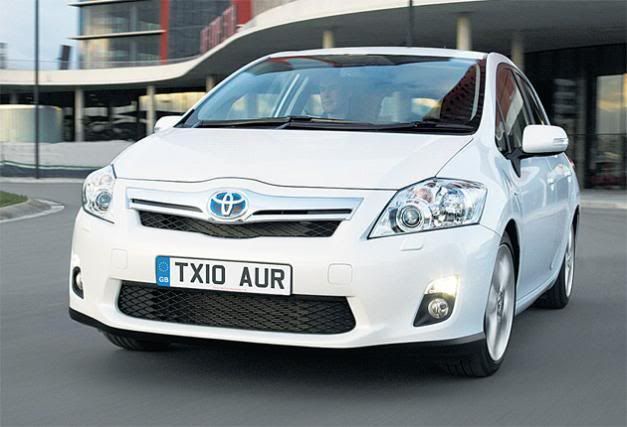
Although a little late, I want to say something about Toyota's decision to build the new Hybrid Auris in Britain, and especially the fact that the engine is going to be built here in Wales.

     BBC website, 17 July 2009

Although I am very much in favour of a radical shift in transport away from cars and onto public transport—and even more in favour of work, shopping and leisure being located close enough to communities to enable people to walk or cycle to them—the simple fact is that most people need cars for some things, and it is therefore better that we have greener cars to use on those occasions when they are needed.


Negotiations between Toyota and the UK government have obviously been going on for some time, and it is a coup to have ensured that Toyota build the car in Britain rather than anywhere else in Europe.

However the news was leaked by the Sunday Times a few weeks ago, and the quote I've highlighted is particularly interesting:

Britain is to make hybrid cars for the first time after a decision by Toyota to start production of the high-tech vehicles at its Burnaston plant near Derby.

The UK is the first European country the Japanese car giant has chosen for hybrid production, and only the third outside Japan. Toyota makes nearly all its hybrids in Japan, with small numbers produced in China and America. The best known of these cars is the Prius.

The introduction of the new vehicle to Burnaston—a hybrid version of the Auris hatchback—follows intense negotiations with the government in recent months. It is understood that Britain will provide financial assistance to help the move ...

Burnaston makes the Auris and the larger Avensis in their entirety, using engines built at Deeside, North Wales, but the hybrid’s drive system (engine, motor, batteries and electronics) will be imported from Japan.

This will be the first hybrid based on an existing production model that Toyota has sold in Europe.

The Sunday Times, 28 June 2009

Now of course it's possible that the Sunday Times got hold of the wrong end of the stick. But they seem to have been right about the rest of it, so I'd be more inclined to think that the decision to build the engine/drive system in Wales rather than import it from Japan was the result of some skillful negotiation in the last couple of weeks.

The real technological advance is the hybrid drive system, and it is good to see that Wales will be at the cutting edge of this part of the new low-carbon manufacturing sector.

Bookmark and Share