Proper Support for War Veterans

I was very impressed with Plaid's video on Channel 4's Political Slot last night:


As with pensions, it is another good example of how Plaid is making a significant contribution not just to politics in Wales but for the benefit of the UK as a whole.

However this video isn't just a soundbite. This is something that I know has concerned Elfyn Llwyd—a barrister with plenty of experience of the problems faced by ex-servicemen—for some years. As he mentioned in the video, the UK is very bad at integrating some of our ex-service personnel back into civilian life.

Even for those fortunate enough to avoid the physical wounds, no one in the services who has seen war can fail to be deeply affected by their experience, and far too many develop behavioural problems because of it. Some are left to cope on their own, for some it is taken out only on their families and friends, but for others it is taken out on society as a whole. A hugely disproportionate 10% of the UK's prison population are ex-servicemen, a figure which required a good deal of investigative work to obtain ... and perhaps unsurprisingly, as it is a terrible indictment both of the lack of support available and of how much the government has wanted to sweep the problem out of the public eye. Our ex-service personnel deserve—and we owe them—much more help than they are getting at present.

Plaid's team at Westminster has produced a detailed background paper on work in support of our veterans: the problems, what is good and bad about the current provision and some concrete suggestions about how to improve the situation. It is available from Plaid's website as a pdf here. However I have to say that the format (since it is set out for printing as a booklet) makes it very difficult to read. So perhaps people will find this version a little easier, especially if you need to print it out:

     Support for Veterans

Bookmark and Share

No, you're still racists!

Nick Griffin is now claiming that, because the BNP has voted to change its membership rules, they can no longer be called a racist party:


     BNP votes to ditch whites-only membership rule

I have just two comments on that. First, that it seems to be an admission that the BNP could be called a racist party before this rule change. But second and rather more importantly, that what makes the BNP a racist party is not its membership, but its policies. Any party that seeks to deny some people in our society the same rights as others because of their racial background is racist.

So the BNP are still racists ... unless they change their policies as well as their membership rules.

Bookmark and Share

Cameron on Wales


Bookmark and Share

Cameron on Scotland

Thanks to the links on Alan Trench's blog, I read David Cameron's speech to the Tory Party in Scotland. There were a couple of things that particularly struck me about it, apart from the normal sort of stuff that we would expect from any speech of this sort.
 

Forced Cooperation

"And it's shameful that during one of the most emotionally-charged moments in our recent history, when the Lockerbie bomber was released from jail to return home to Libya where he still is today, the Scottish Government and British Government refused to cooperate.

"That would not happen on my watch."

The matter of compassionate release—whether one agrees with the decision in the Al Megrahi case or not—is a quasi-judicial decision exercised by a minister of government: in Scotland by the Cabinet Secretary for Justice and in RUK by the Secretary of State for Justice. So how precisely are two different governments meant to "cooperate" if they disagree?

It might mean that the government that did not have the responsibility for making the decision simply made whatever representations it wished to make in private. In fact the Labour government in Westminster did do exactly this, constantly saying in public that it was a matter only for the Scottish government. I think that was entirely right. But Cameron has called it "shameful". Read the sentence again carefully, he did not say the decision to release was shameful (although he undoubtedly thinks it was) but that what happened was a refusal to cooperate, and that the refusal to cooperate was shameful.

So what are the alternatives? Well, one alternative would be that each government openly declared its disagreement with the other. At least that's an honest position. The American government certainly voiced its disagreement with the decision in no uncertain terms. And the Conservative Party both in Holyrood and Westminster were particularly vocal in their disagreement too. But how on earth can open disagreement be described as "cooperation"?

So what's left? If Cameron's statement has any meaning, it can only be that he intends Westminster to overrule any similar decision the Scottish government might make in future. I find that very sinister.
 

Privatization of Welfare and Benefits

"Just look at our plans for welfare. It's shocking today that some people talk about five million people living on out of work benefits as if it's just some un-alterable fact of life. We know that there are millions who could be working but aren't. So we're going to take that twisted logic that rewards idleness and punishes hard work and turn it on its head. If you really can't work, we'll look after you. If you want a job but can't find one, we'll help you.

"We're going to remove the mad restrictions that mean money can't be spent even if the end result is a saving for the taxpayer. And when we've freed up that money, we will then invite commercial specialists and the voluntary sector to come into our welfare system and give the unemployed the intensive, personal help they need, paying them by the results they achieve in getting people off benefits and into work."

I've heard these plans before, but perhaps not quite so clearly as they were expressed here. Essentially the Tories are looking to privatize a major part of the system. Now of course this is a matter of ideology: it is a central plank of right wing thinking that whatever can be privatized should be privatized ... because they believe that this will make everything work more efficiently.

Now I think we would all agree that we need to do more to help people into work. This is something that is not only right in itself, but needs to be done because of the large cost of maintaining the welfare and benefits system as it stands. The question is how to do it.

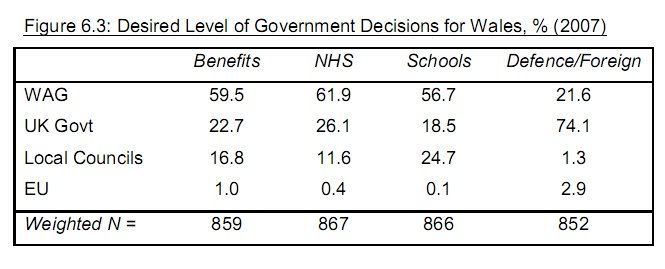
Only a few days ago in this post, I mentioned that the large majority of people in Wales, some 59.5%, think that the welfare and benefits system should be devolved to Wales. Only 22.7% think that decisions on this should be made at Westminster, and 16.8% think they should be made at Local Council level. So it shouldn't come as too big a surprise to find that opinion is much the same in Scotland.

The ongoing Scottish Social Attitudes survey published its headline results for last year a few weeks ago. 60% of Scots thought that welfare and benefits should be decided at Holyrood, 19% at Westminster and 16% at Local Council level.

So this is clearly an area where there opinion is different in both Wales and Scotland to that in England. Even back in the 2005 election, the Tories polled more votes in England than Labour (though thanks the unfair FPTP electoral system, Labour won 92 more English seats than the Tories) and this time round nobody doubts that the Tories will do much better. They will get a big majority in England, even if not in the UK as a whole.

England is a generally right-leaning country; Wales and Scotland aren't. So privatization of part of the welfare system is something that might well find a degree of acceptance among people in England. In many ways it's similar to the increasing privatization of aspects of the English National Health Service as part of an internal market structure that relies on competition. But this is very clearly not the way the majority of people want to do things in Wales or Scotland ... in fact in Wales we dismantled the internal market in our NHS only a few years after it had been implemented.

So I'm not going to be dogmatic and say that a similar sort of privatization of the welfare system is wrong. It's fine if that's the sort of system people want ... and if they vote for a party that will implement it. But it is definitely wrong for a party that will be lucky to get five seats in Scotland and ten in Wales to impose it on Scotland and Wales simply because the vast majority of seats in Westminster are English.

-

Cameron has constantly said that he wants to devolve power downwards from Westminster ... and I couldn't agree more. But power has to be devolved to the appropriate level, and the only way to determine what that level might be is to look at what people themselves say they want. In England, there is no intermediate level between Westminster and Local Councils, so the next step down is to devolve more decision making power to those Councils. But in Wales and Scotland things are different, and the large majority of us want things such as health, education and benefits decided at our respective national levels rather than at either a UK level or Local Council level.

It is not going to be easy to devolve welfare and benefits to Wales and Scotland, in the main because the system has become ever-more entangled with the tax system. But I think the system has become over-complicated as a result of Gordon Brown's changes as Chancellor and now Prime Minister, with the result that many people don't have a clue how it works and miss out on credits that they are entitled to. So disentangling the two would be a very good idea anyway.

My point is this: if the Tory party is determined to pull the welfare and benefits system radically in one direction, they must give Wales and Scotland the opportunity to do things differently. If they don't, their commitment to devolve decision making power downwards is meaningless ... especially when people in both countries want it by a majority of about three to one.

Bookmark and Share

The A of the Bang

I'm delighted that the motion asking for a referendum on primary lawmaking powers was passed yesterday, and even more delighted that it was passed unanimously. No one against it, no abstentions. Who could ask for a more positive signal?

I had hoped this would happen, and I want to express particular thanks to both the Tory and LibDem groups in the Assembly for putting aside their very real, and still unresolved, concerns about the date of the referendum ... as well as for some excellent contributions in the debate.


However it is important to realize that yesterday's vote was only a small step in the process, and that we still don't know for sure whether we will get the referendum, when it will be held, or what the wording of the question will be.

The next stage is simple: Carwyn Jones has to write to Peter Hain to let him know the result of the vote yesterday ... not that he needs to be told. Due process must be followed, of course, but how quickly things now happen will be a clear sign of whether the Labour Party want to get this referendum sorted so that they can concentrate on the upcoming Westminster elections (I only hope they don't forget the "minor" matter of all the ongoing aspects of government in both the Assembly and Westminster) or whether they just want to go through the motions.

Yesterday's statement by Peter Hain was interesting:

Carwyn and I have been working very closely together over the past two months to make progress on this issue. I fully support the First Minister's approach and now look forward to receiving his letter so I can begin the necessary preparatory work to take this forward. In the meantime, as Carwyn and I have said jointly, we both agree that the priority in the coming months will be the General Election, the outcome which will be so important for Wales. We must secure economic recovery for Wales, not choke it off with hasty cuts to Government spending.

The first thing is that Peter Hain hardly needs to wait for a letter before he gets on with his job of drafting the Referendum Order to be laid before Westminster. The issues are quite straightforward, and the only thing which will require any external input is the Electoral Commission's opinion on the wording of the question. However they can't give their formal opinion until they know for sure what Peter Hain is going to put into the draft RO.

In reality, we know that the Electoral Commission are already on the ball. Nick Bourne mentioned before Christmas that he had been approached for his (or the Tory group's) opinion on the wording of the question, and it is inconceivable that other parties would not have been asked the same question. Therefore ideas have been well aired for some time, and it is only a question of choosing what seems to be the best option. We don't need to make too big a deal about it, because the precise form of the question will have absolutely no effect on what will happen if we get a Yes vote. What we will get after we vote Yes is already set out in detail in the GoWA 2006. There is no room for other options.

-

What strikes me is that the wording of Hain's statement is very deliberately ambiguous. It could mean that Carwyn Jones is going to take the full 14 days before sending the letter, so as to mean that Peter Hain can sit on his hands and do nothing in the full knowledge that the 120 day period he has before he needs to respond will extend past the Westminster election. So we will see if the essence of the "very close working" between Jones and Hain a few months ago was, to paraphrase:

I know you don't want this referendum, Peter. But I've got Plaid on my back, and I have to make it look as if I'm serious about it. So I must put it to the Assembly. But if I make it vague enough, the LibDems and Tories might just throw a wobbly and get us out of it ... then we can then blame it all on them. Plus, if I just string everything out by a week or so here and a couple of weeks there, by the time it gets to your desk you will have time to ignore it without actually being seen to have rejected it. That'll mean you can still make out that you're in favour of more devolution.

Of course it might not be that way at all. The First Minister's letter could go off today, and Hain could lay the draft Referendum Order before Parliament on Monday. Only time will tell, so the A of the Bang is:

     AGONIZING WAIT

I would say this: if the intention really is to get on and fight the Westminster election, then the simplest way to do it is to get everything about the referendum sorted as quickly as possible. While there are still unresolved matters, people are going to have to spend time and effort trying to get them resolved.

Look how quickly Labour is moving to get a referendum on the Alternative Vote for Westminster ... and in particular how prominent and proactive Peter Hain has been in the process so far. There is no reason why he should not move just as quickly to set this one up before the Westminster election is called.

Bookmark and Share

More effect on Parliament than the entire Liberal Democrats

Yes, the lesser mortals in the House of Commons cringe in fear and shame before the power and majesty of Plaid's glorious trio. Well, at least that's the picture as seen by the Independent this morning.


Plaid Cymru's fearsome threesome pack quite a punch

What a relief to see Elfyn Llwyd in the House yesterday, still alive and asking questions. He's always more interesting than he looks. Tiny Plaid Cymru are a great parliamentary asset. Blair and Mittal's £2m, that was them. They kicked off Cash for Honours. The Blair Impeachment project, they did that too. Llwyd and Adam Price (they are two-thirds of their party) have probably had more effect on Parliament than the entire Liberal Democrats.

He was suggesting to Jack Straw that half the women in prison shouldn't be there (did you know women have gone to jail for not paying their television licence?) Leave aside his imprisoned women, Elfyn has another fish on the line.

Four years ago, he received a document—top secret, unsigned. From whom? I don't know. Why did he get it? Don't know that either.

What's in it? Ah yes, it details, he says, our leader's conversation at the famous Crawford meeting a year before the Iraq war started. It is, he tells me, "evidence of a done deal between Bush and Blair" and shows that in the light of Blair's subsequent answers on the subject that "the depth of the deceit is astonishing".

So that's why it's nice to see him kicking and swinging—and not from underneath Blackfriars Bridge. Why he has taken four years to bring it up? I can't say but the news has been taken seriously enough to bring in interviewing officers from Special Branch and the Met. Over a week ago he offered the document to the Chilcot inquiry and he hasn't heard back. We'll just have to wait and see.

Independent - 10 February 2010

Mind you, packing more of a punch than all sixty-three Liberal Democrat MPs combined isn't really saying so very much, is it? And that was with only two! Include Hywel, and we have more positive effect on Parliament than both Labour and the Tories combined.

Bookmark and Share

What are the LibDems for?

It is always good to hear someone advocating a fairer and more consistent devolution settlement for Wales, so some of these sentences from Nick Clegg, the leader of the LibDems, are particularly welcome:

Clegg "passionate" about giving more power to Wales

The National Assembly should be transformed into a full parliament with the same powers as its Scottish counterpart, Liberal Democrat leader Nick Clegg has declared.

The party will vote on Tuesday to support a referendum which could give the Assembly law-making powers in 20 strictly defined areas. But Mr Clegg believes devolution in Wales should go further.

In an interview with the Western Mail, he said: “I am a passionate believer in devolving power away from London and Westminster to the constituent nations of the United Kingdom and I think that means the maximum amount of powers for Scotland, for Wales and the other parts of the United Kingdom.”

Arguing this was the best way of guaranteeing the long-term future of the UK, he said: “I think there is nothing inconsistent between keeping the union but devolving ever more powers. In fact, I think the way to keep the union fresh and strong in the decades ahead is precisely to give more and more powers to Holyrood and Cardiff.”

Western Mail - 8 February 2010

However the problem with the LibDems is that they are very good at talking this sort of talk, yet don't have such a good record of walking the walk. The language that Nick Clegg has used is one of devolving "the maximum amount of powers" away from London and Westminster. Fair enough. But when it come to an obvious area in which powers could be devolved to Wales he suddenly becomes very vague and noncommittal:

When asked if he would support the devolution of criminal and justice powers to Wales, he said:

"We would look at it. We are completely open-minded. We have no arbitrary red-lines at all ... "

That isn't a consistent answer. These powers are devolved to Scotland, and are—if everything goes according to plan—going to be devolved to Northern Ireland as well. So why couldn't Nick Clegg answer the question with a simple, unequivocal "Yes"?


Much the same is true of the LibDems' position in Scotland. As I commented here a few months ago, if the LibDems really did want "devolution max" for Scotland, why tie themselves to the almost minimal increases of responsibility for matters in Scotland advocated by Calman? They could very easily come up with their own devolution policies for Scotland to include much greater fiscal autonomy, responsibility for the tax and benefits system, broadcasting and many smaller issues. These could then be put as a third option in a referendum on independence later this year. (It is pointless putting the Calman proposals to a referendum since all parties, between them representing the huge majority of people in Scotland, agree on them as a minimum.) Between them the SNP, Greens and LibDems could carry a vote in the Scottish Parliament to set up such a referendum, and it would put the two big parties in London in a very awkward position if they decided not to implement what had been voted for.

So why exactly are the LibDems so lily-livered? They have a golden opportunity to present the people of Scotland with their ideal vision of a Scotland within the UK. Why are they so afraid to put those cards on the table?

It is hard for me to escape the conclusion that they are putting their own electoral advantage before any issue of principle. Following their "behind closed doors" conference last year it seems that they only want to do this after the Scottish elections in 2011, hoping that their number of seats will increase as a result of them showing themselves more in favour or more devolution that either Labour or the Tories. But they have enough seats to do it now, so why wait?


In Wales, the Labour party has shown us that it only wanted devolution as a way of strengthening its own hold on Wales, and now only wants to move to primary lawmaking powers for the Assembly because it is about to lose power in Westminster. But at least Labour has now come round, the Tories will always be in two minds.

But there would seem to be every opportunity for a party that wants to see devolution progress further in Wales ... but stop short of independence. Why aren't the LibDems in Wales making more of that message? Why are they only prepared to say they are "open minded" over policing and justice? Why, for example, don't we hear them say that they want control over the question of welfare and benefits transferred to Wales? After all, there is very substantial support for it in Wales, as I've mentioned before:

Survey respondents were asked about which level of government "ought to make most of the important decisions for Wales" for four key policy areas: Welfare Benefits, the National Health Service, Schools, and Defence and Foreign Affairs. Results are presented in Figure 6.3 below. These show not only clear majority public support for the devolved level of government to have control over areas where they already make many decisions—on schooling and healthcare—but also a similar level of public endorsement for those powers to extend to an area like welfare benefits. The latter is striking, as it is a policy area that currently remains very much reserved to Westminster.
Source

In fact, for the last four years in a row, the BBC's annual poll has shown that people in Wales think the Assembly should have more influence over our lives than Westminster by a huge margin of about three to one:

60% to 21% in 2006
56% to 19% in 2007
61% to 22% in 2008
61% to 21% in 2009

It is good to see that Dib Lemming is blogging again, I hope she continues. But her first post after a long absence was to berate the fact that the LibDems could not escape being asked which parties they would work with. I want to be less mealy mouthed. In the 2011 Assembly election I expect to see Plaid get somewhere between seven and ten additional seats, but it is hard to see how we could win more than 25 seats.

After the 2007 election Plaid were in the unique position of being able to work with either the LibDems and Tories in the Rainbow, or with Labour. I think it's fair to say that we chose Labour for two major reasons: first because we could not get the referendum on primary lawmaking powers without them (it needs 40 AMs to vote in favour) and second because some of our AMs would have found it almost impossible to work with the Tories, even though the All Wales Accord itself contained hardly anything that was distinctively from the Tory manifesto.

Next time will be different because the referendum will have happened. Although Plaid probably won't get enough seats to form a government alone in 2011, there is a very real chance that we could form a government with the LibDems, even if only a minority government (Labour and the Tories will always cancel each other out because that is how they choose to position themselves in a UK context.) But to do that, the LibDems in Wales have got to start being a lot clearer about what they want for Wales. I would suggest that a clear commitment to the transfer of policing and justice, the responsibility for administering the welfare and benefits system, plus of course a substantial degree of fiscal powers for Wales (since we could use those levers to make it more attractive to do business in Wales, and therefore increase employment) could form a decent foundation to build an agreement on.

But although I think that might make sense to some LibDems, we have to go back to the rather sad fact that the majority of LibDem voters in Wales don't really seem to want the same things as LibDem politicians, as I mentioned here. And that—if you think that asking what the LibDems are for is facetious—does raise serious questions about why people actually vote for them.


Over the weekend I had the great pleasure of meeting Gwynoro Jones for the first time. Something which, by happy coincidence, ties in nicely with these two pieces about him and his son Glyndwr, Plaid's candidate in Merthyr, by Martin Shipton in the Western Mail yesterday:

     Once the biggest foe of Gwynfor, ex-Labour MP aids poll bid by Plaid son
     Gwynoro Jones brands Independent Wales a "childish fantasy"

Gwynoro was particularly active in the early days of the SDP when, for a brief year or two after breaking from the Labour Party, they looked like making a breakthrough in UK politics. But in the end they lost momentum and were subsumed into the old Liberal party, with all their passion for actually making a difference lost. Gwynoro can support his son because he knows Wales needs that sort of passion, even though it wouldn't be right for him to join Plaid because he does not want Wales to be independent (... and, as with Ron Davies, I would not want him to join unless he came to believe in independence.)

So my advice to the LibDems in Wales would be not to leave your leader in London to talk about his "passionate" (though not thought through) desire for greater self-government in Wales, but to start shaping some firm ideas on how you intend to go about it. If you can do that, you might have a reasonable hope of getting the votes of some of the consistent 60% or so who want to see the Assembly have more influence over the lives of people in Wales than Westminster ... but be careful, they might not be the people who vote for you now, since the majority of those who vote for you now are against further devolution.

However if you can't do that, don't be surprised if more and more of those people vote for Plaid simply because we are the only party with consistent ideas on how to devolve more areas of responsibility to Wales, even though they may not be persuaded about independence ... yet!

Bookmark and Share