STV in an 80 seat Senedd

Inspired by Penddu's great work in the previous post, I thought I'd try out a couple of experiments. As I said in the comments last time, I'd prefer to see slightly larger constituencies, averaging about six members each. In the Republic of Ireland, seats are between 3 and 5 members, which is fine for a country where there are "two-and-a-half" parties. But in Northern Ireland that wouldn't work so well because there are "four-and-a-half" parties, and the smaller ones would get squeezed out. Therefore they have six-member constituencies. Wales also has four main parties, with UKIP showing strongly in some elections ... and that's why I thought an average of six would be about right for Wales too.

I was very impressed with Penddu's geographical split. I thought twice only about Ceredigion & Pembrokeshire and Torfaen & Monmouth ... the first because it was a bit long and the second because I wondered if Torfaen more naturally belonged to either the Gwent Valleys or Newport. But after thinking it through, what he had done was better than any alternative I could think of.

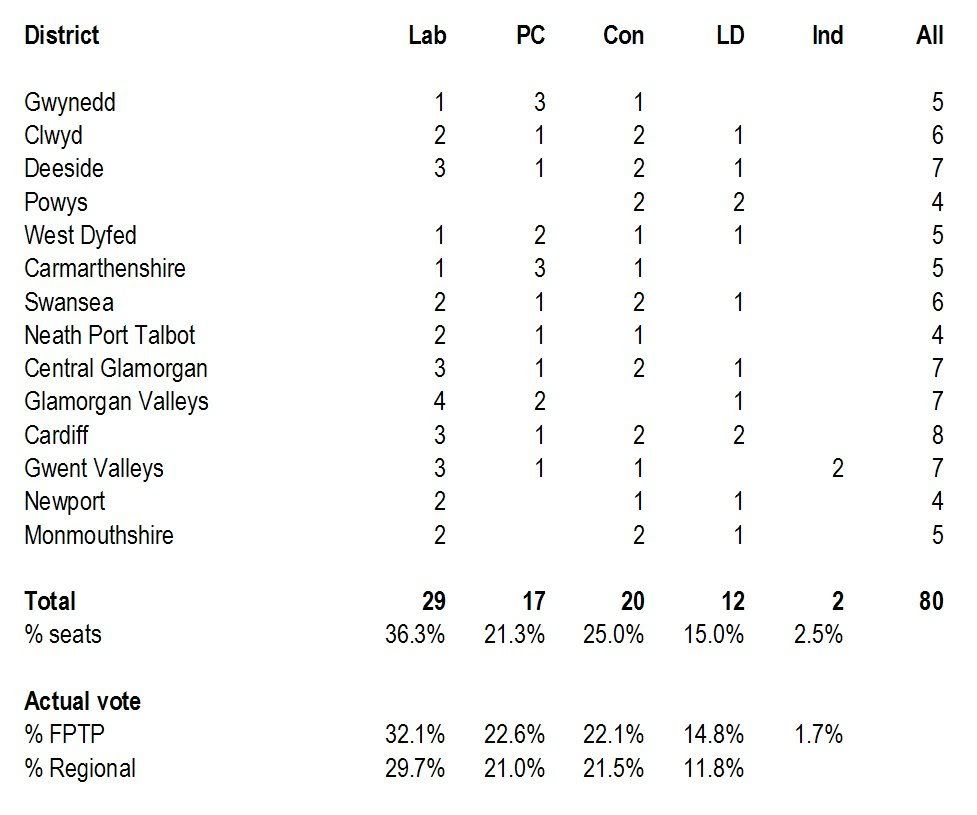
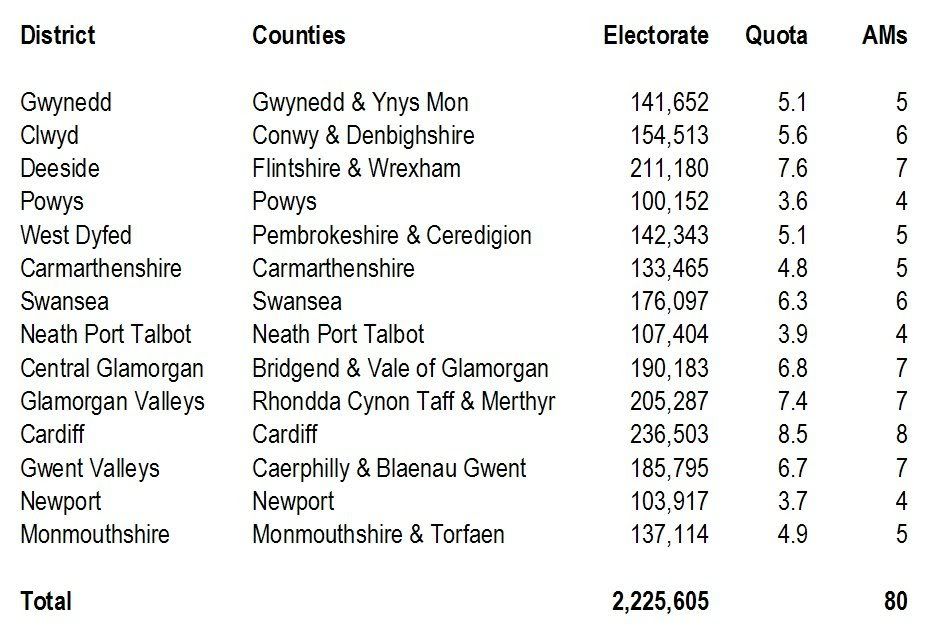
So, this is a table showing the number of seats for each of the 14 districts, but based on a Senedd with 80 seats. That's too many for now, but would be justified in not too many years' time ... when we have primary lawmaking powers, of course, and when the Justice system (police, courts and prisons/probation) is devolved to Wales. The 2015 election.


The second thing I tried to work out was how these 80 seats would be distributed based on the votes cast in 2007. I don't know how Penddu did his calculation, but having tried it for myself it seems that roughly two-thirds of it is fairly straightforward, but the remaining third requires a lot of assumptions. It's a value judgement. There can be no precise answers because there are so many variables.


I've also shown the percentages, and how they compare with the actual votes cast in 2007. I was quite pleasantly surprised by the degree of proportionality.

If you want to see exactly how I worked it out, you can download the spreadsheet. It's rough and I haven't bothered to polish it up. The top half is my untouched version of the 2007 result, but below it I have taken the 2007 consituencies and grouped them into Penddu's 14 STV constituencies. This is a rough fit, but the numbers of votes only matter in relative terms, since the number of seats in each STV constituency has been worked out from the electoral roll data in the first table.

Looking at the detail: The number of Conservative seats is a little high, but that is mainly due to my assumption that those who voted UKIP in 2007 would almost certainly vote Tory as a second choice. The UKIP vote wasn't high enough for them to gain any seats in their own right, but perhaps more people would have voted UKIP with STV. The number of Labour seats is a little high too, but it nearly always happens that the largest party gains a little from the smaller parties that don't get anything.

Bookmark and Share

STV Constituencies in Wales

A guest post by Penddu

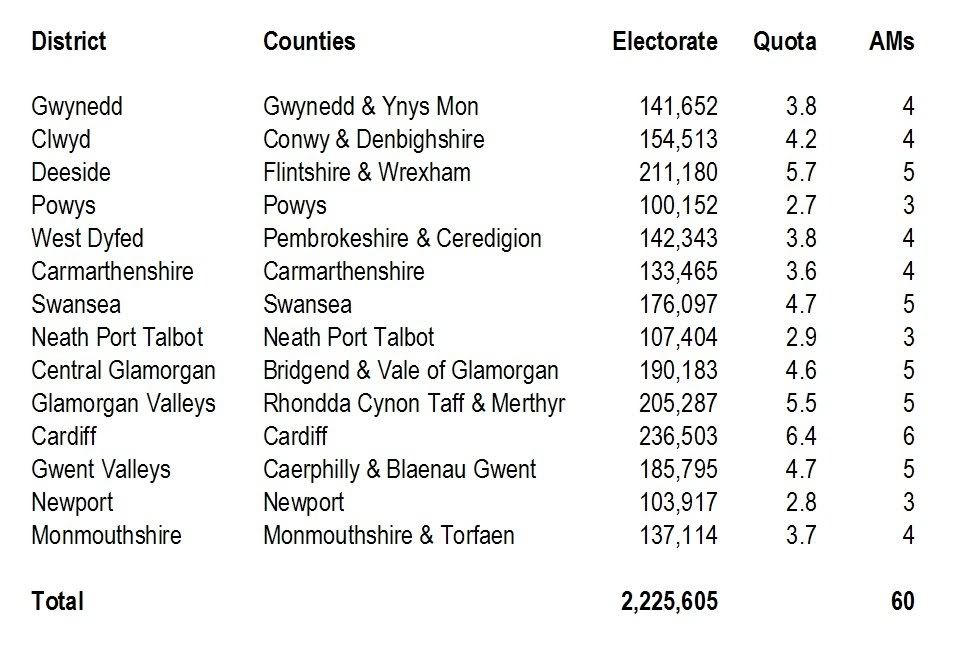
I have been giving some thought as to what the Assembly elections might look like if they were conducted using STV with multi-member constituencies or Districts. Using the figures from the Boundary Commission for Wales latest (2003) reports, Wales has an electorate of 2,225,605 which, assuming the existing total of 60 AMs, means that each AM would need to represent 37,093 voters.

Rather than base new Districts on existing constituencies, I have used the Counties as a basis, as the public usually has a clearer affinity to these. I have aimed to create 4 member or 5 member districts representing a total electorate of 148,373 or 185,547 respectively. But I have also created a number of smaller 3 member districts and one 6 member distict where these seem to be more obvious. A first rough pass gives:


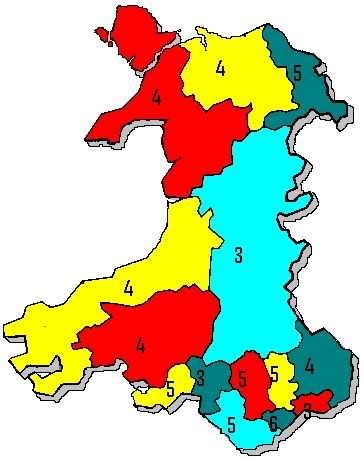
This map shows the initial boundaries, but these would need further local adjustments so as to even up the sizes of the constituencies.


But how would the parties be distributed within each seat?

Taking Cardiff as an example, the combined votes in the 2007 Assembly election would give:

Labour ... 35,802
Conservative ... 32,414
Liberal Democrat ... 25,282
Plaid Cymru ... 13,890
UKIP ... 2,308

Total ... 107,388

The first step is to calculate the qualifying quota - calculated by dividing the total number of votes by the number of seats plus 1 - giving:

Quota = (107,388/(6+1))+1 = 15,342

For every 15,342 votes as first preference, each party would win 1 seat, with remaining unused votes counted:

Labour ... 2 Seats ... remainder 5,118 votes
Conservative ... 2 Seats ... remainder 1,730 votes
Liberal Democrat ... 1 Seat ... remainder 9,940 votes
Plaid Cymru ... No Seats ... remainder 13,890 votes
UKIP ... No Seats ... remainder 2,308 votes

The remaining smallest party is then eliminated and its votes reallocated to the stated second preference party and added to the remaining unused votes, until a party can achieve a quota. In this case, UKIP would be eliminated and its votes distibuted to the stated second preferences. Plaid would need to pick up 1,452 votes to win the 6th seat, otherwise they would be eliminated and their votes redistributed. In this case it would probably give the Liberal Democrats the final seat but with STV encouraging smaller parties like the Greens to enter candidates, and people more likley to vote for their first choice party without fear of it being a wasted vote, the voting patterns become far more tactical, and difficult to predict.

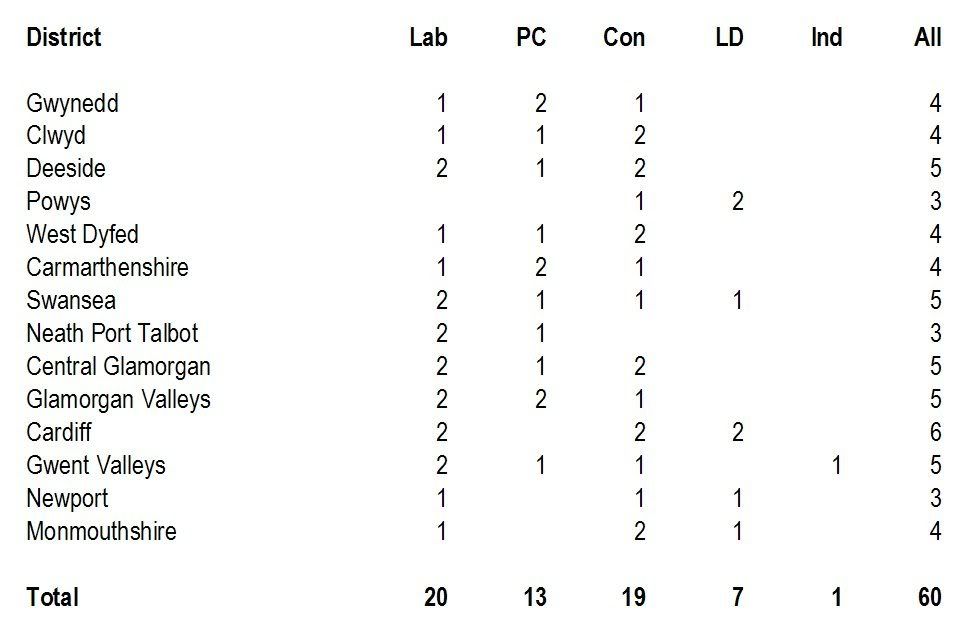
Overall I predict that if the 2007 elections had been based on STV, then seats would "probably" have been distributed:


I have had to make some assumptions about second and third preference votes to get to these figures and, more importantly, electors may vote differently if there is more chance of their vote being counted. Neither am I suggesting that this would be the result if the election was held today.

Bookmark and Share

An "iron-clad" referendum guarantee ... so would you believe him twice?

Czech President Vaclav Klaus has now signed the Lisbon Treaty, meaning that all member states have completed the ratification process. In these circumstances David Cameron has now said that the Tories will not call a referendum on the Treaty.

This post isn't about the rights and wrongs of that decision, but only to note that some sections of the Tory Party (and others) feel very strongly that David Cameron has broken the promise that he gave. Here is a report from the Telegraph:

David Cameron to tell voters: no vote on Lisbon Treaty

The Tory party leader’s admission, which could come as early as Tuesday, will bring accusations that he has broken clear promises to grant a popular vote on the treaty.

Mr Cameron gave voters an “iron-clad” promise in 2007 that a Conservative government would hold a popular vote on Lisbon.
 

... several other [Tory MPs] said they still expect Mr Cameron to honour his “iron-clad” promise and hold a referendum on the treaty regardless.

Bill Cash, another leading Eurosceptic MP, said: “We need a full referendum on Lisbon as we were promised. No ifs or buts. This is about the Government of the UK operating in line with the democratic wishes of the electorate.”

Barry Legg, of the sceptic Bruges Group, said: “David Cameron needs to come clean with the British people: why is he breaking his pledge to hold a referendum on the Lisbon Treaty? How can David Cameron claim he’ll fight to repatriate powers from Brussels when he won’t even fight to implement his own past words?

Opponents of the treaty from other parties also attacked Mr Cameron.

Nigel Farage, the UK Independence Party leader, said: "We can now see how gutless and dishonest the Conservative Party has been about their intentions on a referendum.”

Ian Davidson, a Labour MP who opposes the treaty said: “Those who capitulate and change their position once it is ratified betray the interests of the British people.”

Daily Telegraph, 2 November 2009

Over the past few months I have to admit to being surprised at a general feeling—expressed by a number of senior politicians and commentators—that David Cameron would be certain to let Wales have a referendum on primary lawmaking powers. One of the most common words has been that it would be "inconceivable" for him to refuse the referendum if the Assembly were to ask for it.

The first thing to note is that the Tories have not made that promise to Wales. The official position is that they will keep their powder dry until after the All Wales Convention has reported. Yet they have, rather adroitly, allowed a situation to develop in which a good number of people are optimistic that they will say Yes.

But the second point is that even if they were to make that promise, there is absolutely no guarantee that the Tories will stick to their word. If they break one "iron-clad" guarantee, why wouldn't they break another?


Now I fully understand that there are very cogent reasons for not having a referendum on the Lisbon Treaty now. But think, might that not be equally true (in the minds of those who do not want it, that is) of the Welsh referendum? Off the top of my head, here are some reasons Cameron might give for changing his mind at some future date after having given us a similar "iron-clad" guarantee:

• We're still not out of the financial crisis

• There's a new financial crisis

• The situation in Scotland has changed, and that has had knock on effects that no-one could reasonably have foreseen

• We now intend to introduce a comprehensive review of the asymmetrical nature of devolution, particularly with respect to England ... so we think it unwise to have a Welsh referendum until that has been concluded

• We intend to devolve more responsibility to the Assembly (e.g. prisons) so we want to wrap this into a new referendum

• We want to introduce a threshold (remember 1979)

• We think the wording of the referendum should be put in different terms

• We can't have a referendum while people in the Valleys are out on the streets, protesting over public spending cuts (that's designed to resonate with the more radical wing of the Labour movement ... and Leanne Wood, not that she needs convincing!)

You get the picture. If the Tories want to find a reason to delay the referendum, it won't be too difficult to think of one. They can simply claim that circumstances have changed.


I'll repeat what I've said before. As things stand at present, getting our referendum depends entirely on Labour. We need Labour AMs to get the two-thirds majority in the Senedd, we need Labour's majority in the Commons to get it through Westminster. After the General election, there is a possibility (please bear in mind that I'm primarily trying to convince those in the Labour Party) that Labour will no longer have that majority in the Commons after May.

A number of people in Labour—including Carwyn Jones and Huw Lewis—seem to be saying that it is a decision to be made only after the result of that election is known. My point is that by then it will be too late. We will still get the two-thirds majority in the Senedd, but there is no guarantee that the Tories, if they win, will let us have it.

I would go further and repeat that there are very good reasons why the Tories would not let us have it. As things stand at present, the Secretary of State for Wales has complete control over whether an LCO even gets laid before Parliament. S/he then continues to influence every stage of the process. It is very likely that a Tory SoSW will want to see the text of any proposed Measure as part of the LCO process ... as we saw with Cheryl Gillan over the Welsh Language LCO. Politics is about power, so why would the Tories want to relinquish that power? It is in their interests to hold that "lever of power" while they are in power at Westminster, just as it has been in Labour's interests to hold that lever while they have been in power.

It goes without saying that no-one in Labour is going to trust the Tories one inch further than they can throw them. So isn't it a little naïve to rely on Cameron to allow a referendum that could transfer that degree of power from the Tories in Westminster to a Senedd in which Labour are, and are quite likely to remain, the largest party?

Sure, the Tories will make all the right noises about respecting the Assembly, but isn't it in their interests to lull you into what might be a false sense of comfort? If they can convince you that you don't have to make a decision, they know that the decision will fall to them instead.


I don't think the situation has been helped by suggestions that the referendum itself can, or should, be held in the next few months. In fact I suspect that the suggestion has been floated in order to introduce some friction to the debate: specifically, to divide Labour and Plaid Cymru.

The name of the game is to stick to the game plan.

The commitment is to hold a referendum on or before May 2011. Huw Lewis' "only one election at a time" is perfectly right in respect to the upcoming General election. It would be complete madness to fight it in the next few months, not least because the media will be concentrating on the increasingly-heated election battle. Wales would not get a look-in, so the referendum issues would not be properly aired or discussed.

But it is something entirely different to get the referendum through its approval stages in Cardiff and London now, but to set a date for the referendum itself which is well after the General election is over. Any time between Autumn 2010 and Spring 2011 is fine.

-

There's only one problem: that Labour must take the risk of setting a date for the referendum now, while they are still in control of the process. No matter how optimistic Labour might be about some great sea-change in public opinion carrying them to a fourth term at Westminster, there is no guarantee that it will happen ... and certainly no "cast-iron" guarantee.

Labour cannot afford to take the risk. They need to make a decision about the referendum while power remains in their hands.

Bookmark and Share

Rhodri's absurd non-sequitur

No doubt in an attempt to reduce his high approval ratings and therefore give his potential successors a chance to look better, Rhodri Morgan has come out with a line of thinking that not even I thought him capable of.

     Morgan warns over Tories' MP cuts

He thinks that reducing the number of Welsh MPs would automatically reduce the number of AMs. Of course it wouldn't. If the number of Welsh constituencies was reduced from 40 to say 32 all it would mean is that we would elect 32 AMs from those constituencies, and then either increase the number of regional AMs from 4 per region to 5 or 6 per region or increase the number of regions. In fact this would be good because it would result in a greater degree of proportionality.

The disproportionality of the current 40:20 split between FPTP and regional seats speaks for itself:

Assembly Election 2007, All Seats

Lab ... 32.1% and 29.7% of vote ... 43.3% of seats
Plaid ... 22.6% and 21.0% of vote ... 25.0% of seats
Con ... 22.1% and 21.5% of vote ... 20.0% of seats
LibDem ... 14.8% and 11.75% of vote ... 10.0% of seats

Labour currently get very many more seats than their share of the vote deserves, though it's nowhere near as bad as it would be if we didn't have any regional members:

Assembly Election 2007, FPTP Seats

Lab ... 32.1% of vote ... 60.0% of seats
Plaid ... 22.6% of vote ... 17.5% of seats
Con ... 22.1% of vote ... 12.5% of seats
LibDem ... 14.8% of vote ... 7.5% of seats

A greater proportion of regional seats would make things more proportional. That's why Rhodri is complaining so much. It is Labour that benefits most from the unfairness of the current split ... so Labour will fight tooth and nail to hold on to that unfair advantage.

-

But looking at the wider issue, Wales does have more MPs than it should compared with the remainder of the UK. This was quite deliberate, and it was also true for Scotland. However, after the Scottish Parliament was set up, the number of Scottish MPs was reduced from 72 to 59 to reflect the fact that Scotland would now make many of its own laws. The same will happen when the Senedd gains primary lawmaking powers: the number of Welsh constituencies will be reduced to about 32 ... still a little larger than would be strictly proportionate, but reflecting the more sparsely populated nature of much of Wales.

Now perhaps Labour in Wales think they can somehow hold on to forty Welsh constituencies no matter what. That's unreasonable of course, but it does explain why Labour's Welsh MPs are very much more against primary lawmaking powers than their AMs. Simple self-interest, turkeys don't vote for Christmas.

What Labour don't seem to realize is that the Tories have said they are going to reduce the number of MPs no matter what, and that they will even up the size of constituencies over the whole UK. Does anyone think that they will respect the fact that Wales doesn't have primary lawmaking powers? Of course not. It will count for nothing, and Wales will end up with about 30 MPs after the 2014/2015 election no matter how hard Labour shout about it.

The key to defending Welsh interests is not to hold on to a few more MPs in Westminster ... after all what difference can a few MPs ever make to a House of Commons with 646 members? The key to defending Welsh interests is to ensure that we have power to make our own laws irrespective of who holds power at Westminster.

Bookmark and Share

What does Carwyn mean by "bilingual" education ... and who is calling for it?

I must confess that my previous post was not the main point I wanted to make with regard to Carwyn Jones' manifesto. There was another far more significant difference that I noticed when reading the Welsh and English versions, this time about something that the Senedd does have broad control over: education.

This is what it says in the Welsh version:

Hoffwn weld ...

• Parhau i gefnogi addysg cyfrwng Cymraeg ar bob lefel gan gynnwys hyfforddi athrawon, gyda lle i fwy o ysgolion dwyieithog sy’n adlewyrchu’r gofyn gan athrawon.

And this is the English version:

I want to see ...

• Continuing support for Welsh medium education at all levels including teacher training, with space for more bilingual schools that reflect parental demand.

The two are virtually identical apart from the last phrase. The Welsh version translates as, "with space for more bilingual schools that reflect the demand by teachers".

This is something that requires clarification. Obviously one or the other is wrong, and we need to know which one.


Now some of us may think the answer is obvious, but in fact it is far from obvious. From a parental point of view there is actually very little demand for bilingual schools. The increasing demand is for Welsh-medium schools. In fact where bilingual schools are proposed the general feeling among parents wanting a Welsh-medium education for their children is that a bilingual school will compromise the general ethos of the school and tend to water-down its Welsh content. And the feeling among parents who want an English-medium education for their children is probably just the same, but the other way round. We can see this in what is happening with regard to secondary education in Carmarthenshire.

It's also worth noting that many schools are officially classed as "bilingual", but in practice not very many of them actually are; they tend to be predominantly either one or the other. Parents see them as one or the other in relation to the other choices available in their area.

-

However things are quite different from the point of view of teachers and those with an influence over educational policy in general. One of their general concerns is that Welsh is still not being taught well enough as a second language in EM schools, and that one of the most effective ways of doing it better is to increase children's exposure to Welsh in other taught subjects and in non-formal school activities. To give one example, this approach has been very successful in Treorchy Comprehensive School, an EM school where a large part of the teaching content is now in Welsh. It is undoubtedly a good model for other EM schools to follow ... but this initiative has definitely been led by teachers rather than by parental demand. This is not an isolated case, as a consequence of its success many local authorities are now looking to increase the amount of Welsh used in EM schools.

Therefore Carwyn Jones could be talking about either, and someone should put him on the spot to clarify which he means.


Turning now to comment on the issue itself, I think that both WM education and an improvement in teaching Welsh as a second language in EM schools should work in parallel. One of the main trends in education over the last few decades has been the growth in parental demand for WM education. This is particularly true in the eastern half of Wales and, in the few places where surveys have been conducted, they show that the demand is always at least twice as great as the supply of places available, often more. So if Carwyn Jones had said that he wanted to see more places being made available in Welsh-medium education rather than bilingual education, it would have raised no eyebrows ... it would be a statement of the obvious.

But he didn't. And as a lawyer, he is far too precise with words for this to be just a slip, so we have to presume he means what he actually said.

-

My concern with Labour (no matter which leader they choose) is that they are in general far too centralist and far too controlling. Therefore, rather than regarding the growth in WM education as the result of parental choice, they are more likely to regard its growth as divisive. However WM and EM education are in no sense opposites. WM education produces children who are competent in both English and Welsh, so there is nothing divisive about it. In contrast EM education results in only about a quarter of children leaving school competent in Welsh. For most of the remainder it gives only a basic grounding in the language ... and for far too many of our children it fails to do even that.

This obviously needs to be addressed. But my fear is that Labour would prefer a model in which all schools in Wales were broadly the same. I have no doubt that many in Labour are sincere in wanting to see more children speak Welsh competently ... but their natural political instinct is to want this to happen across the board in all schools. What else could Carwyn Jones mean by this emphasis on bilingual schools? It might make some ideological sense, but the effect in practical terms would be to curtail the growth of WM education.

-

My view is that we should ensure an adequate supply of local WM places for all those parents who choose it and that, as a separate but equally important issue, the EM sector should take the steps it needs to ensure that children become competent Welsh speakers. But I can all too easily see a situation in which parents who want WM eduction will in future be told they can't have the WM school they really want because their council, following some new Assembly guidelines, is planning to raise the amount of Welsh taught to some arbitrary figure that will supposedly make the local EM school "bilingual".

Bookmark and Share

Labour's confusion over renewable energy

I've been very grateful for Wales Home's coverage of the Labour leadership election, though it does seem as if they are trying to flog more life into the horse than it deserves. Things are in fact happening very slowly, indeed it is only today that Carwyn Jones has launched his manifesto. Perhaps someone in his camp should have realized that the subliminal message from the front cover is that Labour are going downhill ... isn't it always the obvious things that go unnoticed?


I was very glad that I read both the Welsh and English versions. In fact I had to because what he said about renewable energy didn't make sense in Welsh, so I thought it might make better sense in English. But no, it seems that he doesn't know what either "trydan adnewyddadwy" or "renewable electricity" is. Nuclear energy is not renewable. But it would be unfair to single him out, for Huw Lewis makes exactly the same mistake in this interview.

It seems that the inability to distinguish between renewable energy and nuclear energy is endemic in Labour. The more cynical part of me would say that is because the UK hasn't done nearly enough to meet the international obligations it has taken on with regard to renewable energy targets, and therefore hopes to get away with saying, "Sorry, will nuclear do instead?"

It won't. It might help the UK reach its targets for CO2 reductions, but those are different and separate from its obligations for renewable energy. This muddle-headedness by Labour politicians now seems to be so consistent that it can only be deliberate.

Bookmark and Share

Sorry, I got it wrong

Following my previous post, it seems that I—not to mention Professor Nutt and the whole Advisory Committee on the Misuse of Drugs—do owe everyone an apology.

There is one incontrovertible piece of evidence which shows that cannabis has an adverse effect on intellectual capacity:


The Guardian has some more cards from the deck here.

Bookmark and Share