Encouraging News on Nuclear Power

Last month, I wrote a this post on nuclear power highlighting the manifesto positions of the various parties. Labour in Westminster were the only party unequivocally in favour of nuclear power, which put them at odds with their Welsh Labour colleagues in the Assembly who think that nuclear power is unnecessary in Wales, because we can generate all the electricity we need from renewable sources. Plaid (with the SNP and Greens) the LibDems and the Tories in the Assembly share that view, and the Tories in Westminster took the position that they would allow new nuclear power stations to be built ... provided they receive no public subsidy.

As every party in the Assembly is against building any new nuclear power stations in Wales, it was very encouraging to hear Chris Huhne make clear what the new ConDem coalition's position on nuclear is in this interview on the Today programme yesterday morning, but also reported here.


This should give those of us who are opposed to nuclear power in Wales a good idea of the grounds on which to fight to ensure that Wylfa B is never built.

In short, there seems to be no way that we can prevent it being built on planning grounds or on safety grounds. If a company or consortium wants to go ahead and build a new nuclear power station the Westminster government will allow them to do it. But they will have to pay for it and, more importantly, pay the costs of decommissioning it afterwards.

Our task has got to be to ensure that these costs are not deliberately underestimated at the outset. Personally I have no absolute objection to nuclear power and believe it might well be the "least worst" option in many parts of the world that do not have the abundance of renewable energy resources we have in Wales. The risks and dangers are great, but those risks can be kept within acceptable limits provided that strict safety regimes are adhered to, which will require a lot of money to maintain both during operation and then for hundreds of years afterwards.

The major issue is not the cost of building the stations but the cost of cleaning up the waste they produce and of decommissioning the site when it has come to the end of its productive life. These costs are much, much greater than the cost of construction. In principle, the government's idea is that the power companies would set aside money each year so as to pay the costs of decommissioning and clean up. The fundamental flaw in that approach is that a private company can either go bust or refuse to honour its contract commitments at any time, in much the same way as happened when National Express walked away from the East Coast rail franchise last year. The taxpayer will be left to pick up the bills. The very nature of private companies is that they make a profit when they can ... but when they can't they can be wound up, leaving others to pick up the pieces.

     

In these situations, the only way to guarantee that the costs will still be met if the company folds is for them to put the money up front, in the form of some sort of bond, perhaps backed by insurance. This happens in the construction industry, but the costs involved in nuclear clean up are way beyond that scale ... not least because it's virtually impossible to predict how much something will cost in maybe 40 years time. So the Labour Government have been trying to run with a mechanism called "Funded Decommissioning" which, in order to make the cost in any way affordable for private companies, seeks to put limits on their liabilities.

At present this is the subject of a public consultation which began last month and is set to run until June. The details are on this page. But this is the stated aim:

The purpose of this consultation is to seek views on whether or not the proposals within this document provide clarity for both operators of new nuclear power stations and the public on the financing arrangements the operator of a new nuclear power station will have to put in place to meet the full costs of decommissioning and their full share of waste management costs.

Reading the document, I have to say that the assumptions made about the cost of decommissioning and storage of waste seem inadequate. This is what the document says:

4.9  The Government’s updated estimates of the costs of decommissioning, waste management and waste disposal (for a generic 1.35GW PWR operating for 40 years) are:
     a. decommissioning and waste management costs in the range
     £800m – £1,800m (undiscounted); and
     b. waste disposal costs in the range £600m – £1,100 (undiscounted).

Compare these estimates with the 2008 estimate of a further £73bn being required to decommission the current crop of 19 nuclear stations. That averages at £3.8bn per station for generally smaller power stations ... nearly one billion more than the top range government estimate. It should be noted that at present most waste is sent to Sellafield for processing, but that it is now intended to store this on each individual site, ending any economy of scale; and that the type of waste that will be produced from new nuclear power stations is much more dangerous than that produced by the old generation of stations.

When we consider that the estimates before the £73bn were themselves wildly optimistic, I am not confident that these estimates are at all reliable. If we don't work on estimates that actually cover the cost, we the taxpayers—well, our children and grandchildren—will be left to foot the bill for any shortfall. It will be another case of private firms making a profit while they can, but the public purse having to pay for any shortfall afterwards.

Bookmark and Share

55%

There has been quite a bit of outrage over the ConDem coalition's plans to set a vote threshold of 55% before parliament can be dissolved. Not least on this page of the BBC website.

As I noted in the comments to my post on Wednesday the point of fixed-term parliaments is not to prevent an intermediate election in the event that a government can't be formed or becomes unsustainable, it is to stop a Prime Minister with a working majority gaining an unfair advantage from doing it at other times.

-

The way fixed term parliaments work in Wales and Scotland is that if an intermediate election is called, the new parliament lasts only for the remainder of the original term, not for a new full term. This prevents the governing party or coalition taking advantage of a short term surge in popularity (or an impending drop in popularity) to get themselves an extra few years in power.

Now it is true that there is a threshold of 67% for both the Senedd and Scottish Parliament, and that would appear to have established a precedent that could be followed at Westminster. The Tories and LibDems will certainly throw that back at Labour as a precedent to justify their lower figure. However I think that any threshold higher than a simple majority is both unfair and counterproductive to the sort of consensual politics that the ConDem coalition say they want to follow. Under such a system a government will "give it a go" on contentious votes—rather than making sure of its majority beforehand by making its proposal less contentious—knowing that it would always have a second, or third, chance.

So in my opinion, stipulating that a new parliament formed after an intermediate election will only run for the remainder of the original term is a sufficient safeguard in itself to prevent abuse, and therefore does not require any higher threshold than a normal majority to trigger it.

-

But the problem is actually much more deep seated than it might at first appear. The reason that fixed-terms can work for Wales and Scotland is that they are "junior" to parliament at Westminster, so Westminster can in effect impose its will on them. But the principle on which Westminster operates is that it is sovereign and therefore it can do whatever it wants. If it agrees to do something now, there is nothing to stop a future parliament changing its mind and either reverting to the old system or adopting another different one.

In other sovereign states, this problem is solved by the simple mechanism of writing those rules into its constitution, and making sure that the constitution can only be changed in exceptional circumstances after a super-majority vote, or a referendum, or some other similarly high threshold.

But this seems to have been lost in the current discussions, and as a result the arguments are already becoming clouded. To my mind the main reason of principle behind those advocating a high threshold for the dissolution of parliament is to in some way mirror the super-majority that other states require before being able to change the constitution. But from another perspective it looks suspiciously like 55% is an arbitrary figure designed purely to reflect the current percentage of Tory MPs in the Commons, so as to ensure that a new election can't be called unless the Tories, with their 47% of seats (gained with only 36% of the vote, but that's a different outrage) agree to it.

-

In those terms, it is a stitch up. And as things stand it is even more of a stitch up because I haven't yet seen one quote or article (someone please correct me if I've missed one) which says that an intermediate election under the current ConDem proposal will elect a parliament which will only run for the remainder of the original term. There is no mechanism in the ConDem proposals to prevent the new parliament voting for a different set of rules.

That's not to say that there can never be a way of solving the conundrum. I'd suggest that the best mechanism to solve it in a way that causes least disruption to our present constitutional arrangements is to vest this power in the Crown, which already has the power to dissolve parliament after five years. But this cannot be changed without wide consultation and a broad consensus across the political spectrum. The way in which the ConDem coalition has presented their proposal—up to now, anyway—makes such consensus extremely unlikely.

Bookmark and Share

A fixed-term parliament fix

As David Cornock has noted, the next Westminster election is now scheduled for 7 May 2015 ... the very same day as the Welsh Assembly and Scottish Parliament elections.

Whatever else the Tories and LibDems are, they're not so stupid as to have not realized it, and are bound to try and justify the coincidence on the grounds that it will increase turnout and therefore as something which is good for democracy.

But applying the same logic, that means we should hold our referendum on primary lawmaking powers on 5 May 2011, the same day as the Assembly elections, for that will increase turnout in the same way. But no, the LibDems and the Tories in particular have been dead set against that idea, because they say it will confuse the voters; even though the more obvious reason is that it will split their party to have half campaigning for one thing, and half for something else, while at the same time trying to be united around their election manifesto. Nice to see the first manifestation of double standards.

-

To me, this is more than an innocent oversight, there is a more sinister agenda. The LibDems got to be in this position of power by virtue of an equal amount of exposure in the televised leaders debates. They will of course expect the same treatment again. So in 2015 the UK media will provide saturation coverage of what to 85% of the UK will be only one election (though there'll be a selection of council elections too) drowning out not only the voices of Plaid Cymru and the SNP on UK-wide issues, but any debate from all parties on the different issues that apply to the Senedd and Scottish Parliament.

The only conclusion to be drawn is that the Tories and the LibDems want to squeeze out Plaid and the SNP in the 2015 elections to the devolved legislatures as well as to Westminster. This is a complete perversion of the democratic ideal of fixed-term parliaments. It is nothing but a blatant attempt to prevent democracy operating as it should.

-

But if the Tories and LibDems get away with this (for I have no doubt that the Electoral Commission will condemn them for it and try and get things changed) there is still a way that the Assembly and Scottish Parliament can get round it. We can call the elections up to six months early—for November 2014—with the next one held as usual in May 2019. But the circumstances are limited, for it requires a two-thirds majority in the Senedd, and the stitch up by the ConDems will suit Labour every bit as much as it does them for exactly the same reasons.

It's far from ideal, for nobody really wants a winter election with a lower turnout due to bad weather and dark evenings ... and canvassing will be a nightmare. The ideal situation would be for Westminster to have four year parliaments on a cycle that doesn't clash with the elections in Wales and Scotland.

Bookmark and Share

Getting what you really, really want

I'm not going to criticize the LibDems for going into coalition with the Tories. Negotiating an agreement between parties is not only the normal way of forming a government in a democracy in which no party gets 50% of the vote, it is the right way.

But the secret of any negotiation is to make sure you get what is really important to you. You need to strip out the inessential and concentrate on the essential. If you can find agreement on other things, fine. That's icing on the cake. But there's no point in getting the icing without getting the cake.

-

I'd invite people to think back three years to the Assembly election in 2007. Plaid were in a very similar position then to that in which the LibDems have found themselves in the last week. We had the choice between dealing with one party or a combination of other parties. Either way we would be in government. The choice was ours to make.

We dealt with the Tories and LibDems first, and came up with what I thought was a very good programme for government. But the one thing that we wanted above anything else was a referendum to give the Senedd primary lawmaking powers; and the only way of getting that was to agree a deal with Labour, because getting the referendum required a two-thirds majority in the Senedd. Everything else could be achieved by the simple majority that a coalition with the Tories and LibDems would have given us ... but Labour could effectively veto the referendum.

Going into the 2007 election, it was clear that Labour had no intention of holding that referendum any time in the foreseeable future. Back then, Peter Hain was talking about it taking a generation, others were saying at least ten years. The chances of getting them to agree to a referendum—and to campaign for a Yes vote in it as well—seemed to be about zero.

But we did it. We knew the basic instinct of a party like Labour is to be in power rather than in opposition.

-

Now look at the LibDems. The LibDems have always said that they think a fair voting system is fundamental. Yet it is now clear that they had not kept the demand for the Single Transferable Vote as an option in a referendum on electoral reform on the negotiating table. At some stage, perhaps during their negotiations with the Tories, or perhaps before they even went into the first meeting, they decided that they would only press for a referendum which included the Alternative Vote option. But having abandoned STV, they still pressed on with a whole host of other issues.

Then, when they walked away from the negotiations to talk to Labour, the Tories were able to shout after them to come back, saying they would now give the LibDems exactly what they had asked for with regard to electoral reform. The Tories did not say, "Come back and we'll meet you half way by including AV but not STV in a referendum."

Now I can't guess at what the response would have been if the LibDems had stuck to their core principles. Perhaps they might have responded by saying, "OK, a step in the right direction is better than nothing" and we would be where we are now. But at least they would have had the option of saying, "No, if you accept it's right that the people should decide about the voting system in a referendum, then why shouldn't that referendum include both options?" In my opinion the Tories would have agreed to that: first, because the big thing was to concede the principle of a referendum and second, because—just as with Labour in 2007—the basic instinct of a party like the Tories is to be in power rather than in opposition.

-

Only a week or so ago I, like others, urged people who would normally vote Plaid to vote LibDem in seats where they stood the best chance of beating one of the two main parties. I did that for the sole reason that the LibDems, if given the opportunity, would put a more proportional voting system at the centre of their negotiations if they held the balance of power. They have betrayed the confidence I had in them.

They should have stood firm on what they believed in and let the Tories try and govern as a minority rather than compromise their core principle. As I said in other posts, the other parties did have enough votes to get a referendum thorough either as a short term alliance with that one aim, or in opposition. Then, after a referendum, we would elect a new parliament in which the numbers of seats better reflected the number of people who voted for each party.

But, by tying themselves to the Tories, the LibDems will now not be able to break ranks. Yes, there will be a referendum where we will be asked to choose between FPTP and AV only. I am sure that either Plaid, the SNP or the Greens will put forward an amendment while the referendum bill is being debated to include an option on STV. But it will be voted down, and we will then witness the ultimate tragedy of the LibDems voting against STV, simply because they have bound themselves to an agreement with the Tories that does not allow for it.

And it will be a tragedy not only for them, but for democracy itself since, as I noted here, the vast majority of the public—62% to 13%—had supported the LibDems in wanting to see STV used for elections to Westminster.

-

Of course, when this referendum comes I will vote for AV, because I think it is a step in the right direction. But it contains no element of proportionality, and so in the next Westminster election one or other of the usual two parties will almost certainly get yet another artificially inflated majority of seats despite getting only a minority of the vote, and the LibDems will be unceremoniously dumped. The knife-edge result we just had was a once in a generation opportunity that they failed to take. They have sacrificed not only a fair electoral system, but their own future as well, in return for the promise of five of their politicians having a seat at the Cabinet table for five years.

Bookmark and Share

Honourable and Decent

Gordon Brown's political career has been built on principle. What he tried to create was a better, fairer and decent society and to his credit things did move in that direction in Labour's early years in power. Even if in later years that promise evaporated, and even though at the end of Labour's period in power some of the most basic measures of unfairness and inequality had widened rather than narrowed, these were failures of policy and errors of judgement rather than failures of intention.


In recent years he came under relentless attack from the right wing media more for his character and personality than for his performance; and being unfairly vilified for things he didn't deserve made it all the more difficult to effectively point out the things he did deserve to be criticized for.

In the end the government he led was poor. It was tired, misguided and complacent. It became defensive, it became draconian. But today is a day to acknowledge and thank Gordon Brown for the thirteen years he has devoted to service in government, for the government the UK is about to get will in all probability be worse.

Bookmark and Share

Labour and Tory voters want STV

Anyone reading the Sunday Times over the weekend might well have glossed over this little snippet right at the bottom of one of their many articles on the election:

As the Tories and Lib Dems try to thrash out a common position on electoral reform, the poll shows strong support for a shift to proportional representation. This is in spite of a worse than expected showing by the Lib Dems, who lost five seats. By nearly five to one, 62% to 13%, people said they favoured a more proportional system of voting.

Sunday Times, 9 May 2010

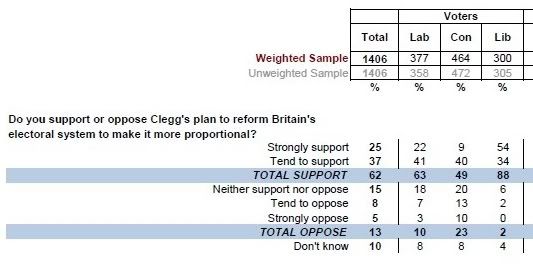
In itself this is an emphatic endorsement for changing the voting system, but the full poll details have now appeared on the YouGov website, and they show something even more extraordinary:


As we'd expect, LibDem voters support a more proportional system by 88% to 2%, but look at the figures for Labour and Tory voters: Labour voters want it by 63% to 10% and even Tory voters want it by 49% to 23%.

So the real question to ask is why the Labour leadership want to disregard the views of their supporters and opt for the Alternative Vote—something which I believe is an improvement on First-past-the-post but which does not contain any element of proportionality—and why the Tory leadership doesn't want to change the system at all.

Are the leaderships of these parties so out of touch? I doubt it. I think it is another example of politicians in the two big parties wanting to maintain a system that gives them, each in their turn, an artificially inflated number seats in the Commons.

-

This should strengthen the hand of the parties that want to see the Single Transferable Vote introduced. In particular it should help the LibDem negotiating team reject Labour's option of introducing the Alternative Vote without the need for a referendum, playing on the fear that if there were to be a referendum it might be lost, so that it would be better not to risk it.

The poll shows very clearly that if the referendum included STV as an option, the majority of us would vote for it.

Bookmark and Share

Game changing

I would not want to second guess the outcome of the current talks between the LibDems and Tories, even thought they have faltered. It may well be that both sides have gone as far as cordial negotiation can take them, and the LibDems now need to play hard ball to force them to go further, by turning to talk to Labour instead.

And so they have. The news that George Osborne has offered a referendum on AV but not STV has just broken as I'm writing this ... which is a clear indication of what the sticking point was, and how far short of what was required the Tories' previous offer had been. It now matches Labour's referendum offer ... but it still won't be enough. The referendum must include STV as one of the options. In my opinion it isn't worth trying to cobble together the sort of compromise that the Jenkins Commission came up with. Let's put the real thing on the table (alongside the Tory and Labour options of course) and leave it up to us the electorate to decide which we want.

-

But the beauty of the situation—from Plaid's point of view—is that even if Labour and the LibDems can agree, they don't have the numbers to get a majority. They need others. Now of course Plaid, the SNP and the Greens want to see STV included in the referendum even more than the LibDems, if that were possible. So, even if the LibDems are tempted by Labour to compromise on STV (by offering AV plus for example, along with a whole host of cabinet seats) they won't get it through because they need our support as well.

My message is exactly the same. We have a once in a generation opportunity to get a fair electoral system. We must not let it slip.


Update 19:55

Just heard on Channel 4 News that Labour are now offering a whipped vote on AV—that means we would get AV without the need for a referendum—followed by a referendum on a system with an element of proportionality. I have to say that this sounds a little dodgy to me. I'm not entirely sure about whether it's constitutionally possible, but that's hard to determine in a state that doesn't have a constitution. The default position is probably that parliament can do whatever it wants unless it's challenged.

Bookmark and Share