This is the second of the two things I wanted to highlight from Gordon Brown's speech yesterday.
Hearing Gordon Brown say he is in favour of electoral reform is a bit like hearing Peter Hain saying he's in favour of law making powers for the Assembly. Their thinking is exactly the same:
Do as little as possible, make sure that your own party will be the main beneficiary of any change ... and leave everything until it's too late for you to be able to implement it.
I've already said what I think about the Alternative Vote here and here. In a nutshell, it's nowhere near as good as STV, but I think that a small deliverable change is better than no change at all.
If Gordon Brown wanted to be positive he could easily have introduced legislation for a referendum on this right now, in the seven months he has left at Downing Street, with a binding referendum being held on the day of the election. It could be combined with a question on fixed-term parliaments.
Only a few months ago—when Gordon Brown's position as Labour leader was under threat and Alan Johnson was one of those put into the frame to replace him—electoral reform seemed more likely than it had been for some time. Things went quiet when he was given the job of Home Secretary instead but, from what I've picked up in a few conversations, electoral reform was being spoken about quite earnestly behind the scenes. This seemed to be confirmed in tonight's edition of Newsnight, in which Michael Crick said that some senior figures he had spoken to were taken by surprise at the announcement, but still hoped to be able to change this and adopt stronger proposals.
Perhaps it is still possible to change this but, as much I'd like to see it, I doubt it will happen. The Prime Minister has now defined "his" position, and he is likely to doggedly hold on to it at all costs.
So, far from Brown's announcement that there will be a referendum if Labour win the next election being something positive or radical, it is in fact a cop out. He bottled it.
I said there might be something nasty in the small print about the cost of the care proposals announced yesterday. I haven't seen anything in print, but on Sky News this morning Gordon Brown said it would cost £350m for the first year and £670m for the second ... so the total is already much higher than reported yesterday and now stands over the £1bn mark. He said the portion that isn't coming from the NHS budget would come from Local Authorities, through ... yes, you guessed it ... efficiency savings.
Nobody reading this needs me to tell them that this is a joke. It is two-faced: a UK Government proudly announcing that they are going to do something new in England, but relying on local government to pay for most of the costs. Councils won't be able to do it without increased funding from central government.
So we are left with this:
• Labour in Westminster obviously think free personal care is a good thing.
• But they have never been prepared to finance it at any time over the previous twelve years. When they had the opportunity do so so, they had other priorities.
• So they announce it within a few months of the end of their term of office, on a heavily back-end weighted programme (nearly twice as much in the second year as the first).
• They then will leave it as a headache for the Tories to pick up, knowing that the Tories will either have to water it down, scrap it, or fund it using one of the mechanisms Labour themselves had decided on only a few months ago.
• So whatever the Tories do, Labour will claim that they introduced "free personal care" and the Tories snatched it away again.
It can only be hypocrisy ... spin, if you want to use a gentler word.
Meanwhile, in Wales, we now have a situation in which care charges are capped at £50 a week. In contrast to what Gordon Brown has just promised this, although more modest, was a commitment that was actually deliverable and has now been delivered.
It is also worth noting that the figure in the BBC report for those who pay for Council-provided personal care in Wales is 14,000 out of 3m, or 4.66%. I think it's fair to say that our proportion of old people in need of care is not going to be lower than in England or Scotland, so the difference can only be that the remainder are already getting such care for free.
The first thing I would note is that providing free care for 350,000 of the "most needy" is likely to leave a substantial number of "less needy" people in the same position as they are now.
This is a graph of those receiving home care (as opposed to residential care) in Scotland:
40,000 in a population of 5.1m is 7.84%, and the number must have increased in the last four years. In contrast 350,000 in a population of 51m is 6.86% I'm not entirely sure of all the swings and roundabouts concerning entitlement in England as compared with Scotland, but it seems obvious that a smaller percentage of English people will benefit.
-
Now, as the changes in Scotland were introduced when Labour were in government there, it seems reasonable to ask why it has taken so long for UK Labour to change their minds on the issue. For me, the announcement that this is to be free is quite astounding given Labour's position only a few short months ago. This is from a BBC report in July:
Ministers are looking to revamp the way the £6bn social care pot is divided up.
The current system targets the poorest. And while they will still get extra help under the plans, the government is proposing to extend the state's contribution to everyone. But in return it wants to bring the public on board as direct contributors to the system.
Ministers ruled out raising taxes and instead put forward three options whereby the state provided a basic package and the public contributed the rest. This could either be done through paying any costs themselves, taking out insurance or introducing a compulsory fee.
As Labour's U-turns go, this is one of the most remarkable. "Free" can only mean that it is going to be paid for out of general taxation. The details are sketchy right now, but the reports are that "less than half" (£400m according to the BBC) of the £870m over two years will be found from the English NHS budget. As no-one is now talking about compulsory fees or insurance, it must (unless there's some nasty small print) mean another £470m or so will be new money from the Treasury.
And this of course will benefit both Wales and Scotland, as we will get a Barnett Consequential on this new money.
-
So the big question for us is what will happen in Wales. Plaid's position is quite clear. This is from our 2007 manifesto:
Free Care
Plaid believes in securing free care provision for older
and disabled people, in principle and as an aim. We reject
the distinction between nursing and personal care. Intimate
personal care can not be described as optional or a matter
of convenience for the patient. By linking entitlement to care
given by nurses, the current funding structure leads to older
people and disabled people being denied appropriate care
thereby causing preventable health deterioration and often
hospitalization.
We set this out as a two-stage process: first to cap and then to scrap care charges for the elderly.
And we did manage to get at least the first part of that commitment into the One Wales Agreement. Local authorities will only be able to charge a maximum of £50 a week for home care services, a change announced in June.
The Barnett Consequential on what was announced today will enable us to do more. It will work out at roughly £27.5m over the two years. But to make Council-provided domiciliary care free for all the 14,000 people in Wales that use it (assuming they all pay £50 a week) would cost a maximum of about £70m over two years.
So we will still have tough choices to make, and especially given the general constriction in our Block Grant over the next few years. But remember that England's "most needy" old people needing care will only be a fraction of the "all" that Plaid is aiming for.
Yes, as I said in the previous post, Glyn Davies seems very eagar to show his credentials as a potential writer for the Daily Mail. This time he's done a piece about the CellNass biomedical archive at Mochdre, Newtown.
I won't repeat it all, but I will highlight this sentence towards the end:
I do hope it's not the Assembly Government's prejudice against the private sector at work again.
Once again Glyn seems to want to get in a little dig against the what he wants others to think is the Welsh Government's "prejudice" against private companies like this.
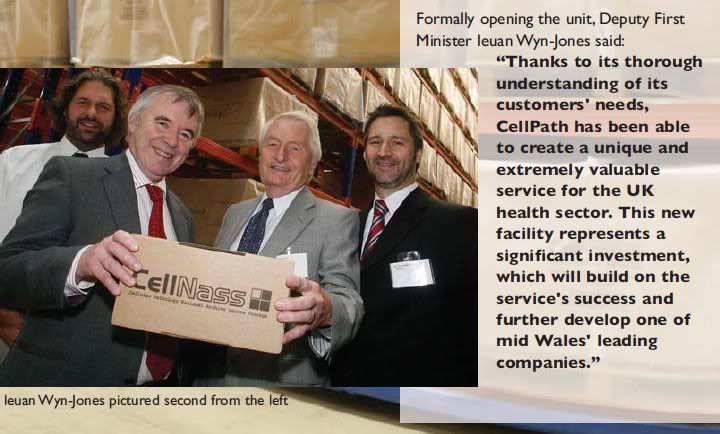
In fact, this facility was set up with the help of aid from the Welsh Government, and opened by none other than Ieuan Wyn Jones himself. We can read about it in the company's own magazine which has this picture and quote on the front page:
If England wants to privatize aspects of their National Health Service, that should be entirely up to England to decide. But it gives us in Wales the opportunity to do their work for them instead ... and we have an Assembly that is proactive in encouraging companies like this to set up facilities here when they could just as easily set them up somewhere in England instead.
That isn't a narrow party political issue either (for I'm sure the aid was arranged before Plaid were part of the Welsh Government) it's simply an example of devolution enabling us to bring skilled jobs to Wales. Yet Glyn Davies wants to paint a picture of "prejudice against the private sector at work again".
-
Please keep this up, Glyn. I thought the odds against Heledd winning Montgomeryshire at the election were long ... but you're gallantly doing what you can to shorten them. Which is all for the best, really. I'm sure writing stories like this for the Daily Mail will be a better match for your talents than being an MP.
I suppose no-one should be too hard on Glyn Davies. Faced with Lembit Opik as the incumbent MP, he probably feels that writing a piece worthy of the Daily Mail would be one rung higher on the ladder down to hell than writing for the Daily Star. This probably explains why he's chosen to write a blog entry that displays the journalistic skills the Daily Mail has honed to perfection.
Glyn would have us believe that he went to the Powys Council website to find the dates of the half-term school break:
Council-speak
We wanted to know when half-term fell this year, so checked the Powys County Council web site. It informed us of the following;
Non-pupil days may be varied into alternative dates within a school year, other than pupil school days, subject to a minimum of one term's notice to the Heads of Schools and Inclusion. If schools wish to vary a non-pupil day into a pupil day, this change can only operate on a catchment basis and must involve all the schools in a particular high school catchment area to avoid increasing the Authority's transport costs. Up to 3 of the 7 non-pupil days may be converted into twilight sessions, subject to a minimum of one term's notice to the Heads of Schools and Inclusion, with one non-pupil day being deemed to be the equivalent of 3 twilight sessions of 2 hours each. The calender allows for 188 school days and 7 non-pupil days in line with legal requirements.
Well yes, it does say that. But if we look at the document itself, we can see that what Glyn has quoted is only a footnote from the bottom of the page.
What the same document says much more clearly in the top half of the page is that Powys's half term is from 26th to 30th October, with the Friday before (the 23rd) as a non-pupil day.
In other words Glyn had got the information he wanted, but then went out of his way to convey the impression that Powys Council could not give him that simple piece of information, and had instead resorted to gobbledygook.
-
It's cheap political spin. No doubt with the sub-text of wanting to convey the impression that the Tories would make sure that residents and taxpayers would get simple, straightforward information if they were in charge.
Glyn Davies might be a decent Tory ... but he's still a Tory. And that means he'll still do all the cheap things we expect Tories to do in the run up to an election.
In my post on Tuesday about the fiasco over proposals for translation of the Assembly's Record of Proceedings and, in particular, the compromise announced on Monday, I said:
I'm only left wondering what the precise logistics will be, because they surely won't publish one version of the Record with the English translation immediately, then publish another version with both translations a week later. That would just be more work and money wasted. So I'd be willing to bet we just have the same version as we have now, but published after three days. If they leave it any longer, then those who need the translation into English will start complaining loudly enough.
I lost that bet.
As we can read on Vaughan Roderick's blog today, the Assembly Commission have gone and done exactly that. As this both unreasonable and illogical, I can only conclude that the Assembly Commission are playing a game of silly buggers.
-
As I said in the previous post, the obligations which the Assembly have undertaken with regard to translation are set out in their Welsh Language Scheme. In it there is no mention at all of the timescale for producing a translated Record of Proceedings. There is no obligation on them to produce it within 24 hours, or three days ... or even a week! Therefore, if they had taken the decision to delay releasing the Record for a day or two (in order to, as they claim, save money on translation) that decision would have been entirely consistent with their obligations.
However, if they decide to translate from Welsh to English first ... and then wait another few days before translating from English to Welsh, they are very clearly not treating both languages equally, and are therefore breaking not only their own WLS, but also the basic principle behind the 1993 Act.
As I said, if they had chosen to produce the full bilingual Record after a few more days, the Welsh Language Board would have had no grounds to step in. But by choosing to do it as a two-stage process, the Assembly Commission has now given the WLB new grounds to step in. Indeed it is their job to do exactly that.
But leaving obligations and legal matters to one side, the route the Assembly Commission has now taken is quite obviously perverse. The stated idea behind the change was to save money. Producing two separate documents costs more money than producing one. It is also inefficient from the point of view of the translator's time, which of course equates to even more money. Previously a translator would have worked on both at the same time, now the same translator is being asked to think in two languages but translate in only one way ... and then put that work to one side for a day or two, only to have to come back to it, do the very same thinking all over again, and translate it the other way.
No rational person could propose doing things in such a way. The decision is perverse and illogical. That is what why this decision can only, in my opinion, have been taken as some political point scoring exercise. Dafydd Elis Thomas seems to be on some sort of crusade against the WLB because they had the temerity to challenge the Commission's original proposal.
There is one other point to raise. This "saving" was first put forward as part of the budget proposals. These budget proposals need to be approved by the Assembly. They haven't yet been voted on. Yes, it is the Commission's job to make day-to-day management decisions about how the Assembly operates. But this is not a "day-to-day" decision ... and neither was it presented as such. It was presented as part of the annual budget proposal. Therefore the Commission is completely out of line to make any change to the existing arrangements before the annual budget has been approved.
-
But as a word of advice to any AM who might be reading this blog, I would urge you not to insist on producing a fully bilingual version of the Record within 24 hours when (as it surely must be) the matter is debated in Plenary. If the current arrangement requires overnight work (though I'm not convinced it does) then there probably is some scope for saving money by doing it during normal working hours instead. Agreeing to publish the Record on-line by the end of the next day would achieve this. So why not compromise on "within 36 hours" and let everyone come away from this sorry episode with some of their dignity left intact?
This blog has been set up to complement the Syniadau Forums.
Much of what will appear on this blog will also appear in the Syniadau Forums, but the emphasis on this blog is slightly different. The forums are focused more on the structures and institutions that Wales will need to develop in order to become a successful independent nation, arranged on a subject by subject basis, but the blog will have more of an emphasis on day to day political news and developments.
People are welcome to reply or leave comments either here or on the Syniadau Forums. If anyone wants to initiate a new subject they are very welcome to do so there.