Not enough Welsh-speaking teachers

This story in WalesOnline about head teachers getting younger reminded me that the General Teaching Council of Wales publishes an annual digest of statistics about teachers and newly qualified teachers. This year's digest is here.

One thing about the statistics is depressingly constant: there is no significant increase in the numbers of teachers who speak Welsh or are able to teach in Welsh. These are the figures for all teachers in Wales, click the image to enlarge it:


The percentage of Welsh-speaking teachers would, at first sight, appear to have gone up slightly from 31.7% to 32.5% over the last five years. But the number of teachers that can't speak Welsh has also gone up ... and by even more. All that has actually changed is that the percentage of teachers whose language ability is unknown has gone down. Exactly the same is true for those who are able to teach in Welsh; the apparent small increase from 26.0% to 26.9% is more than offset by the increase in the percentage who can't teach in Welsh.

These are the figures for newly qualified teachers registered in Wales:


At least there are no unknowns in these figures, but the increases from 32.3% to 32.8% and 24.9% to 25.3% are so small as to be insignificant. We can also see that the GTCW is persisting with the absurdity of thinking that teachers who can't even speak Welsh, let alone speak it well enough to teach in Welsh, are competent to teach it as a second language. This unprofessionalism (there is simply no other word for it) is the main reason why the standard of Welsh taught in non Welsh-medium schools is so poor.

-

These figures are terrible because they will adversely effect the Welsh Government's ability to deliver two of its fundamental educational commitments: the Welsh-medium Education Strategy and the Framework for Learning for the new Foundation Phase.
 

Welsh-medium Education Strategy

The Welsh-medium Education Strategy was published in 2010 and is available here. Fairly obviously, all teachers in Welsh-medium schools (and the Welsh stream of dual stream schools) need to be able do more than speak Welsh, they need to be able to teach in Welsh. But only 26.9% of the current pool of teachers in Wales can do so, and only 25.3% of newly qualified teachers can do so, which means the pool is actually diminishing rather than growing.

The WMES targets for the percentage of children assessed in Welsh to first language standard at Year 2 is 25% by 2015 and 30% by 2020. For Year 9 the figures are 19% and 23%. These targets simply cannot be met without a broadly proportionate number of teachers who are able to teach in Welsh, particularly in the primary sector. In fact the percentage of teachers needed might well be higher because many traditional Welsh-medium schools are in more rural areas with smaller schools and lower than average pupil to teacher ratios.

It's very hard to draw any conclusion other than that the WMES is heading for ignominious failure unless urgent action is taken to turn things around. So far there have been two interim reports on progress to meet the targets in it, which I talked about here and here. Between the first and second reports the percentage of Key Stage 1 assessments in Welsh to first language standard (Outcome 1) was up only 0.1% to 21.9%, and the percentage of Key Stage 3 assessments in Welsh to first language standard (Outcome 2) was up only 0.3% to 16.3%. I don't think it's any coincidence that the minuscule increase in Welsh first language assessments goes hand-in-hand with the minuscule increase in newly qualified teachers who can teach in Welsh.
 

Foundation Phase Framework for Learning

The Framework for Learning is the curriculum that governs the new Foundation Phase for all 3 to 7 year-olds in Wales. It is available here. There are seven major areas of learning, one of which is Welsh.

It's important to realize that this focus on Welsh in the Foundation Phase applies to all schools in Wales, not just Welsh-medium schools. The Framework for Learning spells this out very clearly:

In schools and settings where English is the main medium of communication, children's Welsh language skills should be progressively developed throughout the Foundation Phase by implementing the Welsh Language Development Area of Learning.

During the Foundation Phase, children should learn to use and communicate in Welsh to the best of their ability. Children should listen to Welsh being spoken and respond appropriately in familiar situations, using a range of patterns. They should be encouraged to communicate their needs in Welsh and should be increasingly exposed to Welsh.

Skills are developed through communicating in a range of enjoyable, practical planned activities, and using a range of stimuli that build on and increase children’s previous knowledge and experiences, in safe and stimulating indoor and outdoor learning environments. The children’s oral experiences should be used to develop their reading skills and they should be encouraged to choose and use Welsh reading materials. They should listen to a range of stimuli, including audio-visual material and ICT interactive software in Welsh. Children should be given a range of opportunities to enjoy mark-making and develop their writing skills in Welsh. Language skills learned in one language should support the development of knowledge and skills in another.

I've highlighted the phrase "to the best of their ability" for this reason. As the growth of Welsh-medium education in all parts of Wales demonstrates, children can become competent Welsh speakers to first language standard even when their parents cannot themselves speak Welsh and in areas where very little Welsh is spoken outside school. This shows that every child (except maybe those who have special learning needs) has the ability to use Welsh and communicate in Welsh. So the thing holding children back in non Welsh-medium schools is clearly not their ability to learn Welsh, but the ability of their teachers to teach them Welsh.

This has profound implications. For if we take the Framework for Learning with even an ounce of seriousness, it means that teachers who teach children in the Foundation Phase need to be able to speak Welsh, irrespective of the language category of the school they teach in.

In January of this year, Estyn published a report on Welsh in the Foundation Phase which said this about teaching in non Welsh-medium schools:

Generally, when practitioners' own Welsh is fluent, children's progress in learning Welsh is better. These practitioners use Welsh consistently across all areas of learning. Where there are no confident Welsh-speaking practitioners in a school or setting, the use of Welsh by staff is usually more limited. This means that children hear less Welsh and have less opportunity to practise it. Where there are gaps in practitioners' knowledge, particularly in the grammar, intonation and pronunciation of Welsh, children can learn to speak or pronounce incorrectly. In a few cases, practitioners cannot sustain using Welsh long enough and use a very limited amount of incidental Welsh with the children.

Most settings and schools have very few fluent Welsh-speaking practitioners and many use Welsh television programmes or DVDs to try to compensate for this, so that children can hear more spoken Welsh. However, this approach does not secure sustained progress in learning.

Welsh Language Development in the Foundation Phase – Estyn, January 2013

In many respects this is a statement of the obvious. The GTCW's statistics show that only 32.5% of teachers speak Welsh, and presumably even fewer speak it fluently. Most of these teachers are teaching in Welsh-medium schools (they wouldn't get a job in a Welsh-medium school unless they could) and that means there must be very few Welsh-speaking teachers left over to teach in other schools. There's no exact breakdown, but perhaps as few as one in ten teachers in non Welsh-medium schools can speak Welsh.

-

As I see it, there really is only one practical solution to these problems. The Welsh Government must do whatever it takes to substantially increase the number of primary school teachers who can speak Welsh and teach in Welsh.

No-one would want to put existing teachers out of work, so I think it is better for us to focus our efforts on the way we train new teachers. At present, the minimum requirement to be accepted to train as a primary school teacher is an A*-C GCSE in English, maths and a science. We need to extend this (for Foundation Phase teachers at least) to include an A*-C GCSE in Welsh first language as well, or for prospective teachers to be tested to an equivalent standard. Teaching in Welsh as well as English then needs to be made an integral part of the training course.

The Welsh Government will not be able to meet the targets it has set itself in either the Welsh-medium Education Strategy or the Foundation Phase Framework for Learning unless it takes this sort of radical action.

Bookmark and Share

Imbalances

The EU has just published a further review into the serious macroeconomic imbalances in a number of member states; but what I found more interesting were the imbalances in the way it was reported.

On the BBC website the emphasis was, perhaps rightly, on the worrying situations in Spain and Slovenia; but right at the end they did say that the situation was also serious in eleven other member states, including the UK. What made the reporting bad was that the page carries some prominent red squares about the "Eurozone crisis", yet five of the member states criticized—Bulgaria, Denmark, Hungary, Sweden and the UK—are not even in the Eurozone.

The report was handled even more badly by Reuters. They produced a "factbox" which rightly headlined that the EU report was on thirteen member states, and provided a summary of some of the key points relating to each country. The problem is that they only did this for twelve of the thirteen. The one they conveniently "forgot" to include was the UK. And because Reuters is a news agency, a large number of newspapers and other news media have reproduced the Reuters story almost word for word, therefore perpetuating the imbalance.

For those who are interested enough to get the news from the horse's mouth, the EU report is available from this page, together with in-depth reviews for each of the member states investigated.

-

One of the things that has particularly struck me over than last few years is the way in which the mainstream media have consistently reported what is essentially a debt crisis as a "Eurozone crisis", as if they have a deliberate agenda to present it as a problem which affects "them" rather than "us". This just isn't true. It's the ugly face of a UK isolationism that has become almost endemic. The UK has enormous levels of debt, and while it is true that UK government debt is bad but not as bad as elsewhere, private debt is very much larger making the overall situation in the UK worse than it is for any other large economy. This graphic from Bloomberg Businessweek is about eighteen months old, but it illustrates the scale of the UK's problem relative to other economies.

Not an awful lot has changed since then, and the UK's precarious level of overall debt is one of the main points in the EU report. It's worth noting that government debt is continuing to rise because the deficit between the UK government's income and expenditure has not been brought under control. The UK goverment is certainly cutting public spending with a vengance, but the other side of the equation is income from taxation. While I accept that lowering the tax burden at the bottom end of the scale is a good thing because it means that people have more money to spend on basic consumer goods and services, it doesn't apply to people on middle and high incomes because they will always have enough money to spend on basic goods and services. Fear of properly taxing those on middle incomes is the main reason why the UK is making no headway in reducing its debt.

A second point that is worth noting from the report is that the massive devaluation of the pound since 2008 has only had a very limited effect in boosting exports. One point that most economic commentators in the mainstream media have made ad nauseam over the last few years is that being "tied to the euro" means that the traditional route of currency devaluation is not available, and that countries with a debt problem should therefore get out of the euro and revert to their old currencies so that they can solve their debt problem by devaluation. The idea is that it boost exports by making them cheaper and reduces imports by making them more expensive, allowing the country to trade back into health in the long term. However it certainly isn't having that effect for the UK, and that should put a question mark over whether it would work anywhere else. I suspect their real agenda is to break up the eurozone and, with a bit of luck (from their perspective), bring down the euro itself. I think that's always been a forlorn hope.

-

But I want to end on a positive note. From Wales' perspective, I think it would be worth noting this part of the EU's in-depth review for the UK:

As regards the challenge of increasing external competitiveness, many of the drivers of the UK's persistent trade deficit relate to structural weaknesses that disproportionately impact upon capital-intensive sectors and goods' producers.

Firstly, the competitiveness of the UK economy could be boosted by addressing shortages in airport and seaport capacity, by tackling road congestion and by upgrading the rail network. This would entail meeting the substantial transport infrastructure investment needs indicated in the National Infrastructure Plan 2011, much of which is currently unfunded, by identifying additional sources of funding, addressing high unit costs in transport, and removing regulatory barriers to investment.

Secondly, industrial producers require a labour force with the correct advanced and intermediate technical skills, an area where evidence suggests that gaps and recruitment difficulties persist. Ensuring that the National Apprenticeship Programme effectively equips participants with the professional and technical skills demanded by the tradable sectors of the economy can contribute to closing the skills gap and fostering export performance.

Finally, access to finance is crucial for UK firms seeking to enter, or expand in, exporting sectors. Difficulties in accessing finance are a cross-cutting problem at the current juncture, particularly for smaller and younger companies. It is important that they be addressed at an economy-wide level as well as through specific financing instruments for exporting companies.

UK in-depth review, p4-5

What is true on a UK scale is just as true for Wales. For if the main problem with the UK economy is over-reliance on services at the expense of investment and producing goods, then a smart Welsh government would be able to put Wales ahead of the other countries in the UK by concentrating on these things.

Bookmark and Share

European GDP figures for Wales

When the EU figures for regional GDP are published each spring, the headline is usually that parts of Wales are poorer than some far-flung parts of eastern Europe. True, but somewhat selective. So I thought I'd present a fuller picture.

Wales is divided into two NUTS 2 regions: East Wales, and West Wales and the Valleys. In the first map, the regions that are poorer than West Wales and the Valleys are in green and the regions that are richer are in yellow, adjusted for relative purchasing power between member states, though not within them. The images and data are from here.


As we can see, it's bad. Apart from a handful of poor regions in Spain, Portugal and southern Italy, West Wales and the Valleys is the poorest region in the whole of Western Europe.

But the picture for East Wales is quite different. In the second map, the regions that are poorer than East Wales are in green and the regions that are richer are in yellow. East Wales sits comfortably in the middle.


Perhaps it's more informative to zoom in and look at the position of East Wales within the UK.


East Wales has a higher GDP per head than any part of northern England or the Midlands, with the sole exceptions of Cheshire (which is greyed out in the image, but should be yellow) and Leicestershire/Rutland/Northamptonshire. East Wales ranks above Manchester and Birmingham, and also above Kent, Essex and outer London. These are the figures:

GDP per capita in euros, PPS

Inner London ... 80,300
North Eastern Scotland ... 39,500
Berkshire, Buckinghamshire and Oxfordshire ... 34,900
Cheshire ... 28,800
Gloucestershire, Wiltshire and Bristol/Bath area ... 28,200
Surrey, East and West Sussex ... 27,900
Bedfordshire and Hertfordshire ... 27,500
Hampshire and Isle of Wight ... 26,700
Eastern Scotland ... 26,600
Leicestershire, Rutland and Northamptonshire ... 25,400
East Wales ... 24,600
East Anglia ... 24,500
South Western Scotland ... 24,300
Greater Manchester ... 23,500
Outer London ...23,400
West Midlands ... 23,300
West Yorkshire ... 23,300
Cumbria ... 23,000
Herefordshire, Worcestershire and Warwickshire ... 23,000
North Yorkshire ... 22,800
Derbyshire and Nottinghamshire ... 22,500
Dorset and Somerset ... 22,500
Kent ... 22,000
Essex ... 21,800
Northumberland and Tyne and Wear ... 21,500
Devon ... 21,400
Highlands and Islands ... 21,400
Northern Ireland ... 21,000
Lancashire ... 20,400
East Yorkshire and Northern Lincolnshire ... 19,900
Shropshire and Staffordshire ... 19,900
South Yorkshire ... 19,900
Merseyside ... 19,800
Lincolnshire ... 19,100
Tees Valley and Durham ... 18,900
Cornwall and Isles of Scilly ...17,600
West Wales and The Valleys ... 17,200

PDF version

Statistics can be used to say almost anything, for Wales as a whole is still poorer than any other NUTS 1 region of the UK. The demarcation between East Wales and West Wales and the Valleys is contrived, to say the least. It doesn't follow any natural boundary, but was deliberately chosen so as to make West Wales and the Valleys as poor as possible relative to the rest of Wales in order to maximize the chances of obtaining EU structural and convergence funding. That stroke of genius has resulted in us getting billions of euros more than we would otherwise have got from the EU over the years ... I only wish the same genius had been around when it came to spending it.

Bookmark and Share

An empty victory

I was rather pleasantly surprised to see that Vaughan Roderick has picked up on the same thing that I wrote about in October last year in this post.

The Big Lottery Fund had refused to give a small grant to one of the Papurau Bro—Y Gloran in the Rhondda—on the grounds that the paper is in Welsh only, saying that:

"The terms and conditions of every grant that we give out ask for [the applicants] to make provision for their projects to be in Welsh and English.

"So if they have things like websites or send things out to people, we ask for them to be bilingual; and this is part of the terms and conditions of their grants."

The new Welsh Language Commissioner had argued that it was acceptable to give money to bodies that provided a service only in Welsh if it was to promote or facilitate the use of Welsh. I said that this was the wrong way to look at things, and that it would be much better to get the Big Lottery Fund to stick to its stated policy ... for if the BLF made an exception in favour of Welsh in this case, it would give them carte blanche to carry on giving far more money to projects in Wales that were delivered only in English. In total, some £75m of lottery money is given out in Wales each year by the BLF and other distributors.

-

Thanks to Vaughan's link, we can see that the Big Lottery Fund changed their mind and did make a grant to Y Gloran. Some people might consider this to be a victory, but it is a very hollow one.

As I pointed out before, Crest Cooperative in Llandudno Junction, who were given a quarter of a million pounds of lottery money in 2010, don't have a word of Welsh on their website. And as Vaughan has now pointed out, Tenovus in Cardiff have received just short of a million pounds of lottery money, but the only page in Welsh on their website contains an apology for not having a bilingual website. I'm sure there are many, many more examples.

-

We are our own worst enemies if we are content to let the Welsh Language Commissioner beg for an exception to bilingualism in order to get a few crumbs of grant aid for one local paper delivering a service in Welsh only, but for her not to stand up and challenge bodies like the Big Lottery Fund for the far greater amount of money they give to charities and organizations in Wales that deliver projects only in English.

She should not be begging for exceptions, but taking the Big Lottery Fund to court for breaching its own terms and conditions by making such grants. And if Meri Huws is so compromised that she feels she can't now do it, then charities and organizations in Wales that are committed to work bilingually should be taking the Big Lottery Fund to court, because every pound of lottery money that has been given to monolingual projects in Wales could and should have been given to bilingual projects instead.

Charities and organizations in Wales should be completely free to operate monolingually if they wish; it's just that they should not expect to receive money from the Big Lottery Fund if they do. Those are their rules.

-

Vaughan ended his post by quoting from Julius Caesar, but a better quote from the same play might be:

The fault, dear Welsh, is not in our stars,
But in ourselves, that we are underlings.
Welsh and English: what should be in that "English"?
Why should that tongue be sounded more than yours?
Write them together, yours is as fair a tongue;
Sound them, it doth become the mouth as well;
Weigh them, it is as heavy; conjure with 'em,
Welsh will start a spirit as soon as English.

Julius Caesar: Act 1, Scene 2 ... ish

Bookmark and Share

A complete farrago

Farrago is a good word to describe the hotchpotch of confused and conflicting ideas that UKIP claim to hold. Their aptly named leader provided a perfect example of this yesterday when he said:

"The EU states will simply never agree to give back powers to the nation states. The EU wants more power not less."

Daily Express, 3 April 2013

Where do we begin to unravel this strange utterance? I could start by saying that the "EU states" and the "nation states" he talks about in the first sentence are usually the very same thing, making the sentence complete nonsense. I could point out that the UK is itself an "EU state" so that, by Nigel Farage's strange logic, the UK "will simply never agree" to any repatriation of powers to itself either ... which is again complete nonsense.

-

So it might be better to ask why UKIP regard the UK as different to most other EU states. Nigel Farage has in fact touched on the answer without realizing it: namely that the UK is not a "nation state" at all, but a collection of nations.

UKIP's fundamental hostility to the EU stems from the fact that both the EU and the UK aim to do exactly the same thing. I fully agree with UKIP that we don't need both. I disagree with them about which one better serves the interests of Wales.

-

The principle behind both the UK and the EU is that countries are stronger when they act together on matters of shared interest. But there are some very fundamental differences between the two:

•  The UK was mainly established and enlarged by force. The EU was established and enlarged entirely by mutual, democratic consent.

•  The UK is dominated by one country which, with 83.9% of the population, can impose its wishes on the remainder of the UK irrespective of what the other parts of the UK want. The EU is not dominated by any country, the largest has only 16.3% of the population and its voting rights as a proportion of its population are even smaller.

The structures of the EU are carefully designed to give small countries a bigger say. In fact as individual member states of the EU, the countries of Britain would collectively have much more of a say in the EU than the UK has at present. The UK currently has one member of the EU Council, one commissioner and 72 MEPs. As separate member states Wales, Scotland and England would have three members of the EU council, three commissioners and probably 88 MEPs. On current parities, Wales would have 9 MEPs (the same as Lithuania) instead of 4, Scotland would have 13 MEPs (the same as Slovakia or Denmark) instead of 6, and England would have 66 MEPs (between Italy's 72 for 60m and Spain's 50 for 38m) instead of 59 ... although this would be rounded down for all member states as new states join because the maximum number of MEPs is limited to 751.

•  And finally the UK is very much smaller than the EU. Why would anyone in Wales want to be in a single market trading block with England, Scotland and Northern Ireland rather than be a member, in our own right, of a single market trading block that includes most countries in Europe?

Bookmark and Share

National Savings & Investments is the joke

Because of the date, I wasn't sure whether this article on the BBC website yesterday about National Savings and Investments scrapping their Welsh language service was meant to be a joke or not and, to be honest, I'm still not entirely sure. So, at the risk of making a fool of myself, I'll treat it seriously.

Apparently, NS&I are proposing to end all Welsh language services on 22 April this year. The reason they give is that they are "not a cost effective use of public funds", saying that only 107 people corresponded with them in Welsh and that this worked out at about £900 per customer.

The first thing to note is that this is a minuscule amount in relation to the sums of money they handle. It works out at £96,300. This is less than a millionth of the £98bn of savings that they manage on behalf the Treasury, a total that represents 16% of the entire UK national debt (details here).

The second thing to note is that they are legally obliged to provide a service in Welsh, in accordance with the Welsh Language Scheme they agreed with the Welsh Language Board in 2007. It is quite inconceivable that a public body should renege on an agreement they freely entered into, for there is nothing in the agreement that makes the provision of this service dependent on the number of people using it. It's a red herring.

-

But, that said, the whole problem with Welsh Language Schemes was that there was no way that they could ever be enforced. All the Welsh Language Board could do was conduct an investigation and "name and shame" any organization that broke the terms of their agreement. This was the main reason why the new Welsh Language Measure gives the Commissioner power to take the matter to a tribunal and impose a financial penalty on organizations that fail to comply with the new Language Standards. However, because we do not as yet have any Language Standards, there is nothing to enforce.

Until then, the Commissioner keeps the residual power of the WLB to investigate breaches of existing WLSs, and it is all but certain that Meri Huws will produce a suitably damning—but entirely deserved—report in due course. However that won't, in itself, change anything in the short term. The only real hope of getting NS&I to reverse the decision before it is implemented is by public and political pressure. I trust that the right people will step up to the plate to bring them into line.

In the longer term, everything will depend on the Language Standards that are eventually approved. So I hope that this episode will convince both Leighton Andrews and the Welsh Government that these will need to be strong and strictly enforced. With that in mind I'd like to look at the specifics of this case, because I think it will shed some light on what needs to be done.

Although NS&I is an agency of the Treasury, its day-to-day operations have been contracted out to private organizations. The service was previously run by Siemens IT Solutions and Services, but they were bought out in 2011 by a French multinational operating under the name of Atos IT Solutions and Services. Atos, for those who don't recognize the name, is the very same multinational that is responsible for managing Work Capability Assessment on behalf of the Department of Work and Pensions, and will implement the new Personal Independence Payment that is set to replace the Disability Living Allowance. In short, they are the organization charged with implementing, and given incentives to implement, some of the most draconian aspects of the ConDem coalition's programme of cutting back expenditure on services to the public. With such a remit, it shouldn't come as too much of a surprise that they would look to look to penny-pinch a sum that represents less than a millionth of the money they manage for NS&I.

A second factor is that NS&I has radically changed the way it operates. Shortly after Atos took over the contract, they announced that products would only be available by telephone or online. Premium Bonds are now the only things available over the counter at Post Offices. This decision was obviously taken to save money, and that is not necessarily a bad thing ... except that it is a contributory factor in the viability of Post Offices and is bound to lead to more of them closing. But it does go a long way to explain why so few people deal with NS&I in Welsh. NS&I simply doesn't provide either a telephone or online banking service in Welsh. Some basic, very limited, information about their services is available in Welsh, but you cannot register for or access these services in Welsh. It can only be done in English.

This is, of course, the main reason why so few people use the Welsh language service. If you telephone their English line, you can talk about and get specific answers about your accounts. The only way you can get any specific information about your accounts in Welsh is by post. The choice is either to spend time, effort and money to get an answer in Welsh several days later, or to get an instant answer via a freephone number in English. You can't even get specific information about your accounts by email.

The reasons they give for this are tired and predictable, but still laughable. They say it is "er mwyn eich diogelwch" or "for your security". But do they seriously believe that a breach of security is more likely by someone, somewhere in the world, hacking a phone conversation or online communication in Welsh than it is in English? There must be more Welsh speakers in the world than I thought.

-

There is silver lining to this. It shows in the clearest terms what silly excuses and underhand practices even an agency of government will resort to in an attempt to avoid its duty of providing an equal service to the public in both English and Welsh. We can, and need to, learn from this. The underlying rule in formulating the new Language Standards must be that whatever service is provided in English must also be provided in Welsh. An equal telephone banking service. An equal online banking service. Equally available information and publicity.

Anything less would be a joke.

Bookmark and Share

A new bridge

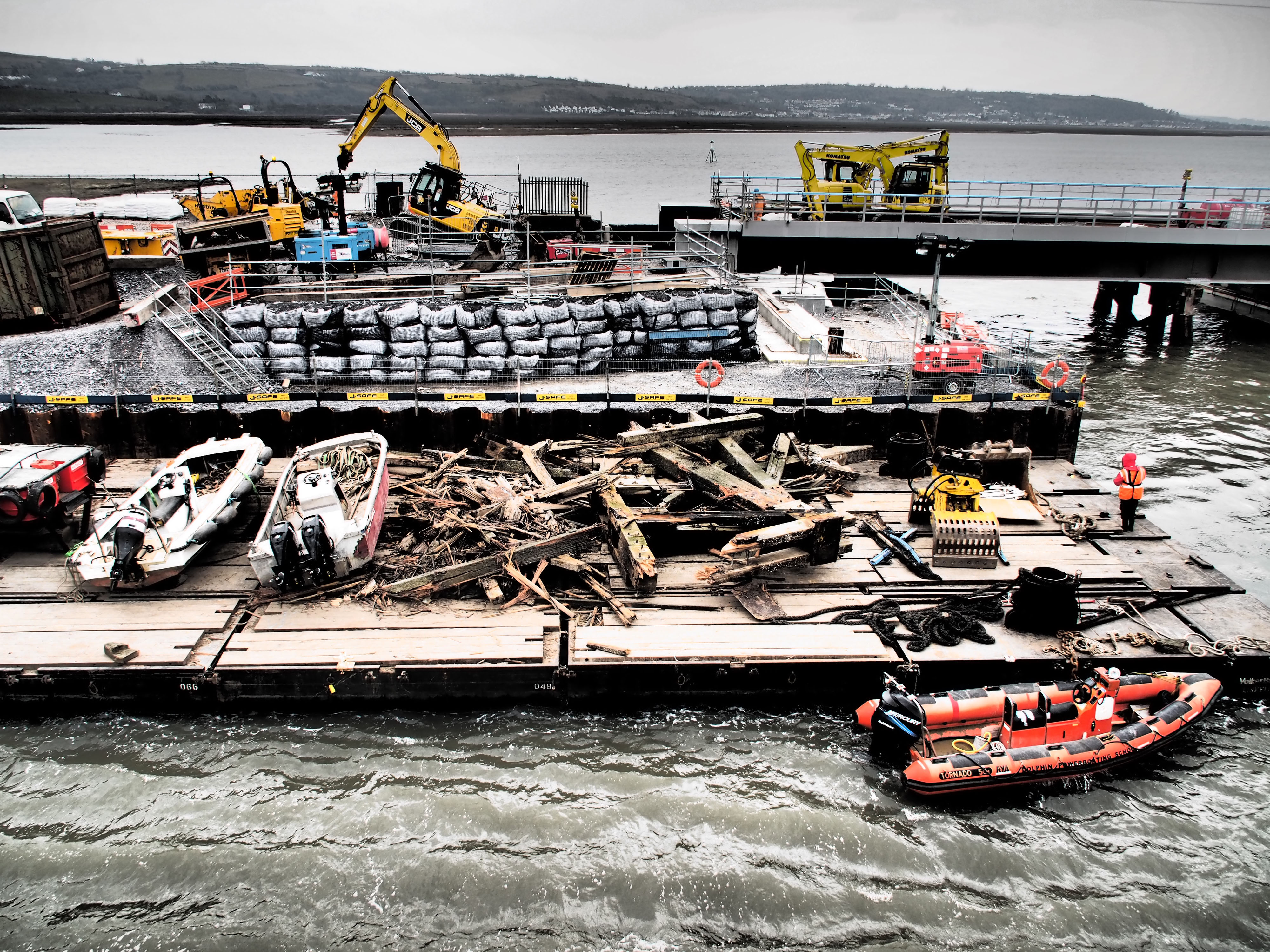
I came across a couple of rather dramatic images of the new Loughor Rail Bridge, taken by Gareth Lovering over the weekend:


Another week, and both the bridge and the track redoubling should be complete; bringing much better rail connexions between civilization and the more benighted regions to the east. It can only help.

Lots more pictures here.

Bookmark and Share