School reorganization in the Vale

In many respects the Vale of Glamorgan's education policy over the last few years has been forward-looking and positive, particularly the way they responded to a survey showing that the demand for Welsh-medium education was much greater than the provision, and quickly moved to establish two new Welsh-medium starter schools, one in Barry and one in Llanilltud Fawr. Details are here and here.

That makes the reports in the Glamorgan Gem and Western Mail about the impending closure of three schools in the Vale—Llanfair Primary and Llancarfan Primary in the rural Vale, and Oakfield Primary in Barry—appear to be something of a departure from their previous standards. The details of the proposals have not yet been published, but I'd like to offer a few comments on matters that don't seem to have been raised in the reports so far.
 

Llanfair and Llancarfan Primary Schools


These two schools in the rural Vale are remarkably similar in several respects. They are both located in small villages some distance away from any alternative school and serve large but sparsely populated areas. They are also about the same size. From last year's school census, Llancarfan has 109 children of statutory school age and Llanfair has 114, although Llanfair also has nursery age provision. For a rural area these are very healthy numbers, and are certainly not low enough to justify any thought of them being closed on account of their size. To put things in perspective, only last week Ceredigion announced that they were reprieving Ysgol Dihewyd, which has fewer than 20 pupils.

The average year size in each school is just over 15 compared with an admission number of 18. This means that both schools are comfortably full with very few surplus places. In fact in both cases the original school premises were too small, and they have therefore had to rely on additional temporary accommodation for many years. In itself, this would be a source of concern which might justify a degree of rationalization; however both schools have been enlarged within the last few years. It is complete lunacy to contemplate closing schools which the council has only recently invested considerable amounts of money to permanently enlarge. There must surely be a degree of continuity between one administration and another, otherwise taxpayers' money will simply have gone to waste.

Finally, both schools are rated very highly by Estyn. The reports are here and here.
 

Oakfield Primary School


The situation at Oakfield is rather different. It is in an urban location in Barry and there are five other schools within easy walking distance of it: Cadoxton, Colcot, Gladstone, Holton and Jenner Park. Based on a capacity of seven times the Admission Number, all these schools have surplus places. These are the figures for statutory age children (i.e. excluding nursery provision) for 2012:

Cadoxton ... 413 capacity ... 331 on roll ... 82 surplus places (20%)
Colcot ... 406 capacity ... 237 on roll ... 169 surplus places (42%)
Gladstone ... 350 capacity ... 329 on roll ... 21 surplus places (6%)
Holton ... 525 capacity ... 344 on roll ... 181 surplus places (34%)
Jenner Park ... 273 capacity ... 199 on roll ... 74 surplus places (27%)

Total ... 1,967 capacity ... 1,440 on roll ... 527 surplus places (26%)

Oakfield ... 210 capacity ... 89 on roll ... 121 surplus places (58%)

Source for capacities | Source for numbers on roll

This level of surplus places is clearly unsustainable and at least one of these schools needs to close, even allowing for future population growth. In such a situation the only question is which.

Oakfield is an obvious choice for three reasons. First, it is not a good school. It's inspection report from Estyn is terrible, classed as "unsatisfactory" on every key question. This is as bad as it can be. So if we put any weight behind the idea that we should not close schools that perform well, it stands to reason that those which perform badly should be first in line to be closed ... providing that there are other, better schools in the same area with enough surplus places. The two closest alternatives, Colcot and Jenner Park, are only a few hundred metres away. So no family will be inconvenienced by the closure.

Second, Oakfield has by far the greatest percentage of surplus places and is now more than half empty. The unpopularity of the school must be linked to its poor performance, and parents are obviously voting with their feet. It is therefore pointless to keep the school open for much longer.

The third reason for choosing to close Oakfield is that it shares the same building with Ysgol Gwaun y Nant. This Welsh-medium school is rated Grade 1 by Estyn on every key question, and is understandably growing both on the strength of its good reputation and because of the general increase in demand for Welsh-medium education. It therefore makes perfect sense for Ysgol Gwaun y Nant to gradually expand into the space currently taken up by Oakfield Primary. Furthermore, there is no reason why this cannot be phased over a few years so as to minimize disruption to children already at Oakfield.

-

In short, I think the Vale of Glamorgan would be wrong to close either Llanfair or Llancarfan Primary Schools, although perhaps there might be a case for administrative savings such as federalizing the schools under a single headteacher and board of governors.

But the closure of Oakfield Primary seems to be entirely justified both in terms of value for money in reducing surplus places and—much more importantly—because it provides a substandard quality of education to the children who go there.

Bookmark and Share

David Jones must be sacked

I've pondered for a while over whether to say something about David Jones' extraordinary comments on Face to Face earlier this week, and his subsequent explanation for them. Of course I have nothing particularly new to add that hasn't already been said by hundreds, if not thousands, of people; but I've decided that I need to add my voice because his comments are of a nature that cannot be ignored. We cannot turn a blind eye to bigotry and prejudice against any section of our society, especially when it comes from those who hold positions of power in government.

First, we need to be clear about exactly what he said. This is the relevant extract from the interview:


"Certainly, in constituency terms, I felt that overwhelmingly the constituents of Clwyd West were opposed to the change. But also I regard marriage as an institution that's developed over many centuries, essentially for the provision of a warm and safe environment for the upbringing of children, which is clearly something that two same-sex partners can't do. Which is not to say that I'm in any sense opposed to stable and committed same-sex partnerships."

Face to Face, ITV Wales, 14 February 2013

Although I disagree with his decision to vote against equal marriage, that in itself is no reason for him to be sacked. The reason David Cameron should remove him from his cabinet position is specifically because he said that same-sex partners cannot provide a warm and safe environment for the upbringing of children. He made a blanket statement—to use his own words from the same interview, we might call it a crude characterization—which is not only patently untrue, but grossly offensive to the many same-sex couples who do provide a warm and safe environment for the upbringing of children.

I would have hoped he might look again at what he said in the interview and apologize. In the stress of an interview it is all too easy not to express things as clearly as one would have liked. But instead of doing so, he tried to justify himself by making this statement:

"I was asked on the Face to Face programme why I voted against the same-sex marriage proposals. I replied that I had done so on the basis that I took the view that marriage is an institution that has developed over the centuries so as to provide a safe and warm environment for the upbringing of children. I made the point of stressing that I was fully supportive of committed same-sex relationships. I also strongly approve of civil partnerships.

"I did not say in the interview that same-sex partners should not adopt children and that is not my view. I simply sought to point out that, since same-sex partners could not biologically procreate children, the institution of marriage was one that, in my opinion, should be reserved to opposite-sex partners."

ITV Wales, 15 February 2013

This is a classic example of studiously missing the point. Nobody is in any doubt that a marriage between opposite-sex partners can provide a warm and safe environment for the upbringing of children. The point at issue is that David Jones made the blanket assertion that same-sex partners cannot provide that sort of environment. That is bigotry, pure and simple.

For me, the obvious question is why, if he really does believe that same-sex couples cannot provide that environment, he is in favour of same-sex partners being allowed to adopt children. In any adoption the well-being of the child is paramount, and no child should be adopted by any couple—whether gay or straight—which cannot provide a warm and safe environment for that child to grow up in. It is self-evident hypocrisy for David Jones to claim he is in favour of same-sex partners being allowed to adopt if he believes that same-sex partners are incapable of providing it.

Prejudice, offensiveness, bigotry and hypocrisy should not be tolerated from any politician of any political party. That is why he must be dismissed from his position as Secretary of State for Wales.

Bookmark and Share

The EU needs to prepare for the inevitable

I'm sure many of you will have noticed from the blog list on the right that the Catalan Parliament this week approved a Declaration of Sovereignty as one of the steps leading towards a referendum on independence in 2014. The full text of the Declaration is here, and this is a short report from Euronews.


In the clip, Alícia Sánchez-Camacho, the leader of the Spanish Partido Popular in the Catalan parliament, claimed that "most of the Catalonian people don't want independence and don't want this division". And even the report in the Guardian claimed that opinion is "evenly divided" over Catalan independence. But neither of these claims is true.

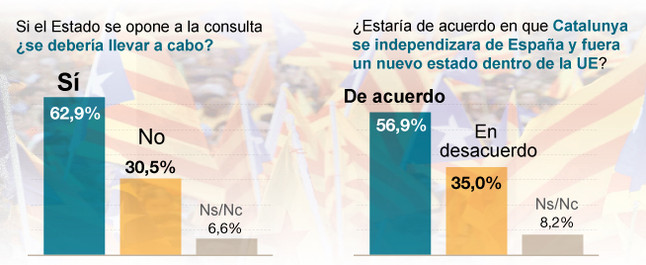
This is a graphic showing the result of a GESOP poll in El Periódico on Sunday:


If the [Spanish] State opposes the referendum, should it be carried out anyway?

Yes ... 62.9%
No ... 30.5%
Don't know/won't say ... 6.6%

Do you agree that Catalunya should be independent from Spain and become a new state within the EU?

Agree ... 56.9%
Disagree ... 35.0%
Don't know/won't say ... 8.2%

GESOP poll for El Periódico, 20 January 2013

The percentage in favour of independence is almost exactly the same as it was in the Baròmetre d’Opinió Política of November last year, which was 57.0%. Details here. As I said then, Catalan independence looks like a cast-iron certainty.

The EU is an organization that isn't usually inclined to make decisions until it has to. It hasn't particularly addressed the issue of Scotland's place in the EU simply because the opinion polls show that there is a considerable degree of uncertainty about whether Scotland will vote for independence. Nor is it likely to particularly address the UK's place in the EU either, because there's an even greater degree of uncertainty about the Tories winning the next UK election with a mandate to renegotiate the UK's terms of membership and hold a referendum.

But the political will of the Catalan Parliament and the degree of public support shown in the opinion polls should be enough, surely, to get the EU to start answering questions about how it will accommodate Catalunya as a new member state in its own right.


Update - 19:27, 26 January 2013

Another poll by CEO was published on 7 January, although the fieldwork was conducted in late September and early October 2012. This was before the post-election agreement between CiU and ERC for the referendum to be held some time in 2014.

Vostè està totalment a favor, més aviat a favor, més aviat en contra o totalment en contra que Catalunya sigui un nou estat d'Europa en els propers anys?

Are you totally in favour, rather in favour, rather against or totally against Catalunya becoming a new state in Europe in the coming years?

Totally in favour ... 49.9%
Rather in favour ... 19.4%
Rather against ... 10.6%
Totally against ... 13.5%
Don't know ... 4.5%
Won't say ... 2.1%

Overall in favour ... 69.3%
Overall against ... 24.1%

CEO Òmnibus, 7 January 2013 – Question 31, page 22

Bookmark and Share

No real appetite?

In the Western Mail today, Damian Green, the Minister of State for Police and Criminal Justice in Englandandwales, said there was "no real appetite" for devolving powers over police and criminal justice to Wales.

He couldn't be more wrong about that.

Two recent opinion polls on the subject show that a significant majority of people in Wales want policing to be devolved. In 2009 the figures were:

For each of the following issues, please indicate which level of government you think should have responsibility for making decisions relating to it in Wales:

Policing

The Welsh Assembly Government ... 50%
The UK Government at Westminster ... 33%
Local Councils in Wales ... 10%
The European Union ... 1%
Don't know ... 7%

YouGov / Prifysgol Aberystwyth, October 2009

And in 2011 the figures were:

Would you like to see the Assembly gain responsibility for police and the criminal justice system?

Yes ... 56.7%
No ... 26.0%
Don't know/unsure ... 17.3%

RMG-Clarity, March 2011


Politicians who are opposed to the devolution of policing and criminal justice to Wales are simply following their own political agenda, for public opinion in Wales is in favour of it by a very large margin.

Bookmark and Share

What will the Government do about Welsh?

Welsh was one of the subjects raised during First Minister's Questions in the Senedd earlier today.


Bookmark and Share

More rubbish in the Western Mail

Gwilym Levell has been spewing his bile on the letters page of the Western Mail for long enough to become a comedy legend. But even I was surprised that the editor published this piece of blatant misinformation from him today.

SIR – Is Aled G Jôb for real? (Letters, 26 December)

It is well known that less than half the population of the four heartland counties can speak Welsh, less than a quarter can read it, less than one eighth can write it, yet he wants those four county councils to conduct all the business in Welsh to provide jobs for Welsh-speakers and gross inconvenience for more than half the population ...

Western Mail Letters, 4 January 2013

The actual figures are here. In total there are 436,681 people aged three or over in Ynys Môn, Gwynedd, Ceredigion and Sir Gâr.

228,580 of them (52.3%) can speak Welsh; 200,447 of them (45.9%) can speak and read Welsh; and 183,627 of them (42.1%) can speak, read and write Welsh.

Bookmark and Share

Blwyddyn Newydd Dda


Bookmark and Share