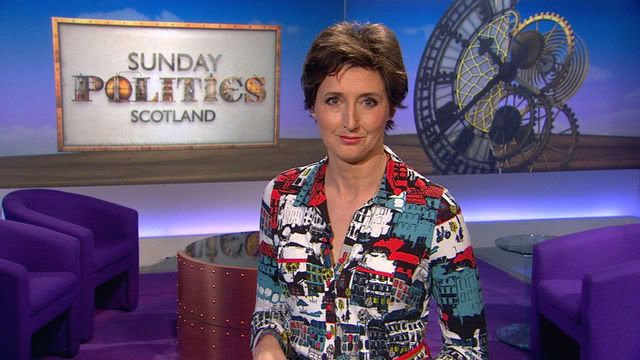
I've watched the Scottish version of the new Sunday Politics programme a couple of times so far this year on iPlayer and noticed that the format of the Scottish version is very different from the Welsh version.
As people will know, we get an hour long programme: the first 30 minutes is from London, then there is a 20 minute slot for Wales, returning to London for the last 10 minutes. Anybody listening to what Andrew Neil says just before the first switch would think that this pattern applies "across the UK" ... but it doesn't.
Last Sunday the Scottish version was made up of the same first 30 minutes from London, but that was followed by 60 minutes of Scottish political discussion without returning to London. The programme was 90 minutes in total, and we can watch it here.
When I watched the programme that was broadcast on 15 January, the Welsh version had the usual 20 minute Welsh slot, returning to London for the last 10 minutes. The Scottish version shared the same first 30 minutes from London, but was followed by 50 minutes of Scottish political discussion without returning to London, 80 minutes in total. Looking at the programme guide, I can see that next Sunday's programme in Scotland will be 90 minutes long and that Wales will get the usual 60 minute version.
-
It's not the only BBC programme that does this. For some time now BBC2's Newsnight has a common first 30 minutes across the UK; but the final 20 minutes in Scotland is devoted to Scottish affairs ... or to whatever international affairs are of particular interest to the Scots.
Why should Wales be treated in a second class manner? Whatever might have happened in the past, the decision makers at BBC Cymru/Wales should surely have taken the opportunity offered by a brand new format Sunday lunchtime political programme to press for each of the devolved countries of the UK to be treated in a similar way. Perhaps they did, but were ignored.
A fresh start deserves a fresh approach. So we should now kick up a fuss and insist that the BBC doesn't treat Wales as if we were merely a region of England, but on an equal basis with Scotland. Devolved politics deserves—in fact it needs—the same exposure to public scrutiny in Wales as it is given in Scotland.
In this post on Friday, I reminded people that Dafydd Elis-Thomas was telling a barefaced lie when he claimed that his position on nuclear power was not at odds with Plaid Cymru's position on the issue, and said that this deliberate untruthfulness made him totally unsuited as leader of the party.
But rather than concentrate on the negative, the more important thing is to show people that there are positive policies that we can pursue in Wales that will meet our energy needs without needing to rely on nuclear power. I've written a good number of posts on how Wales can more than produce the electricity we need from renewable sources, and people can read them here. But the immediate priority for Plaid Cymru is to make sure we elect a leader that supports our position on the issue rather than their own personal position.
On Friday, Leanne put up a new page on her website to made clear her position on this issue, and here are a few extracts from it:
Leanne Wood unveils clean energy revolution plan for Wales
Leanne Wood AM today set out her vision of meeting all Wales’ energy needs through renewables by 2050 – and also developing high quality, long-term jobs on Ynys Môn to replace those in the nuclear industry.
Under her energy action plan, a new Department of Energy for Wales would be based on Ynys Môn. Funding would come to the Welsh Government from winning control of Crown Estate revenue and a fair share of nuclear decommissioning funds.
The key points of the energy plan are:
• Powers to consent all electricity generation infrastructure to be transferred to the National Assembly as a matter of urgency
• An Energy Department for Wales to be established on Ynys Môn as soon as powers are transferred
• A presumption against any new fossil fuel power stations, and a full moratorium on new nuclear
• The Energy Department to publish a detailed energy plan leading to a fully renewable Wales by 2050
Advice on the energy policy was provided to Leanne Wood by Dr Calvin Jones of the Cardiff Business School, author of ‘Wales in the Energy Crunch’.
Leanne Wood believes that renewable energy development should be brought closer to communities. And each council should be given local targets for renewable energy generation. Her Greenprint for the Valleys document highlighted the Green Valleys project in the Brecon Beacons which has shown how a renewable energy co-operative can work.
Leanne Wood rules out the development of new nuclear power stations in Wales. “Some people argue that nuclear can be part of the solution for Wales but I fully support Plaid’s opposition to any new nuclear power stations. Nuclear power is very expensive and outdated, a view shared in Germany, Italy, Switzerland and Belgium. It diverts finance from investing in renewables, and it can’t come on stream soon enough to make Wales’ rapid decarbonisation a reality.
“Perhaps most importantly, while current generations reap the benefits of relatively cheap electricity, the costs of dealing with dangerous radioactive waste will pile up on our descendants thousands of years into the future. Buy now, pay later – a nuclear ideology that’s the antithesis of sustainable development. Nuclear is unsafe, expensive and a distraction from the cheap, abundant natural energy resources we have around us.
“Politicians have a responsibility to do more than just oppose, so that is why I’m proposing alternative plans to provide jobs for our young people so they are not forced to move away for work.”
Leanne Wood says the profits from Wales’ natural resources – the seabed and the land – which currently go to the Crown Estate should be owned by the Welsh Government for the benefit of the people of Wales. And she says the “national scandal of deaths and hardship caused by fuel poverty” must be tackled as top priority. All homes in Wales should be insulated to the maximum levels, she says.
Leanne Wood added: “Wales is blessed with some of the best renewable resources in Europe. It’s time to make the most of them, putting the people of Wales in control of the clean energy revolution – the path to real energy independence.”
I've said this before, but I'll repeat it. There is room for different opinions about what Plaid Cymru's policy should be on any particular issue, and we have lively debates about it. But at the end of the day we come to a democratic decision about what our policy is.
On the issue of nuclear power, Dafydd Elis-Thomas is perfectly free to disagree with party policy. However disagreeing with it is one thing, but lying about it is something very much more serious. This is a clip from last night's Sharp End:
Dafydd made it clear that he is in favour of building a new nuclear power station at Wylfa. But when Adrian Masters pointed out that the Plaid Cymru is opposed to nuclear power he said "No" and went on to talk about what was decided at conference ... although he doesn't finish the sentence. A few moments later he was asked if he could lead the party and have a different view to that which was expressed at conference. He said, "I've done that before ... but in this case it's not a different view."
In their answers, both Leanne and Elin also said that Plaid Cymru is opposed to any new nuclear power stations in Wales, and that they agree with that policy.
-
So are Leanne, Elin and Adrian telling the truth ... or is Dafydd? All we need to do is look at the motion that was passed at Conference:
NUCLEAR ENERGY AND RENEWABLE ENERGY
(Newport Branches / European Parliamentary Group)
Conference notes:
1. The tragic consequence of the earthquake and tsunami in Japan which led to the dangerous situation at the Fukushima nuclear power plant, namely that fuel in the reactors produced considerable amounts of heat which led to a full meltdown, causing radioactive material to leak.
2. That the incident at Fukushima, occurring on the 25th anniversary of Chernobyl, heightens concerns for the safety of nuclear energy.
3. That as a result the European Commission has proposed stress tests on all current nuclear reactors, and the UK government has called on the Chief Nuclear Inspector to carry out a review of nuclear installations.
4. That as a result, Germany has announced that all the country’s nuclear power plants will be phased out by 2022. Switzerland has also committed to phasing out nuclear power by 2034.
Conference further notes:
1. The essential principle of energy independence given Plaid’s long term ambition for devolved sovereignty and independence.
2. That as a net exporter of energy with massive undeveloped renewable energy potential new nuclear developments are not required in Wales in the long term in order to meet energy demand. Further investment is required into developing the potential of wave and tidal technologies which when commercialised could lead to Wales becoming more self sufficient in renewable energy.
3. That cost per KW of production for some forms of renewable power generation are lower than nuclear.
4. That the long term costs of nuclear decommissioning are not calculated.
5. The proven evidence of the effect of carbon emissions towards catastrophic climate change, also the growing pressure on fossil fuel resources including significant commodity price escalation as we approach peak fossil fuel production.
6. That the current coalition government’s policies on the carbon price floor will serve in the short term to raise consumer fuel bills and will leave the nuclear industry by the far the biggest beneficiary and also therefore fail to optimise the potential investment in renewable energy that variants of this legislation could bring.
Conference reaffirms:
1. Plaid Cymru’s belief that all energy decisions should be devolved in full to Wales.
2. Plaid Cymru’s total opposition to the construction of any new nuclear power stations. If the Westminster government gives the go ahead for a new nuclear power station at Wylfa, we should make sure that the investment recognises the need to employ local people, invest in training to maximise local employment and make sure that indigenous companies benefit from supply chain opportunities.
Conference calls:
1. For Plaid at all levels to lobby the coalition Westminster government to restructure Carbon Price Floor legislation in order to exempt nuclear power from receiving any form of public funded subsidy.
2. For the EU’s nuclear stress tests to be carried out by independent experts and to be based on robust criteria.
3. On Plaid Cymru to welcome Germany’s decision to phase out all nuclear power stations and to encourage other governments across the world, including the United Kingdom, to follow their lead.
4. For greater investment by the Welsh government in renewables and energy efficiency measures.
This represents the original motion together with the amendments to it as passed at conference. Full details are in this post.
So what Dafydd said is clearly wrong. At our conference in September last year we reaffirmed our "total opposition to the construction of any new nuclear power stations" including Wylfa B.
The amendment that was added simply says that if it is forced onto us by Westminster against our will, we should try and get the best out of it at local level. Elin explains that very well later in the debate.
-
This is why Dafydd Elis-Thomas is totally unfit to be the leader of Plaid Cymru. He might well be eloquent, I'll willingly grant him that, but isn't it much better for us to have someone with who will tell the truth with a few umms and ahhs than a smooth talking, but blatant, liar? This is an internal Plaid Cymru election. If Dafydd lacks the basic moral decency to tell people in his own party the truth in this election, how on earth will anyone outside the party be able to trust anything he says on behalf of the party when it comes to future elections?
More importantly, how can we hope to make any electoral breakthrough as a party if we as party members are foolish enough to choose a leader who is a blatant liar?
It was sad to see that Dafydd Elis-Thomas's recently professed conversion to independence for Wales is based on a very idiosyncratic version of what independence actually is. On CF99 yesterday evening he said this:
"What I want to stress, in connexion with Wales, is that the only independence that is possible to any country in the 21st century is an independence which is co-dependence in a federal Europe, and therefore to transform the United Kingdom to make it part of a federal Europe. That's not very different from what I've been saying for years."
This is as complete a perversion of the idea of independence as it is possible to get. Why should independence for Wales only be possible if the United Kingdom is part of a federal Europe? The EU is not a federation, it is an organization of twenty seven independent member states. In terms of its organization, policies are primarily determined in the Council of the European Union, in which the individual heads of government (or sometimes other ministers, such as the finance ministers) of each state hammer out agreements. And even though the EU Commissioners have a good deal of power, they are all nominated by member states.
Our independence has absolutely nothing to do with what the EU may or may not become in the future. Perhaps we will see a federal Europe, but I very much doubt it. Are countries like France, Denmark, Portugal or Poland going to give up their seats in the United Nations and other international organizations to a single representative from a federal Europe? Of course not. Each of them realizes the benefits of being an independent state and isn't going to give that up. Tying Welsh independence into the idea of a federalization of Europe is almost guaranteed to make it less attractive to people in Wales rather than more attractive. Though, come to think of it, that might well be exactly what Dafydd wants.
What Plaid Cymru wants is for Wales to take its own place alongside the other independent nations of Europe, with the same status as each of them already has now. Wales' independence is simply not affected one way or the other by the future direction the European Union might take.
-
Dafydd is a victim of his own vanity. The only honest reason he could possibly give for his professed support for independence is that he has changed his mind about it. But his ego won't allow him to do it. That's why he has to twist his outspoken opposition to independence in the past in order to try and get us to believe that what he's saying now is "not very different from what I've been saying for years".
As Lewis Carroll put it:
It's pathetic. In Dafydd Elis-Thomas we have our very own Humpty Dumpty. Not only is he living in a make-believe world of his own, he's mastered the scornful tone to go with it.
One of the millstones around the neck of Plaid Cymru while Ieuan Wyn Jones has been leader has been nuclear power. The party is unequivocally opposed to nuclear power, but Ieuan was personally in favour of it.
But at least Ieuan was honest about the situation. He realized that his position was at odds with that of the party, even though it made things awkward, embarrassing even, whenever he was questioned on the subject; instead of being able to give a straight answer to the question, he had to give complicated answers that compromised him and made it look as if Plaid's policy on the issue wasn't clear. It's hardly surprising, because most other parties have policies that are determined by the leadership, rather than by party members.
So the very last thing Plaid Cymru needs is another leader who will not be able to give straight and unequivocal answers about nuclear energy.
-
Nuclear energy was one of the subjects that came up on the CF99 leadership debate yesterday evening. I think it's well known that both Leanne Wood and Elin Jones are against nuclear energy, but that Dafydd Elis-Thomas is in favour of it. But what I found disturbing was Dafydd's intervention to jump down Elin's throat when she made the simple statement that not only she, but that Plaid Cymru as a party, was opposed to nuclear power.
He interrupted her with a rather petulant, "Well you'll lose Ynys Môn if you carry on talking like that, I have to say." Then tried to interrupt her again later.
How can anyone in Plaid contemplate having a leader that not only holds a position which is completely opposite to party policy, but one who is completely unapologetic about it and openly dismisses something that has been democratically decided by the party's membership? At least Ieuan was principled enough to acknowledge Plaid's position on the issue was at odds with his own.
Dafydd clearly does not share the same principles. He's just shown us that if he gets to be leader all we'll ever hear from him are his own personal views, rather than those of the party he is meant to represent.
I was pleased to see that ITV had commissioned another poll from YouGov; and the results were fairly comprehensively reported in last week's Sharp End, and here on the ITV Wales blog.
But I always like looking at the full information, which has just been put up on the YouGov website, here. I want to pick up on a couple of things from it.
-
First, although it is true that only a disappointing 33% of Plaid Cymru voters said they wanted to see an independent Wales, this was in fact the figure for those who would vote Plaid in Assembly constituencies. The equivalent figure for those who vote Plaid in Westminster elections is a much more respectable 45%. The difference is best explained by noting that appreciably fewer people vote Plaid in Westminster elections (165,394 or 11.3% in 2010) than in Assembly elections (182,907 or 19.3% in 2011). Those who vote Plaid in both can be considered as our "hard core" supporters, and they are obviously more likely to want an independent Wales.
The second thing that struck me was the marked variation of opinion about how Wales should be governed according to different age groups:
18-24
25-39
40-59
60+
Overall
No devolution
6%
16%
15%
25%
17%
Assembly with fewer powers
3%
1%
3%
5%
3%
Status quo
28%
30%
32%
31%
30%
Assembly with more powers
45%
31%
30%
28%
32%
Independence
11%
10%
12%
8%
10%
The 17% who want to revert back to direct government from Westminster in the event of Scotland becoming independent is very heavily influenced by the negative attitude of older voters. Only 6% of young voters would do away with the Assembly.
The percentage wanting to stick with the status quo is remarkably similar across the all ages, so although wanting more powers is the most popular option overall (32%) that figure is much higher among younger voters (45%).
-
So the direction of travel is very clear. We're not going to go backwards, despite the 51% of Tory voters who would like that ... even Andrew RT Davies dismissed that possibility. So the only real question is what extra powers we should be pressing for now, and what the timescale should be. As I see it, the Silk Commission needs to produce a comprehensive package of additional powers and responsibilities—together with a larger Assembly and a revised voting system for it—which would be introduced though a new Government of Wales Act to be passed by Westminster before the next UK election in May 2015, and come into effect for the Assembly election in May 2016.
The temptation will be to do nothing until the result of the Scottish independence referendum is known. But that would be a bad idea. If the unionist parties are to have any hope of keeping Scotland within the United Kingdom, they must show that they are prepared to change the way the UK works by offering a radically improved degree of autonomy to its constituent nations. If the best they can offer Wales is a bit of tinkering around the constitutional edges, how will anyone in Scotland believe that the same unionist parties would be able to agree on and deliver some form of devo-max for them?
If, between them, they can't deliver a substantial degree of additional autonomy to Wales, there is absolutely no chance that they will be able to deliver an even more substantial degree of autonomy to Scotland, is there?
Starting with the obvious: Simon Thomas had absolutely no chance of becoming leader of Plaid Cymru and therefore it is not too much of a surprise to see him bow out of the leadership race. The only question to ask is why he put himself up for election in the first place.
However there is one aspect of his retirement from the leadership contest that is a cause for serious concern. He is reported on both the BBC and WalesOnline as saying that he would support Elin Jones "as her deputy on a joint ticket".
This is simply not possible. The Standing Orders for the party's group in the National Assembly make it quite clear that:
3.2 The leader of the party’s group in the National Assembly shall be elected by the party’s membership in accordance with the relevant Standing Orders.
3.3 All other officers of the Group [this includes the Deputy Leader] are to be elected by secret ballot of the members of the group following the party’s Rules for Internal Elections.
The new leader of Plaid Cymru cannot determine who will be her deputy after she is elected. It is up to the party's AMs, and only the party's AMs, to decide who the deputy leader should be. There is no such thing as a "joint ticket". In a way this is a shame, because I personally had argued for such an arrangement in this post back in May. But rules are rules, and it wasn't possible to change them.
-
However what seems more disturbing is that Elin Jones, judging by what she is reported as saying in WalesOnline, seems to have bought into the idea of Simon as her deputy. It is actually more embarrassing for a potential leader to not understand how the election of the deputy leader works.
If anything, she appears to have been so unquestioningly grateful for Simon's support that she was willing to offer him a position that is not in the gift of the party leader. And it might well prove to be a poisoned kiss. After all, if Simon doesn't have leadership qualities, it's tying a millstone round your own neck to say that you want him to be your deputy leader. And it seems particularly ill-advised for Elin to say that Simon's vision for Plaid Cymru is "identical" with her own when the one thing that was most obviously lacking in Simon's leadership bid was any sense of vision. That's surely the main reason why he was getting virtually no support from party members.
This is a shame, because I think Elin would make a good leader ... although in my opinion not as good a leader as Leanne Wood will be.
This blog has been set up to complement the Syniadau Forums.
Much of what will appear on this blog will also appear in the Syniadau Forums, but the emphasis on this blog is slightly different. The forums are focused more on the structures and institutions that Wales will need to develop in order to become a successful independent nation, arranged on a subject by subject basis, but the blog will have more of an emphasis on day to day political news and developments.
People are welcome to reply or leave comments either here or on the Syniadau Forums. If anyone wants to initiate a new subject they are very welcome to do so there.