Watching the results come in

Having snatched a few hours rest earlier this evening, I and my trusty espresso machine should be able to make it through the night watching the results come in.


Perhaps I'll get egg all over my face if my predictions turn out to be wrong. But never mind, I'll scrape them off and enjoy them lightly poached with a garnish of caviar.

-

I'll also have one eye on the Scottish election, and even though I'm sure it will be mentioned on S4C and BBC Wales, I'll be watching STV's coverage, which will be online here. From past experience it's much less deferential than the BBC's coverage.

The Scottish election has the promise of being much more momentous than ours; for if the SNP and Greens can get a majority, there will be a referendum on Scottish independence within the next four or five years. Whether it is won or lost, the processes leading to it—in particular the legal and constitutional questions that will have to be asked and answered—will go a long way towards setting out a route map for other non-independent countries in the EU to become independent, including Wales.

-

For Wales, whatever the results, I think Labour will continue to lead us on a steady downhill course in terms of economic performance and prosperity relative to the rest of the UK. If we don't vote to change anything, why should we expect anything to change? We will only change this when we are ready to take the levers of the Welsh economy into our own hands. But who knows, perhaps we will take one or two steps towards weening ourselves off dependency in this Fourth Assembly ... even if we have to drag Labour to the point where they are no longer terrified of us taking responsibility for ourselves.

Bookmark and Share

Vote Plaid ... but only 1.95 times

Today's the big day. Get out and vote to make Wales a better place.

We each have two votes. On the regional ballot paper, which will only have the party names rather than the names of the candidates standing, Always Vote Plaid.

On the constituency ballot paper, which will have the name of the candidate as well as the party s/he is standing for, vote for the Plaid Cymru candidate unless you live in Montgomery, Cardiff North or Cardiff Central. In these three seats we need to hold our noses and vote tactically in order to make it more likely that Plaid will win one of the regional seats:

•  Montgomery ... vote for Russell George, Conservative
•  Cardiff North ... vote for Jonathan Morgan, Conservative
•  Cardiff Central ... vote for Nigel Howells, Liberal Democrat

But everywhere else in Wales the answer is simple: Vote Plaid Twice.

Bookmark and Share

Hyperactivity

The biggest laugh of today must be from Paul Murphy's endorsement of Carwyn Jones here on WalesHome. The classic piece of spin was:

In an age where hyperactivity is often mistaken for effective leadership ...

In other words, it might look as if he's asleep, and he probably is asleep ... but we have no choice but to call it a good thing.

And indeed it is, for just think of the damage he could inflict on Wales if he had more energy and determination. As one of Labour's most prominent dinosaurs, Paul Murphy knows every bit as much as one of the others what it's like for a faster and cleverer Plaid Cymru to run rings around an all "too dull" Labour Party.

Long may it continue.


Never particularly fast on his feet, we don't call him Cobweb Jones for nothing.

Bookmark and Share

Analysis ... Wales as a Whole

I've now completed a series of analyses for the five electoral regions of Wales, which people can read by clicking these links:

     South Wales West
     South Wales Central
     South Wales East
     North Wales
     Mid and West Wales

Now the time has come to put it all together and predict what the overall picture will be. I firmly believe that in order to make proper sense of the election—and of course the result—we cannot consider constituency results in isolation from the regions that those constituencies are in. Very often, winning in a particular constituency will result in losing a list seat, and vice versa.

South Wales West

Labour ... 7
Conservative ... 2
Plaid Cymru ... 2

South Wales Central

Labour ... 6
Conservative ... 2
Plaid Cymru ... 2
Liberal Democrat ... 1
Green ... 1

South Wales East

Labour ... 6
Conservative ... 2
Plaid Cymru ... 2
Liberal Democrat ... 1
UKIP ... 1

North Wales

Labour ... 6
Plaid Cymru ... 4
Conservative ... 3

Mid and West Wales

Plaid Cymru ... 4
Labour ... 4
Conservative ... 3
Liberal Democrat ... 1

Wales as a Whole

Labour ... 29
Plaid Cymru ... 14
Conservative ... 12
Liberal Democrat ... 3
Green ... 1
UKIP ... 1

The question to ask is whether this is reasonable. I don't think that anyone will be particularly surprised at Labour getting 29 seats. This seems to be in line with a good many forecasts which show Labour increasing their number of seats but failing to get a majority.

However, when it come to Plaid Cymru, I have to say that 14 seats is more than my gut feeling would say is right; and my gut also tells me that the Conservatives should do better. If the figures had worked out at 14 for the Tories and 12 for Plaid Cymru, it would be in line with what most people are forecasting and made my gut feel more comfortable.

So I've given it some thought, yet have to stick with the sum of my five regional analyses. For the Tories, the key factor is that they might well get a few percentage points more than in 2007, and they might even win seats that they don't hold. But because they are not dominant in any part of Wales, what they gain in constituencies tends to be cancelled out in the regional list; and similarly, anything they lose at constituency level can be made up in the regional list.

In arriving at my 12 seat prediction for the Tories, I have included them gaining new seats in Aberconwy and Montgomery, and said they will hold the key marginal seat of Cardiff North. Yet this still only leaves them with 12 seats. I can't see where a thirteenth seat could come from.

-

For Plaid Cymru, I have tried not to indulge in wishful thinking, and perhaps over-compensated for that by saying that we will lose Aberconwy. Yet I can see how Plaid might not get 14 seats, because in a number of cases Plaid are picking up the fourth list seat in a region at the expense of smaller parties. So for example, we might lose one regional seat in South Wales West if the LibDems get more than half our share of the vote; or we might lose a seat in South Wales Central if the Tories fail to hold Cardiff North; or we might lose a seat in North Wales if the LibDems or UKIP do better than I expect them to. So yes, Plaid could go down to about 11 seats, but I'll stick to my prediction of 14.

-

I don't think my prediction of the LibDems losing seats will come as much of a surprise to anybody. The question has always been just how low they could go, and my prediction of 3 seats is definitely in the lower range of expectations. I am predicting that they will hold Cardiff Central, but the three key issues will be whether they can hold Montgomery and whether they can get enough of the regional vote in South Wales West and North Wales to win a regional seat. They can get more seats than I've predicted, but I think it's unlikely.

-

In predicting that the Greens will win a seat, I might well accuse myself of wishful thinking because I certainly want them to win a seat. But whether they win one in South Wales Central actually depends far less on their share of the vote than on whether the LibDems hold Cardiff Central and the Tories hold Cardiff North. This is one region where tactical voting will be crucial.


So who will form the next Welsh Government?

In a sense, UKIP are the wildcard in any calculation. I've predicted they will win one seat, and they could possibly win another in North Wales. This might well make some in Labour think twice about whether they can form a minority government, for although a "rainbow coalition" of Plaid, the Tories and the LibDems might be remotely possible (or indeed a "super rainbow" that includes the Green AM) it is completely out of the question for it to include UKIP.

Labour will of course toy with the idea of doing a deal with either the Greens or the LibDems. Unfortunately for them, Jake Griffiths is highly unlikely to support them if they support nuclear power. And Labour do now say they support nuclear power, and claim that what it says in their manifesto for this election is worthless, because what it says in their 2010 manifesto for Westminster must take precedence over it. John Dixon beat me to saying what I thought of that here.

-

As for a deal with the LibDems, two factors come into play. The Labour leaders in Westminster might put pressure on Carwyn Jones to do a deal with the LibDems in order to demonstrate to LibDems in Westminster that there is an alternative to them being in coalition with the Tories. The primarily ambition of Labour is to be in power in Westminster and, as we have seen, Labour have played this election in Wales almost entirely in reaction to what the Tories and LibDems are doing in coalition in Westminster rather than on Welsh issues.

On the other hand, as one of my friends told me last night, Labour might well regard this as an opportunity to kill off the LibDems for good. If Labour give credibility to the LibDems by including them in government, they will be giving them a lifeline by which they can rebuild themselves in Wales. Why would Labour want to do that, especially because a good part of their surge in support in the polls has come from angry and disaffected LibDems turning to Labour?

-

So that leaves One Wales 2 as the only option to ensure a stable programme of government for the next five years. When the results come out on Friday, a lot of us will be asking if anything has really changed. Labour will have three more seats, the LibDems will have three less, and Plaid and the Tories will be where they were before the election. A lot of the faces will have changed, but the numbers won't have changed much at all.

Bookmark and Share

Analysis ... Mid and West Wales

On the principle of leaving the best until last, my final analysis is for the Mid and West Wales region.

This was the result in 2007:

    
Mid and West Wales


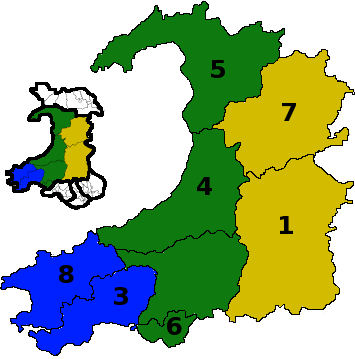
Constituencies
 
1   Brecon & Radnor
2   Carmarthen East & Dinefwr
3   Carmarthen West & SP
4   Ceredigion
5   Dwyfor Meirionnydd
6   Llanelli
7   Montgomery
8   Preseli Pembrokeshire
 
Regional seats
 
1   Labour
2   Labour
3   Conservative
4   Plaid Cymru
 

This was the only region in Wales where Labour failed to win a constituency seat. However they did get 18.4% of the regional vote which entitled them to two regional seats. They were very close to winning a third, but Plaid Cymru just beat them to it.
 

The Constituency Vote

It's probably easiest to start with the LibDems. They won two seats—Brecon and Radnor, and Montgomery—and got a creditable 36.1% in Ceredigion, coming second to Plaid.

I think they are likely to hold Brecon and Radnor not least because of Kirsty Williams, who has proved to be a relatively good leader of her party. She's feisty, and she can sometimes lay a verbal glove on minsters in the Labour-Plaid One Wales government ... although maybe only one time in ten. If that is what an opposition leader is for, she probably makes a better job of it than the Tories. I'm not sure that her party has anything very positive to offer as an alternative, though.

What will see her through is that her margin of victory last time was 52.3% to the Tories' 33.5% ... with both Labour and Plaid down in single figures. This margin is simply too big to be eroded away completely, especially because the only party that has a chance of taking the seat from her is the Tories. No LibDem—no matter how angry they might be about what their party is doing in Westminster—will switch to the Tories because of it.

-

Things are slightly different in Montgomery. Although this seat was won by Mick Bates by a margin of 39.0% to 30.2% over the Tories, he was obliged to leave the LibDems as a result of his conviction for assault and some commentators might consider this to be an independent rather than a LibDem seat as a result.

The LibDems lost this seat at Westminster level in May last year, but there were some unusual factors. We had the strange and rather ridiculous antics of Lembit Öpik, who made the mistake of thinking that any personal publicity, no matter how inappropriate, was a way of promoting politics. And he was up against the popular Glyn Davies who, because of his conversion to devolution and clearly expressed commitment to a Senedd with primary lawmaking powers, is someone I would call a decent Tory.

This result will be crucial to the overall distribution of seats in this region and the Assembly as a whole. It is highly unlikely that the LibDems will get 13% of the regional vote, and as such they would only be entitled to one of the twelve seats on a proportional basis. If the LibDems lose Montgomery, they will not get a regional seat to make up for it. If they win, they will effectively take away a regional seat from one of the other parties. Because of this, people who do not support the LibDems need to vote tactically. It will be close, but the bookies are showing Russell George, the Tory candidate, slightly ahead.

Of course voting for a Tory is something most people in Wales would only do after a full frontal lobotomy. So I need to explain that the Tories will not gain anything in overall terms if they win this seat. They will simply get one less regional seat and end up with the same number as they would get based on their share of the regional vote. I'll explain how it works in more detail later in this post.

-

In Ceredigion the LibDems might feel they have a chance, largely because Mark Williams held the seat comfortably in 2010, by a margin that came as a shock to most people in Plaid. But there are factors that would explain this, and the most important of these is incumbency.

As a particular type of MP, Mark Williams is second to none. He makes himself known all over the constituency, picking up every complaint and promising to deal with it. He faithfully writes the letters or asks the questions, then reports back able to say that he did his best for them. Of course nothing he says or does could actually have made one scrap of difference, because the LibDems did not have the power to change anything. Nor could he ever be criticized for voting one way or the other, because whichever way he voted would make no difference to the result. That is the luxury of being neither in the government nor in the opposition. But who has ever heard of Elizabeth Evans?

The incumbency factor also works for Plaid Cymru's Elin Jones, but in a different way. She is a minister in the One Wales government, and probably the only AM that could successfully deliver on agriculture and rural affairs ... simply because nobody in Labour has got the first clue about it. She has done that job particularly well. I actually think the biggest danger in Ceredigion comes from Plaid not being forthright on its policies, particularly with regard to green issues. Our failure to explicitly state in our manifesto that we are against nuclear power is likely to cost us votes from those who do care passionately about the environment. The LibDems have done this, and this might sway a good number of voters to them.

It is a ridiculous situation for Plaid to find itself in because our opposition to nuclear would come across clearly if it were not for Ieuan Wyn Jones. He seems to have calculated that he stands more chance of winning votes in Ynys Môn by supporting nuclear power there, but opposing it everywhere else. Even at a pragmatic level he is being much too defensive, for his seat is safer than he thinks and much safer than Ceredigion. The margin in Ynys Môn is 22.3%, in Ceredigion it is 13.1%. But on the level of principle, I would go so far as to say that his equivocation on matters like this might well be primarily responsible for our lack-lustre showing in the opinion polls. A leader at odds with his party will constantly be forced onto the back foot. We need to be sending clear messages rather than mixed messages.

Even so, I don't think this will be enough to see Elin lose her seat. But it will make it much closer than it otherwise would be, and will also have a generally negative effect elsewhere in Wales that could make all the difference between Plaid winning and losing regional seats.

-

Dwyfor Meirionnydd and Carmarthern East and Dinefor are and will remain rock solid Plaid seats. The fourth constituency Plaid hold is Llanelli. Helen Mary Jones won this with 50.1% of the vote, comfortably ahead of Labour with 36.1%. That's a large margin and the seat should be safe for Plaid, even though it will be a lot tighter than before. However even if Plaid were to lose the seat, it would probably make no difference to the overall result because we would gain a regional seat to make up for it, and Labour would simply win one regional seat less. Again, I'll explain how that works in more detail later.

-

This leaves two other constituencies currently held by the Tories. In 2007 the Tories won Preseli Pembrokeshire with 38.6% of the vote, with Labour and Plaid not too far behind on 27.4% and 24.7% of the vote respectively. This time round, it should be a battle between the Tories and Labour. Will the Tory vote hold up, or will the general surge to Labour overtake it? The bookies favour Labour and I'd probably go along with that, but I do have a suspicion that the Tories might hold on. Yet whichever way it goes won't make any difference to the overall number of seats each party will win.

In 2007 Carmarthen West and South Pembrokeshire was a very tight contest in which fewer than 300 votes separated the three main parties. The Tories won it with 30.1% of the vote, with Labour on 29.7% and Plaid on 29.2%. In better times, this is a seat that Plaid should expect to win if we ever hope to make a breakthrough in Welsh politics; and I'm sure it was for this reason that Nerys Evans chose to fight this seat now rather than stay on the regional list. Although it must be said that Plaid would have very little hope of winning a list seat if it won five constituency seats, so in that respect she made the right choice.

But it doesn't look like she will win. If Llanelli is going to be tight when Plaid are defending a margin of 14%, I don't think there is any realistic chance of Plaid overtaking Labour in Carmathen West, despite all of Nerys' qualities. This seat will be a battle between Labour and the Tories. I think Labour will win but, in just the same way as in Presceli, the outcome won't make any difference to the overall number of seats either Labour or the Tories will win in the region.

So let's now look at the regional vote to see why.


The Regional Vote

These are the details of the regional vote in 2007. Seats are determined by the percentage of the vote on the second ballot paper, but seats already won at constituency level are taken into account. After a seat has been won, the percentage necessary to win another seat is the original percentage divided by two, then three, then four, etc.

Plaid Cymru ... 31.0%
Conservative ... 22.9%
Labour ... 18.4%
LibDem ... 13.3%

Round 1 ... Plaid Cymru 31.0% ... already won
Round 2 ... Conservative 22.9% ... already won
Round 3 ... Labour 18.4% ... regional seat 1
Round 4 ... Plaid Cymru 15.5% ... already won
Round 5 ... LibDem 13.3% ... already won
Round 6 ... Conservative 11.5% ... already won
Round 7 ... Plaid Cymru 10.3% ... already won
Round 8 ... Labour 9.2% ... regional seat 2
Round 9 ... Plaid Cymru 7.8% ... already won
Round 10 ... Conservative 7.6% ... regional seat 3
Round 11 ... LibDem 6.7% ... already won
Round 12 ... Plaid Cymru 6.2% ... regional seat 4

This time round, the two things we can say with relative certainty are that Labour will increase their share of the vote and will probably come top; and that the LibDems will lose votes. I reckon Plaid will still beat the Tories. As it happens, this is also what the latest YouGov poll suggests. So I'm content to use their figures to project the likely result even though I think YouGov's polling methods tend to over-estimate Labour's share of the vote:

Labour ... 29.0%
Plaid Cymru ... 27.0%
Conservative ... 25.0%
LibDem ... 8.0%

Round 1 ... Labour 29.0%
Round 2 ... Plaid Cymru 27.0%
Round 3 ... Conservative 25.0%
Round 4 ... Labour 14.5%
Round 5 ... Plaid Cymru 13.5%
Round 6 ... Conservative 12.5%
Round 7 ... Labour 9.7%
Round 8 ... Plaid Cymru 9.0%
Round 9 ... Conservative 8.3%
Round 10 ... LibDem 8.0%
Round 11 ... Labour 7.3%
Round 12 ... Plaid Cymru 6.8%

The first thing to note is that it will be impossible for the LibDems to win more than one seat in this region on a proportional basis. Even if they managed to get 13% of the regional vote—which is highly unlikely with the polls showing them at only 8%—they would still only get one seat.

But the additional member electoral system has an inbuilt bias towards constituencies, because these are taken into account first. So if the LibDems win both Brecon and Radnor and Montgomery, they will end up with one more seat than they would otherwise be entitled to, and this will effectively take away a regional seat from one of the other parties. That's why it's important for supporters of other parties to vote tactically for the Tory candidate if they live in Montgomery, but then use their regional vote for their first choice party.

If the LibDems win two seats at constituency level, it means only ten seats are available for the other parties. But if we can hold them to one, it means that eleven seats are available.

-

None of the three main parties is likely to win more constituency seats than they would be entitled to based on the regional vote. So it is the regional vote that will determine the overall number of seats they win, irrespective of the results in any individual constituency. Because of this, voting tactically for the Tory candidate if you live in Montgomery will not give an overall advantage to the Tories ... for they will still win the three seats they are entitled to from their share of the list vote, and are very unlikely to win a fourth seat.

The Tories will get three seats and only three seats. Even in the all but impossible event of them holding Preseli and Carmarthen West, and winning Montgomery from the LibDems, they will still get three seats overall. But it is much more likely that they will win just one constituency, but then get two of the regional seats.

Labour look likely to get four seats overall. As I've said, I think they will win both Carmarthen West and Presceli, but not win Llanelli. If I'm right, that will mean that they win two constituency and two list seats. But if I'm wrong and they do win Llanelli, they'll simply get one less regional seat, making no difference to the overall result.

Finally for Plaid, we will definitely win Dwyfor Meirionydd, Carmarthen East and Ceredigion, and I think we'll just hold on in Llanelli. But even if we lose Llanelli, we will probably get the fourth regional seat anyway ... providing we get more regional votes than the Tories and more than four times the vote of any of the minor parties. Either the Greens or UKIP would need to get somewhere around 7% to take it from us.


The Prediction

The overall result hinges on two key constituency battles: whether the Tories can win Montgomery from the LibDems and, although to a much lesser extent, whether Plaid hold Llanelli. Both will be tight, but this is how I think things will work out:

•  Labour will win both Preseli Pembrokeshire and Carmarthen West and South Pembrokeshire from the Tories, but will fail to take Llanelli from Plaid. They will win two regional seats if they lose Llanelli, but only one if they were to win it. Either way, Labour will get four seats in total.

•  Plaid Cymru will hold each of the constituencies they won in 2007: Dwyfor Meirionnydd, Carmarthen East and Dinefwr, Ceredigion and Llanelli. But if Plaid were to lose Llanelli we would win a regional seat instead. Either way, Plaid will get four seats in total.

•  The Tories will win Montgomeryshire from the LibDems, but will lose the two constituencies they currently hold. They will win two regional seats, giving them three seats in total.

•  The LibDems will hold Brecon and Radnorshire but lose Montgomeryshire to the Tories. They will not win a regional seat, leaving them with only one seat in total.

Bookmark and Share

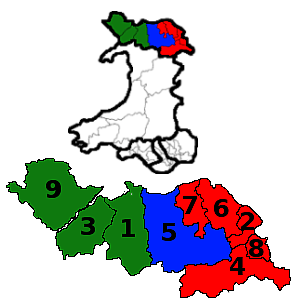
Analysis ... North Wales

The three electoral regions in south Wales: South Wales West, South Wales Central and South Wales East, are characterized by heavy support for Labour with only a small handful of seats that could be won by other parties. As a consequence of this it is virtually impossible for Labour to win any additional seats in the three south Wales regions, and all those who vote for Labour on the regional ballot paper are in effect wasting their vote.

But elsewhere in Wales the constituency map is not predominantly red, and this means a different set of factors come into play. This is how things worked out in the North Wales region in 2007:

    
North Wales


Constituencies
 
1   Aberconwy
2   Alyn & Deeside
3   Arfon
4   Clwyd South
5   Clwyd West
6   Delyn
7   Vale of Clwyd
8   Wrecsam
9   Ynys Môn
 
Regional seats
 
1   Conservative
2   Conservative
3   LibDem
4   Plaid Cymru
 

Labour are strong only in the north east, where they won five constituency seats. The Tories generally ran them close, but only succeeded in winning Clwyd West. Plaid Cymru are strong in the north west, winning all three seats. The LibDems are no more than also-rans, with their greatest pocket of support around Wrecsam ... but even there they only got 16.7% of the constituency vote.

The regional vote was remarkable in that Labour, Plaid Cymru and the Tories each got virtually the same share, with 27.9%, 27.2% and 27.0% respectively. The LibDems managed only 8.2%.

Yet in total Labour ended up with 5 seats, Plaid with 4, the Tories with 3, and the LibDems with 1. This is a very good illustration of why having only 4 regional seats out of a total of 13 is not enough to compensate for the inherent unfairness of the first-past-the-post voting system used for the constituencies. Under a fairer system, each of the three main parties would have won 4 seats in total.


The Constituency Vote

It's probably easiest to start with the five seats Labour already hold. In each of these the Tories came second, and the results were sometimes very close:

•  In the Vale of Clwyd, Labour got 36.4% and the Tories 36.0%
•  In Delyn, Labour got 34.6% and the Tories 32.3%
•  In Clwyd South, Labour got 35.1% and the Tories 29.3%
•  In Wrecsam, Labour got 28.8% and the Tories 17.2%
•  In Alyn and Deeside, Labour got 38.9% and the Tories 22.9%

Yet even in the Westminster election last year, where there was a general swing away from Labour to the Tories, all these seats remained Labour. It is therefore very hard to see Labour losing them now, especially with the general swing to Labour shown in the polls.

However this doesn't mean that there's nothing for the other parties to fight for. The main job of all the candidates in these constituencies will be to increase their party's share of the regional vote, for even though we might urge people to use their two votes in different ways according to where they live, it is much simpler to campaign by urging people to vote the same way twice. That's what most voters do anyway. So a good showing at constituency level might not affect the constituency result, but it will most definitely affect the regional result ... as I hope will become clear later.

-

In the north west, there is no real doubt that both Arfon and Ynys Môn will be held comfortably by Plaid Cymru.

-

But this leaves to seats which are best described as three-way marginals. These were the results in 2007:

Clwyd West

Conservative ... 34.0%
Labour ... 27.9%
Plaid Cymru ... 27.3%
LibDem ... 6.5%

Aberconwy

Plaid Cymru ... 38.6%
Conservative ... 30.4%
Labour ... 21.8%
LibDem ... 9.3%

In Clwyd West, the question is whether the general upswing in the Labour vote will be greater than the Tories' ability to hold on to their share of the vote. I don't think Plaid stand much chance. I'm inclined to say that Labour will edge this seat; but if they do win it, the Tories will not lose out in overall terms. They will pick up a regional seat to replace it.

Aberconwy is a more difficult seat to predict, not least following the result in the Westminster election last May, when the Tories won the seat with 35.8% of the vote, with Labour second and Plaid in fourth place behind the LibDems. I think it's fair to say that people in Plaid are still trying to figure out what happened, because it wasn't what anyone on the ground was predicting ... or at least admitting to. There was a real sense of having been misled, although my view is that there was no deliberate intention of doing so; it was more a case of allowing ourselves to believe the hype.

But Assembly elections are very different, so there's no reason why Plaid should not get back above 30%, and the Tories should also be in the middle-to-low 30% region, which will make this seat a close contest between Plaid and the Tories. I actually think the Tories will edge it; but if they do they will lose a regional seat and Plaid will gain one.

This leaves us in the position that the actual result in both these seats becomes irrelevant to the overall regional performance of the parties. This has two practical consequences: first, that the regional vote matters much more than the constituency vote; and second, that no tactical voting in the constituencies is necessary, for it will make no difference to the overall result.


The Regional Vote

These are the details of the regional vote in 2007. Seats are determined by the percentage of the vote on the second ballot paper, but seats already won at constituency level are taken into account. After a seat has been won, the percentage necessary to win another seat is the original percentage divided by two, then three, then four, etc.

Labour ... 27.9%
Plaid Cymru ... 27.2%
Conservative ... 27.0%
LibDem ... 8.2%
UKIP ... 4.3%

Round 1 ... Labour 27.9% ... already won
Round 2 ... Plaid Cymru 27.2% ... already won
Round 3 ... Conservative 27.0% ... already won
Round 4 ... Labour 13.9% ... already won
Round 5 ... Plaid Cymru 13.6% ... already won
Round 6 ... Conservative 13.5% ... regional seat 1
Round 7 ... Labour 9.3% ... already won
Round 8 ... Plaid Cymru 9.1% ... already won
Round 9 ... Conservative 9.0% ... regional seat 2
Round 10 ... LibDem 8.2% ... regional seat 3
Round 11 ... Labour 7.0% ... already won
Round 12 ... Plaid Cymru 6.8% ... regional seat 4

I think that Labour's vote will go up, and that both Plaid's and the Tories' share of the vote will go down. But I think that North Wales is one region where the LibDem vote is likely to completely collapse, because it has no cores of strong support that could be relied on to hold it up.

So I think the overall share of the vote will be something like:

Labour ... 38.0%
Plaid Cymru ... 25.0%
Conservative ... 22.0%
LibDem ... 6.0%
UKIP ... 5.0%

Which would result in this distribution of seats:

Round 1 ... Labour 38.0%
Round 2 ... Plaid Cymru 25.0%
Round 3 ... Conservative 22.0%
Round 4 ... Labour 19.0%
Round 5 ... Labour 12.7%
Round 6 ... Plaid Cymru 12.5%
Round 7 ... Conservative 11.0%
Round 8 ... Labour 9.5%
Round 9 ... Plaid Cymru 8.3%
Round 10 ... Labour 7.6%
Round 11 ... Conservative 7.3%
Round 12 ... Labour 6.3%
Round 13 ... Plaid Cymru 6.3%

As I said above, I think Labour are certain to win in five constituencies and Plaid Cymru certain to win in two. But these are are less than the number of seats they are entitled to according to my prediction of their share of the vote on the regional list. This means that the additional member system will be able to deliver a broadly proportional result in a way that it is not able to do in the three south Wales regions.

The only way a disproportionate result could be achieved is if Labour win in both Clwyd West and Aberconwy. For there would then not be enough regional seats available to restore proportionality. However I think it is very unlikely that Labour will win in both constituencies.

But Labour are very likely to win six seats in total, either by gaining one constituency seat (probably Clwyd West) or by picking up a regional seat if they fail to do so.

-

The Tories will win three seats in total no matter whether they win or lose individual seats at constituency level. If they hold Clwyd West and win Aberconwy they will get one regional seat. If they lose Clwyd West but gain Aberconwy they will get two regional seats. If they hold Clwyd West and fail to win Aberconwy they will get two regional seats. If they don't win either, they will get three regional seats.

-

Plaid Cymru are certain to hold Arfon and Ynys Môn. It doesn't particularly matter whether we win or lose Aberconwy, because we will get at least one regional seat to make up for it at about the 8.3% level. But provided that Labour do not win Clwyd West and Aberconwy (which is unlikely) there will still be one more regional seat available.

This seat should go to Plaid, provided that we get more of the regional vote than the Tories and more than four times the vote of either the LibDems or UKIP. This is where percentages become critical. If Plaid get 25% of the regional vote, it means that both UKIP and the LibDems must get no more than 6.25% of the vote.

I doubt very much whether UKIP will reach that figure, because people with views on the right of the political spectrum will vote Tory. But I also think that the LibDems are unlikely to reach that figure because they have no strong pockets of support in the region. For that reason I think Plaid will get the final regional seat.


The Prediction

North Wales is an unusual region because Labour, Plaid Cymru and the Tories each have substantial support, even though it is unevenly distributed. It means that the additional member system can work effectively to produce an outcome that is broadly proportional to the percentage of the regional vote as a whole. However this makes the results in the two marginal constituencies—Aberconwy and Clwyd West—less important than they might otherwise be ... except of course to the individual candidates concerned.

I'm fairly confident that Labour will win six seats in total, the Tories will win three, and Plaid will win at least three. That leaves one seat to be decided, and I think it will be won by Plaid. However this overall outcome can be achieved in several different ways, and I'm less certain about the individual results. But I should put myself on the spot, and this is how I think things will work out:

•  The Tories will lose Clwyd West but win Aberconwy. They will get two regional seats, giving them three seats in total.

•  Labour will retain control in the five constituencies they already hold—Alyn and Deeside, Delyn, the Vale of Clwyd, Clwyd South and Wrecsam—and will win Clwyd West. They will not win a regional seat, but will get six seats in total.

•  Plaid will hold Arfon and Ynys Môn. We will lose Aberconwy to the Tories, but win two regional seats ... making four seats in total.

Bookmark and Share

Spinning ... and crashing

I must confess to having laughed once or twice at some of the things Matt Witters has said, and in his column in Wales on Sunday today he more than doubled his score. He said:

... but still, it's better than the royal coverage people have been getting in the United States.

Take Atlanta's WSBTV, which sought to enlighten its viewers about the blushing couple's marital home of Anglesey.

"Despite the majority of Welsh speakers living in the southern areas of Wales, the bulk of the language's authors and poets come from Anglesey," it reported, pointing out that speaking Welsh "goes hand in hand with being a Welsh separatist".

What's more, if you wonder where Welsh people's names are from, most apparently tend to "adopt one's region as a surname". Yee-ha!

Wales on Sunday, 1 May 2011

I thought I'd take a look at the article itself, and this is what it actually said:

Despite the majority of Welsh speakers living in the southern areas of Wales, the bulk of the language's authors and poets come from Anglesey and the immediately surrounding areas of north Wales ...

Being a Welsh speaker often goes hand in hand with being a Welsh separatist. Roughly 70 percent of Anglesey's population are Welsh speakers. The island's representative in Wales' government is Ieuan Wyn Jones, head of Plaid Cymru – a political party whose members have long sought to break from the United Kingdom and make Wales an independent country.

Owain Môn was born and raised on Anglesey and is so fiercely proud of his roots that he uses the old Welsh tradition of adopting one's region as a surname. His name more or less translates to: "Owain of Anglesey".

WSBTV, 26 April 2011

Yee-ha ... or ha, ha?

Well, I suppose we must thank Matt for his ability to completely misunderstand what he reads; for it provides us with a very timely demonstration that far too many people in Wales lack basic literacy skills. It's something that we must tackle while our children are at school ... if only to ensure that future generations of Wales on Sunday reporters don't provide us with similarly misleading stories.

I'm sure that's what he intended.

Bookmark and Share