The Welsh NHS and its English counterpart

Last week Betsan Powys posted something that gave me, and I guess everyone in Wales, cause for a small smile of satisfaction; namely that the much trumpeted difference in NHS waiting list times between Wales and England was not so clear cut as people had been led to believe.

While it's not possible to directly compare figures between Wales and England, as the data is not collected in exactly the same way, it is possible to get a rough indication of performance between the two, helpfully provided at a briefing on today's waiting list figures.

So with those health warnings in mind, at the end of December 2009:

In Wales, 89.9 per cent of patients waiting were waiting less than 18 weeks.
In England, 90 per cent of patients waiting were waiting less than 18 weeks.

Winner? Wales – by a whisker.

In Wales, 0.7 per cent of patients waiting were waiting over 26 weeks.
In England, 4.5 per cent of patients waiting were waiting over 26 weeks.

Winner? Wales

In Wales, no patients were waiting over 36 weeks.
In England, 47,459 patients were still waiting over 36 weeks.

Winner? No contest.

In England, the tolerance level for their 18 week maximum wait target is set at 90 per cent. So – or so at least the argument goes in Cardiff Bay – what you gain on the time you lose on the tolerance.

Betsan Powys, The Long Wait – 11 March 2010

As others—notably Welsh Ramblings in this post—have said, a small difference in waiting times probably doesn't matter very much. If Wales is slightly ahead now, we might well find ourselves behind in a few months time. And all of us will be aware that whenever an arbitrary target is set there will be a temptation to organize resources in a way that helps meet that target (like SATs in schools) at the expense of making more sensible and practical decisions about patients as patients, rather than as statistics. Even yesterday we have a reminder in this article that figures might say one thing, but that the actual experience might be different.

If we want to look at differences between our NHS and that in England we need to stand back and look at the bigger picture.

-

One part of the Politics Show yesterday stood out for me as a perfect example of something that I've said on more occasions than I can count. The biggest change in the NHS came about by restructuring the NHS as an internal market in which clinicians caring for people in need of treatment would buy that treatment from one of a number of competing providers. The stated aim of that reorganization was to drive down cost and provide choice. It was brought in by the Labour Party as a way of responding to the more right-leaning inclinations of middle England (Tony Blair got elected by being as right wing as, if not more right wing than, the Tories) ... but the reorganization in England was duly replicated by the Labour Party in Wales. The most obvious sign of this was to break up the existing Health Boards into 22 smaller units, precisely so that they could compete with each other over the provision of services. Yes, it meant a lot of duplication, but ideology dictated that the benefits of competition would outweigh the duplication.


I've perhaps shown more of the clip than is necessary to make the point, and the point is of course overlaid by a number of other points, but I wanted to put things into context. Gordon Brown firmly believes that he saved the NHS by introducing the internal market (much as he saved the world economy, I guess) and it is something that we can see he remains proud of. And we all know that so much money has been poured into the NHS over the past decade (in England by the UK government, with a proportionate amount to the devolved administrations) that things were bound to improve, despite the wastefulness and unnecessary duplication of the internal market. But what Labour did has fundamentally changed the ethos of the way that the NHS works, because it imposes a competitive business model on a service in which most of the staff are motivated primarily by compassion and the desire to help others rather than money and profit. The NHS works better when the people in it collaborate with each other rather than compete with each other.

I think Sally Austen expressed that perfectly in the clip, especially when she talked about the demoralizing effect it had on clinical staff, wearing them down and draining energy that should be directed towards patient care rather than squeezing the last penny on a funding deal with that part of the NHS that would provide the best care for the patient. And, as Mike Weston said afterwards, when staff are put under that sort of pressure what develops is a culture of blame and fear rather than cooperation. He was looking for a fundamental reappraisal of the way the NHS in England works ... Mr Brown seemed blind to the big picture and only tried to offer solutions that addressed the symptoms rather than the root cause of the problem.

In short, I fear for the NHS in England because I think the direction they have chosen is in danger of destroying the nature of the service. Apart from the most outspoken free-marketeers, nobody wants this. But, in the same way as with the Royal Mail/Post Office, politicians cherry-pick the things that will make an easy "efficiency saving". So, for example, if the profitable bits are farmed out to private companies who can do the same thing slightly more cheaply, the rest of the service will find it harder. And so, step by step, the NHS will keep getting cut back to the point where it only provides a basic safety net to those who can't afford better.

-

In Wales it is different. Yes, we did follow the Labour model in the early years of devolution, but we then decided to dismantle the internal market ... and yes, that did mean another change of structure. It was awkward and embarrassing, and change for the sake of change is useless, but once you realize you're heading in the wrong direction there's no real choice.

The reversal came about as the result of the 2007 election. Although there was a commitment in Labour's manifesto not to use PFI/PPP for capital NHS projects (a very welcome U-turn) there was nothing in the Labour manifesto about dismantling the internal market. The closest they got to it was a mention of ending competitive tendering for hospital cleaning contracts!

So the change clearly came because of Plaid Cymru. But that isn't to say that Labour AMs weren't willing collaborators. I like to imagine the conversation between Tony Blair and Rhodri Morgan, with the latter saying, "Well of course we don't want to get rid of the internal market, Tony. It's one of your greatest achievements. But the Plaidis are insisting on it, and it's either working with them or us being in opposition." At that stage Blair was on the point of retiring anyway and so didn't kick up a fuss. Why not leave Gordon to handle the mess that would be bound to result from abandoning sane, right-wing policies? "Bloody Welsh, they never know what's good for them", shouts Blair as Rhodri leaves. Rhodri walks out of the office with a spring in his step, then allows himself to punch the air once he thinks he's out of range of the security cameras. Labour in Wales got the sort of NHS they wanted (well, I'm not sure that applies to their MPs) but until then had been afraid to stand up for.

-

So there are now three big differences between our NHS and that in England: dismantling the internal market, the refusal to use PFI/PPP for capital projects, and an emphasis on dealing with longer term issues to improve the nation's general health and fitness. In the long term, doing it this way will make us healthier and save us money. Compared with these, the rest is less important.

Bookmark and Share

So biased, the BBC aren't even aware of it

Because of the way the human eye is designed, we each have a blind spot. The problem is that we're all so used to it that we're not usually aware that we have one. Such is the case with the BBC.

Any reasonable person might have thought that the row over the upcoming party leader's debates on the BBC, ITV and Sky would have made the BBC look hard at how they approached other programmes in the run up to May's election—not least the ones that they alone are responsible for—but the Politics Show yesterday proved that they haven't taken a blind bit of notice.

It was an extended hour-long question and answer session with Gordon Brown (followed by the usual 15 minute regional opt out). Next week Nick Clegg will be given the same place in the media spotlight, and it will be David Cameron's turn the week after.

So what should the BBC do?

Simple. Having devoted three hour-long sessions to three of the elected parties who stand in the next election, the BBC have a duty to give the same opportunity to both Plaid Cymru and the SNP in Wales and Scotland. Because the Politics Show already has a UK/regional split, it would be very simple to change that split for one week to have 15 minutes of UK content, followed by the remainder of the show being devoted entirely to a similar question and answer session with Ieuan Wyn Jones in Wales and Alex Salmond in Scotland. I would even be prepared to see the compromise of this being a 45 minute session, so that the Politics show would fit into its usual 60 minute slot. Viewers in England would have a mix of regional or England-only content during this time.

It is a practical and easily implemented solution that will give Plaid Cymru and the SNP the same exposure in Wales and Scotland as the other three parties get. No special favours, just simple equality of treatment. And it would of course not be confined to Welsh and Scottish issues, since both parties have policies for the UK as a whole. In Plaid's case pensions and the treatment of our service personnel after they leave the forces; for the SNP immigration and nuclear arms; and for both parties issues such as Britain's transport infrastructure ... though of course the actual questions would be posed by those invited to participate.

No, this doesn't solve the problem of the BBC/ITV/Sky debates between the three other party leaders. But why should the BBC—who after all have a special duty of balance—repeat the same mistake again?

Bookmark and Share

Not quite on the right track

The Government's White Paper on a high speed rail network is very welcome in this sense: it is a reflexion of the fact that Labour has grasped the need to develop a high speed rail network in Britain. It is hard to believe just how much their policy in this area has changed in the short time since Andrew Adonis became transport secretary. There might be plenty to argue about over the details of the route—particularly with regard to Heathrow—and the eventual extent of the network, but both Labour and the Tories are now in agreement on the principle of a high speed rail network in Britain, and this means that it should go ahead. Gwell hwyr na hwyrach.

-

However, as I read the stories the day after, it seems that politics has got the better of facts. We have the Tories claiming that "their" plan always included Heathrow, which it didn't, and Peter Hain claiming that the HS2 plan will benefit Wales, which it won't. But what else would we expect at election time? I'd prefer to look at things as objectively as I can ... so find a comfy chair.

-

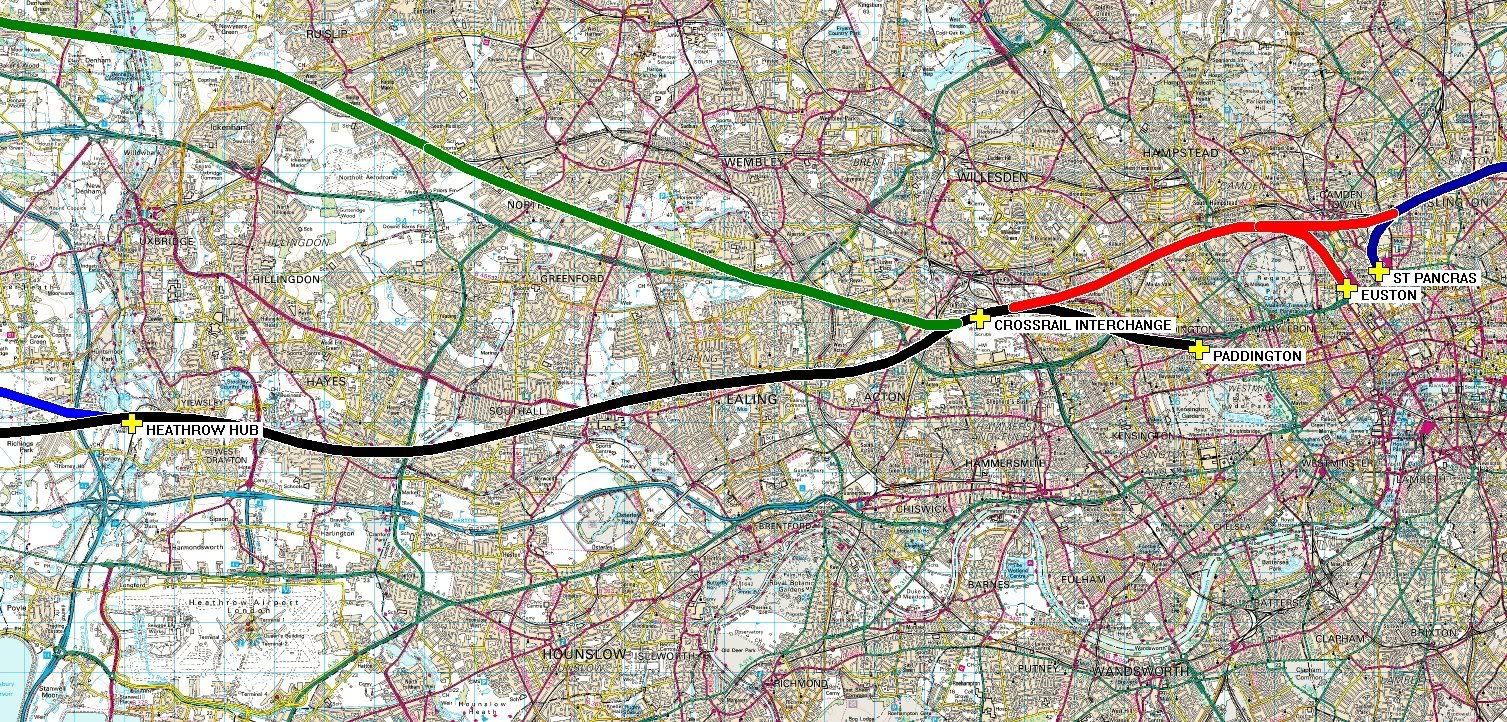
There is a wealth of detail about the Government's proposal (and it should be noted that High Speed Two Ltd is a company that was set up by the government, rather than a disinterested body) on this page. So on the basis that a picture paints a thousand words, this map shows the essence of the proposal.


In some ways it is similar to the Bow Group (a Tory think-tank) proposal that Penddu highlighted in this post a few weeks ago (please take time to read it). But the most obvious difference is where the line splits to go to either north west England and Glasgow, or to north east England and Edinburgh. In this respect I think the HS2 proposal is better than that of the Bow Group. As I mentioned at the time, I think the more convoluted route to Leeds was a legacy from the original Tory proposal that they can't quite bring themselves to ditch. Certainly it is important that Leeds is on the network, but branching just north of Birmingham brings the east Midlands and Sheffield directly onto the main route.

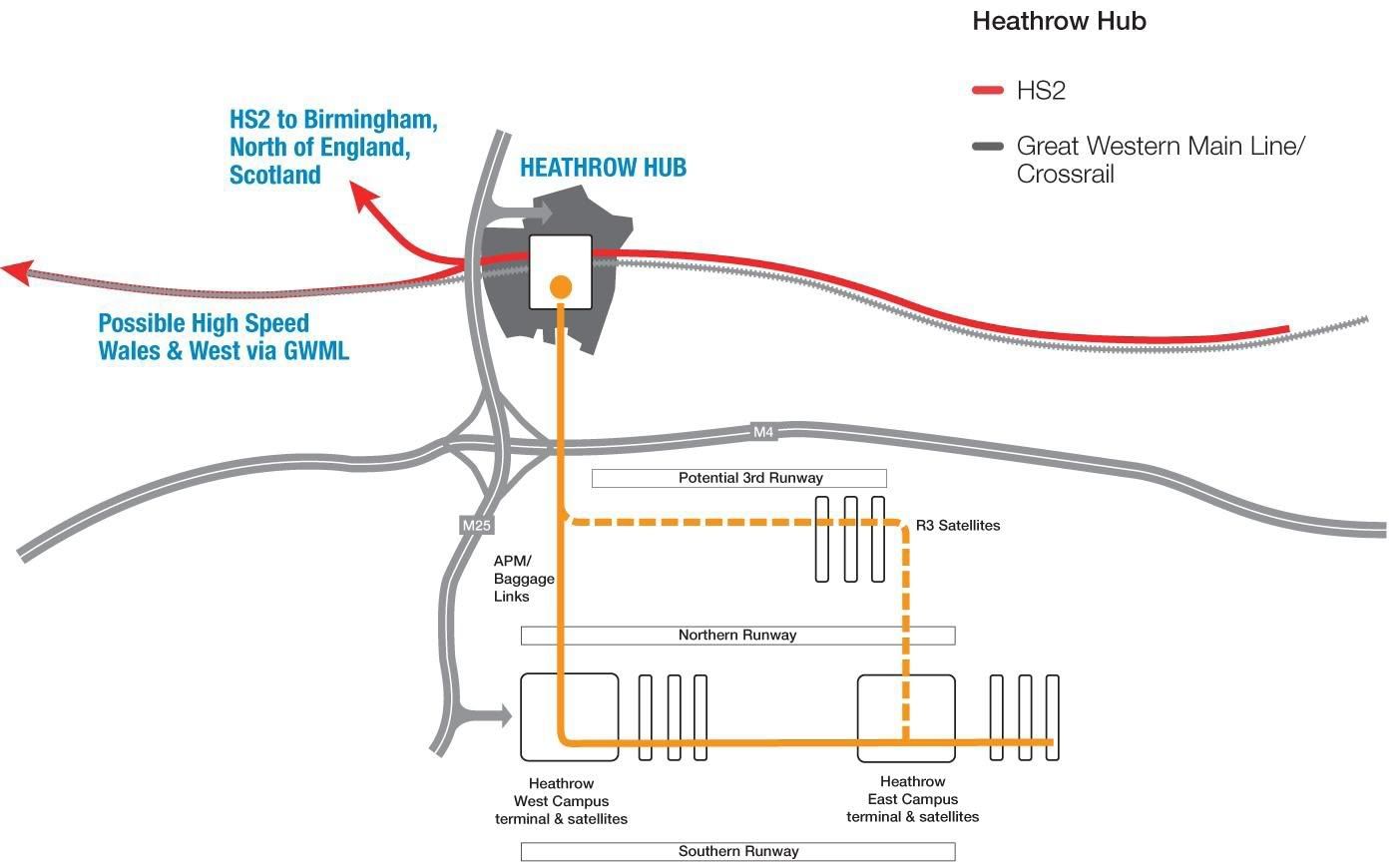
However what matters much more is the way that the HS2 proposal treats Heathrow. The crucial difference between the two is that the Bow Group have taken on board the idea of creating a Heathrow Hub. This is an idea first put forward by Arup, and it makes Heathrow a key part of an integrated transport network. The HS2 proposal leaves Heathrow as a spur off the high speed rail network, rather than part of the network itself.


As we can see, the HS2 proposal centres on a Crossrail Interchange (I'll call it the CRI) which serves a number of useful purposes. But in functional terms it is really doing what the Heathrow Hub itself would do ... but in the wrong place.

The crucial difference is that the CRI is in London, so if people use that interchange, they then have to travel into London and then back out of London to get to Heathrow. They reckon the journey time will be 11 minutes, but the fact is that the current journey from Paddington to Heathrow via the Heathrow Express only takes 15 minutes. That's hardly any saving. On top of that Heathrow itself comprises a number of isolated terminals (Central, Terminal 4, Terminal 5 ... and maybe a Terminal 6 if a third runway is built) and no train station can ever serve all of those. Therefore what is needed is a local terminal interchange service which can take in all of those ... and in so doing also include the major rail lines, as well as a bus station and car parking. This is exactly what Arup are proposing.

By including the Great Western Line, it means that people coming to the airport from south Wales, Bristol and Bath, Cheltenham and Gloucester, south west England and Cornwall can get directly to the airport hub, rather than first having to go into London. This is a good thing, and in theory this could be done whether or not the high speed line went through it.

But the advantage of routing the high speed rail link through the Heathrow Hub is that people from the midlands and north of England can also get to Heathrow without first going into London, and can equally use it as an interchange to get to south Wales and south West England without first going into London. It is also very doubtful whether the cost of the Heathrow Hub could be justified unless the high speed line went through it. This is why routing it through the Heathrow Hub is so important to Wales.

-

The Bow Group see this clearly. As they themselves say, this holistic way of thinking is of the same sort displayed by Michael Heseltine in deciding the route of HS1 – the link from the Channel Tunnel to London. Coming into London from the east rather than the south (as had been proposed by the rail industry) regenerated a whole swathe of what we now call the Thames Gateway ... and the fact that the route was a few kilometres longer didn't matter. It is the same with this proposal by HS2: they are looking at it predominantly from a rail point of view rather than as an integrated transport solution.

Ironically, the HS2 proposal does work around Birmingham, because it makes Birmingham Airport the interchange hub between the new HS line, normal rail services, the airport and the motorway network. All that is necessary is for them to apply the same logic to London's main airport, the normal rails service on the GWR, and the M4.


And I think that HS2 probably realize this. Why else would we see the rather pathetic "loop" to Heathrow on the map above? And what else could explain this statement:

The question is whether there is a case for an additional station at the site of Heathrow itself. HS2 Ltd, after thorough analysis, advise that the business case for such an additional station appears weak, given the estimated cost of at least £2 billion for the additional tunnelling required to serve the site. Furthermore, Heathrow is not a single place; it is an airport with three widely dispersed terminal centres.

However, I am conscious that, as foreshadowed in the Government’s January 2009 decision on adding capacity at Heathrow, there may be a strategic case for a high speed station at Heathrow, particularly in the light of that planned expansion. I have therefore appointed Lord Mawhinney, a former Transport Secretary, to advise on the best way forward, having fully engaged with all interested parties. A complex decision of this nature should not be taken in a knee-jerk fashion, but after a full analysis of the facts and options.

Andrew Adonis - HSR Summary, 11 March 2010

Andrew Adonis at least recognizes where the HS2 scheme is weakest. But I would suggest that if he thinks more clearly, the problem becomes much easier to solve. If the route is taken through Heathrow, as the Bow Group proposes, it will not involve having to build an additional station. If there were a Heathrow Hub, there would be no need for the CRI. It would do everything that the CRI is intended to do, but better. Secondly, Lord Adonis is wrong to suggest that it requires an additional £2bn for tunnelling ... that would only be required if the station were under Heathrow.

The most critical aspect is that of "dispersion", namely that rather than discharge all passengers at the terminal station (Euston) from which they would then have to flood onto the underground to get to various parts of London, an across-the-platform interchange to Crossrail will allow people to go directly to half a dozen points in London. But Crossrail is already set to go through the Heathrow Hub anyway, so it will provide exactly the same "dispersion" that the CRI will provide.

The CRI is intended to be at Old Oak Common in west London, just three miles from Paddington, which is currently the depot for the Eurostar fleet. There is a consensus that the terminal should be at Euston, and this will involve tunnelling between them, and to connect to the HS1 line into St Pancras. The tunnelling is a major cost, but it is common to both schemes. So it is then a question of which route the line follows from there. The HS2 proposal uses the Central Line corridor, the Heathrow Hub proposal uses the Great Western corridor ... both are equally feasible and neither involves major works. The difference in the length of the two routes would be less than a kilometre.


But the biggest difference is that the CRI at Old Oak Common could only ever be a rail solution. There is no way that it could be an integrated transport hub, because there's no way for it interface with road transport. The Heathrow Hub would be right next to the M4/M25 junction, making it very easy to drive and park there, and for a bus station ... as well as the airport, of course. As an integrated solution it wins hands down. The HS2 proposal is a solution that only looks at things from a rail point of view, it lacks breadth of vision.

-

Finally, everybody knows that no decisions are going to be made on this until after the May election, and the Tories have said they will not accept the proposal without looking again at the route. But I don't want to make this into a party political issue.

My point is simply that building a Heathrow Hub is better in almost every respect than siting it at Old Oak Common. But, in particular, it is better for Wales. Because of this, I urge politicians in Wales, especially Labour politicians, not to look at this as a Labour vs Tory issue. Fight for the solution that is best for Wales (as well as for south west England) ... and if party politics gets in the way, remember that the Heathrow Hub wasn't the Tories' idea, it was Arup's idea.

Bookmark and Share

A Good Night Out in the Valleys

Back in November I posted about the launch of National Theatre Wales, but tonight the curtain rose on its first ever production:


     Curtains up as National Theatre Wales' first play opens

It's good to see it up and running at last, not least because it means we now have something to stand alongside and complement the Welsh language Theatr Genedlathol Cymru, set up back in 2004. If we are serious about becoming a truly bilingual nation it is important that we promote and celebrate the many strands that contribute to our rich cultural diversity in both our languages.

I'm particularly proud that establishing an English language National Theatre for Wales was one of Plaid Cymru's manifesto pledges in the 2007 Assembly election, and that this was something that we managed to negotiate into the One Wales Agreement with Labour, who were opposed to the idea and had done nothing to set up an equivalent to Theatr Genedlathol Cymru in all the time they were in power before ... either when in coalition with the LibDems or in power on their own.

-

But that's enough politics. This is a taste of what to expect:


And there's more information about this and future productions here.

Bookmark and Share

Swansea to Cork ... again

It's been a while coming, but it looks like the new Swansea-Cork ferry is now operational.


Yes, it will probably do more for the economy of south west Ireland than it will do for that of Wales ... but even so it will still bring benefits to Wales. And every car or truck it takes off the roads west of Swansea will reduce pollution, make those roads that much safer to use, and reduce the need for those roads to be widened. Those are very welcome benefits.

Congratulations to those who have fought so hard to get the service reinstated. I wish the Fastnet Line every success and hope it will be a permanent part of our transport infrastructure.

Bookmark and Share

An unjust way to do justice

There's breaking news about the decision by the Labour Government in Westminster to refuse to allow bilingual juries in Wales. So far the story is only available in Welsh, here:

     'Na' i reithgorau dwyieithog

This matter has been on the agenda for some years, and the Ministry of Justice has been continually putting off the decision, as mentioned here. Yet despite previous positive indications the last statement by Jack Straw did appear to signal something more negative. So perhaps it shouldn't be such a surprise.

-

But that doesn't make it any less unjust. At present many lawyers specifically advise clients not to choose to testify in Welsh for this very reason. This, for example, is from a lecture by Justice Roderick Evans, the Senior Presiding Judge for Wales.

In every jury case in which I was involved as counsel and in which a witness on the side which I was instructed to represent indicated a preference to give evidence in Welsh, I advised that that witness would be at a substantial disadvantage in giving evidence in Welsh because of the disadvantages of presenting evidence to a jury via a translator. I know that I was not alone in giving such advice, and now as a judge I am aware of cases in which witnesses who would prefer to give evidence in Welsh give their evidence to a jury in English because of the need for translation.

Lecture to the Centre for Welsh Legal Affairs, 2006

The injustice is even more pronounced because of the unequality of the way Welsh is being treated in comparison with English. If any juror is summoned who does not understand sufficient English to be able to follow the case, s/he will be discharged. So why should that same principle not apply to Welsh?

It is simply not sufficient to say, as the MoJ maintains, that translation facilities are provided. The crucial issue is that a jury makes decisons about any case based on the credibility of the witnesses who give evidence.

In most cases, a witness's credibility is primarily determined by the way they answer questions ... especially when put under pressure in cross examination. Their tone of voice, frankness, confidence, hesitation, evasion or defensiveness are important ways in which any jury decides if a person is telling the truth or not. How can this be done if the jury doesn't understand Welsh?

Any translation will be several seconds late, in a voice different from that of the witness. How would a jury member who relies on such a translation decide whether a witness's body language matched what they said?

-

So there should be no issue of principle at stake. However that does not mean there won't be practical matters to address in arranging pools of Welsh speaking jurors. In Wales as a whole, only about 12% of the population were fluent in Welsh at the time of the last census, so there needs to be a practical and workable way of determining who they are beforehand, rather than filtering them out when they arrive for jury service.

The simplest way would be to ask that question as part of the annual electoral registration process, not least because the form already includes a question about age for jury purposes. Putting another tick box on the form is not going to lead to any inconvenience or cost any money.

And of course the jury would still be random. Although the size of the pool of Welsh speakers will vary from area to area, the likelihood of a trial involving significant use of Welsh is going to be correspondingly higher in areas with higher proportions of Welsh speakers. In areas where there are fewer Welsh speakers the answer would be to hold trials with significant use of Welsh in a batch every couple of months or so, or to move the trial to a place where there is a higher concentration of Welsh speakers.

-

So today's decision by the Ministry of Justice is not only fundamentally wrong in principle, but willfully ignores the very simple and practical steps that could be taken to make it possible to summons the necessary pools of bilingual jurors.

The use of Welsh in Courts is a matter that has not been devolved to the Assembly. This outrageous decision shows why it should be. But even without that it is a decision that I hope—and indeed expect—will be reversed by the next UK government. Despite their other faults, the Tories do have a relatively good track record on language issues. The way they react to this decision will show how committed they are to a system of justice that can be fair and just to everybody in Wales, irrespective of whether they choose to use English or Welsh.

Bookmark and Share

Pulling levers

Just for those who like to blame devolution for Wales' undoubtedly poor economic indicators, this clip from last week's Sharp End should be a timely reminder of where the real responsibility for this situation lies.


Alun Cairns was asked whether he was sure he was doing the right thing in wanting to be an MP, especially in light of the fact that people in Wales held MPs in much lower esteem than elsewhere in the UK. His reply was:

Absolutely right. My greatest interest is the economy and business and that's where the powers lie for economy and business really, where I'd like to be able to make a contribution to the constituency.

... When you look at the economy and business and in terms of overcoming deprivation, child poverty and those sorts of issues, it is Westminster that has most of the levers and that's really what can make the biggest influence and difference to the Vale of Glamorgan and other constituencies.

So just remember this next time you hear Alun Cairns or any other Tory criticizing the Welsh Government for Wales' poor economic performance, or why levels of deprivation and child poverty are so bad.

If you're a Tory, the obvious answer is to aim to get elected to Westminster in the hope of being able to hold one of those levers ... although that's something which is just as true for Labour politicians as well. But isn't the much more sensible idea to move the levers to Wales, so that we can take responsibility for these things for ourselves?

Bookmark and Share