The Welsh Language Measure

Like Alan Trench, I was rather surprised that the proposed Welsh Language Measure was not published on St David's Day as intended. The reason given made no sense, so I can only conclude that one of the parties in the One Wales Coalition needed to get the proposed Measure approved by their leaders in Westminster before they would allow it to be published. Which is fair enough. Carwyn Jones is not the leader of the Welsh Labour Party, just the leader of the Labour Group in the Assembly. The Labour Party hasn't yet reached the point where Labour politicians in Wales can make their own decisions about any policy in Wales ... I hope that might change in future, but it is up to them.

-

But anyway, it's only a few days late, and it makes interesting reading even though it is very long. Choose for yourselves which level of detail you want to go into:

     Welsh Government Press Release
     Proposed Measure
     Explanatory Memorandum

In the process of getting the LCO that now allows the Assembly to make legislation on the Welsh language, it appeared to me that the main focus of the argument was on which bodies should be brought under the scope of any new legislation. The end result was that bodies operating in some areas—notably large private companies providing some essential services—were included and that some weren't. It was a compromise which failed to satisfy some, but which represented a minimum that politicians from all parties felt comfortable with. That consensus shouldn't be underestimated. We should not make the language a party political issue.

But as that argument was happening, my thoughts were that not too many people were thinking very hard about the other legislative powers that were being sought. And of course if they hadn't noticed, why should I have wanted to bring it to their attention? Even so, I wasn't exactly sure which direction the eventual legislation would take. The commitment in the One Wales Agreement was only this:

•  to confirm official status for both Welsh and English
•  linguistic rights in the provision of services
•  the establishment of the post of Language Commissioner

What is in the proposed measure, at least at first glance, is very positive in these two major respects:
 

Enforcement

The current Welsh Language Act requires bodies to agree Welsh Language Schemes with the Welsh Language Board. There way no way in which the WLB could insist on any of these bodies doing anything in particular. They could reason, persuade, cajole ... but not insist. Therefore many WLSs were characterized by nice sentiments but very few firm commitments. But, even where commitments were made, the WLB has never had any power to hold the body concerned to its commitments. It had the power to investigate and report ... it could "name and shame" ... it could try to persuade ministers or other officials to apply pressure from above ... but it had no enforcement powers. In short, many bodies got away with saying one thing, but doing either nothing or very little.

What has now changed is that the Commissioner has powers of enforcement, and that there is also to be a Welsh Language Tribunal in any case of disagreement ... followed by resort to the Courts for enforcement of penalties if all else fails.
 

Championing individual rights

Under the current Act, individuals or groups that felt aggrieved by the way they had been treated by a body that was subject to the Act had no direct way of seeking redress from that body. They could raise the matter with the WLB, but even then the WLB had no way to enforce any sort of redress. So another big change is that the Commissioner will be able to act as a champion for individuals and groups, to investigate and seek redress on their behalf. This is very much the same model as is used by the EHRC in matters of discrimination on race, gender, disability etc. To my mind this is entirely appropriate, for it recognizes that the Welsh language is not some sort of special case, but that we are merely seeking to give those who choose to interact in Welsh the same sort of rights that we already accept should be given to other minorities.

The only reason rights for Welsh are not included under the general umbrella of the EHRC is that these language rights only apply in Wales. But given some of the problems within the EHRC that is, shall we say, rather fortunate.

Another part of the Measure (Part 6) deals with the general right to use Welsh or, more specifically, for any two people who choose to communicate in Welsh not to be prevented from doing so. This does not apply just within bodies that are currently required to produce WLSs (or the other large bodies brought now under the scope of the Measure) but would apply in any situation, even in the smallest private companies. This is obviously welcome, and in fact goes further than the One Wales commitment.

-

Taken together, these two aspects of the Measure have the power to make a very real difference to the way we use Welsh. The intention of the 1993 Act was that all public bodies would be required to treat Welsh and English equally, and that provision of services should be available in both languages. In practice, only some public bodies have actually done this. Even after seventeen years some councils, health authorities and the like have only paid the most nominal of lipservice to doing it. It is high time that some enforcement mechanism was put in place to require these bodies to do what they themselves agreed to do.

However it is time to move forward from there. Yes, these are many bodies that have failed to do what they said they would, but in that same seventeen years we also have many good examples of public bodies providing decent bilingual services. So another aspect of the Measure I like is that we will gradually move away from agreed Welsh Language Schemes to enforceable Welsh Language Standards. If some bodies can deliver bilingual services properly, why shouldn't we expect similar standards from all bodies that are included in the scope of this measure?

Bookmark and Share

The WASC Report on a Prison for North Wales

Today the Welsh Affairs Select Committee showed itself at its best. Following the fiasco of the Government changing its mind about a new prison in north Wales last year it decided to reopen its inquiry on the subject, take new evidence to try and get to the bottom of what happened, and make some new recommendations. The report is here:

     Welsh prisoners in the prison estate: follow-up

I was pleased to see that they had come to many of the same conclusions that I have expressed on this blog here, here and here.

Condemning what the Government did last year as "a backward step" their main point is that a 1,500 place prison is unsuitable for the needs of north Wales, but that the UK government is locked into a way of thinking that will only envisage prisons of that size.

The Government has now announced its intention to consider alternative sites in regions across England and Wales, meaning that North Wales can no longer be assured of securing a prison. This is a backward step when there is a pressing need for the immediate creation of prison facilities in North Wales. The Government should give priority to identifying a site in North Wales.

... There is a tension between the size of the prison needed to accommodate prisoners from North Wales and the Government’s intention to build prisons of 1,500 places. We do not believe that North Wales should be denied a prison it so badly needs due to a rigid policy on size on the part of the Ministry of Justice. We urge the Government to be flexible in its approach, which would be consistent with the considered views expressed in recent reports by the Justice Select Committee.

This is a request that is so obviously reasonable that it is difficult to imagine how or why the Labour Government in Westminster so pointedly ignores it. But ignore it they have, and they are still ignoring it, as this quote on the BBC website shows:

A Prison Service spokesperson said: "The Government continues its search for sites suitable for 1,500-place prisons.

"The search is focused on our priority areas of London, north Wales, the north west and west Yorkshire. Some have been suggested by local authorities or members of the public. After carrying out a suitability assessment of the sites we will publish a shortlist of preferred sites later this year."

Of course the government is not obliged to do anything that any Committee of MPs recommends, but to my mind this another perfect illustration of the fallacious way that Labour are conducting their election campaign.

Labour likes to claim that electing Labour MPs will make a difference for Wales. The WASC has a majority of Labour MPs (six out of eleven) and I have no doubt that these Labour MPs sincerely want what is best for Wales. But the fact is that this Labour Government continues to ignore them. It's quite possible to understand why the Labour government would ignore MPs from other parties (even though in this case I'm sure the other parties on the WASC agreed with their Labour colleagues) ... but what sort of party is it that ignores its very own MPs?

Surely the answer is obvious: The Labour Party is set on policies that work for middle England because it needs the votes of middle England. The Labour Party does not represent Wales ... unless, of course, Welsh interests just happen to co-incide with those of middle England.

So what on earth is the point of us voting for Labour candidates in this forthcoming Westminster election? Labour MPs may claim to speak for Wales, but in practice their views will get ignored because the Labour Party is more concerned about being in power at Westminster than it is about Wales. This is just the latest example of it.

-

The second point I want to make is about Labour's mendacity. When the Ministry of Justice reversed its decision to build a prison on the Friction Dynamex site at Caernarfon, the reasons given centred on the suitability of the site in relation to ground contamination.

However the report shows that the MoJ and the owners of the site had very different views about this. But at the end of the day it was just a question of money, for the ground could be remediated, though at a cost.

The much more fundamental problem is that the Caernarfon site is 27 acres, but the MoJ—because it has changed its mind about the size of the prison—will now not consider any site of less than 35 acres. In other words the Labour Government is clearly lying about its reason for rejecting the Caernarfon site. Any argument about the site's value is secondary ... a smokescreen to try and hide the fact that the site could not accommodate the larger prison they wanted to build instead.

-

Anyway, that is now going to become history. So I want to conclude by asking a different question. Labour have said they won't change their minds, so what would the Tories do?

David Jones is a regular reader of this blog, the only Tory MP in north Wales and a member of the WASC. So let me put you on the spot, David. Will your party commit to build a smaller prison in north Wales to serve the needs of north Wales?

Or will David Cameron's government treat you and any fellow MPs you might get in Wales in the same way as Gordon Brown treats his party's MPs?

Bookmark and Share

Complaint about BBC Question Time

COPY OF A LETTER FROM MADOC BATCUP TO THE BBC
REGARDING QUESTION TIME FROM CARDIFF, 25 FEBRUARY 2010

Dear Sir/Madam

I am writing to complain about Question Time from Cardiff which was broadcast last night. It is a programme that seems to be in some pre-devolution timewarp. Whatever internal measures the BBC make have taken following the King Report none of them seemed to be apparent in your recent programme – in great contrast to the Question Time broadcast from Northern Ireland recently.

The choice of the panel left a great deal to be desired with two of the panellists (Nigel Farage and Liam Fox) having no discernible connexion with Wales, while Janet Street Porter's family links to Wales and previous antagonistic comments on the Welsh language and Burberry's did not seem particularly relevant to the debate or the current situation in Wales.

As a result of the panel's composition, it was noticeable that there was no representation from the Liberal Democrats, and the ability of some of the panel members to discuss matters of specifically Welsh interest was somewhat limited. Fortunately for them, of course, they did not have to do so.

The questions themselves seem to have been very heavily filtered (on the assumption that they were not planted) and failed to address any fundamental Welsh political issues. On the contrary, the two questions about the behaviour of Gordon Brown and Nigel Farage did not (as pointed out by a member of the audience) advance in any way the argument of whom to vote for in the forthcoming election. UKIP is the only party that wishes to abolish the Welsh Assembly as far as I am aware, and it would have been much more informative to ask Nigel Farage something about his party's policy in respect of Wales. We were then treated to the extraordinary spectacle of a question of legislation on faith schools which is of limited relevance to Wales, since this is a devolved matter (e.g. see the parliamentary website http://www.commonsleader.gov.uk/output/page2921.asp and its comments on devolution in respect of this legislation). This is a perfectly appropriate matter to discuss, but why in one of the parts of the UK where it will largely not be applicable? Can we expect questions about Scottish and Welsh legislation to be discussed by English Question Time panels in the future, or is this yet another case of Wales being treated as a part of England by the BBC and the issue of devolution being studiously ignored?

To add insult to injury we then had a question about the England football team. It is incomprehensible to me why it was thought such a question was appropriate to be asked in Cardiff. A number of the members of the audience and Elfyn Llwyd made it quite clear that it was a question of little interest to people in Wales. Can we expect questions about Welsh rugby from Newcastle or Basingstoke in the future? At a time when the Welsh Assembly has just voted unanimously to ask for more powers through a referendum, wouldn't this have been an appropriate occasion to discuss this issue, since the majority of your English viewers may be unaware that this potentially historic event even took place. Since it is probably the last time that Question Time will visit Wales prior to the Westminster election it would have a useful opportunity to discuss issues that are of particular relevance to Wales in the same way as the Question Time broadcast from Northern Ireland focused on that part of the UK.

In the BBC's Programme Response to Devolution published in December 1998, the BBC stated that:

In the past the BBC has sometimes appeared insensitive to political, administrative, cultural and linguistic differences across the UK, giving the impression of a London-based organisation dismissive of the more geographically distant parts of the UK. There have been errors of judgement and, on occasions, of accuracy.

As a priority, the BBC is now embarking on an extensive series of measures to educate journalists, programme makers and managers, alerting them to the differences across the UK ... they will include:

•  Regular monitoring of programmes for sensitivity to differences between the nations.

These measures are important not only to enable the BBC to provide accurate and well judged news for its audiences in Scotland, Wales and Northern Ireland but also to allow it to offer all viewers and listeners a true sense of the diversity within the UK.

Although this paragraph related to news programmes the document as a whole deals with news and current affairs, and I assume that the BBC would have the same goals for a programme like Question Time. Whatever measures you may have taken there appears, in the case of this recent programme, to have been no discernible effort to meet the BBC's diversity goal. This programme could just as easily (and more appropriately) have been transmitted from Norwich or Manchester for example. It is a clear indication that any changes that the BBC may have made in respect of reflecting the reality of the diversity of the UK have been wholly inadequate. This programme represented a total failure by the BBC of making the viewers in Wales or the wider UK aware of the important political issues that are distinctive to Wales at a time when there is a Westminster election in the offing. If the BBC wishes to patronise and ignore Wales in equal measure it is a waste of licence payers' money for it to do it locally – it can do this just as easily from London and stop the pretence that Question Time has any meaningful interest in the issues of Wales by broadcasting from Wales.

Yours faithfully

Madoc Batcup


Bookmark and Share

The Bulldozer

As Plaid Wrecsam has noted, yesterday saw the first day of operation of the Infrastructure Planning Commission, a body set up to fast-track planning applications for large projects so as to save them being held up or halted by unwilling local authorities and public inquiries.

This is something that's been on the cards for some time. The IPC was the creation of the 2008 Planning Act, and it has been in existence since October last year ... but just not functional until now. As an indication of just how fast-track the process will be, the IPC will be under an obligation to accept or reject an application within 28 days. In other words it might well be possible for approval for a controversial scheme to be granted permission well before any lobby or protest group has an opportunity to set up a campaign.

The devil, as they say, is in the details ... for the IPC might well turn out to be just a rubber stamping body. Their remit will be to consider planning applications in so far as they relate to "National Policy Statements", so in fact the decisions that are taken in formulating those NPSs will be the most critical part of the equation.

The major policy area for immediate consideration is energy. But if anyone is thinking of mounting any opposition to large windfarms or nuclear power stations the sad fact is that you might as well forget it. It's already too late! The consultation was launched in November last year and closed just over a week ago on 22 February. I'm sure most of the public weren't aware of that ... and in fact Hugh Ellis, chief planner at the Town and Country Planning Association (the main body of planning professionals) went so far as to say:

"I can find no-one who is aware that we are about to launch the most important [energy] programme in the last 40 years"

For more on background on that story, read this in New Energy Focus, and follow the links on that page.


At this point it would be easy for me to repeat how much I am against nuclear energy and how much I am in favour of renewables. But that isn't really the point. The point is that decisions about planning need to be taken at the appropriate level. It is surely up to the people who are affected by any proposed development to have their say and make the decision.

In principle, the decision on a project that can produce a certain amount of energy needs to be decided both by those who are closest to the development—those who will see it, or potentially work at it—and those who would benefit from that energy. Thus a windfarm of say 30 turbines can probably be determined by the local authority, or neighbouring local authorities, affected because it will produce only a part of the electricity that the area needs. But a decision on a nuclear power station that produces more than enough energy for half of Wales should properly be considered at Assembly level, since the Assembly is the democratic body that represents Wales. What is most disturbing about the IPC is that the office that will determine any major project proposed for Wales is not even in Wales. Central government is imposing its will on everybody else with scant, if any, regard for democracy in Wales either at national or local authority level.


So is there any hope for a different outcome? The Tories have said they will abolish the IPC, as is reported in today's story in the Daily Post:

But Conservatives claim it takes power away from elected politicians and puts it in the hand of unelected officials. Under proposals released last week they are committed to abolishing it, although any applications already under way would be dealt with by transitional measures they plan to put in place.

A Welsh Conservative Party spokesman said: "Under our plans to scrap the Infrastructure Planning Commission, local authorities would be the principal reference for planning applications in their capacity as local planning authority. However, using National Policy Statements – which may be locationally-specific – the whole process for infrastructure will be significantly speeded up."

Daily Post, 2 March 2010

That sounds promising at first. But a moment's thought will be enough for anyone to see that this isn't quite what it promises to be. Firstly, the Tories will allow any current applications to continue, although with transitional procedures. But more importantly, the IPC is just the final part of a process that will effectively have been pre-determined through the National Policy Statements ... something that the Tories have confirmed they are going to keep. The Tories will no doubt come up with a local rubber-stamping body that is all but obliged to implement the NPSs which they, central government in Westminster, will have decided, not the people at the levels affected. So much for downward devolution.


So there is no real choice between Labour and the Tories on this issue. Whichever party gets to form a government, Westminster will still decide what's best for Wales ... not us in Wales.

The only fair solution is for decision making on energy projects greater than 50MW to be devolved to Wales. Perhaps we would decide to go ahead with nuclear power (much as that would disappoint me) or decide to put a much greater emphasis on renewables (much as that would please me) however the important thing is that we would be making these decisions by and for ourselves ... just as is already the case in Scotland.

Instead, we will still be stuck with some Secretary of State or Minister from Westminster bulldozing through an energy policy that is geared to suit England rather than Wales.

Bookmark and Share

Plaid Cymru - Plaid Cameron?

I've managed to catch up with the BBC's coverage of the Labour Party conference held over the weekend. It was an unpleasant job, but someone had to do it. I was rather amused to find that one of their new slogans was "Plaid Cymru - Plaid Cameron".

As I mentioned in this post on Saturday, for a party that claims the Westminster election is a straight choice between them and the Tories, Labour do seem to be rather more concerned about Plaid Cymru than they want to admit. Welsh Ramblings picked up on the same theme when commenting on Wayne David's pre-conference article on Wales Home.

So what is this new set of double standards that seems to have pervaded the Labour Party? Peter Hain has been pressing his "It's us or the Tories" mantra for some time. So things must be getting desperate if he now needs to appeal to Plaid and LibDem voters to help Labour out, mustn't they?

-

The simple fact is that the Tories are going to be the largest party in the Commons after the next election. There is no real doubt about that. It is not just a matter of percentages and swings compared to the last election. One of the major things that will make a difference is that the Boundaries Commission has redrawn a number of constituencies, particularly in England, and this will help remove one of the most outrageous anomalies of the 2005 election; namely that the Tories got more votes in England than Labour did, but Labour still got 92 more English seats than the Tories.

So if the Tories won most of the English vote even in 2005, of course they're going to do even better this time round. Labour are fooling themselves by letting themselves think they'll form the next government at Westminster.

-

Will it be nice to be ruled by the Tories? Of course it won't. We know that they will use the current financial crisis as a pretext for public spending cuts, and we know that they will do nothing to shift the burden of taxation from the poor to the rich.

But what makes anyone think that Labour will do anything different? Just take two examples of Labour's taxation policy during the time they have been in office. First, when the Tories said they would reduce inheritance tax, Labour's response was to reduce inheritance tax too because Gordon Brown was terrified he would lose the votes of middle England. Second, in order to try and prove he had been a great Chancellor, Gordon Brown's final flourish was to abolish the 10p starter rate of income tax in order to make better off people even better off. When he realized this was a mistake, instead of reinstating it he decided instead to reduce every standard rate tax payer's bill, which he chose to do by borrowing the money to pay for it. Thus we remain in the scandalous position of the burden of taxation being higher for the poor than it is for the rich. That's what Labour are really like.

-

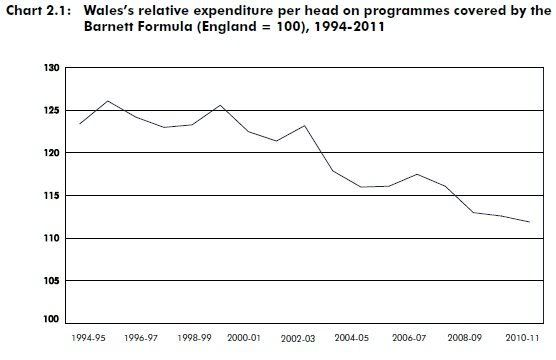
Now I accept that the Tories won't do as well in Wales as they will in England. But that doesn't mean that Labour have Wales' interests at heart. One simple graph from the Holtham Commsiion's report shows what they think of public spending in Wales:


This shows that when the Labour Party came to power, relative spending in Wales was at about 125% of that in England. But the differential has halved in those thirteen years. Meanwhile in Scotland, which also had higher spending levels, the relative percentage did not fall in the same way. In fact in the last six years it went up, as I mentioned here.

It doesn't take any genius to figure out why. Labour need to keep Scotland sweet because of the threat from the SNP ... but they reckoned they could get away with systematically short-changing Wales because they thought the people of Wales would always vote for them.

-

The only difference between the Tories and Labour is that we all know what the Tories are like. They may be ******** but at least they're honest about the cuts they'll make. Labour are blatant hypocrites, because they say they'll protect Wales, but their track record proves that they'll do the exact opposite.

-

So is a vote for Plaid a vote for Cameron? Although the Tories will win more seats than Labour, it's highly unlikely that they'll get an overall majority. So what difference will it make if the Tories are opposed by Labour MPs or LibDem or Plaid MPs? In arithmetical terms it will make no difference at all.

But it will make a difference in terms of Wales' best interests. Unlike Labour, Plaid MPs will fight for Wales because getting the best deal for Wales is our only priority. Labour and LibDem MPs will always have a potential conflict of interest between what is best for the UK and what is best for Wales. If we need an example of that, just look at the hypocrisy of Labour MPs in Wales who campaigned for local services such as Post Offices in order to make headlines in the local media, but who then voted in Westminster to close them. They had no backbone. The party whips would not tolerate dissent, and these Welsh Labour MPs just did what they were told rather than stand up for their constituents.

-

Labour have long ceased to be a radical party or a party of the left. Blair reinvented Labour so that it was indistinguishable from the Tories, and Gordon Brown just carried on where he left off.

Peter Hain likes to kid himself that Labour still have a place in progressive politics. That is not only an inappropriate way to think about what the Labour Party has now become, but singularly offensive coming from a man who used the bogus Progress Peter Forum as a vehicle to conceal funds intended only for his own political advancement.

Hain, every bit as much as the party he speaks for, insults all of us who do want to see progressive politics.

Bookmark and Share

Celebrating the Nation

I've just come across the Welsh Government's YouTube site, which might just be brand new, since all the videos seem to have been put up at the end of last week. It includes a St David's day message from the First Minister and, despite our political differences, as our head of government and in the absence of a head of state, he is the one that should speak to both Wales and the world as we celebrate our national day.


I also like this video celebrating ten years of devolution. Graphics good, music not. It's a bit more political, but still worth showing again:


Bookmark and Share

Diwrnod yng Nghymru Fydd


It's Saint David's Day bank holiday. Relax, spend an extra half hour in bed, take a leisurely breakfast ... and beguile the day.

In Wales, one day.

Bookmark and Share