Wales must plan its future rail network now

In the Daily Post yesterday was a story that gave me major cause for concern. It is about proposals to reinstate the rail link between Bangor and Caernarfon.

Moves to build new rail link between Bangor and Caernarfon

A new multi-million pound rail line re-connecting Caernarfon with the national rail network could be built if campaigners can prove it’s financially worthwhile.

The old line closed in 1970 and part is now a cycle track, with other stretches up for sale to householders. But re-opening the 10-mile long line – possibly along another route – is now an aim of the North Wales transport plan, drawn up by the region’s six county councils.

Gwynedd council – which looks after the track – agrees it would help ease road problems, but is now negotiating the sale of part of the old route to householders in Felinheli because nobody has presented a viable scheme for reopening the railway. Green campaigners have accused Gwynedd of harming Caernarfon’s chances of rejoining the UK rail network ...

Daily Post, 6 April 2010

The part of the story I particularly want to highlight is the proposed sale of part of the land on which the old route ran. It is short-sighted lunacy to sell land in this way, and Gwynedd Council should be severely criticized for wanting to do it. I say that in full knowledge that my own party runs Gwynedd ... but this is far more than a party political issue.

As the Daily Post report goes on to say, councils all over Wales have done exactly the same sort of thing, using the routes of old railways for roads or other forms of development. But policy has changed in recent years, and experience has shown that when old rail routes are reopened, the passenger numbers using them have been much greater than anticipated. For two concrete examples of that, we have the Ebbw Vale line in Wales and the Alloa line in Scotland. The figures for both are here. To me, this suggests that the models that we use to calculate passenger numbers, and therefore the economic viability of reinstating the routes, are still outdated, and that it should therefore be possible to reinstate rail services and rebuild old lines on a larger scale than we have done so far.

-

But we need to think clearly about what we want to achieve. As I see it, there are two separate goals. One goal is to put more places back on the rail network: a local goal bringing local benefits. But in my opinion the more important goal is join together the various fragments of railways we have to create a network that will make it possible to make longer journeys from one part of Wales to another by rail: a strategic goal rather than a local goal.


The map above (click it to open a larger version) shows the rail network in north west Wales. The lines in black are in operation. The two lines in red have existing track, but no rail service. The reinstatement of the branch from Llangefni to Amlwch has already been identified for reinstatement of services, which is very welcome.

The line shown in green is the existing track bed of the dismantled railway between Pont Britannia and Caernarfon, which is now used as a cycletrack. Building it will certainly provide a local benefit, especially to Caernarfon and Y Felinheli. It is a question of whether the cost/benefit ratio stacks up. However the line could also be part of a strategic link between the north coast line and the Cambrian Coast line. The old railway ran along the route shown in pink on the map.

The ideal, of course, is to meet both local and strategic goals. I'm not suggesting that we have to do both at the same time, only that we make decisions now based on the possibility of doing more in the future. It is relatively easy to reinstate the old line from Pont Britannia to Caernarfon, and in my opinion it should go through Y Felinheli so that the people who live there can benefit from a station within walking distance. It is possible to take another route, roughly along the line of the new main road, but that will mean that any station will be some distance from where people live.

But what is much more critical is that if the line is to be extended south beyond Caernarfon, there is only one route it can take. At present this is used as a road which runs under Castle Square, but I think the road can be sacrificed as Caernarfon now has a better through road. The only place where it is impossible to use the old rail alignment is where the new Morrisons store has been built. But it should be possible to divert the line slightly to run between Morrisons and the Victoria Dock development, though that will mean reconfiguring some roads.

The other thing that must be done is to ensure that we reinstate the railway between Pont Britannia and Caernarfon to normal rail rather than light rail standards. It might well be cheaper to build it to light rail standards, but that will make it impossible to use it as part of a strategic north-south rail link in the future.

-

However, even though I think the through route is a good idea, I believe that we can achieve a link between the north coast line and the Cambrian Coast line more effectively via Blaenau Ffestiniog. On the map above, the 8km red section south from Blaenau Ffestiniog is existing track in good condition, and it would require only 10km of brand new track to complete the link. More details are here. In contrast, the green section to Caernarfon is about 11km, and the pink section 29km, making 40km in total. Although it might well be better not to follow the old route but to shorten it as shown by the dotted blue line.

-

This is just an illustration of the issues as they apply to one area of Wales. There are exactly the same issues in other parts of Wales too. So in short what we need is a comprehensive review of what we would like the rail network in Wales to look like ... irrespective of cost or the ability to build it in the medium term. We simply need to identify the routes we want and then, after evaluating the routes in detail, take the necessary steps to safeguard those routes from development. We can then implement that plan in stages as and when we can afford it.

What this story shows all to clearly is that local authorities simply will not do this if left to their own devices. Most of them are so strapped for cash that it is quite understandable that they would look to sell whatever land they can for the best price they can get.

This is an evaluation that needs to be done at a national level by the Welsh Government, and done now. If we fail to do it now we may find that it is a lot harder, if not impossible, to get the rail network Wales needs ... and will need even more as the cost of motoring becomes ever more expensive, both environmentally and as the world wide demand for oil outstrips the supply.

Bookmark and Share

Baile Mor nan Gaidheal

That's the Big City of the Gaels ... or Glasgow. I was very encouraged to see this report on the BBC Scotland website about the city's plans to increase the prominence and use of Gaelic:

Gaelic language plan for Glasgow

A three-year action plan to increase the use of Gaelic throughout Glasgow is being launched by the city council. The strategy will be unveiled at the first board meeting in Glasgow of Gaelic agency, Bord na Gaidhlig. It will see the opening of a second Gaelic school in the city as well as wider use of the language on signs and official council communications.

Councils are legally obliged to prepare a Gaelic Language Plan under the Gaelic Language (Scotland) Act 2005.

Glasgow City Councillor Aileen Colleran said: "We have a vision for Gaelic in our city and this plan sets it out. By 2020, the place of Gaelic will be obvious to all. We'll see it around us - in our buildings, on our streets and in our shops - we'll hear it in conversations, in our schools and in the media. Our young people will be speaking it in Buchanan Street without feeling self conscious about it and people will recognise the language as Gaelic."

BBC, 6 April 2010

It's good to see such a positive attitude. We are not alone in wanting to see our languages thrive, and Scotland seems to have followed up on some of the same methods and strategies that we have used in Wales.

There's some more info on Glasgow City Council's website here, and the Language Plan itself is here.

Bookmark and Share

Llanelli

A week or so back, BlogMenai posted a copy of a letter sent out to every voter in Llanelli by the sitting Labour MP. I've nothing against Nia Griffith as a person, but what was said in her name was something else again:

You understand that Assembly funding and, to a large extent County Council funding, depend on Westminster, and only a Labour Government can deliver for Llanelli.

Liam Byrne MP, Alistair Darling's right-hand man, has agreed that we need to revise the Barnett funding formula to deliver a better deal for Wales. But only a Labour Government in Westminster can actually deliver that money for Wales.

... I'm counting on you to help me get the best deal for the people of the Llanelli constituency.

So let's have a look at those claims in a little more detail. Let's look at what the Labour Government in Westminster has actually delivered for Wales in their thirteen years in power.


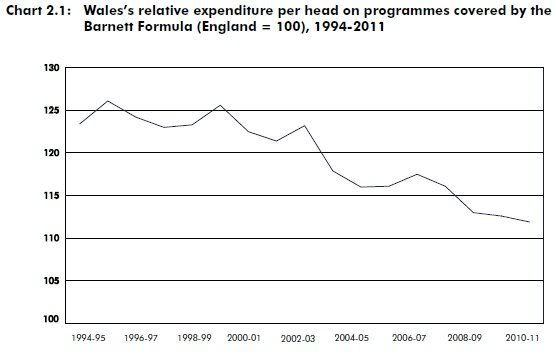
This is a chart showing how spending in Wales relative to the remainder of the UK has fallen, taken from the Holtham Commission's report on finance and funding for Wales. We can see that Wales is now much worse off compared with the other countries of the UK than it was when Labour came to power. So Labour's claim to be the only party that can actually deliver money for Wales is nothing other than a barefaced lie. Precisely the opposite is true.

What has happened is this: Labour have spent a lot of money on the UK as a whole, and a lot of that money has been spent in Wales. The problem for us is that Labour were increasing their spending more per head in England and Scotland than they were doing in Wales. Yet Labour expect us to be grateful to them because we have received half a share, rather than a fair share. They rely on the fact that people in Wales won't look beyond the immediate horizon to see the bigger picture.


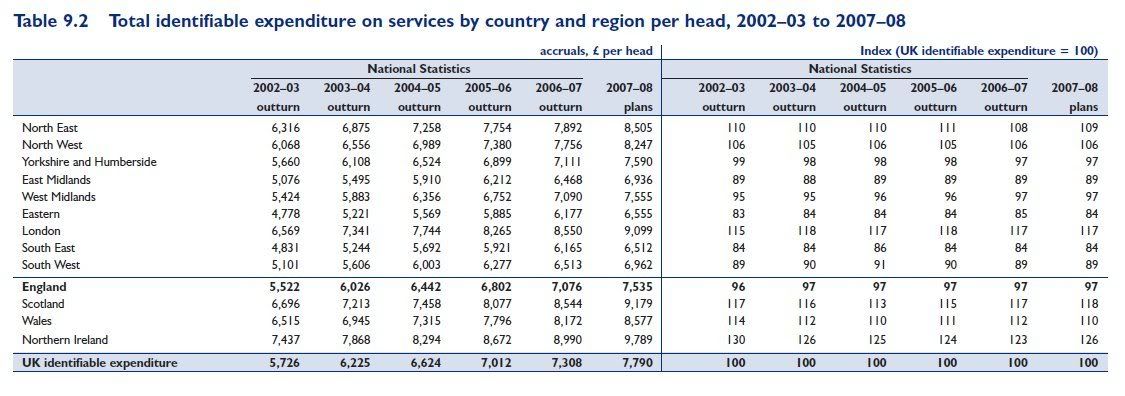
As we can see from this table, the PESA figures show that over the past six years relative spending (the UK as a whole is 100) in Wales has gone down from 114 in 2002-03 to 110 in 2007-08. But for the same period relative spending in Scotland has in fact gone up from 117 to 118, and in England from 96 to 97.

So why has this happened? It is simply because Labour Secretaries of State for Wales have not taken the same care to fight for Wales as their counterparts in Scotland, or the departmental Secretaries for England.

-

But the real scandal is that Labour won't do anything to change this unfair situation. Why do you think the letter mentions Liam Byrne rather than his boss Alistair Darling on one hand, or Peter Hain on the other? Simple, it's because Alistair Darling has refused to make any commitment to change things ... and that Peter Hain, rather than fight for Wales, prefers to take this snub and spin it into something else.

Back in November last year, the Wales Office—headed by none other than Peter Hain, never reluctant to bathe himself in the orange glow of self-praise—proudly proclaimed:

     Hain secures fairer funding agreement for Wales

But it was nothing of the sort. Hain was lying through his teeth. All he got was from the Treasury was the non-committal statement that everything to do with funding for Wales was essentially all right, that it always has been, and that nothing is going to change ... but that they might look at it in future if things get worse.

Gerald Holtham himself said that Labour were acting like "silly billies" for not doing anything to change the system while they could. If he wasn't on television I think he might well have used the sort of language I used when I looked at the Wales Office statement in detail in this post:

     Silly billies ... or yet more silly buggers?

So instead of actually fighting to "actually deliver that money for Wales" Labour meekly gave up the fight without winning any commitment from the Treasury other than to "look at it".

So why the hell should anyone in Llanelli actually vote Labour? In the thirteen years that Labour has been in power their track record has been precisely the opposite of what they claim.

-

And as for Nia Griffith herself? Yes, she probably does care about her constituents, I don't doubt that. But the real question is whether she has been able to make any difference for them in Westminster. Like so many Labour MPs, she's fine at standing up for things like keeping post offices open when she's in the constituency, but in Westminster she will do what the Labour whips tell her to do ... and vote to close them.

That's just one example of why what it says in her letter about a Labour MP being able to make a difference is so pathetic. Most Welsh Labour MPs are just lobby fodder to vote through what the Labour government in Westminster decides.

-

But Llanelli has a far better choice than to vote for Nia Griffith. Llanelli is going to be a contest between Plaid Cymru and Labour and I can guarantee that Plaid's Myfanwy Davies will stand up and fight for Llanelli and for Wales, rather than meekly turn into lobby fodder for the issues that matter to middle England.


It's a big ask, but she can do it. Labour's share of the vote in the 2005 election was 46.9% with Plaid at 26.5%. So it would take a straight swing of just over 10% for us to win. But that's quite close enough to mean that many of those who voted LibDem and Tory (12.9% and 13.7% respectively) will turn to Plaid simply in order to break Labour's hold on the seat.

Only by voting for Myfanwy will people in Llanelli be able to get rid of a Labour Party that does precisely the opposite of what it claims to do for Wales, and a candidate who isn't strong enough to stand up for her constituents when the Labour whips in Westminster tell her to do the opposite of what she told them she would do.

Bookmark and Share

TrawsCambria to TrawsCymru

This story in the Western Mail today highlights some of the problems of the TrawsCambria network of long distance bus routes across Wales:

     Cross-Wales bus service snubbed by long distance passengers

We can get a sense of the history of the service from this article in Wiki. But the significant recent development came five years ago with the stated aim of transforming it into a "network of high-quality services". Yet, as the story very clearly shows, the previous Welsh Government singularly failed to do that. The network is fair enough, but the services that operate on that network are well below anything that could be described as high-quality.

-

The previous minister responsible for transport (and economic development) was Andrew Davies, and what he failed to do was to see the distinction between long distance and short distance travel. This was reflected in two major ways:

•  First, that the service was operated by ordinary short-distance buses which were simply not suitable for journeys of more than about an hour because the seats weren't comfortable enough and there were no toilet facilities

•  Second, that the service made far too many intermediate stops, thus increasing journey times.

In essence, we were left with something that was closer to a local bus service travelling a very long route than an express coach service that could provide a viable alternative to travelling from one part of Wales to another by car.

Roughly 12% of passengers travelling on the existing TrawsCambria network are travelling between principal towns. Around 60% are travelling between administrative centres and their hinterland. The majority are traditional short-distance users, travelling to the nearest town for post offices, libraries or shopping.

It fell between two stools precisely because insufficient thought had been given to what the service was meant to do. But the good news is that this is finally set to change. The starting point is what Plaid set out in the 2007 manifesto:

We will create a fast, convenient national long distance express coach service, well-integrated with feeder rail and local bus services.

In contrast, Labour's manifesto was still thinking in terms of buses. But with Ieuan Wyn Jones now in charge of the portfolio it seems that things are at last moving forward, in particular with the appointment of David Hall. To give some idea of what's in store, this is a PowerPoint presentation he gave last month:


The presentation speaks for itself (well, apart from slide 16) but there is one point that I would particularly want to highlight.

•  A coherent and readily identifiable network of longer distance services, linking centres not directly served by the rail network in Wales.

In essence, this network is primarily meant to do what a rail service would do if Wales had a complete rail network. That's why, to take three examples, the route map does not have any service running along the north Wales coast, nor does it link Machynlleth with Newtown, nor extend from Carmarthen into Pembrokeshire. That's because rail already does that job ... although if we developed our rail services that job could be done even better.


For that reason I would seriously question whether extending the service into Ynys Môn is at all necessary because a properly integrated interchange at Bangor would serve the same purpose. I would instead make a far stronger case for extending the X50 service south from Aberteifi (Cardigan on the map) to Haverfordwest and Milford Haven. But those things can be worked out in the business plan. And uniting the X43 and 704 route is a no-brainer.

-

Yet the one thing I would stress is that any long distance coach service can never be as good as the rail service would be. One of the core elements of the network is to link Carmarthen and Aberystwyth, but the railway that used to run between the two can be fairly easily reinstated. The same is true for the line between Porthmadog and Bangor. Reinstating the rail route between Newtown and Cardiff is part of Tad Deiniol's proposal.

So I think we should regard the new TrawsCymru network as something temporary rather than a permanent solution. We should be looking to establish a new north-south rail route, but even if we started work on it tomorrow I doubt that it could be completed within ten years. Yet in the long term that is what we must do ... and we should start now by working out the route so as to protecting it against future developments, particularly in towns that the railway used to pass through.

This is a video showing the north-south rail route I would like to see developed:


Some more information about it is here and there is more detail on the Ffestiniog/Cambrian Coast link here.

But there is a difference between long-term planning and what we can achieve in the short term. A network of fast, frequent and comfortable coach services between all parts of Wales is something we can achieve in the next year or so.

Bookmark and Share

Wrexham fails a hundred children a year

On Monday, the Daily Post carried this story about Welsh-medium education in Wrexham:

Wrexham council accused of dragging feet over Welsh language education

Education consultant John Morris, who has worked in schools and colleges across the country, fears Wrexham is leaving many families out in the cold who want their children to be educated in Welsh.

He said he had been contacted by a number of parents who had tried to get their youngsters into Welsh schools only to be turned away. And he claimed the local authority was not doing enough to ensure there would be adequate provision to meet demands for Welsh language education in the future.

Mr Morris said: “I have had families come up to me and tell me they haven’t been able to get their children into schools with education provision in Welsh language. People have seen the success of schools in Wrexham which provide Welsh language provision such as Ysgol Plas Coch, Bodhyfryd and Morgan Llwyd. But schools are completely under resourced to cope and at Plas Coch they have put up two mobiles because of the extra demand."

-

The authority’s Chief Learning and Achievement Officer John Davies, said: "The authority is still in the midst of carrying out a feasibility study on a range of possible sites and locations for a new primary welsh-medium language school in Wrexham. This should be completed within the next few weeks. Once this is completed a report will be submitted to the executive board in late April, where members will agree on a preferred option. The authority will then carry out a full consultation, which will seek the views of a wide range of stakeholders about that preferred option.

"There is sufficient accommodation in our Welsh medium schools to meet the current demand. All pupils who have applied for places at Welsh medium schools in Wrexham next September have been allocated places and two of our Welsh medium primary schools still have some places available."

Daily Post, 29 March 2010

This sounds suspiciously like a case of "he said, she said". Whenever anyone makes an allegation there'll always be someone available to deny it, and the average reader is then left with no means of being able to judge who is telling the truth. Happily, the facts become clear with a little research.

-

The current situation is that Wrexham has five Welsh-medium primary schools, although there are also two very small rural schools which teach in Welsh. Wrexham publishes the admission number for each school in this document, together with the number of applications for places in September 2009:

Plas Coch ... Admission number 27 ... Requests 57
Bodhyfryd ... Admission number 46 ... Requests 49
Bryn Tabor ... Admission number 42 ... Requests 31
I D Hooson ... Admission number 29 ... Requests 39
Cynddelw ... Admission number 18 ... Requests 6

Total admission number 162
Total requests 182

This shows that the number of requests for places exceeds the number of places normally available. However it should be noted that the Ysgol Bodhyfryd website says that the school now has an admission number of 60, to refect the fact that temporary space has been found from somewhere. As mentioned in the story, Ysgol Plas Coch also has two temporary classrooms.

So Wrexham have just—but only just—managed to find places for those who have made formal admission requests. However they are very obviously heading directly for another crisis since three of the Council's WM schools are already full for this coming September, and it is almost certain that one of the two remaining schools with places mentioned by Mr Davies is Cynddelw which is in Glyn Ceiriog, some 25km away from Wrexham itself. Therefore only one of the four schools in or anywhere near Wrexham has any space left ... a full six months before the start of term.

-

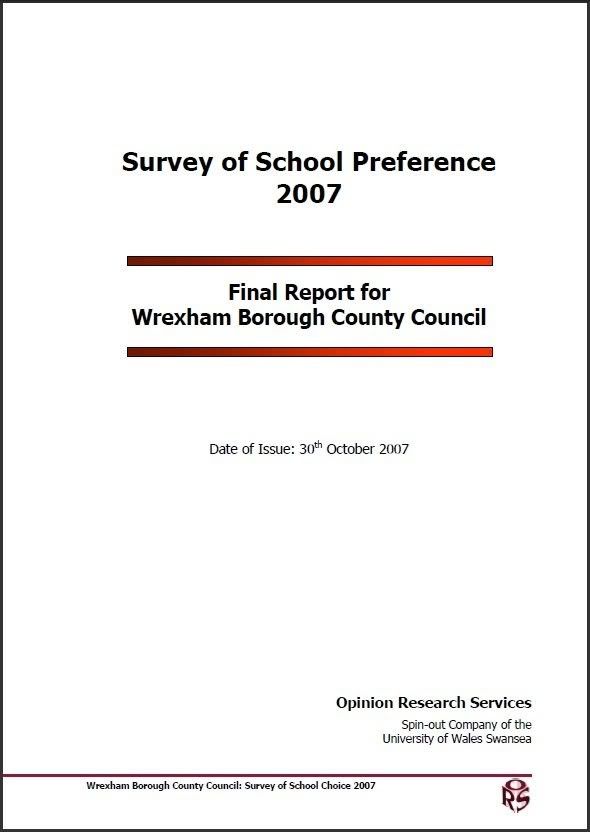
But this is only a part of the picture. Back in December I wrote this post about Wrexham's belated proposals for increasing the number of WM places available. In it, I mentioned that Wrexham had conducted a survey of parental preferences of parents of very young children in October 2007, and the headline percentages were given in this news story from RhAG. I did try to find a copy of that survey at the time but it wasn't anywhere on Wrexham's website. But I've checked again and am pleased to say it now is. Click the cover to read it:


The survey is particularly relevant now because the children in question are those born between September 2005 and August 2006, those starting formal education this year. The main figure is that the parents of 269 children would be very or fairly likely to send them to a Welsh medium primary school if there was one within 2 miles. This is not an extrapolated figure, it is the actual number of responses. The response rate was only 32% and it would be inconceivable that all of the remaining 68% would not want to do so. So that 269 is a minimum figure.

But the sustainable admission number of all WM schools in Wrexham is only 162, for although the temporary accommodation might allow for the figure to be increased for a year or so in the short term, there are seven year groups in total. So at a minimum there are at least a hundred children whose parents want them to have WM education, but for whom there are no spare spaces. That is solid proof that John Morris is right to say that parents are being turned away.

-

So what is happening? I think the main reason for the difference is that parents usually make informal enquiries in the first instance. If they are told that the WM schools near them are full (and Wrexham have confirmed that three of the four in or near Wrexham already are for next September) they will simply not bother making an official application.

Another important factor is that if parents have been unsuccessful in getting their children into WM nursery education they might well feel that their children have already fallen behind, so that even though they might have wanted WM education a couple of years ago they now feel it is too late to catch up. This is very well illustrated in the diagram below, which shows that only 4% were able to get their child into a WM nursery or playgroup, which is very low even though about half of the parents thought their children too young to send to a nursery/playgroup at the time. To my mind this shows that we must make Parent and Toddler groups, called Ti a Fi (you and me) in Welsh, and nursery provision a priority.


But what surprised me most from the survey was the almost total lack of information given to parents by the Local Authority to enable them to make an informed choice. This is from the report:

Information for choosing a Primary School

2.12   Respondents were asked if they felt they had received enough information to make a decision about primary education for their children. The majority (64%) did not feel they had enough information to make this decision (Figure 14).

2.13   89% of respondents did not feel they had received enough information about the schools in their area. Only 74 respondents (11%) felt they had enough information regarding schools in their area (Figure 15).

2.14   An even higher percentage of respondents (94%) felt they had not received enough information regarding the application process for primary education. Only 40 respondents (6%) felt they had enough information on the application process (Figure 16).

2.15   Furthermore, 93% (579) respondents had not received information on Welsh medium schools (figure 17).

To my mind this borders on wanton negligence by Wrexham Council. It makes the figure of 44% who did respond positively all the more remarkable, and this lack of information might well be why the overall response rate only reached 32%.

 
All these factors act to reduce the numbers that make official applications for WM places, and I think it is reasonable to say that local authorities take advantage of this as an excuse for not supplying the number of WM places they should.

 
Now in Wrexham's case, the local authority do realize that they need to act, even though they have been leaving it rather late. They are currently consulting on these three options:

• building a new 1FE (210 place) school at Gwersyllt

• increasing capacity at Ysgol Plas Coch from 1FE to 2FE (420 places)

• building a new 1FE school at Gwersyllt and increasing capacity at Ysgol Plas Coch from 1FE to 1.5FE (315 places)

Consultation Document

I think that the third option is clearly the best, because it provides more WM places than the other two. However, even if it is approved, it adds only 45 places per year to the 162 places currently available. It would still leave a shortfall of at least 60 places each year.

That means at least one more two form entry, or perhaps two one form entry, WM schools are required in Wrexham simply to meet the demand that was surveyed back in 2007. One small amendment that would go some way to help would be to add this as fourth option:

• building a new 1FE (210 place) school at Gwersyllt and increasing capacity at Ysgol Plas Coch from 1FE to 2FE (420 places)

If people in Wrexham want this, you must keep campaigning for it. I hope this analysis will help.

Bookmark and Share

Still playing politics with the Housing LCO

The pre-election antics of Peter Hain would be amusing if they were not so pathetic, or if the issue wasn't so important to Wales.

Although it doesn't give me much satisfaction, what I said about the Housing LCO in this post in February has proved to be accurate. Following the vote in the Assembly, Peter Hain had little choice but to lay the LCO before Parliament. But since then, the Labour Government has done nothing to prioritize it in order to get it through Parliament in the normal course of business, therefore it now looks inevitable that it will be included in the wash up negotiations, as reported by Tomos Livingstone in today's Western Mail:

     Which party will blink first over new housing powers?

As I said back in February, the Tories had sent the strongest signal that they would not agree to pass the LCO and David Jones simply repeated that position again yesterday ... although he did hold out the compromise that the Tories would allow the LCO through as part of the washing up process if the clauses on the right to buy and traveller sites were removed. It goes without saying that I disagree with the Tories' policy position on these two issues, but they have been quite consistent in their opposition. The problem has been that Labour were so pig-headed that they chose to ignore those warning signs.

And so now we get to the stand-off.

Peter Hain wants to portray the situation as one in which the Tories are being two-faced. But, as is so often true, that description fits himself and his government much better. For if, as he claims

"This is an absolutely critical piece of legislation to tackle homelessness and to deal with the housing shortage, to make sure the key housing problems in Wales are comprehensively tackled. It's backed by all the principal housing organisations in Wales."

... then why has he and his government spent the past two years obstructing it? He's just trying to be cute. If Labour wanted the LCO to be passed, Labour would have used the majority they have in Westminster to vote it through. So the only logical conclusion is that Peter Hain does not want it to be passed. But rather than stand up and oppose it in an honest and straightforward way, he prefers to twist things in order to try and make it appear as if the Tories are the ones to blame instead.

-

I don't quite know how things will pan out in the next few weeks. The wash up is a period of horse trading between, as Alex Salmond put it this week, Tweedledum and Tweedledee. It is possible that the Tories will let the LCO through as it stands but, if they do that, it will be because they get their way on another matter that they consider to be of greater importance to them than anything to do with Wales. That would of course be great for us, and it would be exquisite to see Peter Hain and Wayne David saying through gritted teeth that this is what they wanted all along. Who knows, if David Cameron were really smart, he could spin it as an example of the Tories respecting Wales so much that he over-rode the wishes of his three MPs in Wales in favour of the democratic wishes of the majority of people in Wales.

However I think it more likely that Peter Hain will concede the two clauses in order to allow the LCO through in some form. After all, if the LCO is dumped now, it will simply come before the new Secretary of State for Wales after the election ... and will just go round the same roundabout once or twice more. Despite what Peter Hain says now, his track record clearly shows that he doesn't want the Assembly to have the power to suspend the right to buy, so if he concedes that to the Tories now he ends up with exactly what he always wanted. But with the added luxury of being able to point a finger of blame at the Tories ... which, given his inability to see anything except through the lens of Labour-vs-Tory tribalism, probably matters more to him and his career than anything to do with what is right for Wales.

Unfortunately for him, this election offers Wales a greater choice of options than Labour's Tweedle Dumb and the Tories' Tweedle Twee.

Bookmark and Share

... and a camera!

Sorry, it wasn't just a carton of orange juice that brave Sergeant Delroy Smellie felt so threatened by in the video in my previous post ... Nicola Fisher was holding a carton of orange juice and a camera!

That makes much more sense. The police have good reason to be afraid of cameras, as last night's report on Newsnight shows:


What sort of society is the UK becoming? Protesters treated as if they were terrorists. A prosecution service that wants to make an example of protesters and seems to be to be stacked in favour of the police ... which enables them to act with carte blanche, knowing they can get away with things that would not normally be tolerated.

For example, look again at the video in yesterday's post of Sergeant Smellie repeatedly beating a protester. Sure she was shouting and swearing at him, and was certainly "in his face" ... but she didn't attack him physically. I can't see that she even touched him. Now I can imagine that happens fairly regularly in domestic confrontations. So is it now an allowable defence for a man to say that he felt in genuine fear that the bottle of baby milk in his partner's hand was an offensive weapon? And if he then beats her, claiming he was acting in self-defence, can we imagine the judge saying:

"It was for the prosecution to prove this defendant was not acting in lawful self-defence. I have found the prosecution has failed in this respect and the defendant has raised the issue of lawful self-defence and as such is entitled to be acquitted."

... as if the mere mention of the words "self-defence" can shift the burden of proof?

It appears that things are moving bit-by-bit towards a situation where the legal system can apply different standards both in favour of its own, and against those who it doesn't approve of. This should make us angry ... the cool, hard anger that demands we work to change things.

-

So let me ask this question: If police and criminal justice were devolved to Wales, what would we do? Can we imagine a Welsh Home Office allowing this sort of policing? Can we imagine a Welsh Ministry of Justice adopting the same sort of shabby practices and policies in the prosecution service and courts as were all too clear in the second video?

I can't see that we ever would. Is that being hopelessly optimistic about Wales and England having different standards? Or should we simply look north to see that Scotland, where policing and justice are devolved, seems to have remarkably better standards than England in this respect?

Bookmark and Share