Play-based news reporting

I like Channel 4 News. I think it is by far the most authoritative and reliable source of broadcast news in the UK. But this report (a shortened version was broadcast at 7pm) was in one respect well below the standards I've come to expect from them.


Virtually no-one in Wales needs telling that our Government has introduced the Foundation Phase in Wales. It is all about the play-based learning this report commends. We have also done away with SATs at that age.

So it would surely have been both relevant and appropriate to mention it ... not least because when the Channel 4 report did try and make comparisons to show just how out of line the UK government (and opposition, for that matter) is with the way education works in other countries in Europe it mentioned Finland, France and Germany. Why not report on what's already happening just across over their border?

Answer: I don't think those that produced the news report had the slightest idea that we have already taken the initiative by doing things differently in Wales. Or that the same is true in Northern Ireland.


Not that I should single out Channel 4. I've just looked through the main UK broadsheets. The Times editorial starts by saying:

Educating the Educators

Primary, and pre-primary, education in Britain increasingly resembles ...

The Telegraph can always be relied on to keep the threadbare flag of jingoism flying proudly:

After 40 years, we still can't get our schools right

Britain has the best schools in the world. They produce highly-educated pupils who go to the best universities in the world, which also happen to be in Britain ...

And—bless 'em—they finish by saying it would all be sorted out by an incoming Tory Government. Of course. The leader in the Independent doesn't explicitly confuse Britain with England, but it doesn't mention that the report only applies to England. The article in the Guardian at least does make it clear that the report is only about England but, like Channel 4, seems quite unaware of what is happening in Wales.

This standard of collective journalism should make us weep, but not just out of pity for those in England. Think how many people in Wales rely on what are undoubtedly among the best UK sources for informed news coverage ... and fail to get a balanced picture.

I'm sure that one of the reasons why the Welsh blogosphere is so vibrant is because the established UK media simply don't appreciate the differences between the countries of the UK, so it is left to us to flag them up. But is it our job to be journalists? Only by default, since if we don't do it, it doesn't look like anyone else will. Except for the BBC, who used to be every bit as guilty of doing this in the past, but do seem to be addressing the issue now. Their version of this story was very well balanced.


Anyway, back to the subject. This report from the Cambridge Primary Review (it's not available as a free pdf, so I'll link to this summary and save £199) is not only the most comprehensive review of the situation in England for 40 years, but there have been 31 interim reports to go with it. Yet not only has the UK government rejected these recommendations, but so has the Tory opposition.

Well at least we can be grateful that such wilful disregard of professional advice doesn't directly affect us. Wales is to some extent insulated from the knee-jerk reactions and whipped up indignation of a gutter press that pressures Westminster to over-focus on Victorian values and the three Rs rather than see the bigger picture. Although it is surely unfair that the Labour government in Westminster had to rely on its MPs from Wales and Scotland to force its key education policies onto England.

"Prescriptive" and "Stalinist" were two words in the report ... and don't they fit! On more than one level.

Bookmark and Share

LCO consensus ... with a sinister undercurrent

I've just caught up with today's Welsh Grand Committee debate on the Welsh Language LCO. Of course it was primarily a backslapping session before the LCO is finally approved by Westminster. As Peter Hain made quite clear towards the end, there's not going to be any more opportunity for the WASC to debate it or change its form when it finally sees the light of day. I trust there will be no nasty surprises. Nobody expects there to be.


The main impression I was left with was the almost complete consensus from all parties at Westminster on the need for further legislation to build upon the 1993 Act, and how fair and reasonable everyone thought the end result had been. Now of course I would demur, because I think the more fundamental point is that it should be entirely up to the Assembly to decide what legislation it wants to make in relation to Welsh, in just the same way as the Scottish Government has always been able to enact language legislation for Scotland, both Gaelic and Scots. But nonetheless, as the GoWA 2006 allows Westminster to do whatever it chooses to control the LCO process, the final LCO that we are now about to get is remarkable in that it reflects the unity and consensus between each of the four parties.

It is, as Wayne David said in closing, only "a modest step" and no-one in their right mind would imagine that things won't be revisited in a few more years, but it is hardly unimportant that this step builds on the all-party consensus that has existed for some time. Whatever some rogue individuals in some parties might think (or even say) they most emphatically do not represent the view of the parties as a whole, not least because no party wants to be seen as anti-Welsh. Some individuals can't help themselves, though, and David TC Davies had displayed what Paul Flynn gently called "another one of his junior moments".


Paul Flynn's contribution was excellent, and even Alun Michael managed to come across as reasonable. In fact I will give him credit for saying the most sensible thing of the day. He picked up on evidence given by the Catalan government in which they said that a framework of language law was indispensable, but that the framework should be used to strengthen the consensus that was already there, not to undermine it. Those are wise words, and I hope the Measure we eventually enact in the Senedd will do exactly that.


There was however, a rather sinister undercurrent, which had no direct relevance to this LCO, but will definitely be relevant when the Tories get into power. Cheryl Gillan started by trying to get the debate postponed, on the grounds that she wanted to see the final LCO first. That was a bit silly, because today's debate was about the WASC's report, and she didn't get her way on that.

But she kept on that tack, and later in the debate came up with the extraordinary idea that Westminster should see the actual content of the Measure the Assembly would enact if it gained the competence to do so. Everybody laughed her down for this, Peter Hain and Lembit Öpik in particular. Peter Hain said it showed the anti-devolution stance of the Tories and Lembit Öpik said it would roll back one of the fundamental tenets of devolution.

Now, in normal circumstances, that pair usually find that they are objects of ridicule, but on this point they were quite right. Yet Cheryl Gillan wasn't a woman in any mood the see sense. She was incredulous and thought that she was being "perfectly reasonable" in wanting to have "all the information". She simply couldn't understand why anybody would not insist on getting it before making a decision.
 

     This should ring alarm bells.

 
She is making it as clear as possible that she, if her party was in government, would insist that Westminster not only has the pre-legislative scrutiny it now has, but legislative scrutiny of the Measure itself. As I've said before, it doesn't matter whether her interpretation is right or wrong, because if she wants it to be done that way, she would have the power as Secretary of State to insist on it.

So to Labour in particular I would say, Don't get carried away with the backslapping, and especially don't let yourselves think that the LCO process works ... it only works for you because you are in control of the process. When the Tories are in charge they will make sure it works in the way they want it to work.

Bookmark and Share

Baby Steps

When it comes to voting intentions, I'm sure most of us will know the particular significance of this young girl from the Fflintstones:


In Betsan Powys' blog today was some of the best news I've heard for a while. YouGov have set up a panel for Wales, and look likely to conduct regular Welsh polls.

Up until now there has been a dearth of information about public opinion in Wales, and voting intentions in particular. It is virtually impossible to glean information about Wales from the usual UK-wide polls, since even those that have some regional breakdown usually include Wales with the Midlands or South West England.

Over the past few years the BBC have done very well by commissioning an annual poll by ICM which comes out on St Davids Day (and also did one after the 2007 election to gauge opinion on the various coalition options). I certainly hope that this continues, as the continuity is a good way of establishing long term trends. Other than that there has only been ongoing research on attitudes to devolution, and recently the polls commissioned by the All Wales Convention. Plaid have occasionally added questions to Beaufort's quarterly Omnibus Survey, but the accuracy has sometimes not been that good. What we haven't had is any commitment to getting a quick response to day-to-day issues in Wales.

So this move from YouGov is definitely welcome, and I hope others will follow. The more information we get, the more likely we will be to understand the trends and issues that affect Wales ... and in turn for that understanding to help shape our policies. In all parties. This is one of the strongest signs that Welsh politics has moved from crawling to walking.


YouGov's first survey result is due out in a fortnight. That will be closely followed by the AWC's report which will include their final survey, carried out over the summer, on the likely vote in a referendum on primary lawmaking powers. It will be interesting to compare the two.

Let me take a shot at the result: I reckon that we will have 59% in favour of a "Yes" vote on primary lawmaking powers with 34% against and 7% undecided ... a margin of 25%. I would be very surprised if the margin in favour was less than 20%.

Bookmark and Share

Scottish Referendum Developments

The story in Scotland is that the LibDems are reconsidering their position on an independence referendum.

We'll rethink opposition to referendum, say LibDems

The probability of having a referendum on Scottish independence increased yesterday when it emerged that the Liberal Democrats plan to review their policy on the issue in a forthcoming conference.

Currently, the Scottish Liberal Democrats are officially opposed to having a referendum, with leader Tavish Scott insisting that one should not be held in a recession. In February, he said that he would not support a referendum, and late last year his party put down a motion in parliament opposing one.

However, Mr Scott has been under pressure from senior figures south of the Border including Vince Cable, a former Glasgow councillor, to support a referendum. There has also been pressure within Scotland, including from Scottish MEP George Lyon, demanding that the party changes direction.

The Scotsman - 9 October 2009

The BBC's version is here.

I won't say anything about the LibDems' capacity to change their minds, because I think any party is likely to change its mind if it sees the chance to gain something they want from it. So this is how I read the situation.

When the SNP set up their National Conversation on Independence, the three Unionist parties responded by setting up the Calman Commission. As I saw it, the game plan was for the three parties to agree a common position on a third option to put to the Scottish people in the referendum. In broad terms, if offered a three-way choice between independence, the status quo and more powers there would be a far higher chance of people wanting to take a smaller step rather than the big one. At least that's what the opinion polls have shown when a "more powers" option has been added. But trying to define exactly what "more powers" means is rather like asking how long is a piece of string. The job of the Calman Commission was to cut that piece of string to an exact length.

At the time of their interim report, it looked as if they were coming up with a comprehensive package to be put to the people of Scotland in a referendum. But then something seemed to go wrong, and the final report in fact represented a very minimal set of proposals, as I said here.


The three Unionist parties have rather different attitudes towards further devolution. Labour don't want it to go any further than it has, so they will now always opt for as little as possible with as much delay as possible (think Peter Hain in a kilt). The Tories however, are slightly more relaxed. Obviously they want Scotland to remain part of the Union, but they are quite open to the idea of the Scots having a little more fiscal autonomy. Both parties' attitudes of course have plenty to do with their own electoral advantage. Labour need to hold on to their Scottish MPs because they need all the MPs they can get from there (and indeed from Wales) to help them push legislation onto the English (remember Academies and Foundation Hospitals) even though most English MPs were opposed to it. For the Tories, I think their position is that if Scotland has greater responsibility for its own financial affairs, they reckon it is more likely that the Scots will make economic and fiscal policy decisions that are (small c) conservative, because for the past ten years the Scottish Government could only spend what the Treasury gave it and so didn't need to make tough decisions about the other side of the equation.

-

But for the LibDems things are rather different. It's very easy to laugh at them because of their indecisiveness and reticence to take a part in government when offered a chance to do so. Yes, it's so much easier to stick to your ideals if you shy away taking a share of responsibility, but the fact is that the LibDems do have some very good ideals. First and foremost a steadfast commitment to a fair voting system (STV) and second that both Scotland and Wales should have full fiscal autonomy within a federal rather than centralized United Kingdom.

Measured against those principles, it is the LibDems, rather than the other two Unionist parties, who have most reason to feel let down by the final version of the Calman Report. In the end was Labour that got what they wanted out of it: as little change to the status quo as possible. So the question now becomes how the LibDems can make up for that. If they show a bit of backbone, they could pull off quite a coup.


The SNP are going to introduce a referendum bill next year in the Scottish Parliament. As things stand at the moment the SNP, the Greens and Margo MacDonald would vote in favour ... and the three Unionist parties would vote it down. But if the LibDems were to vote in favour too, the bill would get through.

So what would it take for the LibDems to change their minds and back the bill? They have to agree a proper "Devolution Max" option with the SNP, and the essence of that would be a far greater degree of fiscal autonomy than Calman's 10p of Income Tax and very little else. It would include the ability to vary Income Tax bands and thresholds, employers' and employees' National Insurance, Corporation Tax and the framework for local government finance. All these are comparatively easy to collect on a Scottish basis. It would even include a good element of North Sea revenue, because the bulk of that now comes from ordinary Corporation Tax plus a special Corporation Tax supplement (see the graph in the post I mentioned before). Letting the Scots set and keep the ordinary Corporation Tax in the same way as they would for all other companies in Scotland might be a good half-way compromise between the interests of the UK as a whole and the interests of Scotland.

The prize is that if the SNP and the Liberals can agree on this, then it simply won't matter what the other two Unionist parties think. Out of 129 seats in total the SNP have 47, the LibDems 15 and the Greens 2. So with Margo MacDonald they have 65 seats. Just enough.

Labour in particular will be mad as hell. Their ploy is going to be to make out that Calman's recommendations are a big enough step to require a vote on them in a referendum. But that seems quite pointless to me. If all four main parties are agreed on them as a minimum, then they can surely be implemented without a referendum. The only reason the recommendations aren't being implemented right now is because Labour in Westminster want to want to drag things out. As little as possible, as late as possible.


In fact the only danger I can see is to the SNP itself, and to the cause of Scottish independence in the short term. It's a tactical rather than strategic judgement. There is no chance of getting a two-option, Independence or Status quo, referendum this side of the 2011 election. It is also, I believe, going to be quite difficult to get a two-option referendum after it, because it would need the SNP to get a working majority in Holyrood which would require maybe 45% of the vote. I expect them to do well in 2011, but that would be a huge ask.

So that means there must be a three-option referendum. If the "more powers" option is weak, it increases the chance of people voting for independence, and that might persuade some in the SNP to allow the weaker Calman option. But I think it would be a mistake. I suspect that human nature tends always to prefer the middle way in a three way choice. The majority of people will not go into the fine print of the detail between the various "more powers" options. It will only register as "more powers". Therefore it in fact makes sense for those powers to be more substantial rather than less substantial. I think it's better to have a large measure of fiscal autonomy in 2010 than to take the risk of ending up with the "hardly anything" that Calman offers.

-

I'm sure that independence will come. But I think that it will be a case of taking a step, liking what you see, and therefore wanting more ... then liking that and wanting more ... and so on. I've never seen any logic in the idea that steps towards independence should be once-in-a-generation events. Our experience in Wales has shown that the first devolution settlement only lasted from 1999 to 2006, and that we are now likely to vote to move on from our current settlement in 2011. It's only Peter Hain who now thinks his 2006 Act will last a generation.

So what's wrong with seeing how fiscal autonomy within the UK works for a similar five or seven years? Scottish independence in 2017 seems about right to me. And I think our own independence will only be a few years behind that.

Bookmark and Share

The Measure you give ...

Two subjects one should never start an argument about are politics and religion.

Well, as this is a political blog—and in particular a blog about Welsh politics—perhaps those two forbidden subjects should be the Welsh language and religion. But as I'm going to fall foul of one in this post, I might just as well bring in the other. Jesus said,

The way you judge will be the way you are judged ... the measure you give will be the measure you get.

Matthew 7:2

Let's start by translating a post Vaughan Roderick made this morning. That's not too time-consuming now that Google Translate can do most of the spadework. It might even save £250,000 ... but that's a different story.

Translation isn't an easy job at the best of times, and it's almost impossible when the words you translate are in some kind of political code.

Take what Alun Ffred Jones said on "Good Morning Wales" this morning. He said he was "miffed" that the Wales Office has released information about the content of the language LCO before Assembly members had seen it.

How do we reckon "miffed" should be translated? I suggested "furious" to the minister ... and got nothing more than a smile in response. Later someone suggested "****** furious" would be more accurate!

The salt in the wound is in fact the Wales Office. Although the Welsh Government insists that the Order enables it to "deliver the One Wales commitments" the truth is that the Assembly has lost an extremely important constitutional battle.

When the second Government of Wales Act came into force, members of the Assembly—and in particular the Presiding Officer—argued that Westminster had only a quasi-judicial role in the LCO process. Namely that if the Assembly made an application for powers, and particularly if the application was based on manifesto commitments, it should be approved without enquiring about how the Assembly intended to use the Order.

That is, on the whole, what has happened in the House of Lords. But the House of Commons, and in particular the Welsh Affairs Select Committee, has seen things differently. To all intents and purposes, the Committee has acted as a sort of second chamber of the Assembly by setting firm limits on what the Assembly can do.

That's annoying to politicians in the Bay ... even in a period where the Governments in Westminster and Cardiff have relatively similar colours. But how are things likely to be after the general election, given that a Conservative majority across Britain would mean a Conservative majority on the Select Committee?

It's possible that some politicians will be "****** ****** furious".

With whispers increasing that Sir Emyr's Convention is "gung ho" about a referendum, that vote is looking increasingly likely.

Vaughan Roderick - 6 October 2009



This post isn't directly about the Welsh Language LCO. I don't think we should fall into the trap of getting into an argument about the detail of the LCO and whether the Wales Office is justified in changing its scope in the way it just has. My view on that is that the original LCO was already a compromise and that a bit more horse trading was only to be expected. The name of the game, so far as Labour MPs in Westminster were concerned, was always to transfer as little power as possible but still meet, as Betsan Powys rather playfully put it:

their key One Wales agreement commitments: all together now - the language commissioner, linguistic rights and an official status for the Welsh language.

The revised LCO, and as yet the detail is only in this press release, just scrapes in.

But that isn't the point, at least not my point in this post. The UK doesn't have a constitution, so the way things work is decided almost entirely by precedent. As Vaughan has said (along with many others) the GoWA 2006 was not clear or specific about how the LCO process should operate. The more cynical among us would say it was deliberately intended to be like that. That is because there were always two very different views about how it should operate and the Act would never have been passed unless one group (generally Labour AMs) was given to understand it would mean one thing and the other group (generally Labour MPs) was given to understand it would mean something else. It was a classic fudge which resulted in bad law ... bad because any law needs, above anything else, to be unambiguous.

In the absence of the GoWA itself being precise, the only way of resolving how the process would operate was to fight it out to see which side would come out on top. Today shows that the MPs have won.


Now many people reading this might be very pleased that the MPs have got their way on this particular issue. But, as I said, that's not the point. The precedent that has now been set is that MPs will be able to get their way on any LCO that comes before them.

The point that seems still to have escaped the notice of Labour MPs in particular is that it is not only the Wales Office that will be run by the party that gets most seats in the House of Commons as a whole, but that the Welsh Affairs Select Committee will be made up of MPs in numbers that reflect the UK-wide composition of the Commons, rather than the numbers of MPs in Wales.

Labour MPs know that even if they have a disastrous result at the General election in May, they will still end up with roughly half of Wales' 40 MPs. But that will not give then half the numbers of seats on the WASC. A Tory majority in the Commons means a Tory majority on the WASC, even if there are not enough Welsh Tory MPs to fill those seats! They'll just fill those seats with MPs that haven't been elected by people in Wales, as they do now.

So, in just the same way as the WASG has watered down this LCO, a future Tory-dominated WASC will water down any future LCO they don't happen to like. Or to put it in a more portentous way:

The judgement you have made on this LCO will in future enable the Tories to do the same to you.

The Measure that you have watered down will mean that any future Measure can get watered down.


I'm sure there will be some Welsh Labour MPs reading this who have acted in the way they have out of a genuine regard for principle. They believe that the WASC has a proper constitutional role to play, because it acts as a second chamber to the Assembly in the same way as the Lords acts as a second chamber to the Commons.

That's not such a bad argument. Except for one thing: the second chamber at Westminster is not able to veto what the first chamber does. Eventually the Lords must give way to the will of the Commons, and especially on matters that were included in the manifesto it was elected on.

This explains the point the Presiding Officer of the Assembly was trying to make, as Vaughan mentioned in his post. His argument may be fair. It may be logical. It may be reasonable. But that argument has just been thrown out of the window. What we are now left with is an LCO process that operates entirely at the whim of the House of Commons. After the next election that will be a Tory House of Commons.


So if the penny has now finally dropped, there is only one way to prevent the Tories having full control of any new areas of legislation a future Welsh Government might want to enact. It will not be enough that a clear majority of the people of Wales, through either their elected MPs or AMs, have given the proposed legislation an unequivocal mandate. The Tories will be able to veto it or water it down to the point that it become useless ... and if they can, they will.

The only way to prevent that happening is to set in place the referendum on primary lawmaking powers in the seven months or so that Labour still has a majority in the Commons.

Bookmark and Share

... don't bother, they're here

I'm sure it's being beamed around the world as I speak, but here's my contribution to publicizing just how far the UK is set to sink.


Yes, I think we'd probably all want to get drunk too, if we could afford it. Drown our sorrows ... leaving a trail of empty champagne bottles and flowerpot-shattered windows. The clowns have been sent in to run the circus.

But there's a bright side: after ten years of being patronized by this next generation of Tories, the clamour to get Wales as far away as possible from any further rule by Westminster will be overwhelming.

Bookmark and Share

Dwindling Appeal

I had a look at the websites of Labour's leadership contenders this morning. Well, two of them ... I don't think Huw Lewis has a special campaign site, there's no mention of it on his blog.

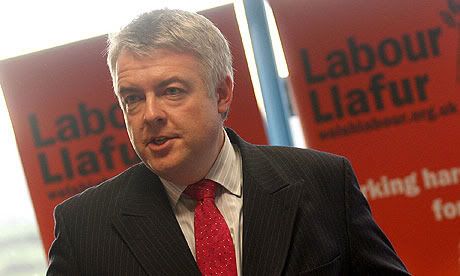
I smiled at something Carwyn Jones had to say on his video:

Like everybody else in the Labour Party, I'm proud to be Welsh but also proud to be British.

Source

Leaving to one side the matter of pride, this seems to be a perfect illustration of Labour's dwindling appeal. Why on earth does the Labour Party want to confine itself to those who consider themselves to be both Welsh and British? Why not try to be relevant to everybody who lives in Wales, irrespective of the way they choose to describe themselves?

I—and I would guess most other people in Plaid—will be laughing all the way to the polling booths.

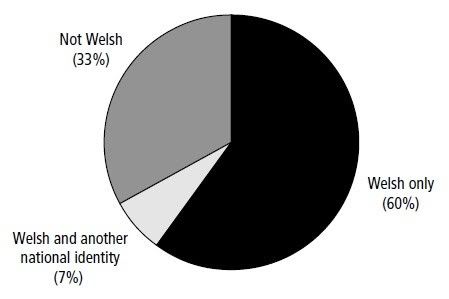
This is because only a certain number of people in Wales regard themselves as "Welsh and British". It may be difficult to determine exactly what this number might be, because the surveys produce different results. However, as a worst case scenario, this is from the Office of National Statistics:

A national identity question was introduced on the Labour Force Survey in 2001. Respondents in Wales were asked if they considered their national identity to be Welsh, English, Scottish, Irish, British or another national identity. They could choose as many or as few options as applied to them.

Sixty per cent of adults in Wales stated their national identity as Welsh only. A further 7 per cent described their national identity as Welsh but included another identity, most commonly British, in their answer. In total, 67 per cent of adults considered their national identity as wholly or partly Welsh.

Source | Archive

So, at one end of the various survey results, no more than 7% of people in Wales considered themselves to be "Welsh and British".

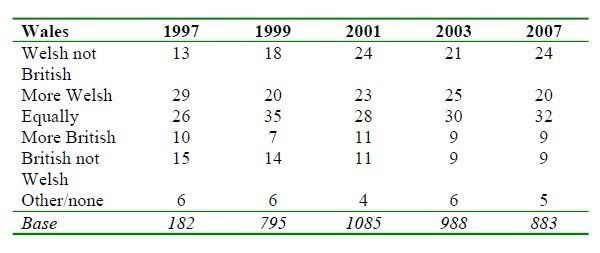
However if we want to put a more positive aspect on Britishness, we could turn to surveys which ask what has become known as a Moreno question. This is from a report listing how answers have changed over the last decade or so:

Source

As we can see, only a minority regard themselves as being equally Welsh and British. And, even in this best case scenario, if you add up all those who consider themselves to be both Welsh and British to any extent, the figure only reaches 61%.

What party in their right mind would be proud to exclude at least 39% of the electorate? What party could fail to notice the trend?

-

In contrast, Plaid doesn't think in these sorts of terms. Yes, each of us will have our own individual view about whether we are Welsh, British, both ... or even neither. That last category isn't so uncommon, either. I know of a good few people who support Plaid who consider themselves to be English, Irish or Scottish ... and a few Australians, a German and a Dutchman.

For me, it's a matter of simple respect ... of letting people describe themselves as they choose to describe themselves ... of wanting to work for everybody who lives in this pleasant corner of the earth we call Wales. Labour, on the other hand, seems determined to make Britishness a central plank of not only its political ideology but, according to Carwyn Jones, its membership.

Bookmark and Share